 Click main image to view in full screen.
HR Onboarding System: New Hire Checklist & Records – PDF
PDF document + Zip archive file (ZIP) 5 Pages


BENEFITS OF THIS DOWNLOADABLE PDF DOCUMENT
- Every step carries an owner and a due date computed from the hire's own start date, so the list rebuilds itself when the date moves.
- A separate register tracks every account, device, badge, key and license seat, and counts what a departing employee still holds on their last day.
- The checklist, the register and the printable pages come as a 19-file pack, so the system works for the manager who never opens Notion.
HUMAN RESOURCES PDF DESCRIPTION
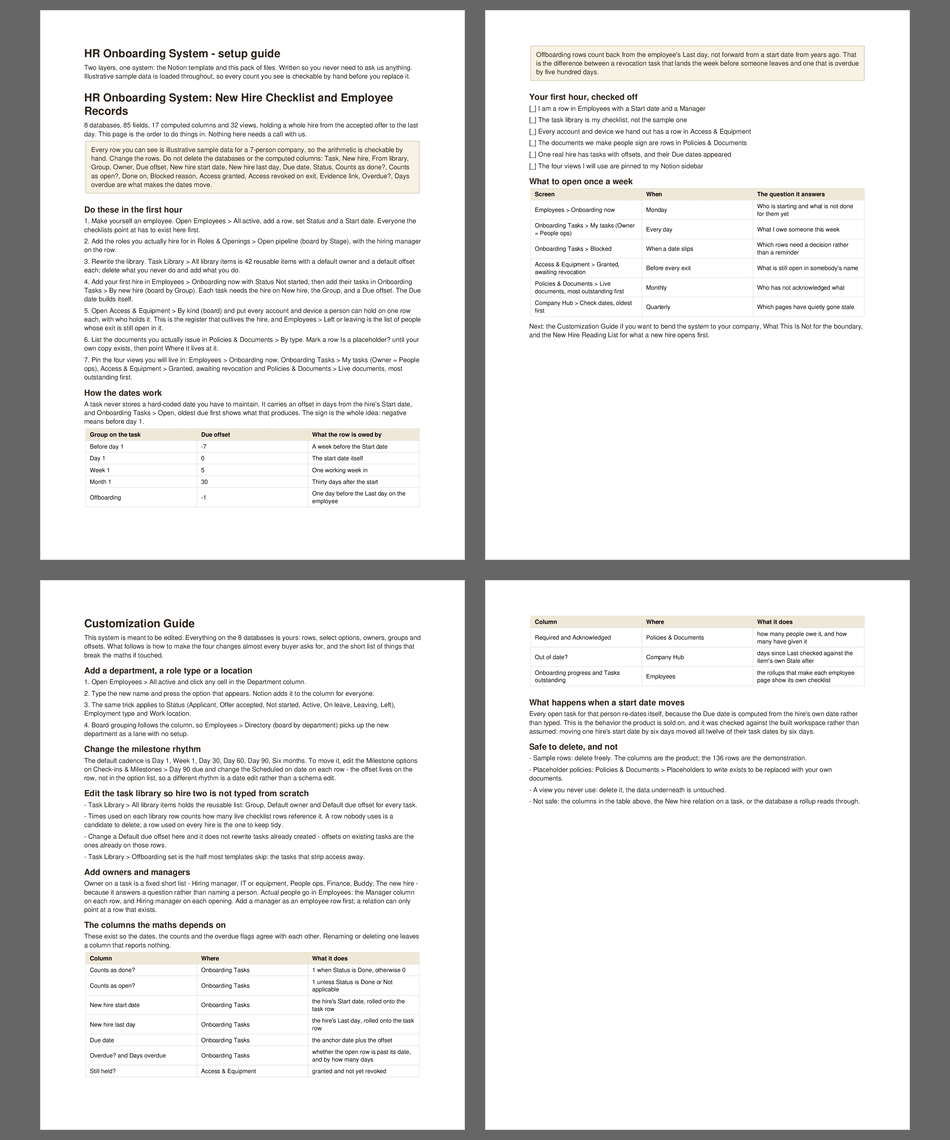
A hiring-to-departure system for a small company that has no HR department yet. 8 linked databases, 85 fields, 32 views and 17 computed columns, with a 19-file pack beside them so the manager who works on paper and the bookkeeper who works in Excel are both inside the same system.
The problem it solves is specific. The offer is accepted, and from that moment twenty small decisions stop being obvious: who creates the account, when the laptop has to ship, what the first week actually contains, who signs off the probation period, and – the one nobody thinks about in November – which of the 16 things this person was given still work on the day they leave. Templates on this shelf answer the first half. The second half is the one that costs money when it is forgotten, and it is why the register is a database here rather than a paragraph on a checklist.
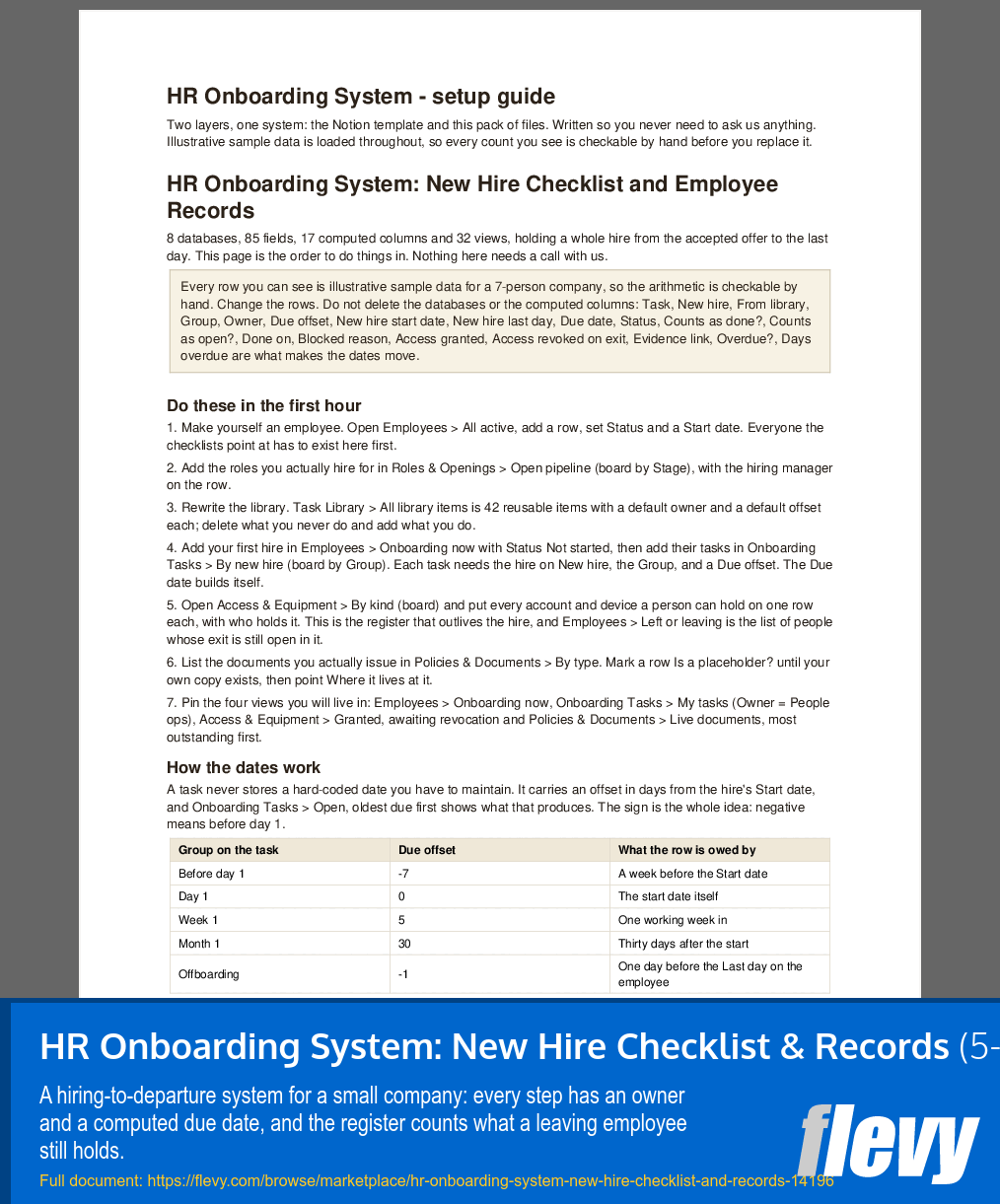
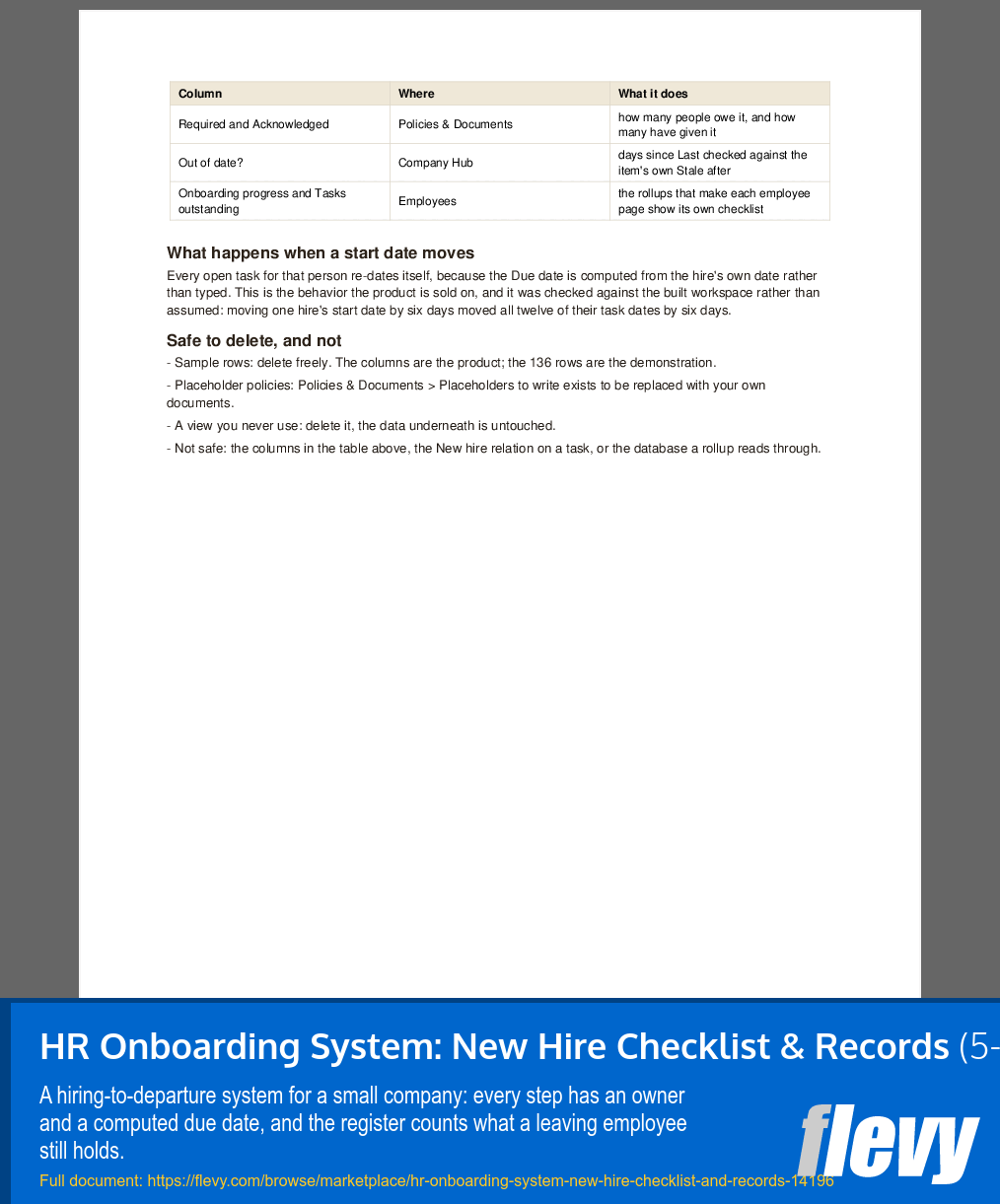
How the checklist stays true without maintenance: a task row carries an owner, a group and a due offset, never a due date. The date is computed from the hire's own start date, and for an Offboarding row from their last day, counting backwards. Move a start date by a week and every date on that hire's checklist moves with it. Nothing is edited by hand, so nothing is left pointing at a date that passed three weeks ago.
What is inside. Employees, one row per person from accepted offer to leaving. Onboarding Tasks, the checklist with progress computed from status. Task Library, 42 reusable steps so hire number nine is a duplicate rather than a retyping. Access & Equipment, the granted and revoked register with a still-held flag. Check-ins & Milestones, the 30/60/90 rhythm with a private note field that is not a performance rating. Policies & Documents, which document, who owes an acknowledgement and who has given one – every row flagged as a placeholder. Company Hub, the page a new hire reads, carrying a last-checked date and a stale-after number so rot is visible. Roles & Openings, the pipeline, with no salary column anywhere.
The file pack. 19 files in 5 formats: an import CSV per database with headers taken straight from the schema, an Excel workbook that rebuilds the due dates, the overdue flags and the still-held count as live formulas and proves itself on a CHECK tab, the Before day 1 / Day 1 / Week 1 page and the last-day revocation page as editable Word and as PDF in both paper sizes, a setup guide, and license, README and change log.
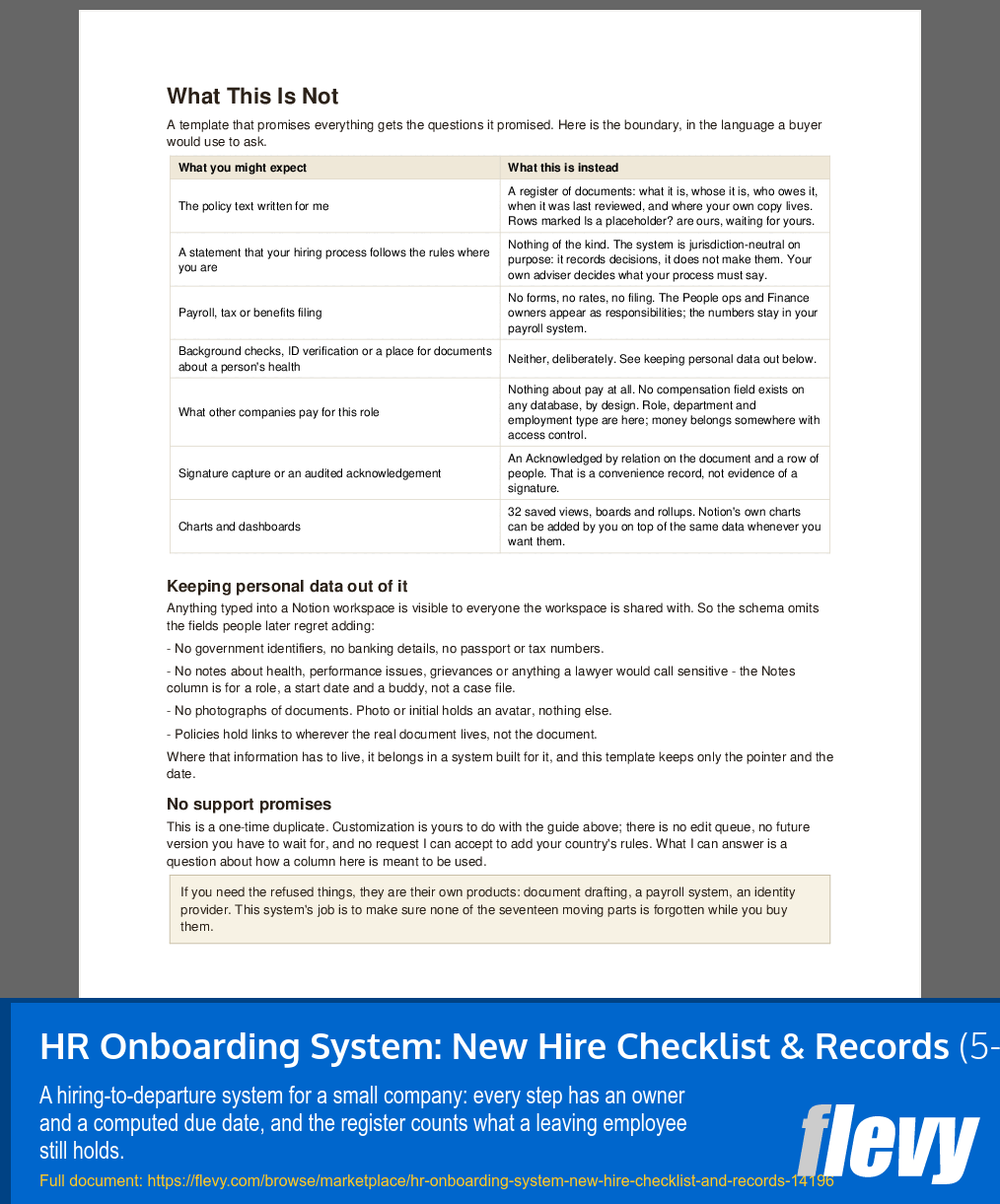
What it is not, stated plainly because the shelf's best-sellers are quietly selling advice. Policies are blank placeholders – this does not tell you what yours should say. There is no payroll, no tax filing and no employment-law position anywhere in it. No field asks for a government identifier, payment details or a medical fact. The sample company is illustrative data, chosen so every percentage and count can be checked by hand before you replace it.
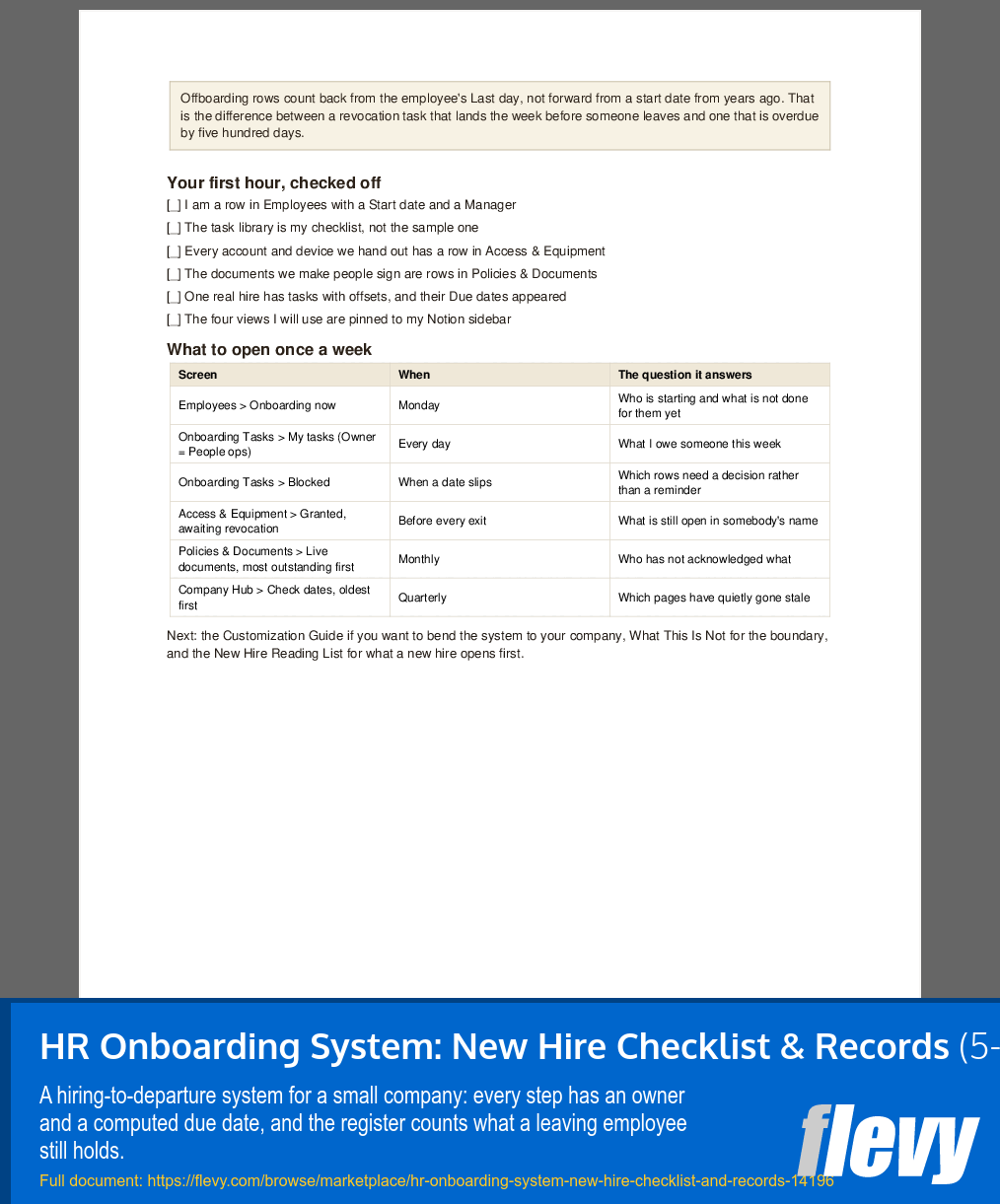
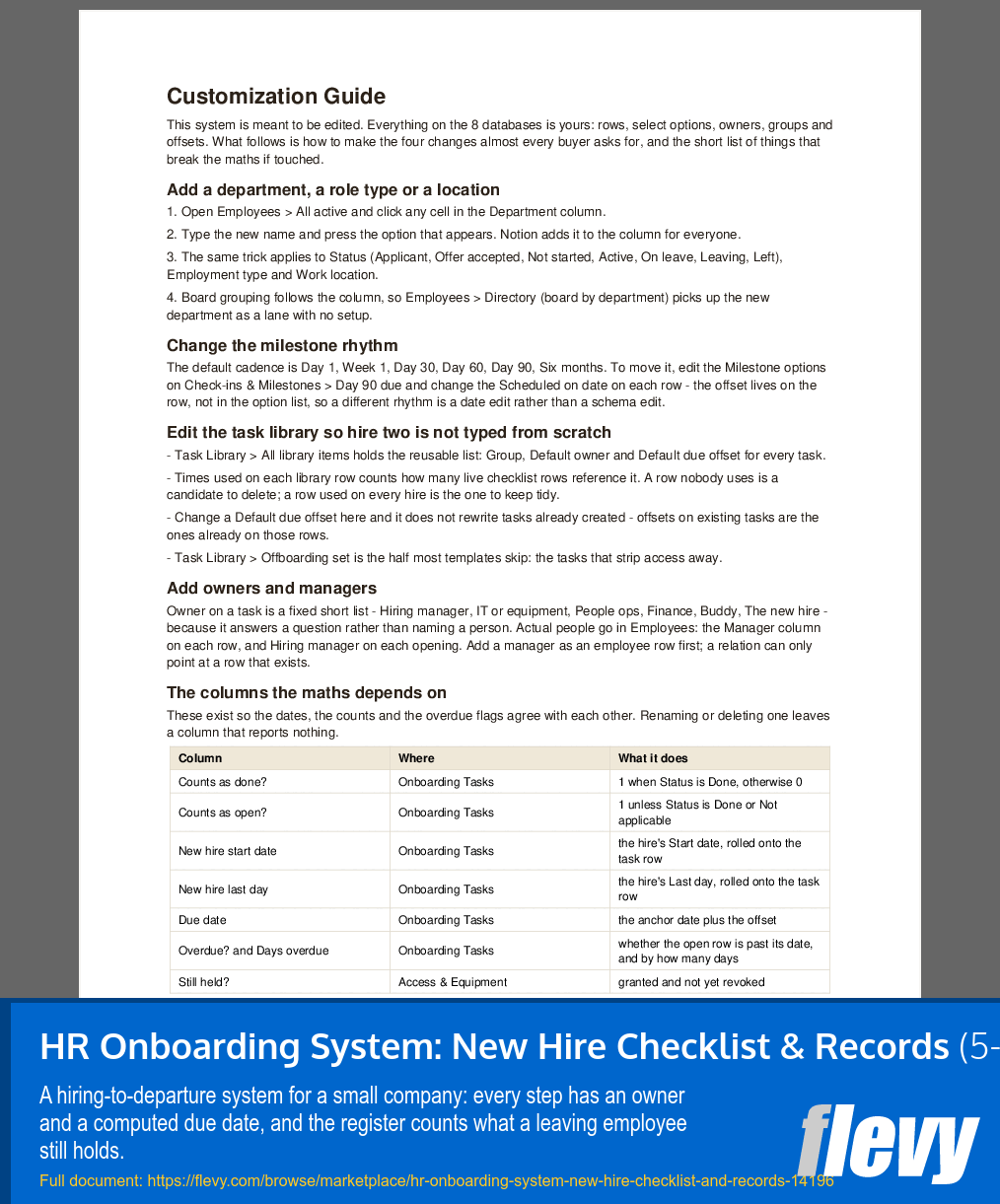
Setup is one duplicate and one hour. The Start Here page lists the six things to do first; the Customization Guide covers the library, the departments and the milestone days. It is written so the buyer never needs to ask anything of the seller, which is the point.
Got a question about the product? Email us at support@flevy.com or ask the author directly by using the "Ask the Author a Question" form. If you cannot view the preview above this document description, go here to view the large preview instead.
Source: Best Practices in Human Resources, Onboarding PDF: HR Onboarding System: New Hire Checklist & Records PDF (PDF) Document, WebsiteGeek
ABOUT THE AUTHOR

WebsiteGeek offers free website tools, SEO suites, file converters, browser extensions, calculators, and image utilities built to supercharge your productivity.
We also builds practical digital tools and templates for small business owners -- real formulas and sourced data.
Ask the Author a Question
You must be logged in to contact the author.