
Stacey Matrix   30-slide PPT PowerPoint presentation slide deck (PPTX)
$29.00

Stacey Matrix (30-slide PPT PowerPoint presentation slide deck (PPTX)) Preview Image
Log in to unlock full preview.
Stacey Matrix (30-slide PPT PowerPoint presentation slide deck (PPTX)) Preview Image
Arrow   Click main image to view in full screen.

Stacey Matrix (PowerPoint PPTX Slide Deck)

PowerPoint (PPTX) 30 Slides FlevyPro Document

Top 500 Best Practice $29.00
FlevyPro price: FREE (included in subscription)
This framework is developed by a team of former McKinsey and Big 4 consultants. The presentation follows the headline-body-bumper slide format used by global consulting firms.
Add to Cart


Immediate download
Free lifetime updates

PROBLEM SOLVING PPT DESCRIPTION

Editor Summary 30-slide PowerPoint presentation delivering the Stacey Matrix decision-making framework and practical application materials. Read more

Today's rapidly evolving business landscape is marked by an unprecedented level of complexity and uncertainty, necessitating tools and frameworks that enable leaders to navigate these challenges effectively. The Stacey Matrix, developed by Ralph Douglas Stacey, stands out as a pivotal instrument in this regard, offering a nuanced understanding of the dynamics at play in organizational decision-making.

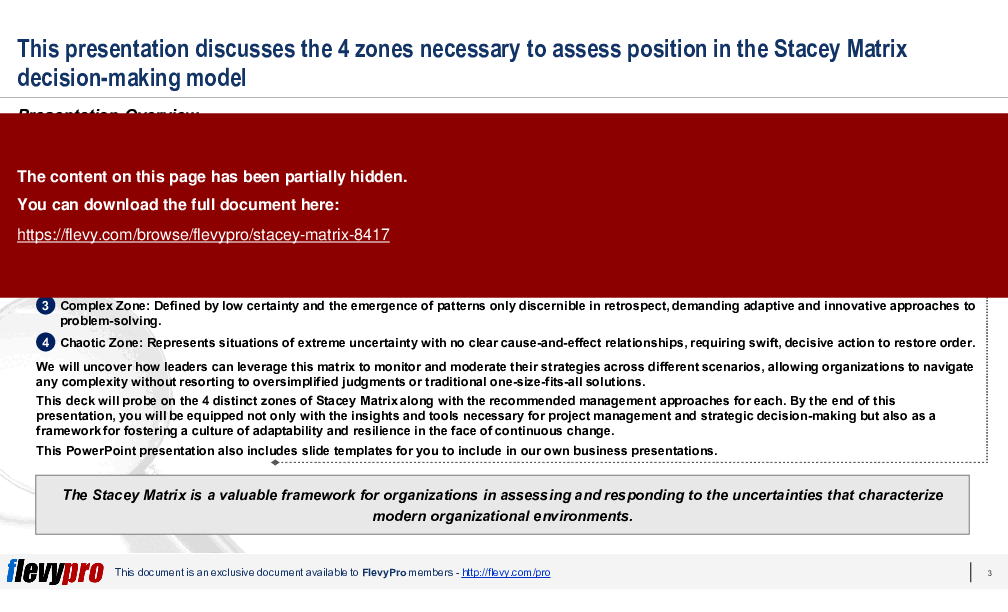
This PowerPoint presentation delves into the essence of the Stacey Matrix, focusing on its foundational axes—agreement and certainty—and categorizes decision-making scenarios into 4 distinct zones:

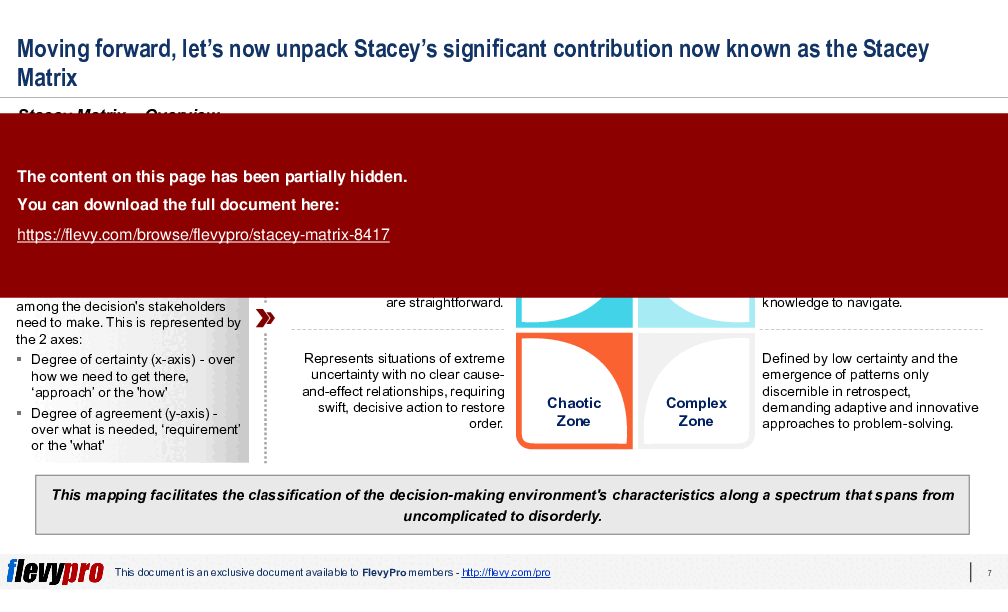
1. Simple Zone: Characterized by high levels of certainty and agreement, where the relationship between cause and effect is clear, and solutions are straightforward.

2. Complicated Zone: Involves a moderate level of certainty with the need for expert analysis, where outcomes are predictable but require specialized knowledge to navigate.

3. Complex Zone: Defined by low certainty and the emergence of patterns only discernible in retrospect, demanding adaptive and innovative approaches to problem-solving.

4. Chaotic Zone: Represents situations of extreme uncertainty with no clear cause-and-effect relationships, requiring swift, decisive action to restore order.

We will uncover how leaders can leverage this matrix to monitor and moderate their strategies across different scenarios, allowing organizations to navigate any complexity without resorting to oversimplified judgments or traditional one-size-fits-all solutions.

This deck will probe on the 4 distinct zones of Stacey Matrix along with the recommended management approaches for each. By the end of this presentation, you will be equipped not only with the insights and tools necessary for project management and strategic decision-making but also as a framework for fostering a culture of adaptability and resilience in the face of continuous change.

This PowerPoint presentation also includes slide templates for you to include in our own business presentations.

Got a question about this document? Email us at flevypro@flevy.com.

MARCUS OVERVIEW

This synopsis was written by Marcus [?] based on the analysis of the full 30-slide presentation.


Executive Summary
The Stacey Matrix presentation provides a strategic framework designed to aid leaders in navigating complex decision-making environments. Developed by Ralph Douglas Stacey, this model categorizes decision-making scenarios into 4 distinct zones: Simple, Complicated, Complex, and Chaotic. By utilizing the Stacey Matrix, executives can assess their organizational context, adapt their strategies accordingly, and foster a culture of resilience and adaptability. This presentation not only elucidates the theoretical underpinnings of the matrix, but also offers practical templates for immediate application in business settings.

Who This Is For and When to Use
•  Corporate executives seeking to enhance strategic decision-making processes.
•  Project managers navigating complex project environments.
•  Change management leaders aiming to implement agile methodologies.
•  Consultants advising organizations on effective decision-making frameworks.

Best-fit moments to use this deck:
•  During strategic planning sessions to assess decision-making environments.
•  In workshops focused on improving project management practices.
•  When implementing agile methodologies across teams.
•  For training sessions aimed at enhancing organizational adaptability.

Learning Objectives
•  Define the Stacey Matrix and its relevance in decision-making.
•  Identify the 4 zones of the Stacey Matrix and their characteristics.
•  Analyze the appropriate management approaches for each zone.
•  Apply the Stacey Matrix to real-world decision-making scenarios.
•  Develop strategies to foster adaptability and resilience within teams.
•  Utilize templates to integrate the Stacey Matrix into existing frameworks.

Table of Contents
•  Overview (page 3)
•  Stacey Matrix (page 7)
•  Zones of the Stacey Matrix (page 10)
•  Additional Considerations (page 14)
•  Slide Design Structure & Templates (page 19)

Primary Topics Covered
•  Stacey Matrix Overview - A conceptual framework that assists leaders in navigating complexities in decision-making by categorizing environments into 4 zones based on certainty and agreement.
•  Simple Zone - Characterized by high certainty and agreement, where solutions are straightforward and predictable, allowing for traditional project management techniques.
•  Complicated Zone - Involves moderate certainty and agreement, requiring expert analysis to navigate challenges effectively.
•  Complex Zone - Defined by low certainty and agreement, necessitating adaptive and innovative approaches to problem-solving.
•  Chaotic Zone - Represents extreme uncertainty with no clear cause-and-effect relationships, requiring swift action to restore order.
•  Management Approaches - Recommended strategies for managing projects effectively within each zone of the Stacey Matrix.

Deliverables, Templates, and Tools
•  Stacey Matrix framework template for visualizing decision-making environments.
•  Slide templates for presenting the 4 zones of the Stacey Matrix.
•  Guidelines for applying the Stacey Matrix in strategic planning sessions.
•  Case study examples illustrating the application of the Stacey Matrix in real-world scenarios.
•  Performance monitoring tools to track project outcomes based on the matrix's insights.

Slide Highlights
•  Overview of the Stacey Matrix and its significance in decision-making.
•  Detailed breakdown of the 4 zones, including characteristics and management strategies.
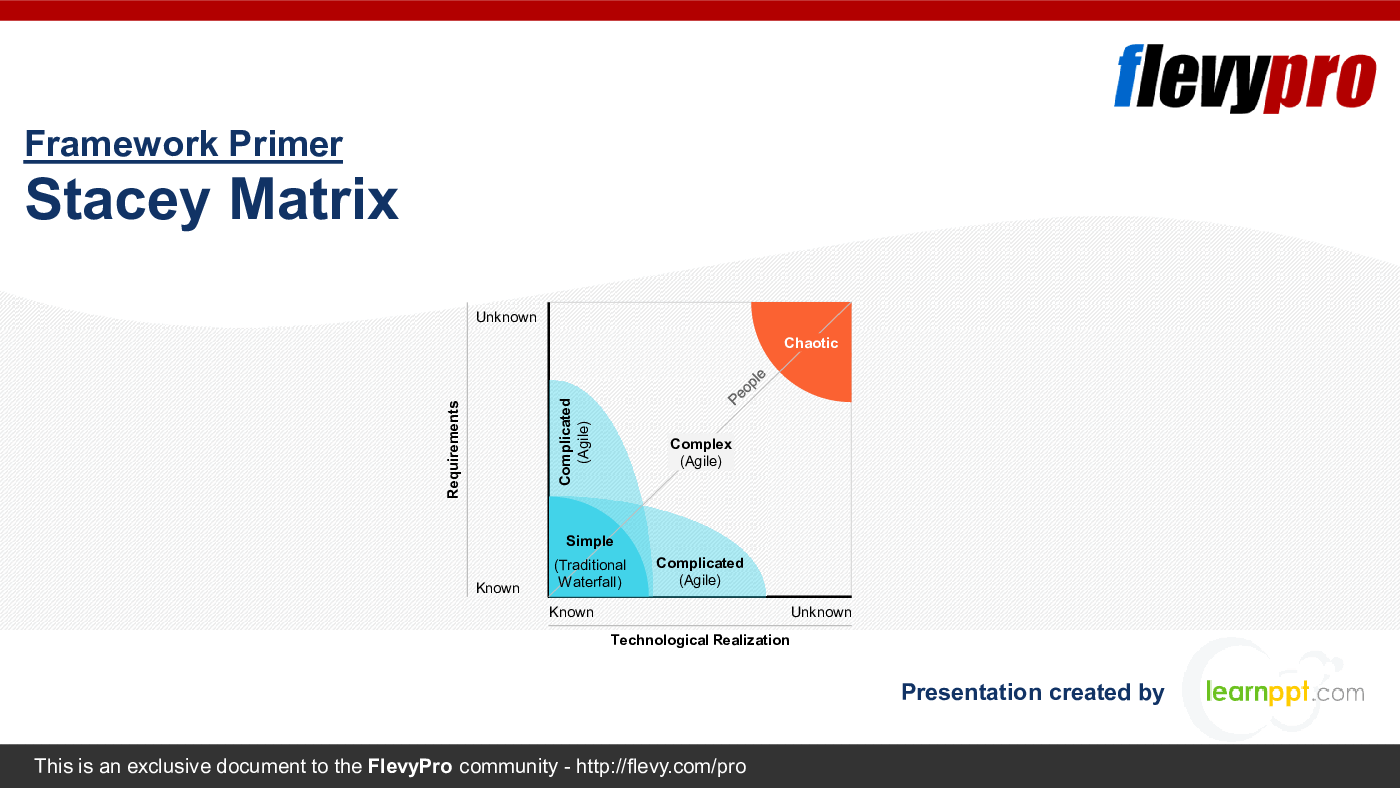
•  Visual representation of the Stacey Matrix diagram, illustrating the relationship between certainty, agreement, and complexity.
•  Case study on TechForward Innovations showcasing successful application of the Stacey Matrix.
•  Summary of advantages and disadvantages of using the Stacey Matrix in organizational contexts.

Potential Workshop Agenda
Introduction to the Stacey Matrix (30 minutes)
•  Overview of the framework and its relevance in decision-making.
•  Discussion on the 4 zones and their characteristics.

Application of the Stacey Matrix (60 minutes)
•  Group activity to assess decision-making scenarios using the matrix.
•  Development of tailored strategies for each zone.

Case Study Review (30 minutes)
•  Presentation of TechForward Innovations' application of the Stacey Matrix.
•  Discussion on lessons learned and best practices.

Conclusion and Q&A (30 minutes)
•  Recap of key insights and takeaways.
•  Open floor for questions and further discussion.

Customization Guidance
•  Adapt the Stacey Matrix framework to fit specific organizational contexts by modifying the zones' definitions.
•  Customize slide templates with organizational branding and terminology.
•  Incorporate real-world examples relevant to the audience's industry for enhanced engagement.
•  Adjust the workshop agenda to align with specific organizational goals and time constraints.

Secondary Topics Covered
•  Complexity theory and its implications for management.
•  The role of agility in modern organizational decision-making.
•  Strategies for fostering a culture of adaptability and resilience.
•  Best practices for implementing the Stacey Matrix in various sectors.

Topic FAQ

What are the 4 zones of the Stacey Matrix and how do they differ?

The Stacey Matrix divides decision contexts into Simple, Complicated, Complex, and Chaotic zones based on levels of certainty and agreement. Simple implies clear cause-and-effect; Complicated requires expert analysis; Complex yields emergent patterns; Chaotic needs immediate action to restore order, collectively described as 4 zones.

How do the certainty and agreement axes determine management approach?

The matrix maps decisions along certainty (predictability of outcomes) and agreement (stakeholder consensus). High certainty and agreement favor traditional methods; low certainty/agreement require adaptive, iterative approaches. The framework’s core axis pair is certainty and agreement.

When should teams use adaptive, iterative methods versus traditional project management?

Apply traditional project management in the Simple zone where cause-and-effect are clear; use adaptive, iterative learning in the Complex zone where patterns emerge only in retrospect. The presentation outlines recommended management approaches for each zone, including Simple and Complex guidance.

What criteria should I use to choose a decision-making framework for a workshop?

Look for a framework that helps participants diagnose certainty and agreement, provides visual templates for exercises, includes application guidelines and case examples, and supports follow-up performance monitoring. Effective workshop decks include slide templates and a suggested agenda.

What practical value do prebuilt Stacey Matrix templates provide for workshop prep and presentations?

Ready templates speed incorporation of the matrix into presentations and workshops by supplying a visual diagram, slide designs for each zone, example use cases, and customization guidance. Flevy's Stacey Matrix provides these materials as a 30-slide PowerPoint with slide templates.

How can I run a workshop to improve project management practices using the Stacey Matrix?

Use an introductory overview, a group activity to map scenarios to the 4 zones, and a session to develop zone-specific management strategies. The deck includes a potential workshop agenda and group exercises to facilitate this format, including activity timings.

Can the Stacey Matrix be customized for different industries or organizational contexts?

Yes; the material advises adapting the matrix by modifying zone definitions, inserting industry-specific examples, and updating terminology and branding in slide templates. The customization guidance recommends altering zones’ definitions and examples.

How should I measure outcomes after applying the Stacey Matrix in projects?

Track project outcomes and milestones using performance monitoring tools aligned to the chosen management approach, and compare results across zones to validate changes. The presentation includes performance monitoring tools to support this tracking.

Document FAQ
These are questions addressed within this presentation.

What is the Stacey Matrix?
The Stacey Matrix is a framework that categorizes decision-making environments into 4 zones based on levels of certainty and agreement, aiding leaders in navigating complexities.

How can the Stacey Matrix be applied in practice?
It can be used to assess organizational contexts, adapt strategies, and foster a culture of resilience by identifying the appropriate management approach for each zone.

What are the 4 zones of the Stacey Matrix?
The 4 zones are Simple, Complicated, Complex, and Chaotic, each representing different levels of certainty and agreement in decision-making scenarios.

What management approaches are recommended for each zone?
•  Simple Zone: Utilize traditional project management techniques.
•  Complicated Zone: Leverage expert analysis and structured problem-solving.
•  Complex Zone: Embrace adaptability and iterative learning.
•  Chaotic Zone: Act swiftly to establish order and then adapt strategies.

Can the Stacey Matrix be customized for different industries?
Yes, the framework can be tailored to fit specific organizational contexts and industries by modifying definitions and examples.

What are the advantages of using the Stacey Matrix?
It provides clarity in navigating uncertainties, encourages customized strategies, and promotes organizational agility.

What are the disadvantages of the Stacey Matrix?
It may not fully address highly uncertain scenarios and could limit the exploration of varied perspectives.

How does the Stacey Matrix support decision-making?
It helps leaders assess their environment, adapt strategies, and make informed decisions based on the complexity of the situation.

Is training available for using the Stacey Matrix?
Yes, workshops and training sessions can be conducted to help teams effectively implement the Stacey Matrix in their decision-making processes.

Glossary
•  Stacey Matrix - A framework categorizing decision-making environments based on certainty and agreement.
•  Simple Zone - High certainty and agreement, straightforward solutions.
•  Complicated Zone - Moderate certainty and agreement, requiring expert analysis.
•  Complex Zone - Low certainty and agreement, necessitating adaptive approaches.
•  Chaotic Zone - Extreme uncertainty and low agreement, requiring swift action.
•  Agility - The ability to adapt and respond quickly to changing circumstances.
•  Complex Adaptive Systems - Organizations viewed as systems characterized by non-linear interactions and emergent behaviors.
•  Iterative Learning - A process of learning through repeated cycles of prototyping and feedback.
•  Performance Monitoring - Tracking project outcomes and milestones to ensure alignment with goals.
•  Stakeholders - Individuals or groups with an interest in the outcomes of a project or decision.
•  Management Approaches - Strategies recommended for effectively managing projects within each zone.
•  Decision-Making - The process of making choices by identifying a decision, gathering information, and assessing alternative resolutions.
•  Framework - A structured approach to understanding and addressing complex issues.

PROBLEM SOLVING PPT SLIDES

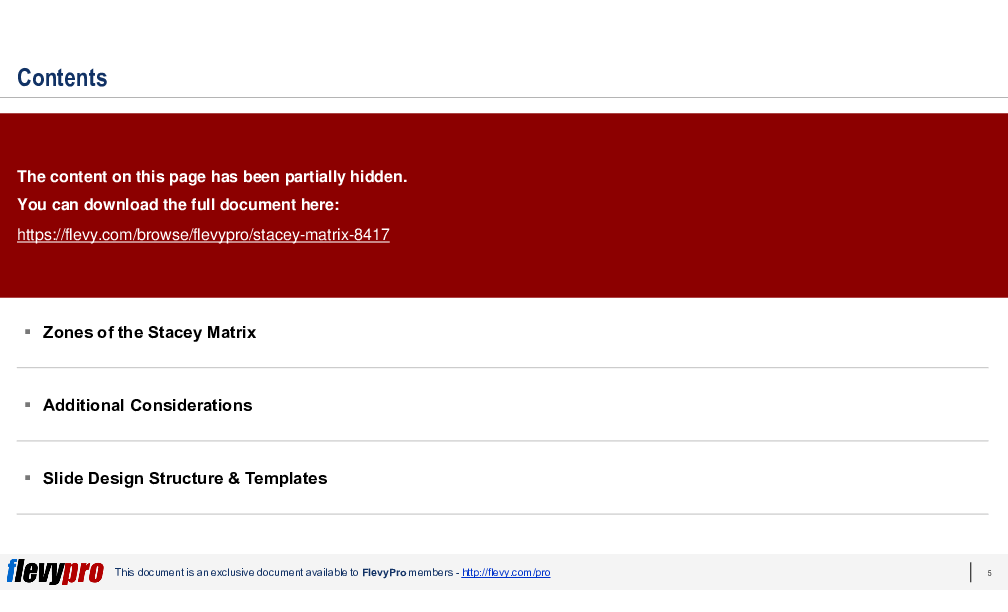
Assessing Complexity in Organizational Processes

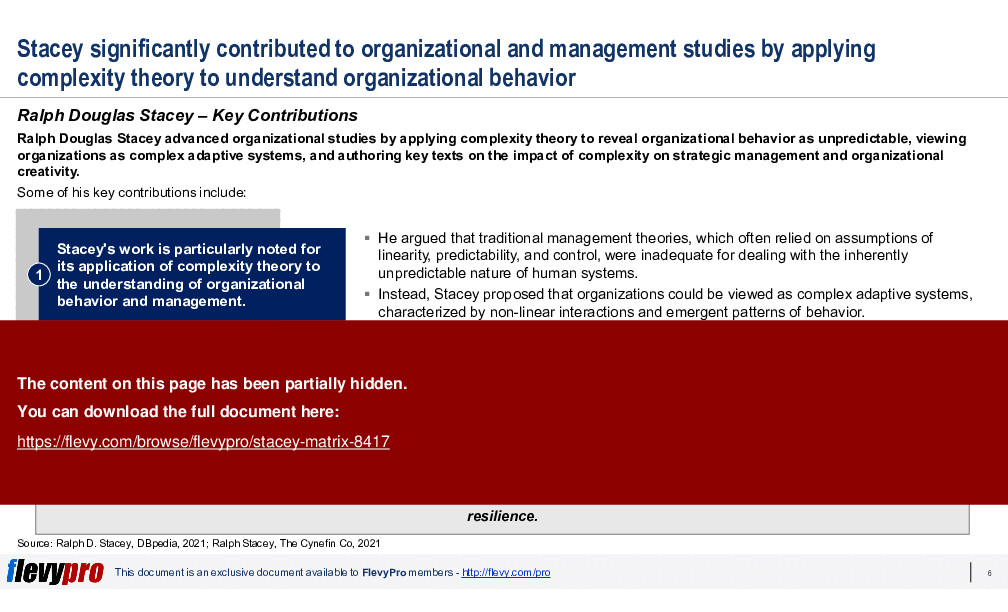
Strategies for Navigating the Complicated Zone

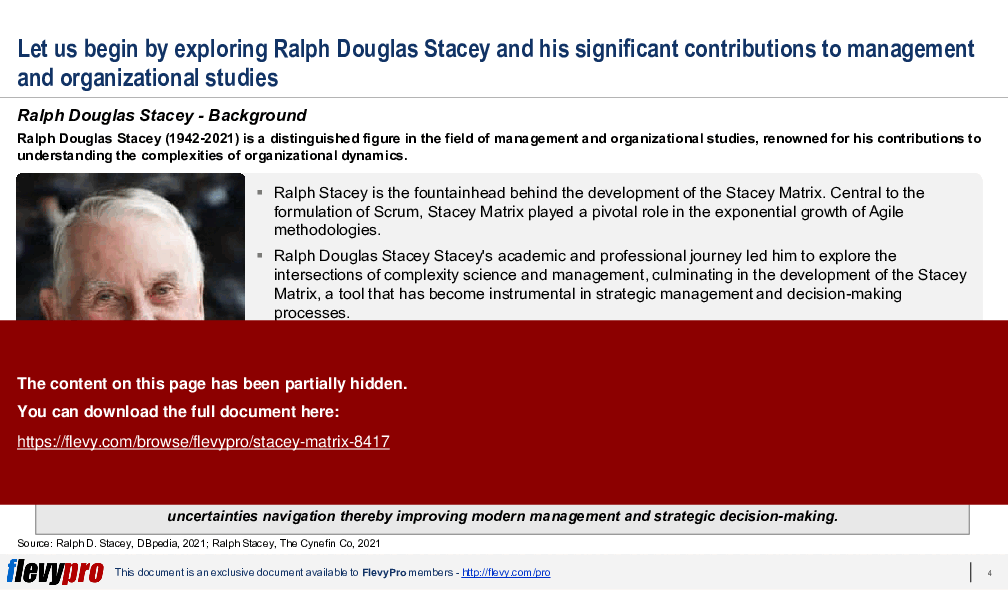
Understanding the Stacey Matrix for Decision-Making

Source: Best Practices in Decision Making, Structured Thinking PowerPoint Slides: Stacey Matrix PowerPoint (PPTX) Presentation Slide Deck, LearnPPT Consulting


$29.00
FlevyPro price: FREE (included in subscription)
This framework is developed by a team of former McKinsey and Big 4 consultants. The presentation follows the headline-body-bumper slide format used by global consulting firms.
Add to Cart
  

Did you need more documents?

Consider a FlevyPro subscription from $39/month. View plans here.

For $10.00 more, you can download this document plus 2 more FlevyPro documents. That's just $13 each.

ABOUT FLEVYPRO

This document is part of the FlevyPro Library, a curated knowledge base of documents for our FlevyPro subscribers.

FlevyPro is a subscription service for on-demand business frameworks and analysis tools. FlevyPro subscribers receive access to an exclusive library of curated business documents—business framework primers, presentation templates, Lean Six Sigma tools, and more—among other exclusive benefits.

Click here to learn more about FlevyPro and its benefits.

Did you know?
The average daily rate of a McKinsey consultant is $6,625 (not including expenses). The average price of a Flevy document is $65.


Trusted by over 10,000+ Client Organizations
Since 2012, we have provided business templates to over 10,000 businesses and organizations of all sizes, from startups and small businesses to the Fortune 100, in over 130 countries.
AT&T GE Cisco Intel IBM Coke Dell Toyota HP Nike Samsung Microsoft Astrazeneca JP Morgan KPMG Walgreens Walmart 3M Kaiser Oracle SAP Google E&Y Volvo Bosch Merck Fedex Shell Amgen Eli Lilly Roche AIG Abbott Amazon PwC T-Mobile Broadcom Bayer Pearson Titleist ConEd Pfizer NTT Data Schwab


Read Customer Testimonials

 
"Flevy is now a part of my business routine. I visit Flevy at least 3 times each month.

Flevy has become my preferred learning source, because what it provides is practical, current, and useful in this era where the business world is being rewritten.

In today's environment where there are so "

– Omar Hernán Montes Parra, CEO at Quantum SFE
 
"As a young consulting firm, requests for input from clients vary and it's sometimes impossible to provide expert solutions across a broad spectrum of requirements. That was before I discovered Flevy.com.

Through subscription to this invaluable site of a plethora of topics that are key and crucial to consulting, I "

– Nishi Singh, Strategist and MD at NSP Consultants
 
"I have found Flevy to be an amazing resource and library of useful presentations for lean sigma, change management and so many other topics. This has reduced the time I need to spend on preparing for my performance consultation. The library is easily accessible and updates are regularly provided. A wealth of great information."

– Cynthia Howard RN, PhD, Executive Coach at Ei Leadership
 
"As a small business owner, the resource material available from FlevyPro has proven to be invaluable. The ability to search for material on demand based our project events and client requirements was great for me and proved very beneficial to my clients. Importantly, being able to easily edit and tailor "

– Michael Duff, Managing Director at Change Strategy (UK)
 
"I have used FlevyPro for several business applications. It is a great complement to working with expensive consultants. The quality and effectiveness of the tools are of the highest standards."

– Moritz Bernhoerster, Global Sourcing Director at Fortune 500
 
"My FlevyPro subscription provides me with the most popular frameworks and decks in demand in today’s market. They not only augment my existing consulting and coaching offerings and delivery, but also keep me abreast of the latest trends, inspire new products and service offerings for my practice, and educate me "

– Bill Branson, Founder at Strategic Business Architects
 
"Last Sunday morning, I was diligently working on an important presentation for a client and found myself in need of additional content and suitable templates for various types of graphics. Flevy.com proved to be a treasure trove for both content and design at a reasonable price, considering the time I "

– M. E., Chief Commercial Officer, International Logistics Service Provider
 
"I am extremely grateful for the proactiveness and eagerness to help and I would gladly recommend the Flevy team if you are looking for data and toolkits to help you work through business solutions."

– Trevor Booth, Partner, Fast Forward Consulting


Customers Also Bought These Documents


Customers Also Like These Documents

Explore Templates on Related Management Topics


Your Recently Viewed Documents
Receive our FREE whitepaper on the Top 101 Consulting Frameworks

Download our 200+ page guide summarizing the Top 101 Management Consulting Frameworks. Each framework provides a structured approach to analyzing and solving a common business problem.