
This framework is developed by a team of former McKinsey and Big 4 consultants. The presentation follows the headline-body-bumper slide format used by global consulting firms.
Editor Summary
Capabilities-Driven Strategy (CDS) is a 24-slide PowerPoint framework developed by ex-McKinsey consultants that presents a three-phase approach—Identify Capabilities, Build Capabilities, Divest Businesses—to align capabilities with strategic objectives.
Read moreIncludes 6 deliverables: capability identification framework, portfolio coherence strategy template, action plan template, divestiture assessment tool, metrics dashboard, and case examples. Target users include corporate executives, integration leaders, business consultants, and innovation teams. Sold as a digital download on Flevy with immediate digital download for use in strategic planning, workshops, and divestiture assessments.
This deck is designed for situations where leadership needs to align or reconfigure organizational capabilities during strategic planning, M&A integration, portfolio reviews, or capability-building initiatives.
Corporate strategy leads mapping capability gaps to strategic objectives during annual planning cycles.
Integration leaders reconciling overlapping capabilities and prioritizing target-state capabilities in post-merger integration workstreams.
External consultants building client roadmaps that sequence capability investments and potential divestitures.
Innovation teams prioritizing capability investments against customer demand drivers during product portfolio reviews.
The 3-phase CDS methodology—identify, build, divest—follows a structured, hypothesis-driven consulting approach associated with McKinsey-style strategy work.
Formulating a Capabilities-Driven Strategy (CDS) is easy but execution is difficult, especially in turbulent times. This is not the time to find a cave and hibernate until the economic storm passes. It is unlikely that the storm will pass anytime soon. Capabilities-Driven Strategy is the only way to remain equipped for perpetually stormy weather.
Companies need to take care or build those capabilities that are genuinely needed and not those that do not serve our customers. Capabilities do not manifest themselves overnight. They take time to grow. But companies who have mastered the art of developing and implementing a Capabilities-Driven Strategy have grown to develop world's leading brands. Distinctive capabilities have been used to propel them to reach Operational and Organizational Excellence.
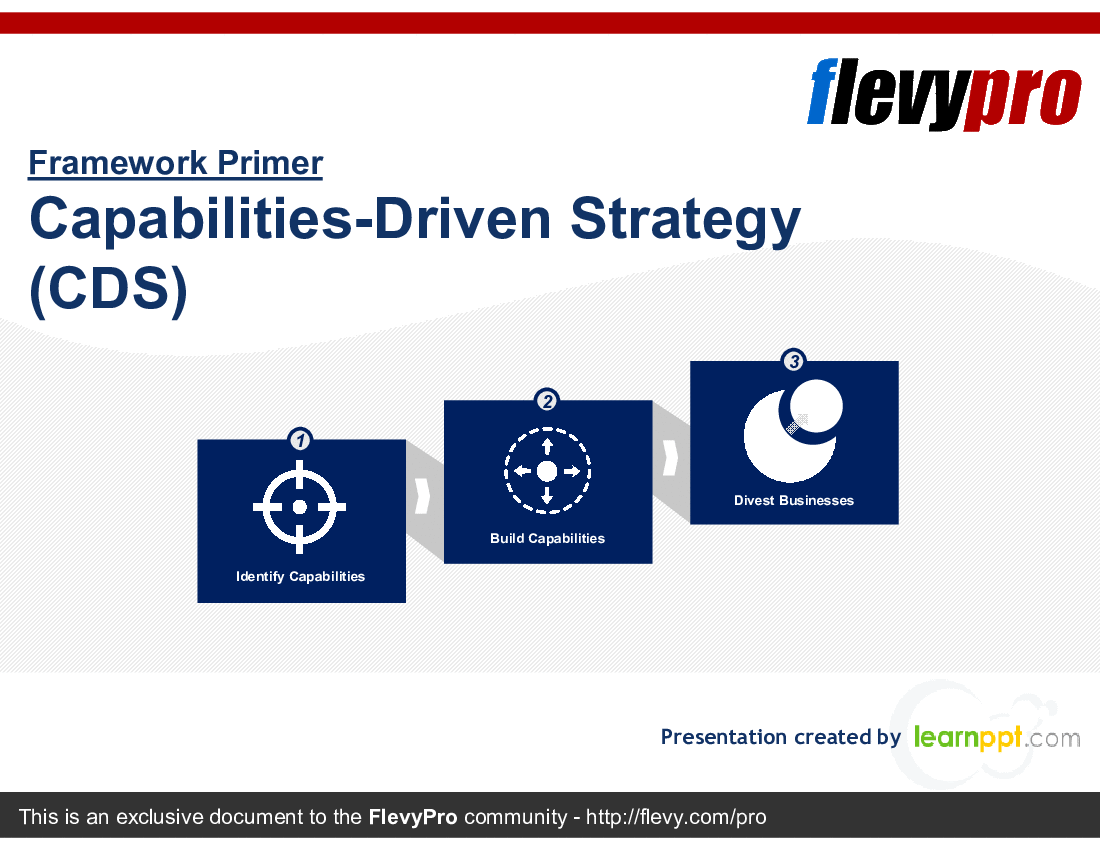
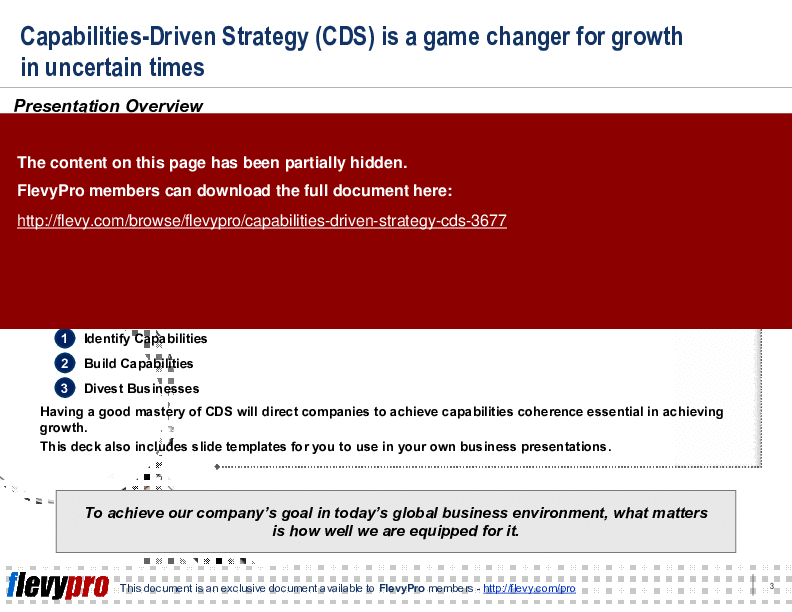
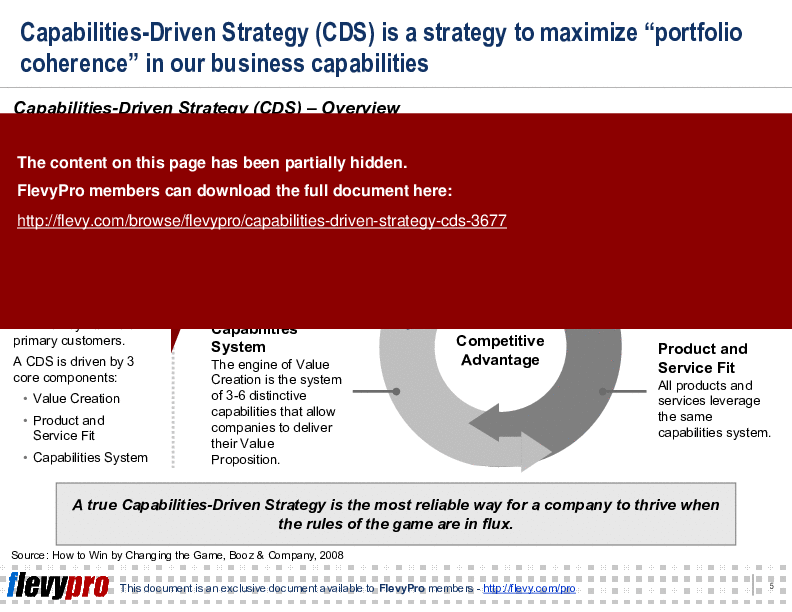
There is a 3-phase approach to CDS that organizations can master. This framework discusses the importance of CDS and its 3-phase approach:
Having a good mastery of CDS will direct companies to achieve capabilities coherence essential in achieving growth.
This deck also includes slide templates for you to use in your own business presentations.
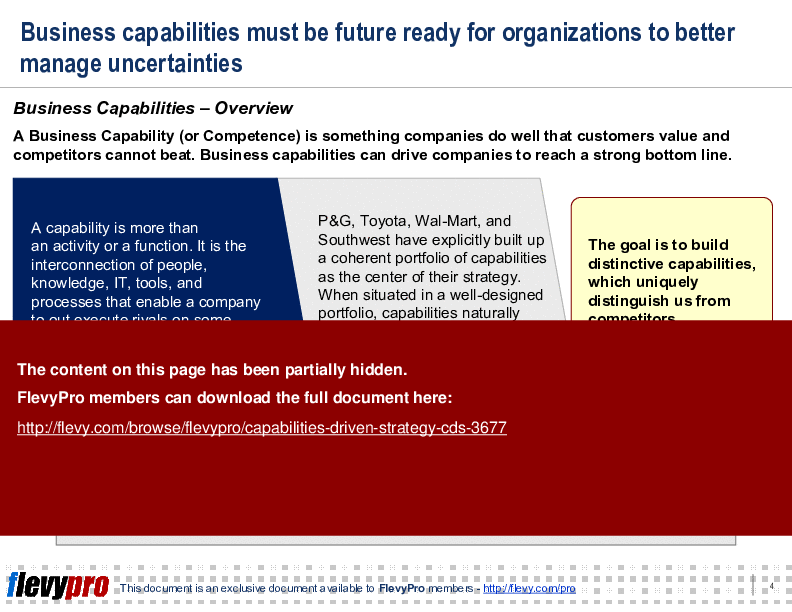
The Capabilities-Driven Strategy (CDS) framework is an essential tool for organizations aiming to achieve coherence in their capabilities portfolio. This PPT delves into the intricacies of building distinctive capabilities that set your company apart from competitors. It emphasizes the importance of aligning business capabilities with strategic goals to drive profitability and operational excellence. The framework is backed by examples from leading companies like P&G, Toyota, and Wal-Mart, showcasing how a coherent capabilities system can lead to sustained competitive advantage.
This deck provides a comprehensive overview of the 3-phase approach to CDS, including identifying, building, and divesting capabilities. It includes practical templates for immediate application in your business strategy sessions. The insights and strategies presented are designed to help companies navigate uncertainties and achieve long-term success. By leveraging this framework, your organization can ensure that its capabilities are not only aligned with market demands, but also optimized for future growth.
This synopsis was written by Marcus [?] based on the analysis of the full 24-slide presentation.
Executive Summary
The Capabilities-Driven Strategy (CDS) presentation provides a structured framework for organizations to navigate growth in uncertain environments. Developed by ex-McKinsey consultants, this framework emphasizes the importance of aligning capabilities with strategic objectives to achieve operational excellence. The presentation outlines a three-phase approach: identifying capabilities, building them, and divesting non-essential businesses. By mastering CDS, companies can enhance their capability coherence, leading to sustained growth and competitive advantage.
Who This Is For and When to Use
• Corporate executives seeking to refine strategic direction and operational capabilities
• Integration leaders managing capability alignment during mergers or acquisitions
• Business consultants advising clients on strategic growth and operational efficiency
• Teams focused on innovation and capability development within their organizations
Best-fit moments to use this deck:
• During strategic planning sessions to align capabilities with business goals
• In workshops aimed at identifying and prioritizing core competencies
• When assessing potential divestitures or restructuring initiatives
Learning Objectives
• Define the Capabilities-Driven Strategy and its relevance in today's business landscape
• Identify key capabilities that align with organizational goals and customer needs
• Build a coherent portfolio of capabilities that drive competitive advantage
• Develop a structured approach to divest non-essential business units
• Establish metrics for tracking capability development and performance
• Create actionable plans for capability enhancement and alignment
Table of Contents
• Overview (page 3)
• Capabilities Coherence (page 7)
• Approach to Capabilities-Driven Strategy (page 10)
• Case Examples (page 15)
• Templates (page 18)
Primary Topics Covered
• Overview of Capabilities-Driven Strategy - An introduction to the CDS framework, emphasizing its importance for growth in uncertain times.
• Capabilities Coherence - The alignment of a company’s capabilities with its strategic purpose and product portfolio to enhance operational efficiency.
• Three-Phase Approach - A structured methodology consisting of identifying capabilities, building them, and divesting non-essential businesses.
• Identifying Capabilities - Steps to determine market demand drivers and prioritize enterprise-wide capabilities.
• Building Capabilities - Focus on investments and acquisitions that enhance core competencies while filling capability gaps.
• Divesting Businesses - Strategies for streamlining operations by selling or discontinuing non-essential business units.
Deliverables, Templates, and Tools
• Capability identification framework to assess market drivers and customer needs
• Portfolio coherence strategy template for aligning capabilities with business objectives
• Action plan template for building and enhancing capabilities
• Divestiture assessment tool to evaluate non-essential business units
• Metrics dashboard for tracking capability development and performance
• Case study examples illustrating successful implementation of CDS
Slide Highlights
• Overview slide detailing the importance of a Capabilities-Driven Strategy
• Capabilities Coherence slide showing the relationship between capability alignment and operational efficiency
• Three-Phase Approach diagram outlining the steps for implementing CDS
• Case Examples showcasing leading companies that successfully leveraged distinctive capabilities
• Template slides for practical application of the CDS framework in business presentations
Potential Workshop Agenda
Identifying Capabilities Session (90 minutes)
• Discuss market demand drivers and customer engagement
• Identify enterprise-wide capabilities that distinguish the organization
• Develop a prioritized list of capabilities
Building Capabilities Session (90 minutes)
• Review current capabilities and identify gaps
• Discuss investment strategies for capability enhancement
• Create an action plan for capability development
Divesting Businesses Session (60 minutes)
• Evaluate non-essential business units
• Discuss criteria for divestiture decisions
• Develop a roadmap for executing divestitures
Customization Guidance
• Tailor the capability identification framework to reflect industry-specific market dynamics
• Adjust the investment strategies based on organizational resources and market conditions
• Modify the divestiture assessment criteria to align with corporate goals and risk tolerance
Secondary Topics Covered
• The role of leadership in driving capability development
• Best practices for maintaining capability coherence across business units
• The impact of technology on capability enhancement
• Strategies for fostering a culture of continuous improvement
Topic FAQ
What is a capabilities-driven strategy and why does it matter for my company?
A capabilities-driven strategy aligns an organization’s capabilities with its strategic objectives to improve operational efficiency and competitive positioning. It emphasizes identifying market demand drivers, prioritizing enterprise-wide capabilities, and ensuring portfolio coherence, following a three-phase approach: Identify, Build, Divest.
How should I identify the right capabilities to prioritize in my organization?
Identification should start with analyzing market demand drivers and customer needs, then mapping capabilities that differentiate the business. Organizations commonly use structured capability identification frameworks to rank and prioritize enterprise-wide capabilities; Flevy’s Capabilities-Driven Strategy (CDS) includes a capability identification framework.
Which metrics are useful for tracking capability development progress?
Track performance metrics that show alignment with strategic objectives, the impact on customer satisfaction, and operational efficiency. A dashboard that ties capability initiatives to measurable outcomes helps monitor progress; the CDS deck includes a metrics dashboard for this purpose.
What elements should I expect from a practical CDS template or toolkit?
A practical CDS toolkit should provide tools for capability identification, portfolio coherence alignment, action planning for capability building, divestiture assessment criteria, and a metrics dashboard to track performance. These concrete templates enable workshop-to-execution handoff with defined artifacts.
How much time should I schedule for workshops to apply a CDS approach?
A typical workshop agenda in the CDS materials recommends a 90-minute Identifying Capabilities session, a 90-minute Building Capabilities session, and a 60-minute Divesting Businesses session, providing a modular half-day to full-day workshop structure.
Will pre-built templates actually speed up capability planning and execution?
Pre-built templates provide structured artifacts—capability identification, portfolio coherence, action plans, and divestiture assessments—that translate strategy into workshop activities and execution milestones; Flevy’s Capabilities-Driven Strategy (CDS) supplies these templates across a 24-slide PPT package.
In an M&A integration, how does a capabilities-driven approach help with overlap and prioritization?
CDS guides integration teams to map combined market demand drivers, identify duplicate or complementary capabilities, prioritize investments or consolidations, and evaluate non-core units for divestiture using defined criteria and assessment tools like a divestiture assessment tool.
I’m deciding whether to divest a business unit—what framework helps make that decision?
Use a capability-alignment framework that assesses whether the unit contributes to core strategic capabilities and customer value; if misaligned, apply divestiture criteria and a structured assessment process to develop a divestiture roadmap and execution plan.
Document FAQ
These are questions addressed within this presentation.
What is the Capabilities-Driven Strategy?
The Capabilities-Driven Strategy (CDS) is a framework that helps organizations align their capabilities with strategic objectives to achieve operational excellence and sustained growth.
How can this framework help in uncertain times?
CDS provides a structured approach to identify and build essential capabilities, enabling organizations to navigate challenges and capitalize on opportunities effectively.
What are the 3 phases of the CDS approach?
The 3 phases are: Identify Capabilities, Build Capabilities, and Divest Businesses.
How do I identify the right capabilities for my organization?
Focus on understanding market demand drivers and customer needs, then prioritize capabilities that can distinguish your organization in the marketplace.
What should I consider when building capabilities?
Invest in product development and acquisitions that complement existing capabilities while addressing identified gaps.
When is it appropriate to divest a business unit?
Consider divesting when a business unit does not align with your strategic capabilities or does not contribute to overall organizational goals.
What metrics should I track for capability development?
Establish metrics that measure performance, alignment with strategic objectives, and the impact of capabilities on customer satisfaction and operational efficiency.
Can this framework be applied across different industries?
Yes, the Capabilities-Driven Strategy is adaptable and can be tailored to fit the specific needs and dynamics of various industries.
Glossary
• Capabilities-Driven Strategy (CDS) - A framework for aligning organizational capabilities with strategic objectives.
• Capabilities Coherence - The alignment of capabilities with strategic purpose and product portfolio.
• Core Competencies - Distinctive capabilities that provide competitive advantage.
• Divestiture - The process of selling or discontinuing non-essential business units.
• Market Demand Drivers - Factors influencing customer needs and preferences.
• Portfolio Coherence Strategy - A strategy for aligning capabilities across business units.
• Investment Strategy - A plan for allocating resources to enhance capabilities.
• Performance Metrics - Measurements used to assess capability development and effectiveness.
• Capability Gaps - Areas where the organization lacks essential capabilities.
• Customer Engagement - The level of interaction and connection between a company and its customers.
• Operational Excellence - The execution of business strategies with efficiency and effectiveness.
• Strategic Objectives - Goals that guide an organization's direction and decision-making.
• Enterprise-Wide Capabilities - Capabilities that span across the entire organization.
• Sustained Growth - Continuous improvement and expansion of a business over time.
• Investment in Capabilities - Allocating resources to develop and enhance organizational capabilities.
This PPT slide outlines a two-step process for identifying and prioritizing distinctive capabilities essential for market presence. The first step involves analyzing market demand drivers, including customer engagement, product diversity, potential market size, and core market interests. This analysis aligns capabilities with actual market demands. The second step focuses on identifying a limited number of enterprise-wide capabilities that satisfy customer needs across all business areas, emphasizing how these capabilities differentiate the company from competitors. It also specifies the tools and processes necessary for superior performance. A critical note highlights that a lack of market demand can diminish capability value, underscoring the need for alignment with market needs to ensure relevance and value.
This PPT slide analyzes "Capability Coherence" within corporate strategy in the consumer products sector, referencing a 2008 study linking portfolio capability coherence to profitability. The scatter plot displays companies with the x-axis representing coherence scores and the y-axis indicating EBIT margins. Larger circles represent higher revenue companies. Procter & Gamble (P&G) and Nestlé show favorable positions with high EBIT margins and coherence scores, while Sara Lee and ConAgra exhibit lower coherence and profitability. The analysis indicates that enhancing capability coherence correlates with improved profitability, guiding executives in strategic shifts and investments in capability development. Organizations should assess portfolio strategies to align operational strengths with corporate goals for better financial outcomes.
This PPT slide outlines a strategic process for divesting non-contributing businesses to enhance organizational effectiveness. The first step involves identifying and streamlining or selling off businesses that do not advance prioritized capabilities, ensuring alignment with strategic goals and focusing resources on high-return areas. The second step emphasizes investing in capability areas that align with core strengths and market opportunities, shifting from a scattergun strategy to focused investments. The final step reinforces the necessity of eliminating businesses outside the capabilities portfolio, optimizing the business structure to support the overarching strategic vision. Organizations must make decisive choices about their business units to ensure alignment with strategic objectives.
This framework is developed by a team of former McKinsey and Big 4 consultants. The presentation follows the headline-body-bumper slide format used by global consulting firms.
For $10.00 more, you can download this document plus 2 more FlevyPro documents. That's just $13 each.
ABOUT FLEVYPRO
This document is part of the FlevyPro Library, a curated knowledge base of documents for our FlevyPro subscribers.

FlevyPro is a subscription service for on-demand business frameworks and analysis tools. FlevyPro subscribers receive access to an exclusive library of curated business documents—business framework primers, presentation templates, Lean Six Sigma tools, and more—among other exclusive benefits.
The average daily rate of a McKinsey consultant is $6,625 (not including expenses). The average price of a Flevy document is $65.
Trusted by over 10,000+ Client Organizations
Since 2012, we have provided business templates to over 10,000 businesses and organizations of all sizes, from startups and small businesses to the Fortune 100, in over 130 countries.
"I am extremely grateful for the proactiveness and eagerness to help and I would gladly recommend the Flevy team if you are looking for data and toolkits to help you work through business solutions."
– Trevor Booth, Partner, Fast Forward Consulting
"FlevyPro has been a brilliant resource for me, as an independent growth consultant, to access a vast knowledge bank of presentations to support my work with clients. In terms of RoI, the value I received from the very first presentation I downloaded paid for my subscription many times over! The
quality of the decks available allows me to punch way above my weight – it's like having the resources of a Big 4 consultancy at your fingertips at a microscopic fraction of the overhead.
"
– Roderick Cameron, Founding Partner at SGFE Ltd
"Flevy.com has proven to be an invaluable resource library to our Independent Management Consultancy, supporting and enabling us to better serve our enterprise clients.
The value derived from our [FlevyPro] subscription in terms of the business it has helped to gain far exceeds the investment made, making a subscription a no-brainer for any growing consultancy – or in-house strategy team."
– Dean Carlton, Chief Transformation Officer, Global Village Transformations Pty Ltd.
"Flevy is our 'go to' resource for management material, at an affordable cost. The Flevy library is comprehensive and the content deep, and typically provides a great foundation for us to further develop and tailor our own service offer."
– Chris McCann, Founder at Resilient.World
"I have found Flevy to be an amazing resource and library of useful presentations for lean sigma, change management and so many other topics. This has reduced the time I need to spend on preparing for my performance consultation. The library is easily accessible and updates are regularly provided. A wealth of great information."
– Cynthia Howard RN, PhD, Executive Coach at Ei Leadership
"If you are looking for great resources to save time with your business presentations, Flevy is truly a value-added resource. Flevy has done all the work for you and we will continue to utilize Flevy as a source to extract up-to-date information and data for our virtual and onsite presentations!"
– Debbi Saffo, President at The NiKhar Group
"[Flevy] produces some great work that has been/continues to be of immense help not only to myself, but as I seek to provide professional services to my clients, it gives me a large "tool box" of resources that are critical to provide them with the quality of service and outcomes they are expecting."
– Royston Knowles, Executive with 50+ Years of Board Level Experience
"My FlevyPro subscription provides me with the most popular frameworks and decks in demand in today’s market. They not only augment my existing consulting and coaching offerings and delivery, but also keep me abreast of the latest trends, inspire new products and service offerings for my practice, and educate me
Download our free compilation of 50+ Strategy & Transformation slides and templates. Frameworks include McKinsey 7-S, Balanced Scorecard, Disruptive Innovation, BCG Curve, and many more.