
This framework is developed by a team of former McKinsey and Big 4 consultants. The presentation follows the headline-body-bumper slide format used by global consulting firms.
Editor Summary
31-slide PowerPoint framework "Digital Transformation: Challenges in Execution" by LearnPPT Consulting maps 9 key challenges of large-scale digital transformation into 3 areas: Challenges in Execution, Challenges in Resources, and Challenges in Organization and Change.
Read moreThe deck focuses on the Execution category and its 3 composite challenges — The Legacy Challenge, The Governance Challenge, and The Innovation Challenge — and includes ready-to-use slide templates. Targeted at Chief Digital Officers, digital transformation leads, and strategy/IT executives. Sold as a digital download on Flevy with immediate download availability.
Use this framework when an organization faces accelerated digitization and needs to diagnose execution bottlenecks across technology, governance, and innovation, especially in larger enterprises post-COVID-19.
Chief Digital Officers establishing a cross-functional governance model and defining governance objectives across strategy, value delivery, risk, resources, and performance.
IT leaders assessing and planning legacy modernization to enable adoption of emerging technologies and new product delivery.
Strategy executives designing new digital products, business models, and partner ecosystem integrations to deliver end-to-end solutions.
The framework’s diagnostic split of 9 challenges into 3 areas follows a consulting-style problem-decomposition and governance-focused approach.
Digital Transformation is now at the forefront of most strategic agendas, as COVID-19 has accelerated the digitization of many industries by a decade or longer. The importance of "going digital" is undisputed.
However, successful and truly disruptive Digital Transformation requires massive efforts to create strategic and organizational capabilities that enable the organization to compete successfully in the Digital Era. These efforts become increasingly complex for larger organizations.
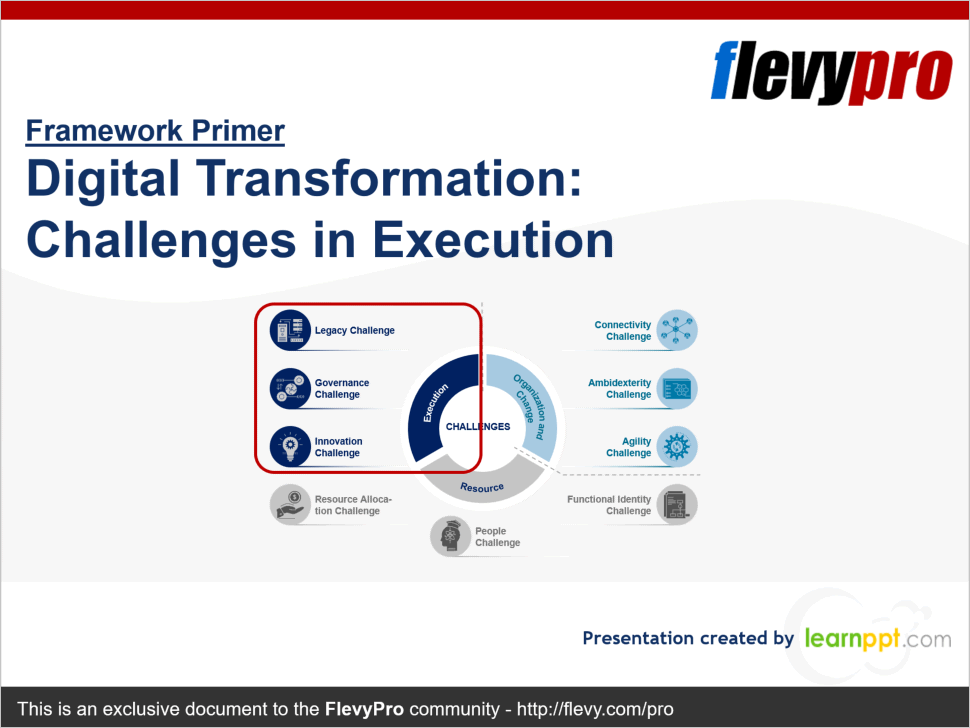
This framework introduces 9 key challenges to large scale Digital Transformation, which can be categorized into 3 areas:
1. Challenges in Execution
2. Challenges in Resources
3. Challenges in Organization and Change
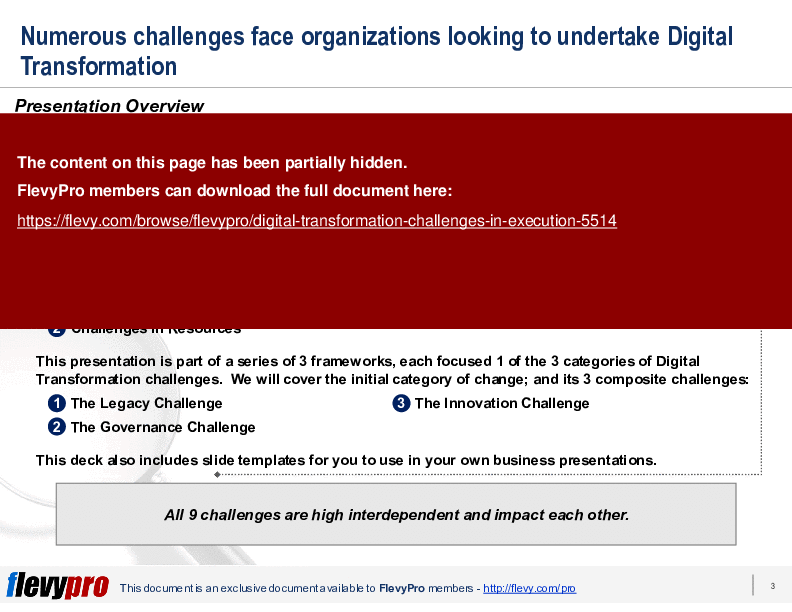
This presentation is part of a series of 3 frameworks, each focused 1 of the 3 categories of Digital Transformation challenges. We will cover the initial category of challenges; and its 3 composite challenges:
1. The Legacy Challenge
2. The Governance Challenge
3. The Innovation Challenge
This deck also includes slide templates for you to use in your own business presentations.
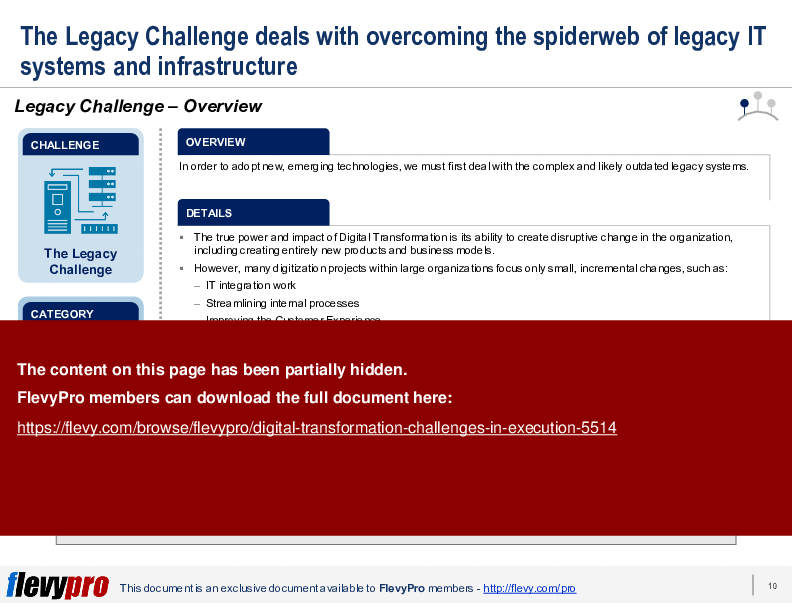
This PPT delves into the intricate Legacy Challenge, addressing the complexities of outdated IT systems and infrastructure. It emphasizes the necessity of overcoming these legacy systems to adopt new, emerging technologies effectively. The presentation outlines the importance of creating entirely new products and business models, rather than focusing on incremental changes. It also highlights the role of business ecosystems, integrating operations, technology, and people to provide end-to-end solutions.
The Governance Challenge is another critical area covered in this framework. It discusses the importance of establishing proper governance structures to coordinate transformational activities. The role of the Chief Digital Officer (CDO) is explored in depth, emphasizing the need for a multi-functional approach spanning strategy, communication, IT, and operations. The framework also outlines key governance objectives, such as strategic alignment, value delivery, risk management, resource management, and performance management, ensuring a holistic approach to digital governance.
What are the main execution-related challenges organizations face during digital transformation?
Execution challenges commonly center on legacy IT and infrastructure that hinder new technology adoption, governance gaps that prevent coordinated change, and limited innovation capacity to create new products or business models. A structured view groups these into 3 composite execution challenges: Legacy, Governance, and Innovation, comprising part of 9 key challenges.
How should a company approach legacy IT when planning digital initiatives?
Companies should assess the degree to which outdated systems block new capabilities, prioritize replacement or integration paths that enable emerging technology use, and plan product/business-model changes rather than only incremental fixes. The material frames this work under the Legacy Challenge and its implications for infrastructure and capabilities.
What governance objectives are important to coordinate a digital transformation program?
Effective governance should pursue strategic alignment, value delivery, risk management, resource management, and performance management, and often requires a multi‑functional leadership role to connect strategy, communication, IT, and operations. These governance objectives are explicitly outlined as central to coordinating transformation.
How do business ecosystems affect digital transformation planning?
Business ecosystems require organizations to integrate operations, technology, and people with external partners to deliver end‑to‑end solutions; transformation planning therefore needs to consider partner roles, integration points, and operating-model changes that support ecosystem value creation across operations, technology, and people.
What should I look for when choosing a slide-based digital transformation framework?
Look for a framework that diagnoses execution, resource, and organizational challenges; documents governance objectives; addresses legacy and innovation tradeoffs; and provides reusable templates for stakeholder presentations. A useful product will explicitly cover challenge areas and include slide templates, such as the 31-slide deck format.
How do slide-based frameworks support internal planning teams on timing and budget decisions?
Slide-based frameworks help teams structure diagnostic work, prioritize challenge areas (legacy, governance, innovation), and align stakeholders,, but they do not prescribe time or budget. They inform planning by exposing the 9 key challenges to scope work and estimate effort based on organizational complexity.
I need to restructure IT after pandemic-driven digital shifts — which execution areas should I prioritize?
Prioritize assessing the Legacy Challenge to determine modernization needs, establish governance structures to ensure strategic alignment and resource allocation, and create capacity for the Innovation Challenge to enable new products and business models. These priorities correspond to the 3 execution composite challenges.
What role should a Chief Digital Officer play during transformation execution?
A Chief Digital Officer should operate multi‑functionally across strategy, communication, IT, and operations to coordinate transformational activities and ensure governance objectives—strategic alignment, value delivery, risk, resource, and performance management—are met throughout execution.
Organizations face governance challenges during digital transformation initiatives, necessitating appropriate governance structures to manage complexities. Successful digital transformation relies on tactics to mitigate stakeholder politics and coordinate transformational activities. Key factors influencing governance approaches include digital maturity, centralization versus decentralization in management structures, business portfolio diversity, organizational size, global reach, and industry context. The CEO's perspective on digital transformation significantly impacts governance effectiveness. Micropolitical dynamics among stakeholders and the influence of external consultants complicate governance. Appointing a Chief Digital Officer (CDO) can help oversee governance across digital strategy elements, ensuring alignment with organizational goals and fostering collaboration among stakeholders.
This PPT slide outlines a governance model for effective digital transformation, focusing on the alignment of digital governance with corporate governance. The first objective emphasizes the role of Chief Information Officers (CIOs) in enhancing transparency and ensuring alignment with business objectives to leverage technology for desired outcomes. The second objective defines governance objectives across strategic alignment, value delivery, risk management, resource management, and performance management, essential for a comprehensive governance framework. The third objective advocates for holistic governance across the digital value chain, integrating all digital functions to support cohesive digital transformation efforts.
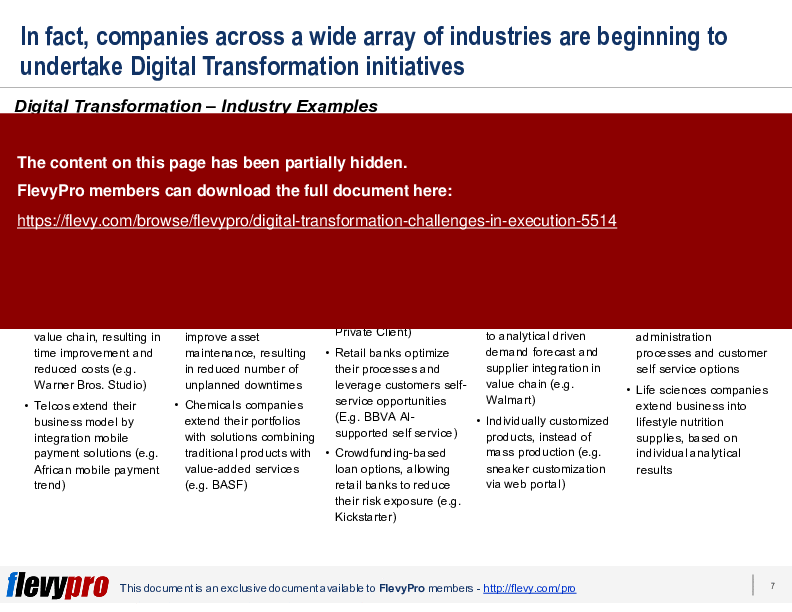
This PPT slide outlines digital transformation initiatives across industries, showcasing strategies and innovations enhancing operations and customer engagement. In the Telco, Media, and Technology sector, companies form partnerships with retailers to promote opt-in offers and digitize operational value chains for efficiency and cost reduction, as seen with Warner Bros. Studio. The Energy and Chemicals sector highlights firms using technology for streamlined processes, such as online order management portals and analytics for asset maintenance. In Financial Services, retail banks expand offerings with mobile payments and AI-supported services for operational efficiency. The Retail and Consumer Packaged Goods industry features e-commerce platforms and data analytics for inventory optimization, emphasizing product customization. The Life Sciences sector illustrates pharmaceutical companies using analytics to customize products and reduce public health service costs through digitization.
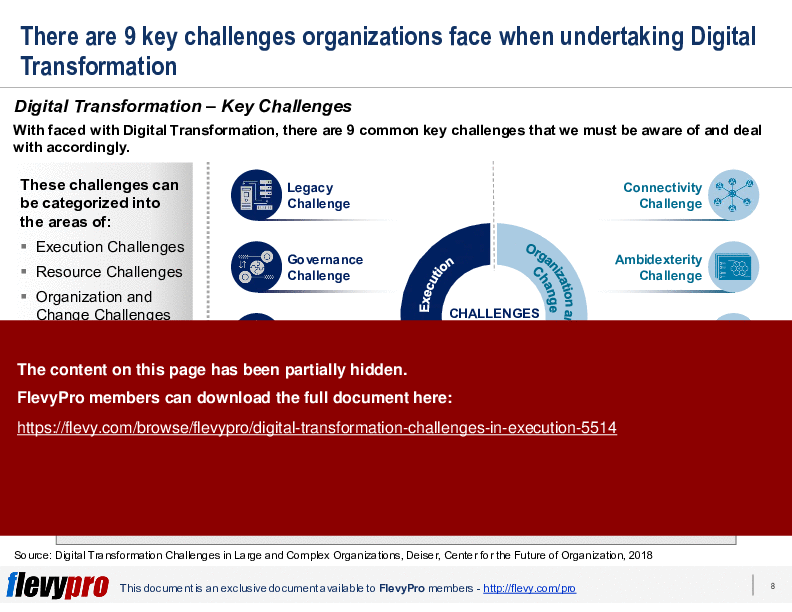
This PPT slide outlines nine challenges organizations face during digital transformation, categorized into Execution Challenges, Resource Challenges, and Organization and Change Challenges. Execution Challenges include project management and operational execution issues. Resource Challenges pertain to the allocation of financial and human resources. Organization and Change Challenges focus on the necessary cultural and structural shifts for effective digital change. The challenges include Legacy, Governance, Innovation, Resource Allocation, People, Connectivity, Ambidexterity, Agility, and Functional Identity. Addressing these interconnected challenges requires a holistic approach and a comprehensive strategy for successful digital transformation.
This PPT slide outlines 4 critical business ecosystems for successful digital transformation: Customer Solutions, Operations, Technology, and People. The Customer Solutions ecosystem focuses on delivering comprehensive digital products and services, enhancing the customer experience and positioning organizations as market leaders. The Operations ecosystem serves as a foundational layer that requires alignment with technology, people, and culture to optimize operational efficiency and adapt to market changes. Effective integration of these ecosystems creates an enhanced digital value chain, essential for sustaining growth and innovation in a dynamic business environment.
Corporate Entrepreneurship involves teams within a parent organization creating and managing new business ventures using organizational resources. It encompasses various innovations, including services, brands, and channels, allowing organizations to explore multiple growth avenues beyond new product initiatives. Corporate Entrepreneurship can lead to significant transformations through Business Model Innovation (BMI), rethinking value delivery to customers. Benefits include stimulating innovation, revitalizing the organization, and enhancing employee productivity, contributing to overall growth and superior market positioning. Distinctions are made between Corporate Entrepreneurship, Corporate Venture Capital (VC), and spinouts, clarifying that it primarily relies on internal resources and management, essential for effective implementation.
Source: Best Practices in Digital Transformation, Innovation PowerPoint Slides: Digital Transformation: Challenges in Execution PowerPoint (PPTX) Presentation Slide Deck, LearnPPT Consulting
This framework is developed by a team of former McKinsey and Big 4 consultants. The presentation follows the headline-body-bumper slide format used by global consulting firms.
For $10.00 more, you can download this document plus 2 more FlevyPro documents. That's just $13 each.
ABOUT FLEVYPRO
This document is part of the FlevyPro Library, a curated knowledge base of documents for our FlevyPro subscribers.
FlevyPro is a subscription service for on-demand business frameworks and analysis tools. FlevyPro subscribers receive access to an exclusive library of curated business documents—business framework primers, presentation templates, Lean Six Sigma tools, and more—among other exclusive benefits.
The average daily rate of a McKinsey consultant is $6,625 (not including expenses). The average price of a Flevy document is $65.
Trusted by over 10,000+ Client Organizations
Since 2012, we have provided business templates to over 10,000 businesses and organizations of all sizes, from startups and small businesses to the Fortune 100, in over 130 countries.
"As an Independent Management Consultant, I find Flevy to add great value as a source of best practices, templates and information on new trends. Flevy has matured and the quality and quantity of the library is excellent. Lastly the price charged is reasonable, creating a win-win value for
the customer, Flevy and the various authors. This is truly a service that benefits the consulting industry and associated clients. Thanks for providing this service.
"
– Jim Schoen, Principal at FRC Group
"I am extremely grateful for the proactiveness and eagerness to help and I would gladly recommend the Flevy team if you are looking for data and toolkits to help you work through business solutions."
– Trevor Booth, Partner, Fast Forward Consulting
"Flevy is now a part of my business routine. I visit Flevy at least 3 times each month.
Flevy has become my preferred learning source, because what it provides is practical, current, and useful in this era where the business world is being rewritten.

many challenges and there is the need to make the right decisions in a short time, with so much scattered information, we are fortunate to have Flevy. Flevy investigates, selects, and puts at our disposal the best of the best to help us be successful in our work.
"
– Omar Hernán Montes Parra, CEO at Quantum SFE
"One of the great discoveries that I have made for my business is the Flevy library of training materials.
As a Lean Transformation Expert, I am always making presentations to clients on a variety of topics: Training, Transformation, Total Productive Maintenance, Culture, Coaching, Tools, Leadership Behavior, etc. Flevy
It is well worth the money to purchase these presentations. Sure, I have the knowledge and information to make my point. It is another thing to create a presentation that captures what I want to say. Flevy has saved me countless hours of preparation time that is much better spent with implementation that will actually save money for my clients.
"
– Ed Kemmerling, Senior Lean Transformation Expert at PMG
"If you are looking for great resources to save time with your business presentations, Flevy is truly a value-added resource. Flevy has done all the work for you and we will continue to utilize Flevy as a source to extract up-to-date information and data for our virtual and onsite presentations!"
– Debbi Saffo, President at The NiKhar Group
"FlevyPro has been a brilliant resource for me, as an independent growth consultant, to access a vast knowledge bank of presentations to support my work with clients. In terms of RoI, the value I received from the very first presentation I downloaded paid for my subscription many times over! The
quality of the decks available allows me to punch way above my weight – it's like having the resources of a Big 4 consultancy at your fingertips at a microscopic fraction of the overhead.
"
– Roderick Cameron, Founding Partner at SGFE Ltd
"As a small business owner, the resource material available from FlevyPro has proven to be invaluable. The ability to search for material on demand based our project events and client requirements was great for me and proved very beneficial to my clients. Importantly, being able to easily edit and tailor
the material for specific purposes helped us to make presentations, knowledge sharing, and toolkit development, which formed part of the overall program collateral. While FlevyPro contains resource material that any consultancy, project or delivery firm must have, it is an essential part of a small firm or independent consultant's toolbox.
"
– Michael Duff, Managing Director at Change Strategy (UK)
"Last Sunday morning, I was diligently working on an important presentation for a client and found myself in need of additional content and suitable templates for various types of graphics. Flevy.com proved to be a treasure trove for both content and design at a reasonable price, considering the time I
saved. I encountered a download issue during the ordering process. However, a quick email to Flevy's support team, even on a Sunday (!!!), resulted in assistance within less than an hour, allowing me to download the content I needed. Fantastic job, Flevy! I give 5 stars for both content/price and customer service. Thank you!
"
– M. E., Chief Commercial Officer, International Logistics Service Provider
Download our FREE Digital Transformation Templates
Download our free compilation of 50+ Digital Transformation slides and templates. DX concepts covered include Digital Leadership, Digital Maturity, Digital Value Chain, Customer Experience, Customer Journey, RPA, etc.