 Click main image to view in full screen.
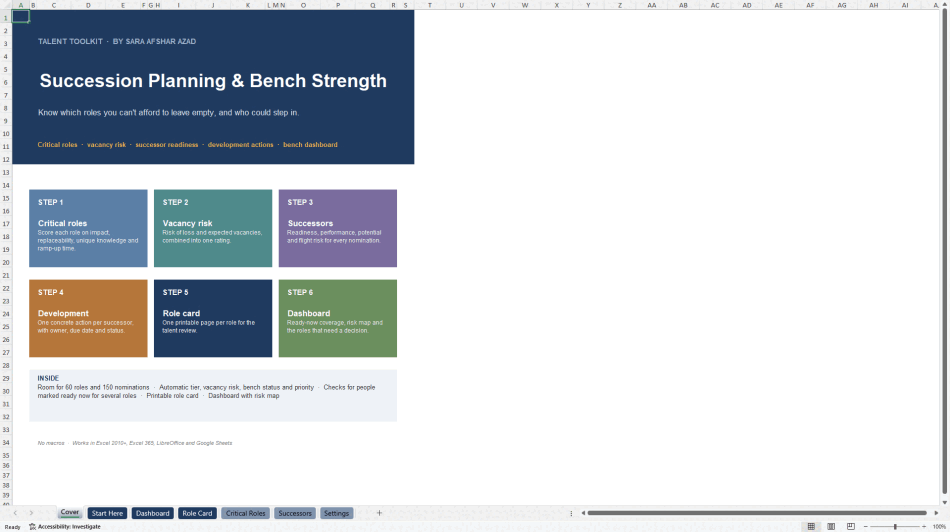
Succession Planning & Bench Strength Toolkit – Excel XLSX
Excel (XLSX) + supplemental PDF


BENEFITS OF THIS DOWNLOADABLE EXCEL DOCUMENT
- Shows which roles would hurt most if they were empty, scored on four clear factors.
- Measures bench strength and flags people counted as ready now for several roles.
- Turns the talent review into decisions, with one development action per successor.
TALENT MANAGEMENT EXCEL DESCRIPTION
This toolkit helps you find the roles your organization can least afford to leave empty, see how deep the bench is behind each one, and agree what the successors still need. It starts from roles rather than people, which is where most succession lists go wrong. A 9-page user guide in PDF is included as a secondary document.
WHAT IS INSIDE
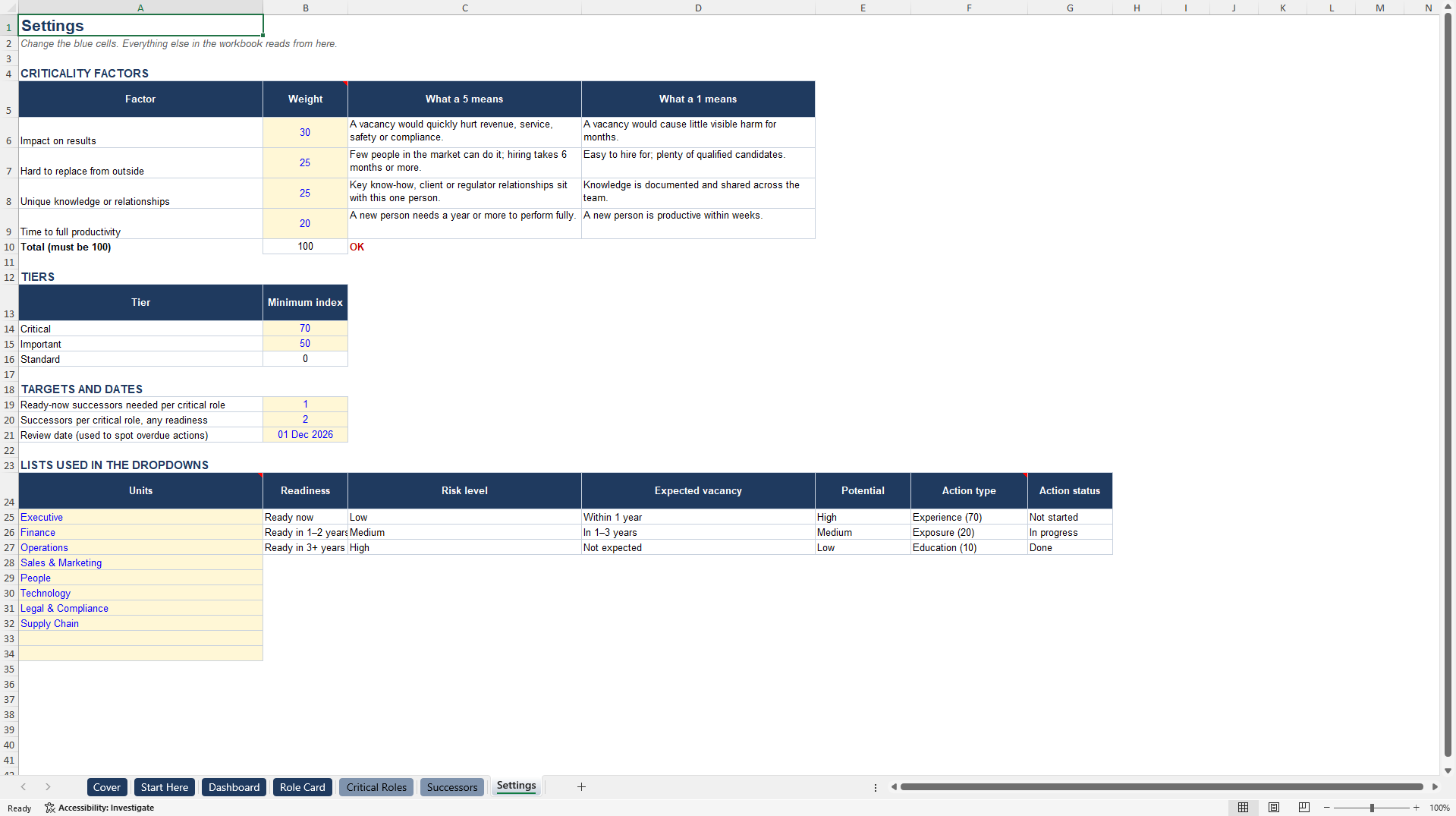
A cover page and six working sheets. Settings holds the weights of four criticality factors (impact on results, how hard the role is to replace from outside, unique knowledge or relationships, and time to full productivity), the thresholds for Critical and Important roles, your targets for ready-now successors and bench depth, a review date, and the dropdown lists.
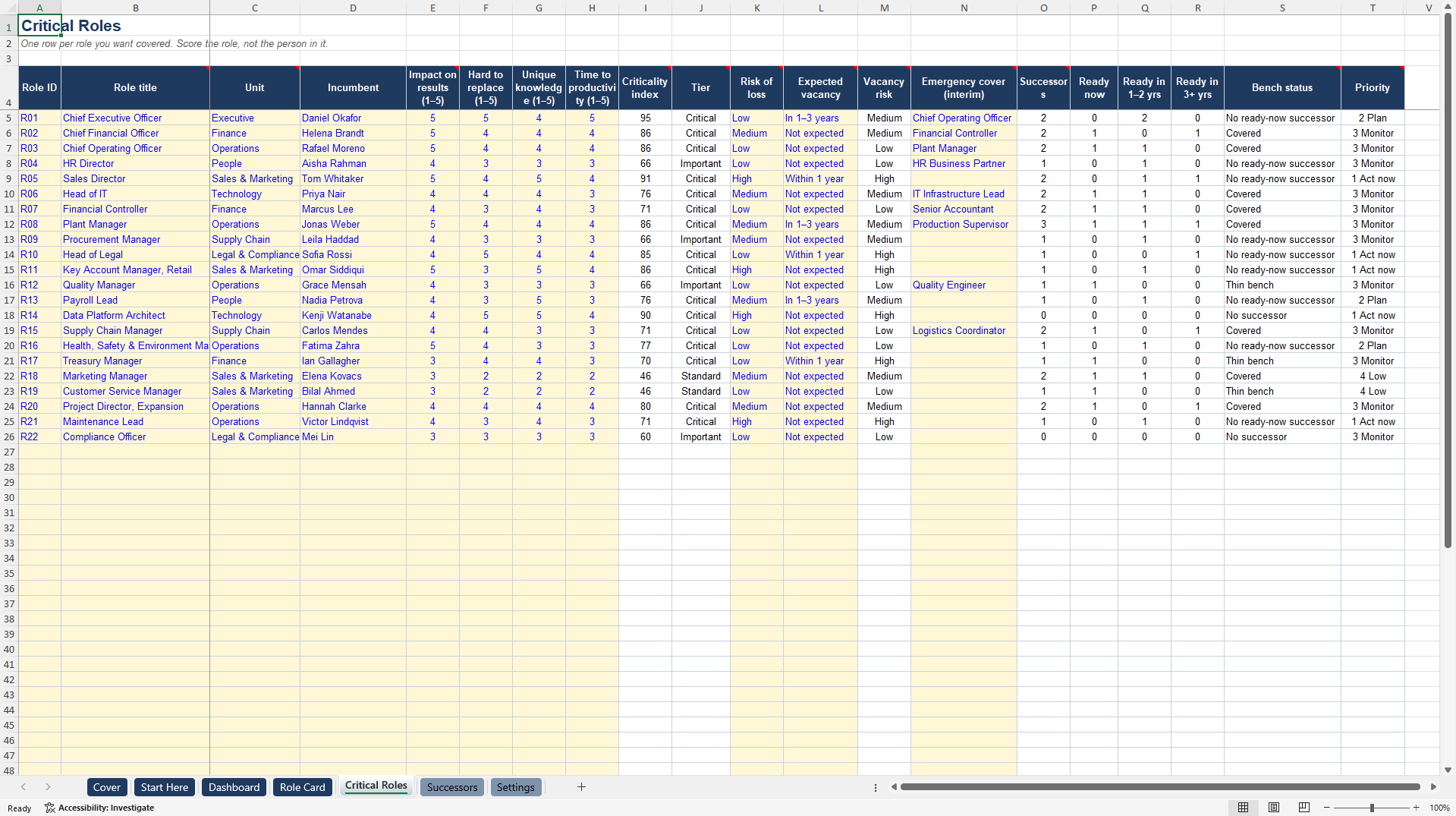
Critical Roles has room for 60 roles. Each role is scored from 1 to 5 on the four factors, and the file calculates a criticality index from 20 to 100 and a tier. You add the risk of losing the incumbent and any vacancy you already expect, and the file turns these into a vacancy risk of High, Medium or Low. It then counts successors by readiness and gives each role a bench status (No successor, No ready-now successor, Thin bench or Covered) and a priority: Act now, Plan, Monitor or Low.
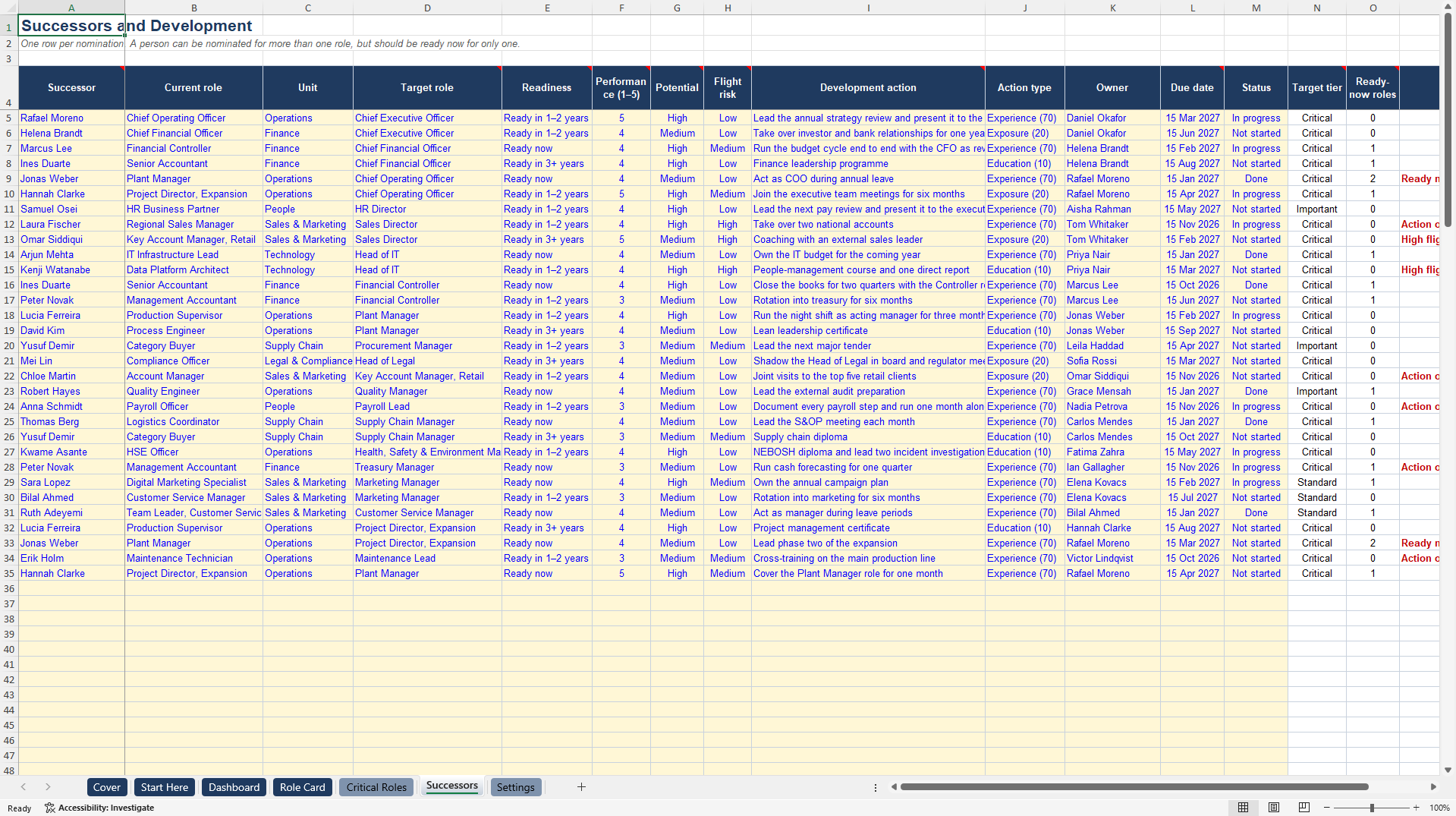
Successors has room for 150 nominations. For each one you record readiness (Ready now, Ready in 1 to 2 years, Ready in 3+ years), last performance rating, potential, flight risk, and one development action with its type (experience, exposure or education), owner, due date and status. A check column flags people marked ready now for more than one role, ready-now successors rated below 3, overdue actions and high flight risk.
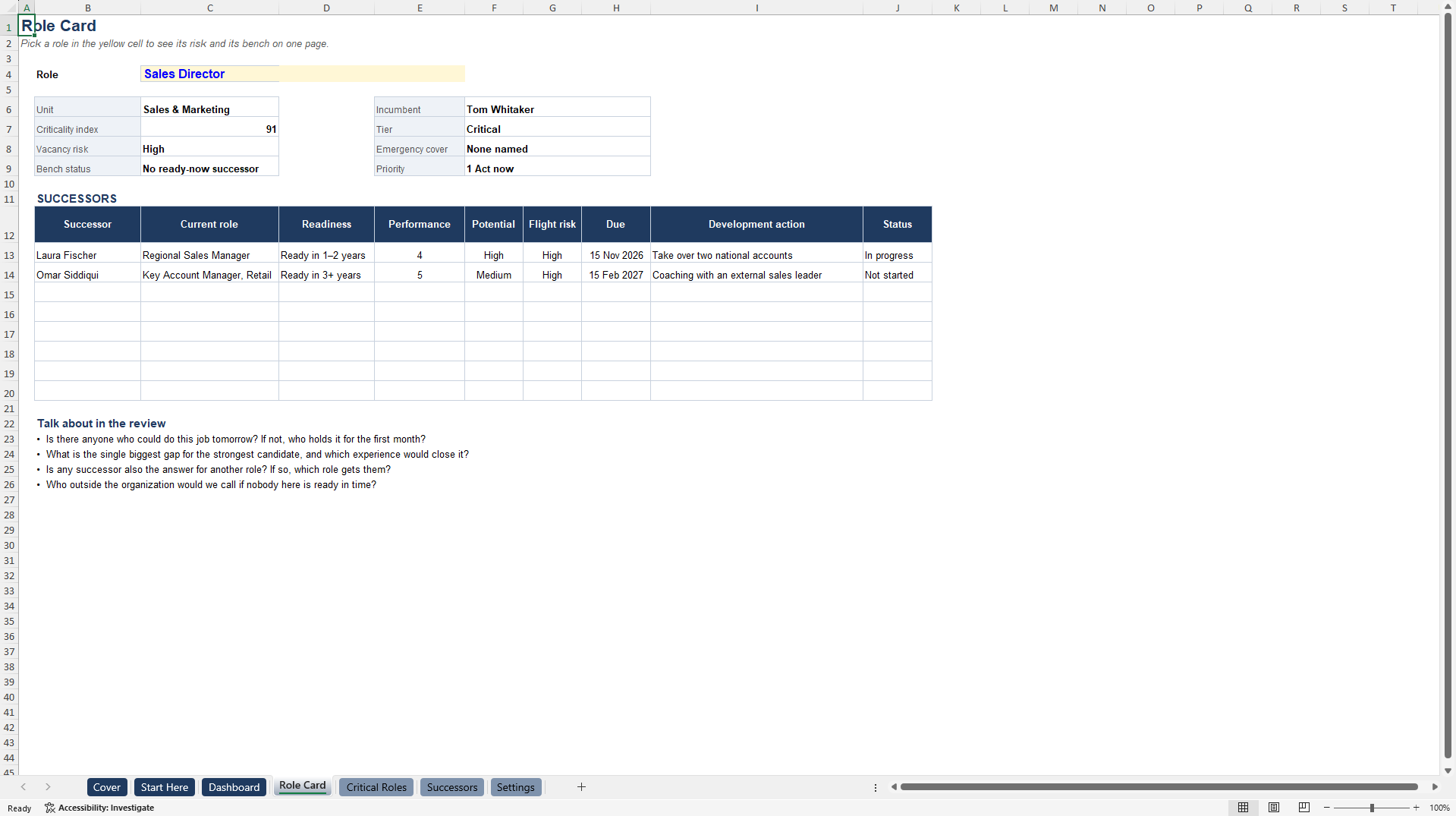
Role Card gives you one printable page per role: its criticality, vacancy risk, emergency cover, bench status and up to eight successors with their development actions, plus four questions for the talent review.
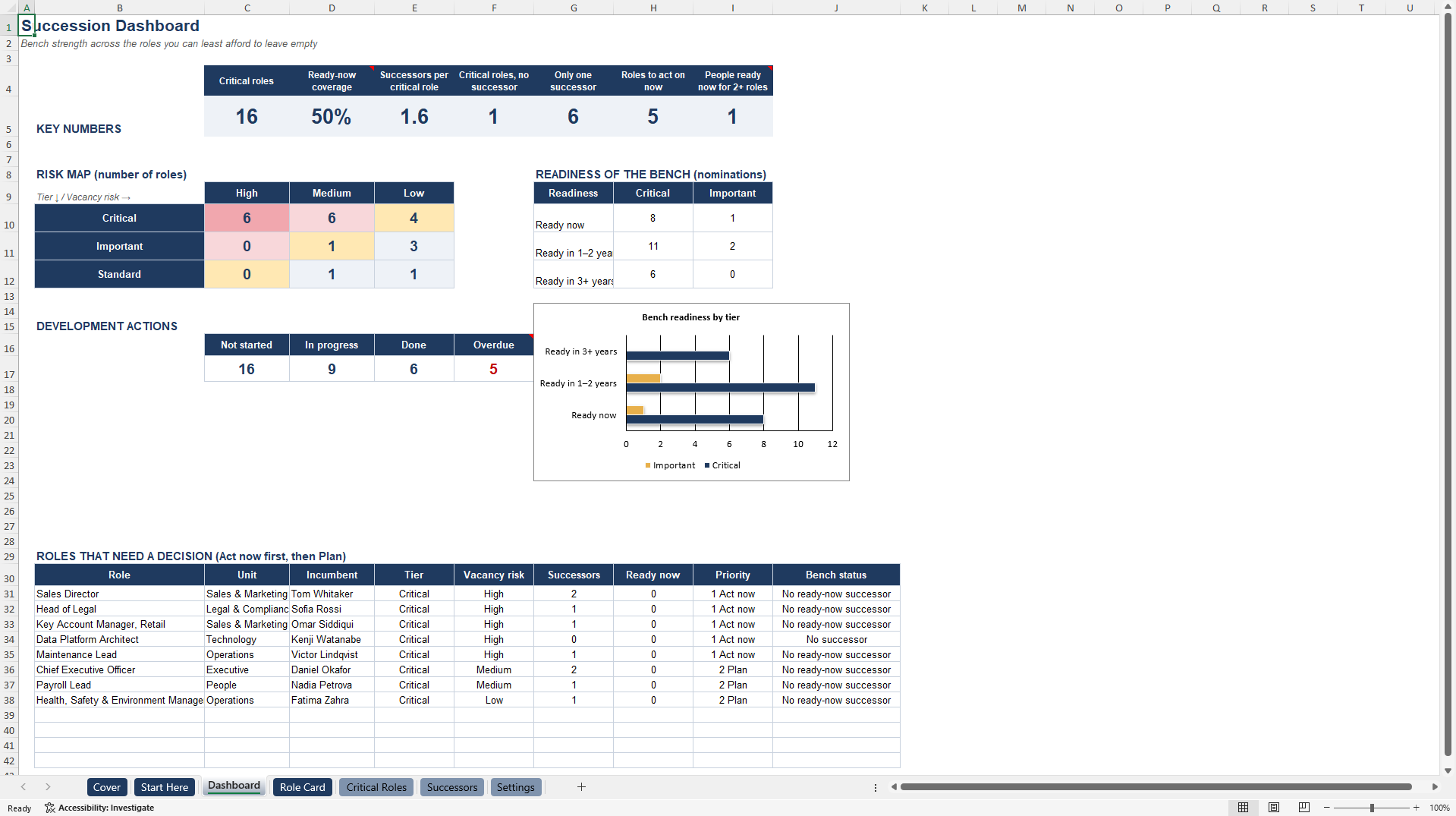
Dashboard shows ready-now coverage of critical roles, successors per critical role, critical roles with no successor or only one, the number of people counted as ready now for several roles, a risk map of tier against vacancy risk, bench readiness by tier, development action status, and a list of the roles that need a decision, Act now first.
The workbook comes filled with a fictional mid-size company (22 roles and 31 nominations) so you can see how it behaves before entering your own data. Blue cells are inputs and black cells are formulas. Every column header has a short note on what goes in it.
WHO IT IS FOR
HR leaders, HR business partners and leadership teams who want a working succession plan they can review once a year, without buying a talent management system.
COMPATIBILITY
No macros. The file uses only widely supported functions such as INDEX, MATCH, COUNTIFS and SUMPRODUCT, so it works in Excel 2010 or later, Excel 365, LibreOffice and Google Sheets.
Got a question about the product? Email us at support@flevy.com or ask the author directly by using the "Ask the Author a Question" form. If you cannot view the preview above this document description, go here to view the large preview instead.
Source: Best Practices in Talent Management, Succession Planning Excel: Succession Planning & Bench Strength Toolkit Excel (XLSX) Spreadsheet, Sara Afshar Azad