
This presentation is intended for use as workshop material to introduce Sales & Operations Planning (S&OP) to all the senior management with activities to include the current way of silo planning and proposed way of collaborative planning. It has 60 slides in all split in to 2 parts, presentation and a case study.

Contents:
S&OP Definition
Linkages to S&OP and benefits of S&OP
The SMAP Process (Sales & Marketing Activity Planning)
Demand forecasting and management
Lean forecasting
Role of Sales & Marketing
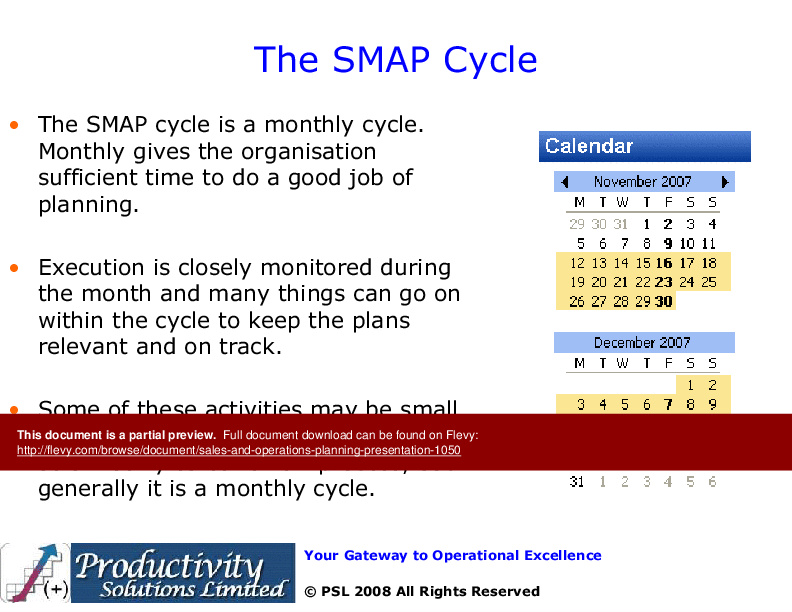
SMAP cycle
Supply planning
Capacity planning
Pre S&OP
Executive S&OP
S&OP Implementation process – the 10 steps
Case Study from FMCG industry New Zealand
Also included with this document is a bonus zip of 41 Lean documents (includes templates, case studies, articles, posters, charts, and more).
This Sales & Operations Planning Presentation delves into the intricacies of the S&OP process, emphasizing its critical role as the backbone of any business. The presentation provides a comprehensive overview of the S&OP process, including key stages such as Pre-S&OP meetings, Executive S&OP meetings, and Sales & Marketing Activity Planning. It highlights the importance of collaborative planning over silo planning, ensuring that all departments are aligned and working towards common goals.
The document covers essential topics like demand forecasting and lean forecasting. It explains how demand managers review historical data, clean out anomalies, and run forecasting systems to produce accurate demand forecasts. Lean forecasting is also addressed, advocating for forecasting at the mix level only up to the Planning Time Fence (PTF) and beyond that in aggregate. This approach helps in avoiding the technological imperative of overcomplicating processes.
The presentation also includes a detailed case study from the FMCG industry in New Zealand, providing real-world examples of S&OP implementation. The case study demonstrates how effective S&OP processes can lead to significant improvements in forecast accuracy, customer service levels, and reduction in write-offs. This practical example underscores the tangible benefits of adopting a robust S&OP framework.
Got a question about the product? Email us at support@flevy.com or ask the author directly by using the "Ask the Author a Question" form. If you cannot view the preview above this document description, go here to view the large preview instead.
Executive Summary
The Sales & Operations Planning (S&OP) Presentation is a comprehensive resource designed to enhance organizational efficiency and strategic alignment across various business functions. Developed by a Lean pioneer and certified LSS Master Black Belt, this PowerPoint deck provides a structured approach to S&OP, detailing processes that integrate sales forecasts, production planning, and inventory management. Users will gain insights into the S&OP framework, enabling them to create actionable plans that align with business objectives and improve operational performance.
Who This Is For and When to Use
• Executives and senior management overseeing strategic planning and operational efficiency
• Sales and marketing teams responsible for demand forecasting and activity planning
• Supply chain managers focused on inventory management and production scheduling
• Finance professionals involved in budgeting and resource allocation
Best-fit moments to use this deck:
• During quarterly or monthly business reviews to align sales and operational strategies
• In training sessions for teams new to S&OP processes
• When launching new products or initiatives that require cross-functional coordination
Learning Objectives
• Define the S&OP process and its significance in achieving business objectives
• Develop an integrated sales plan that aligns with production and inventory targets
• Implement effective demand forecasting techniques to enhance accuracy
• Establish a collaborative framework for cross-functional communication and decision-making
• Analyze performance metrics to identify gaps and drive continuous improvement
• Create a structured agenda for S&OP meetings to ensure effective outcomes
Table of Contents
• Introduction to S&OP (page 3)
• Benefits of S&OP (page 5)
• Sales and Marketing Activity Planning (page 10)
• Demand Forecasting Techniques (page 15)
• Supply Planning Overview (page 20)
• Pre-S&OP Review Process (page 25)
• Executive S&OP Meeting Structure (page 30)
• Implementation Steps for S&OP (page 35)
• Case Study: Mainland Products Limited (page 40)
• Key Takeaways and Recommendations (page 50)
Primary Topics Covered
• S&OP Definition - S&OP is a company-wide process that integrates sales forecasts with supply chain management to achieve competitive advantage.
• Benefits of S&OP - The S&OP process improves operational efficiencies, enhances communication, and provides forward visibility for better decision-making.
• Sales and Marketing Activity Planning - This involves creating an unconstrained sales plan based on demand forecasts and input from sales and marketing teams.
• Demand Forecasting Techniques - Effective forecasting methods are discussed, focusing on maximizing accuracy and minimizing stockouts.
• Supply Planning Overview - The supply plan must align with the sales forecast, ensuring that production capabilities meet demand requirements.
• Executive S&OP Meeting Structure - This outlines the decision-making process for approving sales and operational plans, ensuring alignment across departments.
Deliverables, Templates, and Tools
• Sales and operations planning spreadsheet template for tracking forecasts and actuals
• Demand forecasting model to analyze historical data and predict future sales
• Supply planning checklist to ensure alignment with sales forecasts
• Meeting agenda template for S&OP sessions to facilitate structured discussions
• Performance metrics dashboard for monitoring key indicators such as forecast accuracy and order fulfillment
Slide Highlights
• Overview of the S&OP process, illustrating key linkages between sales, marketing, and supply chain
• Benefits slide detailing how S&OP enhances operational efficiency and reduces surprises
• Demand forecasting techniques slide emphasizing the importance of accurate data analysis
• Case study slide showcasing successful implementation of S&OP at Mainland Products Limited
• Key takeaways slide summarizing the main points for easy reference
Potential Workshop Agenda
S&OP Introduction Session (90 minutes)
• Overview of the S&OP process and its importance
• Discussion on roles and responsibilities in the S&OP framework
• Introduction to demand forecasting techniques
Sales and Marketing Alignment Workshop (120 minutes)
• Review of current sales forecasts and marketing plans
• Collaborative session to develop an integrated sales plan
• Identification of potential challenges and solutions
Supply Planning and Execution Meeting (90 minutes)
• Presentation of supply plan based on sales forecasts
• Discussion on capacity constraints and resource allocation
• Finalization of the production schedule for the upcoming period
Customization Guidance
• Tailor the sales and operations planning spreadsheet to reflect specific product families and categories
• Adjust the meeting agendas to fit the unique structure and culture of your organization
• Incorporate company-specific performance metrics into the dashboard for better tracking
Secondary Topics Covered
• Role of finance in S&OP and its impact on budgeting
• Importance of cross-functional collaboration in the S&OP process
• Techniques for managing new product introductions within the S&OP framework
• Strategies for improving forecast accuracy and reducing write-offs
FAQ
What is the primary purpose of S&OP?
S&OP aims to align sales forecasts with supply chain capabilities, ensuring that the organization can meet customer demand efficiently.
How often should the S&OP process be reviewed?
The S&OP process should be reviewed at least monthly to adapt to changing market conditions and operational realities.
What are the key components of an effective S&OP meeting?
An effective S&OP meeting includes a review of sales forecasts, supply capabilities, performance metrics, and decision-making on any necessary adjustments.
How can demand forecasting accuracy be improved?
Improving demand forecasting accuracy involves analyzing historical data, incorporating market intelligence, and regularly updating forecasts based on real-time information.
What is the role of marketing in the S&OP process?
Marketing is responsible for providing insights on market trends and customer preferences, which are critical for developing accurate sales forecasts.
What challenges might arise during S&OP implementation?
Challenges include resistance to change, lack of understanding of the process, and difficulties in cross-departmental communication.
How can organizations ensure successful S&OP implementation?
Success can be achieved through training, clear communication of roles, and establishing a culture of collaboration and accountability.
What metrics should be tracked in the S&OP process?
Key metrics include forecast accuracy, order fulfillment rates, inventory levels, and write-off amounts.
Glossary
• S&OP - Sales and Operations Planning, a process for aligning sales forecasts with supply chain management.
• Demand Forecasting - The process of predicting future customer demand based on historical data and market trends.
• Supply Planning - The process of ensuring that production capabilities align with sales forecasts.
• Executive S&OP Meeting - A high-level meeting where key decisions regarding sales and operations plans are made.
• Pre-S&OP Review - A preparatory meeting to address potential issues before the executive S&OP meeting.
• Performance Metrics - Measurements used to assess the effectiveness of the S&OP process.
• Collaboration - The act of working together across departments to achieve common goals.
• Capacity Planning - The process of determining production capacity needed to meet changing demands for products.
• Inventory Management - The supervision of non-capitalized assets (inventory) and stock items.
• Market Intelligence - Information relevant to a company's markets, including customer preferences and competitive analysis.
• Write-Offs - Inventory that cannot be sold and must be removed from financial records.
• Forecast Accuracy - A measure of how closely actual sales match predicted sales.
Source: Best Practices in S&OP PowerPoint Slides: Sales & Operations Planning Presentation PowerPoint (PPT) Presentation Slide Deck, OpEx Academy NZ
This document is available as part of the following discounted bundle(s):
Save %!
PSL - Lean Supply Chain Bundle
This bundle contains 6 total documents. See all the documents to the right.
|
Receive our FREE presentation on Operational Excellence
This 50-slide presentation provides a high-level introduction to the 4 Building Blocks of Operational Excellence. Achieving OpEx requires the implementation of a Business Execution System that integrates these 4 building blocks. |