
 Click main image to view in full screen. Unlock all 19 preview images:
Mining Balanced Scorecard - Strategic Performance Management – PowerPoint PPTX Template
PowerPoint (PPTX) 51 Slides


PERFORMANCE MANAGEMENT PPT TEMPLATE DESCRIPTION
In this presentation, we present an empirical study to measure the performance of a mining company. The study uses PEST analysis technique to evaluate opportunities and threats associated with external as well as internal factors influencing the firm. The study designs a questionnaire and asks decision maker through the mining value chain to evaluate internal/external threats. In terms of external factors, otherwise Key Success Factors (KSF) there are opportunities and threats associated with External Factor Evaluation (EFE). In terms of Strengths and weaknesses, existing internal capacities has received the highest priority. In addition, the study uses SWOT analysis for matching Key Success Factors (KSF) and Strategic Competencies (SC) in order to develop competitive advantage or wining scenario.
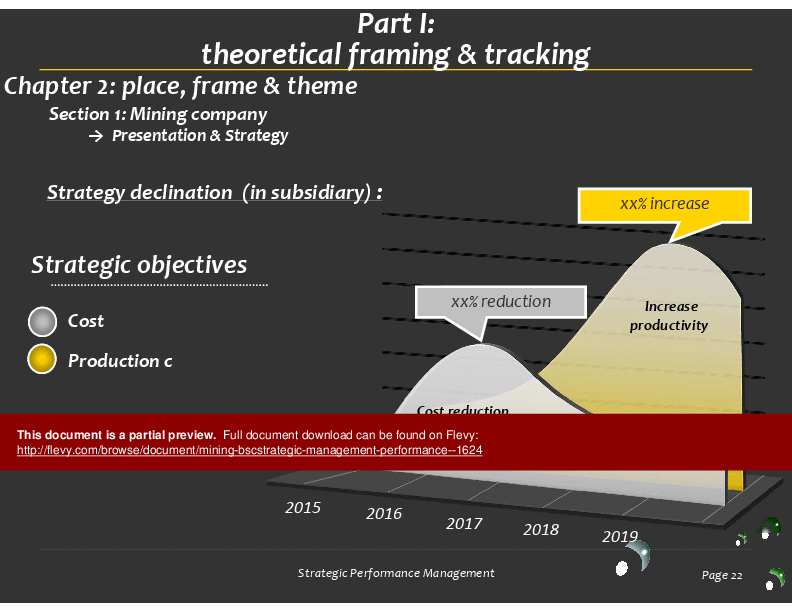
Furthermore, a reviewed Balanced Scorecard (BSC) technique is used to look at the performance of the firm in terms of learning and growth, internal process, safety, environment and financials. The study determines the present and ideal status of the firm.
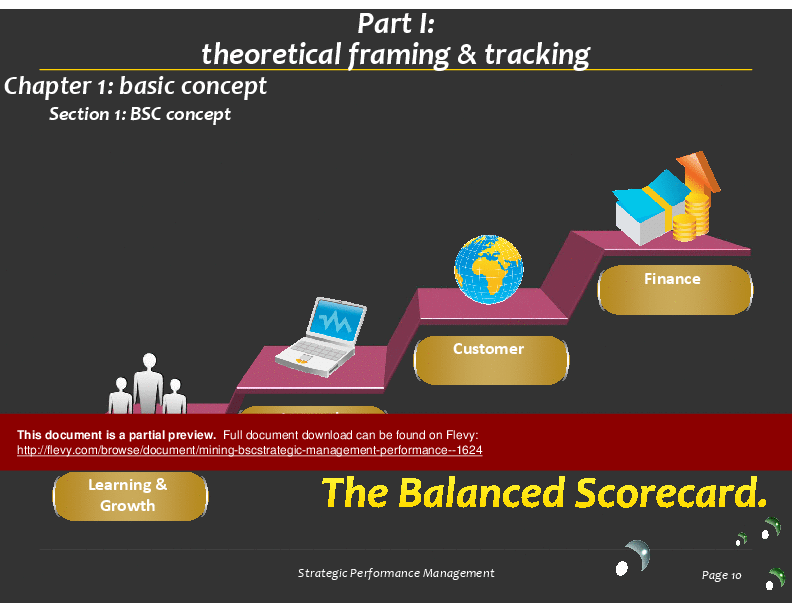
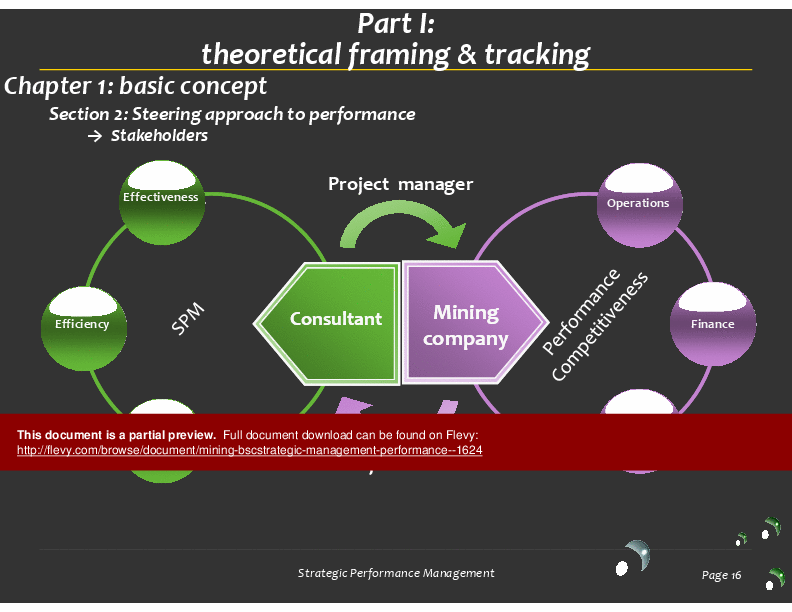
The PPT delves into the core principles of the Balanced Scorecard (BSC) concept, focusing on its application within the mining sector. It provides a comprehensive framework for aligning organizational strategy with performance measures, ensuring that all levels of the organization are working towards common objectives. The BSC objectives are clearly outlined, covering organizational, strategic, performance, and strategic performance aspects, making it an invaluable tool for senior management.
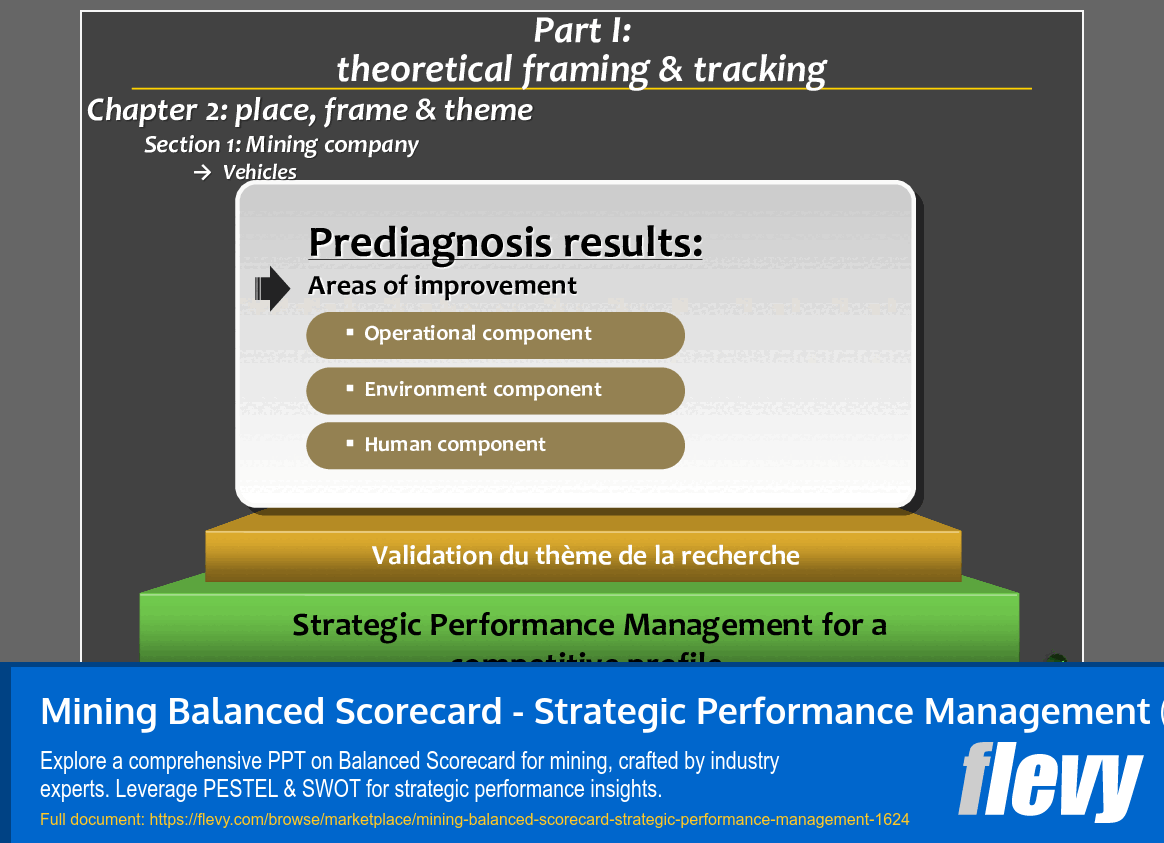
The presentation also highlights the strategic development process, from field investigation to strategic diagnosis and action planning. It includes detailed sections on internal and external analysis, using PESTEL and SWOT frameworks to identify key areas for improvement. The document is designed to equip C-level executives with the insights needed to drive operational excellence and achieve strategic goals in the mining industry.
Got a question about the product? Email us at support@flevy.com or ask the author directly by using the "Ask the Author a Question" form. If you cannot view the preview above this document description, go here to view the large preview instead.
TOPIC FAQ
What are the core components of a Balanced Scorecard tailored for a mining company?
A mining-focused Balanced Scorecard typically covers multiple perspectives beyond finance, explicitly including learning & growth, internal process, safety, environment, and financials, enabling alignment of operational, safety, and strategic objectives within the BSC framework.How can PESTEL and External Factor Evaluation (EFE) be applied to assess external risks in mining?
Apply PESTEL to identify political, economic, social, technological, environmental, and legal opportunities and threats, then use External Factor Evaluation (EFE) to prioritize those Key Success Factors (KSF) and quantify external impact, helping decision makers focus on the most significant external risks and opportunities using EFE.How does SWOT help match Key Success Factors and Strategic Competencies to develop competitive advantage?
Use SWOT to map internal strengths and weaknesses against external opportunities and threats, then explicitly match Key Success Factors (KSF) with Strategic Competencies (SC) to identify winning scenarios and capability gaps, a process illustrated in Flevy's Mining Balanced Scorecard - Strategic Performance Management using SWOT matching KSF and SC.How should safety and environmental measures be integrated into a mining Balanced Scorecard?
Include safety and environment as distinct BSC perspectives with specific KPIs, set present versus ideal target states, and track performance alongside internal process and financial metrics to ensure operational decisions consider safety and environmental outcomes within the BSC perspectives.What features should I look for when selecting a BSC template for the mining sector?
Look for industry-specific perspectives (safety, environment), inclusion of external analysis tools (PESTEL, EFE), internal analysis support (SWOT, KSF–SC matching), and guidance linking diagnosis to action planning so templates explicitly cover PESTEL, SWOT, EFE, and BSC perspectives.What are the practical steps from field investigation to action planning in a strategic diagnostic process?
Practical steps begin with field investigation to collect stakeholder inputs and empirical data, proceed to strategic diagnosis using tools like PESTEL, EFE, and SWOT, then conclude with action planning that maps initiatives to BSC perspectives, mirroring the field investigation → strategic diagnosis → action planning sequence shown in the presentation.How does an External Factor Evaluation (EFE) differ from a SWOT analysis in strategic planning?
EFE focuses solely on assessing and prioritizing external opportunities and threats to quantify their impact on strategy, while SWOT combines that external view with internal strengths and weaknesses for matching KSFs with Strategic Competencies; the distinction is EFE versus combined internal–external analysis using SWOT.Are pre-built Balanced Scorecard slide decks worthwhile compared to building a BSC from scratch for mining projects?
Pre-built decks can reduce time by providing ready-made frameworks and linked analyses (PESTEL, EFE, SWOT) and templates for present versus ideal status comparisons; for example, Flevy's Mining Balanced Scorecard - Strategic Performance Management is a 51-slide PowerPoint that bundles these elements for faster deployment.Source: Best Practices in Performance Management, Balanced Scorecard, Mining Industry PowerPoint Slides: Mining Balanced Scorecard - Strategic Performance Management PowerPoint (PPTX) Presentation Slide Deck, Youssef AIT AKKI - The Horizon Strategy.




























