
Activity Based Costing   29-slide PPT PowerPoint presentation slide deck (PPT)
$39.00

Activity Based Costing (29-slide PPT PowerPoint presentation slide deck (PPT)) Preview Image
Log in to unlock full preview.
Activity Based Costing (29-slide PPT PowerPoint presentation slide deck (PPT)) Preview Image
Arrow   Click main image to view in full screen.

Activity Based Costing (PowerPoint PPT Slide Deck)

PowerPoint (PPT) 29 Slides

#2 in Cost Optimization $39.00
This presentation is created by former McKinsey, BCG, Deloitte, EY, and Capgemini consultants. It teaches a practical consulting framework actively used by tier-1 consulting firms.
Add to Cart


Immediate download
Free lifetime updates

COST OPTIMIZATION PPT DESCRIPTION

Activity Based Costing PPT: Learn ABC costing basics, cost allocation, and differences from traditional methods. Download this ready-to-use presentation now. Activity Based Costing is a 29-slide PPT PowerPoint presentation slide deck (PPT) available for immediate download upon purchase.

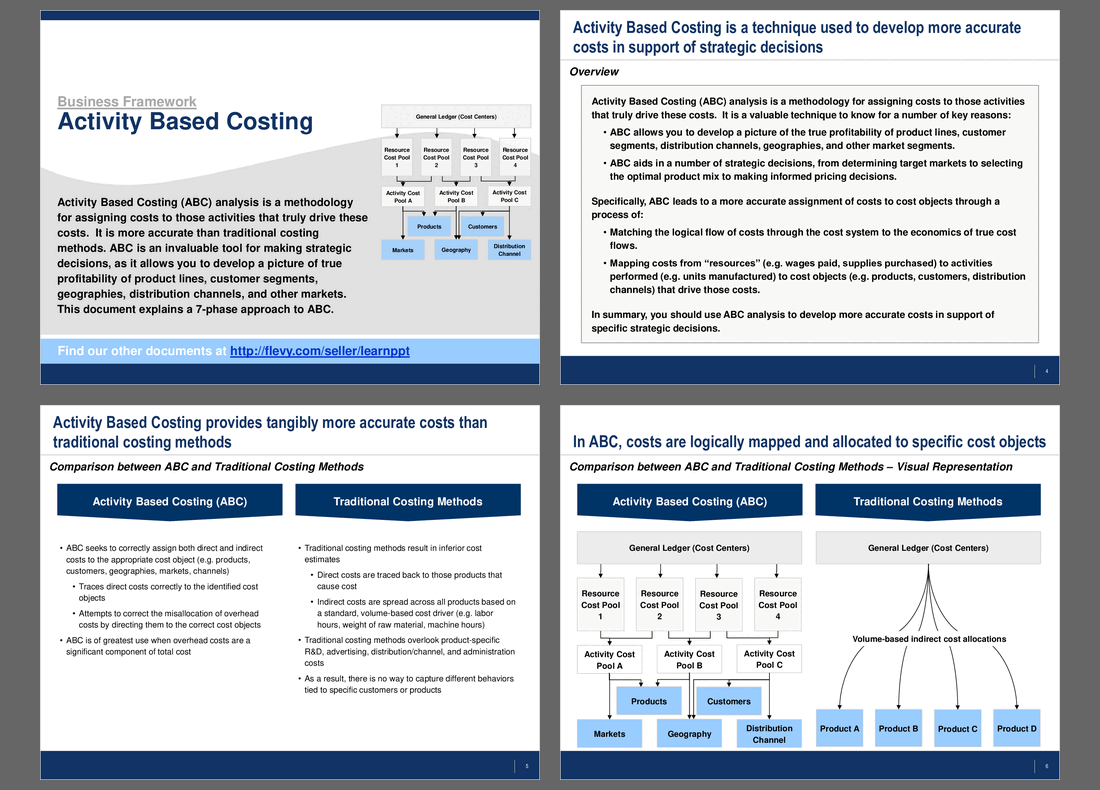
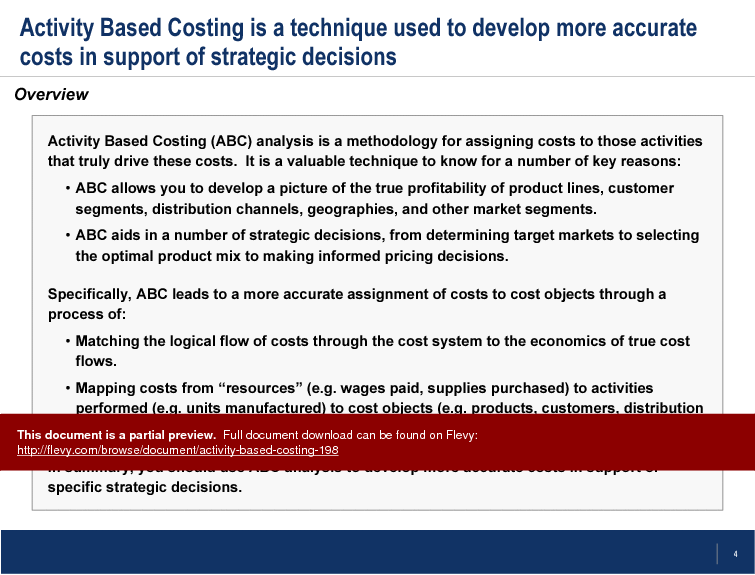
Activity Based Costing (ABC) analysis is a methodology for assigning costs to those activities that truly drive these costs. It is tangibly more accurate than traditional costing methods. Traditional costing methods overlook product-specific R&D, advertising, distribution/channel, and administration costs. As a result, there is no way to capture different behaviors tied to specific customers or products.

ABC costing analysis is a valuable costing technique to know for a number of key reasons:

•  ABC allows you to develop a picture of the true profitability of product lines, customer segments, distribution channels, geographies, and other market segments.
•  ABC aids in a number of strategic decisions, from determining target markets to selecting the optimal product mix to making informed pricing decisions.

Specifically, Activity Based Costing analysis leads to a more accurate assignment of costs to cost objects through a process of:

•  Matching the logical flow of costs through the cost system to the economics of true cost flows.
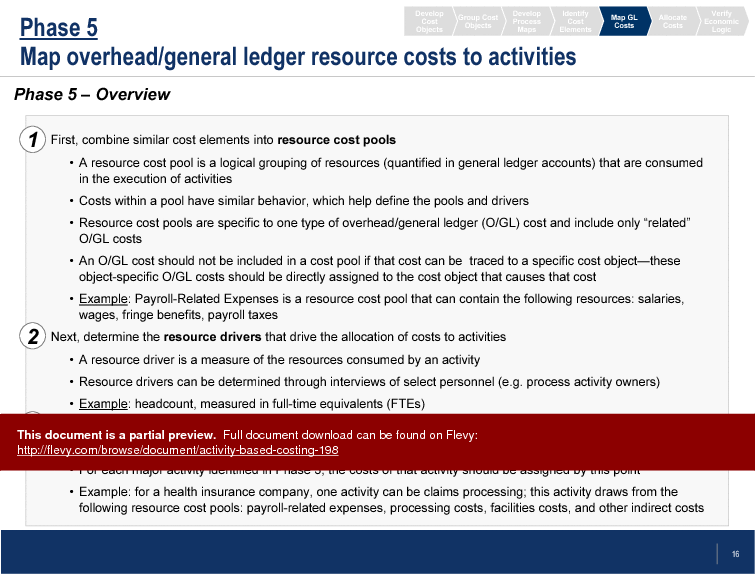
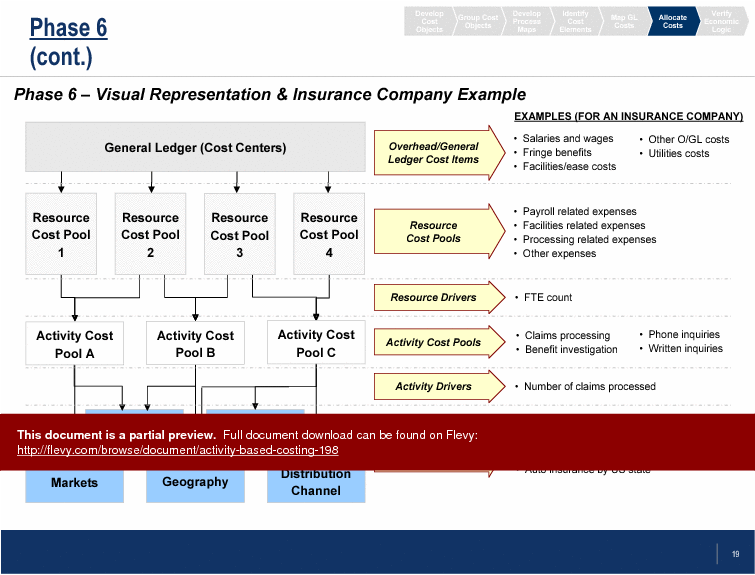
•  Mapping costs from "resources" (e.g. wages paid, supplies purchased) to activities performed (e.g. units manufactured) to cost objects (e.g. products, customers, distribution channels) that drive those costs.

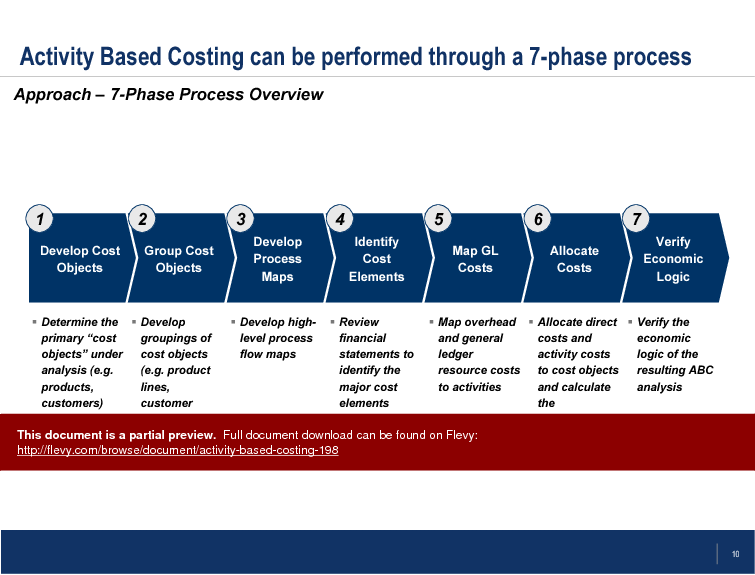
ABC is an invaluable tool for making strategic decisions, as it allows you to develop a picture of true profitability of product lines, customer segments, geographies, distribution channels, and other markets. This document explains a 7-phase approach to Activity Based Costing:

1. Develop Cost Objects
2. Group Cost Objects
3. Develop Process Maps
4. Identify Cost Elements
5. Map General Ledger Costs
6. Allocate Costs
7. Verify Economic Logic

In this Activity Based Costing PowerPoint presentation, each phase is discussed in detail and includes examples.

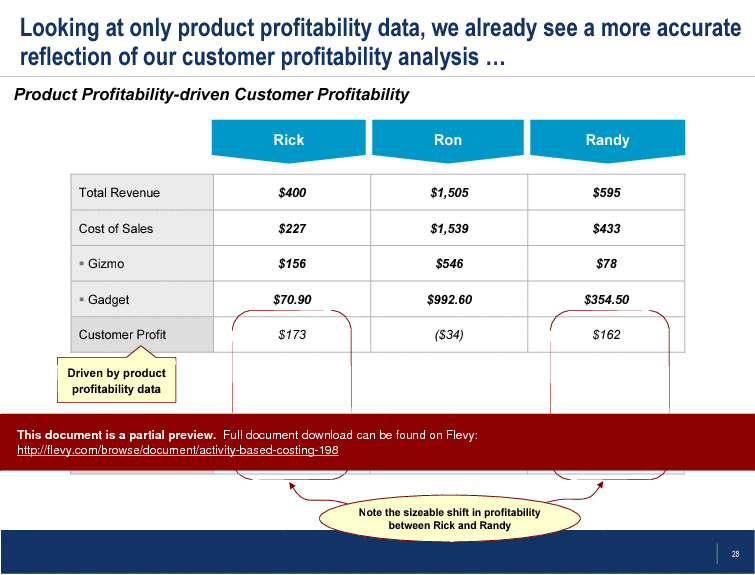
Additional topics discussed in this Activity Based Costing PPT include ABC vs. traditional costing methods, advantages and drawbacks of ABC, spreadsheet modeling, product profitability-driven customer profitability, among others. With this in-depth presentation, you can gain the understanding of how to develop an Activity Based Costing formula and Activity Based Costing System for your organization.

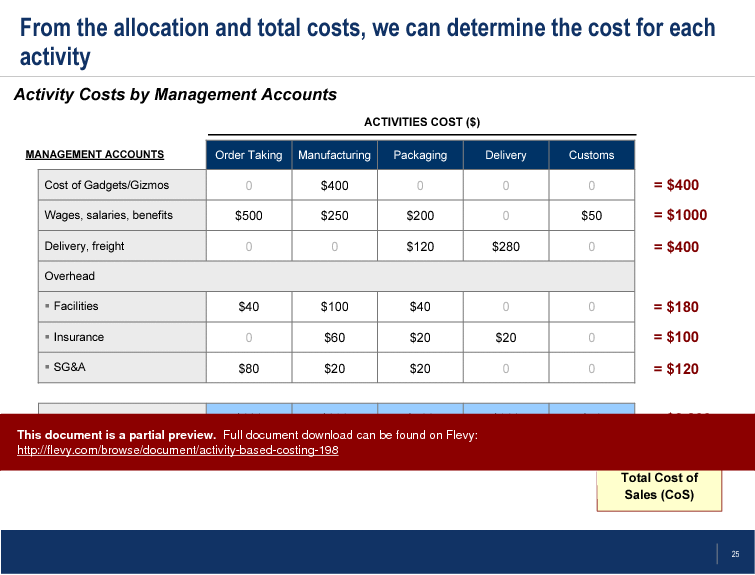
A full Activity Based Costing example is also included, which breaks down the financials overview, key activities, activity costs, activity drivers, product profitability analysis, and activity based customer profitability.

Gain insights into how ABC can be leveraged for cost object-level decisions, such as dropping unprofitable product lines. Understand the role of resource cost pools and resource drivers in accurately attributing costs to activities.

Got a question about the product? Email us at support@flevy.com or ask the author directly by using the "Ask the Author a Question" form. If you cannot view the preview above this document description, go here to view the large preview instead.

MARCUS OVERVIEW

This synopsis was written by Marcus [?] based on the analysis of the full 29-slide presentation.


Executive Summary
The Activity Based Costing (ABC) presentation provides a comprehensive methodology for accurately assigning costs to activities that drive those costs, surpassing traditional costing methods. Developed by former consultants from McKinsey, BCG, Deloitte, EY, and Capgemini, this consulting-grade resource equips corporate executives and consultants with the tools to make informed strategic decisions. By utilizing ABC, users can gain insights into the true profitability of product lines, customer segments, and distribution channels, enabling them to optimize pricing and product mix. This presentation outlines a structured 7-phase approach to implementing ABC, ensuring clarity and precision in cost management.

Who This Is For and When to Use
•  Financial analysts tasked with cost management and profitability analysis
•  Corporate executives seeking to enhance strategic decision-making
•  Consultants advising businesses on cost allocation methods
•  Operations managers aiming to improve efficiency and reduce costs

Best-fit moments to use this deck:
•  During financial strategy sessions to evaluate product and customer profitability
•  When transitioning from traditional costing methods to more accurate ABC analysis
•  In workshops focused on process improvement and operational efficiency

Learning Objectives
•  Define Activity Based Costing and its advantages over traditional methods
•  Develop a clear understanding of cost objects and their significance
•  Implement a 7-phase approach to ABC for effective cost allocation
•  Analyze profitability at the product and customer level using ABC
•  Identify and map cost drivers to enhance cost management
•  Utilize ABC for strategic decision-making in complex environments

Table of Contents
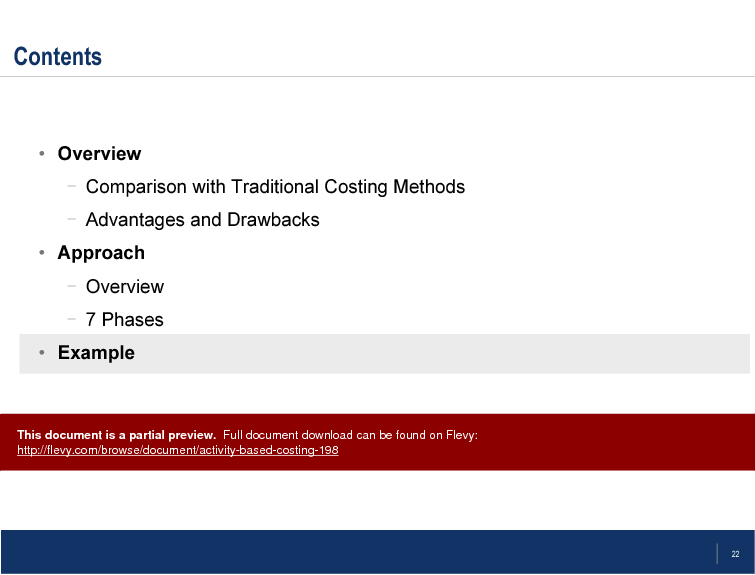
•  Overview (page 3)
•  Comparison with Traditional Costing Methods (page 5)
•  Advantages and Drawbacks (page 7)
•  Approach (page 9)
•  Overview of 7 Phases (page 10)
•  Example (page 22)

Primary Topics Covered
•  Overview of ABC - Activity Based Costing is a methodology for assigning costs to activities that drive costs, providing a clearer picture of profitability across various segments.
•  Comparison with Traditional Costing - ABC offers a more accurate assignment of both direct and indirect costs, correcting misallocations often found in traditional methods.
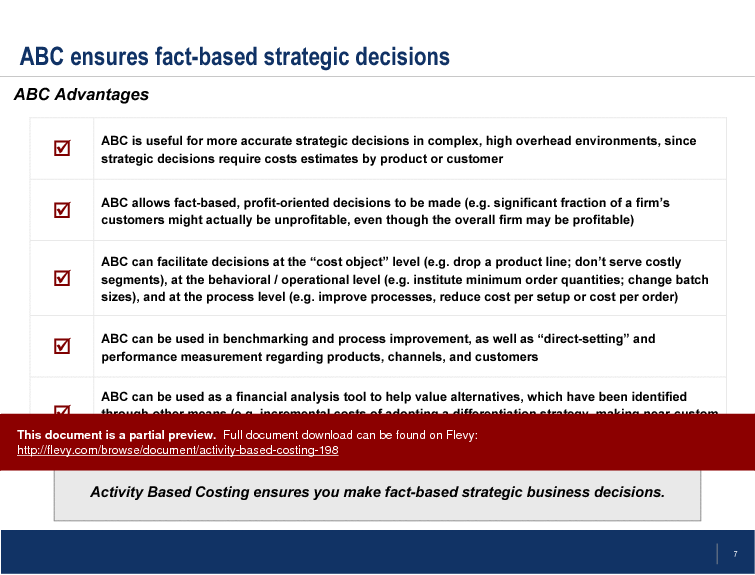
•  Advantages of ABC - ABC supports fact-based strategic decisions by revealing the true profitability of products and customers, crucial for high-overhead environments.
•  Drawbacks of ABC - While ABC provides improved accuracy, it may not address opportunity costs or reflect current operations if the system is outdated.
•  7-Phase Approach - A structured method for implementing ABC, including developing cost objects, mapping costs, and verifying economic logic.
•  Example Application - A practical case study demonstrating the application of ABC in a manufacturing context, showcasing its effectiveness in profitability analysis.

Deliverables, Templates, and Tools
•  Cost object identification template for defining products, customers, and markets
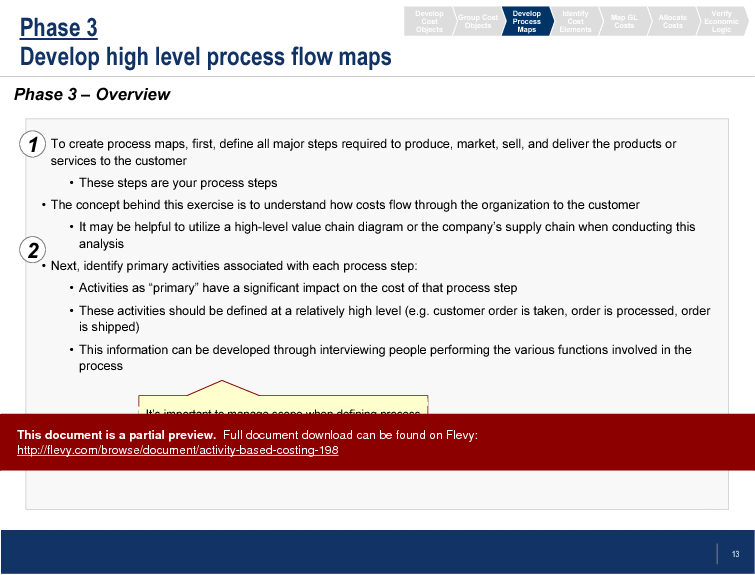
•  Process mapping framework to visualize cost flow through activities
•  Cost driver analysis tool to allocate costs accurately
•  Profitability analysis model for assessing product and customer profitability
•  Spreadsheet templates for income statements reflecting ABC analysis
•  Benchmarking tools for comparing ABC results with industry standards

Slide Highlights
•  Overview slide detailing the importance of ABC in strategic decision-making
•  Comparison slide illustrating the differences between ABC and traditional costing methods
•  Visual representation of the 7-phase approach to implementing ABC
•  Example slide showcasing a case study of a manufacturer using ABC
•  Slide summarizing the advantages and drawbacks of ABC analysis

Potential Workshop Agenda
Introduction to Activity Based Costing (30 minutes)
•  Overview of ABC principles and methodology
•  Discussion on the importance of accurate cost allocation

Implementing the 7-Phase Approach (60 minutes)
•  Step-by-step guide through the 7 phases of ABC
•  Group activity: Identifying cost objects and mapping processes

Case Study Analysis (45 minutes)
•  Review of the example application of ABC
•  Group discussion on insights and lessons learned

Customization Guidance
•  Tailor cost object definitions to align with your organization’s specific products and services
•  Adjust process maps to reflect your operational workflow and activities
•  Modify cost driver metrics based on industry standards and organizational needs

Secondary Topics Covered
•  Cost allocation methods and their implications for financial reporting
•  The role of overhead costs in overall profitability
•  Strategies for integrating ABC with existing financial systems
•  Best practices for maintaining ABC systems over time
•  The impact of ABC on pricing strategies and market positioning

FAQ
What is Activity Based Costing?
Activity Based Costing is a methodology for assigning costs to activities based on their actual consumption of resources, providing a more accurate reflection of profitability than traditional methods.

How does ABC differ from traditional costing methods?
ABC assigns both direct and indirect costs to specific cost objects, correcting misallocations common in traditional methods that often spread costs uniformly across products.

What are the main advantages of using ABC?
ABC allows for more accurate strategic decisions by revealing the true profitability of products and customers, especially in high-overhead environments.

Are there any drawbacks to ABC?
ABC may not address opportunity costs and can produce static data if the system is not regularly updated to reflect current operations.

How can I implement ABC in my organization?
Implement ABC by following the structured 7-phase approach outlined in this presentation, starting with identifying cost objects and mapping costs.

What tools can assist with ABC analysis?
Utilize spreadsheet models and templates for income statements, cost driver analysis, and profitability assessments to facilitate ABC implementation.

Can ABC be integrated with existing financial systems?
Yes, ABC can be integrated with current financial systems,, but it may require adjustments to ensure accurate data flow and reporting.

How often should ABC systems be updated?
Regular updates are essential to maintain the accuracy of cost allocations and reflect changes in operations, processes, and market conditions.

Glossary
•  Activity Based Costing (ABC) - A method for assigning costs to activities based on their actual consumption of resources.
•  Cost Object - Any end item to which activity costs are assigned, such as products or customers.
•  Cost Driver - A factor that causes a change in the cost of an activity, used for allocating costs.
•  Resource Cost Pool - A logical grouping of resources consumed in executing activities.
•  Activity Cost Pool - The total costs associated with performing a specific activity.
•  Profitability Analysis - The assessment of the profitability of products, customers, or segments based on cost allocations.
•  Overhead Costs - Indirect costs that cannot be directly traced to a specific cost object, such as utilities and administrative expenses.
•  Direct Costs - Costs that can be directly attributed to a specific cost object, such as raw materials and labor.
•  Financial Statements - Reports that summarize the financial performance and position of a business, including income statements and balance sheets.
•  Process Mapping - The visualization of the steps involved in producing, marketing, and delivering products or services.
•  Benchmarking - The process of comparing business processes and performance metrics to industry bests or best practices from other companies.
•  Value Chain - A model that describes the full range of activities required to create a product or service.
•  Segmentation - The process of dividing a market into distinct groups of buyers with different needs or behaviors.
•  Sanity Check - A review process to ensure that the results of an analysis make logical sense and are consistent with expectations.
•  Financial Analysis Tool - Software or methods used to evaluate financial data and support decision-making.
•  Incremental Costs - The additional costs incurred when a business adopts a new strategy or makes changes to existing operations.
•  Management Accounts - Internal financial reports used for decision-making and performance evaluation within an organization.
•  Strategic Decision-Making - The process of making choices that will shape the direction and performance of an organization.
•  Cost Allocation - The process of identifying, aggregating, and assigning costs to cost objects.
•  Operational Efficiency - The ability to deliver products or services in the most cost-effective manner without compromising quality.
•  Customer Profitability - The assessment of the profitability of individual customers based on their purchases and associated costs.
•  Financial Reporting - The process of producing statements that disclose an organization's financial status to stakeholders.

COST OPTIMIZATION PPT SLIDES

Cost Allocation: ABC vs. Traditional Methods

Cost Driver Identification and Unit Cost Calculation

Structured 7-Phase Approach to Activity Based Costing

Enhancing Cost Accuracy: ABC vs. Traditional Methods

Income Statement Modeling for Cost Object Analysis

Identifying Primary Cost Objects in ABC Analysis

Visual Framework for Activity-Based Costing Implementation

Source: Best Practices in Cost Optimization, Management Accounting, Activity Based Costing PowerPoint Slides: Activity Based Costing PowerPoint (PPT) Presentation Slide Deck, LearnPPT Consulting


$39.00
This presentation is created by former McKinsey, BCG, Deloitte, EY, and Capgemini consultants. It teaches a practical consulting framework actively used by tier-1 consulting firms.
Add to Cart
  

ABOUT THE AUTHOR

Author image
Additional documents from author: 141

We are a team of management consultants trained by top tier global consulting firms (including McKinsey, BCG, Deloitte, EY, Capgemini) with a collective experience of several decades. We specialize in business frameworks based on real-life consulting engagements.

We have served 100s of clients that range from Fortune 500 companies to tech startups to ... [read more]

Ask the Author a Question

You must be logged in to contact the author.

Click here to log in Click here register

Did you know?
The average daily rate of a McKinsey consultant is $6,625 (not including expenses). The average price of a Flevy document is $65.

Bundle and save! You can save up to % with bundles!

View bundle(s)


Trusted by over 10,000+ Client Organizations
Since 2012, we have provided business templates to over 10,000 businesses and organizations of all sizes, from startups and small businesses to the Fortune 100, in over 130 countries.
AT&T GE Cisco Intel IBM Coke Dell Toyota HP Nike Samsung Microsoft Astrazeneca JP Morgan KPMG Walgreens Walmart 3M Kaiser Oracle SAP Google E&Y Volvo Bosch Merck Fedex Shell Amgen Eli Lilly Roche AIG Abbott Amazon PwC T-Mobile Broadcom Bayer Pearson Titleist ConEd Pfizer NTT Data Schwab


Read Customer Testimonials

 
"I have used FlevyPro for several business applications. It is a great complement to working with expensive consultants. The quality and effectiveness of the tools are of the highest standards."

– Moritz Bernhoerster, Global Sourcing Director at Fortune 500
 
"I like your product. I'm frequently designing PowerPoint presentations for my company and your product has given me so many great ideas on the use of charts, layouts, tools, and frameworks. I really think the templates are a valuable asset to the job."

– Roberto Fuentes Martinez, Senior Executive Director at Technology Transformation Advisory
 
"The wide selection of frameworks is very useful to me as an independent consultant. In fact, it rivals what I had at my disposal at Big 4 Consulting firms in terms of efficacy and organization."

– Julia T., Consulting Firm Owner (Former Manager at Deloitte and Capgemini)
 
"My FlevyPro subscription provides me with the most popular frameworks and decks in demand in today’s market. They not only augment my existing consulting and coaching offerings and delivery, but also keep me abreast of the latest trends, inspire new products and service offerings for my practice, and educate me "

– Bill Branson, Founder at Strategic Business Architects
 
"Flevy.com has proven to be an invaluable resource library to our Independent Management Consultancy, supporting and enabling us to better serve our enterprise clients.

The value derived from our [FlevyPro] subscription in terms of the business it has helped to gain far exceeds the investment made, making a subscription a no-brainer for any growing consultancy – or in-house strategy team."

– Dean Carlton, Chief Transformation Officer, Global Village Transformations Pty Ltd.
 
"Flevy is now a part of my business routine. I visit Flevy at least 3 times each month.

Flevy has become my preferred learning source, because what it provides is practical, current, and useful in this era where the business world is being rewritten.

In today's environment where there are so "

– Omar Hernán Montes Parra, CEO at Quantum SFE
 
"As a consulting firm, we had been creating subject matter training materials for our people and found the excellent materials on Flevy, which saved us 100's of hours of re-creating what already exists on the Flevy materials we purchased."

– Michael Evans, Managing Director at Newport LLC
 
"Last Sunday morning, I was diligently working on an important presentation for a client and found myself in need of additional content and suitable templates for various types of graphics. Flevy.com proved to be a treasure trove for both content and design at a reasonable price, considering the time I "

– M. E., Chief Commercial Officer, International Logistics Service Provider


Save with Bundles

This document is available as part of the following discounted bundle(s):

Save %!
Competitive and Company Cost Analysis

This bundle contains 5 total documents. See all the documents to the right.

$129.00


Add Bundle & Save


Customers Also Bought These Documents


Customers Also Like These Documents

Explore Related Management Topics


Your Recently Viewed Documents
Receive our FREE presentation on Operational Excellence

This 50-slide presentation provides a high-level introduction to the 4 Building Blocks of Operational Excellence. Achieving OpEx requires the implementation of a Business Execution System that integrates these 4 building blocks.