
This framework is developed by a team of former McKinsey and Big 4 consultants. The presentation follows the headline-body-bumper slide format used by global consulting firms.
Explore UML fundamentals in this PPT by ex-McKinsey and Big 4 consultants. Enhance system design, stakeholder communication, and risk management. Unified Modeling Language (UML) Primer is a 40-slide PPT PowerPoint presentation slide deck (PPTX) available for immediate download upon purchase.
The complexity of specifying, building, and visualizing software systems presents a significant challenge, particularly in environments where clear communication between business stakeholders and technical teams is crucial.
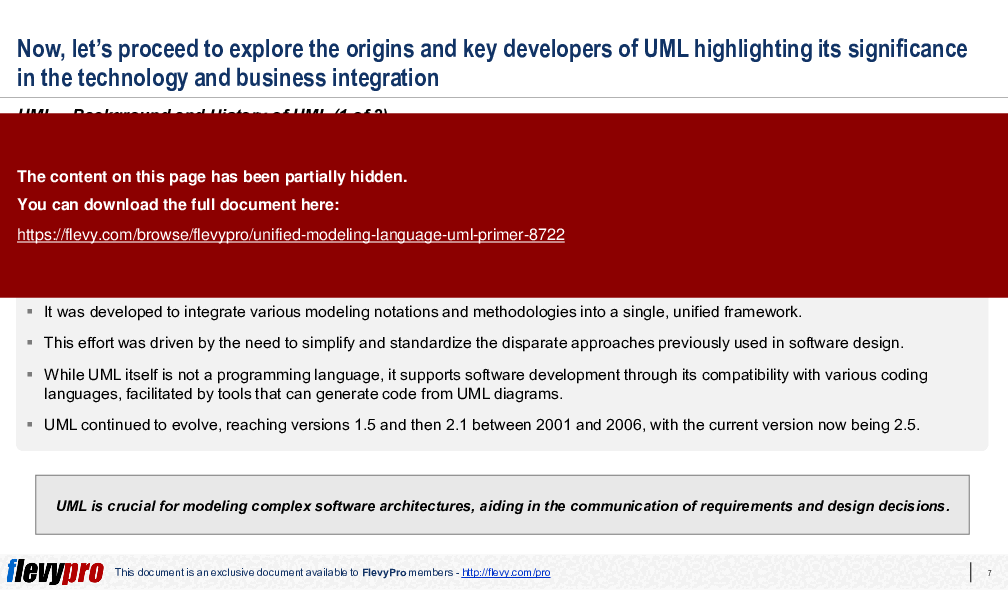
Thus, the Unified Modeling Language (UML) was developed as a solution to this problem. UML aims to provide a standardized visual modeling language that enhances mutual understanding across different disciplines. UML bridges the gap between technical and non-technical stakeholders, ensuring a shared understanding of system requirements and designs.
UML is not just applicable in software development but also in business processes and other areas, functioning like blueprints to guide system design across various applications. It encompasses a range of diagram types, including behavior, interaction, and structure diagrams, which together describe the system's boundaries, structures, and behaviors.
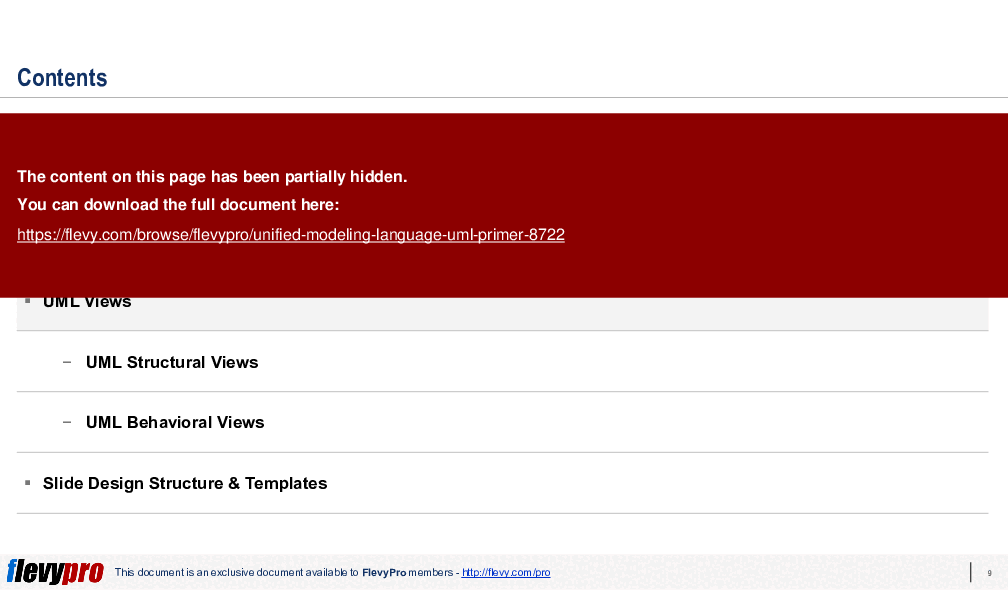
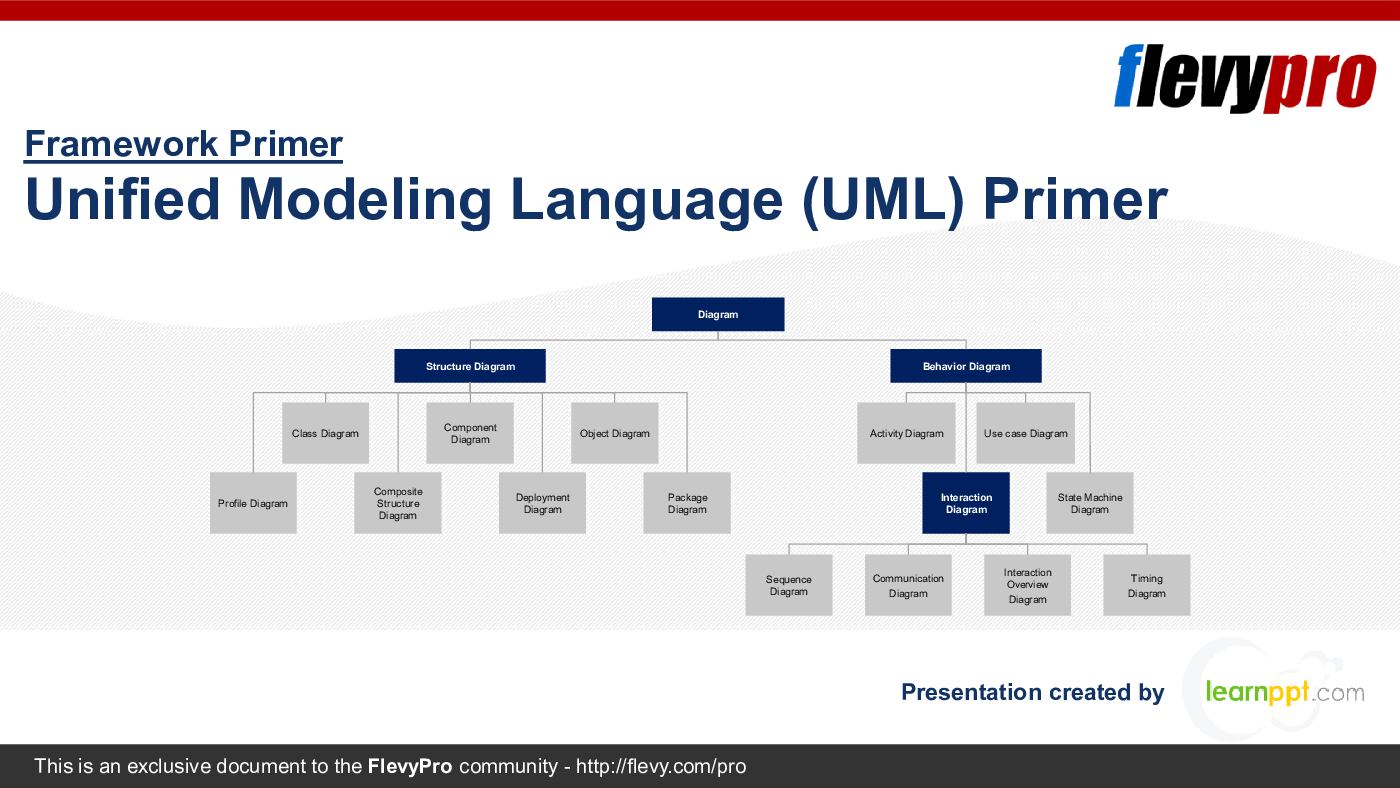
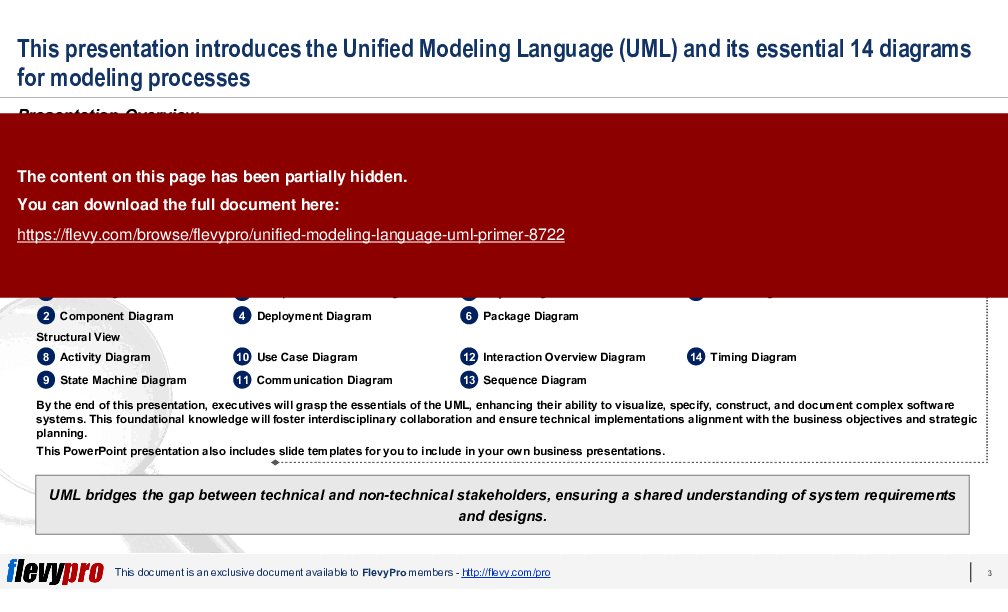
In this PowerPoint presentation, we will discuss the 2 general views of UML, Behavioral View and Structural View, and the 7 diagram types categorized under each view:
Structural View
8. Activity Diagram
9. State Machine Diagram
10. Use Case Diagram
11. Communication Diagram
12. Interaction Overview Diagram
13. Sequence Diagram
14. Timing Diagram
By the end of this PPT presentation, executives will grasp the essentials of the UML, enhancing their ability to visualize, specify, construct, and document complex software systems. This foundational knowledge will foster interdisciplinary collaboration and ensure technical implementations alignment with the business objectives and strategic planning.
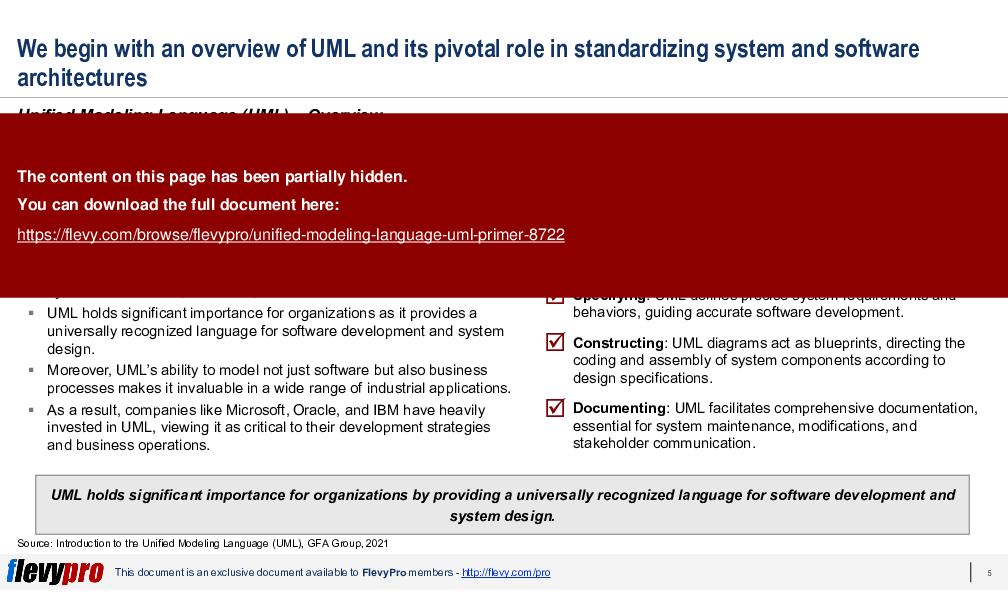
UML serves as a critical tool for ensuring clear and consistent communication across various teams and stakeholders in an organization, from business analysts and architects to developers and testers. By providing a standardized visual representation of system architecture, workflows, and processes, UML minimizes misunderstandings, aligns expectations, and accelerates the development lifecycle.
For Enterprise Architects (EAs) and IT executives, UML is invaluable in designing scalable, robust systems. It allows for the detailed visualization of system components and their interactions, making it easier to identify potential bottlenecks, redundancies, and opportunities for optimization. This foresight ensures that systems can scale efficiently with organizational growth and evolving business requirements.
Utilizing UML in the planning and design phases aids IT executives in identifying and mitigating risks early in the project lifecycle. Detailed UML diagrams provide a comprehensive view of system dependencies and potential failure points, enabling proactive risk management. This, in turn, supports more informed decision-making, ensuring that projects stay on track, within budget, and aligned with strategic objectives.
This PowerPoint presentation also includes slide templates for you to include in your own business presentations.
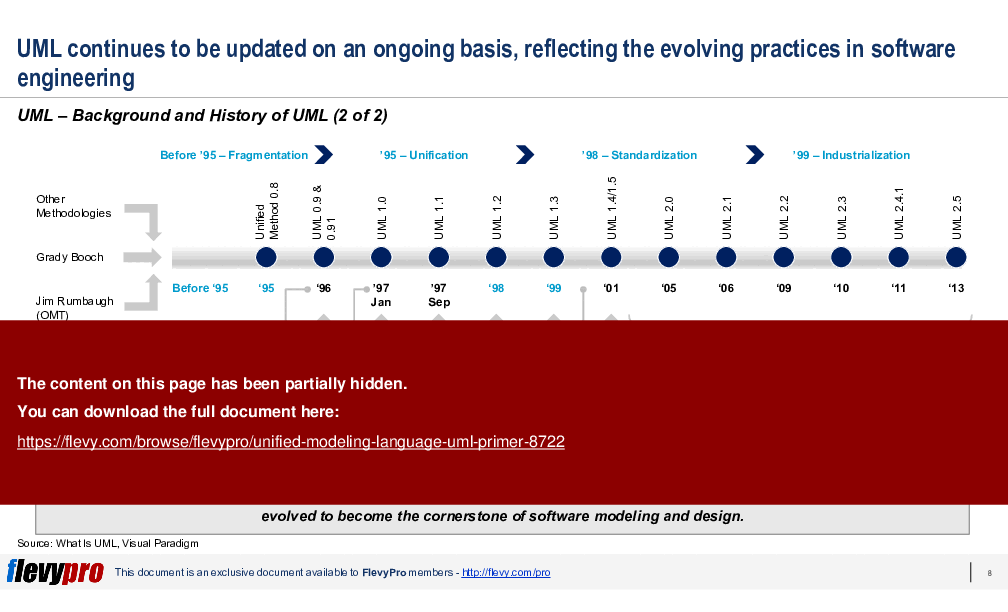
The timeline details the evolution of the Unified Modeling Language (UML) from its fragmented beginnings before 1995, where methodologies like the Unified Method and OMT coexisted. Key milestones include the unification of these methodologies in 1995 by Ivar Jacobson, leading to UML's formal introduction in 1996. The Object Management Group (OMG) officially adopted UML in 1997, ensuring industry support and standardization. UML 2.0 was released in 2000, enhancing scalability and expressiveness. The timeline concludes with UML 2.5 in 2013, reflecting ongoing updates that align with evolving software engineering practices. UML's adaptability underscores its significance as a modeling and design tool in contemporary software development.
This PPT slide provides an overview of the Package Diagram within the Unified Modeling Language (UML) framework, highlighting its role in organizing UML model elements into packages for managing extensive systems. Key components include Packages, Package Dependencies, and Package Merge. Packages group related UML elements, such as classes and interfaces, ensuring clarity in complex systems. Package Dependencies show interconnections between packages, indicating how changes in one can affect others, which is essential for effective system management and risk mitigation. Package Merge consolidates elements from one package into another, critical for system refactoring. Actionable steps for leveraging Package Diagrams include organizing system elements, managing dependencies, and refactoring to enhance structure and consolidate components.
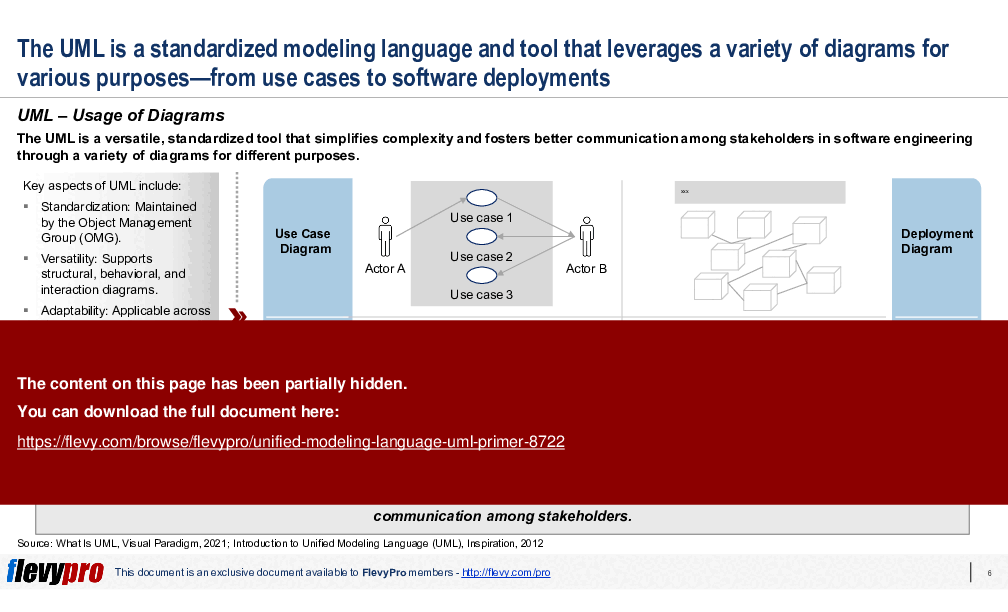
This PPT slide provides an overview of the Unified Modeling Language (UML) and its application in software engineering through various diagrams. UML, standardized by the Object Management Group (OMG), simplifies complexity and enhances communication among stakeholders. Key UML diagram types include Use Case Diagrams, which illustrate interactions between actors and use cases, and Sequence Diagrams, depicting the order of operations and interactions over time. Additional diagram types are Deployment Diagrams, showing the physical deployment of artifacts on nodes, and Class Diagrams, representing the static structure of a system and detailing classes and their relationships. UML standardization reduces complexity, improving understanding and collaboration across diverse teams, which is essential for streamlining software development processes.
This PPT slide provides an overview of the Structural View within the Unified Modeling Language (UML), focusing on the system's static structure. It categorizes various diagrams that illustrate the organization of classes, objects, and their relationships. The Class Diagram is foundational, depicting classes and their interrelations, essential for understanding component interactions. The Component Diagram details system partitioning into components and their dependencies, helping identify bottlenecks. The Composite Structure Diagram showcases a class's internal structure and interactions, crucial for developers. The Deployment Diagram illustrates hardware used in system implementations, aiding operational planning. The Profile Diagram links stereotypes as classes and profiles as packages to the metamodel. The Package Diagram shows system organization into packages and their dependencies. Lastly, the Object Diagram provides a snapshot of the system's structure for debugging and analysis.
UML Component Diagrams illustrate the modularity of system architecture, categorizing content into Overview, Components, and Implementation. The Overview states that component diagrams are essential for mapping physical and logical components, crucial for understanding software component architecture and supporting modular development. The Components section identifies 3 key elements: Components, Interfaces, and Component Realizations. Components are modular parts like software packages that encapsulate specific functionalities. Interfaces specify the inputs and outputs required by components, while Component Realizations detail how these interfaces are implemented. The Implementation section outlines a three-step process: identifying system components and relationships, documenting interfaces for interoperability, and aligning deployment with the diagram to guide physical integration.
Source: Best Practices in Enterprise Architecture, Business Architecture, Business Process Management, Systems Thinking PowerPoint Slides: Unified Modeling Language (UML) Primer PowerPoint (PPTX) Presentation Slide Deck, LearnPPT Consulting
This framework is developed by a team of former McKinsey and Big 4 consultants. The presentation follows the headline-body-bumper slide format used by global consulting firms.
For $10.00 more, you can download this document plus 2 more FlevyPro documents. That's just $13 each.
ABOUT FLEVYPRO
This document is part of the FlevyPro Library, a curated knowledge base of documents for our FlevyPro subscribers.

FlevyPro is a subscription service for on-demand business frameworks and analysis tools. FlevyPro subscribers receive access to an exclusive library of curated business documents—business framework primers, presentation templates, Lean Six Sigma tools, and more—among other exclusive benefits.
The average daily rate of a McKinsey consultant is $6,625 (not including expenses). The average price of a Flevy document is $65.
Trusted by over 10,000+ Client Organizations
Since 2012, we have provided business templates to over 10,000 businesses and organizations of all sizes, from startups and small businesses to the Fortune 100, in over 130 countries.
"FlevyPro provides business frameworks from many of the global giants in management consulting that allow you to provide best in class solutions for your clients."
– David Harris, Managing Director at Futures Strategy
"One of the great discoveries that I have made for my business is the Flevy library of training materials.
As a Lean Transformation Expert, I am always making presentations to clients on a variety of topics: Training, Transformation, Total Productive Maintenance, Culture, Coaching, Tools, Leadership Behavior, etc. Flevy
It is well worth the money to purchase these presentations. Sure, I have the knowledge and information to make my point. It is another thing to create a presentation that captures what I want to say. Flevy has saved me countless hours of preparation time that is much better spent with implementation that will actually save money for my clients.
"
– Ed Kemmerling, Senior Lean Transformation Expert at PMG
"I have found Flevy to be an amazing resource and library of useful presentations for lean sigma, change management and so many other topics. This has reduced the time I need to spend on preparing for my performance consultation. The library is easily accessible and updates are regularly provided. A wealth of great information."
– Cynthia Howard RN, PhD, Executive Coach at Ei Leadership
"As a consultant requiring up to date and professional material that will be of value and use to my clients, I find Flevy a very reliable resource.
The variety and quality of material available through Flevy offers a very useful and commanding source for information. Using Flevy saves me time, enhances my expertise and ends up being a good decision."
– Dennis Gershowitz, Principal at DG Associates
"FlevyPro has been a brilliant resource for me, as an independent growth consultant, to access a vast knowledge bank of presentations to support my work with clients. In terms of RoI, the value I received from the very first presentation I downloaded paid for my subscription many times over! The
quality of the decks available allows me to punch way above my weight – it's like having the resources of a Big 4 consultancy at your fingertips at a microscopic fraction of the overhead.
"
– Roderick Cameron, Founding Partner at SGFE Ltd
"As an Independent Management Consultant, I find Flevy to add great value as a source of best practices, templates and information on new trends. Flevy has matured and the quality and quantity of the library is excellent. Lastly the price charged is reasonable, creating a win-win value for
the customer, Flevy and the various authors. This is truly a service that benefits the consulting industry and associated clients. Thanks for providing this service.
"
– Jim Schoen, Principal at FRC Group
"If you are looking for great resources to save time with your business presentations, Flevy is truly a value-added resource. Flevy has done all the work for you and we will continue to utilize Flevy as a source to extract up-to-date information and data for our virtual and onsite presentations!"
– Debbi Saffo, President at The NiKhar Group
"The wide selection of frameworks is very useful to me as an independent consultant. In fact, it rivals what I had at my disposal at Big 4 Consulting firms in terms of efficacy and organization."
– Julia T., Consulting Firm Owner (Former Manager at Deloitte and Capgemini)
Receive our FREE presentation on Operational Excellence
This 50-slide presentation provides a high-level introduction to the 4 Building Blocks of Operational Excellence. Achieving OpEx requires the implementation of a Business Execution System that integrates these 4 building blocks.
Receive our FREE presentation on Operational Excellence
Get Our FREE Product.
This 50-slide presentation provides a high-level introduction to the 4 Building Blocks of Operational Excellence. Achieving OpEx requires the implementation of a Business Execution System that integrates these 4 building blocks.