
Jobs-to-Be-Done (JTBD) Theory   35-slide PPT PowerPoint presentation slide deck (PPTX)
$29.00

Jobs-to-Be-Done (JTBD) Theory (35-slide PPT PowerPoint presentation slide deck (PPTX)) Preview Image
Log in to unlock full preview.
Jobs-to-Be-Done (JTBD) Theory (35-slide PPT PowerPoint presentation slide deck (PPTX)) Preview Image
Arrow   Click main image to view in full screen.

Jobs-to-Be-Done (JTBD) Theory (PowerPoint PPTX Slide Deck)

PowerPoint (PPTX) 35 Slides FlevyPro Document

Top 500 Best Practice $29.00
FlevyPro price: FREE (included in subscription)
This framework is developed by a team of former McKinsey and Big 4 consultants. The presentation follows the headline-body-bumper slide format used by global consulting firms.
Add to Cart


Immediate download
Free lifetime updates

INNOVATION MANAGEMENT PPT DESCRIPTION

Editor Summary Jobs-to-Be-Done (JTBD) Theory is a 35-slide PowerPoint (PPTX) deck by LearnPPT Consulting that presents a structured JTBD framework and implementation approach developed by an ex-McKinsey consultant. Read more

The enormous amount of data available today should have made it easy for organizations to capture what the customers hope to achieve. However, this is not the case. Almost everywhere, data is being used to find out correlations instead of causation.

This presentation provides a detailed overview of the Jobs-to-Be-Done (JTBD) Theory and its role in helping us perceive customer choices by getting to the level of what causes a purchase.

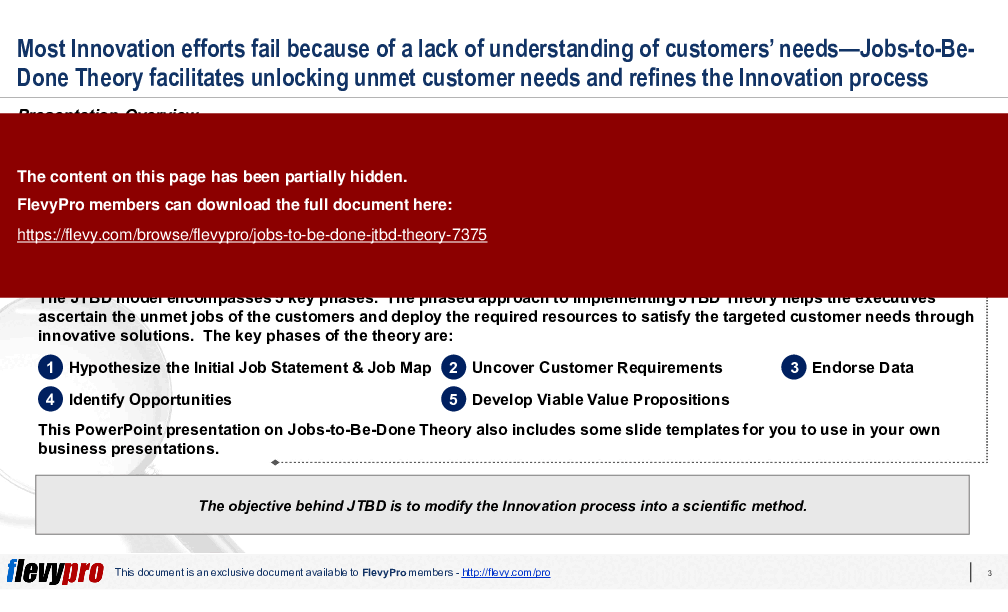
The JTBD Theory provides a robust approach to ascertaining customer requirements and pain points. JTBD Theory does that by identifying the tasks or jobs that customers desire to accomplish. Understanding unmet customer requirements is the foundation behind the JTBD Theory, which it leverages to develop a robust Innovation Strategy.

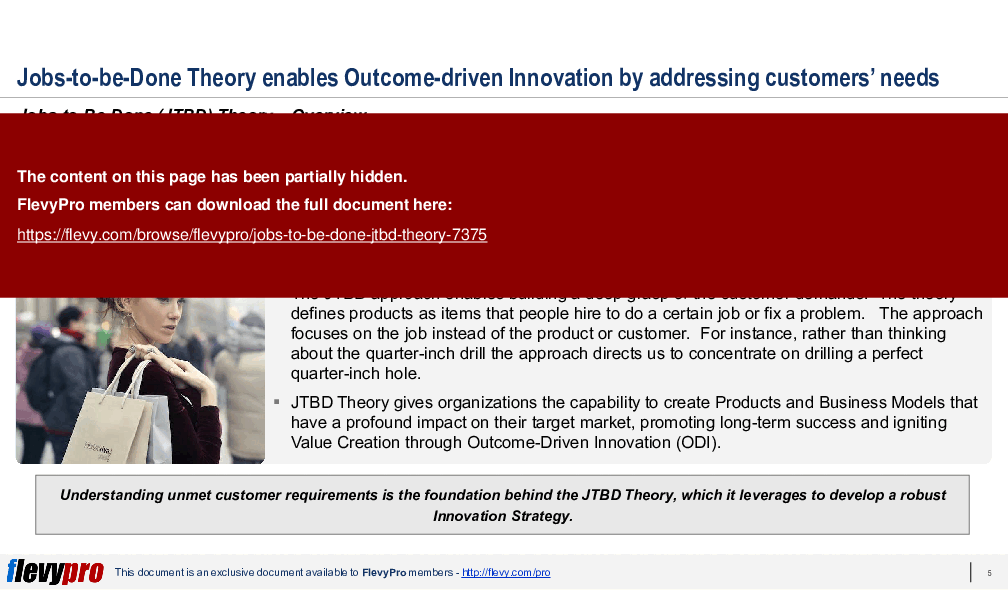
This framework defines products as items that people hire to do a certain job or fix a problem. The approach focuses on the job instead of the product or customer. For instance, rather than thinking about the quarter-inch drill the approach directs us to concentrate on drilling a perfect quarter-inch hole.

JTBD Theory gives organizations the capability to create Products and Business Models that have a profound impact on their target market, promoting long-term success and igniting Value Creation through Outcome-Driven Innovation (ODI).

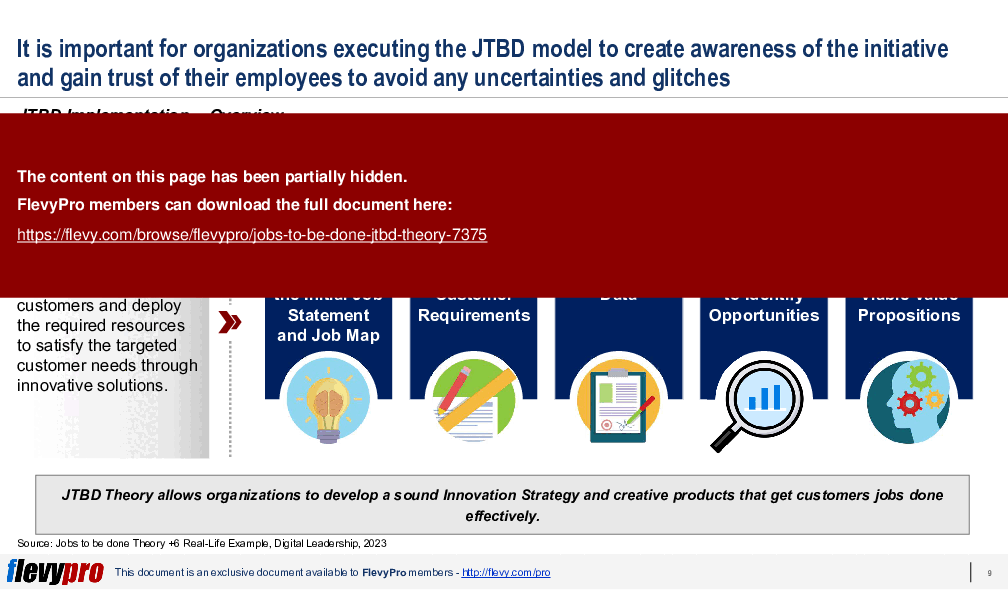
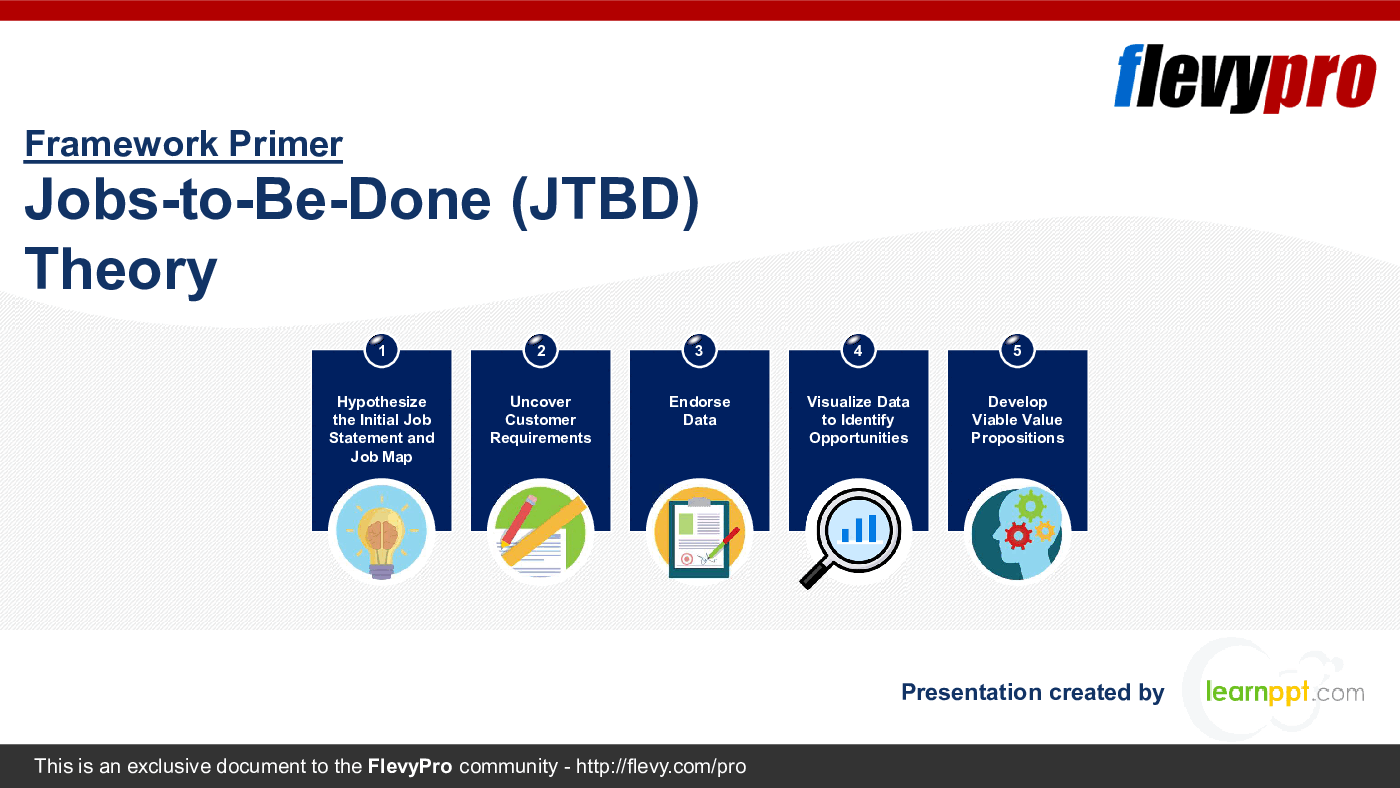
The JTBD model encompasses 5 key phases. The phased approach to implementing JTBD Theory helps the executives ascertain the unmet jobs of the customers and deploy the required resources to satisfy the targeted customer needs through innovative solutions. The key phases of the theory are:

1. Hypothesize the Initial Job Statement & Job Map
2. Uncover Customer Requirements
3. Endorse Data
4. Identify Opportunities
5. Develop Viable Value Propositions

Each of these phases is discussed in depth. Additional topics covered in this presentation include the 9 Pillars of JTBD Theory, the Customer Job Statement, 9-Phase Job Map Refinement, Customer Criteria, among other topics. This presentation also includes a number of examples of JTBD applications at numerous blue-chip companies.

This PowerPoint presentation on Jobs-to-Be-Done Theory also includes some slide templates for you to use in your own business presentations.

Got a question about this document? Email us at flevypro@flevy.com.

MARCUS OVERVIEW

This synopsis was written by Marcus [?] based on the analysis of the full 35-slide presentation.


Executive Summary
The Jobs-to-Be-Done (JTBD) Theory presentation provides a comprehensive framework for understanding customer needs and enhancing innovation strategies. Developed by an ex-McKinsey consultant, this PowerPoint deck outlines a structured approach to identifying unmet customer jobs and deploying resources effectively. By leveraging JTBD, organizations can transform their innovation processes into a scientific method, leading to improved product development and customer satisfaction. The presentation includes practical templates and insights to facilitate implementation in various business contexts.

Who This Is For and When to Use
•  Product Managers seeking to refine product offerings based on customer insights
•  Innovation Teams focused on developing customer-centric solutions
•  Marketing Professionals aiming to understand customer motivations and behaviors
•  Executives looking to enhance strategic decision-making through data-driven insights

Best-fit moments to use this deck:
•  During product development workshops to align teams on customer needs
•  In strategy sessions focused on innovation and market positioning
•  For training sessions aimed at integrating JTBD principles across teams

Learning Objectives
•  Define the Jobs-to-Be-Done framework and its application in innovation
•  Build a clear Job Statement and Job Map to capture customer needs
•  Conduct effective customer interviews to uncover requirements
•  Analyze data to identify opportunities for product development
•  Develop compelling value propositions that address unmet customer jobs

Table of Contents
•  Overview (page 3)
•  Jobs-to-Be-Done (JTBD) Theory (page 5)
•  JTBD Implementation (page 9)
•  Additional Considerations (page 19)
•  Slide Design Structure & Templates (page 24)

Primary Topics Covered
•  JTBD Theory Overview - An introduction to the JTBD framework, emphasizing its role in understanding customer needs and driving innovation.
•  Phases of JTBD Implementation - A structured approach comprising 5 key phases to effectively implement JTBD in organizations.
•  Customer Interviews - Techniques for conducting interviews to gather qualitative data on customer needs and pain points.
•  Data Visualization - Methods for visualizing customer data to identify opportunities and inform strategic decisions.
•  Value Proposition Development - Strategies for creating value propositions that effectively address customer jobs and differentiate from competitors.

Deliverables, Templates, and Tools
•  Job Statement template for capturing customer needs
•  Job Map framework to visualize customer tasks
•  Structured interview guides for conducting customer research
•  Data visualization tools for analyzing survey results
•  Value proposition development templates for aligning product offerings

Slide Highlights
•  Overview of the JTBD Theory and its significance in innovation
•  Detailed phases of JTBD implementation with actionable steps
•  Visual representation of the Job Map and its components
•  Examples of successful JTBD applications across various industries
•  Best practices for integrating JTBD insights into organizational culture

Potential Workshop Agenda
JTBD Introduction and Overview (60 minutes)
•  Present the JTBD framework and its importance
•  Discuss the phases of JTBD implementation
•  Review case studies of successful JTBD applications

Customer Interview Techniques (90 minutes)
•  Train participants on conducting effective customer interviews
•  Role-play scenarios to practice interviewing skills
•  Develop a Job Statement and Job Map based on interview findings

Data Analysis and Visualization (60 minutes)
•  Introduce tools for visualizing customer data
•  Analyze survey results to identify key insights
•  Discuss how to prioritize opportunities based on data

Customization Guidance
•  Tailor the Job Statement template to reflect specific customer segments
•  Modify interview guides to align with industry-specific contexts
•  Adapt data visualization tools to suit organizational needs and metrics
•  Incorporate company-specific examples in value proposition development

Secondary Topics Covered
•  The role of qualitative vs. quantitative data in understanding customer needs
•  Challenges in implementing JTBD and strategies to overcome them
•  Best practices for fostering a customer-centric culture within organizations
•  Examples of innovative products developed using JTBD principles

Topic FAQ

What are the key phases of a JTBD implementation process?

A JTBD implementation follows 5 phases: hypothesize the initial Job Statement and Job Map; uncover customer requirements; endorse data; identify opportunities; and develop viable value propositions. These phases guide discovery through commercial validation and are presented sequentially as the core implementation model in the deck, totaling 5 key phases.

How do you create a Job Map to capture customer tasks?

A Job Map is built by breaking the target job into ordered steps customers take to complete it, documenting pain points and success criteria at each step, and iterating from customer interviews. The presentation includes a Job Map framework and examples to visualize tasks and touchpoints using the Job Map framework.

What structure should customer interviews follow for JTBD research?

JTBD interviews use structured, open-ended questions to elicit causal motivations, task sequences, and unmet outcomes. The deck recommends role-play practice, scenario probes, and transcripts analysis to surface requirements and pain points, supported by provided structured interview guides tailored for JTBD interview execution.

How does JTBD differ from traditional product-centric research?

JTBD shifts focus from product attributes to the underlying job customers hire a product to perform, emphasizing causation over mere correlation in behavior data. This approach targets unmet customer requirements and outcome metrics rather than feature checklists, centering analysis on the job instead of the product.

What should I look for when buying a JTBD toolkit for a small team with limited budget?

Prioritize toolkits that include practical templates, workshop agendas, interview guides, and customization guidance so teams can run workshops without heavy consulting hours. The product description identifies slide count, author background, and included tools—this deck offers 35 slides plus Job Statement and Job Map templates.

How long does a typical JTBD workshop take using a standard deck?

The suggested workshop agenda in the presentation totals about 210 minutes: 60 minutes for JTBD introduction and overview, 90 minutes for customer interview techniques and role-play, and 60 minutes for data analysis and visualization—roughly a 3.5-hour session using the provided agenda.

I need to prioritize product features after customer interviews — how can JTBD help?

JTBD helps by translating interview insights into customer requirements, endorsing data to validate importance, identifying opportunity spaces, and shaping value propositions that map to prioritized jobs. The deck supplies data visualization tools and value proposition development templates to move from interviews to prioritized solutions and templates.

Are paid JTBD slide decks worth it compared to free online resources for team training?

Paid JTBD decks typically package structured templates, workshop agendas, examples, and customization guidance that save preparation time and standardize training. This presentation specifically includes slide templates, interview guides, Job Statement and Job Map artifacts, and workshop agendas as packaged deliverables available on Flevy.

Document FAQ
These are questions addressed within this presentation.

What is the Jobs-to-Be-Done Theory?
The Jobs-to-Be-Done Theory is a framework that helps organizations understand customer needs by focusing on the tasks or "jobs" customers aim to accomplish.

How can JTBD improve innovation strategies?
By identifying unmet customer jobs, organizations can develop targeted solutions that resonate with users, leading to higher success rates in innovation.

What are the key phases of JTBD implementation?
The key phases include hypothesizing the Job Statement, uncovering customer requirements, endorsing data, visualizing opportunities, and developing viable value propositions.

How do I conduct effective customer interviews?
Use structured questionnaires with open-ended questions to gather in-depth insights about customer behaviors, pain points, and preferences.

What tools can help visualize customer data?
Data visualization tools can assist in identifying trends, segmenting markets, and prioritizing opportunities based on customer feedback.

How do I develop a compelling value proposition?
Compare prioritized customer needs against your organization’s capabilities to create value propositions that effectively address those needs.

What challenges might arise when implementing JTBD?
Common challenges include misidentifying customer needs, relying too heavily on quantitative data, and lacking organizational buy-in for a customer-centric approach.

How can organizations foster a customer-centric culture?
Encourage collaboration across teams, prioritize customer feedback in product development, and align organizational goals around customer jobs.

Glossary
•  Jobs-to-Be-Done (JTBD) - A framework for understanding customer needs based on the tasks they aim to accomplish.
•  Job Statement - A concise statement summarizing the customer’s unmet jobs.
•  Job Map - A visual representation of the steps customers take to complete a job.
•  Customer Criteria - Metrics used to assess customer satisfaction and the importance of various needs.
•  Data Visualization - Techniques for representing data graphically to identify trends and insights.
•  Value Proposition - A statement that outlines how a product meets customer needs effectively.
•  Qualitative Research - Research methods focused on understanding customer behaviors and motivations through interviews and observations.
•  Quantitative Research - Research methods that involve collecting numerical data to analyze customer satisfaction and preferences.
•  Innovation Strategy - A plan for developing new products or services based on customer insights and market opportunities.
•  Customer-Centric Culture - An organizational mindset that prioritizes understanding and addressing customer needs.
•  Market Segmentation - The process of dividing a market into distinct groups of customers with similar needs.
•  Competitive Advantage - The attributes that allow an organization to outperform its competitors.
•  Outcome-Driven Innovation (ODI) - An approach that focuses on delivering customer outcomes through innovative solutions.
•  Customer Journey - The complete experience a customer has with a product or service from awareness to purchase and beyond.
•  Customer Feedback - Insights gathered from customers regarding their experiences and satisfaction with a product or service.
•  Prototyping - The process of creating a preliminary model of a product to test concepts and gather user feedback.
•  Stakeholder Engagement - Involving key individuals or groups in the decision-making process to ensure alignment and support.
•  Continuous Improvement - Ongoing efforts to enhance products, services, or processes based on customer feedback and performance metrics.
•  Customer Loyalty - The tendency of customers to continue purchasing from a particular brand or company due to positive experiences.

INNOVATION MANAGEMENT PPT SLIDES

Defining Customer Criteria for JTBD Implementation

Structured Framework for Job-to-Be-Done Analysis

Framework for Developing Customer Job Statements

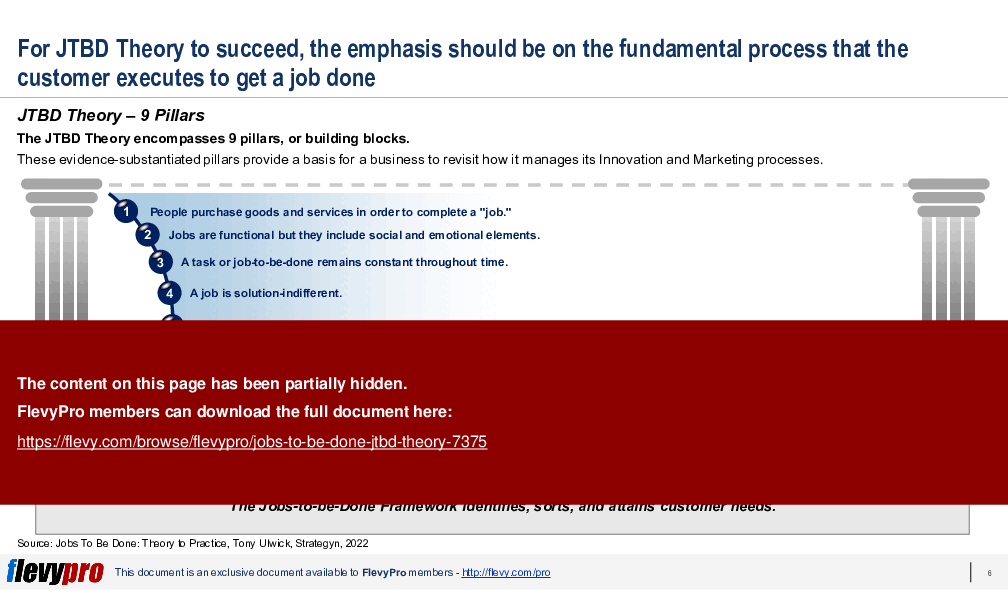
Understanding the Nine Pillars of JTBD Theory

Crafting Effective Value Propositions for Customer Needs

Phased Approach to Jobs-to-be-Done Implementation

Source: Best Practices in Innovation, Customer Satisfaction, Customer Analysis, Customer-centric Design PowerPoint Slides: Jobs-to-Be-Done (JTBD) Theory PowerPoint (PPTX) Presentation Slide Deck, LearnPPT Consulting


$29.00
FlevyPro price: FREE (included in subscription)
This framework is developed by a team of former McKinsey and Big 4 consultants. The presentation follows the headline-body-bumper slide format used by global consulting firms.
Add to Cart
  

Did you need more documents?

Consider a FlevyPro subscription from $39/month. View plans here.

For $10.00 more, you can download this document plus 2 more FlevyPro documents. That's just $13 each.

ABOUT FLEVYPRO

This document is part of the FlevyPro Library, a curated knowledge base of documents for our FlevyPro subscribers.

FlevyPro is a subscription service for on-demand business frameworks and analysis tools. FlevyPro subscribers receive access to an exclusive library of curated business documents—business framework primers, presentation templates, Lean Six Sigma tools, and more—among other exclusive benefits.

Click here to learn more about FlevyPro and its benefits.

Did you know?
The average daily rate of a McKinsey consultant is $6,625 (not including expenses). The average price of a Flevy document is $65.


Trusted by over 10,000+ Client Organizations
Since 2012, we have provided business templates to over 10,000 businesses and organizations of all sizes, from startups and small businesses to the Fortune 100, in over 130 countries.
AT&T GE Cisco Intel IBM Coke Dell Toyota HP Nike Samsung Microsoft Astrazeneca JP Morgan KPMG Walgreens Walmart 3M Kaiser Oracle SAP Google E&Y Volvo Bosch Merck Fedex Shell Amgen Eli Lilly Roche AIG Abbott Amazon PwC T-Mobile Broadcom Bayer Pearson Titleist ConEd Pfizer NTT Data Schwab


Read Customer Testimonials

 
"Flevy.com has proven to be an invaluable resource library to our Independent Management Consultancy, supporting and enabling us to better serve our enterprise clients.

The value derived from our [FlevyPro] subscription in terms of the business it has helped to gain far exceeds the investment made, making a subscription a no-brainer for any growing consultancy – or in-house strategy team."

– Dean Carlton, Chief Transformation Officer, Global Village Transformations Pty Ltd.
 
"I am extremely grateful for the proactiveness and eagerness to help and I would gladly recommend the Flevy team if you are looking for data and toolkits to help you work through business solutions."

– Trevor Booth, Partner, Fast Forward Consulting
 
"As a small business owner, the resource material available from FlevyPro has proven to be invaluable. The ability to search for material on demand based our project events and client requirements was great for me and proved very beneficial to my clients. Importantly, being able to easily edit and tailor "

– Michael Duff, Managing Director at Change Strategy (UK)
 
"As an Independent Management Consultant, I find Flevy to add great value as a source of best practices, templates and information on new trends. Flevy has matured and the quality and quantity of the library is excellent. Lastly the price charged is reasonable, creating a win-win value for "

– Jim Schoen, Principal at FRC Group
 
"As a consultant requiring up to date and professional material that will be of value and use to my clients, I find Flevy a very reliable resource.

The variety and quality of material available through Flevy offers a very useful and commanding source for information. Using Flevy saves me time, enhances my expertise and ends up being a good decision."

– Dennis Gershowitz, Principal at DG Associates
 
"I have used FlevyPro for several business applications. It is a great complement to working with expensive consultants. The quality and effectiveness of the tools are of the highest standards."

– Moritz Bernhoerster, Global Sourcing Director at Fortune 500
 
"One of the great discoveries that I have made for my business is the Flevy library of training materials.

As a Lean Transformation Expert, I am always making presentations to clients on a variety of topics: Training, Transformation, Total Productive Maintenance, Culture, Coaching, Tools, Leadership Behavior, etc. Flevy "

– Ed Kemmerling, Senior Lean Transformation Expert at PMG
 
"As a niche strategic consulting firm, Flevy and FlevyPro frameworks and documents are an on-going reference to help us structure our findings and recommendations to our clients as well as improve their clarity, strength, and visual power. For us, it is an invaluable resource to increase our impact and value."

– David Coloma, Consulting Area Manager at Cynertia Consulting


Customers Also Bought These Documents


Customers Also Like These Documents

Explore Templates on Related Management Topics


Your Recently Viewed Documents
Download our FREE Strategy & Transformation Framework Templates

Download our free compilation of 50+ Strategy & Transformation slides and templates. Frameworks include McKinsey 7-S, Balanced Scorecard, Disruptive Innovation, BCG Curve, and many more.