
Customer Development Model (CDM)   28-slide PPT PowerPoint presentation slide deck (PPTX)
$29.00

Customer Development Model (CDM) (28-slide PPT PowerPoint presentation slide deck (PPTX)) Preview Image
Log in to unlock full preview.
Customer Development Model (CDM) (28-slide PPT PowerPoint presentation slide deck (PPTX)) Preview Image
Arrow   Click main image to view in full screen.

Customer Development Model (CDM) (PowerPoint PPTX Slide Deck)

PowerPoint (PPTX) 28 Slides FlevyPro Document

Top 1,000 Best Practice $29.00
FlevyPro price: FREE (included in subscription)
This framework is developed by a team of former McKinsey and Big 4 consultants. The presentation follows the headline-body-bumper slide format used by global consulting firms.
Add to Cart


Immediate download
Free lifetime updates

MARKET RESEARCH PPT DESCRIPTION

Editor Summary Customer Development Model (CDM) is a 28-slide PowerPoint framework presenting Steve Blank’s four-step customer development process: Customer Discovery, Customer Validation, Customer Creation, and Company Building. Read more

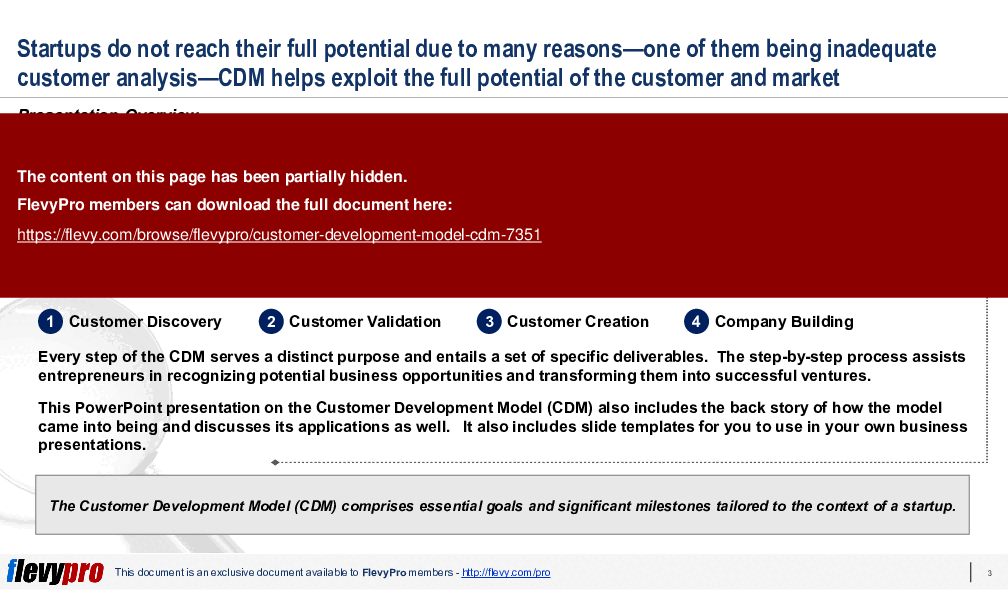
In today's business environment, there are many startups that have not yet reached the level of being fully established companies. This situation can be attributed to various factors, including ideas that do not gain traction, insufficient funding, and inadequate customer analysis.

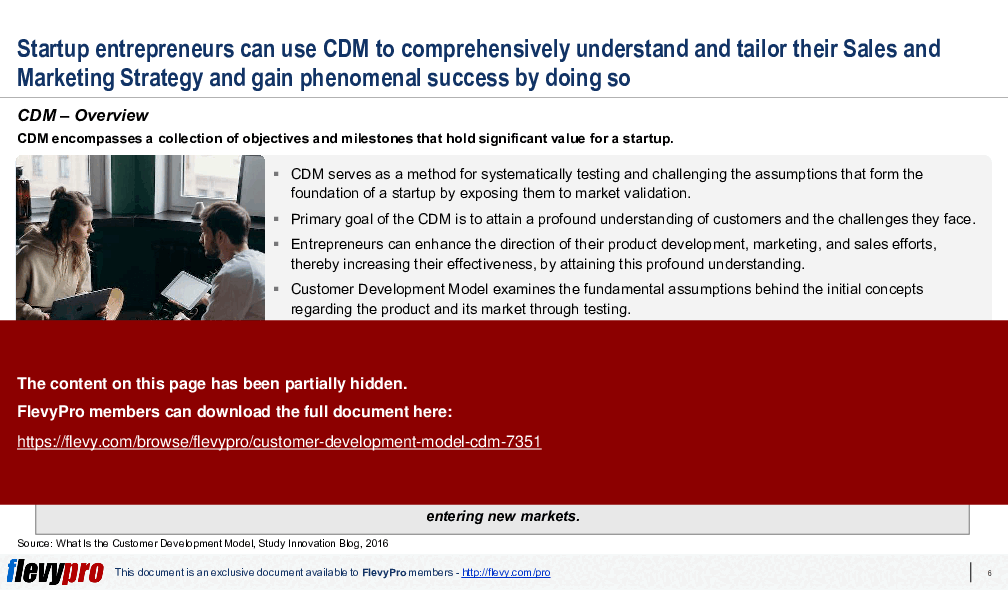
This PowerPoint presentation highlights the Customer Development Model (CDM), a framework that provides a means to recognize and address all the activities related to customers during the initial stages of forming a company. More specifically, CDM serves as a method for systematically testing and challenging the assumptions that form the foundation of a startup by exposing them to market validation. Understanding target customers, product solutions, and purchasing behavior caters to the fragile nature of startups by providing entrepreneurs with valuable insights for success.

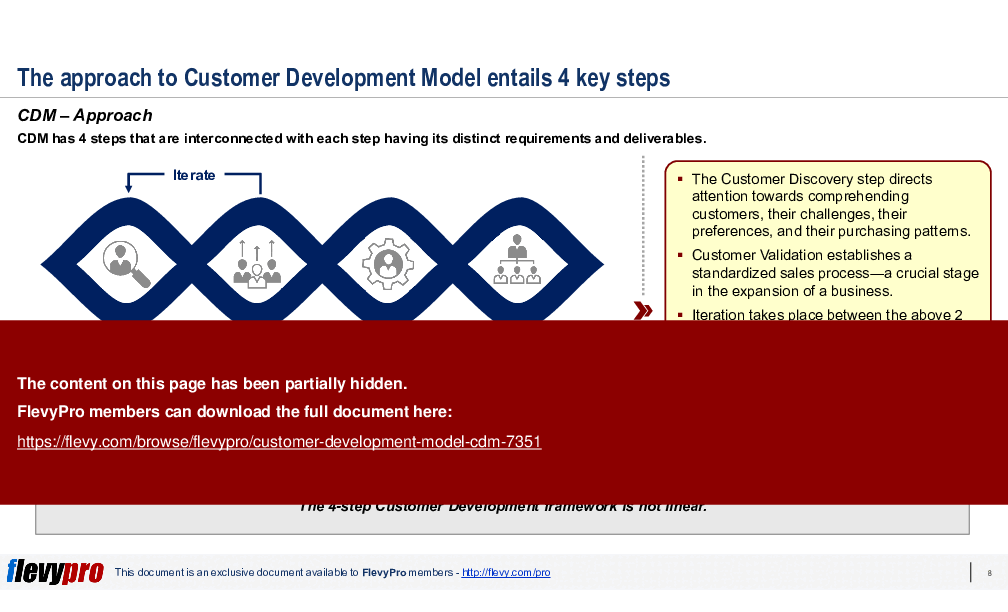
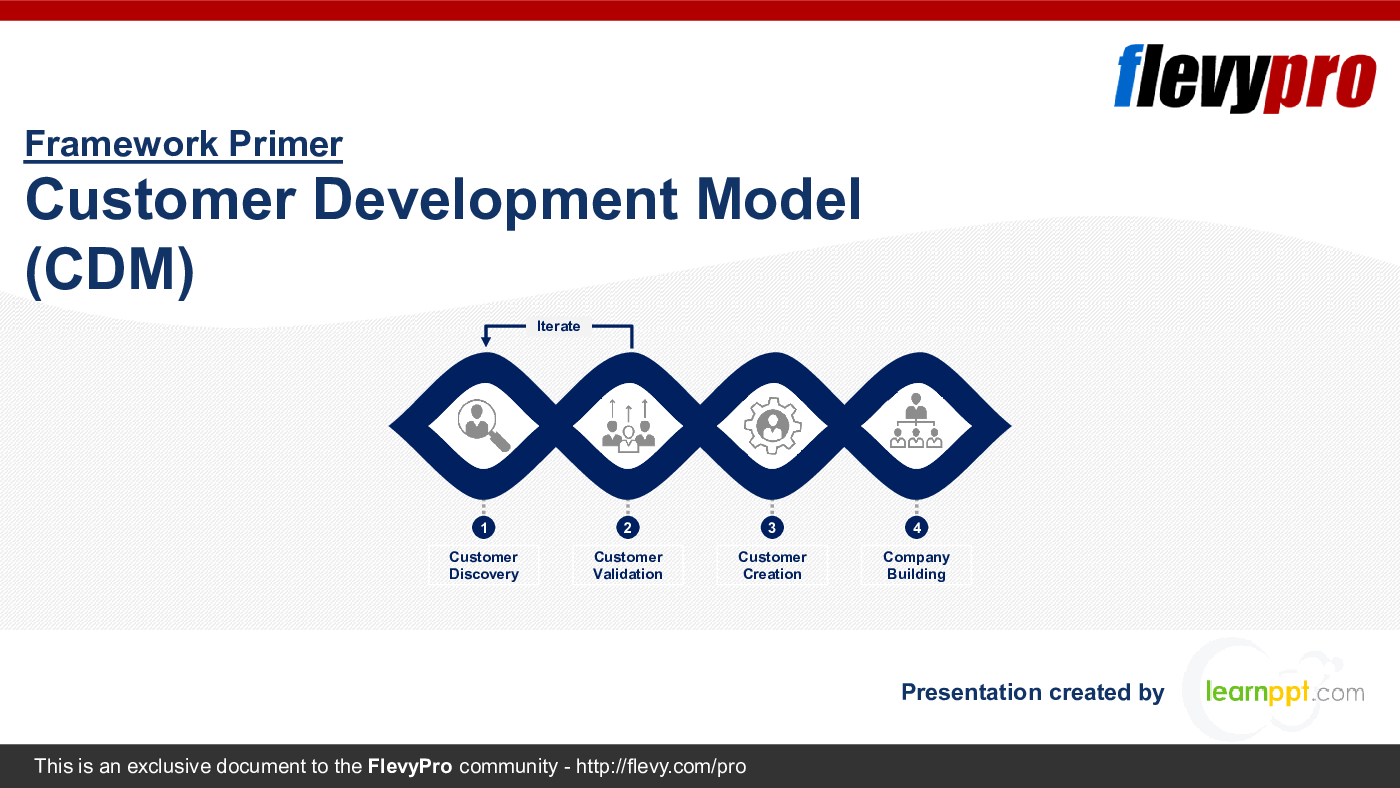
The Customer Development Model embodies an iterative and adaptable process that mirrors the uncertain nature of starting a new business and entering new markets. The CDM process comprises the following 4 interconnected yet individual steps:

1. Customer Discovery
2. Customer Validation
3. Customer Creation
4. Company Building

Every step of the CDM serves a distinct purpose and entails a set of specific deliverables. The first two steps, customer discovery and customer validation, are iterated until a point when customer creation can proceed.

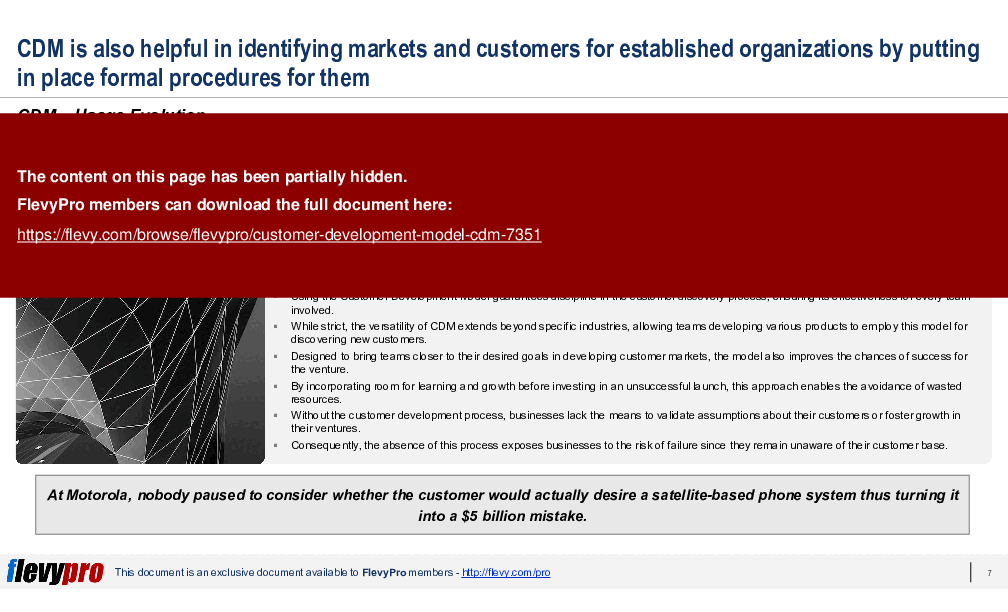
The step-by-step process assists entrepreneurs in recognizing potential business opportunities and transforming them into successful ventures. CDM is also helpful in identifying markets and customers for established organizations by putting in place formal procedures for them. This presentation discusses each of these steps in depth.

This PowerPoint presentation on the Customer Development Model (CDM) also includes the back story of how the model came into being and discusses its applications as well. It also includes slide templates for you to use in your own business presentations.

The CDM approach emphasizes the importance of engaging with real customers in the field to validate assumptions and refine product offerings. This model is particularly beneficial for startups aiming to scale effectively by minimizing risks and maximizing market fit.

Got a question about this document? Email us at flevypro@flevy.com.

MARCUS OVERVIEW

This synopsis was written by Marcus [?] based on the analysis of the full 28-slide presentation.


Executive Summary
The Customer Development Model (CDM) presentation provides a structured framework for startups to enhance their customer engagement and market strategies. Developed by Steve Blank, this model emphasizes a systematic approach to understanding customer needs and validating business assumptions. By following the 4 key steps—Customer Discovery, Customer Validation, Customer Creation, and Company Building—entrepreneurs can effectively navigate the uncertainties of launching a new business. This presentation not only outlines the CDM process, but also includes practical templates and insights for immediate application in real-world scenarios.

Who This Is For and When to Use
•  Startup founders and entrepreneurs seeking to refine their business models
•  Marketing and sales teams focused on customer engagement strategies
•  Product development teams aiming to align offerings with market needs
•  Business consultants advising startups on customer-centric approaches

Best-fit moments to use this deck:
•  During the initial stages of startup formation to establish a customer-focused strategy
•  When pivoting business models based on customer feedback and market validation
•  In workshops aimed at enhancing team understanding of customer needs and behaviors

Learning Objectives
•  Define the 4 steps of the Customer Development Model and their significance
•  Build a customer-centric strategy that aligns product development with market needs
•  Establish a systematic process for validating customer assumptions and market fit
•  Identify key customer segments and their specific challenges
•  Create actionable plans for customer engagement and demand generation
•  Develop a framework for iterating on business strategies based on customer feedback

Table of Contents
•  Overview (page 3)
•  Customer Development Model (CDM) (page 5)
•  CDM Process (page 8)
•  Additional Considerations (page 15)
•  Slide Design Structure & Templates (page 18)

Primary Topics Covered
•  Customer Discovery - Focuses on understanding customer challenges, preferences, and purchasing behaviors through direct engagement.
•  Customer Validation - Establishes a standardized sales process to confirm market assumptions and customer interest.
•  Customer Creation - Involves generating demand and identifying potential customers through targeted marketing efforts.
•  Company Building - Concentrates on structuring the organization to support growth and operational effectiveness.

Deliverables, Templates, and Tools
•  Customer Discovery interview templates for engaging potential customers
•  Customer Validation frameworks for mapping sales processes
•  Customer Creation marketing plans to stimulate demand
•  Company Building organizational structure templates for scaling operations

Slide Highlights
•  Overview of the Customer Development Model illustrating the iterative process
•  Detailed breakdown of each CDM step with specific deliverables
•  Visual aids demonstrating the relationship between customer discovery and validation
•  Templates for practical application in business presentations

Potential Workshop Agenda
Customer Discovery Workshop (90 minutes)
•  Discuss customer engagement strategies and methodologies
•  Conduct role-playing exercises to practice customer interviews
•  Develop initial customer profiles based on insights gathered

Customer Validation Session (60 minutes)
•  Review findings from customer discovery
•  Create a roadmap for testing market assumptions
•  Establish metrics for measuring customer interest and engagement

Customization Guidance
•  Tailor customer discovery templates to fit specific industry contexts and target demographics
•  Adjust customer validation frameworks to align with unique sales processes
•  Incorporate company-specific terminology and metrics into the presentation slides

Secondary Topics Covered
•  Importance of iterative learning in the startup process
•  Strategies for minimizing marketing expenses during initial customer acquisition
•  Techniques for integrating customer feedback into product development

Topic FAQ

What are the core phases of the Customer Development Model and how do they connect?

The CDM comprises 4 interconnected phases: Customer Discovery (understand problems), Customer Validation (confirm market fit and sales process), Customer Creation (generate demand), and Company Building (scale operations). The model iterates the first 2 phases until readiness for Customer Creation, forming a four-step process.

How does Customer Discovery differ from Customer Validation in practice?

Customer Discovery focuses on direct engagement to surface customer challenges, preferences, and purchasing behaviors through interviews and observation. Customer Validation uses those insights to test market assumptions and establish a repeatable, standardized sales process, shifting from discovery activities to validation of a sales model and metrics.

What practical deliverables should teams expect from a CDM toolkit?

A CDM toolkit provides actionable artifacts for each phase: interview templates for Customer Discovery, frameworks and sales-process maps for Customer Validation, marketing plans for Customer Creation, and organizational-structure templates for Company Building. These deliverables support workshops and implementation and are provided in Flevy’s Customer Development Model (CDM) PowerPoint.

How should teams structure customer interviews during the discovery phase?

Teams should use predefined interview templates, engage real customers in the field, practice role-playing to refine questions, and synthesize findings into customer profiles and problem hypotheses. Workshops often include role-play and profile development to ensure consistent learning, using the provided Customer Discovery interview templates.

What should I look for when choosing a CDM slide deck or toolkit for my startup?

Prioritize decks that explain each CDM step, include editable templates for interviews, validation frameworks, marketing plans, and organizational design, and offer workshop agendas and customization guidance so a small team can run sessions. Look specifically for slide templates and workshop agendas.

How quickly can a small founding team apply CDM methods to validate core assumptions?

A focused team can run initial Customer Discovery via a 90-minute workshop using interview templates and follow with a 60-minute Customer Validation session to map tests and metrics. The deck’s workshop agenda and templates support these short, iterative sessions and timeframes.

After receiving negative customer feedback, which CDM activities should I prioritize to pivot effectively?

Prioritize re-running Customer Discovery interviews to clarify pain points, update hypotheses, and design targeted validation tests. Use assumption-testing roadmaps and metrics to validate changes before scaling demand-generation. Focus on iterating Customer Discovery and Customer Validation until findings are validated.

Can established companies use the Customer Development Model for new product launches?

Yes. Established organizations can apply CDM to formalize customer-facing procedures, test assumptions, and identify target markets before scaling. The model’s first phases—Customer Discovery and Customer Validation—help integrate customer feedback into product and go-to-market plans.

Document FAQ
These are questions addressed within this presentation.

What is the Customer Development Model?
The Customer Development Model is a framework designed to help startups understand their customers and validate their business assumptions through a structured process.

How many steps are in the CDM?
The CDM consists of 4 key steps: Customer Discovery, Customer Validation, Customer Creation, and Company Building.

Can established companies use the CDM?
Yes, the CDM is beneficial for both startups and established organizations looking to refine their customer engagement strategies.

What is the primary goal of Customer Discovery?
The primary goal of Customer Discovery is to gain a comprehensive understanding of customers, including their challenges and preferences.

How does Customer Validation differ from Customer Discovery?
Customer Validation focuses on confirming market assumptions and establishing a scalable sales process, while Customer Discovery is about understanding customer needs.

What are the deliverables from the Customer Creation step?
Deliverables from Customer Creation include marketing plans and strategies for generating demand and identifying potential customers.

How can I customize the CDM templates for my business?
You can customize the templates by incorporating specific industry terminology, adjusting metrics, and aligning them with your organization's unique processes.

What are the risks of not using the Customer Development Model?
Without the CDM, businesses may fail to validate their assumptions about customers, leading to wasted resources and potential market failure.

Glossary
•  Customer Development Model (CDM) - A framework for understanding and validating customer needs and market assumptions.
•  Customer Discovery - The first step in the CDM focused on identifying customer challenges and preferences.
•  Customer Validation - The second step that establishes a standardized sales process based on customer feedback.
•  Customer Creation - The third step aimed at generating demand and identifying potential customers.
•  Company Building - The final step that focuses on structuring the organization for growth.
•  Iterate - The process of revisiting previous steps based on new insights and feedback.
•  Market Validation - The process of confirming that a product meets the needs of its target market.
•  Sales Process - A structured approach to selling that is developed during the Customer Validation step.
•  Minimum Viable Product (MVP) - The simplest version of a product that can be released to gather feedback.
•  Lean Startup - A methodology that encourages rapid iteration and customer feedback to develop products.
•  Assumption Testing - The process of validating or invalidating business assumptions through customer engagement.
•  Target Market - The specific group of customers that a business aims to reach with its products or services.

MARKET RESEARCH PPT SLIDES

Key Steps in the Customer Development Model

Structuring for Growth: The Company Building Phase

Framework for Effective Customer Validation Process

Source: Best Practices in Customer Strategy, Customer Analysis, Market Entry PowerPoint Slides: Customer Development Model (CDM) PowerPoint (PPTX) Presentation Slide Deck, LearnPPT Consulting


$29.00
FlevyPro price: FREE (included in subscription)
This framework is developed by a team of former McKinsey and Big 4 consultants. The presentation follows the headline-body-bumper slide format used by global consulting firms.
Add to Cart
  

Did you need more documents?

Consider a FlevyPro subscription from $39/month. View plans here.

For $10.00 more, you can download this document plus 2 more FlevyPro documents. That's just $13 each.

ABOUT FLEVYPRO

This document is part of the FlevyPro Library, a curated knowledge base of documents for our FlevyPro subscribers.

FlevyPro is a subscription service for on-demand business frameworks and analysis tools. FlevyPro subscribers receive access to an exclusive library of curated business documents—business framework primers, presentation templates, Lean Six Sigma tools, and more—among other exclusive benefits.

Click here to learn more about FlevyPro and its benefits.

Did you know?
The average daily rate of a McKinsey consultant is $6,625 (not including expenses). The average price of a Flevy document is $65.


Trusted by over 10,000+ Client Organizations
Since 2012, we have provided business templates to over 10,000 businesses and organizations of all sizes, from startups and small businesses to the Fortune 100, in over 130 countries.
AT&T GE Cisco Intel IBM Coke Dell Toyota HP Nike Samsung Microsoft Astrazeneca JP Morgan KPMG Walgreens Walmart 3M Kaiser Oracle SAP Google E&Y Volvo Bosch Merck Fedex Shell Amgen Eli Lilly Roche AIG Abbott Amazon PwC T-Mobile Broadcom Bayer Pearson Titleist ConEd Pfizer NTT Data Schwab


Read Customer Testimonials

 
"As a consultant requiring up to date and professional material that will be of value and use to my clients, I find Flevy a very reliable resource.

The variety and quality of material available through Flevy offers a very useful and commanding source for information. Using Flevy saves me time, enhances my expertise and ends up being a good decision."

– Dennis Gershowitz, Principal at DG Associates
 
"[Flevy] produces some great work that has been/continues to be of immense help not only to myself, but as I seek to provide professional services to my clients, it gives me a large "tool box" of resources that are critical to provide them with the quality of service and outcomes they are expecting."

– Royston Knowles, Executive with 50+ Years of Board Level Experience
 
"I like your product. I'm frequently designing PowerPoint presentations for my company and your product has given me so many great ideas on the use of charts, layouts, tools, and frameworks. I really think the templates are a valuable asset to the job."

– Roberto Fuentes Martinez, Senior Executive Director at Technology Transformation Advisory
 
"Flevy is now a part of my business routine. I visit Flevy at least 3 times each month.

Flevy has become my preferred learning source, because what it provides is practical, current, and useful in this era where the business world is being rewritten.

In today's environment where there are so "

– Omar Hernán Montes Parra, CEO at Quantum SFE
 
"As a small business owner, the resource material available from FlevyPro has proven to be invaluable. The ability to search for material on demand based our project events and client requirements was great for me and proved very beneficial to my clients. Importantly, being able to easily edit and tailor "

– Michael Duff, Managing Director at Change Strategy (UK)
 
"The wide selection of frameworks is very useful to me as an independent consultant. In fact, it rivals what I had at my disposal at Big 4 Consulting firms in terms of efficacy and organization."

– Julia T., Consulting Firm Owner (Former Manager at Deloitte and Capgemini)
 
"One of the great discoveries that I have made for my business is the Flevy library of training materials.

As a Lean Transformation Expert, I am always making presentations to clients on a variety of topics: Training, Transformation, Total Productive Maintenance, Culture, Coaching, Tools, Leadership Behavior, etc. Flevy "

– Ed Kemmerling, Senior Lean Transformation Expert at PMG
 
"As a young consulting firm, requests for input from clients vary and it's sometimes impossible to provide expert solutions across a broad spectrum of requirements. That was before I discovered Flevy.com.

Through subscription to this invaluable site of a plethora of topics that are key and crucial to consulting, I "

– Nishi Singh, Strategist and MD at NSP Consultants


Customers Also Bought These Documents


Customers Also Like These Documents

Explore Templates on Related Management Topics


Your Recently Viewed Documents
Download our FREE Strategy & Transformation Framework Templates

Download our free compilation of 50+ Strategy & Transformation slides and templates. Frameworks include McKinsey 7-S, Balanced Scorecard, Disruptive Innovation, BCG Curve, and many more.