
 Click main image to view in full screen. Unlock all 32 preview images:
TPM Education & Training (E&T) Pillar – PowerPoint PPTX Template
PowerPoint (PPTX) 111 Slides


BENEFITS OF THIS DOWNLOADABLE POWERPOINT DOCUMENT
- Audit-Ready JIPM Compliance: Gain a fully aligned, 110+ slides masterclass and diagnostic toolkit that directly satisfies Category 7 award audit criteria.
- Plug-and-Play Shopfloor Execution: Instantly deploy facilitation-ready TWI guides, visual Skills Matrix templates, and OPL frameworks without spending dozens of hours designing materials from scratch.
- Measurable Loss Reduction: Systematically target and eliminate human-error downtime, quality defects, and speed losses by directly linking skill gaps to OEE improvements.
EMPLOYEE TRAINING PPT TEMPLATE DESCRIPTION
TPM EDUCATION & TRAINING (E&T) PILLAR PRESENTATION & TOOLKIT
Shift from reactive, ad-hoc instruction to a systematic, data-driven competency development system that empowers your frontline and fulfills JIPM criteria.
EXECUTIVE SUMMARY
Unskilled operators quietly contribute to chronic machine breakdowns, quality defects, and speed losses. This comprehensive TPM Education & Training (E&T) Practitioner Toolkit delivers the operational framework required to build a structured, JIPM-aligned workforce development system. Designed around the official Japan Institute of Plant Maintenance (JIPM) Checklist C (Category 7) evaluation criteria and the OEC TPM Maturity Diagnostic, this module provides actionable guidance for systematically upgrading operator and technician skills.
Utilizing proven instruction methods like Training Within Industry (TWI) 4-Step Job Instruction (JI), this deck clarifies how to schedule Training Timetables, set up visual Skills Matrix Boards, and roll out peer-to-peer One-Point Lessons (OPLs). It connects classroom theory with shopfloor execution, assisting your facility in transitioning from reactive instruction to a self-managing learning ecosystem.
KEY BENEFITS
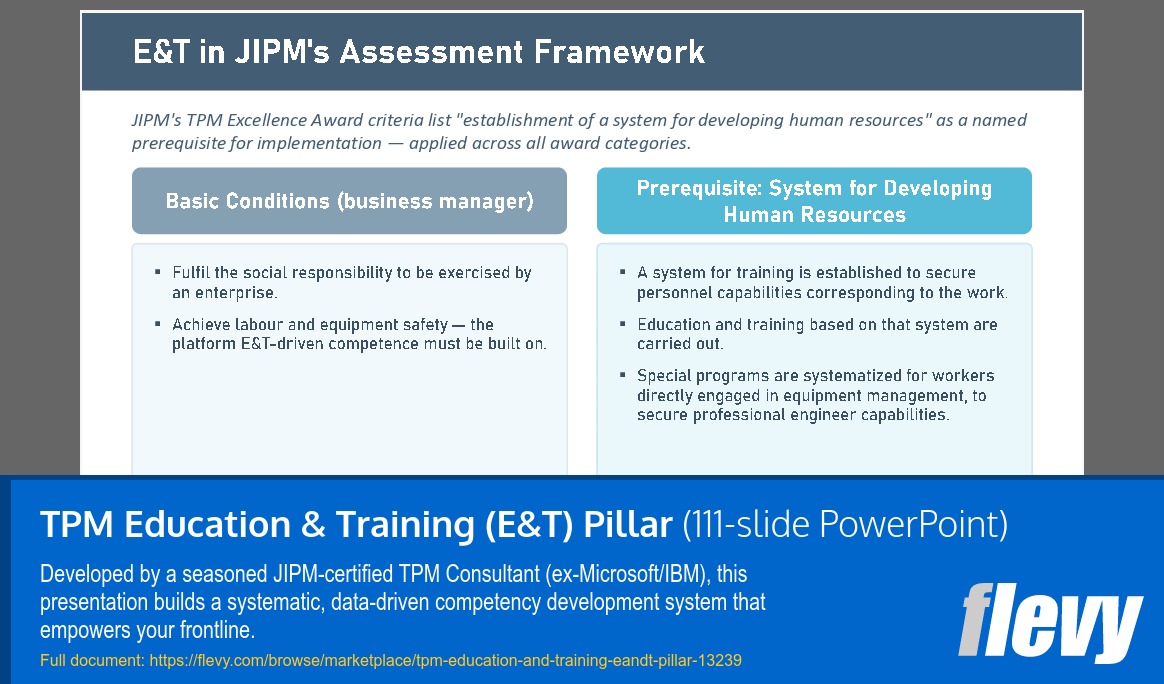
★ Ensure JIPM Award Alignment: Meet the prerequisite human resource development criteria and satisfy Category 7 audit requirements across all award levels.
★ Target Loss-Driving Skill Gaps: Link the Six Big Losses (including unplanned downtime, minor stoppages, and defects) directly to underlying competency gaps and deploy targeted E&T solutions.
★ Implement Visual Work Management: Deploy visible shopfloor Skills Matrix Boards and 4-quadrant skill maps to capture and standardize operational knowledge.
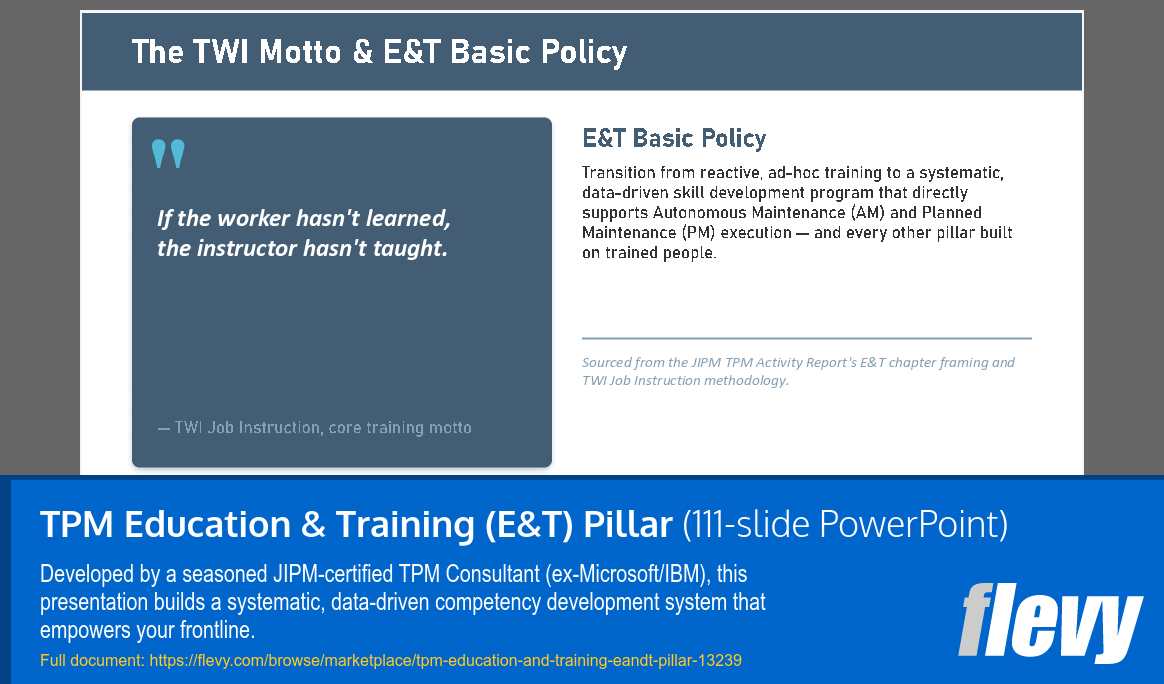
★ Establish an On-the-Job (OJT) Delivery Dojo: Develop standardized training schedules and leverage the TWI JI framework to enforce the principle that "if the worker hasn't learned, the instructor hasn't taught."
★ Enable Autonomous & Planned Maintenance:Train operators in 5-senses inspection techniques and support maintenance technicians as they advance from Time-Based (TBM) to Condition-Based Maintenance (CBM).
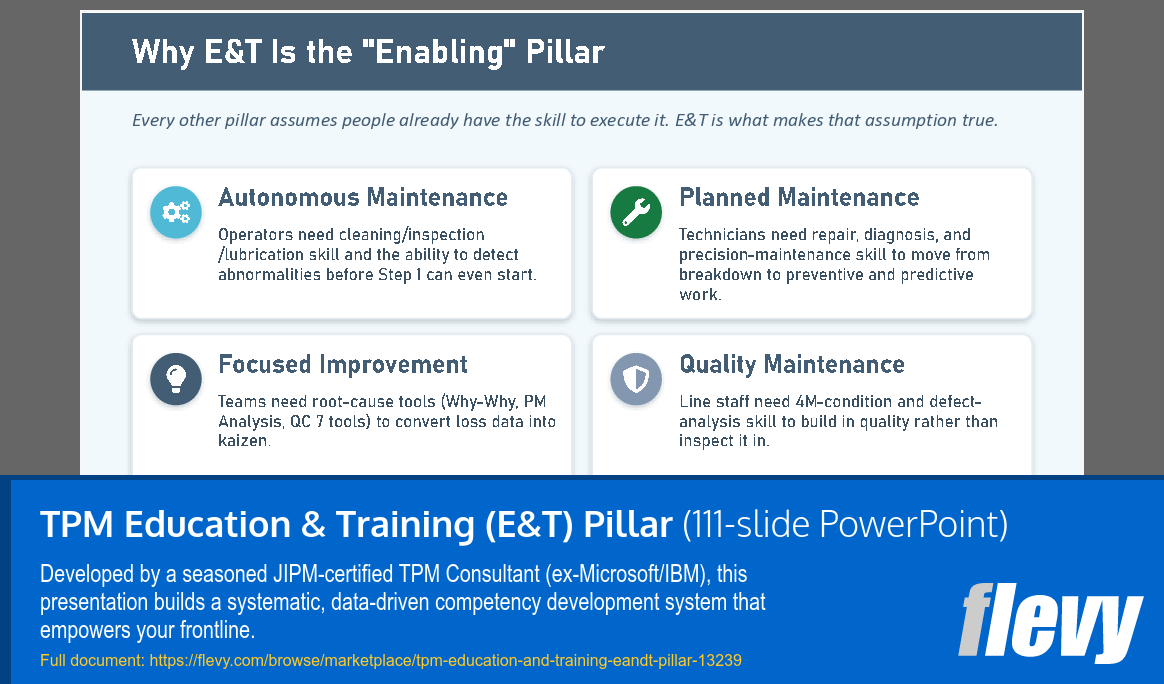
As emphasized by the Japan Institute of Plant Maintenance, Education & Training (E&T) is a foundational pillar that builds the necessary skills to support all other pillars.
TARGET AUDIENCE
This toolkit is engineered for manufacturing leaders aiming for world-class operational excellence:
• TPM Promotion Office Leads & Steering Committees preparing Chapter 9 of the TPM Activity Report for JIPM assessors.
• E&T Pillar Leaders responsible for creating, deploying, and tracking skill development frameworks across plant operations.
• Plant Managers & Operations Directors seeking to close consistency gaps across pillars and build an audit-ready baseline.
• Corporate Trainers & OJT Instructors requiring an adaptable masterclass to elevate shopfloor capability.
WHAT'S INCLUDED IN THE BOX?
★ The Masterclass Presentation (110+ Slides): A structured curriculum across 8 modules detailing pillar foundations, loss mapping, JIPM criteria, skills matrices, TWI, AM/PM enablement, supervisory leadership, and award submission readiness.
★ The E&T Maturity Diagnostic: A 5-dimension evaluation framework assessing maturity from Foundational to World-Class levels, including the peer-pillar protocol.
★ TWI 4-Step JI Training Aids: Practical cards and templates designed for standard job instruction delivery.
★ One-Point Lesson (OPL) Visual Standard: Guidelines and layout examples for creating Basic Knowledge, Problem, and Improvement lessons.
LEARNING OBJECTIVES
By completing this 8-module curriculum, participants will be able to:
• Explain how E&T supports every other TPM pillar and locate its specific placement within the JIPM assessment hierarchy.
• Map the Six Major Losses (Availability, Performance, and Quality) directly to the root-cause skill gaps driving them.
• Interpret and apply JIPM E&T checklist guidelines (Checklists C, B, A, and S) across the five award categories.
• Construct and maintain a visual skills matrix board using the 4-quadrant skill progress circle system, Training Timetables, and OPLs.
• Utilize the TWI 4-Step Job Instruction framework along with Job Breakdown Sheets (JBS) to deliver effective practical training.
• Demonstrate how the E&T pillar facilitates Autonomous Maintenance (AM Step 4) and Planned Maintenance (PM Steps 1-3) activities.
• Apply analytical tools (5-Why, ECRS, 4M) and TWI Job Relations (JR) principles to strengthen supervisory leadership and sustain capabilities.
• Evaluate E&T maturity using the 5-dimension diagnostic tool and construct a strategy for JIPM award readiness.
DEATILED TRAINING CONTENTS
This practitioner toolkit is divided into eight targeted modules:
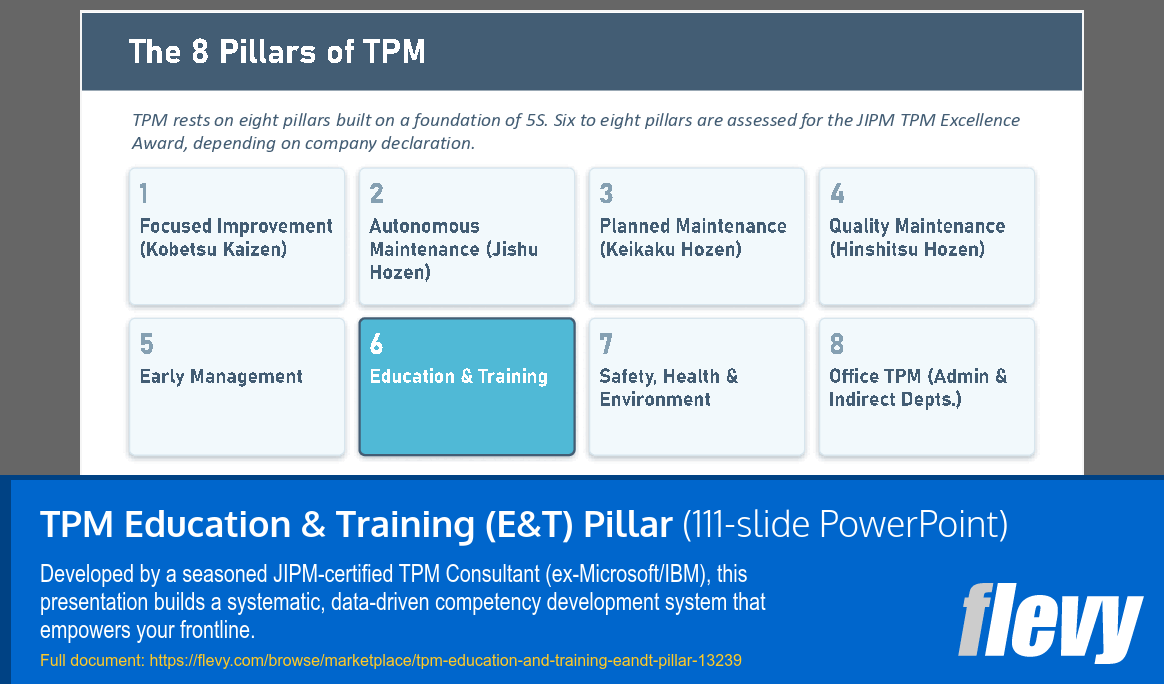
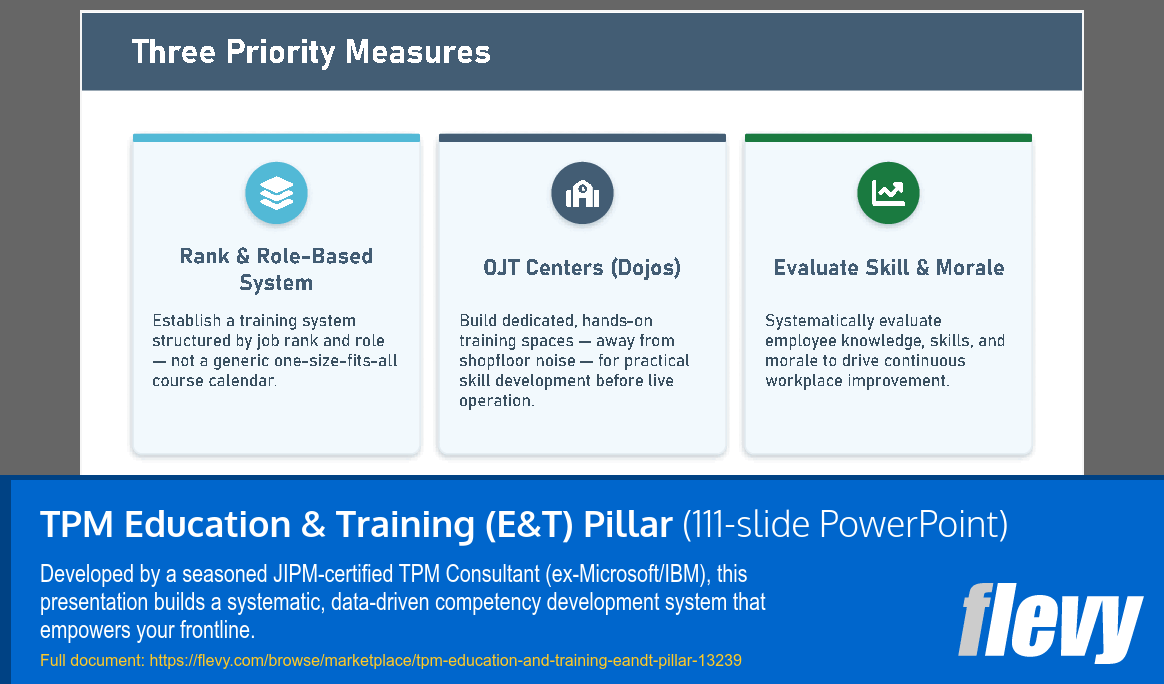
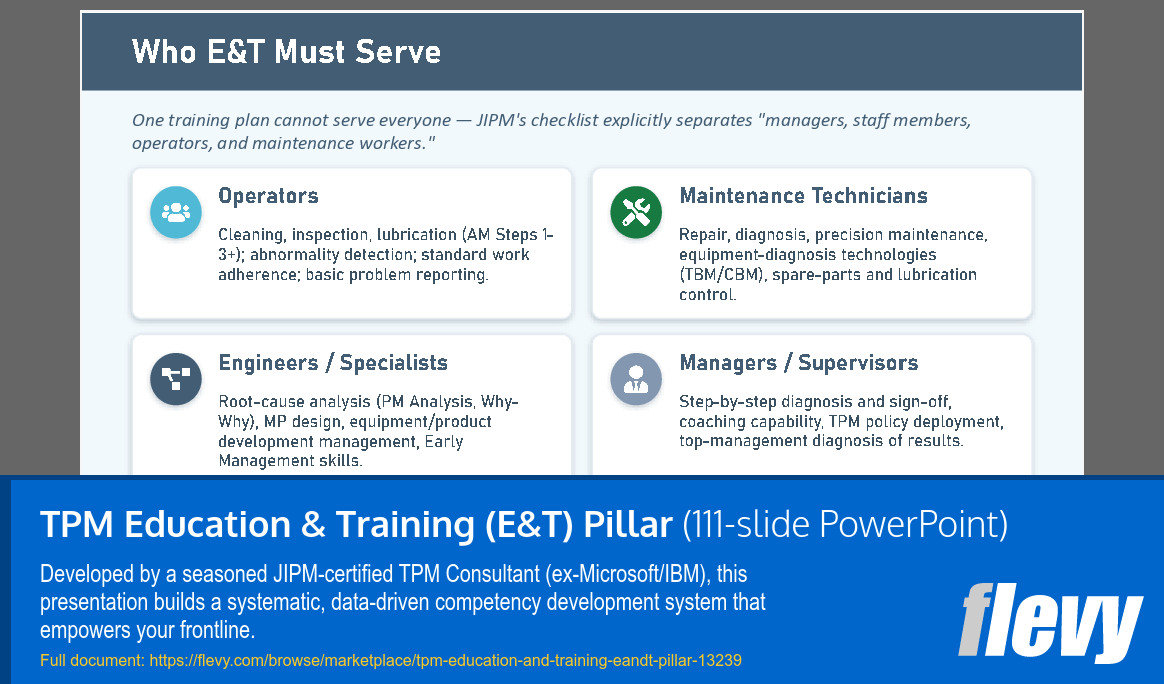
• Module 1 – Foundations of the E&T Pillar: Overview of the 8 TPM pillars, core requirements, the TWI motto, three priority measures, four maturity stages, and four target groups (operators, technicians, engineers, managers).
• Module 2 – The 6 Major Losses & the Skill Gaps Behind Them: The OEE structure; breakdown and setup/adjustment losses; minor stoppage and speed losses; defect/rework and startup/yield losses; Loss -> Gap -> E&T Response mapping; JIPM Achievement Sheet metrics (Productivity, Quality, Cost, Delivery, Safety, Morale).
• Module 3 – JIPM E&T Assessment Criteria Deep-Dive: Navigating the 5 award tiers; Category 7 checkpoint progression (C, B, A, S); tracking metrics across KMI (competency indices), KPI (instructor counts), and KAI (OPL updates); Self-Checklist scoring mechanics.
• Module 4 – Building the Skills Matrix: Visual skill progress circle system (Empty to Full circle); layout design for Skills Matrix Boards; triggers for Training Timetables (new equipment installations, performance drops, personnel turnover); OPL visual guidelines; OPL cascading methodology.
• Module 5 – Designing the Training System (TWI Job Instruction): Limitations of relying solely on telling or showing; breakdown of the TWI JI 4 Steps (Prepare, Present, Try-Out, Follow Up); constructing Job Breakdown Sheets (Important Steps, Key Points, Reasons); handling complex instruction scenarios (extended operations, high-noise environments, sensory-based "feel"); setting strategic training budgets.
• Module 6 – E&T Enabling AM & PM Execution: AM Step 4 (General Inspection Skills Training); applying 5-senses inspections and visual controls; PM support bridge (PM Steps 1-3 training AM operators); building the PM Step 6 CBM skill ladder.
• Module 7 – E&T Enabling FI, QM & Supervisory Leadership: Focused Improvement problem-solving tools (Cause & Effect, 5-Why, P-M Analysis); TWI JM 4-Step ECRS application (Eliminate, Combine, Rearrange, Simplify); Quality Maintenance 4M management; TWI Job Relations 4 Foundations and the 4-Step JR approach.
• Module 8 – Sustaining, Measuring & Award Readiness: The 5 evaluation areas (Needs Assessment, Skills Visibility, Dojo Infrastructure, Qualification, and Business Impact); OEC peer-pillar protocol and gemba walks; TPM Activity Report Chapter 9 case study ("Line 3 Zero Minor Stoppages"); roadmap planning for continuous improvement.
PROPOSED 1-DAY WORKSHOP AGENDA
This package supports an intensive full-day training session. A standard timetable includes:
• 09:00 – 10:30: Foundations of E&T, Priority Measures, and JIPM Assessment Criteria (Modules 1-3).
• 10:45 – 12:30: Building the Skills Matrix Board and Designing the OJT TWI System (Modules 4-5).
• 13:30 – 15:30: Cross-Pillar Integration: Enabling AM, PM, FI, and QM Execution (Modules 6-7).
• 15:45 – 17:00: Measuring Maturity, Chapter 9 Case Study Drafting, and JIPM Award Submission Readiness (Module 8).
GLOSSARY OF KEY TERMS
• TWI Job Instruction (JI): A structured four-step methodology (Prepare, Present, Try-Out, and Follow Up) used by supervisors to transfer skills efficiently, based on the core standard that "if the worker hasn't learned, the instructor hasn't taught."
• Job Breakdown Sheet (JBS): An instructor's reference document that organizes an operation into Important Steps (actions advancing the task), Key Points (critical safety, quality, or technique details), and Reasons (the underlying rationale). It remains exclusively an instructor reference and is not distributed to trainees.
• One-Point Lesson (OPL): A visual micro-training document designed for 5-to-10 minute sessions focused on a single topic on one page. OPLs fall into three categories: Basic Knowledge, Problem Examples, or Improvement Examples.
• Skills Matrix Board: A visual management grid displaying employee names vertically and required operational skills horizontally, utilizing a four-quadrant circle system to highlight team capability gaps instantly.
• Training Timetable: A structured timeline created by supervisors to proactively plan targeted skill development, avoiding random or unplanned scheduling.
• Key Management Indicators (KMIs): High-level operational metrics tracked on the JIPM Achievement Sheet, including total multi-skilling percentages and overall plant competency scores.
• TWI Job Methods (JM): A four-step analytical framework using ECRS (Eliminate, Combine, Rearrange, Simplify) to help Focused Improvement teams streamline operational workflows.
• TWI Job Relations (JR): A supervisory leadership methodology designed to build positive workplace relationships, prevent personnel issues, and maintain team motivation.
FREQUENTLY ASKED QUESTIONS (FAQs)
What is the fundamental difference between a standard HR training plan and the TPM E&T Pillar? Traditional HR training calendars generally focus on broad career development objectives. In contrast, the TPM E&T pillar targets and eliminates specific operational competency gaps that directly contribute to equipment downtime, performance losses, or quality issues.
How does JIPM's four-quadrant skills circle track shopfloor competency? Rather than recording simple attendance, the progress circle measures practical ability: an empty circle indicates no training, one quadrant represents completed theory, two quadrants mean execution under supervision, three quadrants denote independent capability, and a full circle certifies the operator to train others.
What specific triggers dictate when to schedule a Training Timetable? A structured E&T program generates a Training Timetable in response to three specific events: introducing new equipment, identifying line performance issues caused by operator skill gaps, or managing staff turnover to protect tribal knowledge.
What is an "orphan OPL" and how does the E&T framework eliminate it? An "orphan OPL" refers to a standalone training sheet created to meet a quota without addressing an actual gap on the skills matrix. The E&T cascading method prevents this by requiring teams to identify a matrix gap first, draft the lesson, deliver the instruction, and record progress directly on the shopfloor board.
How does the E&T Pillar directly support Autonomous Maintenance (AM) execution? E&T drives AM Step 4 (Conduct General Inspection Skills Training) by providing peer-led technical instruction on topics like pneumatics, hydraulics, lubrication, drive systems, and safety using 5-senses inspection and visual controls.
How do Planned Maintenance (PM) technicians function within the E&T delivery system? During initial PM steps, technicians instruct AM operators on machine mechanisms, normal versus abnormal operational states, tagging procedures, and the creation of effective One-Point Lessons.
Why does traditional "telling" or "showing" alone fail as an effective training method? Telling alone fails because spoken words cannot convey tactile feel, proper timing, or safety nuances. Showing alone leads to imitation without an understanding of underlying principles, resulting in operational errors and minor stoppages over time.
How does E&T ensure complete traceability from boardroom outcomes to shopfloor actions? E&T links outcomes across three levels: Key Management Indicators (KMIs) at the executive level, Key Performance Indicators (KPIs) at the managerial level (e.g., qualified instructor counts), and Key Activity Indicators (KAIs) on the shopfloor (e.g., updated matrices and completed OPLs).
Got a question about the product? Email us at support@flevy.com or ask the author directly by using the "Ask the Author a Question" form. If you cannot view the preview above this document description, go here to view the large preview instead.
Source: Best Practices in Employee Training, TPM PowerPoint Slides: TPM Education & Training (E&T) Pillar PowerPoint (PPTX) Presentation Slide Deck, Operational Excellence Consulting
ABOUT THE AUTHOR

Operational Excellence Consulting, founded in 2009 by Allan Ung, draws from extensive experience at Microsoft, IBM, and Underwriters Laboratories (UL). We specialize in strategy deployment, customer experience design, and operational excellence, applying Design Thinking, Lean, and Systems Thinking to maximize customer value and minimize waste.
Our
... [read more]
Ask the Author a Question
You must be logged in to contact the author.




























