
 Click main image to view in full screen.
Third Party Logistics (3PL) Warehouse Contract Best Practice (Word DOCX)
Word (DOCX) 8 Pages


BENEFITS OF THIS WORD DOCUMENT
- Learn how to negotiate with a 3PL.
- Achieve Cost Reduction.
- Obtain Service Level Agreement benefits.
LOGISTICS WORD DESCRIPTION
This document covers the following topics: Cost Reduction Methodology, LEAN initiatives, 3PL Warehouse Key Performance Indicators (KPIs), Service Level Agreements, Safety Requirements, Embedded 3PL into the organization, Engaging Employees, Quality Requirements, Customer metrics, Negotiating with a 3PL, Gain sharing, Collaboration, Standard Operating Procedures, and Suggestions for Continuous Improvement,
This Word document also delves into critical governance structures essential for maintaining robust 3PL relationships. It outlines the necessary frameworks for oversight and accountability, ensuring that all parties adhere to agreed-upon standards and practices. This is crucial for minimizing risks and maximizing operational efficiency.
Other best practices covered include strategies for fostering innovation within 3PL partnerships. The document provides actionable insights into leveraging technology and data analytics to drive continuous improvement and stay ahead of industry trends. This is vital for companies looking to maintain a competitive edge in a rapidly evolving market.
The comprehensive nature of this document makes it an indispensable resource for executives aiming to optimize their 3PL contracts. It not only addresses the operational aspects, but also emphasizes strategic alignment and long-term value creation. This ensures that your organization can achieve sustainable growth and enhanced service delivery.
Got a question about the product? Email us at support@flevy.com or ask the author directly by using the "Ask the Author a Question" form. If you cannot view the preview above this document description, go here to view the large preview instead.
MARCUS OVERVIEW
This synopsis was written by Marcus [?] based on the analysis of the full 8-slide presentation.
Executive Summary
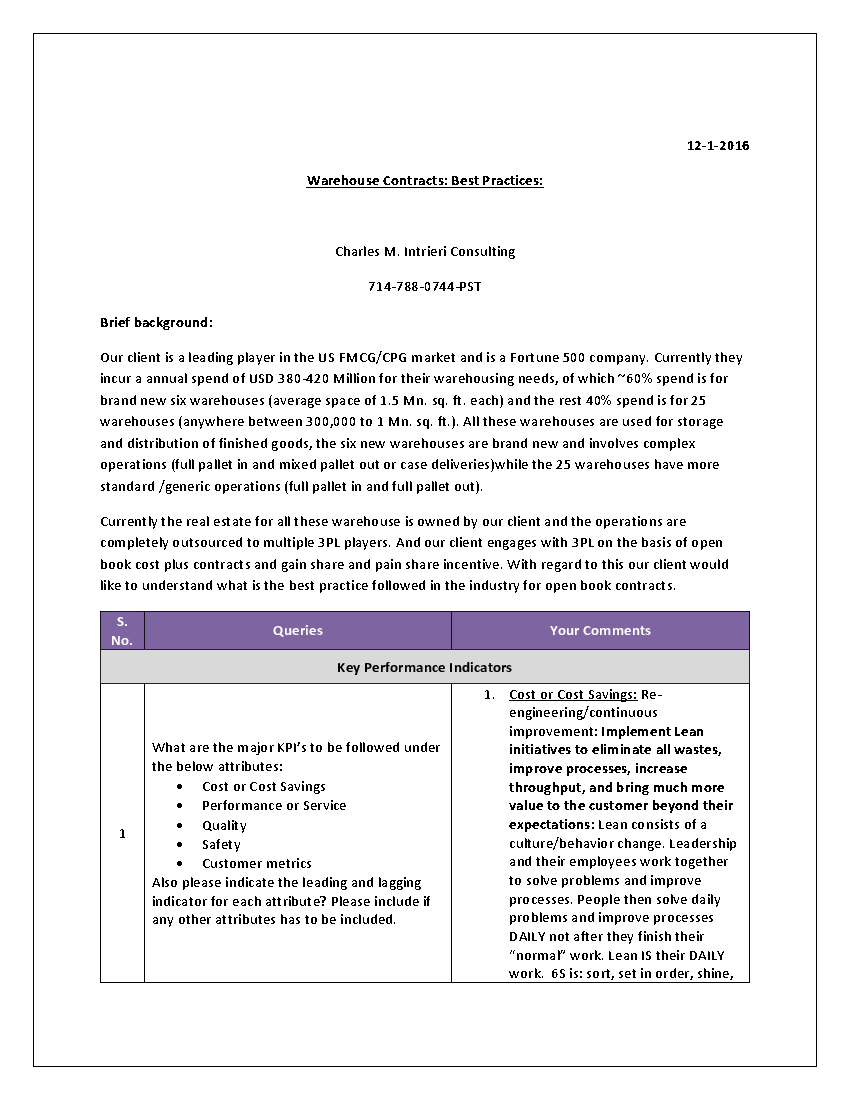
The "Third Party Logistics (3PL) Warehouse Contract Best Practice" document serves as a comprehensive guide for organizations seeking to optimize their warehousing contracts and relationships with third-party logistics providers. It outlines best practices for establishing effective open book contracts, emphasizing collaboration, transparency, and performance metrics. The document provides insights into key performance indicators (KPIs), governance structures, and strategies for cost reduction and continuous improvement. By leveraging this resource, corporate executives and logistics managers can enhance operational efficiency, reduce costs, and foster stronger partnerships with 3PL providers.
Who This Is For and When to Use
• Supply Chain Executives overseeing logistics and warehousing operations
• Procurement Managers negotiating contracts with 3PL providers
• Operations Managers responsible for warehouse performance and efficiency
• Financial Analysts focused on cost management in logistics
Best-fit moments to use this deck:
• During contract negotiations with third-party logistics providers
• When evaluating current warehousing performance and KPIs
• To establish or revise governance structures for logistics operations
• For training sessions on best practices in logistics management
Learning Objectives
• Define key performance indicators (KPIs) for effective warehouse management
• Establish governance frameworks that enhance accountability and performance
• Implement cost-saving initiatives through continuous improvement practices
• Foster collaborative relationships with 3PL providers to drive mutual success
• Analyze the impact of performance metrics on logistics efficiency
• Develop strategies for effective negotiation of warehousing contracts
Table of Contents
• Overview of Warehouse Operations and Costs (page 1)
• Key Performance Indicators for 3PL Contracts (page 2)
• Governance Structures for Warehouse Management (page 4)
• Cost Plus and Management Fee Structures (page 5)
• Incentives and Gain Share Mechanisms (page 6)
• Best Practices for Open Book Contracts (page 7)
• Recommendations for Continuous Improvement (page 8)
Primary Topics Covered
• Warehouse Operations Overview - A detailed analysis of warehousing costs, including the distribution of expenditures across various facilities.
• Key Performance Indicators (KPIs) - Identification of essential KPIs for cost savings, service performance, quality, safety, and customer satisfaction.
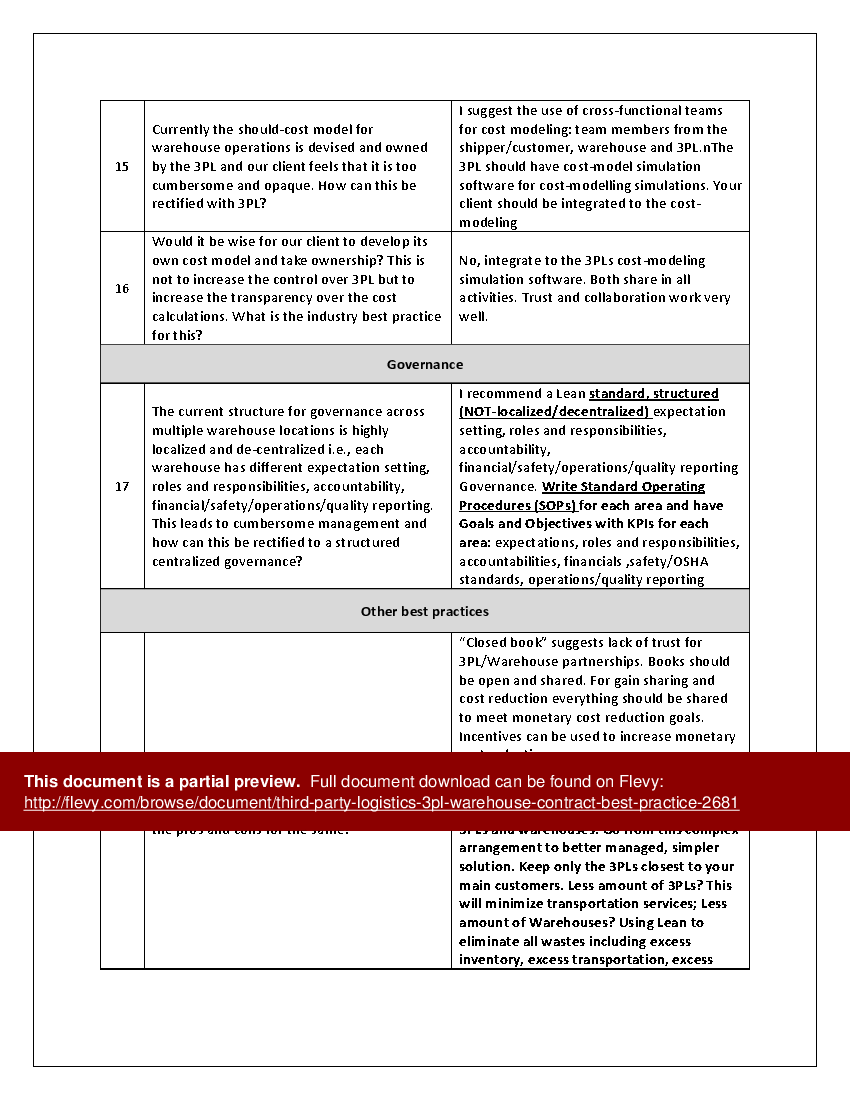
• Governance Structures - Recommendations for centralized governance to streamline operations and enhance accountability across multiple warehouse locations.
• Cost Plus Contracts - Insights into management fee structures, including industry standards and negotiation strategies.
• Incentive Structures - Examination of gain share and pain share mechanisms to motivate 3PL providers and enhance performance.
• Continuous Improvement Practices - Strategies for implementing Lean initiatives and fostering a culture of ongoing process enhancement.
Deliverables, Templates, and Tools
• KPI framework template for measuring performance in warehousing
• Governance structure model for centralized management of logistics operations
• Cost plus contract negotiation checklist to guide discussions with 3PL providers
• Gain share and pain share calculation tool for performance incentives
• Continuous improvement action plan template for logistics teams
Slide Highlights
• Overview of the current warehousing landscape and associated costs
• Detailed breakdown of KPIs and their relevance to logistics performance
• Governance model illustrating roles, responsibilities, and accountability
• Visual representation of cost plus contract structures and negotiation points
• Case studies showcasing successful implementation of Lean initiatives in warehousing
Potential Workshop Agenda
KPI Development Session (60 minutes)
• Discuss key performance indicators relevant to warehousing
• Collaborate on establishing measurable targets for 3PL performance
• Review case studies of successful KPI implementation
Governance Framework Workshop (90 minutes)
• Define roles and responsibilities for warehouse management
• Develop a centralized governance model for multiple warehouse locations
• Create standard operating procedures (SOPs) for operational excellence
Cost Negotiation Strategy Session (60 minutes)
• Analyze current cost structures and management fees
• Role-play negotiation scenarios with 3PL providers
• Establish guidelines for effective contract discussions
Customization Guidance
• Tailor KPIs to reflect specific operational goals and customer requirements
• Adjust governance structures based on the number of warehouses and complexity of operations
• Modify cost plus contract terms to align with organizational financial strategies
• Incorporate specific Lean initiatives relevant to the operational context
Secondary Topics Covered
• Trends in third-party logistics and warehousing
• Impact of technology on logistics efficiency
• Strategies for managing multiple 3PL relationships
• Best practices for inventory management in warehousing
Topic FAQ
What are the most important KPIs to include in a 3PL warehouse contract?
Key KPIs commonly used in 3PL warehouse contracts measure cost savings, service performance (on‑time/accuracy), quality metrics (error rates), safety standards, and customer satisfaction. These dimensions are highlighted to link commercial incentives and operational oversight to measurable outcomes such as cost savings, service performance, quality, safety, and customer satisfaction.How should governance be set up for multiple warehouse locations managed by a 3PL?
A centralized governance model is recommended, with clearly defined roles, responsibilities, and standard operating procedures to ensure consistent oversight across sites. Governance should establish accountability, reporting cadences, and decision rights tied to KPIs and SOPs, implemented through a centralized governance model with roles, responsibilities, and SOPs.How do cost‑plus contracts and management fees typically work in warehousing?
Cost‑plus contracts reimburse the 3PL for allowable costs plus an agreed management fee. Management fee structures vary and are negotiated based on performance and cost structures; typical market guidance in the document cites management fees commonly ranging from 5% to 8% of costs.What should I include in a 3PL contract template to prepare for negotiations?
A negotiation‑ready template should include a KPI framework, governance model, cost‑plus fee terms, incentive mechanisms (gain/pain share), open book provisions, and SOPs for operations and safety. Flevy’s Third Party Logistics (3PL) Warehouse Contract Best Practice specifically provides a KPI framework template, governance structure model, and cost plus contract negotiation checklist.How can incentives like gain share be structured to encourage 3PL cost savings?
Incentives are structured by tying shared savings or bonuses to agreed KPIs, using gain share and pain share mechanisms and transparent open book accounting. Contracts specify thresholds, measurement methods, and payment splits so that both client and provider share defined savings through gain share and pain share mechanisms.Are pre‑built templates and checklists worth buying for a small logistics team?
Pre‑built templates can shorten setup time and provide standard formats for KPIs, governance, and negotiation checklists while allowing customization for scale and complexity. The document offers customization guidance and includes templates such as a KPI framework and governance structure model to adapt to the number of warehouses and operational needs.What practical steps help implement continuous improvement (Lean) in a 3PL warehouse?
Practical steps include defining measurable KPIs, engaging employees in process improvement, running targeted Lean initiatives, and scheduling regular performance reviews. Using a structured action plan helps sustain progress; the document supplies a continuous improvement action plan template to guide Lean activities and reviews.What are best practices for open book contracts to ensure transparency and cost control?
Best practices for open book contracts include full cost transparency, agreed accounting rules, collaborative cost reviews, and linked incentives so that cost reductions are measured and shared. These practices foster trust and collaborative cost management, typically implemented alongside gain share arrangements and clear KPIs.Document FAQ
These are questions addressed within this presentation.
What are the key performance indicators for 3PL contracts?
Key performance indicators include cost savings, service performance, quality metrics, safety standards, and customer satisfaction measures.
How often should KPIs be reviewed?
KPIs should be reviewed regularly, ideally monthly, to ensure they remain relevant and aligned with operational goals.
What is the best practice for governance in warehousing?
A centralized governance model with clear roles, responsibilities, and standard operating procedures is recommended to streamline operations and enhance accountability.
How can we motivate 3PL providers to achieve cost savings?
Establishing a collaborative partnership with clear incentives tied to performance metrics can motivate 3PL providers to focus on cost-saving initiatives.
What are the advantages of open book contracts?
Open book contracts foster transparency and trust between parties, allowing for collaborative cost management and shared savings initiatives.
How should management fees be structured in cost plus contracts?
Management fees can vary, but typically range from 5% to 8%, with negotiations based on performance and cost structures.
What incentives can be included in a warehousing contract?
Incentives may include gain share arrangements, performance bonuses, and penalties for underperformance to ensure accountability.
How can continuous improvement be implemented in warehousing?
Continuous improvement can be achieved through Lean initiatives, employee engagement in process enhancement, and regular performance reviews.
Glossary
• 3PL - Third Party Logistics: A service provider that manages logistics operations for clients.
• KPI - Key Performance Indicator: A measurable value that demonstrates how effectively a company is achieving key business objectives.
• Lean Initiatives - Strategies aimed at improving efficiency by eliminating waste and enhancing processes.
• Governance - The framework of rules and practices by which an organization ensures accountability and transparency.
• Cost Plus Contract - A pricing model where the client pays the provider for the costs incurred plus an additional fee.
• Gain Share - A financial incentive structure where savings are shared between the client and the service provider.
• SOP - Standard Operating Procedure: A set of step-by-step instructions to help workers carry out routine operations.
• Continuous Improvement - Ongoing efforts to improve products, services, or processes over time.
• Service Level Agreement (SLA) - A contract that defines the level of service expected from a service provider.
• Performance Metrics - Standards used to measure the efficiency and effectiveness of a service.
• Transparency - Openness in communication and operations, fostering trust between parties.
• Collaboration - Working together towards a common goal, particularly in a business context.
• Inventory Management - The supervision of non-capitalized assets (inventory) and stock items.
• Cost Savings - Reduction in expenses achieved through various efficiency measures.
• Safety Metrics - Measurements used to assess the safety performance of an organization.
• Customer Satisfaction - A measure of how products and services meet or exceed customer expectations.
• Operational Efficiency - The ability to deliver products or services in the most cost-effective manner without compromising quality.
• Performance Improvement - Efforts aimed at enhancing the efficiency and effectiveness of operations.
• Warehouse Management System (WMS) - Software designed to support warehouse or distribution center management.
• Transportation Management System (TMS) - Software that facilitates the planning and execution of the physical movement of goods.
• Value Engineering - A method to improve the value of a product or service by assessing its functions.
• Occupational Safety and Health Administration (OSHA) - A US agency responsible for ensuring safe and healthy working conditions.
Source: Best Practices in Logistics, Contract, Warehouse Management, 3PL Word: Third Party Logistics (3PL) Warehouse Contract Best Practice Word (DOCX) Document, Charles M. Intrieri Consulting