
Third Party Logistics (3PL) Service Provider Checklist   10-page Word document
$20.00

Third Party Logistics (3PL) Service Provider Checklist (10-page Word document) Preview Image
Flevy is the marketplace for business best practices.
Third Party Logistics (3PL) Service Provider Checklist (10-page Word document) Preview Image
Arrow   Click main image to view in full screen.

Third Party Logistics (3PL) Service Provider Checklist (Word DOCX)

Word (DOCX) 10 Pages

Top 1,000 Best Practice $20.00

Add to Cart


Immediate download
Fully editable Word
Free lifetime updates

LOGISTICS WORD DESCRIPTION

Editor Summary Third Party Logistics (3PL) Service Provider Checklist is a 10-page DOCX checklist and RFP package authored by Charles M. Read more

The Third-Party Logistics (3PL) checklist and RFP detail what you need to know to make an effective decision on a collaborative and effective 3PL.

The request for quotation (RFQ) is detailed so you receive a realistic quotation from the 3PL you choose.

My recommendation is to send this RFQ to three 3PLs and study their RFQ responses. Next, make sure you VISIT the chosen 3PL with the checklist in hand. Your best bet is to negotiate the RFQ while on-site at the 3PL. This gives you leverage, as you have traveled to their location to view their operation, talk to management and negotiate prices submitted to you in the RFQ.

•  Ask to see all departments at the 3PL: Warehouse, does the warehouse follow Lean 5S? Does the warehouse practice Kanban or pull techniques? Picking area, do they practice slotting, returned goods area, receiving, shipping, quality assurance: does quality assurance follow Lean Six Sigma principles?
•  Do they practice Kaizen/Continuous Improvement?
•  Does Management treat their people well? Do their people respect management? Does Management visit the shop floor to solve problems and improve processes?
•  Is SAFETY a top priority at the 3PL? Is there a Safety Manager?
•  What is the top priority for you?

The chemistry you feel with management, your future contact person, and their people, after your visit.

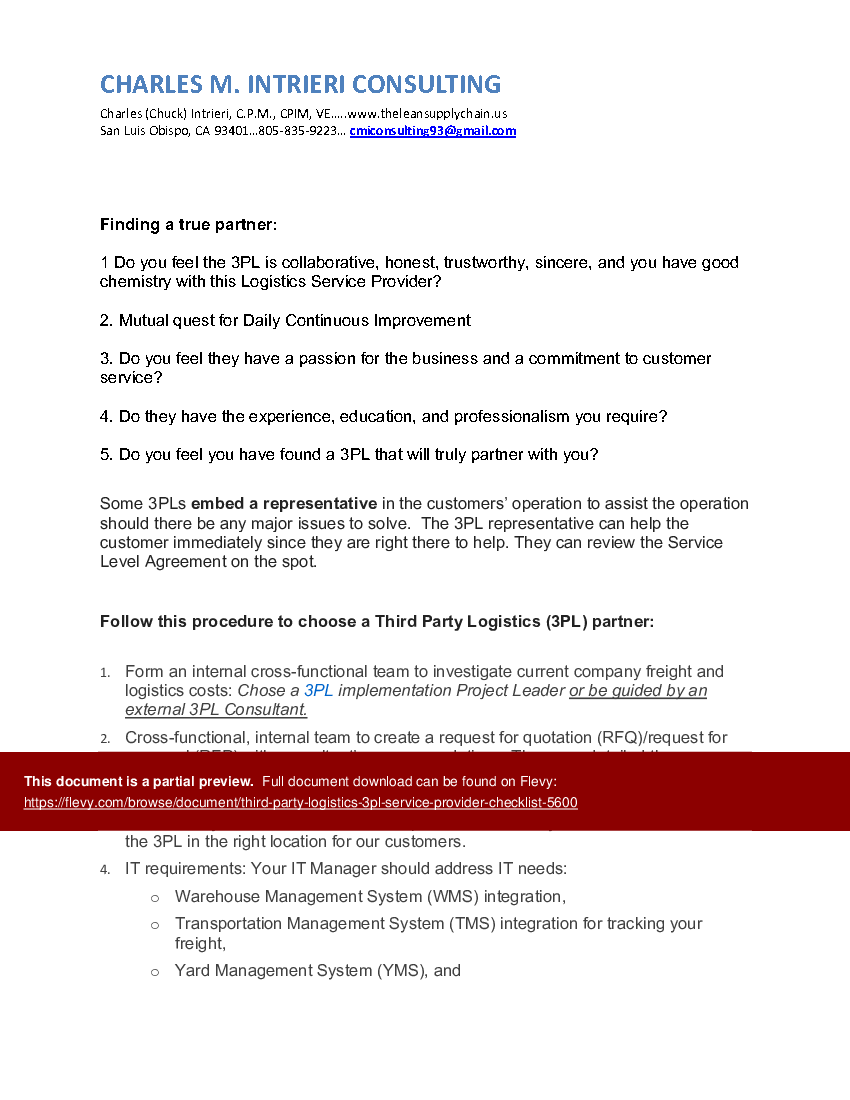
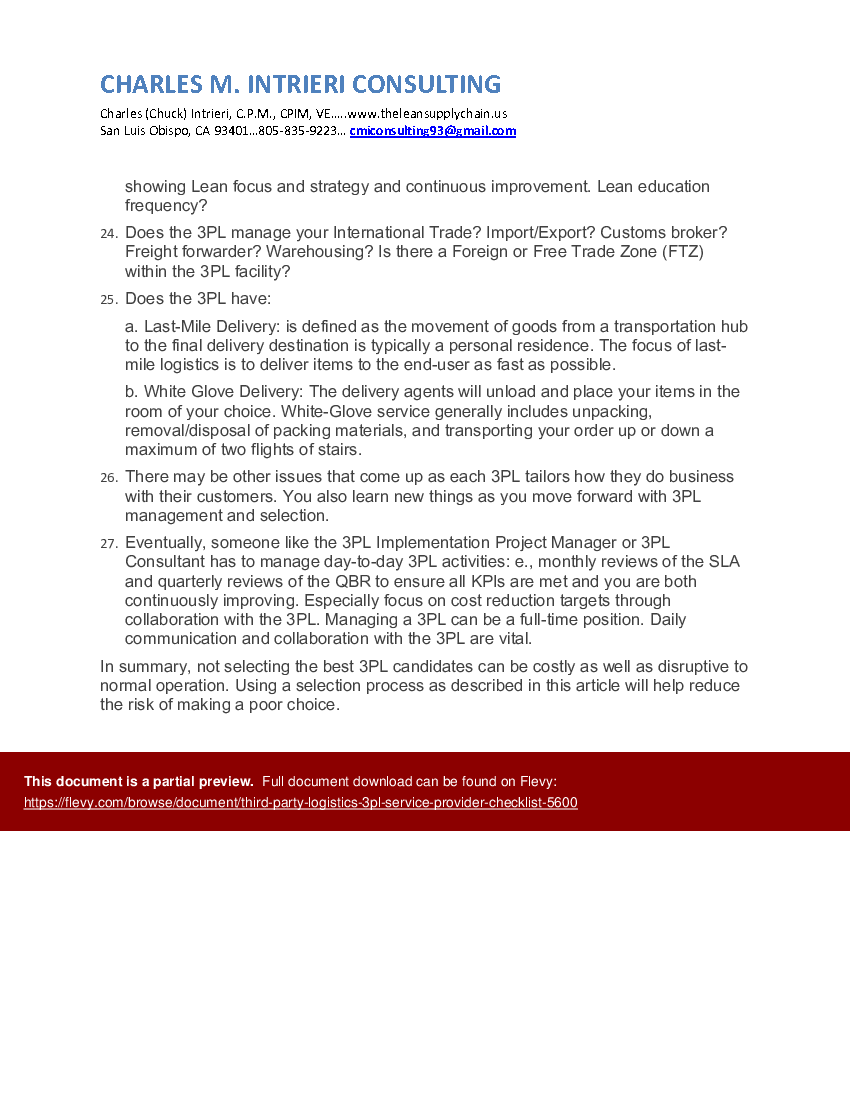
This comprehensive checklist also emphasizes the importance of embedding a 3PL representative within your operation to swiftly address any issues and ensure seamless collaboration. It outlines the necessity of forming a cross-functional team to evaluate logistics costs and create a detailed RFQ, ensuring all IT requirements are met, including WMS, TMS, and YMS integrations. The Word document delves into the specifics of last-mile and white-glove delivery services, international trade management, and continuous improvement practices. By following this structured approach, you can mitigate risks and make an informed decision that aligns with your operational goals.

Got a question about the product? Email us at support@flevy.com or ask the author directly by using the "Ask the Author a Question" form. If you cannot view the preview above this document description, go here to view the large preview instead.

MARCUS OVERVIEW

This synopsis was written by Marcus [?] based on the analysis of the full 10-slide presentation.


Executive Summary
The Third Party Logistics (3PL) Service Provider Checklist is an essential resource for organizations seeking to evaluate and select a 3PL partner. This document provides a comprehensive framework for assessing potential logistics providers, focusing on critical areas such as location, technology, lean initiatives, equipment, staffing, communication, qualifications, pricing, and international capabilities. By utilizing this checklist, corporate executives and logistics leaders can streamline their selection process, ensuring they choose a provider that aligns with their operational needs and business goals.

Who This Is For and When to Use

•  Supply Chain Managers responsible for logistics and distribution
•  Procurement Officers tasked with vendor selection and management
•  Operations Executives looking to optimize logistics processes
•  Project Managers overseeing 3PL implementation and integration

Best-fit moments to use this checklist:

•  During the initial stages of selecting a 3PL provider
•  When evaluating existing 3PL partnerships for performance improvement
•  In preparation for a Request for Proposal (RFP) or Request for Quotation (RFQ)
•  When assessing logistics capabilities for expansion or new product lines

Learning Objectives

•  Define the key criteria for selecting a 3PL provider
•  Assess the technological capabilities of potential logistics partners
•  Evaluate lean initiatives and their impact on operational efficiency
•  Analyze pricing structures and their implications for budgeting
•  Identify communication protocols essential for effective collaboration
•  Establish a framework for ongoing performance evaluation and improvement

Table of Contents

•  Location Considerations (page 1)
•  Technology Requirements (page 2)
•  Lean Initiatives Assessment (page 2)
•  Equipment Evaluation (page 3)
•  Staffing and Training (page 3)
•  Flexibility and Service Range (page 4)
•  Communication Protocols (page 4)
•  Qualifications and Experience (page 5)
•  Performance Expectations (page 6)
•  International Capabilities (page 7)
•  Pricing Structure (page 8)
•  Partnership Evaluation (page 9)

Primary Topics Covered

•  Location Considerations - Assess the physical attributes of the 3PL's facilities, including size, accessibility to transportation hubs, and available space for operations and expansion.
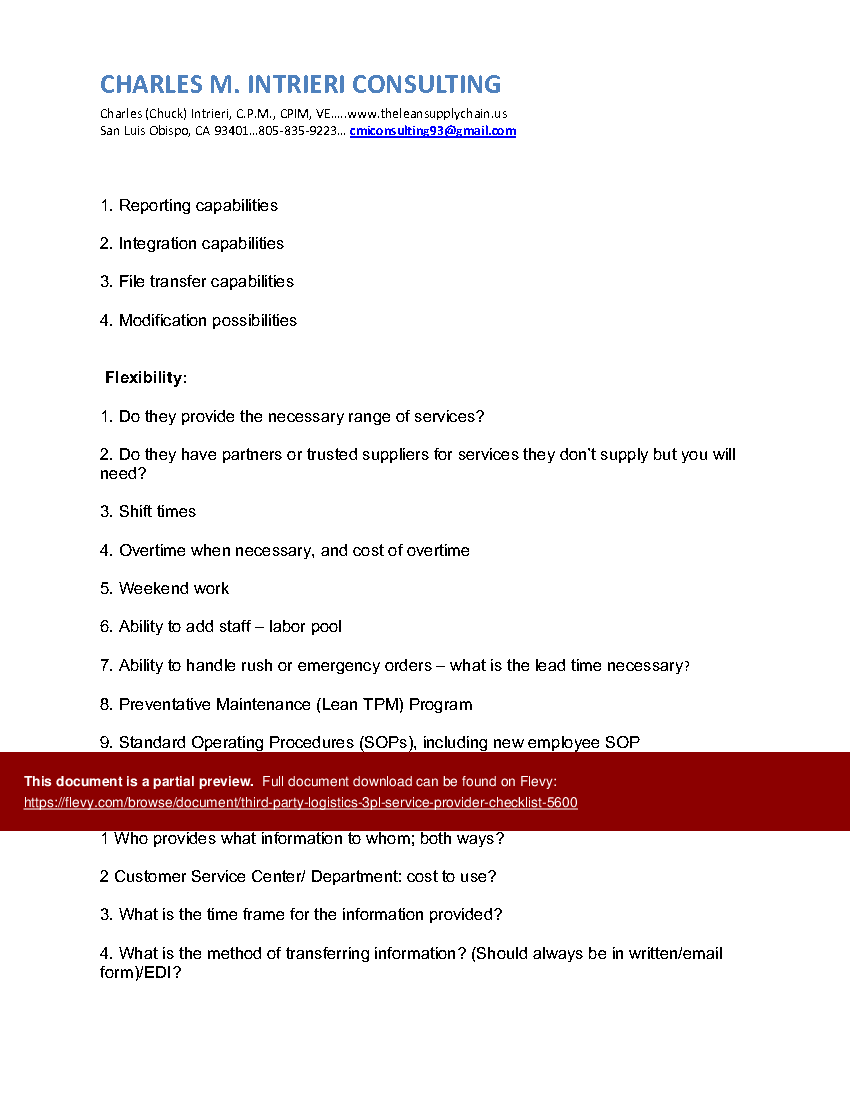
•  Technology Requirements - Evaluate the 3PL's technological infrastructure, including Warehouse Management Systems (WMS), Transportation Management Systems (TMS), and integration capabilities.
•  Lean Initiatives Assessment - Determine the 3PL's commitment to lean practices, including waste elimination, continuous improvement, and employee engagement in problem-solving.
•  Equipment Evaluation - Review the types of equipment available at the 3PL, such as pallet racks, conveyors, and scanning stations, to ensure they meet operational needs.
•  Staffing and Training - Analyze the qualifications, training procedures, and turnover rates of the 3PL's workforce to gauge operational reliability.
•  Flexibility and Service Range - Investigate the 3PL's ability to provide a diverse range of services and adapt to changing operational demands.

Deliverables, Templates, and Tools

•  Comprehensive 3PL provider qualification checklist
•  RFP template for soliciting proposals from potential 3PL partners
•  Performance evaluation framework for ongoing 3PL assessment
•  Lean initiative implementation guide for logistics operations
•  Pricing comparison matrix to analyze different 3PL offers
•  Communication protocol template for effective information exchange

Slide Highlights

•  Overview of location assessment criteria, emphasizing proximity to transportation hubs
•  Technology capabilities slide detailing essential systems for integration
•  Lean initiatives framework showcasing the importance of a continuous improvement culture
•  Equipment inventory checklist highlighting necessary tools for efficient operations
•  Staffing evaluation criteria focusing on training and qualifications

Potential Workshop Agenda

3PL Selection Workshop (120 minutes)
•  Discuss the importance of location and technology in 3PL selection
•  Review lean initiatives and their impact on logistics efficiency
•  Analyze staffing needs and training requirements for optimal performance

Performance Evaluation Session (90 minutes)
•  Establish key performance indicators (KPIs) for ongoing 3PL assessment
•  Develop a communication protocol for effective collaboration with the 3PL
•  Identify areas for continuous improvement and cost reduction

Customization Guidance

•  Tailor the checklist to reflect specific operational needs and industry standards
•  Adjust performance metrics based on organizational goals and customer expectations
•  Incorporate unique communication protocols relevant to your business context

Secondary Topics Covered

•  International logistics considerations and compliance
•  Risk management strategies in 3PL partnerships
•  Cost structures and pricing models in logistics contracts
•  Service Level Agreements (SLAs) and Key Performance Indicators (KPIs)
•  Continuous improvement methodologies in logistics

Topic FAQ

What criteria should I use to evaluate a 3PL provider?

Core criteria include physical location and access to transportation hubs, technological capabilities (WMS/TMS/YMS and integration), commitment to lean/continuous improvement, available equipment, staffing qualifications and turnover, flexibility of services, communication protocols, and pricing structures, with assessment across these areas in a single checklist.

How do I evaluate a 3PL's technology capabilities?

Evaluate whether the 3PL operates a Warehouse Management System (WMS), Transportation Management System (TMS), yard management or other systems, and their ability to integrate with your IT. Also inquire about advanced technologies like RFID or IoT; focus on WMS, TMS, and integration capabilities.

What should be included in an RFP/RFQ when soliciting 3PL proposals?

An effective RFP/RFQ should specify detailed operational requirements, evaluation criteria, timelines, service level expectations, IT integration needs (WMS/TMS/YMS), international capabilities, and specific questions on experience; the Third Party Logistics (3PL) Service Provider Checklist includes a ready RFP template for this purpose.

How can I assess a 3PL's lean initiatives and continuous improvement practices?

Ask about visible lean practices on the shop floor (5S, Kanban), use of Kaizen or continuous improvement programs, whether quality follows Lean Six Sigma principles, and management engagement with frontline teams; verify through observation and specific examples of process improvements like 5S or Kaizen events.

What should I consider when choosing a 3PL selection template or checklist for my company?

Prefer templates that are customizable to your industry, include an RFP/RFQ template, a pricing comparison matrix, a performance evaluation framework, and communication protocol examples to support negotiation and on-site assessment; the Third Party Logistics (3PL) Service Provider Checklist provides these specific templates.

I need to change 3PLs after a merger — what practical steps should I follow to select a new provider?

Form a cross-functional evaluation team, define operational requirements, develop and send a detailed RFQ to multiple 3PLs (recommendation: three), analyze responses with a pricing comparison matrix, visit shortlisted facilities with the checklist, and negotiate on-site using direct observations and RFQ data.

How should I measure ongoing 3PL performance and hold providers accountable?

Establish clear SLAs and KPIs, perform regular reviews against benchmarks, use a structured performance evaluation framework to document compliance and improvement opportunities, and schedule periodic performance evaluation sessions to review results and corrective actions using measurable KPIs and a performance evaluation framework.

What international logistics capabilities should I verify with a potential 3PL?

Verify international trade management experience such as customs brokerage, bonded warehouse handling, freight forwarding arrangements, cargo insurance options, and capabilities for cross-border compliance and last-mile or white-glove delivery services when applicable; confirm specific items like customs brokers and bonded warehouse access.

Document FAQ
These are questions addressed within this presentation.


What is the purpose of the 3PL Service Provider Checklist?
The checklist serves as a comprehensive tool for evaluating and selecting third-party logistics providers, ensuring alignment with operational needs and business objectives.

How can I customize the checklist for my organization?
You can tailor the checklist by incorporating specific operational requirements, industry standards, and unique communication protocols relevant to your business.

What key areas should I focus on when assessing a 3PL provider?
Focus on location, technology capabilities, lean initiatives, equipment, staffing, flexibility, communication protocols, and pricing structures.

How do I evaluate the technological capabilities of a 3PL?
Assess their Warehouse Management Systems (WMS), Transportation Management Systems (TMS), integration capabilities, and any advanced technologies like RFID or IoT.

What are lean initiatives, and why are they important?
Lean initiatives focus on eliminating waste and improving processes. They are crucial for enhancing operational efficiency and meeting customer expectations.

How can I ensure effective communication with my 3PL provider?
Establish clear communication protocols, define points of contact, and ensure that information is exchanged in a timely and documented manner.

What should I include in a Request for Proposal (RFP) for 3PL services?
Include detailed requirements, evaluation criteria, timelines, and specific questions regarding the provider's capabilities and experience.

How do I measure the performance of my 3PL provider?
Utilize Key Performance Indicators (KPIs) to track performance against established benchmarks, and conduct regular reviews to assess compliance and areas for improvement.

Glossary

•  3PL (Third Party Logistics) - A service provider that manages logistics operations on behalf of another company.
•  WMS (Warehouse Management System) - Software that supports warehouse or distribution center management.
•  TMS (Transportation Management System) - Software that facilitates transportation operations and logistics.
•  Lean Initiatives - Strategies aimed at improving efficiency by eliminating waste.
•  SLA (Service Level Agreement) - A contract that defines the level of service expected from a service provider.
•  KPIs (Key Performance Indicators) - Metrics used to evaluate the success of an organization or employee in meeting objectives.
•  RFQ (Request for Quotation) - A document used to solicit price proposals from suppliers.
•  RFP (Request for Proposal) - A document that outlines project requirements and invites suppliers to submit proposals.
•  EDI (Electronic Data Interchange) - The electronic exchange of business information in a standardized format.
•  Continuous Improvement - Ongoing efforts to enhance products, services, or processes.
•  Inventory Control - The process of managing inventory levels to meet customer demand while minimizing costs.
•  Last-Mile Delivery - The final step of the delivery process where goods are transported from a transportation hub to the final delivery destination.
•  White Glove Delivery - A premium service that includes unpacking and setup of delivered items.
•  Customs Broker - A professional who helps importers and exporters comply with customs regulations.
•  Freight Forwarder - An agent who arranges the transportation of goods on behalf of shippers.
•  Bonded Warehouse - A secure storage facility where goods can be stored without payment of duties until they are removed.
•  Gainsharing - A compensation strategy that rewards employees for increased productivity or cost savings.
•  Activity-Based Pricing - A pricing model based on the activities required to produce a service.
•  Cargo Insurance - Insurance that protects against loss or damage to goods while in transit.
•  Reverse Logistics - The process of moving goods from their final destination for the purpose of return, repair, or recycling.

Source: Best Practices in Logistics, 3PL Word: Third Party Logistics (3PL) Service Provider Checklist Word (DOCX) Document, Charles M. Intrieri Consulting


$20.00

Add to Cart
  

ABOUT THE AUTHOR

Additional documents from author: 14

Independent consultant of over 25 years. Expertise include:

OPERATIONAL EXCELLENCE
•  Planning - Strategic to Tactical
•  Leadership, Coaching & Mentoring
•  Budgeting & Reporting
•  Risk Management, Compliance & Audit
•  Process Improvement

SUPPLY CHAIN & LOGISTICS
•  Warehouse, Distribution & Fulfillment ... [read more]

Ask the Author a Question

You must be logged in to contact the author.

Click here to log in Click here register

Did you know?
The average daily rate of a McKinsey consultant is $6,625 (not including expenses). The average price of a Flevy document is $65.


Trusted by over 10,000+ Client Organizations
Since 2012, we have provided business templates to over 10,000 businesses and organizations of all sizes, from startups and small businesses to the Fortune 100, in over 130 countries.
AT&T GE Cisco Intel IBM Coke Dell Toyota HP Nike Samsung Microsoft Astrazeneca JP Morgan KPMG Walgreens Walmart 3M Kaiser Oracle SAP Google E&Y Volvo Bosch Merck Fedex Shell Amgen Eli Lilly Roche AIG Abbott Amazon PwC T-Mobile Broadcom Bayer Pearson Titleist ConEd Pfizer NTT Data Schwab


Read Customer Testimonials

 
"FlevyPro provides business frameworks from many of the global giants in management consulting that allow you to provide best in class solutions for your clients."

– David Harris, Managing Director at Futures Strategy
 
"I like your product. I'm frequently designing PowerPoint presentations for my company and your product has given me so many great ideas on the use of charts, layouts, tools, and frameworks. I really think the templates are a valuable asset to the job."

– Roberto Fuentes Martinez, Senior Executive Director at Technology Transformation Advisory
 
"I have used FlevyPro for several business applications. It is a great complement to working with expensive consultants. The quality and effectiveness of the tools are of the highest standards."

– Moritz Bernhoerster, Global Sourcing Director at Fortune 500
 
"One of the great discoveries that I have made for my business is the Flevy library of training materials.

As a Lean Transformation Expert, I am always making presentations to clients on a variety of topics: Training, Transformation, Total Productive Maintenance, Culture, Coaching, Tools, Leadership Behavior, etc. Flevy "

– Ed Kemmerling, Senior Lean Transformation Expert at PMG
 
"[Flevy] produces some great work that has been/continues to be of immense help not only to myself, but as I seek to provide professional services to my clients, it gives me a large "tool box" of resources that are critical to provide them with the quality of service and outcomes they are expecting."

– Royston Knowles, Executive with 50+ Years of Board Level Experience
 
"Flevy is our 'go to' resource for management material, at an affordable cost. The Flevy library is comprehensive and the content deep, and typically provides a great foundation for us to further develop and tailor our own service offer."

– Chris McCann, Founder at Resilient.World
 
"As an Independent Management Consultant, I find Flevy to add great value as a source of best practices, templates and information on new trends. Flevy has matured and the quality and quantity of the library is excellent. Lastly the price charged is reasonable, creating a win-win value for "

– Jim Schoen, Principal at FRC Group
 
"As a consultant requiring up to date and professional material that will be of value and use to my clients, I find Flevy a very reliable resource.

The variety and quality of material available through Flevy offers a very useful and commanding source for information. Using Flevy saves me time, enhances my expertise and ends up being a good decision."

– Dennis Gershowitz, Principal at DG Associates


Customers Also Bought These Documents


Customers Also Like These Documents

Explore Templates on Related Management Topics


Your Recently Viewed Documents
Receive our FREE presentation on Operational Excellence

This 50-slide presentation provides a high-level introduction to the 4 Building Blocks of Operational Excellence. Achieving OpEx requires the implementation of a Business Execution System that integrates these 4 building blocks.








