
Editor Summary
39-slide PowerPoint (PPTX) titled "Strategy Development Process - Mining Industry" by STRATICX is a consulting-grade strategic framework for the mining sector that covers context setting, Shareholder Values, and Strategy Design Assessment across 4 key areas: Shareholder Values, Mineral Assessment, Value Chain Assessment, and Geography Assessment.
Read moreIncludes strategic framework templates, economic modeling tools, workshop facilitation guides, and action plan templates. Target users include corporate executives, strategy consultants, financial analysts, and operations managers. Sold as a digital download on Flevy with immediate digital download.
This deck is designed for situations where a mining company must define medium- to long-term strategy, assess investments or divestitures, align shareholder expectations, or run strategic planning workshops.
Corporate executives defining medium- to long-term goals and aligning those goals to shareholder expectations using the Shareholder Values analysis.
Strategy consultants evaluating portfolio options and comparing organic versus inorganic growth using the Strategy Design Assessment.
Financial analysts modeling funding requirements and cash flow impacts for investment or divestiture decisions using the economic modeling tools.
Operations managers mapping value chain capabilities to strategic choices during workshop sessions.
The three-part structure — context setting, shareholder values, strategy design assessment — follows consulting-grade analysis used at McKinsey, Bain, and BCG.
This is a strategy development process document and framework specifically designed for the mining industry.
The document covers four key areas:
1. Shareholder Values
2. Mineral Assessment
3. Value Chain Assessment
4. Geography Assessment
The process covers setting the initial context, including the problem / opportunity faced by the business and then the key framework for designing the strategy covering the four key areas mentioned above.
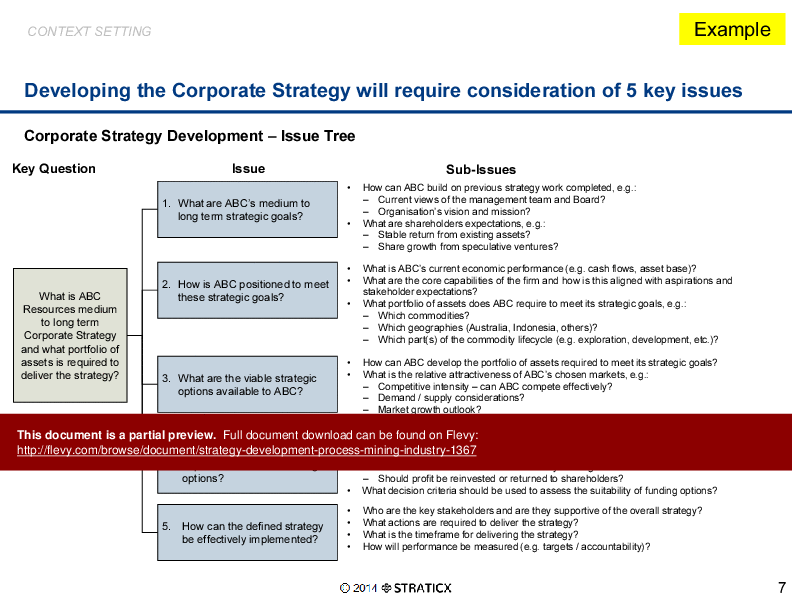
This PPT provides a comprehensive framework for addressing the strategic challenges in the mining industry. It includes detailed analysis of cash flow profiles, strategic options, and key issues that need to be considered for corporate strategy development. The issue tree format helps in breaking down complex strategic questions into manageable sub-issues, ensuring a thorough examination of all critical factors.
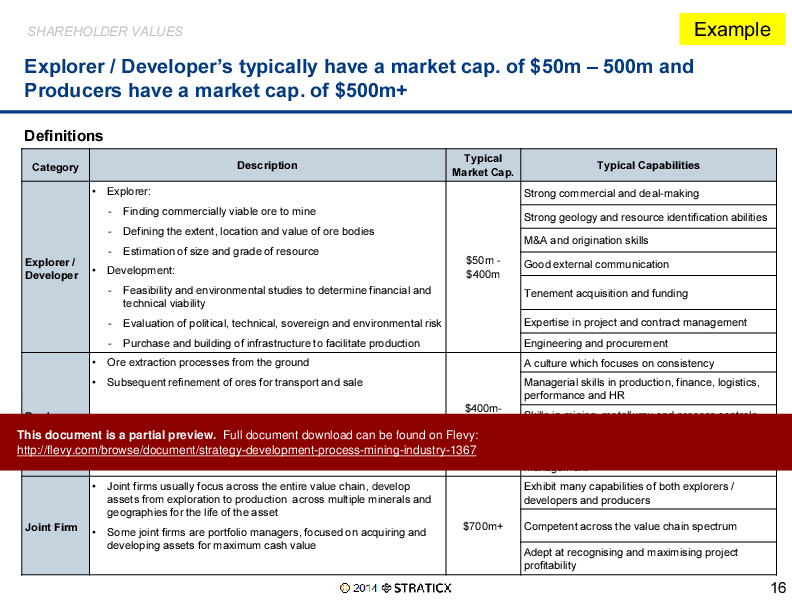
The document also outlines four strategic options for mining companies, ranging from pure exploration to full-scale production. Each option is assessed based on investment stages, risk categorization, and typical activities, providing a clear roadmap for decision-making. The inclusion of market cap and typical capabilities for different types of mining firms adds a layer of practical insight, making it easier for executives to align their strategies with industry standards.
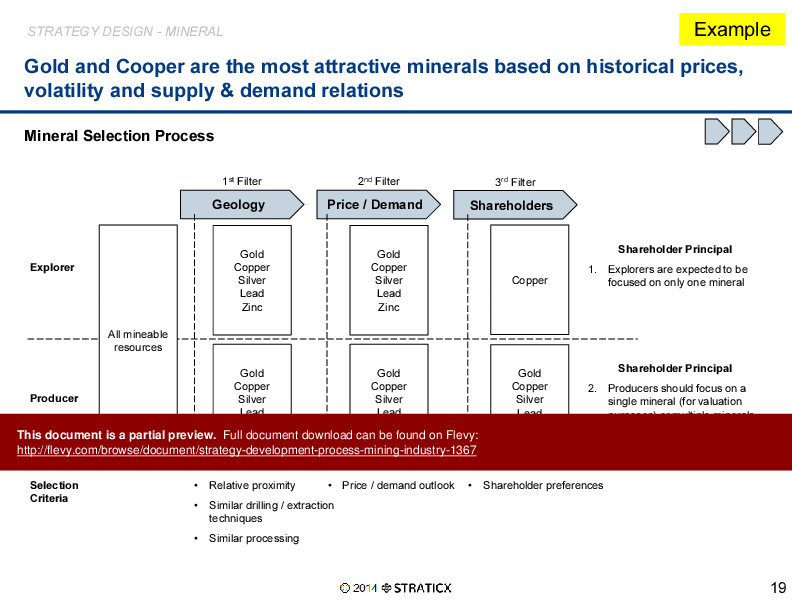
Additionally, the document delves into mineral selection processes, highlighting the most attractive minerals based on historical prices, volatility, and demand relations. It also covers the geographical assessment, identifying first-world countries as the most favorable locations for mining operations due to their low-risk profiles. The strategic design assessment section discusses the advantages and disadvantages of organic growth through partnerships, offering valuable guidance for companies looking to expand their operations.
Got a question about the product? Email us at support@flevy.com or ask the author directly by using the "Ask the Author a Question" form. If you cannot view the preview above this document description, go here to view the large preview instead.
MARCUS OVERVIEW
This synopsis was written by Marcus [?] based on the analysis of the full 39-slide presentation.
Executive Summary
This presentation outlines a strategic development framework tailored for the mining industry, specifically focusing on ABC Resources. Crafted with the rigor expected from a McKinsey, Bain, or BCG-quality analysis (consulting-grade; not affiliated), this framework aids corporate executives in navigating complex strategic decisions. It addresses key issues such as portfolio management, shareholder expectations, and economic implications of strategic options. By leveraging this framework, executives will be equipped to enhance decision-making, optimize resource allocation, and align corporate strategies with stakeholder values.
Who This Is For and When to Use
• Corporate executives in the mining sector responsible for strategic planning and decision-making
• Strategy consultants advising mining companies on portfolio management and growth strategies
• Financial analysts evaluating investment opportunities in mining assets
• Operations managers seeking to align operational capabilities with strategic goals
Best-fit moments to use this deck:
• During strategic planning sessions to define medium and long-term goals
• When assessing potential investments or divestitures in mining assets
• In workshops focused on aligning shareholder expectations with corporate strategy
• For presentations to stakeholders regarding strategic direction and financial outlook
Learning Objectives
• Define ABC Resources' medium to long-term strategic goals
• Analyze the company's positioning to meet these strategic goals
• Identify viable strategic options available to ABC Resources
• Evaluate the economic implications of various strategic options
• Develop an actionable plan for effective strategy implementation
• Align corporate strategy with shareholder values and expectations
Primary Topics Covered
• Context Setting - Establishes the current operational landscape and strategic challenges facing ABC Resources, including cash flow dynamics and asset management.
• Shareholder Values - Analyzes the composition of ABC's shareholder base and their expectations regarding returns and growth.
• Strategy Design Assessment - Evaluates strategic options for growth, focusing on both organic and inorganic pathways to enhance value creation.
Deliverables, Templates, and Tools
• Strategic framework template for assessing portfolio options and shareholder alignment
• Economic modeling tools for evaluating the financial implications of strategic choices
• Workshop facilitation guides for stakeholder engagement and strategy refinement
• Action plan templates for implementing strategic initiatives
Slide Highlights
• Overview of ABC Resources' cash flow profile and strategic challenges
• Visual representation of shareholder composition and market expectations
• Framework for evaluating strategic options, including organic and inorganic growth pathways
• Analysis of commodity trends and their implications for ABC Resources' strategy
Potential Workshop Agenda
Strategic Planning Workshop (90 minutes)
• Review current strategic goals and performance metrics
• Engage stakeholders in discussions on portfolio management and shareholder alignment
• Identify key strategic options and evaluate their potential impact
Economic Implications Session (60 minutes)
• Analyze financial models related to proposed strategic options
• Discuss funding requirements and risk mitigation strategies
• Align on decision-making criteria for future investments
Customization Guidance
• Tailor the strategic framework to reflect specific operational challenges faced by ABC Resources
• Adjust financial modeling tools to incorporate current market data and forecasts
• Modify workshop agendas to focus on particular strategic initiatives relevant to stakeholders
Secondary Topics Covered
• Market attractiveness assessments for various minerals
• Risk analysis related to geographical and operational factors
• Shareholder principles guiding strategic decision-making
• Value chain analysis for optimizing operational capabilities
Topic FAQ
What are the core stages of a mining strategy development process?
A typical process begins with context setting to define the problem or opportunity, then analyzes shareholder values and company positioning, assesses strategy design across mineral, value chain, and geography dimensions, evaluates economic implications of options, and concludes with implementation planning and monitoring across the 4 key areas.
How do you assess shareholder expectations in mining strategic planning?
Assessments analyze shareholder composition and preferences to determine acceptable returns and growth horizons, then translate those preferences into decision criteria for portfolio choices and funding. The product includes a Shareholder Values section and tools to map composition and expectations, such as the Shareholder Values analysis on page 13.
What role does economic modeling play in evaluating mining strategic options?
Economic modeling quantifies funding requirements, cash flow impacts, and projected returns to compare options and identify viable investment paths. The Strategy Development Process - Mining Industry includes economic modeling tools for cash flow projections and investment assessments to evaluate financial implications.
How should geography risk be incorporated into a mining strategy?
Geography assessment requires evaluating political, economic, and environmental risk factors that affect operational viability and cost of capital, with an emphasis on low-risk jurisdictions. The framework explicitly identifies first-world countries as more favorable locations in its geographical assessment.
What should I look for when buying a mining strategy toolkit?
Buyers should seek templates for portfolio assessment, economic modeling capabilities (cash flow and investment analysis), workshop facilitation guides, customization guidance, and an issue-tree format for problem decomposition. Flevy's Strategy Development Process - Mining Industry provides those features, including templates and economic modeling tools.
How much time and team resources are needed to run a strategic planning workshop using a toolkit?
The sample agendas suggest a 90-minute Strategic Planning Workshop for goal review and stakeholder alignment, plus a 60-minute Economic Implications Session for financial analysis and funding discussion. Typical participants include executives, finance, operations, and key stakeholders across those 2 sessions.
I need to evaluate whether to pursue organic growth or M&A — what framework should I use?
Use a strategy design assessment that compares organic and inorganic pathways by mapping investment stages, risk categorization, typical activities, and capability requirements. The author describes 4 strategic options and evaluates organic versus inorganic growth with investment-stage and risk assessments.
How do I prioritize which mineral to focus on for development projects?
Prioritization should consider historical price levels, price volatility, demand relationships, and market attractiveness for each mineral, then map those criteria to company capabilities and investment stage. The framework includes a mineral selection process that evaluates attractiveness using historical prices, volatility, and demand relations.
Document FAQ
These are questions addressed within this presentation.
What is the primary focus of the strategy development framework?
The framework focuses on aligning ABC Resources' corporate strategy with shareholder values while assessing viable strategic options for growth and sustainability.
How does the framework address shareholder expectations?
It evaluates shareholder composition and preferences, ensuring that strategic decisions align with their expectations for returns and growth.
What are the key strategic options available to ABC Resources?
Options include organic growth through operational improvements and inorganic growth via joint ventures or acquisitions.
How can the defined strategy be effectively implemented?
Implementation involves creating actionable plans, engaging stakeholders, and monitoring performance against established metrics.
What economic implications should be considered when evaluating strategic options?
Considerations include funding requirements, potential returns on investment, and the impact on cash flow and profitability.
How does the framework incorporate risk assessment?
It includes a thorough analysis of market risks, operational challenges, and financial constraints associated with each strategic option.
What tools are provided for economic modeling?
The framework offers templates and tools for financial analysis, including cash flow projections and investment assessments.
How can the strategic framework be customized for different scenarios?
Customization can be achieved by adjusting the framework to reflect specific operational contexts, market conditions, and stakeholder priorities.
What are the expected outcomes of using this framework?
Expected outcomes include improved strategic alignment, enhanced decision-making capabilities, and a clearer path to achieving corporate goals.
Glossary
• Cash Flow Profile - A financial overview detailing the inflows and outflows of cash within a company.
• Shareholder Values - Expectations and principles guiding the interests of shareholders in a company.
• Strategic Options - Potential pathways for growth and development that a company can pursue.
• Value Chain - The full range of activities required to create a product or service, from conception to delivery.
• Geographical Risk - The potential for financial loss due to political, economic, or environmental factors in a specific location.
• Organic Growth - Expansion achieved through internal resources and capabilities rather than through mergers or acquisitions.
• Inorganic Growth - Growth achieved through mergers, acquisitions, or partnerships.
• Market Attractiveness - An assessment of the potential profitability and growth prospects of a market segment.
• Economic Modeling - The process of creating representations of economic scenarios to evaluate potential outcomes.
• Stakeholder Engagement - The process of involving individuals or groups with an interest in the company's operations and strategy.
• Portfolio Management - The strategic approach to managing a collection of investments or assets to achieve specific objectives.
• Risk Mitigation - Strategies and actions taken to reduce the potential negative impact of risks.
• Commodity Trends - Patterns and changes in the supply and demand dynamics for specific commodities.
• Joint Venture (JV) - A business arrangement where 2 or more parties agree to pool resources for a specific project while retaining their distinct identities.
• Mergers and Acquisitions (M&A) - The consolidation of companies or assets through various types of financial transactions.
• Operational Capabilities - The skills and resources a company possesses to effectively execute its business strategy.
• Financial Constraints - Limitations on a company's ability to secure funding or manage cash flow effectively.
• Strategic Planning - The process of defining a company's direction and making decisions on allocating resources to pursue that direction.
• Stakeholder Principles - Guidelines that inform how a company should engage with its stakeholders to align interests and expectations.
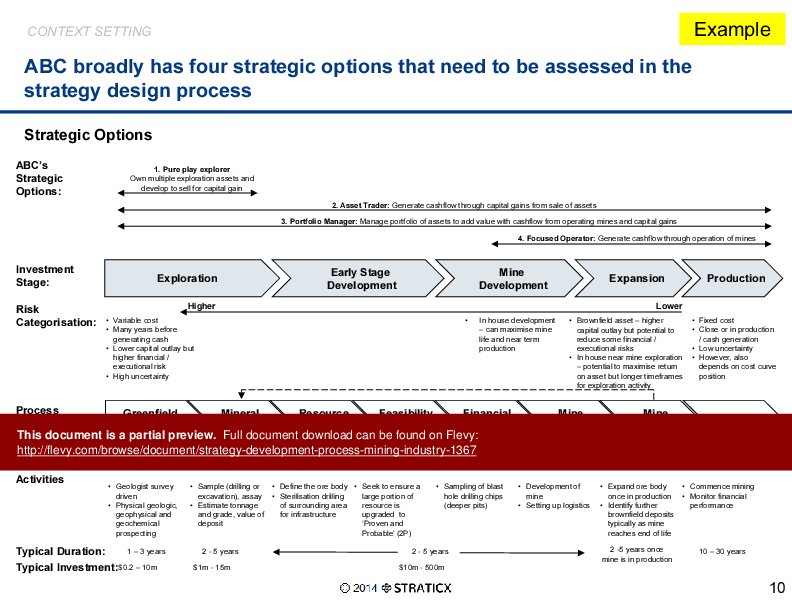
This PPT slide outlines 4 strategic options for ABC in the mining industry, positioned along a continuum from exploration to production, reflecting various investment stages and associated risks.
1. Pure Play Explorer: Focuses on owning multiple exploration assets for capital gains, emphasizing high returns with significant risks.
2. Asset Trader: Generates cash flow through the sale of capital assets, promoting active management to optimize asset value and liquidity.
3. Portfolio Manager: Manages a diverse portfolio to enhance cash flow from operating mines and capital gains, highlighting strategic asset allocation and risk management.
4. Focused Operator: Centers on cash flow generation through mine operations, aiming to maximize operational efficiency and production output.
The investment stages indicate higher risks during the Exploration phase, with decreasing risks and returns as one moves toward Production. This structured approach aids stakeholders in assessing the viability of each strategic option.
This PPT slide presents a structured framework for evaluating mineral resources based on geological characteristics and extraction methodologies. Resources are categorized into 4 groups: Precious Metals, Base Metals, Ferrous Metals, and Fossil Fuels, each listing specific minerals and their mineability. The proximity of mineable deposits can influence strategic decisions regarding resource prioritization for operational efficiencies. Similarity in drilling and extraction techniques is crucial for companies aiming to streamline operations and reduce costs, leading to operational synergies. Processing requirements are essential for assessing feasibility and cost implications of extraction and refining. Checkmarks and crosses indicate whether resources meet criteria for proximity, extraction techniques, and processing, providing a visual reference for decision-making.
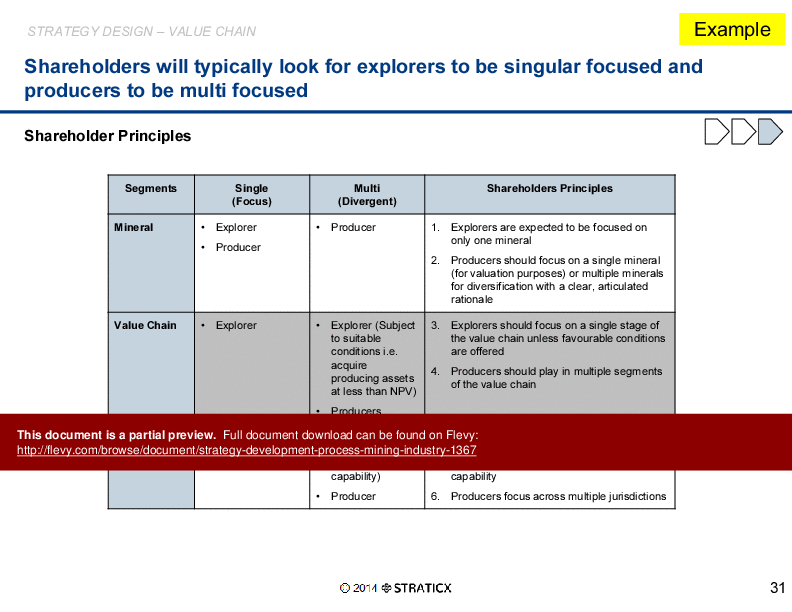
Key principles for shareholders evaluating mineral exploration and production companies are categorized into 3 segments: Mineral, Value Chain, and Geography, focusing on single versus multi-dimensional strategies. In the Mineral segment, explorers should concentrate on a single mineral to enhance valuation, while producers can diversify across multiple minerals with a clear rationale. The Value Chain section advises explorers to focus on one stage unless favorable conditions arise, whereas producers benefit from operating across multiple segments for increased flexibility. Geographically, explorers should limit their focus to one area unless they can manage operations in multiple regions, while producers should engage in various jurisdictions to leverage opportunities and mitigate risks. This framework guides mining companies in aligning operational strategies with shareholder expectations.
This PPT slide outlines the capabilities required at various stages of the mining value chain for ABC Resources: exploration, development, and production. In the exploration phase, essential capabilities include geology and resources identification, statistical analysis, external communications, tenement acquisition, commercial capability, and partnering, indicating ABC's strong exploration track record. The development stage requires procurement, engineering, project management, contract management, and funding, with a note on challenges related to cost management, as indicated by "new mine successfully developed though over budget." In production, capabilities focus on operational aspects like OH&S and HR management, production management, financial management, logistics management, and performance management, with a mention of "start-up operational difficulties with production." This structured view highlights ABC Resources' strengths in exploration and areas for improvement in development and production.
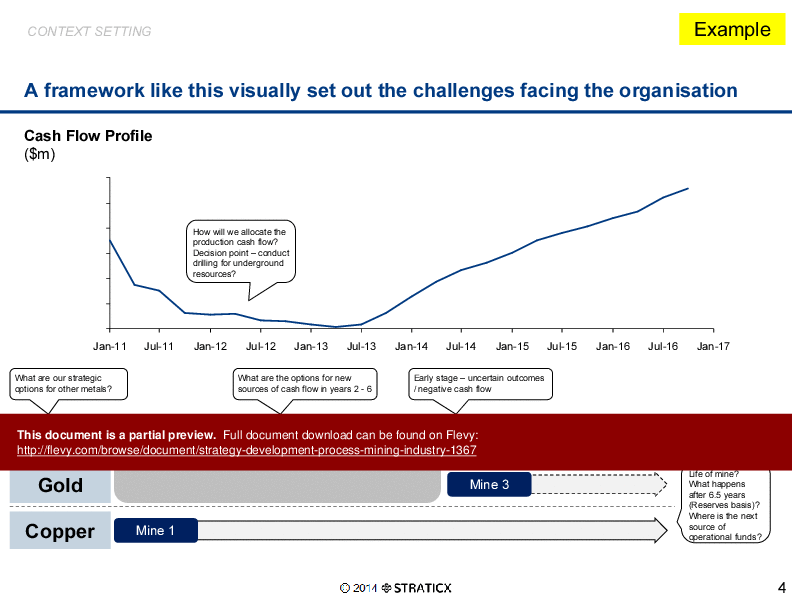
This framework illustrates the cash flow profile of an organization from January 2011 to January 2017, highlighting significant fluctuations, including a dip in mid-2012 and a gradual recovery. Key questions prompt strategic considerations, such as effective allocation of production cash flow and diversification strategies for other metals to mitigate risks. The ‘Growth Hole’ section signifies uncertainty in cash flow outcomes, emphasizing the need for planning and risk assessment. Specific mines (Mine 2 and Mine 3) focus on resource management, with questions about mine life and future reserves underscoring the importance of long-term planning in the mining sector. This framework communicates the challenges and strategic considerations for decision-makers.
Zinc and lead markets are experiencing significant demand fluctuations, particularly influenced by industrial growth in China and India. Zinc demand is rising due to its essential role in galvanizing steel, despite challenges from large stockpiles affecting pricing dynamics. Macroeconomic factors and fiscal uncertainty are expected to drive price movements more than supply constraints. On the supply side, capacity limitations outside China and India, along with a lack of smelting operations, further strain the market. For lead, demand is closely linked to consumer sentiment in China, especially for lead-acid batteries and electric bikes. While lead prices have been volatile, improving economic conditions and low stock levels may stabilize them. Both metals face similar supply constraints, necessitating close monitoring of demand and supply dynamics for informed decision-making in the mining sector.
This PPT slide outlines a strategic framework for ABC Resources, focusing on 3 key areas: Situation, Complication, and Key Questions. In the Situation section, ABC Resources' primary asset is an open-cut copper and gold mine, currently cash flow positive, with projected significant annual revenue and exploration potential for a larger life pit. This indicates a focus on both gold and copper, with early strategy work revealing a 'cash hole' that needs addressing. The Complication section raises questions about updating corporate strategy, optimal asset portfolios, and geographical priorities for operations, emphasizing stakeholder alignment in reinvesting future cash flow. The Key Questions segment distills strategic considerations into actionable inquiries regarding corporate strategy, financial capacity, and meeting strategic goals.
This PPT slide assesses 2 strategic options for resource development within ABC: "Refocus for Phased Organic Growth" and "Phased Inorganic Growth." Each option is evaluated against criteria such as maximizing ABC value, creating new growth opportunities, providing future optionality, and mitigating reputational, financial, and execution risks. The visual representation indicates that "Refocus for Phased Organic Growth" excels in maximizing value and growth opportunities, while "Phased Inorganic Growth" presents different risk profiles. Timing is critical, as both options must align with the appropriate cycle for implementation. The assessment highlights varying levels of risk and timing considerations essential for executive decision-making.
This PPT slide presents a Geographic Mineral Potential Attractiveness Analysis, identifying Africa and Latin America as prime locations for mineral exploration. It categorizes jurisdictions into 4 groups: Africa, Asia, Latin America, and First World, listing the top 20 high-potential resource jurisdictions. The chart plots these jurisdictions on a potential attractiveness scale, revealing Brazil and Peru as highly attractive for mineral investment. Conversely, Indonesia is marked as a difficult jurisdiction due to operational challenges despite its resource potential. ABC's capability to navigate these challenges suggests a strategic focus on less favorable jurisdictions. This analysis aids mining industry decision-makers in assessing exploration opportunities and risks across different regions.
Source: Best Practices in Strategic Plan Example, Mining Industry PowerPoint Slides: Strategy Development Process - Mining Industry PowerPoint (PPTX) Presentation Slide Deck, STRATICX
Straticx is redefining strategy and innovation consulting through online access to high value consulting partners, who work with senior executives and boards of corporations to frame key business issues, develop hypothesis, apply structured problem solving and commercial acumen to drive development of solutions. The partners all have 10+ consulting experience covering a broad range of sectors and
... [read more] have delivered a range of engagements such as corporate and business unit strategy, business transformation, business case development, M&A, and operational improvement.
The average daily rate of a McKinsey consultant is $6,625 (not including expenses). The average price of a Flevy document is $65.
Trusted by over 10,000+ Client Organizations
Since 2012, we have provided business templates to over 10,000 businesses and organizations of all sizes, from startups and small businesses to the Fortune 100, in over 130 countries.
"Flevy.com has proven to be an invaluable resource library to our Independent Management Consultancy, supporting and enabling us to better serve our enterprise clients.
The value derived from our [FlevyPro] subscription in terms of the business it has helped to gain far exceeds the investment made, making a subscription a no-brainer for any growing consultancy – or in-house strategy team."
– Dean Carlton, Chief Transformation Officer, Global Village Transformations Pty Ltd.
"As a young consulting firm, requests for input from clients vary and it's sometimes impossible to provide expert solutions across a broad spectrum of requirements. That was before I discovered Flevy.com.
Through subscription to this invaluable site of a plethora of topics that are key and crucial to consulting, I
have been able to exceed expectations and deliver quality advice and solutions to my clients. The quality and expertise of the authors are exemplary and gives me great confidence to use as part of my service offerings.
I highly recommend this company for any consultant wanting to apply international best practice standards in their service offerings.
"
– Nishi Singh, Strategist and MD at NSP Consultants
"As an Independent Management Consultant, I find Flevy to add great value as a source of best practices, templates and information on new trends. Flevy has matured and the quality and quantity of the library is excellent. Lastly the price charged is reasonable, creating a win-win value for
the customer, Flevy and the various authors. This is truly a service that benefits the consulting industry and associated clients. Thanks for providing this service.
"
– Jim Schoen, Principal at FRC Group
"I have used FlevyPro for several business applications. It is a great complement to working with expensive consultants. The quality and effectiveness of the tools are of the highest standards."
– Moritz Bernhoerster, Global Sourcing Director at Fortune 500
"As a consulting firm, we had been creating subject matter training materials for our people and found the excellent materials on Flevy, which saved us 100's of hours of re-creating what already exists on the Flevy materials we purchased."
– Michael Evans, Managing Director at Newport LLC
"I like your product. I'm frequently designing PowerPoint presentations for my company and your product has given me so many great ideas on the use of charts, layouts, tools, and frameworks. I really think the templates are a valuable asset to the job."
– Roberto Fuentes Martinez, Senior Executive Director at Technology Transformation Advisory
"One of the great discoveries that I have made for my business is the Flevy library of training materials.
As a Lean Transformation Expert, I am always making presentations to clients on a variety of topics: Training, Transformation, Total Productive Maintenance, Culture, Coaching, Tools, Leadership Behavior, etc. Flevy
It is well worth the money to purchase these presentations. Sure, I have the knowledge and information to make my point. It is another thing to create a presentation that captures what I want to say. Flevy has saved me countless hours of preparation time that is much better spent with implementation that will actually save money for my clients.
"
– Ed Kemmerling, Senior Lean Transformation Expert at PMG
"I am extremely grateful for the proactiveness and eagerness to help and I would gladly recommend the Flevy team if you are looking for data and toolkits to help you work through business solutions."
Download our free compilation of 50+ Strategy & Transformation slides and templates. Frameworks include McKinsey 7-S, Balanced Scorecard, Disruptive Innovation, BCG Curve, and many more.