 Click main image to view in full screen. Unlock all 14 preview images:
Positive Deviance Workshop Toolkit: Find What Works – PowerPoint PPTX Template
PowerPoint (PPTX) + Zip archive file (ZIP) 39 Slides


BENEFITS OF THIS DOWNLOADABLE POWERPOINT DOCUMENT
- Helps identify uncommon operational success among comparable teams through a structured, evidence-aware Positive Deviance workshop.
- Includes six editable PowerPoint canvases, completed fictional examples, a 16-page facilitator guide and observation prompts for immediate application.
- Turns promising local practices into small, approved experiments with safeguards and a documented 30-day learning decision.
CHANGE MANAGEMENT PPT TEMPLATE DESCRIPTION
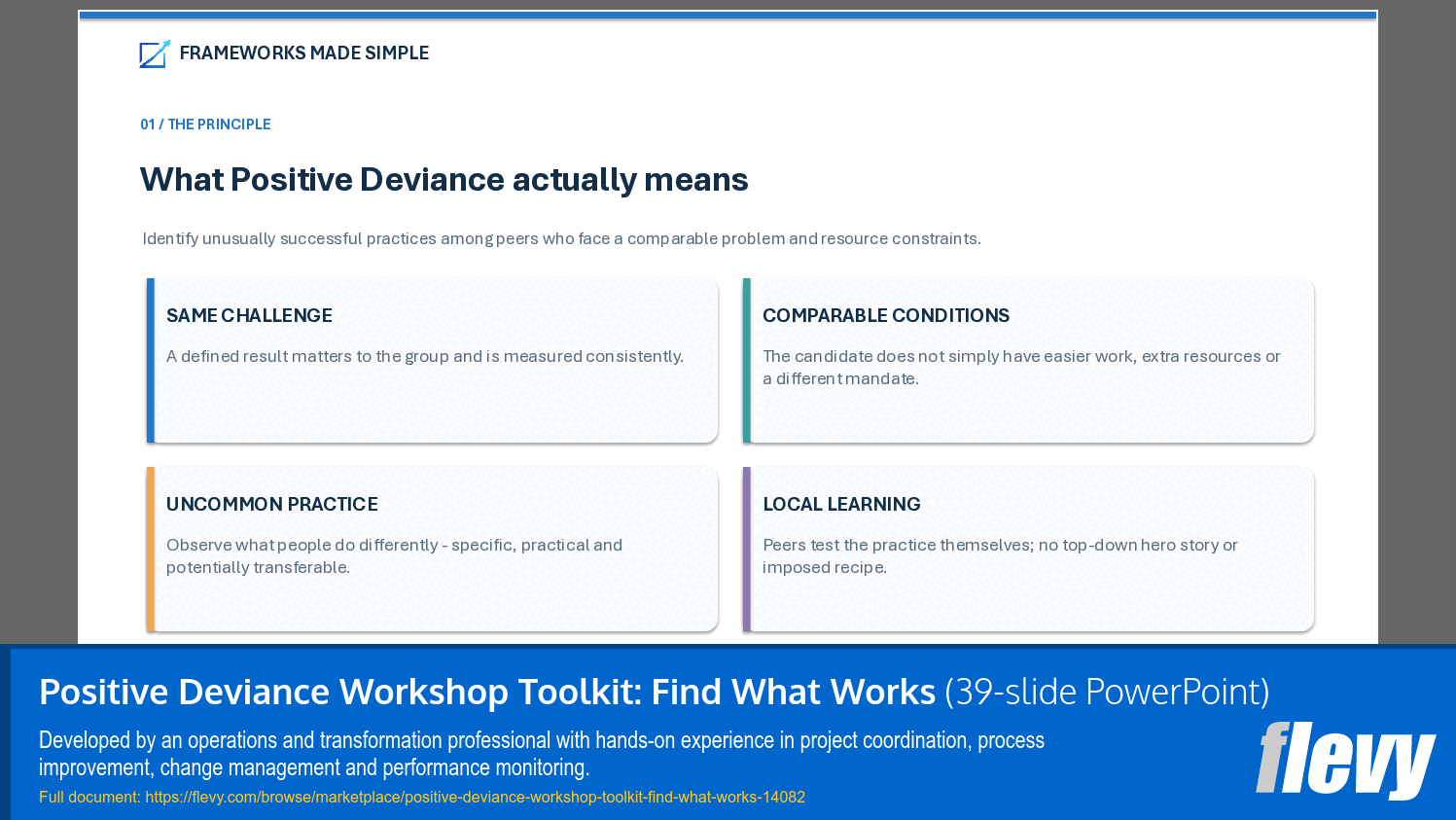
Many operational improvement programs begin by investigating failure. But what if someone in your organization is already achieving unusually good results while dealing with the same everyday constraints?
Positive Deviance Workshop Toolkit: Find What Works helps managers and continuous improvement facilitators identify potential local success patterns, investigate the actual practices behind them and design safe, evidence-informed experiments.
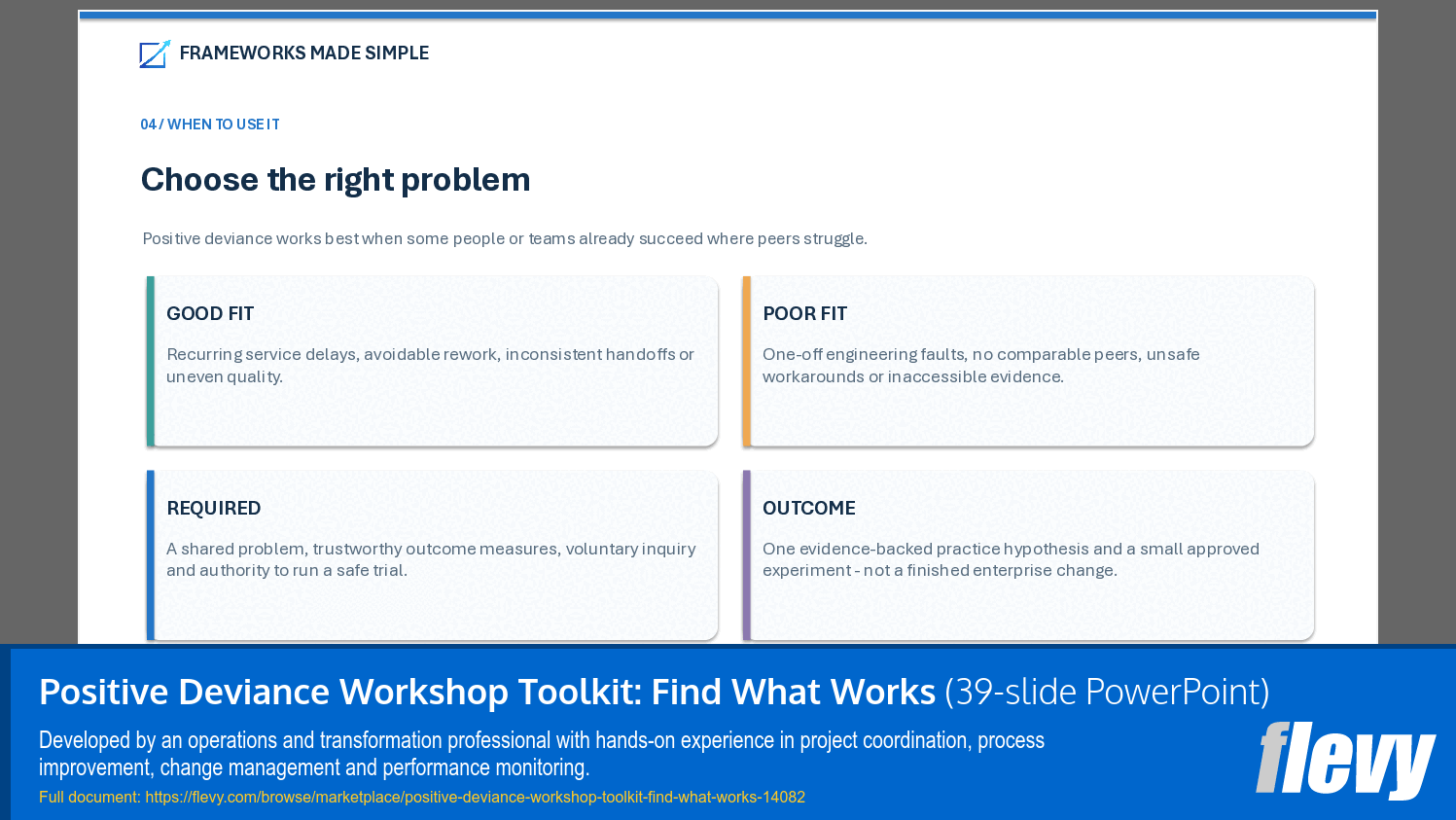
Designed as a practical introduction to Positive Deviance, this toolkit transforms an abstract concept into a guided operational inquiry process. It is especially useful when a recurring problem persists yet some comparable teams appear to do better without privileged resources.
THE PROBLEM
Unusually successful performance can disappear inside averages. Managers may respond by importing external best practices or celebrating high performers without understanding the specific behaviours, comparison conditions and practical limits that contribute to the result.
This toolkit helps teams ask a more useful question: which uncommon, observable practices might already work in our context, and how can we test them responsibly?
THE SIX WORKING CANVASES
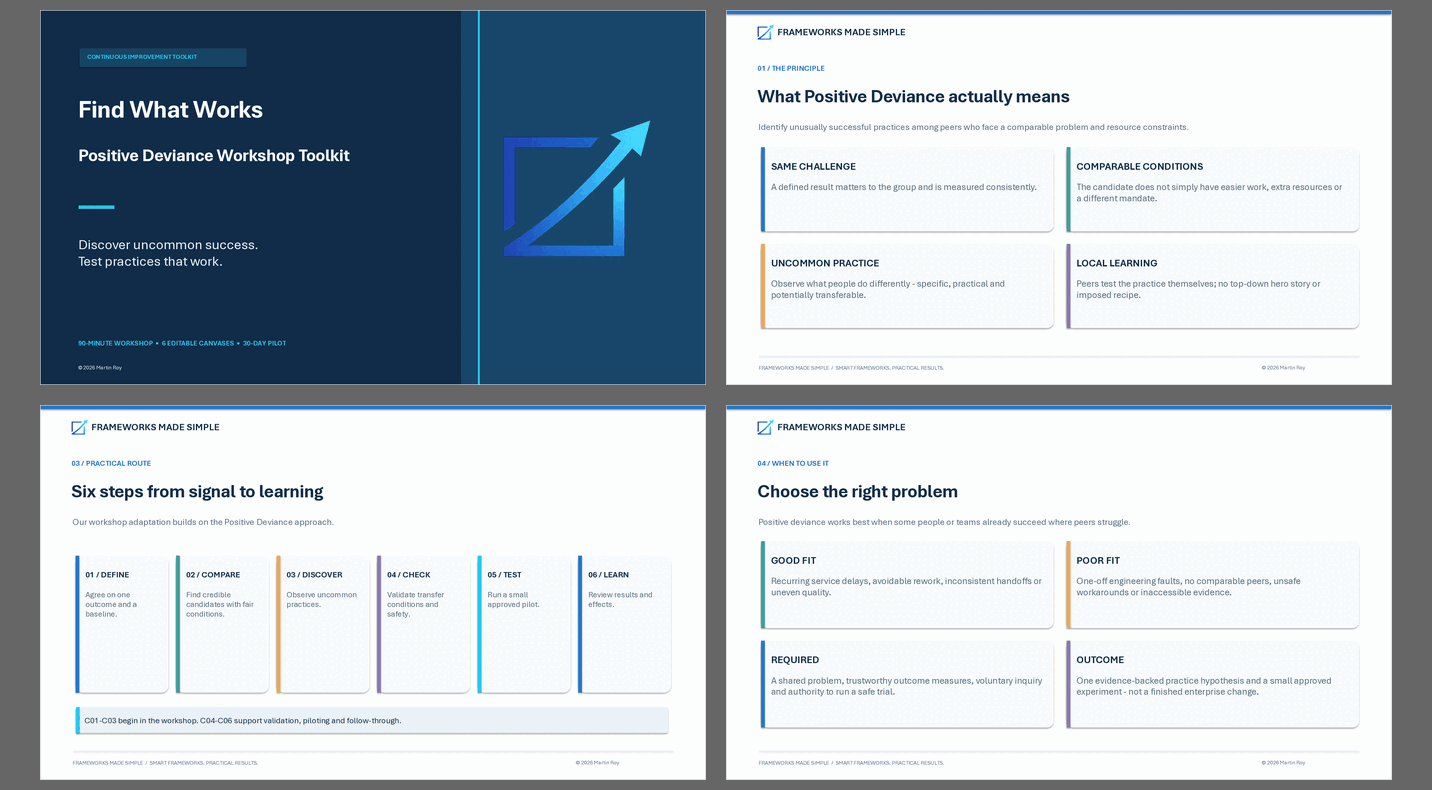
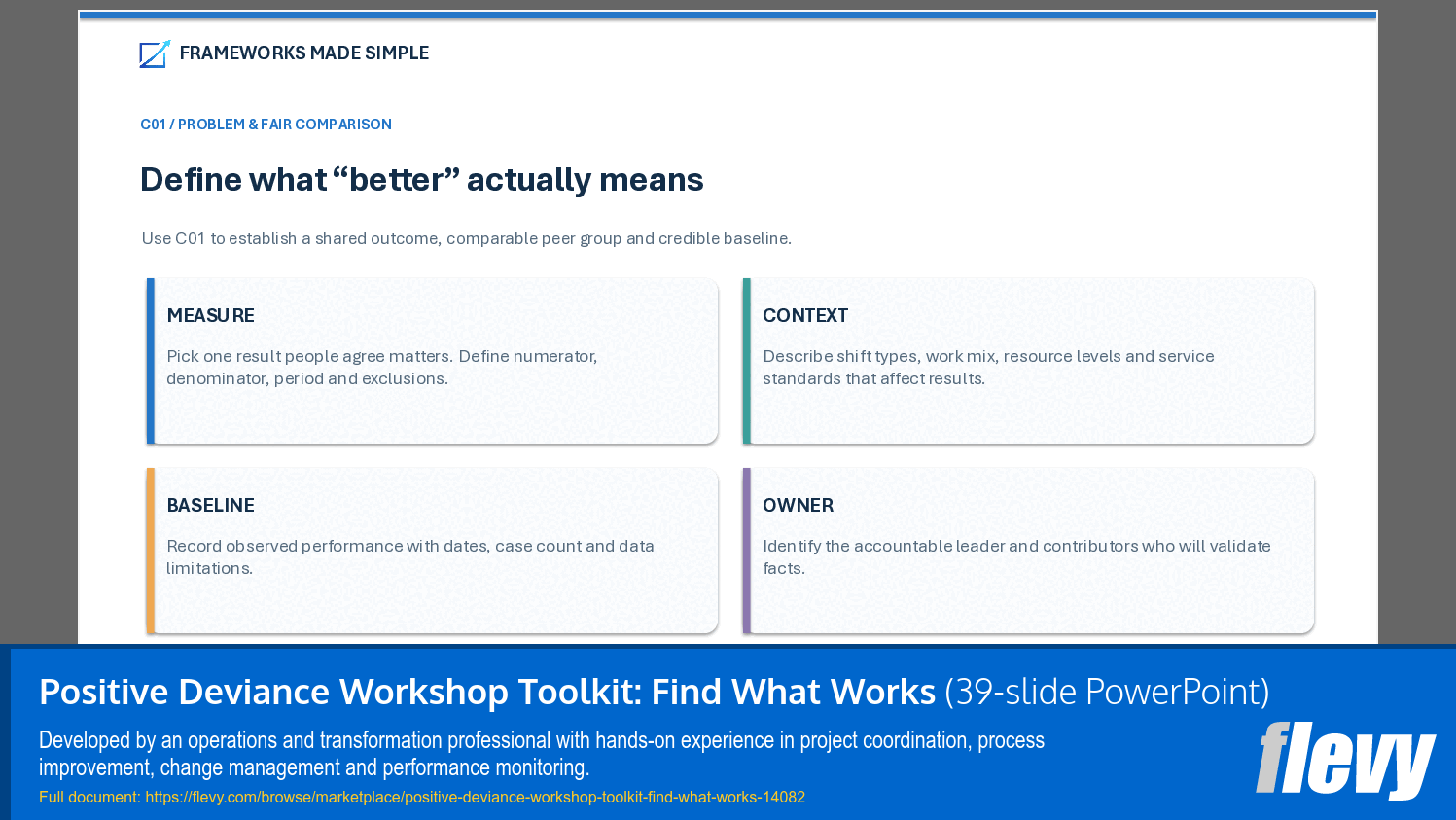
C01 – Problem & Fair Comparison. Agree on a meaningful outcome and establish credible comparison conditions.
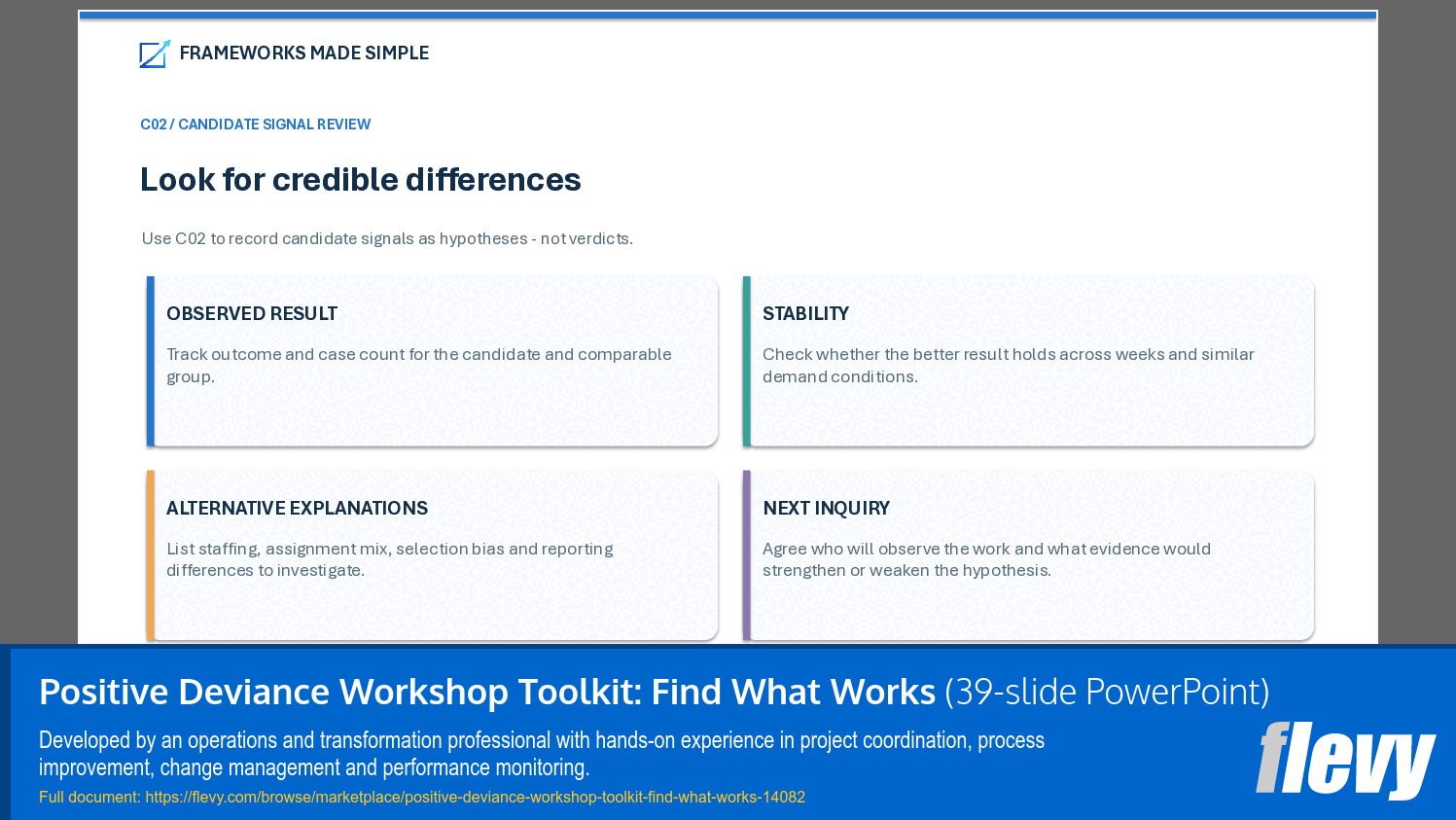
C02 – Candidate Signal Review. Review apparent outperformance, sample size and alternative explanations.
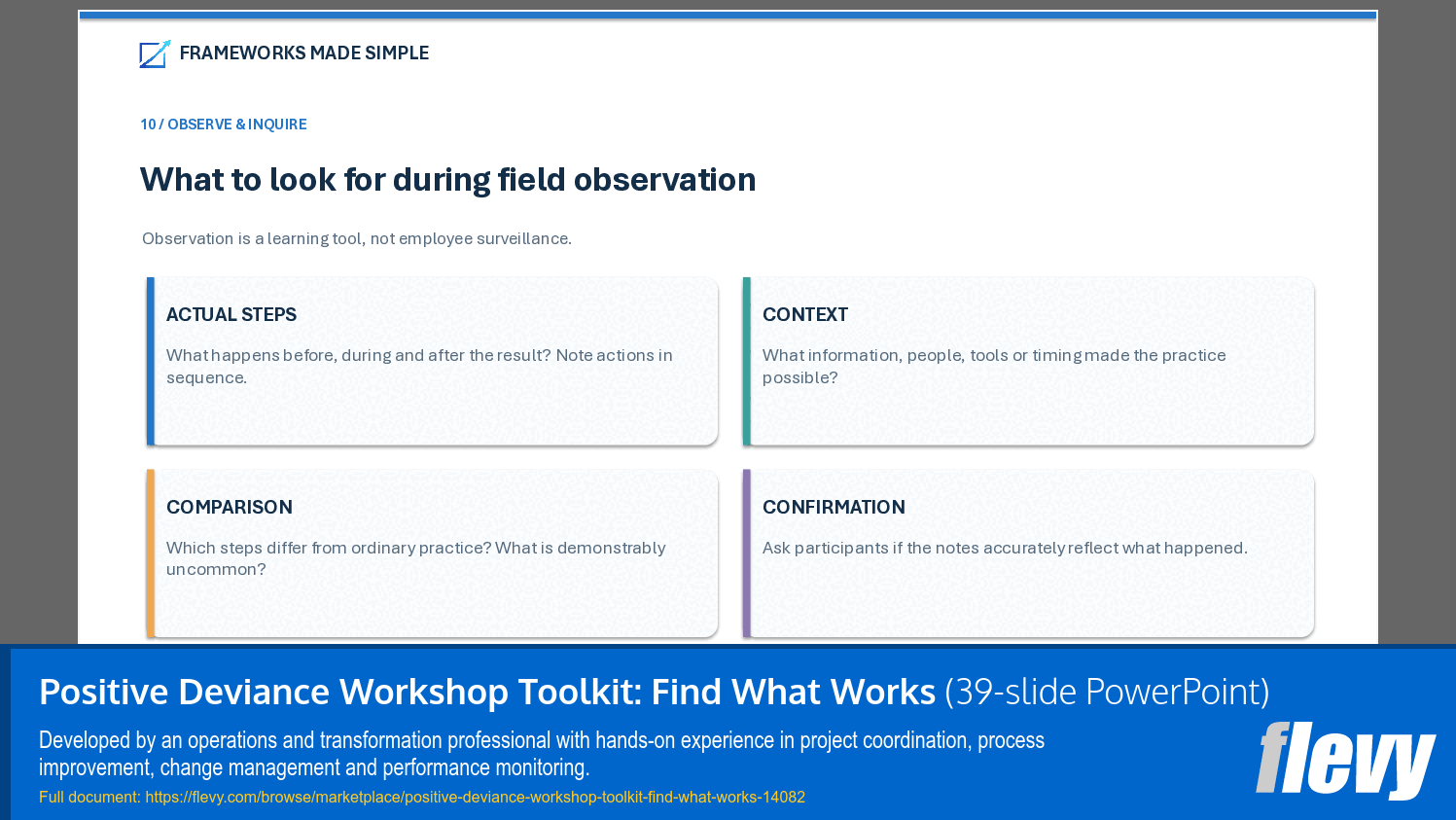
C03 – Field Inquiry & Observation. Record uncommon behaviours, operating context and direct evidence.
C04 – Transferability & Safeguards. Check feasibility, approvals, privacy, safety and workload risks.
C05 – Small Experiment Design. Plan a limited trial with owners, measures and stop rules.
C06 – 30-Day Learning & Decision. Review results, uncertainties and the decision to retest, adapt, expand or stop.
WHAT IS INCLUDED
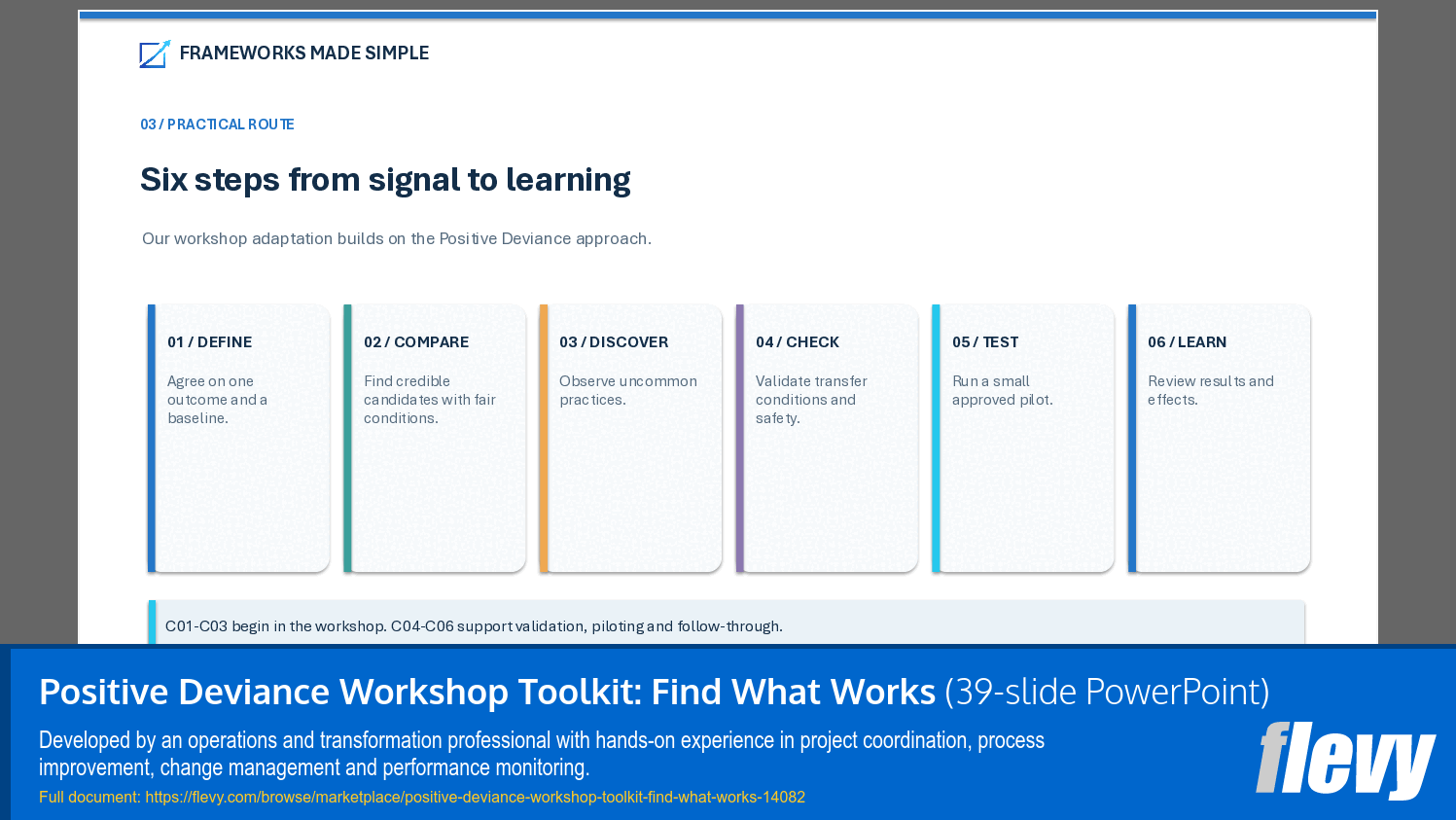
Primary file: 39-slide editable PowerPoint workshop presentation explaining the Positive Deviance concept, its limitations and a practical sequence from defining the problem through field observation, cautious experimentation and management decisions.
Secondary ZIP file contains four additional resources:
1. Editable Canvases PowerPoint: 13 slides with six blank canvases and six corresponding completed fictional examples, plus a cover. Each worksheet contains native editable PowerPoint elements.
2. Facilitator Guide PDF: 16 pages, including the Start Here sequence, 90-minute workshop agenda, individual instructions for all six canvases, role and safety guidance, a fictional example and 30-day follow-through.
3. Printable Canvases PDF: six worksheet pages for offline facilitation.
4. Field Inquiry Reference PDF: two pages of voluntary observation prompts, validation checks, decision questions and safety reminders.
A fictional Northbridge Service Hub example illustrates outcome comparisons and a small handoff trial. All figures are hypothetical and do not establish proven effects.
HOW TO USE IT
First, read the guide and choose a single operational problem that matters to participants. Second, use the workshop PowerPoint to run the 90-minute session and complete C01-C02 and plan C03. Third, validate candidate practices through consensual observation and independent evidence. Fourth, use C04 and C05 to approve a small test where appropriate. Finally, track evidence and record the management decision in C06 within 30 days.
WHO IT IS FOR
Operations and frontline managers, team leaders, continuous improvement professionals, internal consultants, HR and organizational development teams, and workshop facilitators across industries.
WHAT MAKES IT DIFFERENT
This is not a generic best-practice catalog, a top-employee ranking system or a promise of rapid performance gains. It is a practical way to investigate existing, local behaviours while protecting context, consent and service requirements. It includes editable worksheets, completed examples, a facilitator guide and field inquiry prompts rather than theory alone. No Excel or specialist software is required beyond PowerPoint and a PDF reader.
LIMITATIONS AND LICENSE
This product is an original independent learning and operational improvement toolkit informed by general published Positive Deviance resources. It is not affiliated with or endorsed by the Positive Deviance Collaborative or any organization and does not reproduce proprietary documents or organization-specific processes. It is not a certified assessment or a guarantee of better performance. Findings are hypotheses until verified, and users are responsible for local validation, privacy, permissions, safety and operational use.
Frameworks Made Simple – Smart frameworks. Practical results. Copyright © 2026 Martin Roy. All rights reserved. Purchased materials are licensed for personal or internal organizational use under the applicable platform terms. No resale, redistribution or standalone republication. Digital sales are final except where applicable law or platform rules require otherwise.
Got a question about the product? Email us at support@flevy.com or ask the author directly by using the "Ask the Author a Question" form. If you cannot view the preview above this document description, go here to view the large preview instead.
Source: Best Practices in Change Management, Problem Solving PowerPoint Slides: Positive Deviance Workshop Toolkit: Find What Works PowerPoint (PPTX) Presentation Slide Deck, Frameworks Made Simple
ABOUT THE AUTHOR

Frameworks Made Simple creates practical, editable business tools that help managers and professionals turn established management frameworks into actionable results.
Created by Martin Roy, the brand draws on hands-on professional experience in operations, cross-functional project coordination, process improvement, organizational change and performance monitoring.
Our approach focuses on a
... [read more]
Ask the Author a Question
You must be logged in to contact the author.