
Lean Six Sigma Memory Jogger   134-slide PPT PowerPoint presentation slide deck (PPTX)
$49.00

Lean Six Sigma Memory Jogger (134-slide PPT PowerPoint presentation slide deck (PPTX)) Preview Image
Log in to unlock full preview.
Lean Six Sigma Memory Jogger (134-slide PPT PowerPoint presentation slide deck (PPTX)) Preview Image
Arrow   Click main image to view in full screen.

Lean Six Sigma Memory Jogger (PowerPoint PPTX Slide Deck)

PowerPoint (PPTX) 134 Slides

$49.00
This presentation is developed by a pioneer in Lean and certified LSS Master Black Belt who has trained over 5,000+ students globally, from Directors, CEOs, GMs, to shop floor staff. He's endorsed by CMI Consortium, NZTE, HERA, NZPICS, CBAFF.
Add to Cart


Immediate download
Fully editable PowerPoint
Free lifetime updates

LEAN PPT DESCRIPTION

Editor Summary 134-slide PowerPoint presentation Lean Six Sigma Memory Jogger by OpEx Academy NZ provides a slide-based refresher on Lean and Six Sigma concepts, covering PDCA, DMAIC, 5S, TQM, TOC, JIT and related problem-solving tools. Read more

This document offers a ready refresher with over 130 slides on Lean Six Sigma and other related best practice concepts. It includes tools, templates, and checklists.

The following core LSS concepts are covered:
•  Constancy of Purpose
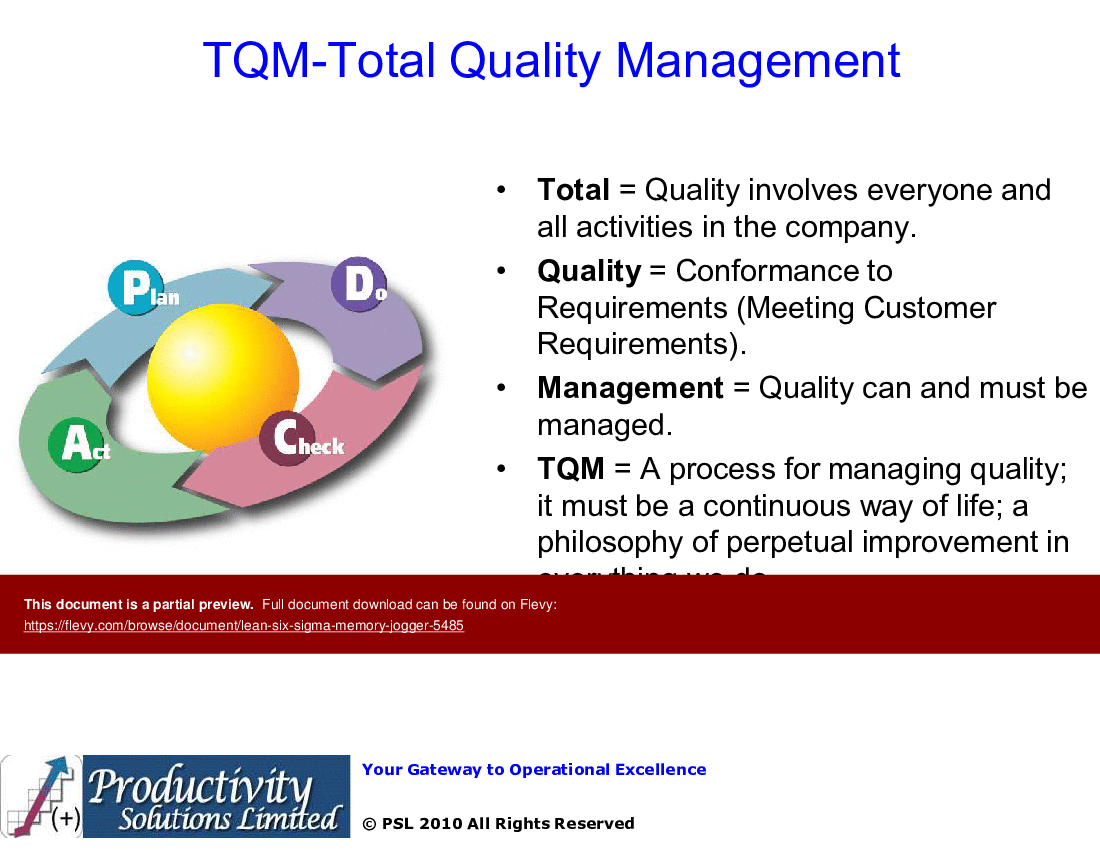
•  Total Quality Management (TQM)
•  Theory of Constraints (TOC)
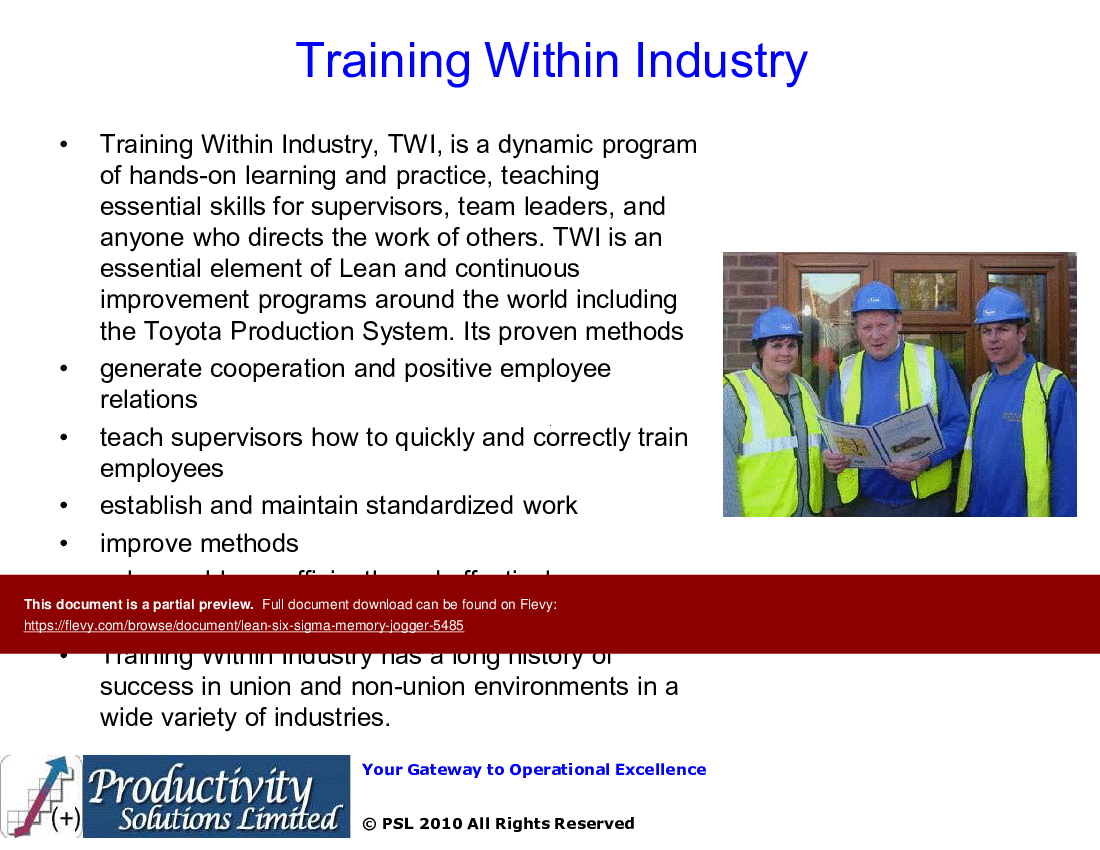
•  Training Within Industry (TWI)

Lean and Six Sigma fundamentals include:
•  3 Ms
•  8 Wastes
•  PDCA
•  5 Principles
•  4 Rules

Problem Solving tools include:
•  Brainstorming
•  Affinity
•  Fishbone
•  SCAMPER
•  8 Disciplines (8D)
•  5 Whys
•  Pareto Principle
•  Value Stream Mapping (VSM)
•  SIPOC
•  Cost Of Quality

Lean tools include:
•  5S
•  Visual
•  Workflow
•  SMED
•  OEE
•  TPM
•  3P

Management topics include:
•  Graphs
•  Correlation
•  MSA/Gauge R&R
•  SPC
•  Capability

Project Management topics include:
•  Strategy Deployment
•  DMAIC
•  VOC
•  CTs
•  QFD
•  Selection
•  Charter
•  Checklist
•  Benefits
•  RACI
•  Golden Rules
•  Risk
•  Reporting
•  Action Plan

People Management topics include:
•  Effectiveness
•  Belbin
•  Bolman's Change
•  Conflict
•  Coaching
•  One-minute Manager

Kaizen Workshop topics include:
•  When to Kaizen
•  Agenda
•  Behaviours
•  Presentation Format
•  Checklist
•  Notes

Got a question about the product? Email us at support@flevy.com or ask the author directly by using the "Ask the Author a Question" form. If you cannot view the preview above this document description, go here to view the large preview instead.

MARCUS OVERVIEW

This synopsis was written by Marcus [?] based on the analysis of the full 134-slide presentation.


Executive Summary
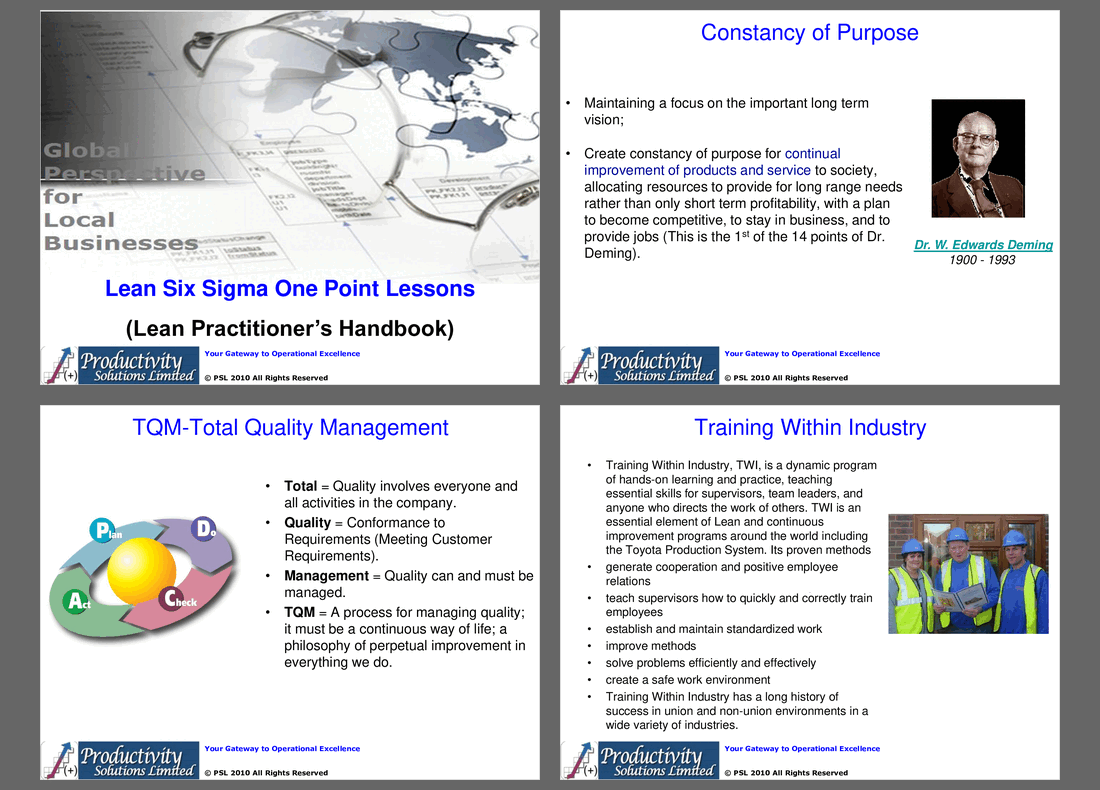
The Lean Six Sigma One Point Lessons presentation serves as a comprehensive guide for practitioners aiming to achieve operational excellence through Lean and Six Sigma methodologies. Developed by a seasoned expert, this presentation provides actionable insights into key concepts such as PDCA, DMAIC, and various problem-solving tools. Users will gain the ability to implement continuous improvement strategies, enhance quality management, and effectively eliminate waste in their processes.

Who This Is For and When to Use
•  Lean practitioners seeking to deepen their understanding of Lean Six Sigma principles
•  Quality managers responsible for process improvement initiatives
•  Project managers overseeing operational excellence projects
•  Team leaders conducting Kaizen workshops and continuous improvement activities

Best-fit moments to use this deck:
•  During training sessions for new Lean Six Sigma team members
•  As a reference guide for ongoing process improvement projects
•  In workshops focused on problem-solving and quality enhancement
•  For strategic planning meetings to align team objectives with Lean Six Sigma principles

Learning Objectives
•  Define key Lean Six Sigma concepts and their applications in operational excellence
•  Build effective problem-solving frameworks using tools like Fishbone diagrams and Pareto analysis
•  Establish a culture of continuous improvement through Kaizen methodologies
•  Implement measurement systems to track performance and quality metrics
•  Develop project management skills specific to Lean Six Sigma initiatives
•  Utilize the DMAIC framework to drive process improvements and control variations

Table of Contents
•  Constancy of Purpose (page 3)
•  Total Quality Management (TQM) (page 5)
•  Theory of Constraints (page 7)
•  Lean Manufacturing Principles (page 10)
•  Just-In-Time (JIT) (page 12)
•  Six Sigma Overview (page 14)
•  Training Within Industry (TWI) (page 16)
•  Problem Solving Tools (page 18)
•  Lean Tools (page 22)
•  Measurement Techniques (page 25)
•  Project Management Strategies (page 28)
•  Managing People in Lean Environments (page 32)
•  Kaizen Workshop Guidelines (page 35)

Primary Topics Covered
•  Constancy of Purpose - Emphasizes the importance of a long-term vision for continuous improvement in products and services.
•  Total Quality Management (TQM) - A holistic approach to managing quality that involves all employees and activities within the organization.
•  Theory of Constraints - A management philosophy focused on identifying and managing constraints that hinder system performance.
•  Lean Manufacturing Principles - Systematic methods for eliminating waste and enhancing efficiency in manufacturing processes.
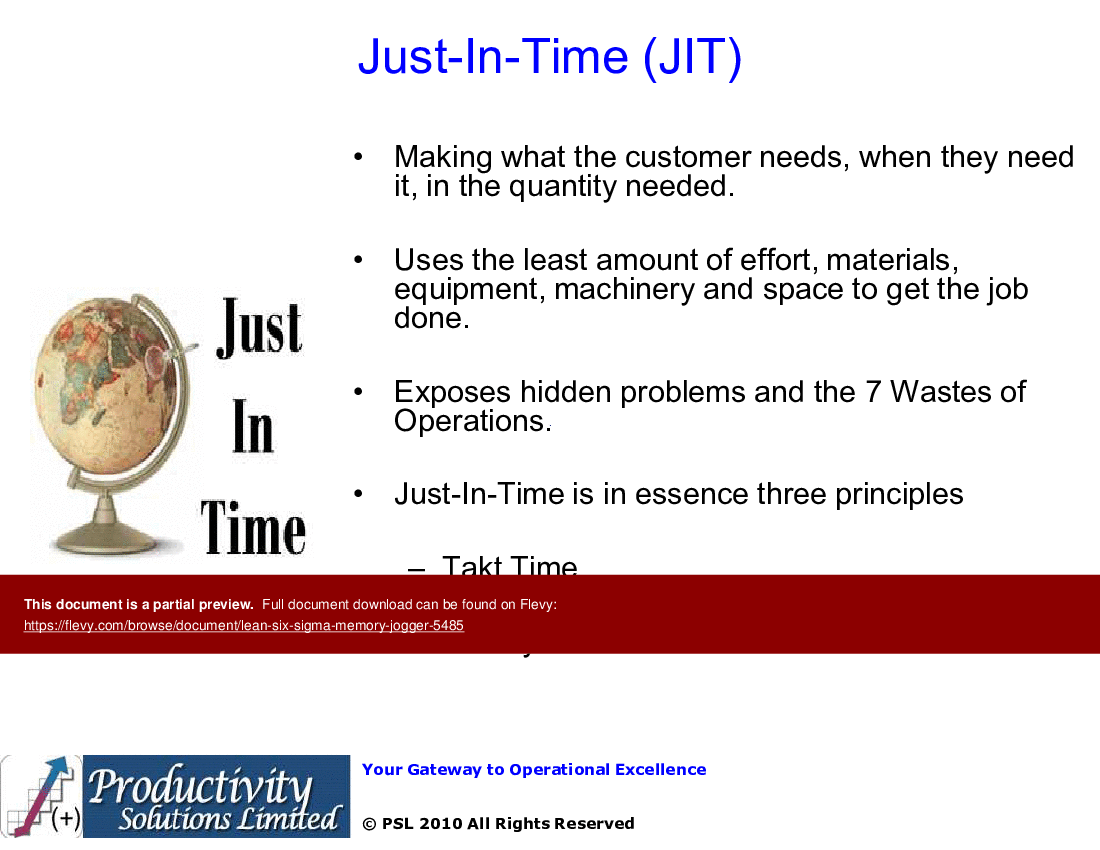
•  Just-In-Time (JIT) - A strategy that aligns production with customer demand to minimize waste and improve efficiency.
•  Six Sigma - A data-driven approach aimed at reducing defects and improving quality across processes.

Deliverables, Templates, and Tools
•  Lean Six Sigma project charter template for defining project scope and objectives
•  DMAIC process flowchart for guiding project execution
•  Fishbone diagram template for root cause analysis
•  Pareto chart for identifying significant factors in quality issues
•  Kaizen workshop agenda template for structured improvement sessions
•  SIPOC diagram for mapping suppliers, inputs, processes, outputs, and customers

Slide Highlights
•  Overview of Lean principles and their application in operational settings
•  Detailed explanation of the DMAIC framework and its significance in process improvement
•  Visual representation of the 5S methodology for workplace organization
•  Case studies showcasing successful implementation of Lean Six Sigma tools
•  Interactive elements for engaging participants during workshops

Potential Workshop Agenda
Introduction to Lean Six Sigma (60 minutes)
•  Overview of Lean and Six Sigma principles
•  Discussion on the importance of operational excellence

Kaizen Workshop (180 minutes)
•  Measure the current situation and identify improvement areas
•  Brainstorm ideas for the new situation and develop an action plan

Problem-Solving Techniques (90 minutes)
•  Introduction to various problem-solving tools
•  Hands-on practice with Fishbone diagrams and Pareto analysis

Project Management in Lean Six Sigma (120 minutes)
•  Discuss project management strategies specific to Lean Six Sigma
•  Develop project charters and define roles using RACI charts

Customization Guidance
•  Tailor the presentation content to align with specific organizational goals and challenges
•  Adjust the workshop agenda based on team size and available time
•  Incorporate company-specific examples and case studies to enhance relevance
•  Modify templates to reflect internal processes and terminology

Secondary Topics Covered
•  Gemba walks as a method for observing and improving processes
•  The role of visual management in Lean environments
•  Techniques for managing change within organizations
•  Strategies for fostering a culture of continuous improvement

Topic FAQ

What are the core phases of DMAIC and how is it used in process improvement?

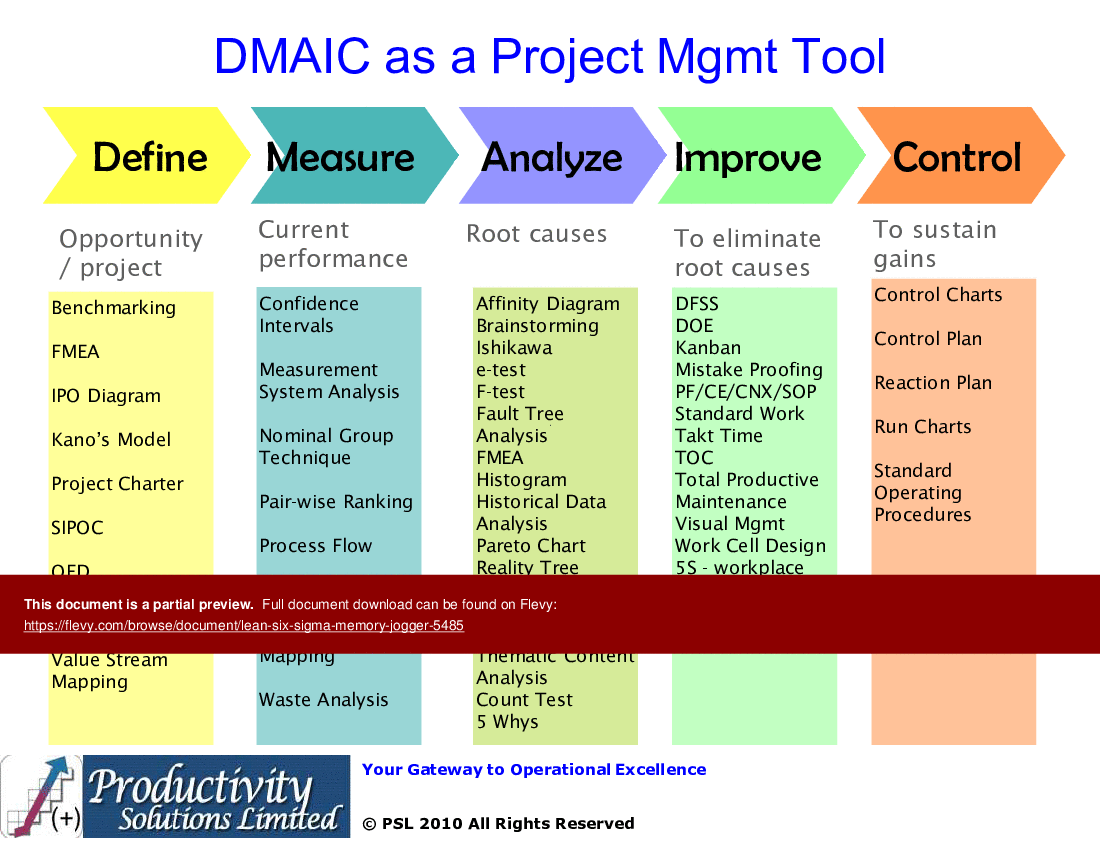
DMAIC stands for Define, Measure, Analyze, Improve, Control and is used as a structured framework to guide process-improvement projects from problem definition through sustained control. Organizations apply DMAIC to identify root causes, implement improvements, and maintain gains across the 5 phases: Define, Measure, Analyze, Improve, Control.

Which problem-solving tools are commonly used in Lean Six Sigma projects?

Common Lean Six Sigma problem-solving tools include brainstorming, affinity mapping, Fishbone (cause-and-effect) diagrams, 5 Whys, 8D, Pareto analysis, SCAMPER, Value Stream Mapping, SIPOC, and Cost of Quality. These tools support root-cause analysis and prioritization, for example using a Fishbone diagram and Pareto analysis.

How should I measure the success of a Lean Six Sigma initiative?

Success is measured using relevant KPIs such as defect rates, cycle times, customer satisfaction scores and statistical process control metrics. Measurement techniques highlighted include SPC, capability analysis, and MSA/Gage R&R to ensure reliable data for tracking improvements and control charts.

What should I look for when purchasing a Lean Six Sigma training deck or toolkit?

Look for slide-based coverage of core concepts (DMAIC, PDCA, 5S), ready templates (project charter, SIPOC), measurement guidance (SPC, capability), workshop agendas, and customization notes; confirm slide count and included templates — for example, Lean Six Sigma Memory Jogger contains 134 slides and multiple templates.

How much time should I allocate for a Kaizen workshop using standard materials?

Typical agendas in practitioner materials allocate around 180 minutes (3 hours) for a focused Kaizen workshop session, plus preparatory and introductory sessions (for example a 60-minute introduction to Lean Six Sigma), making the Kaizen session example 180 minutes.

Can Lean Six Sigma be applied in service industries and which tools help?

Yes; Lean Six Sigma applies to services to streamline processes and improve customer outcomes. Tools useful for service settings include SIPOC for end-to-end mapping, Voice of the Customer (VOC) for requirements, and Value Stream Mapping to analyze information and process flow, such as using a SIPOC diagram.

How can a project manager structure a DMAIC project charter and define roles?

A project manager should define scope, objectives, expected benefits, key metrics, timeline and stakeholders, and assign responsibilities using a RACI matrix. Practical templates to accomplish this include a project charter template and a RACI chart as provided in Lean Six Sigma Memory Jogger.

Are ready-made Lean Six Sigma templates and checklists worth using versus building from scratch?

Ready-made templates and checklists provide a consistent structure and accelerate setup for training and projects; they serve as a refresher for established practices. The Lean Six Sigma Memory Jogger offers over 130 slides with tools, templates, and checklists that can be adapted to organizational needs.

Document FAQ
These are questions addressed within this presentation.

What is Lean Six Sigma?
Lean Six Sigma is a methodology that combines Lean manufacturing principles with Six Sigma quality management to improve processes by eliminating waste and reducing variation.

How can I implement Lean Six Sigma in my organization?
Start by training team members on Lean Six Sigma principles, then identify key processes for improvement and apply the DMAIC framework to guide your efforts.

What tools are essential for Lean Six Sigma projects?
Key tools include process mapping, root cause analysis techniques like Fishbone diagrams, and performance measurement systems such as control charts.

What is the significance of Kaizen in Lean Six Sigma?
Kaizen promotes a culture of continuous improvement by encouraging all employees to identify and implement small, incremental changes that enhance efficiency and quality.

How do I measure the success of Lean Six Sigma initiatives?
Success can be measured through key performance indicators (KPIs) such as defect rates, cycle times, and customer satisfaction scores.

What is the role of leadership in Lean Six Sigma?
Leadership is crucial for fostering a culture of continuous improvement, providing resources, and ensuring alignment with organizational goals.

Can Lean Six Sigma be applied in service industries?
Yes, Lean Six Sigma principles can be effectively applied in service industries to improve processes, enhance customer satisfaction, and reduce operational costs.

What are common challenges in implementing Lean Six Sigma?
Challenges may include resistance to change, lack of training, and insufficient leadership support. Addressing these proactively can enhance success.

Glossary
•  Lean - A systematic approach to identifying and eliminating waste in processes.
•  Six Sigma - A data-driven methodology for reducing defects and improving quality.
•  DMAIC - Define, Measure, Analyze, Improve, Control; a framework for process improvement.
•  Kaizen - Continuous improvement philosophy focusing on small, incremental changes.
•  TQM - Total Quality Management; an organization-wide approach to continuous improvement.
•  5S - A workplace organization method that includes Sort, Set in order, Shine, Standardize, Sustain.
•  SIPOC - A tool for mapping Suppliers, Inputs, Processes, Outputs, and Customers.
•  Gemba - The place where value is added; often refers to the shop floor in manufacturing.
•  Value Stream Mapping - A visual tool to analyze and improve the flow of materials and information.
•  Poka-Yoke - Error-proofing techniques to prevent mistakes in processes.
•  RACI - A responsibility assignment matrix outlining who is Responsible, Accountable, Consulted, and Informed.
•  SPC - Statistical Process Control; a method of quality control using statistical methods.
•  FMEA - Failure Mode and Effects Analysis; a systematic approach to identifying potential failures in a process.
•  VOC - Voice of the Customer; the expressed needs and expectations of customers.
•  OEE - Overall Equipment Effectiveness; a measure of how effectively a manufacturing operation is utilized.
•  JIT - Just-In-Time; an inventory strategy that aligns production with demand.
•  Takt Time - The maximum allowable time to produce a product to meet customer demand.
•  TPM - Total Productive Maintenance; an approach to maintaining and improving the effectiveness of production equipment.
•  Kanban - A scheduling system for lean and just-in-time manufacturing.
•  SCAMPER - A technique for generating ideas through substitution, combination, adaptation, modification, putting to another use, elimination, and reversal.

Source: Best Practices in Lean, Six Sigma Project PowerPoint Slides: Lean Six Sigma Memory Jogger PowerPoint (PPTX) Presentation Slide Deck, OpEx Academy NZ


$49.00
This presentation is developed by a pioneer in Lean and certified LSS Master Black Belt who has trained over 5,000+ students globally, from Directors, CEOs, GMs, to shop floor staff. He's endorsed by CMI Consortium, NZTE, HERA, NZPICS, CBAFF.
Add to Cart
  

ABOUT THE AUTHOR

Author image
Additional documents from author: 88

Vishnu Rayapeddi is an experienced management consultant and trainer specializing in implementing continuous process improvements. Vishnu is a pioneer in Lean Management which combines the power of Lean Thinking, TOC, Six Sigma, TQM, TWI, Balanced Scorecard, cGMP and other best-class methodologies such as, DMAIC, Value Stream Mapping, Root Cause Analysis, 5S, Quick Changeovers, Quality and ... [read more]

Ask the Author a Question

You must be logged in to contact the author.

Click here to log in Click here register

Did you know?
The average daily rate of a McKinsey consultant is $6,625 (not including expenses). The average price of a Flevy document is $65.



Trusted by over 10,000+ Client Organizations
Since 2012, we have provided business templates to over 10,000 businesses and organizations of all sizes, from startups and small businesses to the Fortune 100, in over 130 countries.
AT&T GE Cisco Intel IBM Coke Dell Toyota HP Nike Samsung Microsoft Astrazeneca JP Morgan KPMG Walgreens Walmart 3M Kaiser Oracle SAP Google E&Y Volvo Bosch Merck Fedex Shell Amgen Eli Lilly Roche AIG Abbott Amazon PwC T-Mobile Broadcom Bayer Pearson Titleist ConEd Pfizer NTT Data Schwab


Read Customer Testimonials

 
"The wide selection of frameworks is very useful to me as an independent consultant. In fact, it rivals what I had at my disposal at Big 4 Consulting firms in terms of efficacy and organization."

– Julia T., Consulting Firm Owner (Former Manager at Deloitte and Capgemini)
 
"I have found Flevy to be an amazing resource and library of useful presentations for lean sigma, change management and so many other topics. This has reduced the time I need to spend on preparing for my performance consultation. The library is easily accessible and updates are regularly provided. A wealth of great information."

– Cynthia Howard RN, PhD, Executive Coach at Ei Leadership
 
"As a small business owner, the resource material available from FlevyPro has proven to be invaluable. The ability to search for material on demand based our project events and client requirements was great for me and proved very beneficial to my clients. Importantly, being able to easily edit and tailor "

– Michael Duff, Managing Director at Change Strategy (UK)
 
"As a consultant requiring up to date and professional material that will be of value and use to my clients, I find Flevy a very reliable resource.

The variety and quality of material available through Flevy offers a very useful and commanding source for information. Using Flevy saves me time, enhances my expertise and ends up being a good decision."

– Dennis Gershowitz, Principal at DG Associates
 
"FlevyPro provides business frameworks from many of the global giants in management consulting that allow you to provide best in class solutions for your clients."

– David Harris, Managing Director at Futures Strategy
 
"My FlevyPro subscription provides me with the most popular frameworks and decks in demand in today’s market. They not only augment my existing consulting and coaching offerings and delivery, but also keep me abreast of the latest trends, inspire new products and service offerings for my practice, and educate me "

– Bill Branson, Founder at Strategic Business Architects
 
"As an Independent Management Consultant, I find Flevy to add great value as a source of best practices, templates and information on new trends. Flevy has matured and the quality and quantity of the library is excellent. Lastly the price charged is reasonable, creating a win-win value for "

– Jim Schoen, Principal at FRC Group
 
"I like your product. I'm frequently designing PowerPoint presentations for my company and your product has given me so many great ideas on the use of charts, layouts, tools, and frameworks. I really think the templates are a valuable asset to the job."

– Roberto Fuentes Martinez, Senior Executive Director at Technology Transformation Advisory


Customers Also Bought These Documents


Customers Also Like These Documents

Explore Templates on Related Management Topics


Your Recently Viewed Documents
Receive our FREE presentation on Operational Excellence

This 50-slide presentation provides a high-level introduction to the 4 Building Blocks of Operational Excellence. Achieving OpEx requires the implementation of a Business Execution System that integrates these 4 building blocks.