
This framework is developed by a team of former McKinsey and Big 4 consultants. The presentation follows the headline-body-bumper slide format used by global consulting firms.
Editor Summary
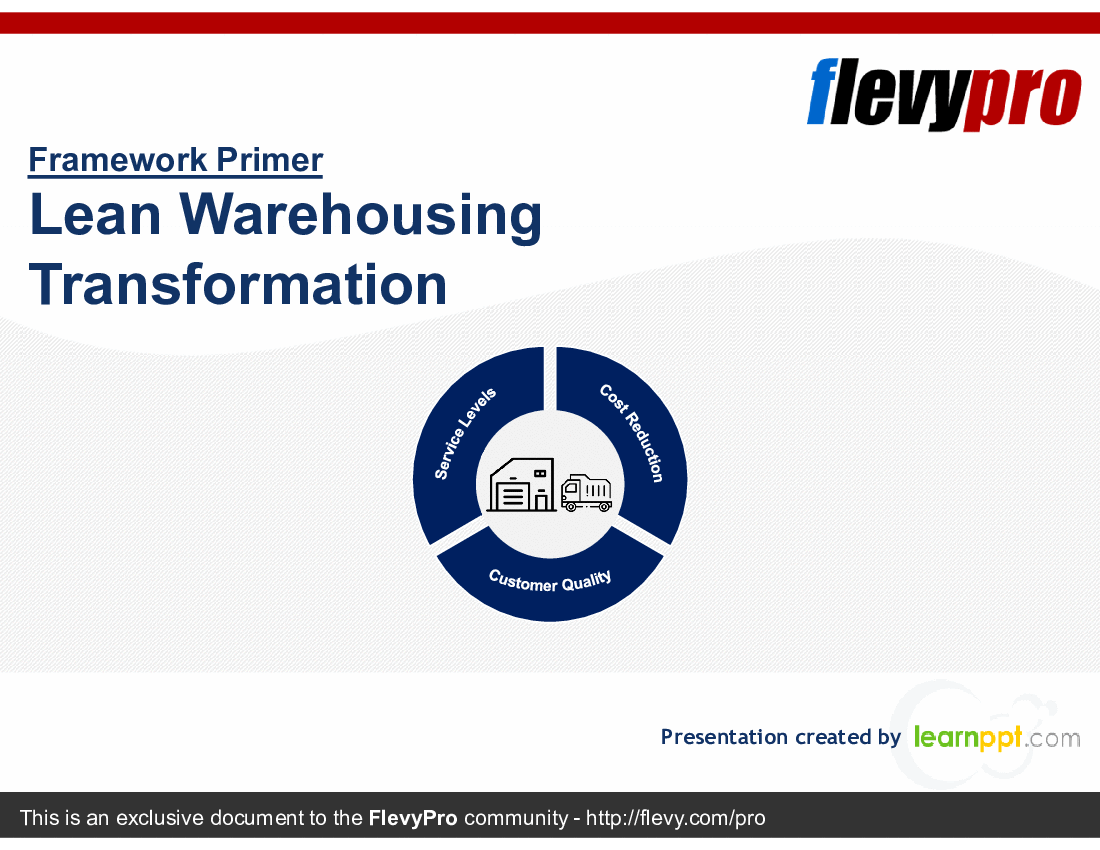
Lean Warehousing Transformation is a 27-slide PowerPoint (PPTX) by LearnPPT Consulting that presents a Lean Warehousing methodology focused on 3 improvement areas: Cost Reduction, Customer Quality, and Service Levels.
Read moreThe deck outlines Lean Warehousing Transformation, 3 organizational capabilities for Lean operations, Model Warehousing implementation, a Knowledge Sharing workshop, and examples of technologies such as Smart Glasses and HoloLens; it also includes slide templates. Sold as a digital download on Flevy.
Use this presentation when warehousing performance is a barrier to customer service, cost targets, or scaling distribution operations.
Warehouse managers standardizing picking, packing, and shipping processes to reduce variability and waste in daily operations.
Supply chain managers redesigning inventory and logistics flows to meet cost-reduction targets and service-level commitments.
Continuous improvement or operations leads designing and running Knowledge Sharing workshops to train central teams on Lean methods.
Senior executives piloting new warehousing technology and observing best practices in a Model Warehouse with Smart Glasses and HoloLens.
The approach emphasizes Lean principles: waste reduction, continuous improvement, and pilot-based learning through a Model Warehouse.
As the last decisive step in customer service, a warehouse ensures cost effective distribution. Latest technological innovation has turned Warehousing into a Competitive Advantage. It offers untapped potential for improvement.
However, Warehousing is a hugely neglected part of global Supply Chains. There is inconsistency in picking, packing, and shipping all orders; storing receipts; managing inventory and logistics operations. Other issues and limitations in the way of smooth Warehousing operations—i.e. waste, variability, and inflexibility—exist almost everywhere.
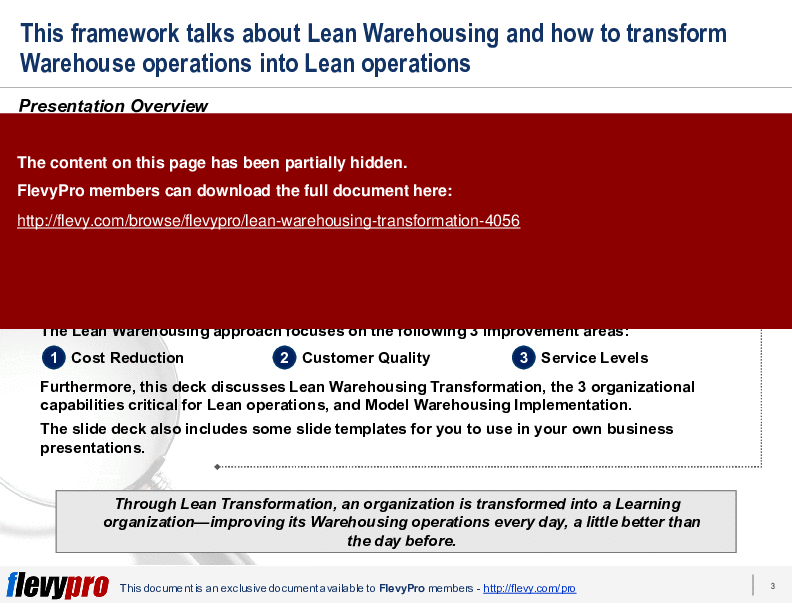
This presentation provides a detailed overview of Lean Warehousing—a comprehensive methodology designed to unlock significant productivity enhancement and growth opportunities. The Lean Warehousing approach focuses on the following 3 improvement areas:
1. Cost Reduction
2. Customer Quality
3. Service Levels
Furthermore, this deck discusses Lean Warehousing Transformation, the 3 organizational capabilities critical for Lean operations, and Model Warehousing Implementation.
The slide deck also includes some slide templates for you to use in your own business presentations.
Lean Warehousing Transformation also emphasizes the importance of continuous improvement and the role of a Model Warehouse. This facility allows participants to experience the latest warehousing technologies and systems, such as Smart Glasses and HoloLens, providing hands-on training that links theory to practice. The Model Warehouse serves as a learning environment where executives can observe, analyze, and implement best practices in their own operations.
The framework includes a rigorous Knowledge Sharing workshop, designed to build awareness and train central teams on Lean Warehousing methods. Participants engage in practical exercises and simulations to reinforce learning and ensure knowledge retention. This comprehensive approach ensures that your organization can achieve significant operational efficiencies and maintain a competitive edge in the market.
What is lean warehousing and which problems does it aim to solve?
Lean warehousing targets waste, variability, and inflexibility in warehouse operations, addressing inconsistent picking, packing, shipping, receipt storage, inventory, and logistics management. It focuses on improving Cost Reduction, Customer Quality, and Service Levels as the 3 primary improvement areas.
What are the most common operational weaknesses in warehouses I should assess first?
Common weaknesses include inconsistent picking, packing, and shipping; inefficient handling of receipts; poor inventory control; and logistics variability. These issues manifest as waste and inflexibility across processes and are the primary targets of a Lean Warehousing assessment focused on reducing variability.
How can a Model Warehouse be used during a transformation program?
A Model Warehouse provides a controlled learning environment where participants can observe, analyze, and implement best practices, and it enables hands-on trials of new systems and wearables such as Smart Glasses and HoloLens to link theory to practice in a real-world setting.
What role do training and knowledge sharing play in sustaining warehouse improvements?
Training and knowledge sharing build awareness and capability in central teams; practical exercises and simulations reinforce learning and retention. Structured workshops help spread Lean Warehousing methods across the organization via the Knowledge Sharing workshop model.
What should I look for when selecting a lean warehousing slide toolkit or playbook?
Look for explicit coverage of core improvement objectives (cost, quality, service), guidance on implementation (Model Warehouse use), materials for training central teams (Knowledge Sharing workshop), and reusable presentation slides or templates—features present in Lean Warehousing Transformation.
How does a purchased toolkit support on-the-job learning and pilot testing?
A toolkit can provide the structure and materials to run workshops and hands-on sessions, and to stage pilots in a Model Warehouse where teams can practice with technologies and processes before wider rollout, supported by Knowledge Sharing workshop content.
I need to improve on-time delivery and reduce customer complaints—what should I prioritize first?
Prioritize measures that directly affect service levels and customer quality: reduce process variability in picking/packing/shipping, improve inventory accuracy, and embed continuous improvement practices supported by training and Model Warehouse trials to validate changes.
We're planning a pilot of wearable tech in our warehouse—what practical steps should we include?
Include a controlled learning environment to test usability and process integration, train participants through practical exercises, observe outcomes, and capture lessons for roll-out; the Model Warehouse is specifically described as the environment for Smart Glasses and HoloLens trials.
This PPT slide outlines the essential components for implementing a Lean Warehousing transformation, focusing on 3 areas: Operating System, Management Infrastructure, and Mindset and Behaviors. The Operating System targets waste elimination through workflow analysis, emphasizing cost reduction and service enhancement. The Management Infrastructure develops effective problem-solving strategies and encourages a culture of continuous improvement, allowing employees to contribute ideas for operational enhancements. The Mindset and Behaviors section stresses the importance of a team-oriented approach and structured transformation programs, highlighting the need for a cultural shift to support Lean principles. These capabilities are critical for modernizing warehousing operations and achieving greater efficiency.
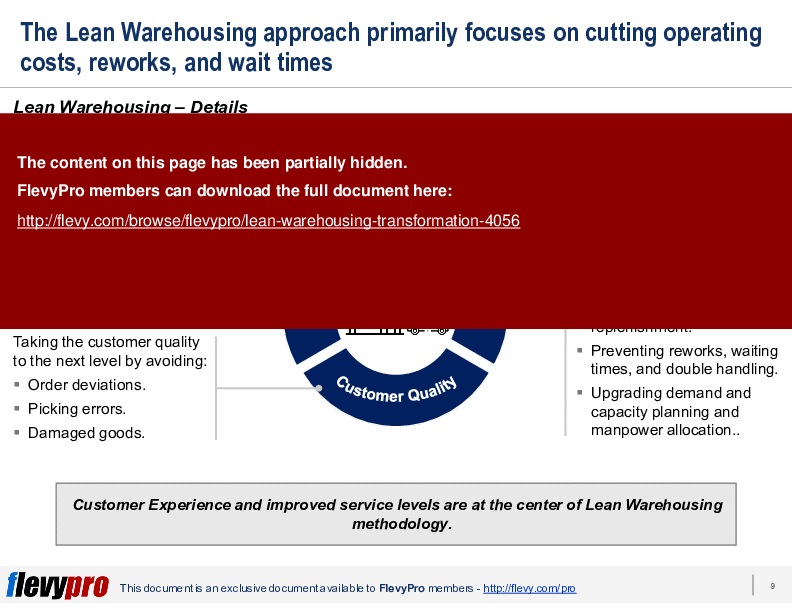
The Lean Warehousing approach, developed by Toyota, focuses on reducing operating costs, reworks, and wait times. It emphasizes 3 core improvement areas: Service Levels, Cost Reduction, and Customer Quality. Improving service levels involves strategies like reducing lead times and enhancing on-shelf availability to meet customer expectations. Customer quality is addressed by avoiding order deviations, picking errors, and damaged goods, which directly impact customer satisfaction. Cost reduction strategies include increasing productivity by minimizing unnecessary walking and searching, preventing needless replenishment, and reducing reworks and waiting times. The Lean Warehousing methodology aims to create a more efficient, customer-centric operation, leading to improved service delivery and cost management.
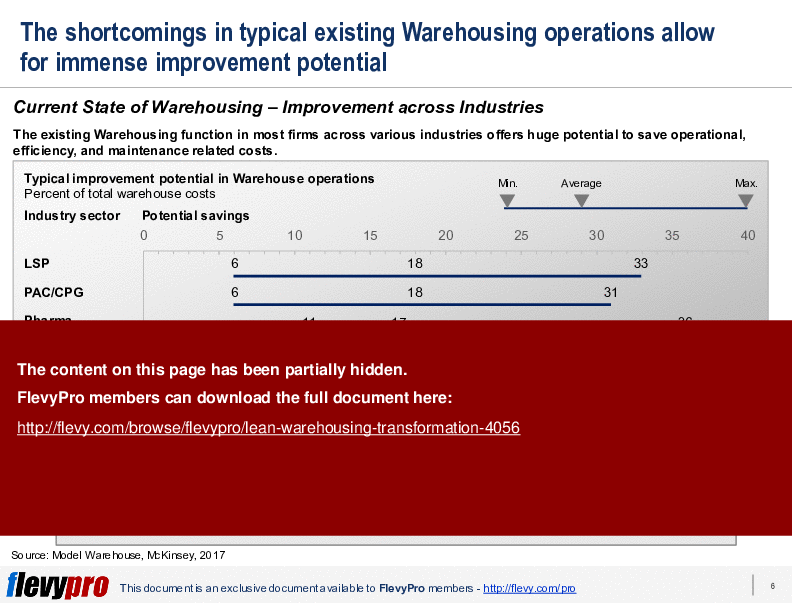
This PPT slide analyzes warehousing across industries, revealing significant potential for operational improvements and cost savings. Many firms, including Logistics Service Providers (LSP), Packaged Consumer Goods (PAC/CPG), Pharma, Retail, General Engineering and Manufacturing (GEM), Aerospace and Automotive (A&A), and High Tech, are underutilizing their warehousing capabilities, leading to inefficiencies. The chart indicates potential savings as a percentage of total warehouse costs, with High Tech showing a maximum of 36%, LSP at 33%, and PAC/CPG at 31%. Common themes of underperformance highlight the need for warehouse leaders to understand inbound and outbound demands, as a lack of awareness can hinder improvement efforts. Focusing on information flow and demand management can yield substantial savings and enhance operational efficiency.
The agenda for the Knowledge Sharing session focuses on Lean Warehousing principles, targeting C-level executives, managers, and change agents. It begins with an introduction to Lean concepts, followed by an exercise to identify cost reduction and service improvement opportunities. Interactive game rounds, such as "Plug and Play," reinforce learning by encouraging participants to observe and eliminate waste in processes. The session emphasizes problem-solving methodologies and structured approaches to waste reduction, alongside discussions on standard work and performance management for sustaining improvements. It concludes with insights into Lean leadership and transformation strategies, equipping participants with the mindset to drive change and implement Lean principles effectively for enhanced operational efficiency.
This PPT slide analyzes knowledge retention across 3 learning modalities: traditional books and presentations, simulations and games, and hands-on training in a real-world warehouse environment. Data shows that knowledge retention is significantly higher in experiential learning settings, with 70% retention from books, 72% from simulations, and 85% from hands-on training after 3 weeks. Retention rates drop sharply over 3 months, with reading and presentations falling to 10%, simulations to 32%, and hands-on training maintaining 65%. The findings underscore the effectiveness of practical training in enhancing long-term knowledge retention and application in supply chain operations. Investing in experiential learning environments is essential for optimizing training methodologies.
This framework is developed by a team of former McKinsey and Big 4 consultants. The presentation follows the headline-body-bumper slide format used by global consulting firms.
For $10.00 more, you can download this document plus 2 more FlevyPro documents. That's just $13 each.
ABOUT FLEVYPRO
This document is part of the FlevyPro Library, a curated knowledge base of documents for our FlevyPro subscribers.

FlevyPro is a subscription service for on-demand business frameworks and analysis tools. FlevyPro subscribers receive access to an exclusive library of curated business documents—business framework primers, presentation templates, Lean Six Sigma tools, and more—among other exclusive benefits.
The average daily rate of a McKinsey consultant is $6,625 (not including expenses). The average price of a Flevy document is $65.
Trusted by over 10,000+ Client Organizations
Since 2012, we have provided business templates to over 10,000 businesses and organizations of all sizes, from startups and small businesses to the Fortune 100, in over 130 countries.
"As a niche strategic consulting firm, Flevy and FlevyPro frameworks and documents are an on-going reference to help us structure our findings and recommendations to our clients as well as improve their clarity, strength, and visual power. For us, it is an invaluable resource to increase our impact and value."
– David Coloma, Consulting Area Manager at Cynertia Consulting
"I have used FlevyPro for several business applications. It is a great complement to working with expensive consultants. The quality and effectiveness of the tools are of the highest standards."
– Moritz Bernhoerster, Global Sourcing Director at Fortune 500
"The wide selection of frameworks is very useful to me as an independent consultant. In fact, it rivals what I had at my disposal at Big 4 Consulting firms in terms of efficacy and organization."
– Julia T., Consulting Firm Owner (Former Manager at Deloitte and Capgemini)
"I have used Flevy services for a number of years and have never, ever been disappointed. As a matter of fact, David and his team continue, time after time, to impress me with their willingness to assist and in the real sense of the word. I have concluded in fact
that it is not at all just a repository of documents/resources but, in the way that David and his team manage the firm, it is like dealing with consultants always ready to assist, advise and direct you to what you really need, and they always get it right.
I am an international hospitality accomplished senior executive who has worked and lived during the past 35 years in 23 countries in 5 continents and I can humbly say that I know what customer service is, trust me.
Aside from the great and professional service that Flevy's team provide, their wide variety of material is of utmost great quality, professionally put together and most current.
Well done Flevy, keep up the great work and I look forward to continue working with you in the future and to recommend you to a variety of colleagues around the world.
"
– Roberto Pelliccia, Senior Executive in International Hospitality
"Flevy.com has proven to be an invaluable resource library to our Independent Management Consultancy, supporting and enabling us to better serve our enterprise clients.
The value derived from our [FlevyPro] subscription in terms of the business it has helped to gain far exceeds the investment made, making a subscription a no-brainer for any growing consultancy – or in-house strategy team."
– Dean Carlton, Chief Transformation Officer, Global Village Transformations Pty Ltd.
"As a young consulting firm, requests for input from clients vary and it's sometimes impossible to provide expert solutions across a broad spectrum of requirements. That was before I discovered Flevy.com.
Through subscription to this invaluable site of a plethora of topics that are key and crucial to consulting, I
have been able to exceed expectations and deliver quality advice and solutions to my clients. The quality and expertise of the authors are exemplary and gives me great confidence to use as part of my service offerings.
I highly recommend this company for any consultant wanting to apply international best practice standards in their service offerings.
"
– Nishi Singh, Strategist and MD at NSP Consultants
"As a consultant requiring up to date and professional material that will be of value and use to my clients, I find Flevy a very reliable resource.
The variety and quality of material available through Flevy offers a very useful and commanding source for information. Using Flevy saves me time, enhances my expertise and ends up being a good decision."
– Dennis Gershowitz, Principal at DG Associates
"FlevyPro has been a brilliant resource for me, as an independent growth consultant, to access a vast knowledge bank of presentations to support my work with clients. In terms of RoI, the value I received from the very first presentation I downloaded paid for my subscription many times over! The
quality of the decks available allows me to punch way above my weight – it's like having the resources of a Big 4 consultancy at your fingertips at a microscopic fraction of the overhead.
Receive our FREE presentation on Operational Excellence
This 50-slide presentation provides a high-level introduction to the 4 Building Blocks of Operational Excellence. Achieving OpEx requires the implementation of a Business Execution System that integrates these 4 building blocks.
Receive our FREE presentation on Operational Excellence
Get Our FREE Product.
This 50-slide presentation provides a high-level introduction to the 4 Building Blocks of Operational Excellence. Achieving OpEx requires the implementation of a Business Execution System that integrates these 4 building blocks.