
This framework is developed by a team of former McKinsey and Big 4 consultants. The presentation follows the headline-body-bumper slide format used by global consulting firms.
Editor Summary
A 21-slide PowerPoint presentation by LearnPPT Consulting summarizing modern customer experience approaches, including 2 consulting frameworks: McKinsey's Customer Decision Journey and Accenture's Nonstop Customer Experience Model.
Read moreExplains the shift from linear to continuous, cyclical customer journeys (discovery, evaluation, purchase, post-purchase), channel integration (open vs branded content), adoption barriers, and includes actionable insights and templates. Excerpted from a larger Digital Transformation Strategy framework; available on Flevy with immediate digital download.
Use this deck when an organization is rethinking customer engagement as part of a digital transformation effort—shifting from a linear funnel to an always-on, multi-touch journey.
Customer experience (CX) leaders mapping continuous journey stages and redesigning post-purchase engagement based on discovery-to-post-purchase loops.
Digital transformation leads assessing channel integration and barriers to customer adoption to inform tech and channel roadmaps.
Marketing executives aligning open and branded content strategies across touchpoints for consistent value delivery.
Management consultants benchmarking client CX models and presenting framework comparisons.
The deck’s use of McKinsey’s and Accenture’s frameworks reflects a journey-centric, channel-integrated consulting approach.
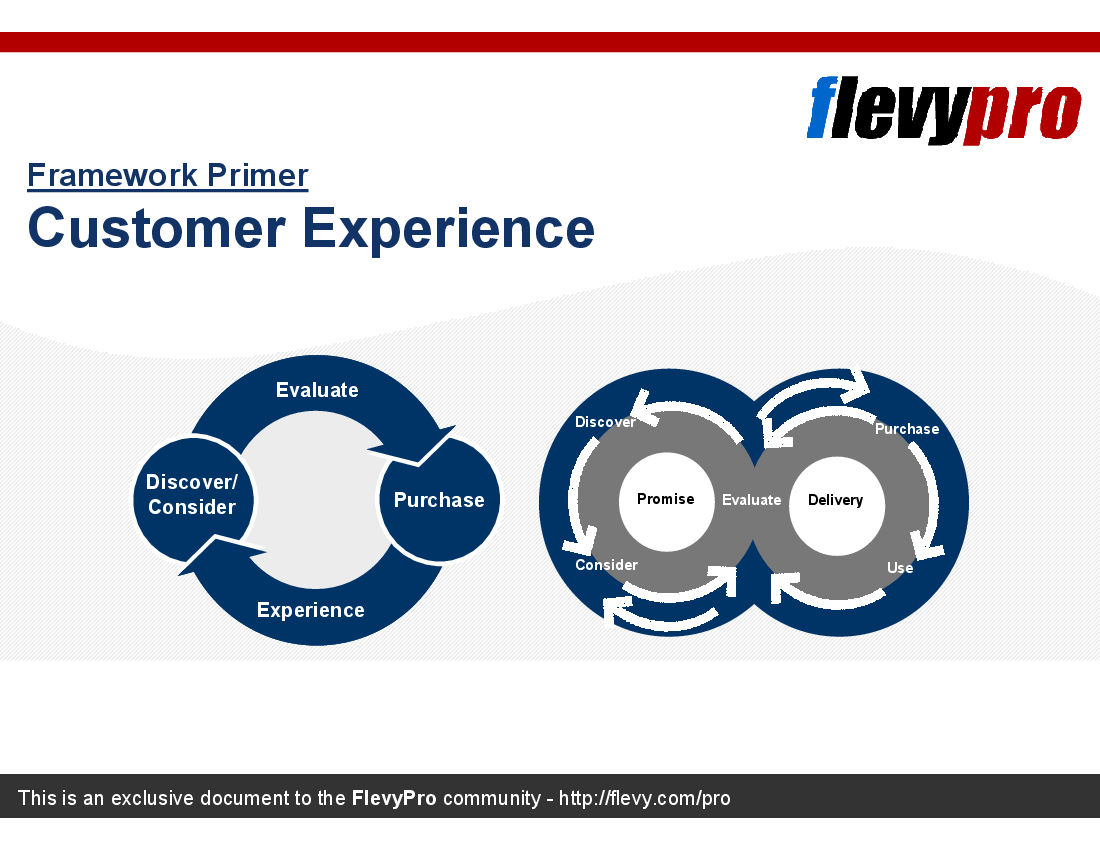
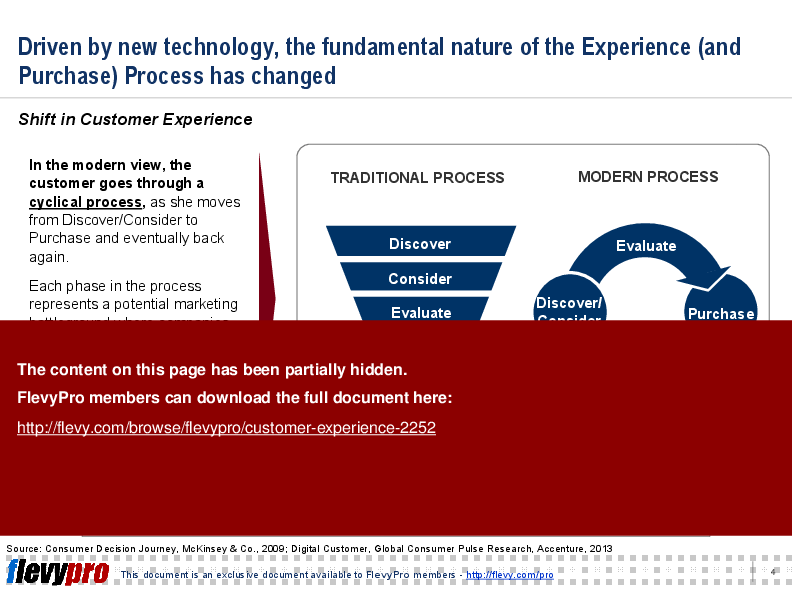
Emerging technology trends are driving businesses to Digital Transformation across industries. At the core of most Digital Transformation projects is the evolution of the Customer Experience, from a traditional linear process (with few touch points) to a continuous, circular process (with constant touch points).
This new approach to Customer Experience has been captured by many top-tier management consulting firms. In fact, this presentation will provide overviews for 2 such frameworks:
This presentation dives deep into the shifting paradigms of Customer Experience, emphasizing the transition from traditional to modern processes. The cyclical nature of the modern customer journey is highlighted, where customers continuously loop through discovery, evaluation, purchase, and post-purchase phases. This shift underscores the need for businesses to adapt their strategies to maintain constant engagement with customers, ensuring a seamless and ongoing relationship.
The PPT also explores Accenture's Nonstop Customer Experience Model, which integrates open and branded content channels to create a cohesive customer journey. This model emphasizes the importance of delivering on promises and maintaining a consistent delivery of value throughout the customer lifecycle. By leveraging this framework, businesses can better understand and meet the evolving expectations of their customers in a digital-first world.
Several trends are identified, indicating that companies must move beyond merely admiring digital opportunities and start capitalizing on them. The presentation outlines the barriers customers face in adopting digital service channels and the rising expectations that companies must meet. It provides actionable insights and templates to help organizations implement customer-centric practices, ensuring they stay ahead in the competitive landscape.
What is the practical difference between a linear and a continuous (cyclical) customer journey?
A linear journey treats customer interactions as sequential steps ending at purchase, while a continuous journey views behavior as an ongoing loop requiring repeat engagement and value delivery. The cyclical model maps repeated movement through discovery, evaluation, purchase, and post-purchase in ongoing customer relationships.
How does Accenture’s Nonstop Customer Experience Model change content and channel strategy?
Accenture’s model calls for integrating open (third-party/social) and branded channels to create a cohesive experience, focusing on delivering promises and consistent value throughout the lifecycle. The approach emphasizes channel integration across the customer journey and open versus branded content channels.
What does McKinsey’s Customer Decision Journey help organizations map?
McKinsey’s Customer Decision Journey helps organizations chart how customers move between awareness and repurchase, highlighting touchpoints where influence occurs and where to focus engagement and interventions. It is used to visualize decision behavior across the customer lifecycle.
What should I look for in a short CX framework slide deck for an executive briefing?
For executive briefings, prioritize decks that contrast traditional vs modern journeys, show channel integration, identify adoption barriers, and provide ready templates for action. The Customer Experience deck is a 21-slide PowerPoint that summarizes McKinsey and Accenture frameworks and includes templates.
How can templates and insights in a CX slide deck accelerate implementation work?
Templates standardize diagnostics, journey maps, and channel assessments so teams spend less time formatting and more on analysis; the presentation explicitly supplies actionable insights and templates to support implementation and reduce upfront design work.
Which model is recommended when integrating open content channels with branded experiences?
The Accenture Nonstop Customer Experience Model specifically addresses integration of open and branded content channels and the need to maintain consistent delivery of value across those channels. Use Accenture’s Nonstop Customer Experience Model for guidance.
After digital transformation initiatives, how should companies maintain continuous customer engagement?
Companies should adopt a cyclical view of the customer lifecycle, redesign touchpoints for constant interaction, address barriers to digital channel adoption, and apply templates and insights to operationalize continuous engagement through discovery, evaluation, purchase, and post-purchase loops.
Where can I find a concise comparison of major consulting CX frameworks?
Overviews comparing multiple consulting frameworks can be found in focused decks that summarize leading models; the Customer Experience presentation provides side-by-side overviews of McKinsey’s Customer Decision Journey and Accenture’s Nonstop Customer Experience Model.
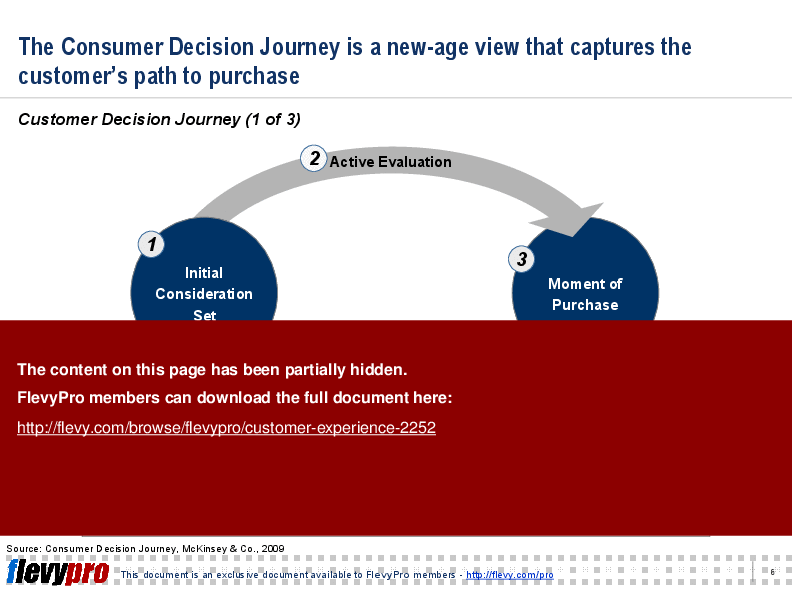
The Consumer Decision Journey outlines how customers progress from awareness to purchase and beyond, encompassing 4 key stages: Initial Consideration Set, Active Evaluation, Moment of Purchase, and Post-purchase Experience. In the Initial Consideration Set, potential customers identify products or services that meet their needs, laying the groundwork for engagement. During Active Evaluation, customers research and compare options, making it crucial for brands to influence perceptions. The Moment of Purchase signifies the transaction, influenced by promotions, ease of purchase, and customer service. The journey continues into the Post-purchase Experience, focusing on ongoing engagement and satisfaction, which affects future purchasing behavior and brand loyalty. The entire journey can span days to months, shaped by product complexity and individual circumstances, highlighting the importance of understanding customer behavior over time. This framework serves as a roadmap for enhancing customer experience strategies and fostering deeper relationships.
Source: Best Practices in Digital Transformation, Customer Experience, Customer Decision Journey PowerPoint Slides: Customer Experience PowerPoint (PPT) Presentation Slide Deck, LearnPPT Consulting
This framework is developed by a team of former McKinsey and Big 4 consultants. The presentation follows the headline-body-bumper slide format used by global consulting firms.
For $10.00 more, you can download this document plus 2 more FlevyPro documents. That's just $13 each.
ABOUT FLEVYPRO
This document is part of the FlevyPro Library, a curated knowledge base of documents for our FlevyPro subscribers.

FlevyPro is a subscription service for on-demand business frameworks and analysis tools. FlevyPro subscribers receive access to an exclusive library of curated business documents—business framework primers, presentation templates, Lean Six Sigma tools, and more—among other exclusive benefits.
The average daily rate of a McKinsey consultant is $6,625 (not including expenses). The average price of a Flevy document is $65.
Trusted by over 10,000+ Client Organizations
Since 2012, we have provided business templates to over 10,000 businesses and organizations of all sizes, from startups and small businesses to the Fortune 100, in over 130 countries.
"As an Independent Management Consultant, I find Flevy to add great value as a source of best practices, templates and information on new trends. Flevy has matured and the quality and quantity of the library is excellent. Lastly the price charged is reasonable, creating a win-win value for
the customer, Flevy and the various authors. This is truly a service that benefits the consulting industry and associated clients. Thanks for providing this service.
"
– Jim Schoen, Principal at FRC Group
"As a consultant requiring up to date and professional material that will be of value and use to my clients, I find Flevy a very reliable resource.
The variety and quality of material available through Flevy offers a very useful and commanding source for information. Using Flevy saves me time, enhances my expertise and ends up being a good decision."
– Dennis Gershowitz, Principal at DG Associates
"I have used FlevyPro for several business applications. It is a great complement to working with expensive consultants. The quality and effectiveness of the tools are of the highest standards."
– Moritz Bernhoerster, Global Sourcing Director at Fortune 500
"As a young consulting firm, requests for input from clients vary and it's sometimes impossible to provide expert solutions across a broad spectrum of requirements. That was before I discovered Flevy.com.
Through subscription to this invaluable site of a plethora of topics that are key and crucial to consulting, I
have been able to exceed expectations and deliver quality advice and solutions to my clients. The quality and expertise of the authors are exemplary and gives me great confidence to use as part of my service offerings.
I highly recommend this company for any consultant wanting to apply international best practice standards in their service offerings.
"
– Nishi Singh, Strategist and MD at NSP Consultants
"As a niche strategic consulting firm, Flevy and FlevyPro frameworks and documents are an on-going reference to help us structure our findings and recommendations to our clients as well as improve their clarity, strength, and visual power. For us, it is an invaluable resource to increase our impact and value."
– David Coloma, Consulting Area Manager at Cynertia Consulting
"My FlevyPro subscription provides me with the most popular frameworks and decks in demand in today’s market. They not only augment my existing consulting and coaching offerings and delivery, but also keep me abreast of the latest trends, inspire new products and service offerings for my practice, and educate me
in a fraction of the time and money of other solutions. I strongly recommend FlevyPro to any consultant serious about success.
"
– Bill Branson, Founder at Strategic Business Architects
"Flevy is our 'go to' resource for management material, at an affordable cost. The Flevy library is comprehensive and the content deep, and typically provides a great foundation for us to further develop and tailor our own service offer."
– Chris McCann, Founder at Resilient.World
"The wide selection of frameworks is very useful to me as an independent consultant. In fact, it rivals what I had at my disposal at Big 4 Consulting firms in terms of efficacy and organization."
– Julia T., Consulting Firm Owner (Former Manager at Deloitte and Capgemini)
Download our FREE Digital Transformation Templates
Download our free compilation of 50+ Digital Transformation slides and templates. DX concepts covered include Digital Leadership, Digital Maturity, Digital Value Chain, Customer Experience, Customer Journey, RPA, etc.









