
This framework is developed by a team of former McKinsey and Big 4 consultants. The presentation follows the headline-body-bumper slide format used by global consulting firms.
Editor Summary
The Strategic Goals Grid (SGG) is a 26-slide PowerPoint (PPTX) by LearnPPT Consulting that delivers a 4-quadrant strategic planning template and accompanying slide templates and example grids.
Read moreThe SGG presents an alternative to SWOT and is implemented via a 3-step process—Visualize and Document; Coalesce; Synthesize and Align—to help planners set objectives, reconcile conflicting goals, and create objective review criteria. Target users include planners and participants of strategic and long-range planning workshops. Sold as a digital download on Flevy.
Use the SGG when SWOT outputs leave unclear priorities or when a workshop must translate stakeholder inputs into aligned goals and review criteria.
Strategic planners facilitating long-range planning, using the 4-quadrant SGG template to capture current direction and desired direction.
Workshop facilitators aggregating and synthesizing participant input across group exercises to generate agreed objectives.
Strategy team members translating competing initiatives into objective review criteria and reconciled goals.
Presentation owners building slide decks from provided templates and example grids for executive discussion.
The SGG’s three-step, workshop-driven sequencing (Visualize and Document → Coalesce → Synthesize and Align) reflects iterative synthesis practices used in strategic planning workshops.
A very popular Strategic Planning tool is the SWOT analysis (or SWOT matrix). However, sometimes assessing the organization's Strengths, Weaknesses, Opportunities, and Threats is not enough to set a direction for the planning process.
This presentation provides a framework alternative to SWOT called the Strategic Goals Grid (SGG). The SGG gives the planners a different perspective to view the organization, the direction it has taken, the direction that the collective wisdom of the organization wants to take, and set goals. SGG is an extremely effective overall Organizational Analysis tool for participants of strategic and long-range planning workshops.
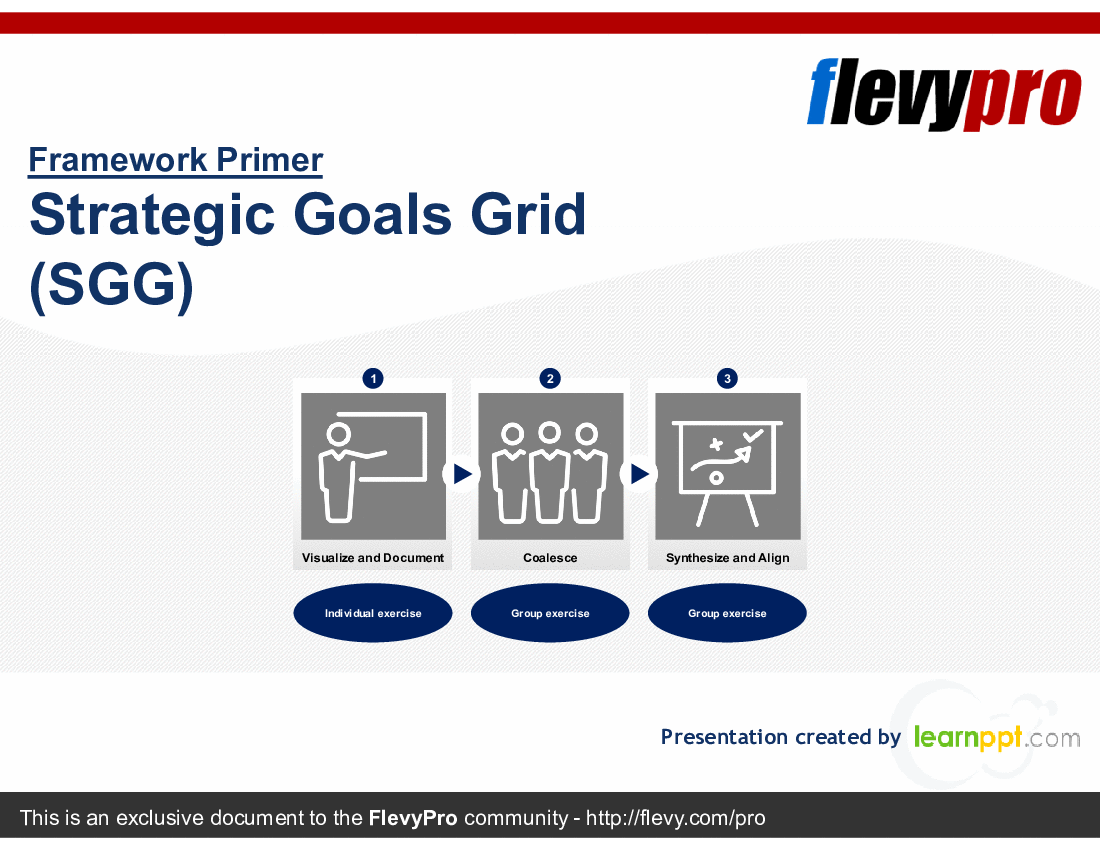
The SGG is implemented using 3 progressive steps:
1. Visualize and Document
2. Coalesce
3. Synthesize and Align
Other topics discussed in the presentation include Strategic Goals Grid utilization and benefits, how to populate the grid, its comparison with SWOT analysis, SWOT Definition, and the steps to SWOT Analysis.
The slide deck also includes some slide templates for you to use in your own business presentations.
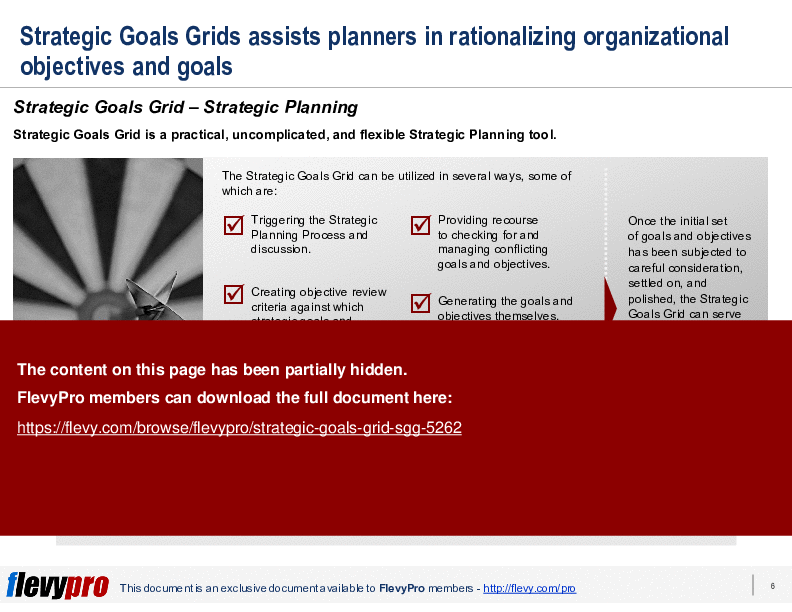
The Strategic Goals Grid (SGG) is a practical tool that helps planners rationalize organizational objectives and goals. It is designed to be simple yet flexible, making it suitable for various scenarios. The SGG framework assists in creating objective review criteria and managing conflicting goals. This tool can be used to trigger strategic planning discussions and generate goals and objectives that align with the organization's vision.
The SGG's 4-quadrant template provides a visual reference, making the planning process more intuitive. It can be used for both individual and group exercises, ensuring that all participants' wisdom is accumulated and synthesized. The PPT includes templates for populating the grid and examples of completed grids, offering a comprehensive guide for effective strategic planning.
What is the Strategic Goals Grid and how does it compare to a SWOT analysis?
The Strategic Goals Grid (SGG) is a 4-quadrant strategic planning framework intended as an alternative perspective to SWOT, helping planners view organizational direction, collective preferences, and set goals. The SGG focuses on synthesizing participant wisdom and creating objective review criteria rather than the Strengths/Weaknesses/Opportunities/Threats categorization, implemented through 3 steps.
When is it appropriate to use a grid-based approach like the SGG instead of continuing with SWOT?
Use SGG when SWOT identifies factors, but does not clarify direction, priorities, or how to reconcile conflicting goals. The SGG is designed for workshops where participants’ collective wisdom must be visualized, coalesced, and synthesized into goals and review criteria in structured sessions.
What are the implementation steps of the SGG methodology?
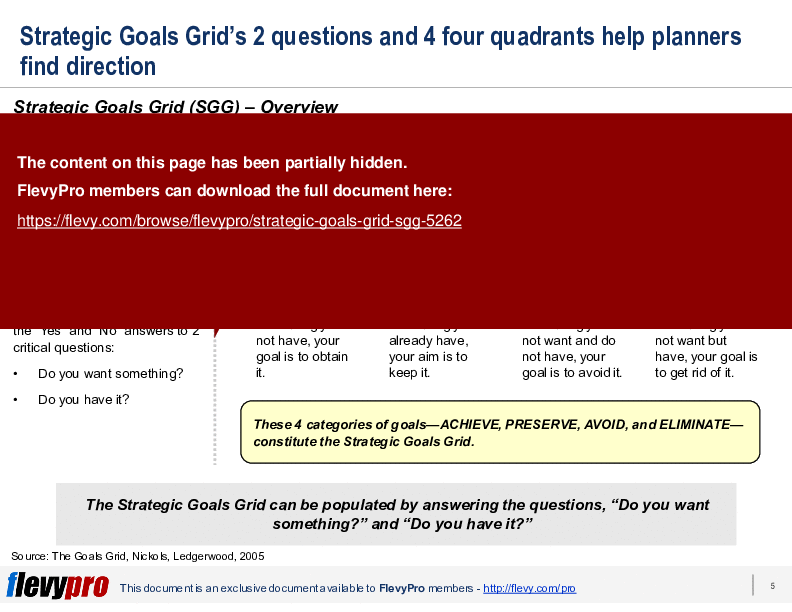
The SGG is implemented in 3 progressive steps: Visualize and Document (capture inputs), Coalesce (group and synthesize perspectives), and Synthesize and Align (convert syntheses into aligned goals and review criteria). These steps guide workshop activities and grid population in a 3-step sequence.
How can the SGG be used in group strategic planning workshops?
In group workshops the SGG’s 4-quadrant template is used for individual and group exercises to accumulate participant inputs, surface differing directions, coalesce consensus, and synthesize aligned objectives. The process supports converting workshop output into measurable goals and objective review criteria using the 4-quadrant template.
What features should I look for in a slide deck or toolkit that supports the SGG approach?
Look for a slide deck that explains utilization and benefits, provides guidance on how to populate the grid, offers a side-by-side comparison with SWOT, and includes editable templates plus example completed grids to use in presentations and workshops as tangible tools and references.
Can the SGG help reconcile conflicting strategic goals within an organization?
The SGG framework is explicitly described as assisting planners to manage conflicting goals by creating objective review criteria and synthesizing participant views into aligned goals, making it a tool for resolving competing priorities and establishing reviewable objectives.
How do templates and example grids assist someone new to the SGG method?
Slide templates and completed example grids provide practical guidance on how to populate each quadrant, illustrate expected outputs from workshop exercises, and serve as ready visuals for business presentations, enabling faster adoption of the SGG approach using tangible templates and examples.
How does Flevy’s Strategic Goals Grid PPT support adoption of the SGG in my organization?
Flevy’s Strategic Goals Grid PPTX by LearnPPT Consulting includes explanatory slides on usage and benefits, guidance for populating the grid, a comparison with SWOT, and editable templates plus example completed grids within its 26-slide deck.
The Strategic Goals Grid (SGG) framework facilitates strategic planning through 3 steps: "Visualize and Document," "Coalesce," and "Synthesize and Align." The first step encourages individual exercises for participants to articulate ideas, gathering diverse perspectives. The second step focuses on group exercises to refine these ideas, fostering alignment and synthesizing insights into a cohesive strategy. The final step further develops and aligns consolidated ideas with organizational objectives, ensuring actionable strategic direction. The SGG is versatile for individual and group settings, aiding discussions and tracking progress, providing a structured yet flexible approach to strategic planning.
The Strategic Goals Grid (SGG) is a visual framework for strategic planning that addresses 2 key questions: "Do you want something?" and "Do you have it?" This framework categorizes responses into 4 quadrants: "Achieve," "Preserve," "Avoid," and "Eliminate," based on participants' desires and current states. For example, if participants want something and have it, they are in the "Preserve" quadrant, indicating a need to maintain their position. Conversely, if they desire something, but do not possess it, they fall into the "Achieve" quadrant, focusing on obtaining that goal. The SGG enhances clarity in strategic initiatives, aligning team objectives and fostering collaboration, making it valuable for both group and individual planning.
This framework is developed by a team of former McKinsey and Big 4 consultants. The presentation follows the headline-body-bumper slide format used by global consulting firms.
For $10.00 more, you can download this document plus 2 more FlevyPro documents. That's just $13 each.
ABOUT FLEVYPRO
This document is part of the FlevyPro Library, a curated knowledge base of documents for our FlevyPro subscribers.

FlevyPro is a subscription service for on-demand business frameworks and analysis tools. FlevyPro subscribers receive access to an exclusive library of curated business documents—business framework primers, presentation templates, Lean Six Sigma tools, and more—among other exclusive benefits.
The average daily rate of a McKinsey consultant is $6,625 (not including expenses). The average price of a Flevy document is $65.
Trusted by over 10,000+ Client Organizations
Since 2012, we have provided business templates to over 10,000 businesses and organizations of all sizes, from startups and small businesses to the Fortune 100, in over 130 countries.
"If you are looking for great resources to save time with your business presentations, Flevy is truly a value-added resource. Flevy has done all the work for you and we will continue to utilize Flevy as a source to extract up-to-date information and data for our virtual and onsite presentations!"
– Debbi Saffo, President at The NiKhar Group
"I am extremely grateful for the proactiveness and eagerness to help and I would gladly recommend the Flevy team if you are looking for data and toolkits to help you work through business solutions."
– Trevor Booth, Partner, Fast Forward Consulting
"As a consulting firm, we had been creating subject matter training materials for our people and found the excellent materials on Flevy, which saved us 100's of hours of re-creating what already exists on the Flevy materials we purchased."
– Michael Evans, Managing Director at Newport LLC
"Flevy is our 'go to' resource for management material, at an affordable cost. The Flevy library is comprehensive and the content deep, and typically provides a great foundation for us to further develop and tailor our own service offer."
– Chris McCann, Founder at Resilient.World
"I like your product. I'm frequently designing PowerPoint presentations for my company and your product has given me so many great ideas on the use of charts, layouts, tools, and frameworks. I really think the templates are a valuable asset to the job."
– Roberto Fuentes Martinez, Senior Executive Director at Technology Transformation Advisory
"One of the great discoveries that I have made for my business is the Flevy library of training materials.
As a Lean Transformation Expert, I am always making presentations to clients on a variety of topics: Training, Transformation, Total Productive Maintenance, Culture, Coaching, Tools, Leadership Behavior, etc. Flevy
It is well worth the money to purchase these presentations. Sure, I have the knowledge and information to make my point. It is another thing to create a presentation that captures what I want to say. Flevy has saved me countless hours of preparation time that is much better spent with implementation that will actually save money for my clients.
"
– Ed Kemmerling, Senior Lean Transformation Expert at PMG
"I have found Flevy to be an amazing resource and library of useful presentations for lean sigma, change management and so many other topics. This has reduced the time I need to spend on preparing for my performance consultation. The library is easily accessible and updates are regularly provided. A wealth of great information."
– Cynthia Howard RN, PhD, Executive Coach at Ei Leadership
"The wide selection of frameworks is very useful to me as an independent consultant. In fact, it rivals what I had at my disposal at Big 4 Consulting firms in terms of efficacy and organization."
– Julia T., Consulting Firm Owner (Former Manager at Deloitte and Capgemini)
Download our free compilation of 50+ Strategy & Transformation slides and templates. Frameworks include McKinsey 7-S, Balanced Scorecard, Disruptive Innovation, BCG Curve, and many more.









