
 Click main image to view in full screen. Unlock all 10 preview images:
Line Balancing and Takt Planning Training with Excel Planner – PowerPoint PPTX Template
PowerPoint (PPTX) + Zip archive file (ZIP) 50 Slides


BENEFITS OF THIS DOWNLOADABLE POWERPOINT DOCUMENT
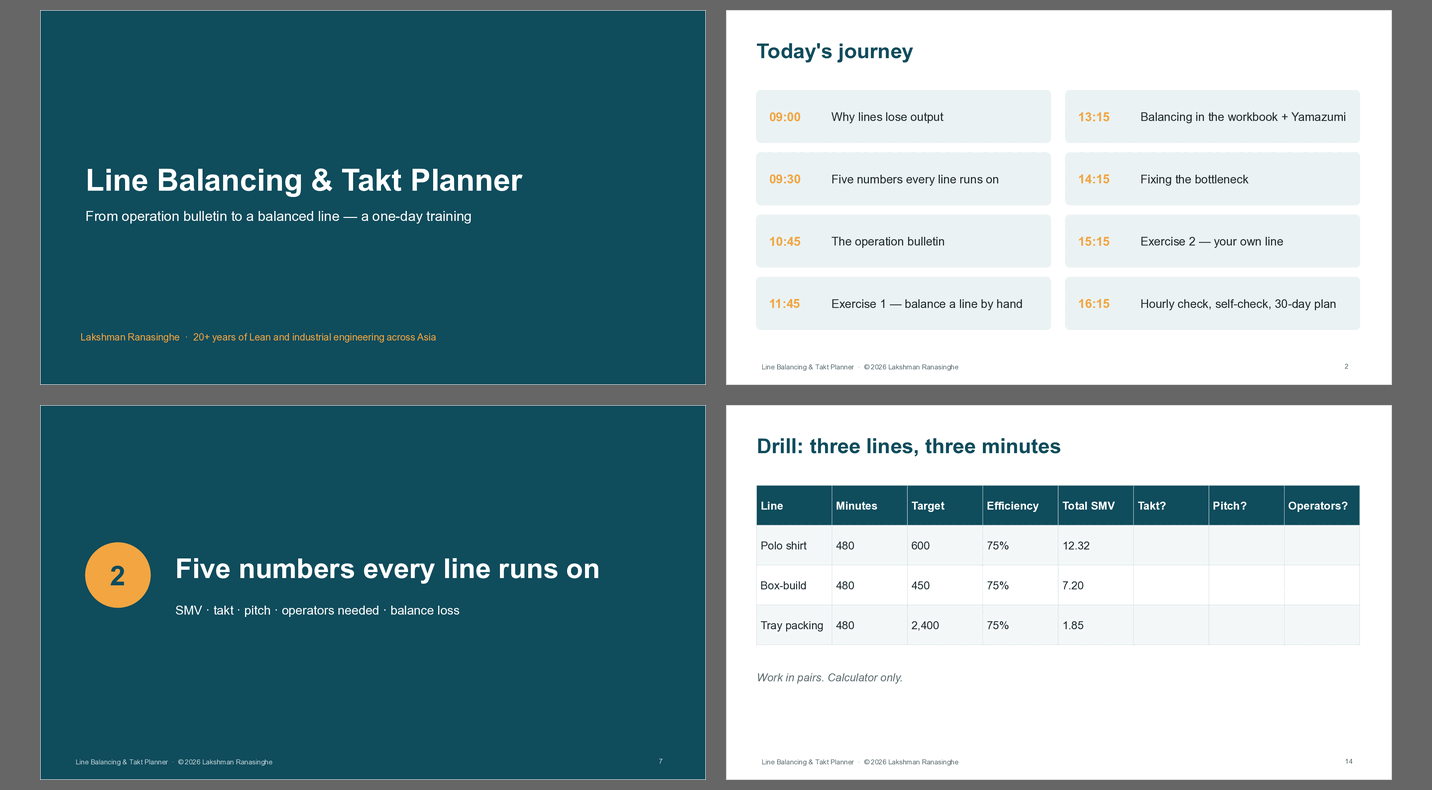
- Teaches takt, pitch, operators needed, balance loss and the Yamazumi chart through a one-day, 50-slide workshop with two hands-on exercises.
- Turns any operation bulletin into balanced stations with the bottleneck, line capacity and labour cost per piece calculated automatically in Excel.
- Keeps the balance alive on the floor with an hourly output check, a reason for every gap and a loss Pareto that shows what to fix first.
LEAN MANAGEMENT PPT TEMPLATE DESCRIPTION
Most manual production lines have enough people to reach their target and still miss it. The reason is rarely effort. The work is not shared evenly across the line, so one station sets the speed and every other operator waits for part of every cycle. Line balancing is the discipline of sharing that work against the rhythm the customer needs, and it is one of the fastest ways to raise output without adding headcount.
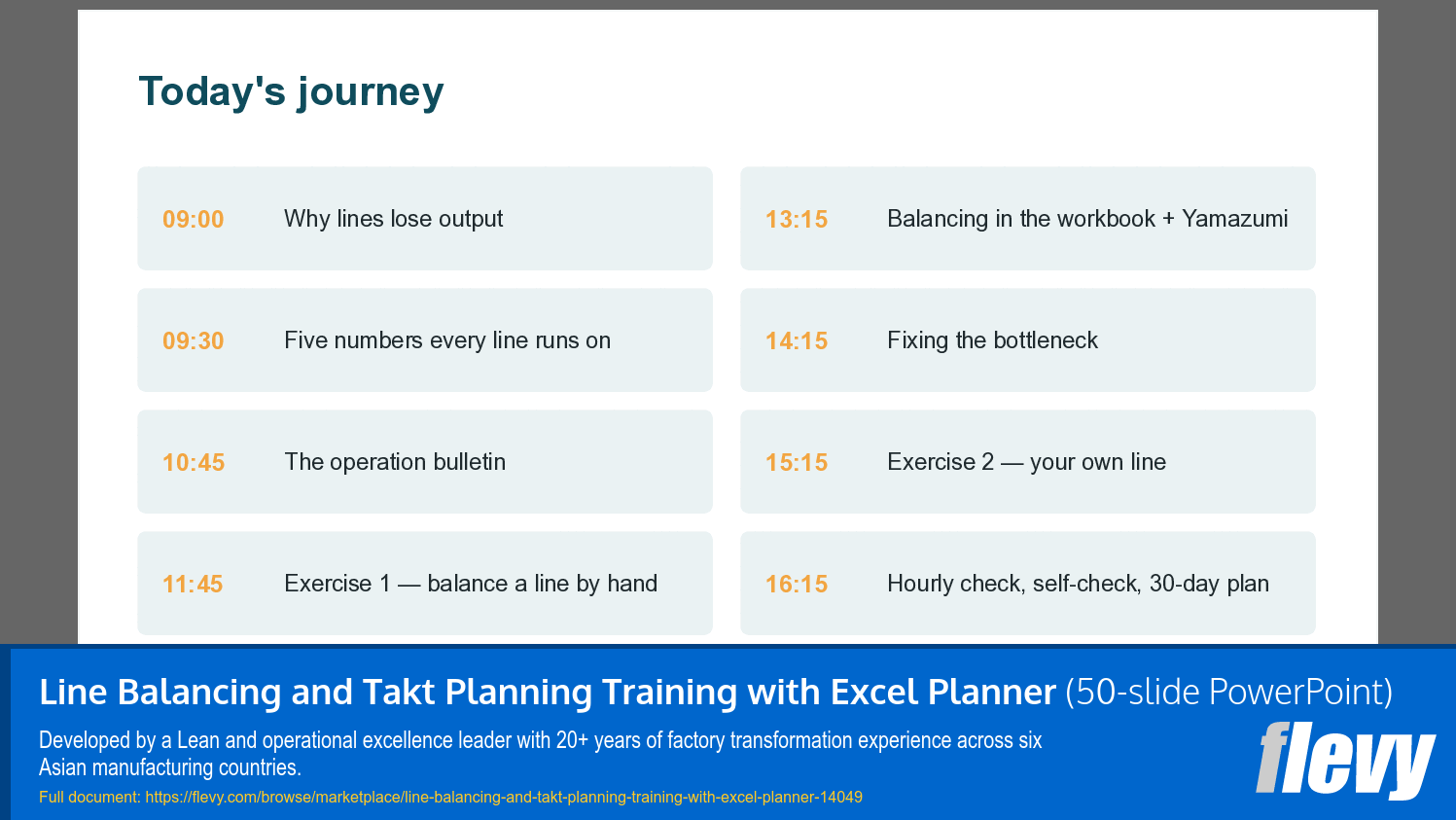
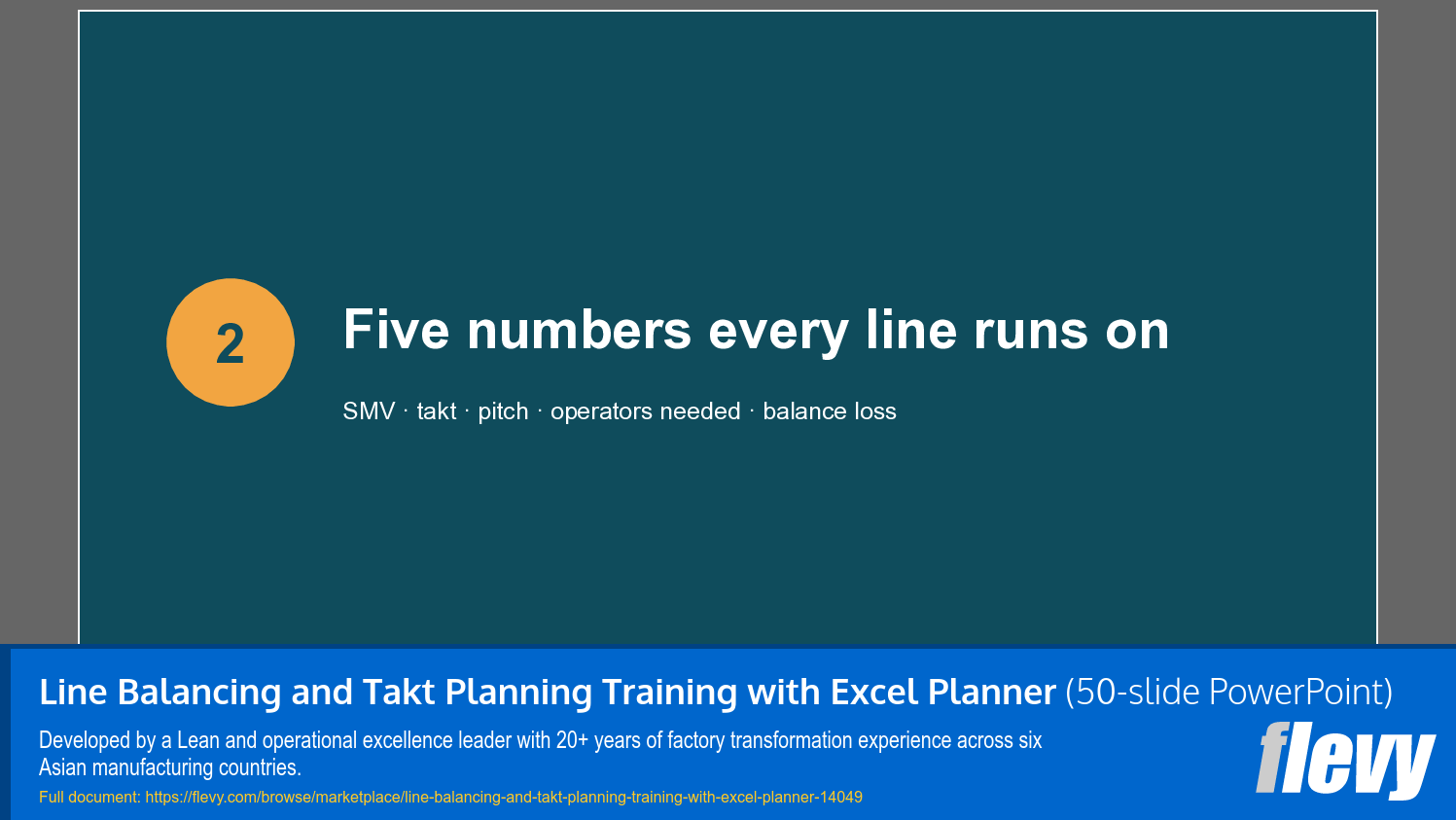
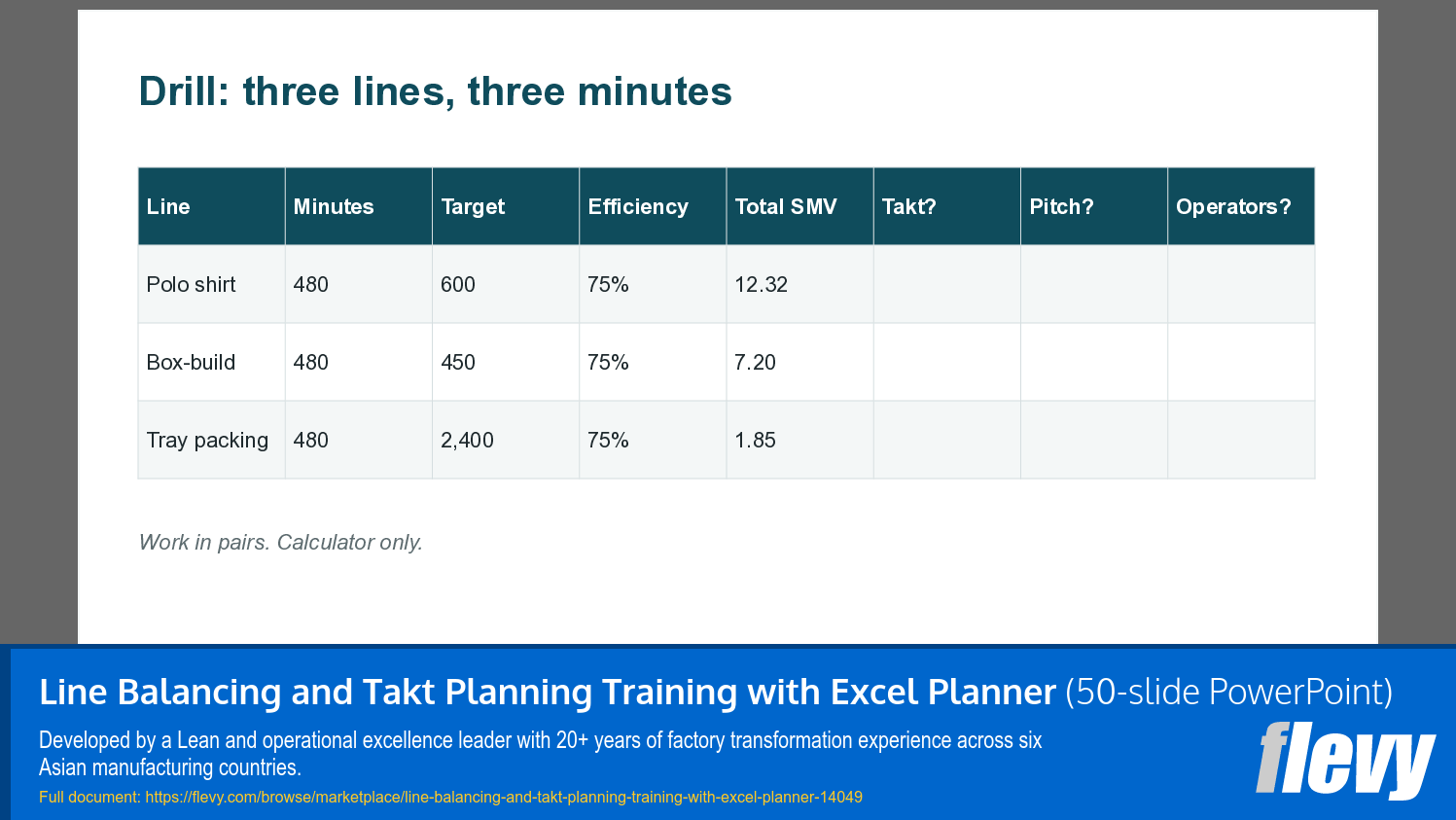
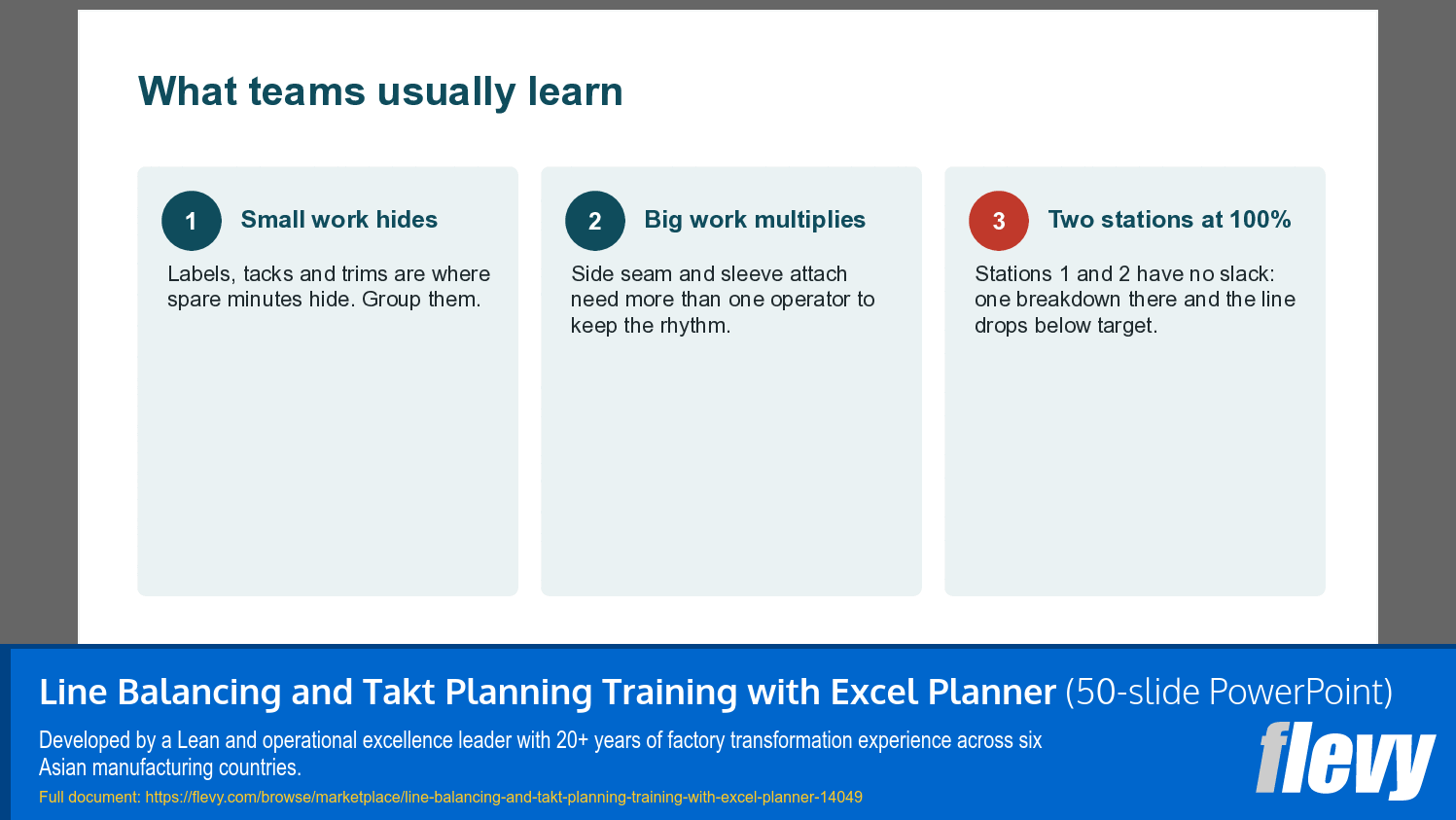
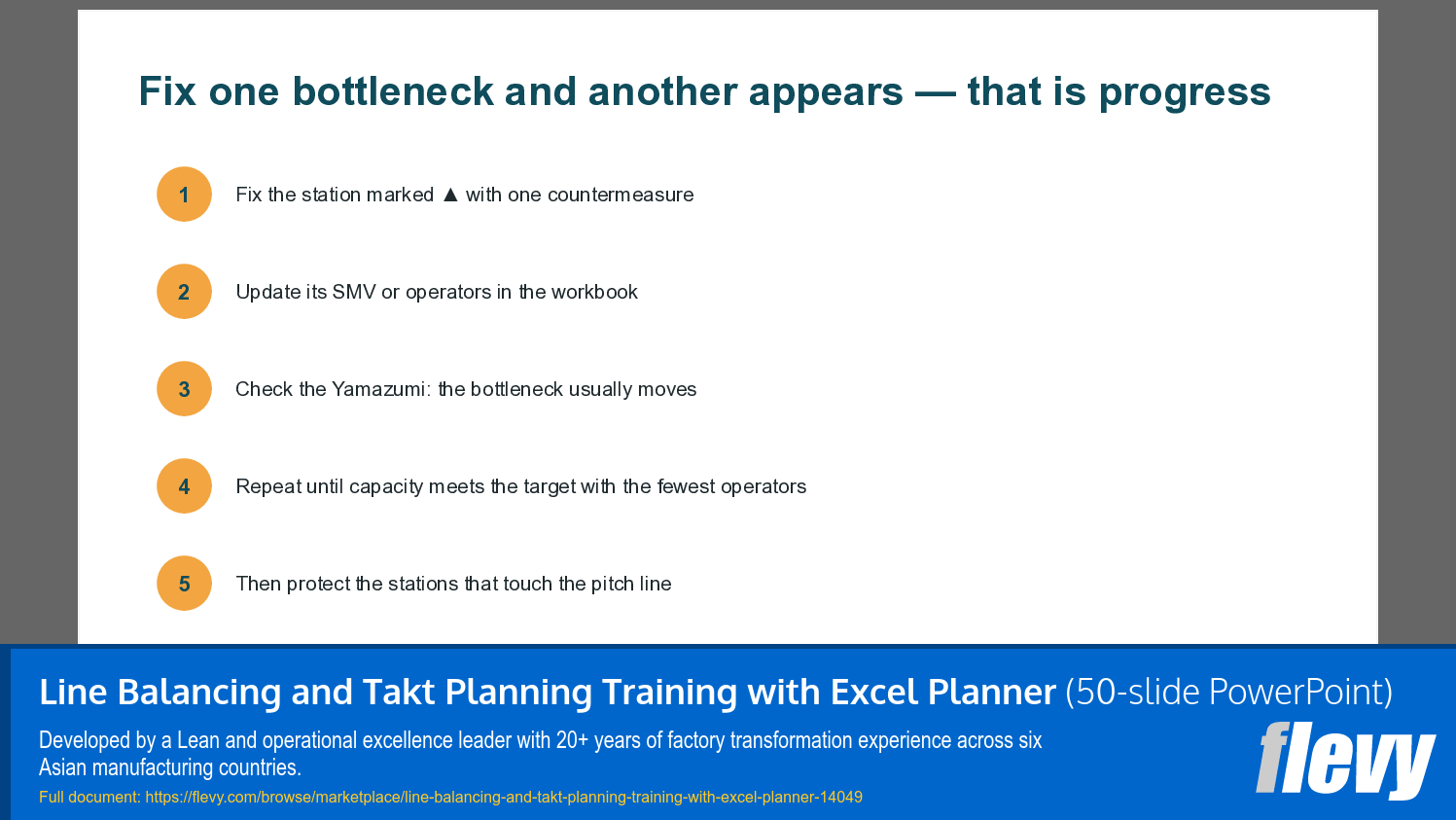
This package is a complete training and planning kit for line balancing and takt planning. The primary document is a 50-slide training deck designed to run as a one-day workshop for supervisors, industrial engineers, line leaders and production managers. It moves in eight modules: why lines lose output, the five numbers every line runs on (SMV, takt, pitch, operators needed and balance loss), the operation bulletin, a paper exercise balancing a real line by hand, balancing in the workbook, fixing the bottleneck with eight countermeasures, the hourly check and loss Pareto, and a second exercise where teams balance their own line and present it. Every exercise comes with worked answers.
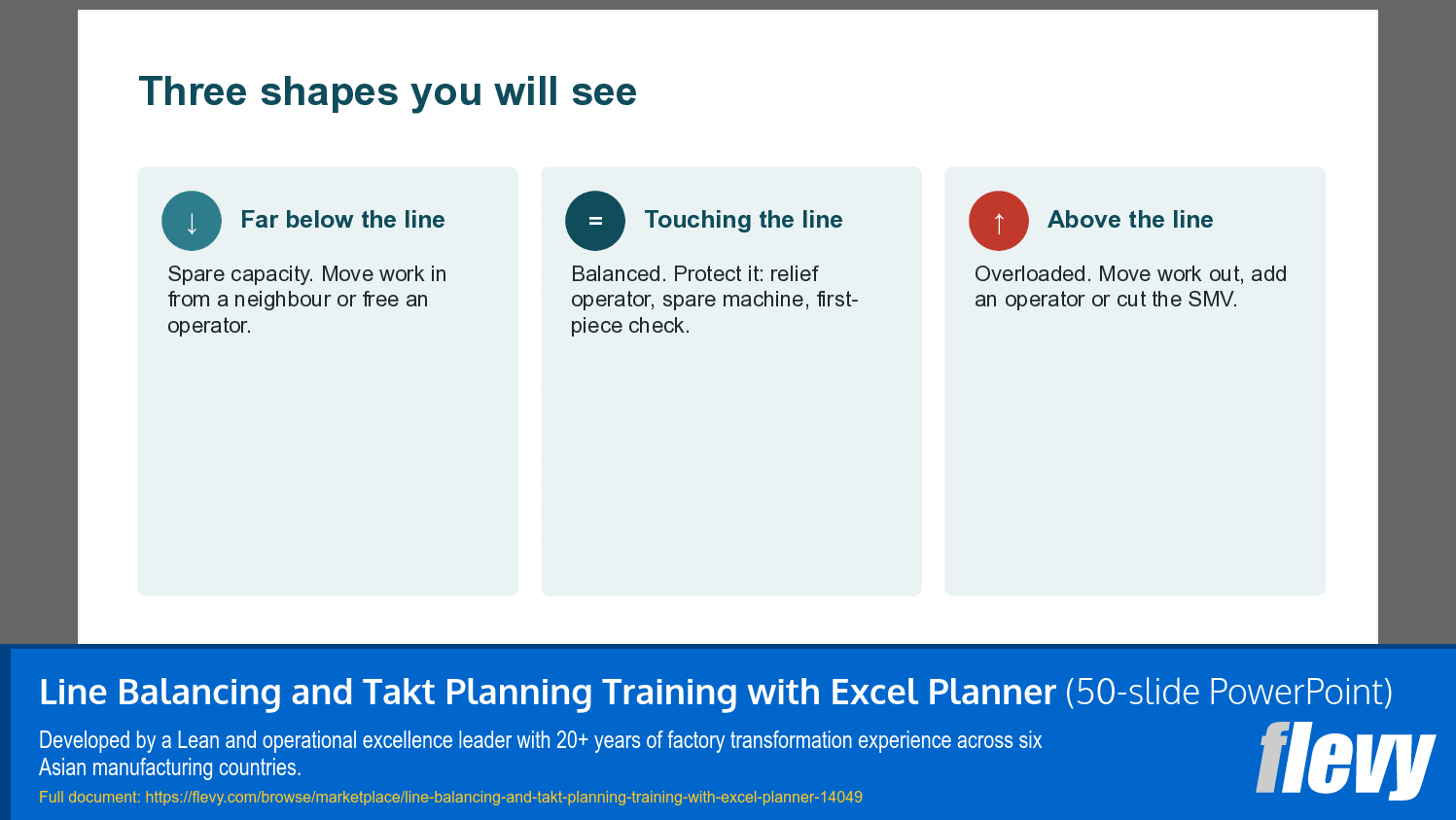
The secondary file contains the Excel planner and supporting material. The planner has seven windows. Settings holds available minutes, daily target, planned efficiency, maximum load and labour cost. The Bulletin takes each operation with its machine type, skill grade and SMV. Takt and Capacity shows takt time, pitch, theoretical and actual operators, the bottleneck station, line capacity per day, balance loss, planned line efficiency and labour cost per piece. Balancing groups operations into stations automatically, either keeping one machine type per station or allowing multi-skilled stations, and lets the user override any station or operator count. The Yamazumi window charts the work per operator at each station, stacked by operation, against the pitch line. The Hourly Check logs actual output against target every hour with a loss reason and builds a Pareto. A Self-Check scores the team's work out of 100 for an in-house review: Practitioner at 70 and Leader at 85.
Six worked example lines are included: a basic T-shirt, a polo shirt, five-pocket jeans, a shoe upper, an electronics box-build and a food tray packing line, so the method can be shown in apparel, footwear, electronics and food before applying it to the user's own process.
Also included are a 17-page guide book in PDF and editable Word, a facilitator's workshop program with timings and answers, a ten-prompt AI prompt pack, a one-page quick-start card, and A3 printables for a Yamazumi wall chart and an hourly output board.
Developed from more than 20 years of Lean and operational excellence leadership across Sri Lanka, China, Bangladesh, Indonesia, Thailand and Vietnam.
Requirements: PowerPoint or any compatible presentation software; Excel 2016 or later. No macros.
Got a question about the product? Email us at support@flevy.com or ask the author directly by using the "Ask the Author a Question" form. If you cannot view the preview above this document description, go here to view the large preview instead.
Source: Best Practices in Lean Management, Standard Work PowerPoint Slides: Line Balancing and Takt Planning Training with Excel Planner PowerPoint (PPTX) Presentation Slide Deck, Lakshman Ranasinghe
ABOUT THE AUTHOR

Lakshman Ranasinghe is an operational excellence and talent development leader with more than 20 years of experience in Lean manufacturing, quality and industrial engineering across Sri Lanka, China, Bangladesh, Indonesia, Thailand and Vietnam.
He has led factory transformation programs in apparel manufacturing, including product development cycle-time reduction, material flow automation and
... [read more]
Ask the Author a Question
You must be logged in to contact the author.