Idea Generation Templates   7-page PDF document
$50.00

Idea Generation Templates (7-page PDF document) Preview Image
Flevy is the marketplace for business best practices.
Idea Generation Templates (7-page PDF document) Preview Image
Arrow   Click main image to view in full screen.

Idea Generation Templates (PDF)

PDF document 7 Pages

Top 1,000 Best Practice $50.00

Add to Cart


Immediate download
Editable with PDF editor
Free lifetime updates

BENEFITS OF THIS PDF DOCUMENT

  1. simple, memorable and engaging structure for conceptualising and summarily presenting new business ideas
  2. Practical Creativity Stimulation/Provocation; Learning-by-doing in Action!
  3. Promoting a culture of Creativity, Innovation and Self-efficacy

IDEATION PDF DESCRIPTION

Editor Summary The Idea Generation Templates is a 7-page PDF by consultfca providing customizable ideation tools for workshop and classroom use, available on Flevy with immediate digital download. Read more

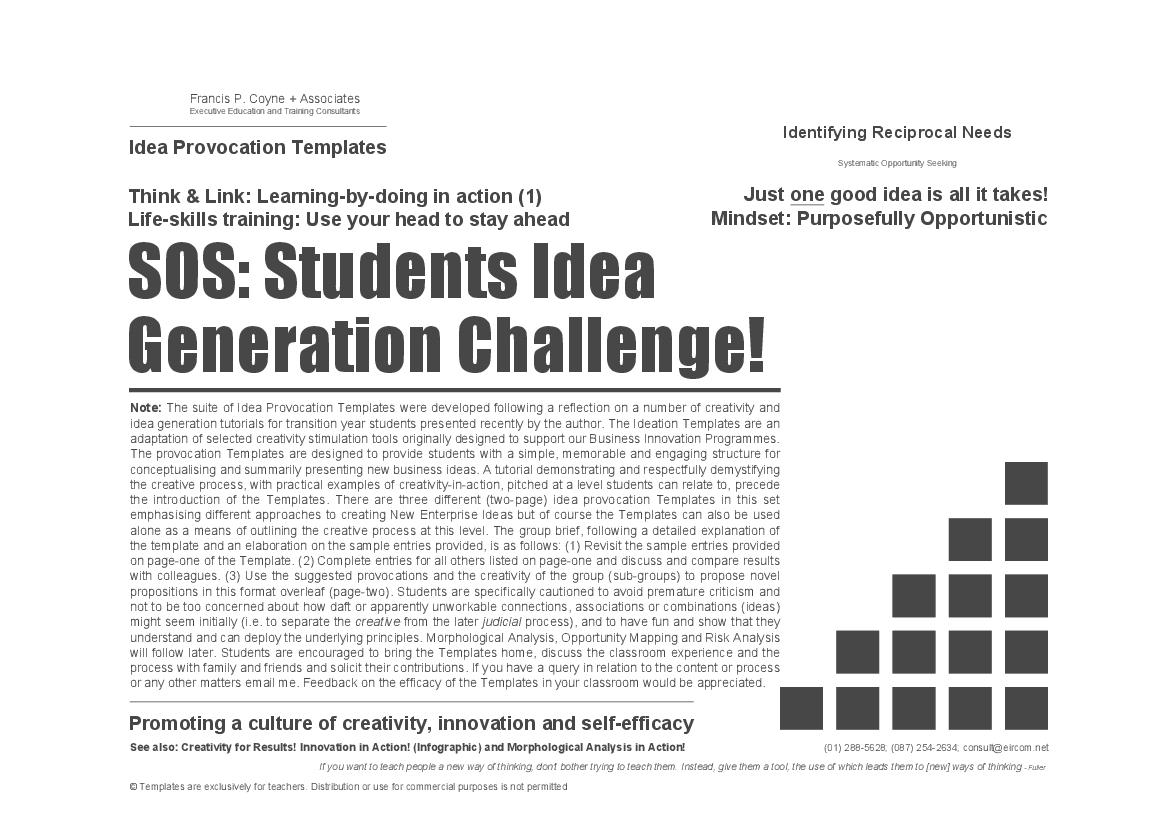
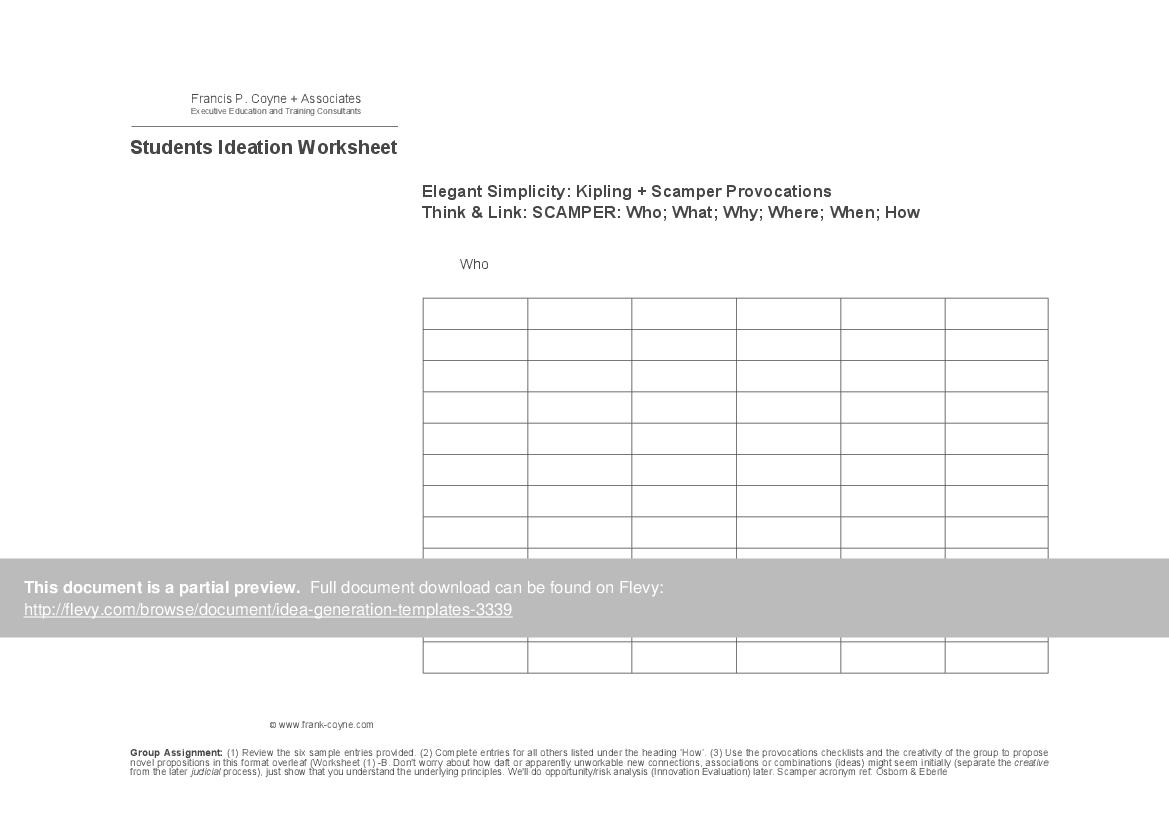
The customisable suite of Idea Provocation Templates were developed following a reflection on a number of creativity and idea generation tutorials for graduate and transition year students presented recently by the author. The Ideation Templates are an adaptation of selected creativity stimulation tools originally designed to support our Business Innovation Programmes. The Idea Provocation Templates are designed to provide students with a simple, memorable and engaging structure for conceptualising and summarily presenting new business ideas. A tutorial demonstrating and respectfully demystifying the creative process, with practical examples of creativity-in-action, pitched at a level students can relate to, precede the introduction of the Templates. There are three different (two-page) idea provocation Templates in this set emphasising different approaches to creating New Enterprise Ideas but of course the Templates can also be used alone as a means of outlining the creative process at this level. The group brief, following a detailed explanation of the template and an elaboration on the (customisable) sample entries provided, is as follows: (1) Revisit the sample entries provided on page-one of the Template. (2) Complete entries for all others listed on page-one and discuss and compare results with colleagues. (3) Use the suggested provocations and the creativity of the group (sub-groups) to propose novel propositions in this format overleaf (page-two). Students are specifically cautioned to avoid premature criticism and not to be too concerned about how daft or apparently unworkable connections, associations or combinations (ideas) might seem initially (i.e. to separate the creative from the later judicial process), and to have fun and show that they understand and can deploy the underlying principles. Morphological Analysis, Opportunity Mapping and Risk Analysis will follow later. Students are encouraged to bring the Templates home, discuss the classroom experience and the process with family and friends and solicit their contributions.

Got a question about the product? Email us at support@flevy.com or ask the author directly by using the "Ask the Author a Question" form. If you cannot view the preview above this document description, go here to view the large preview instead.

MARCUS OVERVIEW

This synopsis was written by Marcus [?] based on the analysis of the full 7-slide presentation.


Executive Summary
The Idea Generation Templates PDF is a comprehensive resource designed to facilitate creativity and innovation in business contexts. This document provides customizable ideation tools that include creativity provocations, morphological analysis, and risk mapping. Users can leverage these templates to generate and present new business ideas effectively. The structured approach encourages participants to explore novel concepts while minimizing premature criticism, fostering an environment conducive to creative thinking.

Who This Is For and When to Use

•  Educators teaching creativity and innovation to students
•  Corporate trainers focusing on ideation and business development
•  Business leaders seeking to enhance team creativity
•  Consultants facilitating workshops on innovation and problem-solving

Best-fit moments to use this deck:
•  During creativity training sessions for students or professionals
•  In workshops aimed at generating new business ideas
•  When conducting brainstorming sessions with teams
•  For educational purposes in classrooms or corporate training environments

Learning Objectives

•  Define the concept of idea generation and its importance in business
•  Build a structured approach to ideation using templates
•  Establish a framework for evaluating creative ideas
•  Encourage collaborative creativity among participants
•  Identify and articulate latent needs in target markets
•  Apply the SCAMPER technique to enhance idea generation
•  Develop a risk analysis framework for new business concepts
•  Foster an environment that separates creative thinking from critical evaluation
•  Utilize morphological analysis to explore various dimensions of ideas
•  Create actionable plans based on generated ideas

Table of Contents

•  Introduction to Idea Generation Templates (page 1)
•  Group Assignment Overview (page 2)
•  SCAMPER Technique Explained (page 3)
•  Examples of Idea Provocations (page 4)
•  Students Ideation Worksheet (page 5)
•  Accidental Entrepreneurship Insights (page 6)
•  Conclusion and Further Resources (page 7)

Primary Topics Covered

•  Idea Generation Techniques - Various methods and frameworks for generating innovative business ideas are presented, emphasizing structured creativity.
•  SCAMPER Method - A detailed explanation of the SCAMPER technique, which encourages participants to think creatively by substituting, combining, adapting, modifying, putting to other uses, eliminating, and rearranging ideas.
•  Morphological Analysis - An approach to dissecting and exploring different aspects of ideas to foster deeper understanding and innovation.
•  Risk Mapping - Tools for identifying and assessing potential risks associated with new business ideas, promoting informed decision-making.
•  Collaborative Creativity - Strategies for fostering teamwork and collaboration in the ideation process, enhancing the quality of generated ideas.
•  Latent Needs Identification - Techniques for uncovering unmet needs in target markets, guiding the ideation process toward practical solutions.

Deliverables, Templates, and Tools

•  Idea Provocation Templates for structured brainstorming sessions
•  SCAMPER worksheets to guide creative thinking
•  Morphological analysis frameworks for idea exploration
•  Risk analysis templates to evaluate potential challenges
•  Group assignment outlines for collaborative ideation
•  Student worksheets for documenting and presenting ideas

Slide Highlights

•  Overview of the SCAMPER technique with practical examples
•  Templates showcasing the structure of idea provocation
•  Visuals illustrating the process of morphological analysis
•  Case studies of successful idea generation in action
•  Guidelines for facilitating group discussions and brainstorming sessions

Potential Workshop Agenda

Introduction to Idea Generation (30 minutes)
•  Overview of the importance of creativity in business
•  Introduction to the Idea Generation Templates and their applications

SCAMPER Workshop (60 minutes)
•  Explanation of the SCAMPER technique
•  Group activity using SCAMPER to generate new ideas

Morphological Analysis Session (45 minutes)
•  Introduction to morphological analysis
•  Hands-on activity to explore different dimensions of generated ideas

Risk Mapping and Evaluation (30 minutes)
•  Discussion on identifying risks associated with new ideas
•  Group activity to create risk maps for selected concepts

Customization Guidance

•  Tailor the templates to fit specific business contexts or industries
•  Adjust the SCAMPER prompts to align with organizational goals
•  Include company-specific examples in the worksheets for relevance
•  Modify risk analysis frameworks to reflect industry-specific challenges

Secondary Topics Covered

•  The role of creativity in entrepreneurship
•  Techniques for fostering a culture of innovation
•  The importance of separating creative and critical thinking
•  Insights into accidental entrepreneurship and its implications
•  Strategies for engaging students in the creative process

Topic FAQ

What is the SCAMPER technique and how is it used in ideation sessions?

SCAMPER is a mnemonic for Substitute, Combine, Adapt, Modify, Put to other uses, Eliminate, and Rearrange; it prompts divergent thinking by systematically altering aspects of a concept. In practice, facilitators use SCAMPER worksheets to run timed group exercises that generate variants of a base idea, as in the SCAMPER worksheets.

How does morphological analysis support creating new business concepts?

Morphological analysis breaks an idea into orthogonal dimensions (components or attributes) and explores combinations across those axes to surface unconventional configurations. It helps teams map solution space methodically and compare concept variants; the Idea Generation Templates include a morphological analysis framework for classroom and workshop use.

What is risk mapping in the ideation process and why include it?

Risk mapping identifies and assesses potential challenges for nascent ideas—technical, market, regulatory, or operational—so teams can prioritise mitigation and inform go/no-go decisions. Including risk maps anchors creative output to feasible execution and is supported in these materials by dedicated risk analysis templates.

How can facilitators prevent premature criticism during brainstorming?

Facilitators explicitly separate the creative phase from evaluation, use provocations to encourage divergent suggestions, and assign group tasks that require completing sample entries before judging ideas. The document’s group brief and idea provocation templates instruct participants to avoid immediate criticism and document all entries for later review.

What should I look for when choosing an idea-generation template set for workshops?

Evaluate whether the set provides structured stimuli (provocations), divergent tools (SCAMPER, morphological analysis), risk evaluation, group assignment outlines, and customization guidance for your context. The Idea Generation Templates include these elements alongside student worksheets and customization suggestions.

How do I assess the value of a short PDF of templates versus a larger toolkit?

Assess fit to your use case: brevity can aid classroom or single-session workshops if essential tools are present and customizable. Consider the number and type of templates, ease of adaptation, and workshop alignment; this resource is a 7-page PDF containing 3 two‑page idea provocation templates and related worksheets.

I have a class timed at 90 minutes—what workshop structure can I use from these materials?

A 90-minute session can pair a 30-minute introduction to idea generation with a 60-minute SCAMPER activity, mirroring the suggested workshop structure. Use the provided SCAMPER explanation and worksheet for the 60-minute group exercise and the student worksheet for capture and presentation.

How should I structure group assignments to maximise participation and output?

The brief in the materials recommends reviewing sample entries, completing remaining items collaboratively, then using provocations in sub-groups to generate propositions on the template’s second page. This sequence—sample review, completion, and provocation-driven ideation—uses the group assignment outline and student worksheet.

Document FAQ
These are questions addressed within this presentation.


What are Idea Generation Templates?
Idea Generation Templates are structured tools designed to facilitate the creative process, helping users generate and present new business ideas effectively.

How can I use the SCAMPER technique?
The SCAMPER technique encourages users to think creatively by exploring different aspects of an idea through substitution, combination, adaptation, modification, and more.

What is morphological analysis?
Morphological analysis is a method for exploring various dimensions of ideas, allowing users to dissect and understand the components that contribute to innovative solutions.

Who can benefit from these templates?
Educators, corporate trainers, business leaders, and consultants can all benefit from using these templates to enhance creativity and innovation in their respective fields.

Can these templates be customized?
Yes, the templates can be tailored to fit specific business contexts, industries, or educational settings to maximize their effectiveness.

What is the importance of risk mapping?
Risk mapping helps identify potential challenges associated with new ideas, enabling informed decision-making and strategic planning.

How do I encourage collaborative creativity in my team?
Utilizing structured templates and facilitating group discussions can foster an environment where team members feel comfortable sharing and developing ideas collaboratively.

What is the goal of the Idea Generation Templates?
The primary goal is to provide a structured approach to creativity, enabling users to generate innovative ideas while minimizing premature criticism and fostering collaboration.

Glossary

•  Idea Generation - The process of creating new concepts or solutions.
•  SCAMPER - An acronym for a creative thinking technique that stands for Substitute, Combine, Adapt, Modify, Put to other uses, Eliminate, and Rearrange.
•  Morphological Analysis - A method for exploring the different dimensions of ideas to foster innovation.
•  Risk Mapping - A tool for identifying and assessing potential risks associated with new business ideas.
•  Latent Needs - Unmet needs in target markets that can inspire new business opportunities.
•  Collaborative Creativity - The process of working together to generate and develop ideas.
•  Creativity Provocations - Stimuli designed to inspire creative thinking and idea generation.
•  Accidental Entrepreneurship - The phenomenon where success is attributed to chance rather than skill or planning.
•  Innovation Evaluation - The process of assessing the viability and potential impact of new ideas.
•  Group Assignment - A collaborative task designed to encourage teamwork and collective ideation.
•  Student Worksheet - A document used by students to outline and present their ideas during the ideation process.
•  Entrepreneurial Mindset - A way of thinking that encourages innovation, risk-taking, and proactive problem-solving.
•  Creativity Training - Educational programs designed to enhance individuals' creative thinking skills.
•  Business Innovation - The process of implementing new ideas or improvements in business practices.
•  Idea Provocation Templates - Structured tools that guide users in generating and presenting new business ideas.
•  Systematic Opportunity Seeking - A methodical approach to identifying and pursuing new business opportunities.
•  Feedback Mechanism - A process for gathering input on the effectiveness of ideas and strategies.
•  Creative Process - The series of steps involved in generating and developing new ideas.
•  Entrepreneurial Motivation - The drive and desire to create and innovate within a business context.
•  Outcome-Driven - A focus on achieving specific results or goals through creative efforts.

Source: Best Practices in Ideation PDF: Idea Generation Templates PDF (PDF) Document, consultfca


$50.00

Add to Cart
  

ABOUT THE AUTHOR

Author: consultfca
Additional documents from author: 4

Ask the Author a Question

You must be logged in to contact the author.

Click here to log in Click here register

Did you know?
The average daily rate of a McKinsey consultant is $6,625 (not including expenses). The average price of a Flevy document is $65.


Trusted by over 10,000+ Client Organizations
Since 2012, we have provided business templates to over 10,000 businesses and organizations of all sizes, from startups and small businesses to the Fortune 100, in over 130 countries.
AT&T GE Cisco Intel IBM Coke Dell Toyota HP Nike Samsung Microsoft Astrazeneca JP Morgan KPMG Walgreens Walmart 3M Kaiser Oracle SAP Google E&Y Volvo Bosch Merck Fedex Shell Amgen Eli Lilly Roche AIG Abbott Amazon PwC T-Mobile Broadcom Bayer Pearson Titleist ConEd Pfizer NTT Data Schwab



Read Customer Testimonials

 
"I like your product. I'm frequently designing PowerPoint presentations for my company and your product has given me so many great ideas on the use of charts, layouts, tools, and frameworks. I really think the templates are a valuable asset to the job."

– Roberto Fuentes Martinez, Senior Executive Director at Technology Transformation Advisory
 
"As a niche strategic consulting firm, Flevy and FlevyPro frameworks and documents are an on-going reference to help us structure our findings and recommendations to our clients as well as improve their clarity, strength, and visual power. For us, it is an invaluable resource to increase our impact and value."

– David Coloma, Consulting Area Manager at Cynertia Consulting
 
"My FlevyPro subscription provides me with the most popular frameworks and decks in demand in today’s market. They not only augment my existing consulting and coaching offerings and delivery, but also keep me abreast of the latest trends, inspire new products and service offerings for my practice, and educate me "

– Bill Branson, Founder at Strategic Business Architects
 
"The wide selection of frameworks is very useful to me as an independent consultant. In fact, it rivals what I had at my disposal at Big 4 Consulting firms in terms of efficacy and organization."

– Julia T., Consulting Firm Owner (Former Manager at Deloitte and Capgemini)
 
"I am extremely grateful for the proactiveness and eagerness to help and I would gladly recommend the Flevy team if you are looking for data and toolkits to help you work through business solutions."

– Trevor Booth, Partner, Fast Forward Consulting
 
"Flevy is now a part of my business routine. I visit Flevy at least 3 times each month.

Flevy has become my preferred learning source, because what it provides is practical, current, and useful in this era where the business world is being rewritten.

In today's environment where there are so "

– Omar Hernán Montes Parra, CEO at Quantum SFE
 
"As an Independent Management Consultant, I find Flevy to add great value as a source of best practices, templates and information on new trends. Flevy has matured and the quality and quantity of the library is excellent. Lastly the price charged is reasonable, creating a win-win value for "

– Jim Schoen, Principal at FRC Group
 
"Flevy is our 'go to' resource for management material, at an affordable cost. The Flevy library is comprehensive and the content deep, and typically provides a great foundation for us to further develop and tailor our own service offer."

– Chris McCann, Founder at Resilient.World


Customers Also Bought These Documents


Customers Also Like These Documents

Explore Templates on Related Management Topics


Your Recently Viewed Documents
Download our FREE Strategy & Transformation Framework Templates

Download our free compilation of 50+ Strategy & Transformation slides and templates. Frameworks include McKinsey 7-S, Balanced Scorecard, Disruptive Innovation, BCG Curve, and many more.









