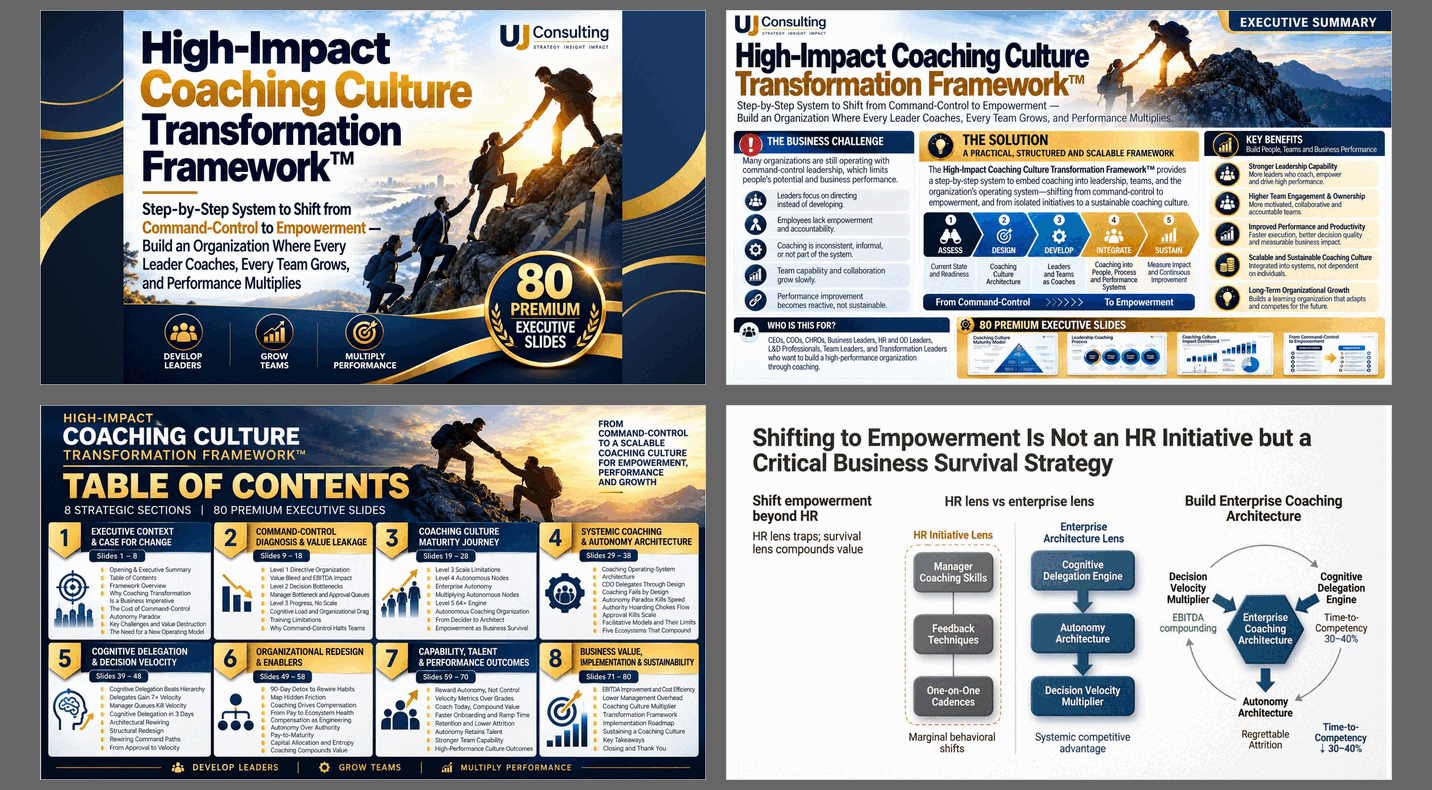

 Click main image to view in full screen. Unlock all 22 preview images:
High-Impact Coaching Culture Transformation Framework™ – PowerPoint PPTX Template
PowerPoint (PPTX) 80 Slides


BENEFITS OF THIS DOWNLOADABLE POWERPOINT DOCUMENT
- Transform Coaching into Organizational Capability. Move beyond isolated coaching techniques with a structured framework connecting leadership, autonomy, cognitive delegation, decision rights, capability development, and performance.
- Connect Coaching to Business Performance. Explore how coaching architecture can influence decision velocity, onboarding, retention, productivity, management overhead, EBITDA, and sustainable organizational growth.
- Gain 80 Premium Executive Slides. Access a substantial visual resource featuring frameworks, transformation models, quantitative illustrations, architecture concepts, and executive-ready insights for presentations and workshops.
HUMAN RESOURCES PPT TEMPLATE DESCRIPTION
High-Impact Coaching Culture Transformation Framework™
Organizations cannot achieve sustainable high performance when every important decision, approval, and problem must flow through a small number of leaders. Traditional command-control structures may provide oversight, but they can also create managerial bottlenecks, slow decision-making, concentrate cognitive load, limit employee autonomy, and prevent leadership capability from scaling across the organization.
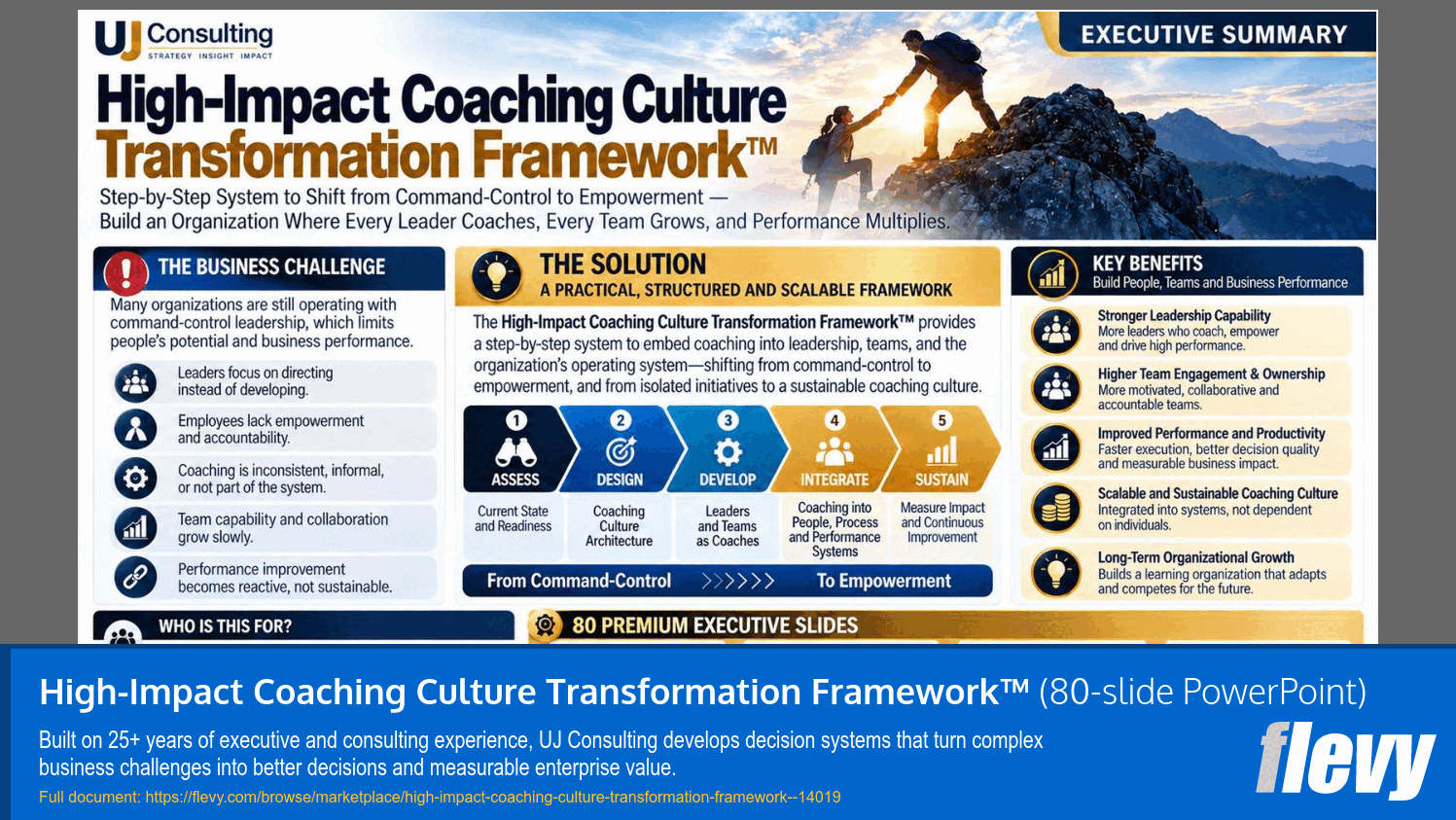
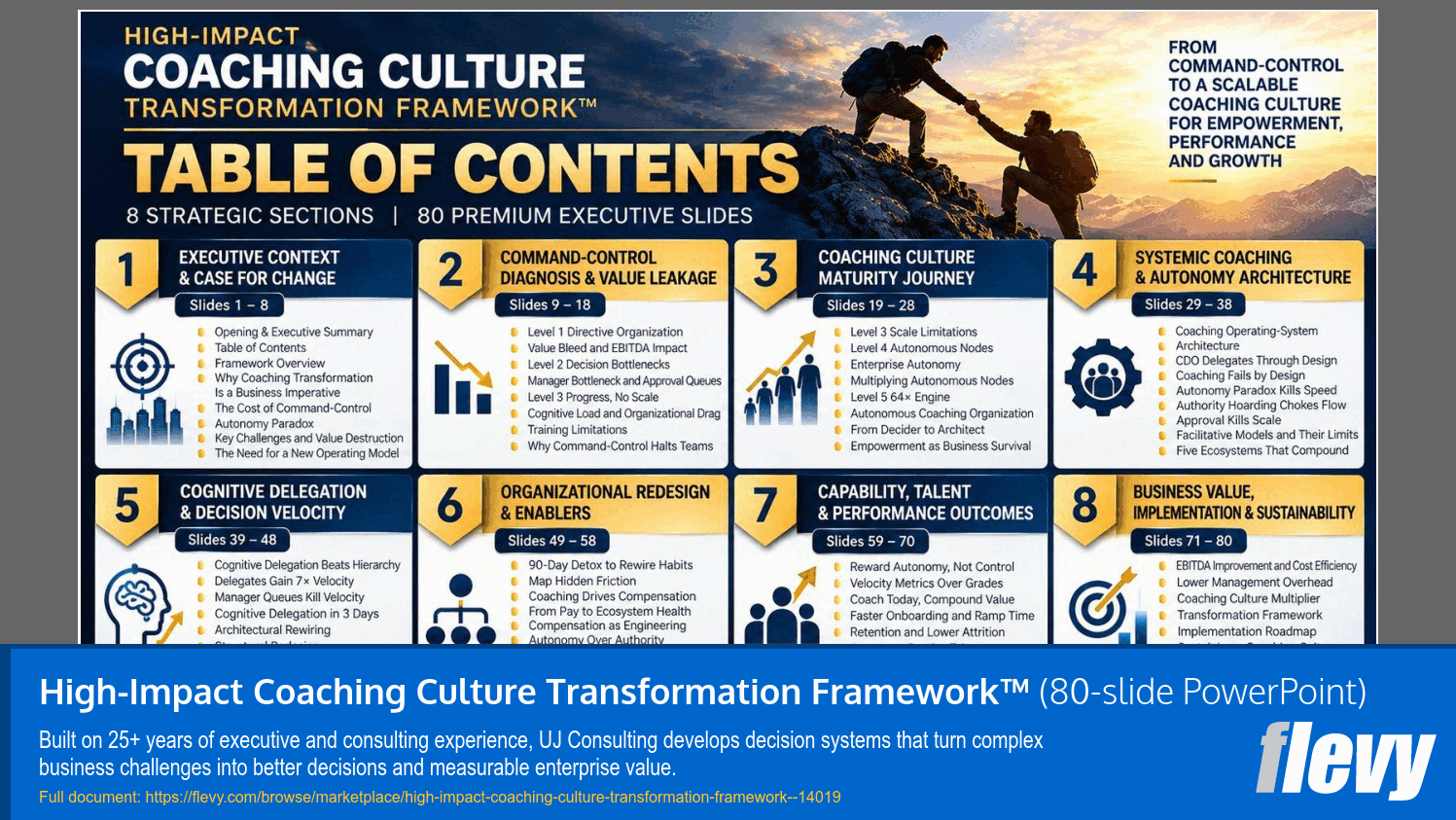
High-Impact Coaching Culture Transformation Framework is an 80-slide premium executive presentation designed to help leaders understand and navigate the shift from command-control toward a scalable coaching culture built around empowerment, distributed capability, and stronger organizational performance.
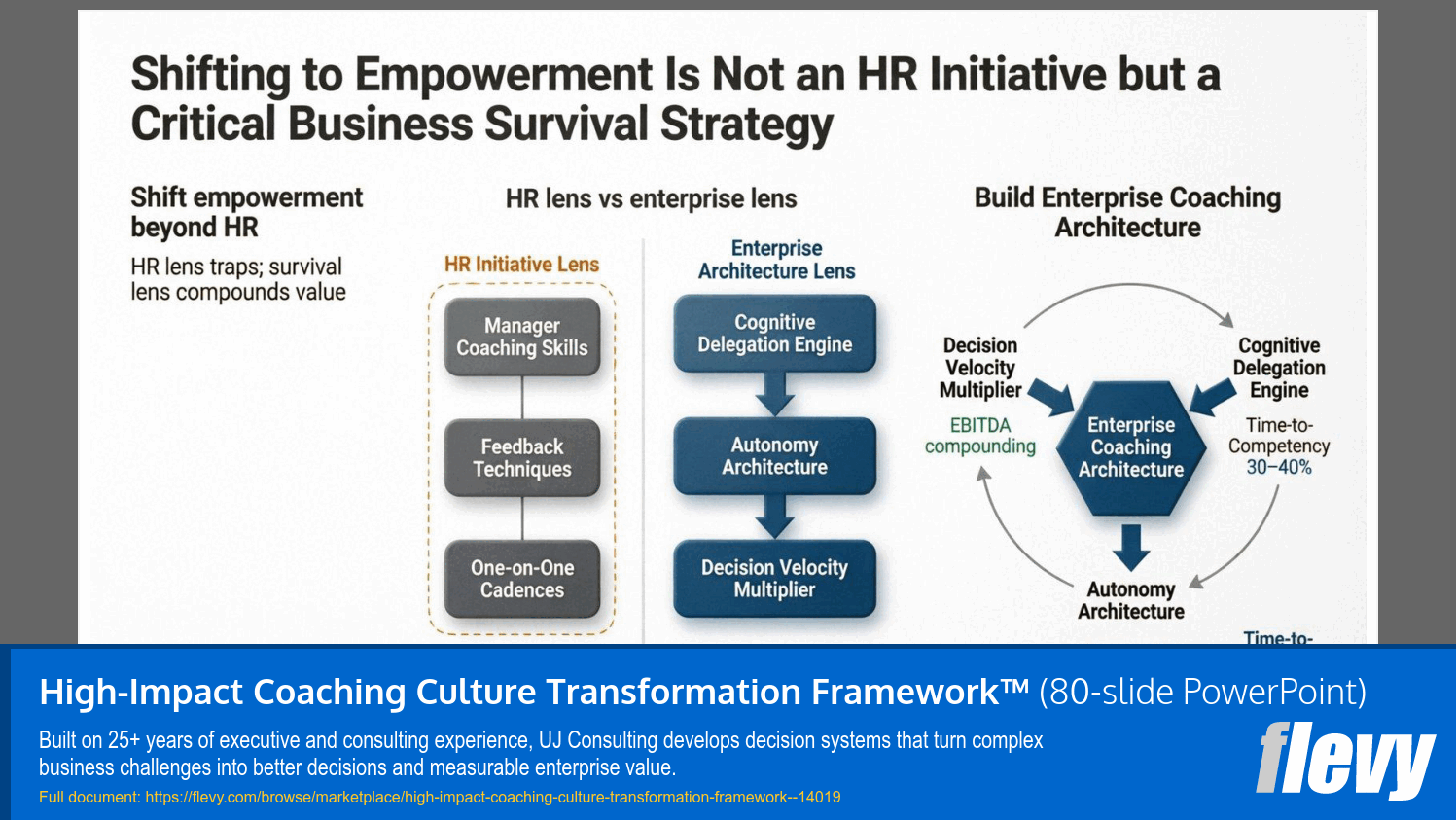
The framework moves beyond viewing coaching as an isolated leadership technique or periodic training intervention. Instead, it presents coaching as part of a broader organizational architecture connecting leadership behavior, cognitive delegation, decision rights, autonomy, capability development, performance, and business value.
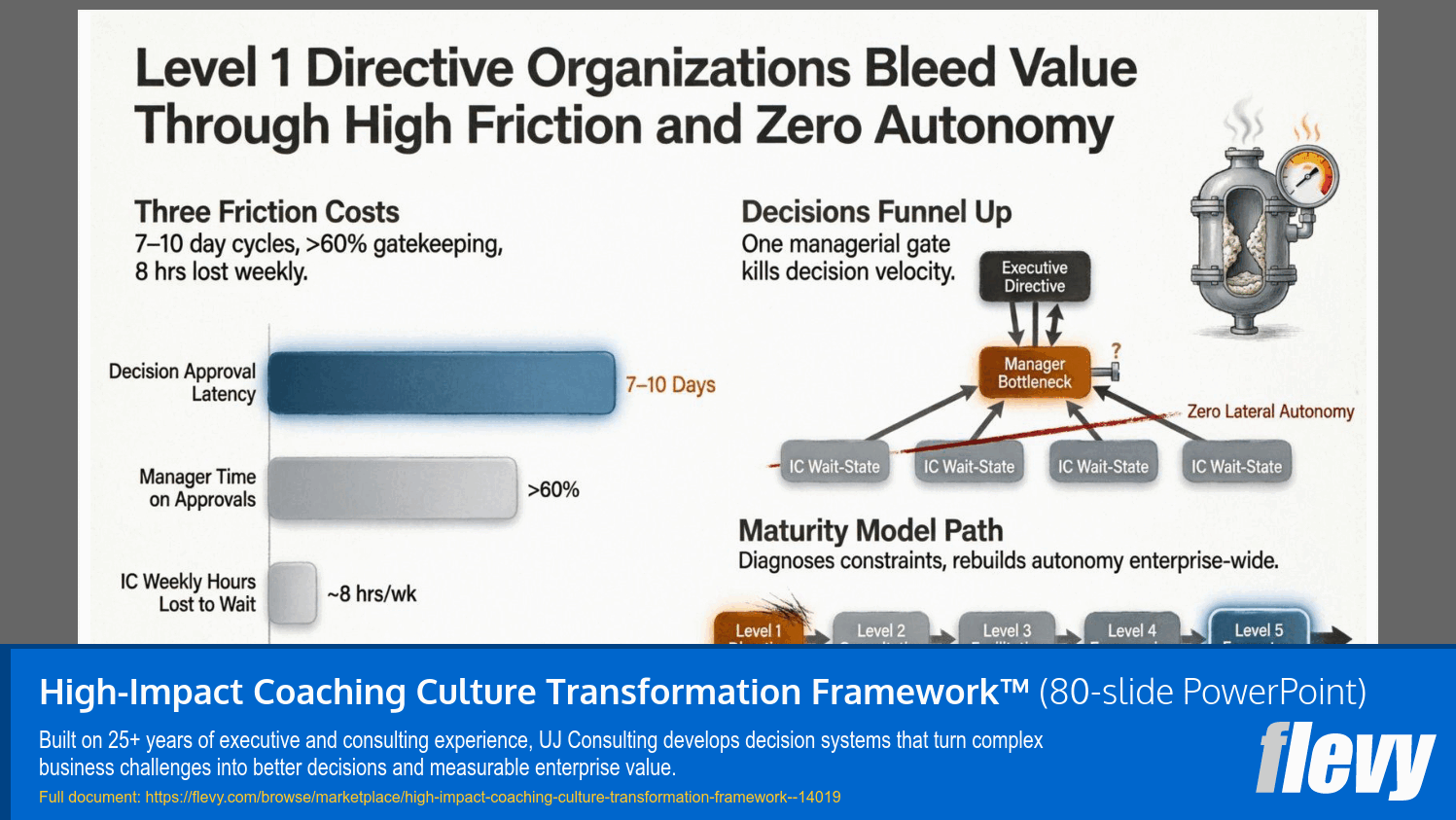
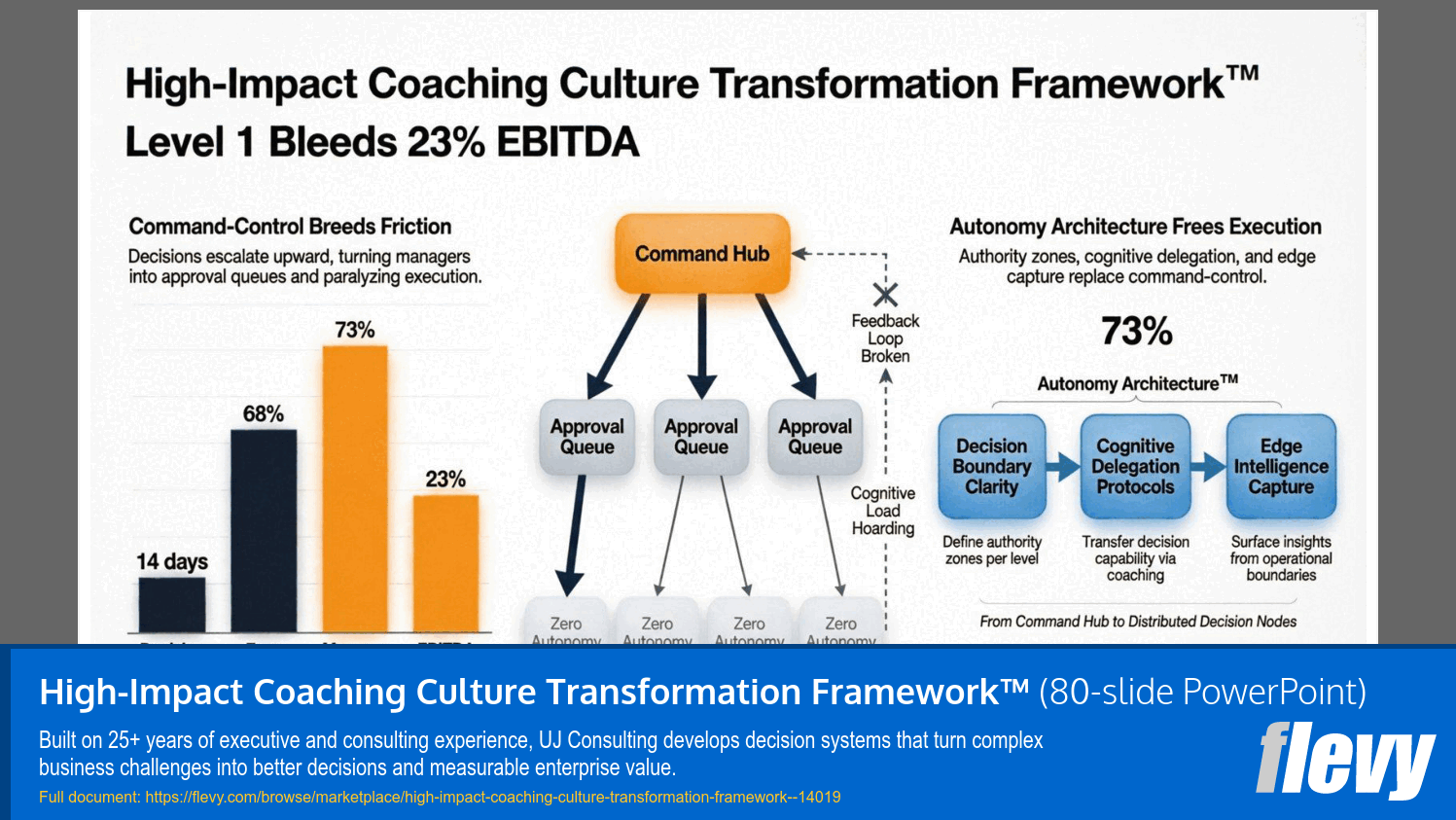
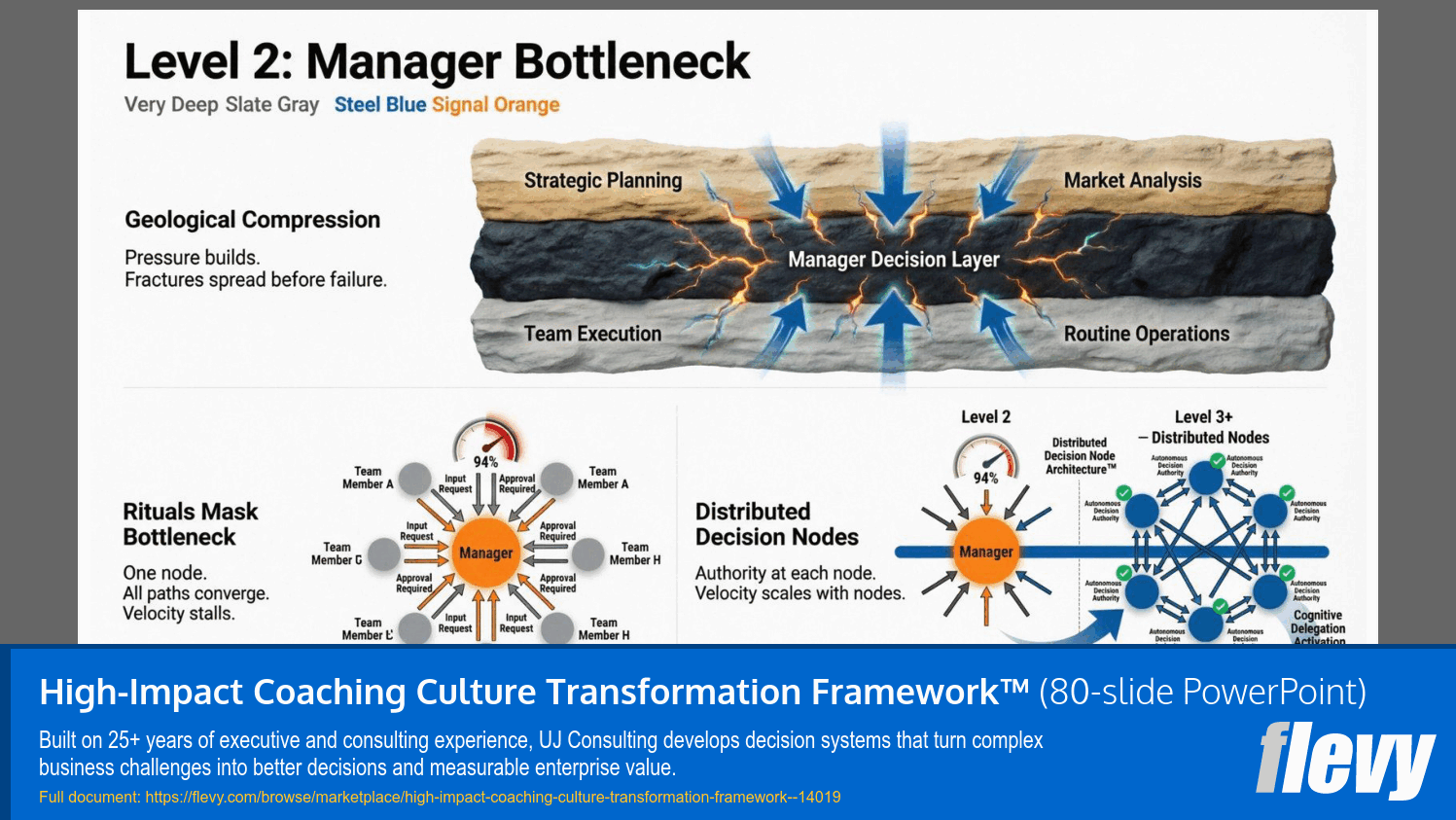
The presentation explores the progression from highly directive organizations toward increasingly autonomous coaching environments. It examines how management dependency, approval queues, cognitive-load concentration, fragmented training, and limited decision authority can constrain organizational velocity—and how systemic coaching architecture can help overcome these barriers.
Executives are introduced to practical concepts including Cognitive Delegation Architecture™, Autonomy Architecture™, Systemic Coaching Architecture, coaching maturity, capability multiplication, distributed decision nodes, and self-propagating coaching ecosystems. These concepts help leaders visualize how organizations can move from manager-centered execution toward systems where people are progressively equipped to think, decide, coach, and perform with greater autonomy.
Importantly, the framework connects coaching transformation with measurable organizational outcomes. The slides explore relationships between coaching architecture and decision velocity, onboarding and time-to-competency, talent retention, management overhead, productivity, EBITDA improvement, and sustainable organizational growth. This business-oriented perspective helps position coaching not simply as an HR initiative, but as a potential driver of operating performance.
The presentation also provides a structured transformation journey—from diagnosing current organizational friction and leadership constraints through architecture redesign, capability development, integration, measurement, and sustained implementation. Visual frameworks, process models, maturity concepts, quantitative illustrations, and executive-level diagrams make complex ideas easier to communicate and discuss.
Designed for CEOs, COOs, CHROs, business leaders, HR and Organizational Development leaders, L&D professionals, transformation executives, team leaders, and consultants, this presentation can support executive discussions, leadership workshops, transformation planning, organizational diagnostics, and capability-building initiatives.
High-Impact Coaching Culture Transformation Framework™provides leaders with a structured perspective for developing leaders who coach, teams that grow, decisions that move faster, and organizational capabilities that multiply.
Move beyond command-control. Build an organization where coaching becomes a scalable capability for empowerment, performance, and growth.
Regards,
UJ Consulting
Strategy – Insight – Impact
Strategy to Money
SEO
High-Impact Coaching Culture Transformation Framework, Coaching Culture, Leadership Coaching, Coaching Culture Transformation, Executive Coaching Framework, Leadership Development, Employee Empowerment, Cognitive Delegation, Autonomy Architecture, Systemic Coaching Architecture, Organizational Development, Coaching Maturity Model, Decision Velocity, Capability Development, Leadership Transformation, Team Coaching, High Performance Culture, CHRO, Organizational Transformation, Employee Autonomy, Talent Retention, Business Performance, EBITDA Improvement, Executive Presentation
Got a question about the product? Email us at support@flevy.com or ask the author directly by using the "Ask the Author a Question" form. If you cannot view the preview above this document description, go here to view the large preview instead.
Source: Best Practices in Human Resources, Coaching PowerPoint Slides: High-Impact Coaching Culture Transformation Framework™ PowerPoint (PPTX) Presentation Slide Deck, UJ Consulting _ Strategy-Insight-Impact
ABOUT THE AUTHOR

UJ Consulting | Strategy • Insight • Impact
UJ Consulting is an executive management consulting and business transformation practice founded by Untung Juanto, ST., MM., a senior executive, consultant, and transformation practitioner with more than 25 years of professional experience across local and multinational companies and diverse industries.
His career progressed from frontline
... [read more]
Ask the Author a Question
You must be logged in to contact the author.