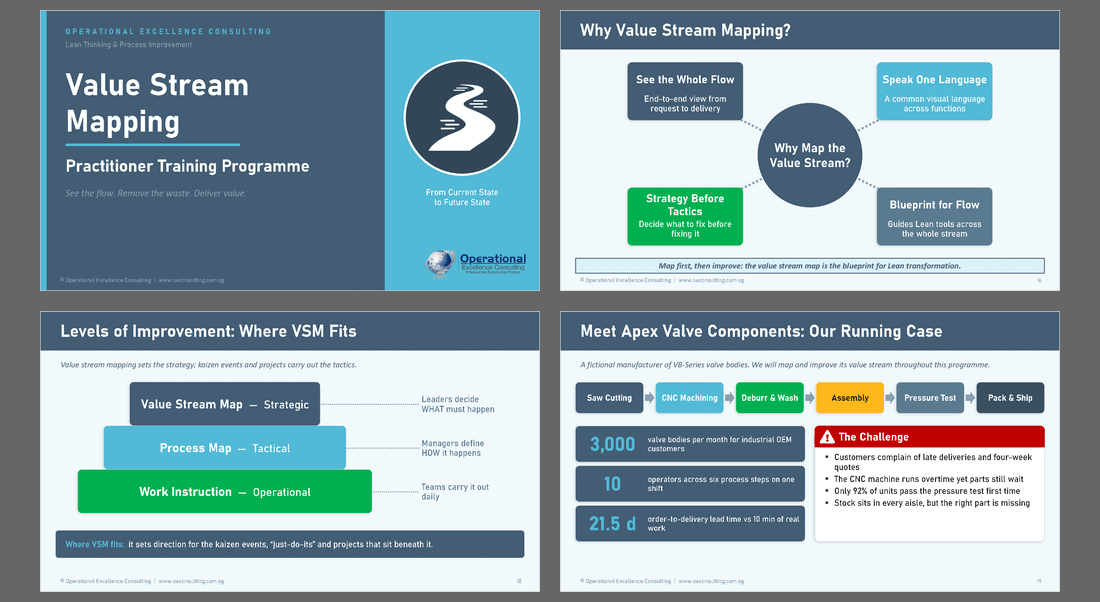
 Click main image to view in full screen. Unlock all 32 preview images:
Value Stream Mapping (VSM) Practitioner Toolkit – PowerPoint PPTX Template
PowerPoint (PPTX) + Zip archive file (ZIP) 168 Slides


BENEFITS OF THIS DOWNLOADABLE POWERPOINT DOCUMENT
- Turnkey 8-Module Curriculum: Deliver structured VSM training using 160+ editable slides, facilitator scripts, and 8 timed team exercises.
- Hands-On Case & Flow Math: Build practical mastery through the Apex Valve Components case study and formulas for Takt time, lead time, WIP, and EPEI.
- Ready-to-Use Project Tools: Move straight into live mapping events with an automated Excel workbook, storyboard deck, and 14 workshop canvases.
VALUE STREAM MAPPING PPT TEMPLATE DESCRIPTION
VALUE STREAM MAPPING (VSM) PRACTITIONER TRAINING COURSE & MASTER PACKAGE
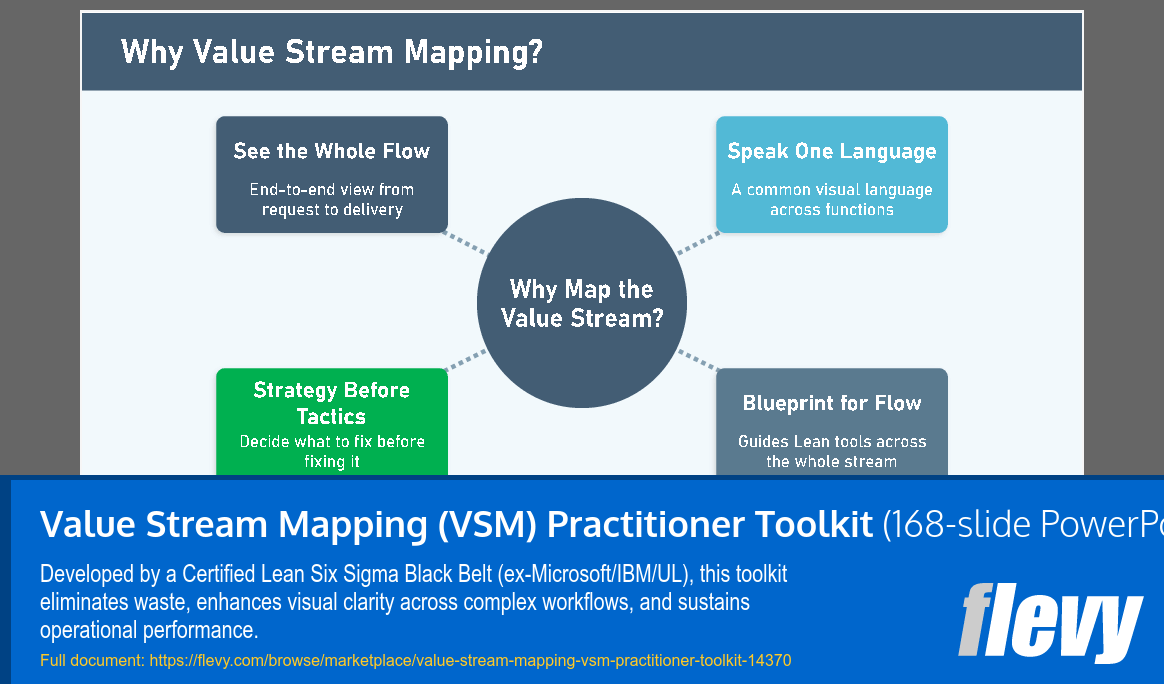
"See the flow. Remove the waste. Deliver value." Most improvement programs stall because teams jump into local fixes before understanding how the full system behaves. Value Stream Mapping (VSM) provides an end-to-end visual blueprint of how materials and information travel from customer order to final delivery. This 8-module practitioner course delivers a structured classroom curriculum to upskill teams, slash lead-time waste, and establish pull-based flow.
EXECUTIVE SUMMARY
The VSM Practitioner Training Course offers a complete, multi-day training curriculum in a modern 16:9 widescreen format. Its 8-module structure guides participants through scoping, Gemba observation, current-state analysis, future-state design, and implementation governance. Using the continuous Apex Valve Components case study, learners calculate Takt time, eliminate the 8 wastes (DOWNTIME), design continuous flow cells, size kanban loops, and build a 90-to-120-day rollout plan.
KEY BENEFITS FOR YOUR ORGANIZATION
★ Linear 8-Module Architecture: Turnkey curriculum designed for corporate academies, 2-day workshops, or modular internal training.
★ Continuous Case Study Learning: Follows one running industrial scenario (Apex Valve Components) across all 8 modules for cumulative practical depth.
★ Turnkey Group Exercises: Features 8 timed team activities (15–30 minutes each) with clear instructions and benchmark outputs.
★ System-Wide Vision: Shifts team focus from isolated departmental efficiency to end-to-end value stream throughput.
TARGET AUDIENCE: WHO IS IT FOR?
• Corporate Lean Trainers & Educators: Needing a complete, ready-to-teach deck with structured exercises and module takeaways.
• Lean Champions & OpEx Directors: Preparing cross-functional teams before launching major VSM initiatives.
• External Management Consultants: Seeking an executive-grade 16:9 presentation package for client workshops.
• Plant Managers & Operations Leaders: Upskilling supervisors and engineers in value stream flow, Takt time, and pull systems.
WHAT'S INCLUDED IN THE BOX?
★ Master Presentation & Training Curriculum (.pptx):
• 168-Slide Widescreen Master Deck (16:9): Full 8-module practitioner curriculum with clean visuals, module dividers, takeaways, and reflection prompts.
★ Instructor & Facilitation Manuals (.docx & .pdf):
• Facilitator's Guide (.docx): Slide-by-slide teaching scripts, lecture notes, and pacing guides for smooth delivery.
• Team Exercise Facilitation Notes (.docx): Coaching cues, timing breakdowns, and worked solutions for all 8 team activities.
• Facilitator Metric Cheat Sheet (.pdf): Print-ready 1-page reference covering key formulas, baseline targets, and common calculation traps.
★ Turnkey Templates & Project Toolkits (.pptx & .xlsx):
• Standalone VSM Project Storyboard Deck (.pptx): Ready-to-use template for project leads to document and pitch live mapping events to sponsors.
• VSM Data & Calculation Workbook (.xlsx): Automated Excel workbook with tabs for Takt time, capacity analysis, Little's Law, lead-time bridges, and action plans.
• 14 Workshop Canvases & Forms (.pptx): Editable templates including the VSM Charter, Product Family Matrix, Current/Future Canvases, A3 Sheet, Gemba Checklist, and Scorecard.
★ Experiential Learning & Reference Materials:
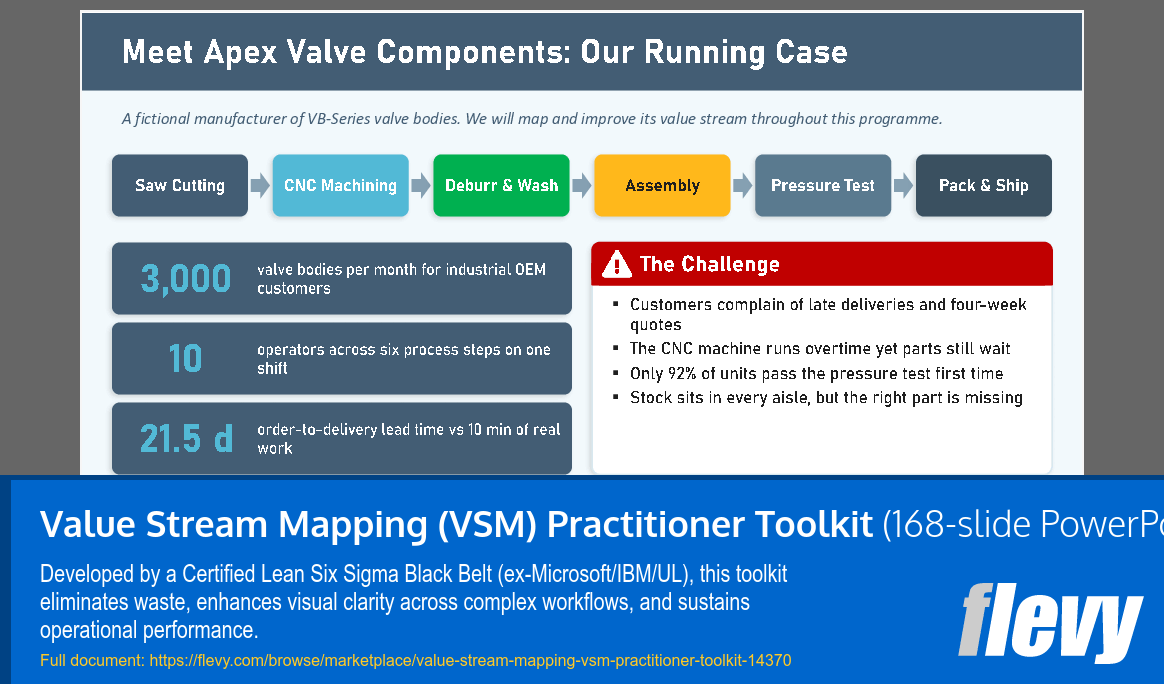
• Apex Valve Components Industrial Case Study: Realistic operational dataset (6 process steps, 21.5-day lead time) running across all modules.
• 8 Timed Team Exercises & Calculation Framework: Group activities (15–30 min) backed by formulas for Takt Time, Cycle Time, Lead Time, % Activity, RFPY, and EPEI.
LEARNING OBJECTIVES
By the end of this training programme, participants will be able to:
• Understand Lean Foundations: Explain Lean principles, value definition, the 8 wastes, and why a whole-stream view surpasses local fixes.
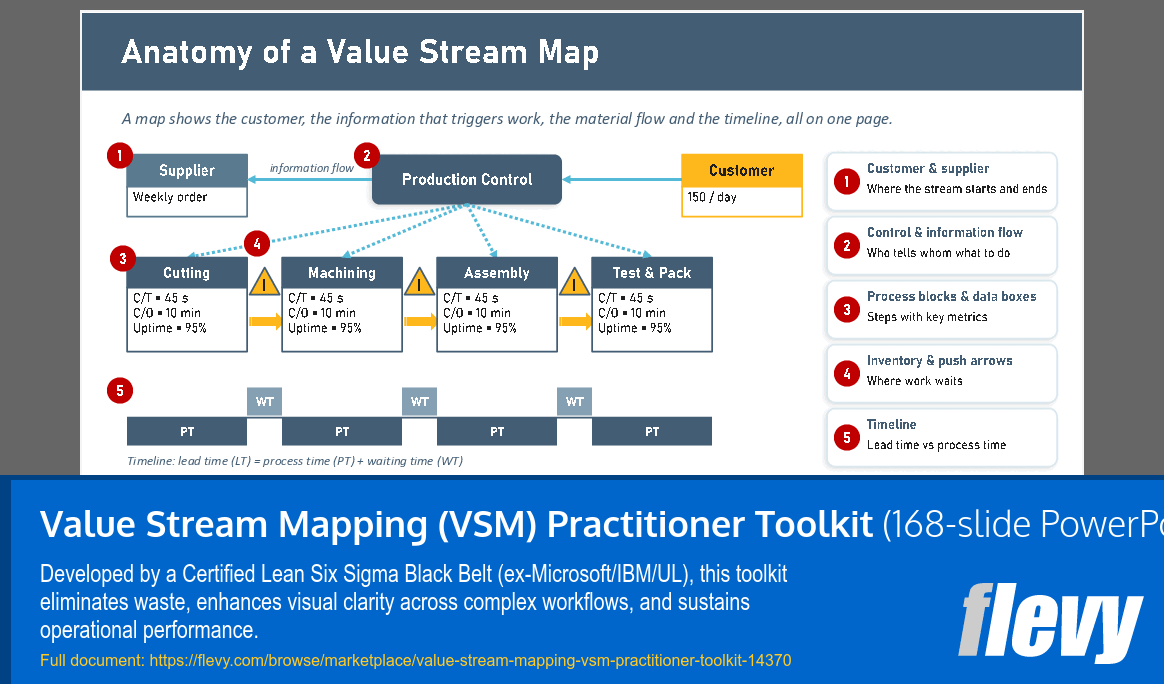
• Read & Draw Value Stream Maps: Read and draw current and future state maps using standard symbols, data boxes, and timeline metrics.
• Lead the 4-Phase VSM Process: Lead teams through scoping charters, current-state documentation, future-state design, and implementation planning.
• Deliver Sustainable Results: Connect maps to Lean tools (TPM, SMED, Kanban, Poka-Yoke), build prioritized plans, and sustain governance with executive support.
DETAILED TRAINING CONTENTS
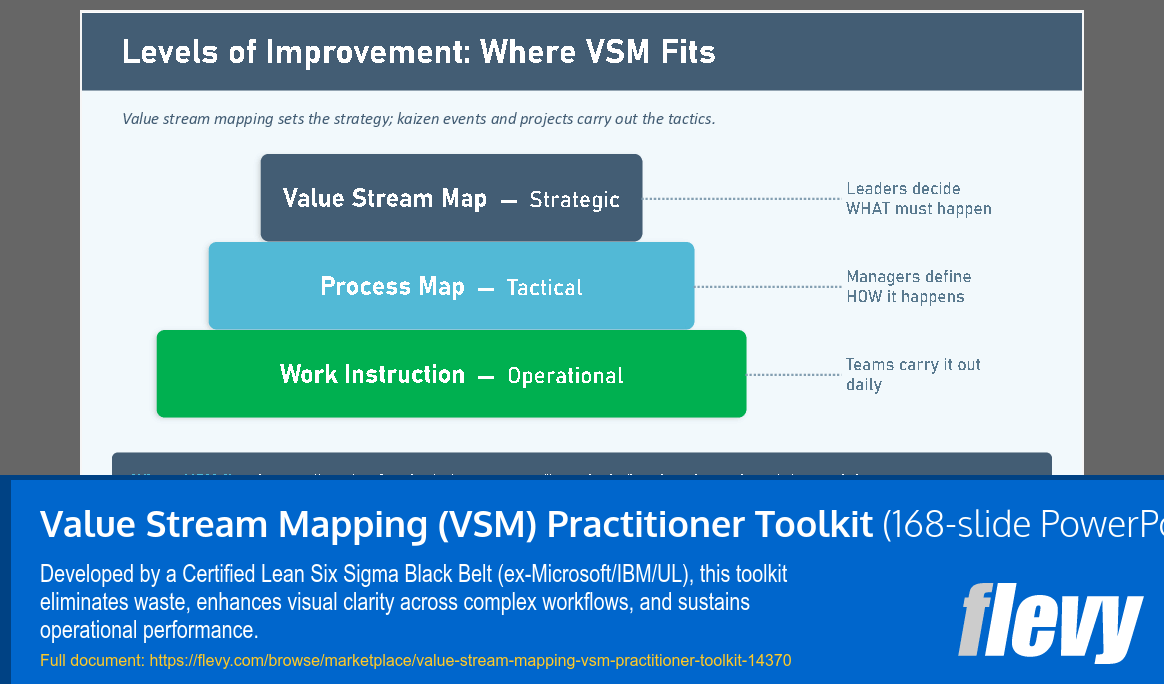
• Module 1: Lean Foundations & the Case for VSM: Covers Lean principles, customer value, and the 8 wastes (DOWNTIME), showing why end-to-end flow beats local optimization.
• Module 2: VSM Fundamentals & Framework: Introduces standard mapping icons, core time/quality metrics, and the 4-Phase VSM deployment model.
• Module 3 – Phase 1: Define Scope, Team & Charter: Teaches problem scoping, product family grouping by shared routing, and drafting a one-page VSM Charter.
• Module 4 – Phase 2: Map the Current State: Walks through an 8-step Gemba mapping process capturing material flow, information signals, inventory queues, and timeline ladders.
• Module 5 – Phase 2: Analyse the Current State: Compares cycle times against Takt time, pinpoints bottlenecks, applies Little's Law, and places evidence-based Kaizen bursts.
• Module 6 – Phase 3: Design the Future State: Applies Rother & Shook's 8 Future-State Design Questions to build flow cells, pull supermarkets, pacemaker control, and leveled mix.
• Module 7: Lean Toolbox & Implementation Plan: Links Lean tools (TPM, SMED, 5S, Poka-Yoke) to Kaizen bursts and sequences projects into a 9-month, 3-wave roadmap.
• Module 8: Best Practices, Pitfalls & Leadership: Addresses common mapping traps, leader Gemba habits, review cadences, and the VSM maturity ladder.
PROPOSED WORKSHOP & COURSE SCHEDULE
• Module 1 (Day 1, 08:30 – 09:45): Lean Foundations & the Case for VSM (Team Exercise 1: Spot the 8 Wastes).
• Module 2 (Day 1, 10:00 – 11:15): VSM Fundamentals & Framework (Team Exercise 2: Sketch Your Own Stream).
• Module 3 (Day 1, 11:15 – 12:30): Phase 1 – Define Scope, Team & Charter (Team Exercise 3: Draft a Mini Charter).
• Module 4 (Day 1, 13:30 – 15:00): Phase 2 – Map the Current State (Team Exercise 4: Map a Process on One Wall).
• Module 5 (Day 1, 15:15 – 16:30): Phase 2 – Analyse the Current State (Team Exercise 5: Find the Waste on Your Map).
• Module 6 (Day 2, 08:30 – 10:30): Phase 3 – Design the Future State (Team Exercise 6: Design Your Future State).
• Module 7 (Day 2, 10:45 – 12:30): Lean Toolbox & Implementation Plan (Team Exercise 7: Plan and Pitch Your Implementation).
• Module 8 (Day 2, 13:30 – 15:30): Best Practices, Pitfalls & Leadership (Team Exercise 8: Plan a Leadership Gemba Walk).
GLOSSARY OF KEY TERMS
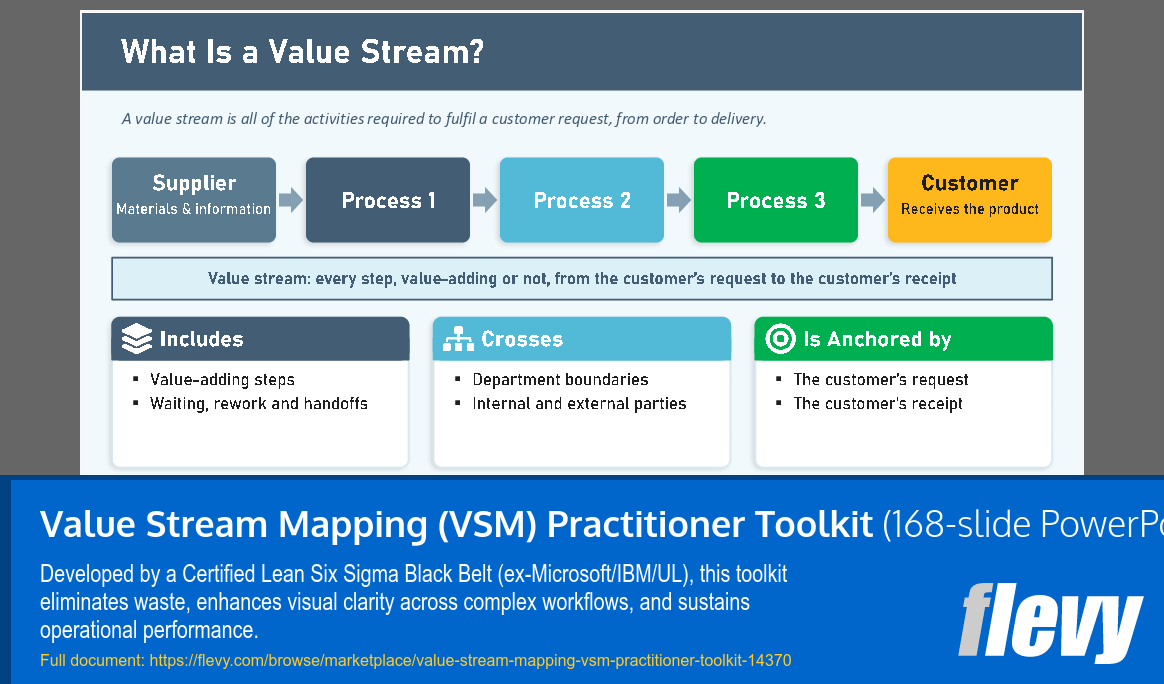
• Value Stream Mapping (VSM): A Lean visual tool used to map and improve all material and information flows required to deliver a product or service from order to customer.
• Takt Time: The required pace of production or delivery, calculated by dividing net available working time by customer demand volume.
• Lead Time (LT) vs. Cycle Time (CT): Lead time is total elapsed time from request to delivery; cycle time is actual uninterrupted touch time spent working on one unit.
• Rolled First-Pass Yield (RFPY): The cumulative percentage of units passing through every value stream step cleanly without defects, scrap, or rework.
• Pacemaker Process: The single process step scheduled directly to customer demand, setting the tempo for upstream pull loops and downstream flow cells.
• Every Part Every Interval (EPEI): A measure of how often each product variant can run in a cell based on changeover times and available capacity.
• Poka-Yoke & Quality at Source: Built-in mistake-proofing devices and source inspections that stop defects from advancing downstream.
• Little's Law: The queuing principle showing that average lead time equals work-in-process (WIP) divided by average completion rate.
FREQUENTLY ASKED QUESTIONS (FAQ)
How does this Practitioner Training Course differ from the VSM Implementation Toolkit?
This Practitioner Course is an 8-module classroom curriculum in 16:9 widescreen built around one continuous manufacturing case study (Apex Valve Components) with 8 group exercises. The Implementation Toolkit is a 4-phase facilitation deck in 4:3 designed for consultants running live mapping events across healthcare, purchasing, and manufacturing.
Is this presentation deck optimized for virtual training and modern displays?
Yes. All 168 slides use a 16:9 widescreen format suited for boardroom screens, Zoom/Teams sessions, and corporate learning management systems.
What case study is used during the training?
Learners work through Apex Valve Components, a valve body manufacturer with real metrics (3,000 units/month, 21.5-day lead time vs. 10 minutes of touch time) to design a Future State.
Does the presentation deck include group activities and takeaways?
Yes. Each of the 8 modules ends with a timed team exercise (15 to 30 minutes) and 4 concise summary takeaways.
Are all PowerPoint slides fully customizable?
Yes. All slides, icons, data boxes, diagrams, and text blocks are 100% editable in Microsoft PowerPoint (.pptx).
What mathematical metrics are covered in the training?
The course covers exact formulas for Takt Time, Cycle Time, Lead Time, Activity Ratio, Rolled First-Pass Yield (RFPY), Little's Law, and EPEI changeover sizing.
What corporate license terms apply to this purchase?
Your purchase includes a single-location corporate license permitting customization, intranet hosting, and internal training across one organizational site.
Can this course architecture be adapted for service or office environments?
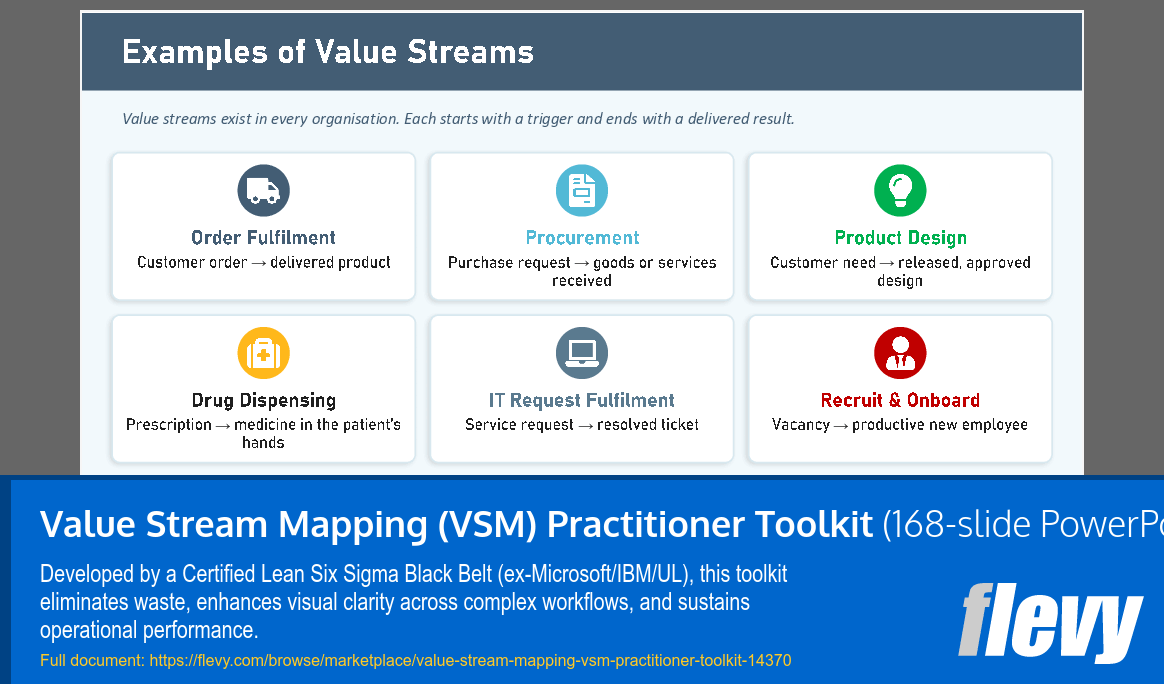
Yes. While the primary case study is industrial, every module features service and administrative mapping examples, including purchase order processing and outpatient clinic flows.
Got a question about the product? Email us at support@flevy.com or ask the author directly by using the "Ask the Author a Question" form. If you cannot view the preview above this document description, go here to view the large preview instead.
Source: Best Practices in Value Stream Mapping PowerPoint Slides: Value Stream Mapping (VSM) Practitioner Toolkit PowerPoint (PPTX) Presentation Slide Deck, Operational Excellence Consulting
ABOUT THE AUTHOR

Operational Excellence Consulting, founded in 2009 by Allan Ung, draws from extensive experience at Microsoft, IBM, and Underwriters Laboratories (UL). We specialize in strategy deployment, customer experience design, and operational excellence, applying Design Thinking, Lean, and Systems Thinking to maximize customer value and minimize waste.
Our
... [read more]
Ask the Author a Question
You must be logged in to contact the author.