
 Click main image to view in full screen. Unlock all 32 preview images:
Flow Engineering: From VSM to Effective Action – PowerPoint PPTX Template
PowerPoint (PPTX) 163 Slides


BENEFITS OF THIS DOWNLOADABLE POWERPOINT DOCUMENT
- Start today, not next quarter -- no prerequisite Lean certification, no need for perfect data.
- Find the bottleneck you can't currently see -- Dependency Mapping surfaces cross-team friction other methods miss entirely.
- Leave with owned actions, not just insights -- every workshop ends with a time-boxed roadmap and named accountability.
VALUE STREAM MAPPING PPT TEMPLATE DESCRIPTION
FLOW ENGINEERING: TRAINING PRESENTATION & PRACTITIONER TOOLKIT
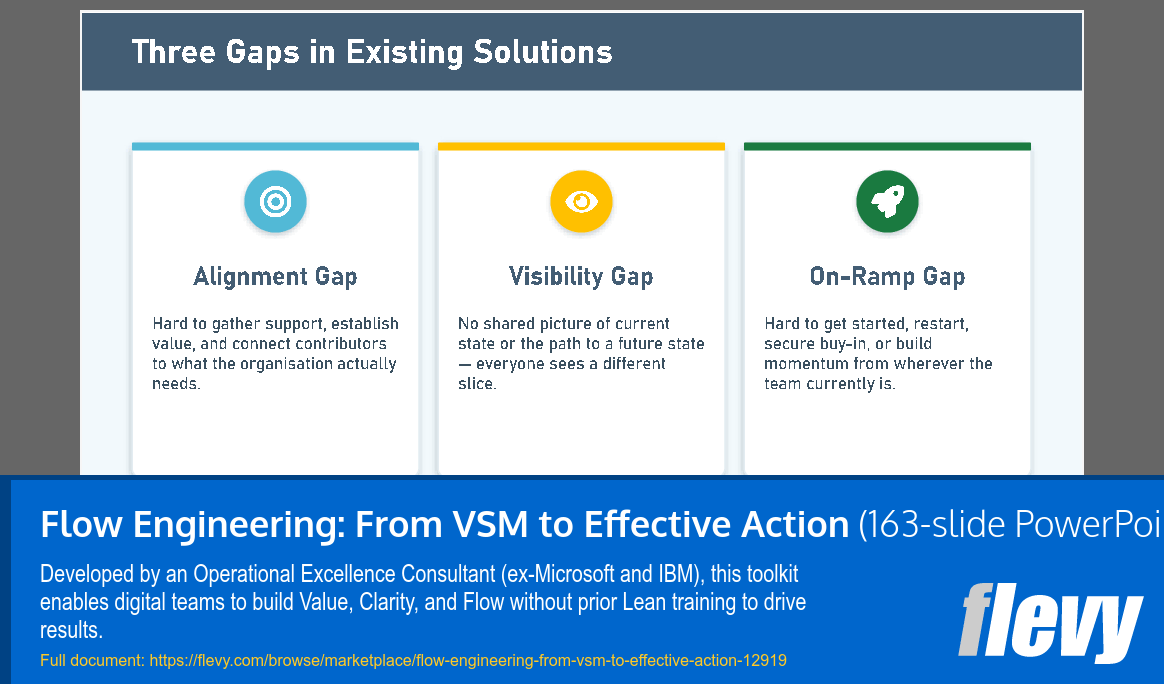
If your organization keeps "admiring the problem" instead of fixing it, the issue usually isn't ambition – it's the absence of an accessible starting point. Most digital and service teams write off classic Value Stream Mapping as a manufacturing-only discipline, too rigid and too symbol-heavy for knowledge work. Flow Engineering closes that on-ramp gap. It's a modern, facilitator-friendly method that takes a team from confusion to a prioritized, owned set of actions in a single working session – not weeks of analysis. Built for IT, digital, and service environments, it converts the tangled, invisible dependencies behind slow delivery into a clear, sequenced path toward flow.
EXECUTIVE SUMMARY
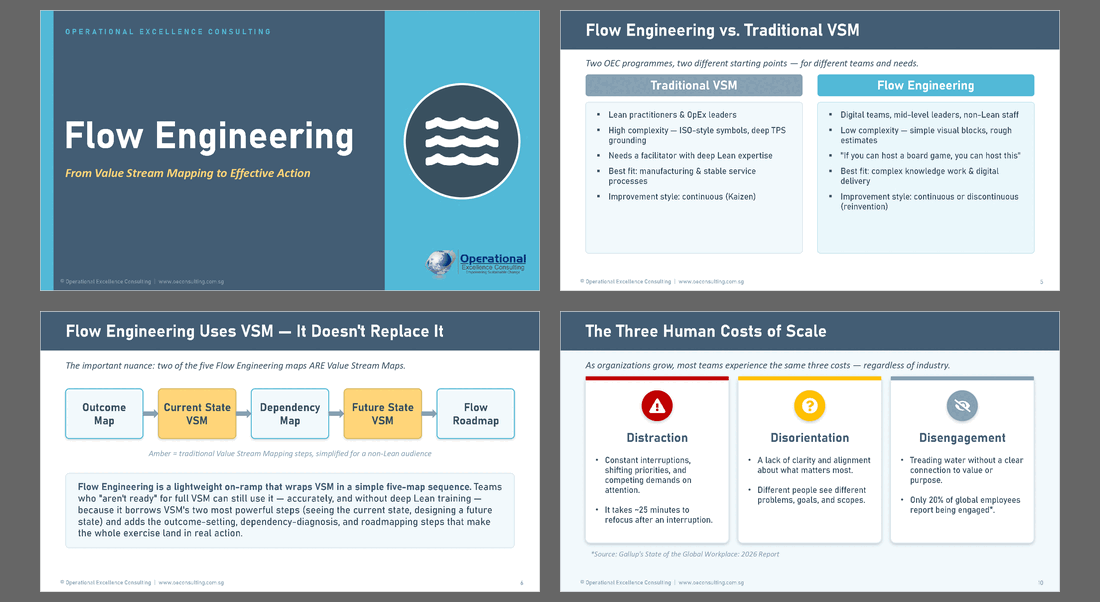
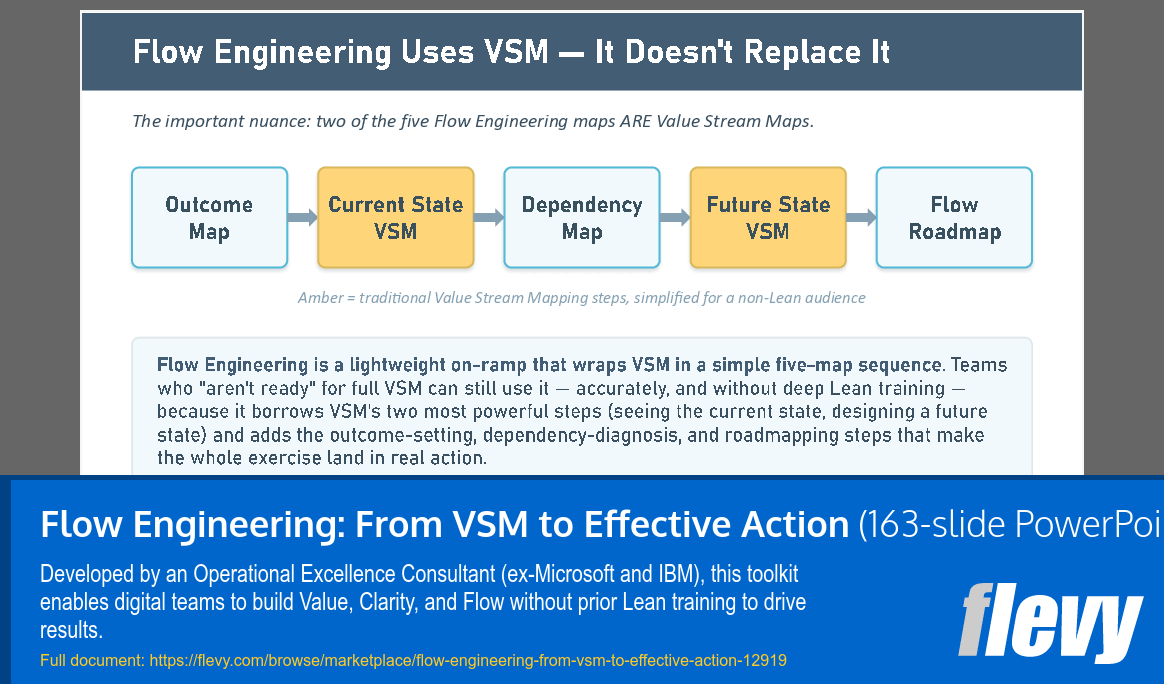
Flow Engineering runs on a five-map sequence – Outcome, Current State, Dependency, Future State, and Flow Roadmap – engineered to protect three things: Value, Clarity, and Flow. Instead of the formal ISO-style notation used in traditional process mapping, it works with plain, easy-to-read visual blocks that any cross-functional group can pick up in minutes. It isn't a substitute for Value Stream Mapping – it's a delivery wrapper around it, built specifically to make sure every insight a team surfaces gets converted into a time-boxed, owned commitment rather than a forgotten workshop artifact.
KEY BENEFITS
★ Bridges the readiness gap – Teams can begin today, without months of prior Lean certification or a perfect data set in hand.
★ Exposes hidden bottlenecks – Dependency Mapping pulls cross-team blockers into view that standard process diagrams routinely miss.
★ Protects psychological safety – Outcome Discovery reframes what can feel like a group therapy session into a set of concrete, agreed strategic targets.
★ Converts talk into ownership – A "Now, Next, Later" Flow Roadmap assigns single-threaded accountability to every action item that comes out of the workshop.
The framework is grounded in the methodology developed by Steve Pereira and Andrew Davis, and is tuned toward what they call the "Cybercorp" ambition: shrinking the distance between people and the technology they depend on.
TARGET AUDIENCE
• IT and DevOps leaders looking to unclog delivery pipelines and make technical debt visible rather than assumed.
• Service and back-office managers trying to bring structure to "invisible" workflows – procurement, HR, legal, and similar knowledge-work processes.
• Agile coaches and Scrum Masters who want a lighter-weight complement to heavyweight frameworks for retrospectives and PI planning.
• Mid-level leaders in matrixed organizations expected to deliver more with fewer resources across siloed teams.
WHAT'S INSIDE THE PACKAGE
★ A 160+ slides master deck – modern, digitally-native visuals with a modular, teachable flow suited to both live workshops and self-study.
★ The complete five-map template set – ready-to-use layouts for the Outcome Map, Simplified Current/Future State VSMs, Dependency Map, and Flow Roadmap.
★ A facilitator's field guide – practical rules of engagement covering session time-boxing and group-size limits (capped at roughly 12 participants for quality of discussion).
★ A library of applied case examples – including a $20M investment redirect and a "Parchment" case study tracing the shift from metric scrutiny to genuine flow.
LEARNING OBJECTIVES
• Explain the three pillars of effective action – Value, Clarity, and Flow – and why organizational scale erodes all three.
• Run an Outcome Mapping session that aligns stakeholders on the "Why" before anyone jumps to solutioning.
• Pinpoint the single rate-limiting constraint in a workflow using simplified notation and directional timing data.
• Sketch a Future State that adapts the classic DOWNTIME waste categories for knowledge-work contexts.
DETAILED TRAINING CONTENTS
• Module 1 – The Flow Landscape: How scale quietly breaks well-intentioned teams; the Iron Triangle of constraints; an introduction to cybernetic feedback loops.
• Module 2 – Outcome & Current State Mapping: Stage-by-stage discovery board mechanics; the 5 Rs for choosing which value stream to map; distinguishing cycle time from wait time.
• Module 3 – Diagnose & Design: Tracing dependencies with a 5 Whys approach; designing the Future State; applying the Improvement Kata.
• Module 4 – Navigating and Sustaining Flow: Leading change from within the system; telling governing constraints apart from enabling ones; the Flow Flywheel concept.
• Module 5 – Appendix & Templates: Blank, ready-to-print canvases for all five maps, a glossary, and planning reference sheets.
PROPOSED 1-DAY WORKSHOP AGENDA
• 09:00–10:30 – Outcome Discovery & Alignment: defining the target value.
• 10:45–12:30 – Current State VSM: mapping sequence and timing as they actually happen.
• 13:30–15:00 – Dependency & Root Cause Analysis: tracing the friction points.
• 15:15–16:30 – Future State Design & Flow Roadmap: sequencing the owned next steps.
• 16:30–17:00 – The Flow Flywheel: locking in momentum and planning the scale-up.
GLOSSARY OF KEY TERMS
• Value: What the team and stakeholders agree is worth pursuing – the reason the work exists in the first place.
• Clarity: How well a team's mental model of the situation actually matches what's happening on the ground.
• Flow: Steady, unobstructed progress toward value – smooth handoffs, no thrashing, no stop-start rework.
• Constraint: The one step in the value stream that limits how much total throughput the system can produce.
• Wait Time: The stretch of time a task sits idle in a queue, not actively being worked.
• Lead Time: The full elapsed time from initial request to final delivery, start to finish.
• %C&A (Percent Complete & Accurate): The share of work that moves forward through a stage without needing rework or clarification.
• Improvement Kata: A repeatable Plan-Do-Study-Act cycle that turns continuous improvement into a team habit rather than a one-off event.
FREQUENTLY ASKED QUESTIONS (FAQs)
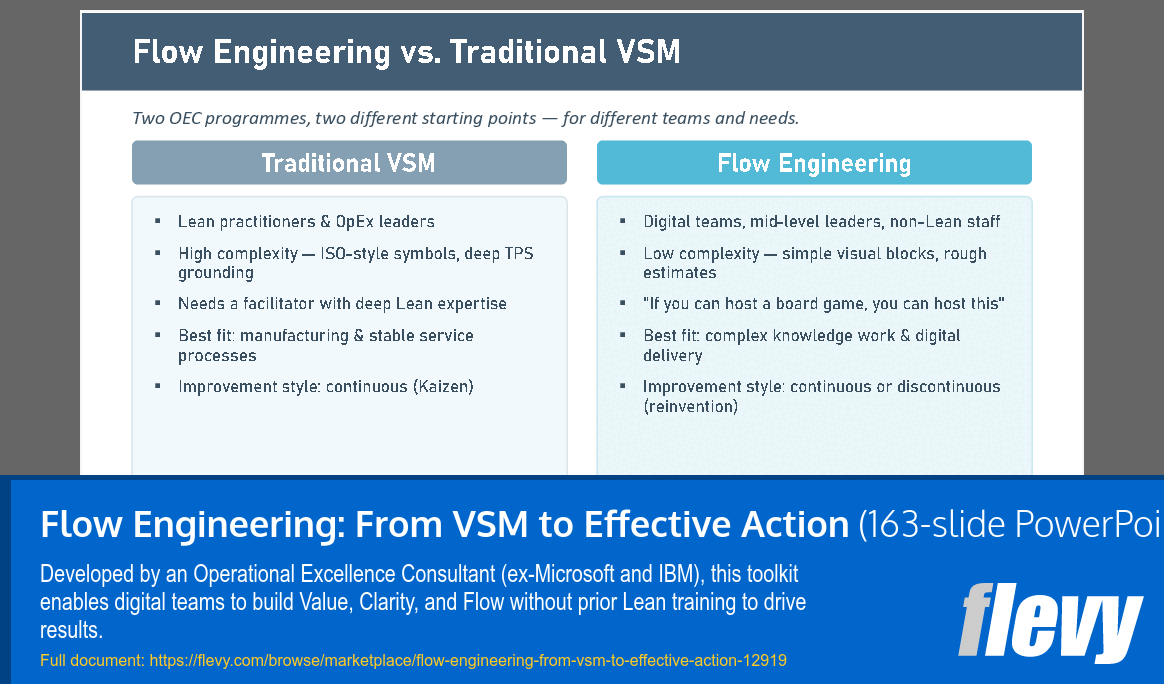
How does Flow Engineering differ from conventional VSM? It trades specialized ISO symbols for plain-language labels and adds an Outcome Map step up front, so stakeholders align on goals before mapping ever starts.
Do we need clean data before we begin? No. The method is built around the 80/20 rule – rough, directional estimates from the group are enough to identify the primary constraint and start moving.
Will this work for a remote or hybrid team? Yes – the visual-block notation was designed with digital whiteboards and collaboration tools in mind, so distributed teams can run the same sessions as co-located ones.
What exactly is the "on-ramp gap"? It's the hesitation teams feel when they don't believe they're "ready" for formal Lean practice. This toolkit gives them a low-friction starting point that builds real momentum within hours.
How long does the full five-map sequence take? An experienced facilitator can run it in about six hours. Teams doing it for the first time typically spread nine to ten hours of work across a few weeks.
Who should be in the room for these sessions? Aim for up to 12 participants – a mix of people who touch the value stream directly and leaders with the authority to actually change the system.
Does this replace traditional Value Stream Mapping? No – two of the five maps are simplified VSM steps. The other three maps exist specifically to make sure those insights turn into real, owned action.
• What are the five maps, exactly? Outcome Map, Current State VSM, Dependency Map, Future State VSM, and Flow Roadmap – run in that order.
Got a question about the product? Email us at support@flevy.com or ask the author directly by using the "Ask the Author a Question" form. If you cannot view the preview above this document description, go here to view the large preview instead.
Source: Best Practices in Value Stream Mapping PowerPoint Slides: Flow Engineering: From VSM to Effective Action PowerPoint (PPTX) Presentation Slide Deck, Operational Excellence Consulting
ABOUT THE AUTHOR

Operational Excellence Consulting, founded in 2009 by Allan Ung, draws from extensive experience at Microsoft, IBM, and Underwriters Laboratories (UL). We specialize in strategy deployment, customer experience design, and operational excellence, applying Design Thinking, Lean, and Systems Thinking to maximize customer value and minimize waste.
Our
... [read more]
Ask the Author a Question
You must be logged in to contact the author.