

 Click main image to view in full screen. Unlock all 24 preview images:
Supplier Risk Management - Implementation Toolkit – Excel XLSX
Excel (XLSX) + Zip archive file (ZIP)


SUPPLIER MANAGEMENT EXCEL DESCRIPTION
Save time, empower your teams and effectively upgrade your processes with access to this practical Supplier Risk Management Toolkit and guide. Address common challenges with best-practice templates, step-by-step work plans and maturity diagnostics for any Supplier Risk Management related project.
Download the Toolkit and in Three Steps you will be guided from idea to implementation results.
The Toolkit contains the following practical and powerful enablers with new and updated Supplier Risk Management specific requirements:
STEP 1: Get your bearings
Start with...
• The latest quick edition of the Supplier Risk Management Self Assessment book in PDF containing 49 requirements to perform a quickscan, get an overview and share with stakeholders.
Organized in a data driven improvement cycle RDMAICS (Recognize, Define, Measure, Analyze, Improve, Control and Sustain), check the?
• Example pre-filled Self-Assessment Excel Dashboard to get familiar with results generation.
Then find your goals...
STEP 2: Set concrete goals, tasks, dates and numbers you can track
Featuring 908 new and updated case-based questions, organized into seven core areas of process design, this Self-Assessment will help you identify areas in which Supplier Risk Management improvements can be made.
Examples (5 of the 908 standard requirements):
• Is management periodically considering advise from external parties (e.g., customers, vendors and others doing business with the entity, external auditors, and regulators) on the functioning of an entitys enterprise Risk Management?
• Is one supplier head and shoulders above the rest in terms of the value it provides; including price, innovation, ability to adapt to changing situations, capacity to work with your team, task joint risks, etc.?
• Do you look for vendors whose solutions are designed to facilitate your IWMS objectives. Do their solutions promote efficiencies, reduce costs, mitigate compliance-related risks and speed time to market?
• Licensing expertise – do you have the licensing expertise for smaller vendors with high audit risk, including product licensing, applying to servers/ clients/network access/virtualized environments?
• Many organizations are unsure who should be in charge of managing third-party risk: in your organization, is it a function of procurement, legal, compliance, risk management or information security?
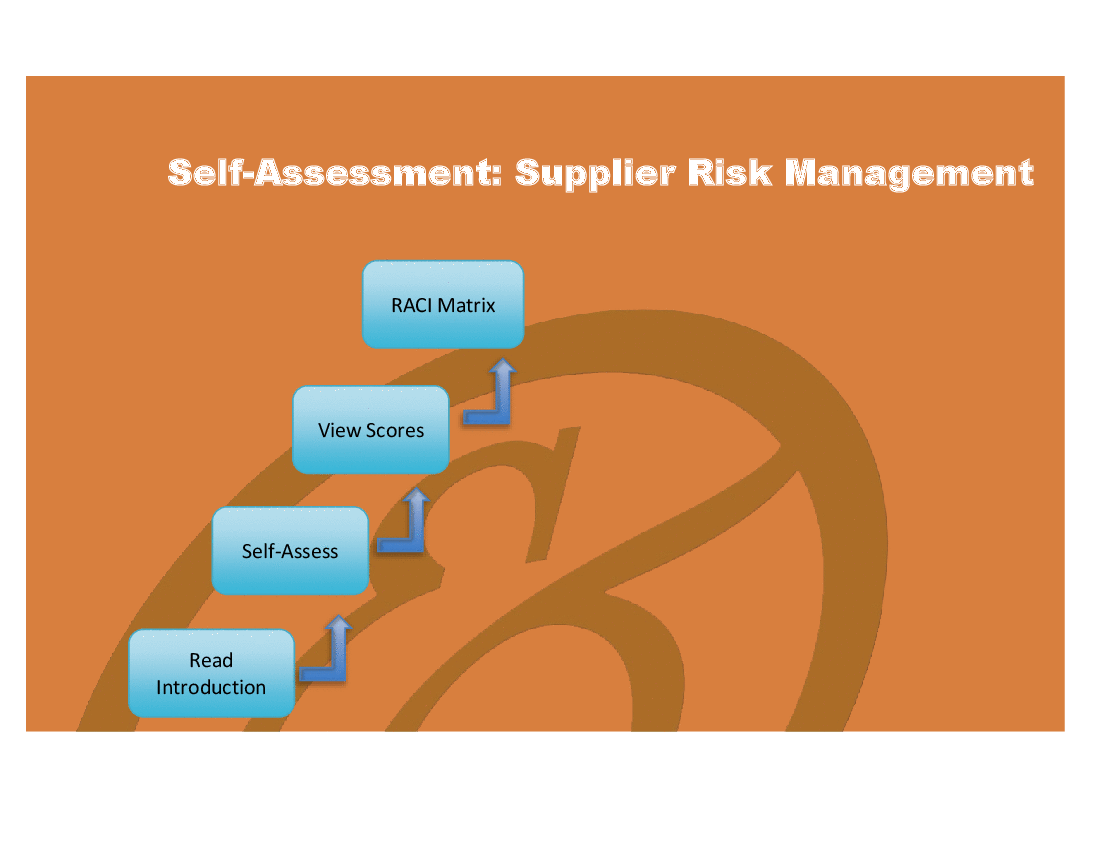
Complete the self assessment, on your own or with a team in a workshop setting. Use the workbook together with the self assessment requirements spreadsheet:
• The workbook is the latest in-depth complete edition of the Supplier Risk Management book in PDF containing 908 requirements, which criteria correspond to the criteria in...
Your Supplier Risk Management self-assessment dashboard which gives you your dynamically prioritized projects-ready tool and shows your organization exactly what to do next:
• The Self-Assessment Excel Dashboard; with the Supplier Risk Management Self-Assessment and Scorecard you will develop a clear picture of which Supplier Risk Management areas need attention, which requirements you should focus on and who will be responsible for them.
STEP 3: Implement, Track, follow up and revise strategy
The outcomes of STEP 2, the self assessment, are the inputs for STEP 3; Start and manage Supplier Risk Management projects with the 62 implementation resources:
• 62 step-by-step Supplier Risk Management Project Management Form Templates covering over 1500 Supplier Risk Management project requirements and success criteria.
Got a question about the product? Email us at support@flevy.com or ask the author directly by using the "Ask the Author a Question" form. If you cannot view the preview above this document description, go here to view the large preview instead.
TOPIC FAQ
What is the RDMAICS improvement cycle used in supplier risk management?
RDMAICS is a data-driven improvement cycle organized as Recognize, Define, Measure, Analyze, Improve, Control and Sustain. It is the organizing principle in the toolkit for sequencing assessment and implementation activities, providing a structured seven-phase approach to supplier risk improvements with defined diagnostic and project follow-up steps.How can I perform a quick supplier risk scan to brief stakeholders?
Begin with a quick-edition PDF self-assessment containing concise requirements to generate an initial view and share with stakeholders. The toolkit pairs this quickscan with a pre-filled Self-Assessment Excel Dashboard to visualize results and get familiar with outcome generation, based on 49 quick-scan requirements.What types of questions should a supplier risk self-assessment include?
Effective self-assessments probe governance, supplier value concentration, vendor solution fit, licensing expertise, and role ownership for third-party risk. The toolkit’s in-depth workbook organizes these into 908 case-based questions to identify gaps across 7 core process areas and prioritize next steps.What features should I look for when choosing a supplier risk management toolkit?
Look for a structured self-assessment, a scorecard/dashboard for prioritization, maturity diagnostics, and implementation templates to manage remediation. The Supplier Risk Management - Implementation Toolkit explicitly provides a Self-Assessment Excel Dashboard and 62 implementation resources to move from assessment to execution.Are template bundles worth the investment for supplier risk projects?
Templates can reduce setup time and ensure consistency by providing ready project forms and success criteria. The Supplier Risk Management - Implementation Toolkit includes 62 Project Management Form Templates that cover over 1,500 Supplier Risk Management project requirements and success criteria.How can I decide which function should own third‑party risk in my organization?
Use a structured self-assessment and scorecard to map responsibilities, capture stakeholder inputs, and highlight governance gaps. The toolkit’s Supplier Risk Management Self-Assessment and Scorecard provide an output that shows which requirements need focus and who should be responsible, surfaced in the Self-Assessment Excel Dashboard.We face licensing audit risk with smaller vendors—how should we address it?
Assess licensing expertise and audit exposure as part of your self-assessment to identify capability gaps and remediation needs. The toolkit includes licensing-related requirements within the 908-question workbook and supports follow-through with 62 Project Management Form Templates to manage actions.How do I move from assessment to implementation in supplier risk management?
Follow a three-step path: (1) Get bearings with the quick-scan PDF and sample dashboard, (2) set concrete goals via the 908-question in-depth self-assessment and scorecard, and (3) execute and track using the 62 implementation resources provided in the toolkit.Source: Best Practices in Supplier Management Excel: Supplier Risk Management - Implementation Toolkit Excel (XLSX) Spreadsheet, Gerard Blokdijk