
The PSL – Six Sigma Green Belt Training series has 8 modules and 258 slides in all as per below:
SSGB1 – Introduction – 30 slides
SSGB2 – Stakeholders -38 slides
SSGB3 – Project Methodology – 31 slides
SSGB4 – Define Phase – 27 slides
SSGB5 – Measure Phase – 46 slides
SSGB6 – Analyze Phase – 34 slides
SSGB7 – Improve Phase – 24 slides
SSGB8 – Control Phase – 26 slides
A few templates are also attached as an Excel spreadsheet.

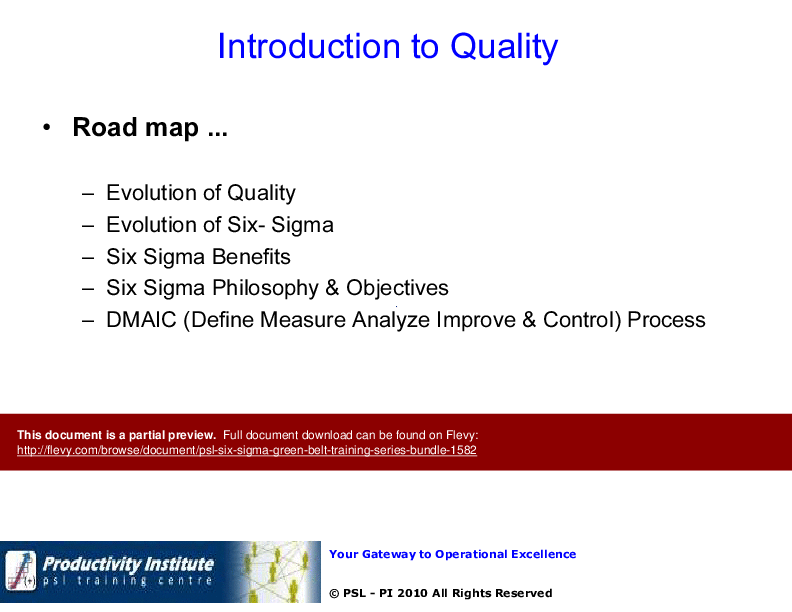
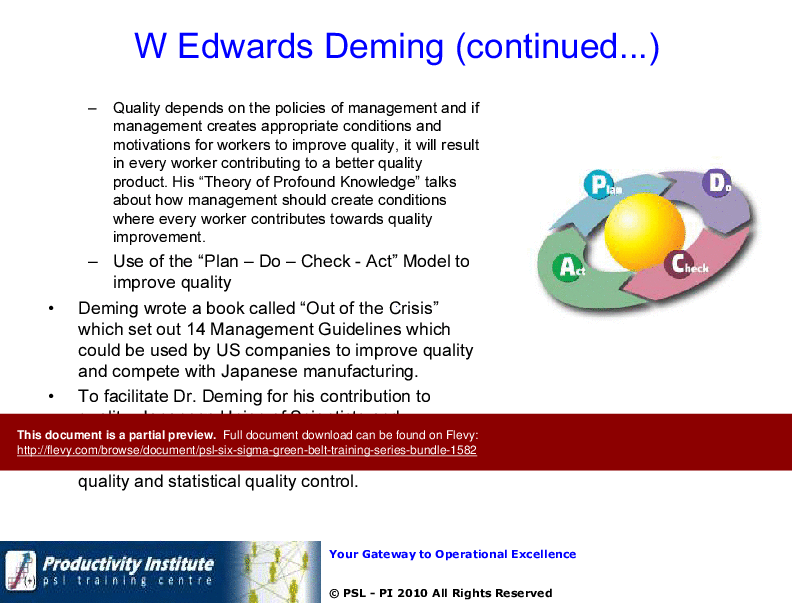
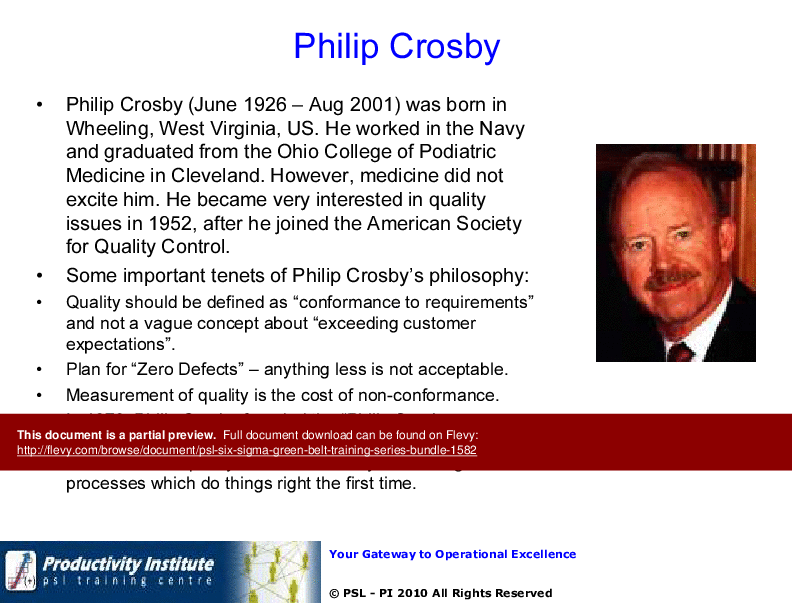
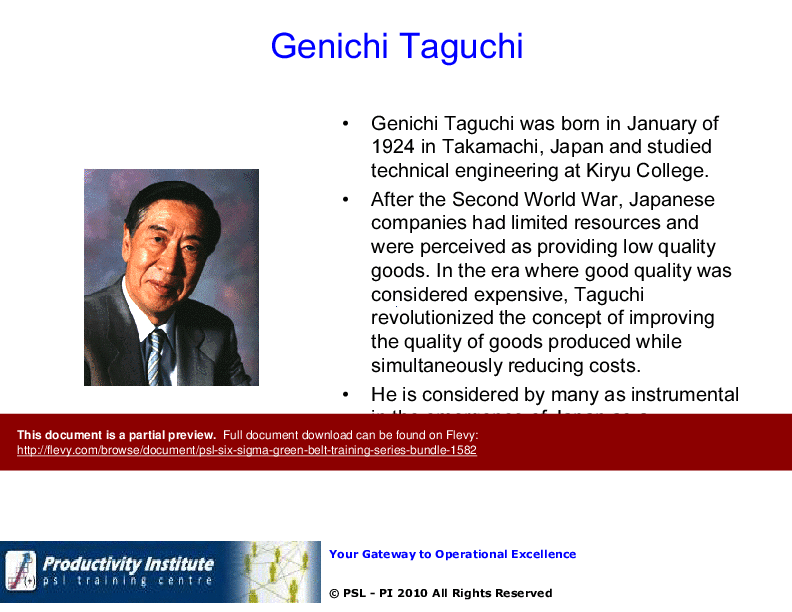
This training series delves into the evolution of quality and Six Sigma, highlighting its benefits and philosophy. The DMAIC process is thoroughly explained, ensuring participants grasp the methodology's core principles. The series also covers the contributions of quality pioneers like W. Edwards Deming, Philip Crosby, and Genichi Taguchi, providing a historical context to the Six Sigma approach.
The training emphasizes the importance of stakeholder identification and engagement in Six Sigma projects. It outlines the roles of project managers, team members, sponsors, customers, and end users. The series also includes practical tools and techniques for data collection and analysis, such as surveys, focus groups, and Quality Function Deployment (QFD).
Participants will gain insights into key performance metrics, including Defects Per Unit (DPU) and Rolled Throughput Yield (RTY). The training also covers financial concepts like Internal Rate of Return (IRR) and opportunity costs, essential for project selection and evaluation. This comprehensive approach ensures that participants are well-equipped to drive quality improvements and achieve operational excellence.
Got a question about the product? Email us at support@flevy.com or ask the author directly by using the "Ask the Author a Question" form. If you cannot view the preview above this document description, go here to view the large preview instead.
Executive Summary
The PSL Six Sigma Green Belt Training Series Bundle is a comprehensive educational resource designed to equip professionals with the skills necessary to implement Six Sigma methodologies effectively. Developed by a recognized LSS Master Black Belt with extensive global training experience, this bundle covers essential concepts, tools, and techniques across multiple modules, including DMAIC (Define, Measure, Analyze, Improve, Control). Users will gain insights into quality improvement, stakeholder engagement, and project management, enabling them to drive operational excellence within their organizations.
Who This Is For and When to Use
• Quality Managers and Engineers focused on process improvement
• Project Managers overseeing Six Sigma initiatives
• Team Leaders and Members involved in quality assurance
• Business Analysts seeking to enhance operational efficiency
Best-fit moments to use this deck:
• During Six Sigma training sessions for new team members
• As a reference guide for ongoing Six Sigma projects
• In workshops aimed at improving process capabilities and quality metrics
Learning Objectives
• Define the Six Sigma methodology and its core principles
• Build effective project charters and establish clear metrics
• Analyze process capabilities and identify critical quality parameters
• Implement robust solutions to minimize defects and enhance quality
• Control processes to sustain improvements and ensure ongoing compliance
Table of Contents
• Introduction to Quality (page 3)
• Stakeholders, Customers, and Financial Measures (page 10)
• Project Methodology (page 29)
• Define Phase (page 37)
• Measure Phase (page 44)
• Analyze Phase (page 101)
• Improve Phase (page 113)
• Control Phase (page 120)
Primary Topics Covered
• DMAIC Process - The structured approach for process improvement, encompassing Define, Measure, Analyze, Improve, and Control phases to enhance quality and reduce defects.
• Project Charter Development - Guidelines for creating a project charter that outlines objectives, scope, and resources necessary for successful Six Sigma projects.
• Stakeholder Engagement - Techniques for identifying and balancing stakeholder needs using tools like the Balanced Scorecard and the Kano Model.
• Data Collection Techniques - Methods for gathering and analyzing data effectively, including surveys, check sheets, and focus groups.
• Process Capability Analysis - Tools for assessing process performance and identifying areas for improvement, including control charts and statistical analysis.
• Return on Investment (ROI) - Framework for evaluating the financial benefits of Six Sigma projects against their costs to ensure maximum value.
Deliverables, Templates, and Tools
• Project Charter template for defining project scope and objectives
• Balanced Scorecard framework for measuring stakeholder goals
• Pareto Chart for identifying key areas for improvement
• Ishikawa Diagram for analyzing root causes of defects
• Control Plan template for sustaining process improvements
• Data Collection Check Sheet for tracking quality metrics
Slide Highlights
• Overview of the DMAIC process with detailed descriptions of each phase
• Visual representation of the Balanced Scorecard and its application in Six Sigma
• Case studies illustrating the use of FMEA and Ishikawa diagrams in real-world scenarios
• Examples of control charts demonstrating process stability and performance
Potential Workshop Agenda
Six Sigma Overview and Introduction (90 minutes)
• Discuss the importance of Six Sigma in operational excellence
• Review the DMAIC process and its applications
Stakeholder Engagement and Project Charter Development (60 minutes)
• Identify key stakeholders and their needs
• Create a project charter as a team exercise
Data Collection and Analysis Techniques (90 minutes)
• Explore various data collection methods and their applications
• Conduct a hands-on session using check sheets and Pareto charts
Customization Guidance
• Tailor the project charter template to fit specific organizational goals and metrics
• Modify data collection tools to align with industry-specific requirements
• Adjust case studies and examples to reflect the unique challenges faced by your organization
Secondary Topics Covered
• Quality Function Deployment (QFD) for aligning customer needs with product features
• Benchmarking best practices against industry standards
• Financial metrics for evaluating project success, including NPV and IRR
• Techniques for managing team dynamics and conflict resolution
Topic FAQ
Document FAQ
These are questions addressed within this presentation.
What is Six Sigma?
Six Sigma is a data-driven methodology aimed at improving quality by identifying and eliminating defects in processes, achieving near-perfect performance levels.
How long does the training take?
The training duration may vary,, but it typically spans several sessions, covering all modules comprehensively.
What are the prerequisites for this training?
While there are no strict prerequisites, a basic understanding of quality management principles is beneficial.
Can this training be customized for my organization?
Yes, the training can be tailored to meet the specific needs and challenges of your organization.
What tools will I learn to use?
Participants will learn to use various tools, including control charts, Pareto analysis, and FMEA, among others.
Is there a certification upon completion?
Yes, participants will receive a certification upon successfully completing the training and assessments.
How can I apply what I learn in this training?
The skills and tools learned can be directly applied to ongoing and future projects to enhance quality and operational efficiency.
Glossary
• DMAIC - Define, Measure, Analyze, Improve, Control; a structured problem-solving process.
• CTQ - Critical to Quality; key measurable characteristics of a product or process.
• COPQ - Cost of Poor Quality; costs associated with failing to meet quality standards.
• ROI - Return on Investment; a measure of the profitability of an investment.
• FMEA - Failure Mode and Effects Analysis; a systematic method for evaluating potential failure modes.
• Pareto Principle - A principle stating that roughly 80% of effects come from 20% of causes.
• Ishikawa Diagram - A visual tool for identifying potential causes of a problem.
• Balanced Scorecard - A strategic planning and management tool used to align business activities to the vision and strategy of the organization.
• Statistical Process Control - A method of quality control that uses statistical methods to monitor and control a process.
• Kaizen - A Japanese term meaning "continuous improvement."
• Lean - A methodology focused on minimizing waste within manufacturing systems.
• Kanban - A scheduling system for lean and just-in-time manufacturing.
• 5S - A workplace organization method that uses 5 Japanese words: Seiri, Seiton, Seiso, Seiketsu, and Shitsuke.
Source: Best Practices in Six Sigma Project, Lean Six Sigma Green Belt PowerPoint Slides: PSL - Six Sigma Green Belt Training Series Bundle PowerPoint (PPTX) Presentation Slide Deck, OpEx Academy NZ
|
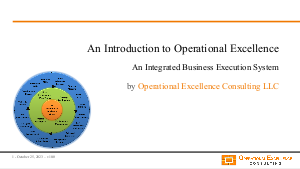
Receive our FREE presentation on Operational Excellence
This 50-slide presentation provides a high-level introduction to the 4 Building Blocks of Operational Excellence. Achieving OpEx requires the implementation of a Business Execution System that integrates these 4 building blocks. |