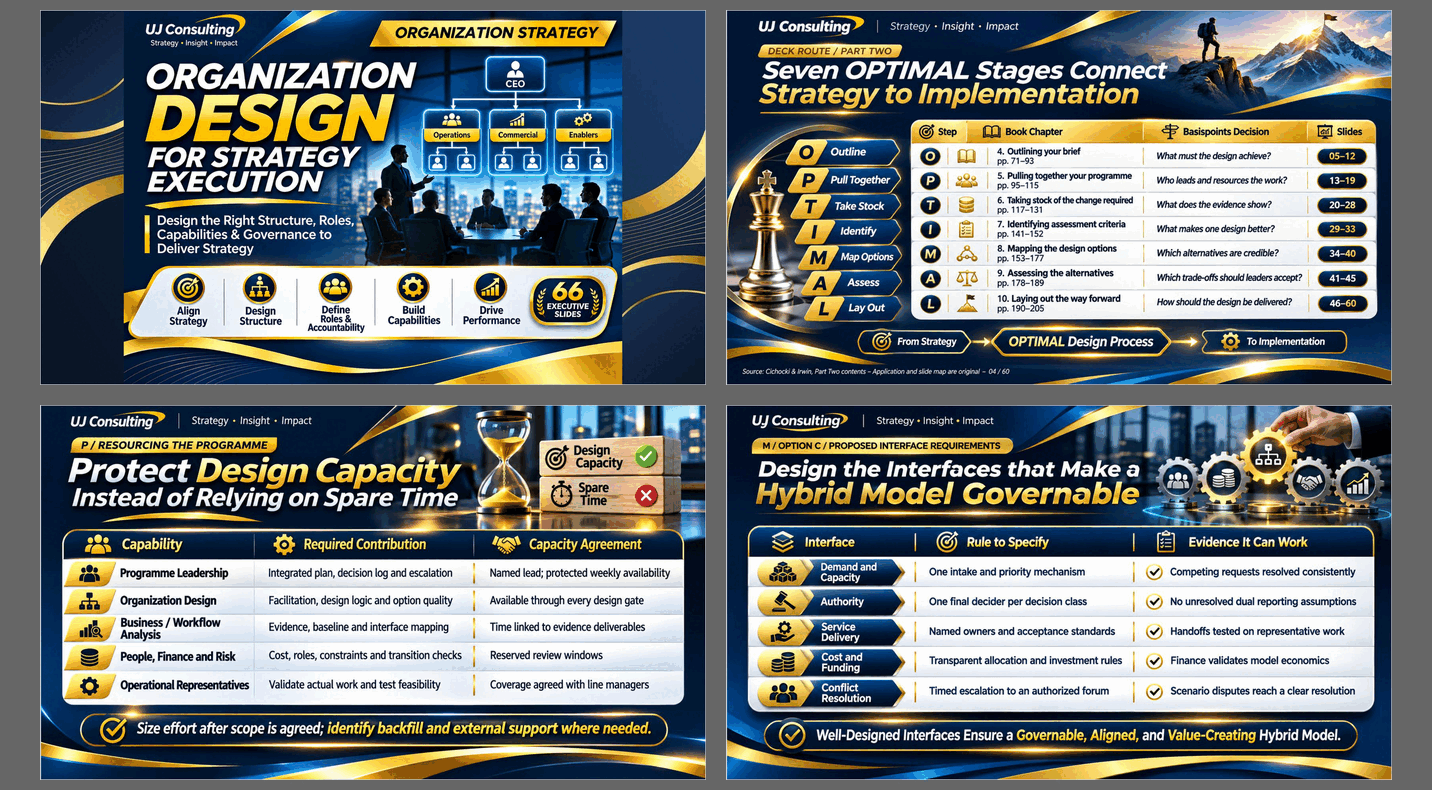

 Click main image to view in full screen. Unlock all 22 preview images:
Organization Design for Strategy Execution – PowerPoint PPTX Template
PowerPoint (PPTX) 66 Slides


BENEFITS OF THIS DOWNLOADABLE POWERPOINT DOCUMENT
- Align Organization Design with Business Strategy. Learn how to connect organizational structure, decision rights, accountability, and capabilities with strategic priorities through a structured seven-stage organization design methodology.
- Make Better Executive Organization Design Decisions. Access 66 executive slides covering organizational alternatives, governance interfaces, assessment criteria, leadership responsibilities, and evidence-based decision frameworks for effective organizatio
- Translate Organizational Blueprints into Execution. Strengthen implementation readiness through clear role accountability, operational interfaces, capability requirements, resource planning, and transition management to support sustainable business perfor
ORGANIZATIONAL DESIGN PPT TEMPLATE DESCRIPTION
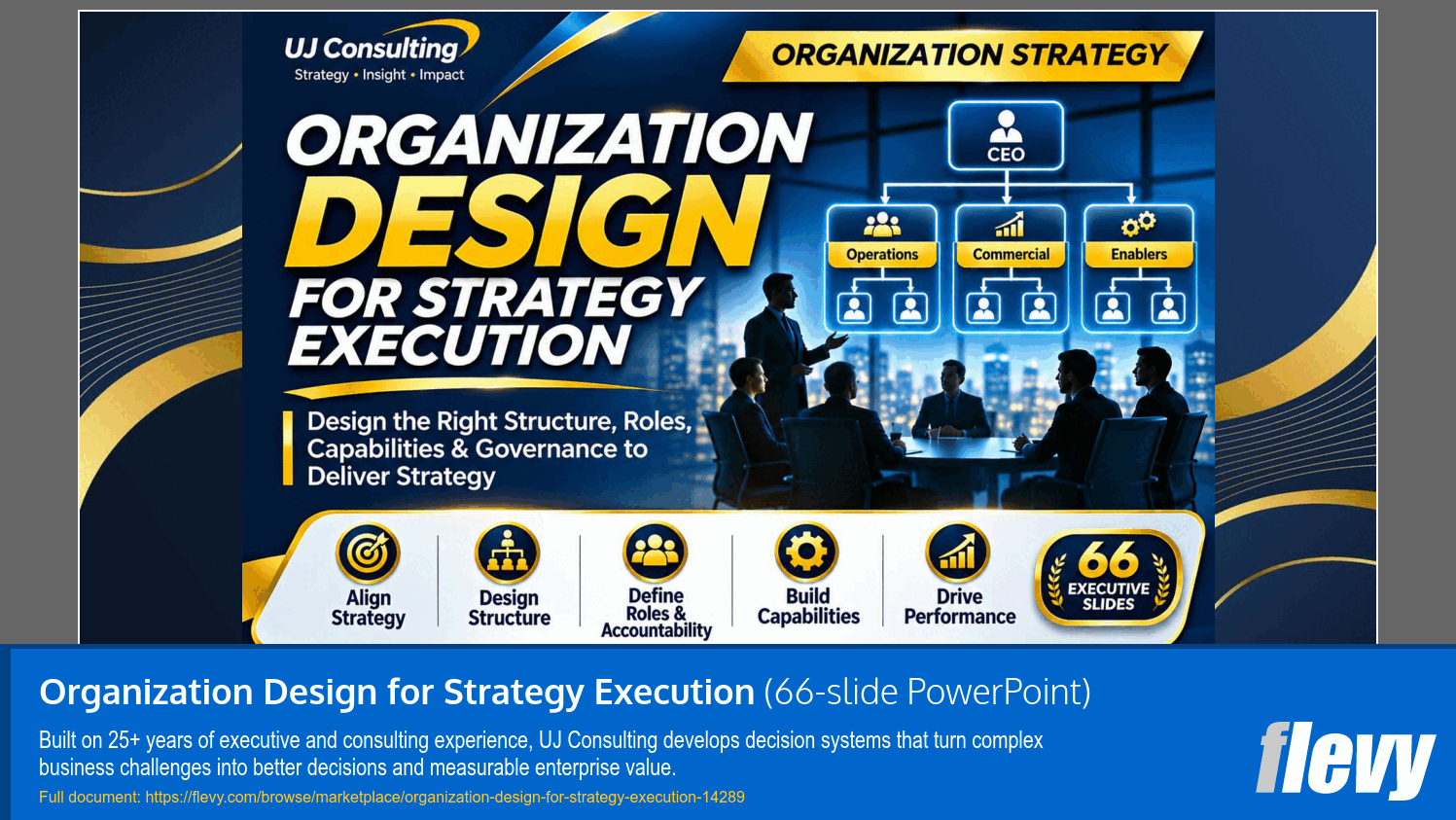
Organization Design for Strategy Execution
66 Executive Slides | UJ Consulting Executive Learning Series
An effective organizational structure is not simply an arrangement of reporting lines, departments, and job descriptions. It is a strategic management system that connects business priorities, decision-making authority, organizational capabilities, accountability, and operational execution. Organization Design for Strategy Execution is a comprehensive 66-slide executive presentation designed to help business leaders, executives, HR professionals, and management consultants develop organizational models that translate strategic objectives into coordinated business performance.
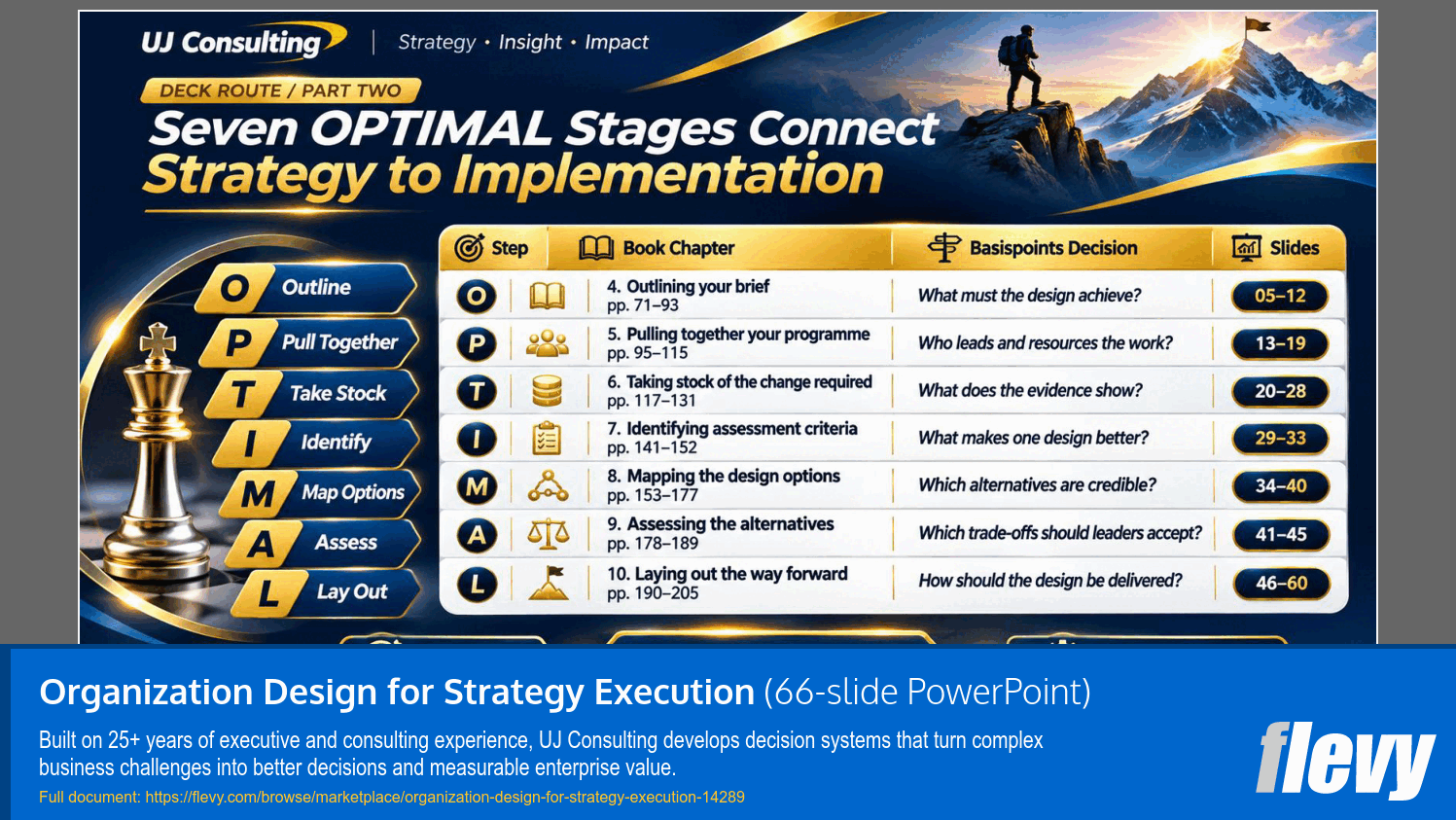
Structured around the seven-stage OPTIMAL methodology, this executive learning resource provides a disciplined approach to organizational transformation, from defining design objectives and mobilizing resources to evaluating alternatives and preparing implementation.
The presentation introduces seven interconnected stages:
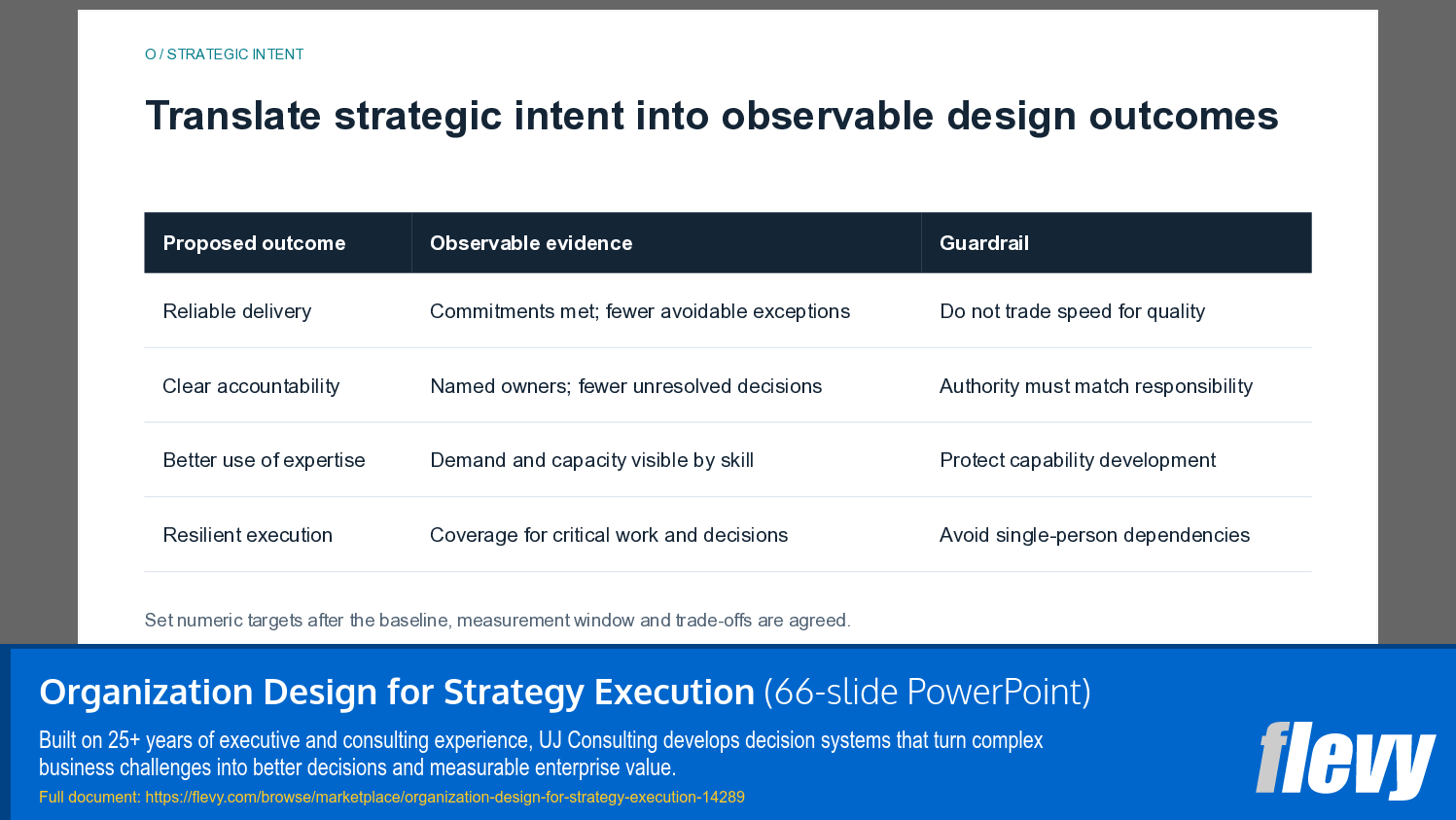
1. Outline Your Brief – Establish strategic objectives, design boundaries, business requirements, and the expected outcomes of organizational redesign.
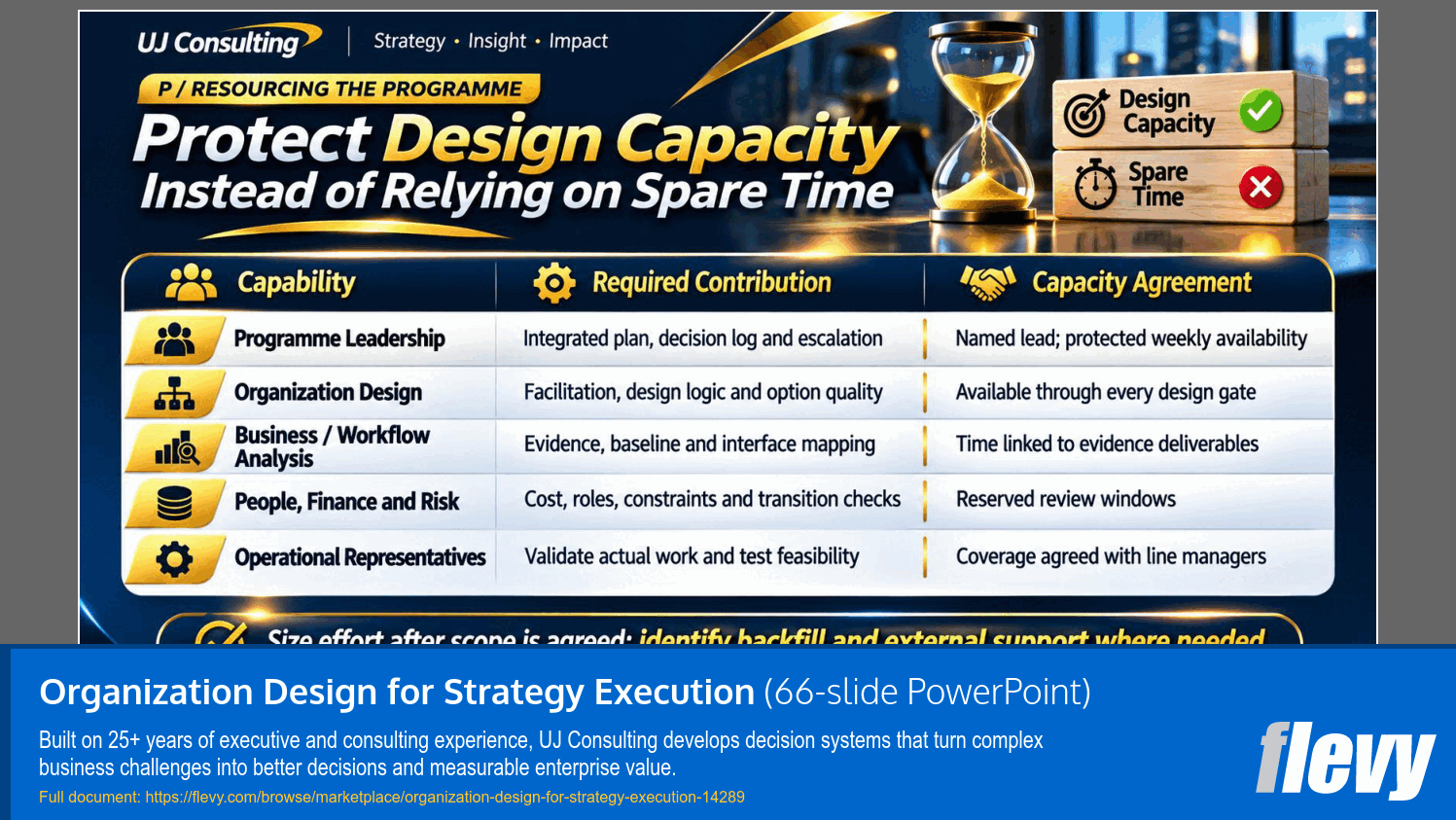
2. Pull Together Your Programme – Define programme leadership, governance responsibilities, resource requirements, stakeholder engagement, and protected organizational design capacity.
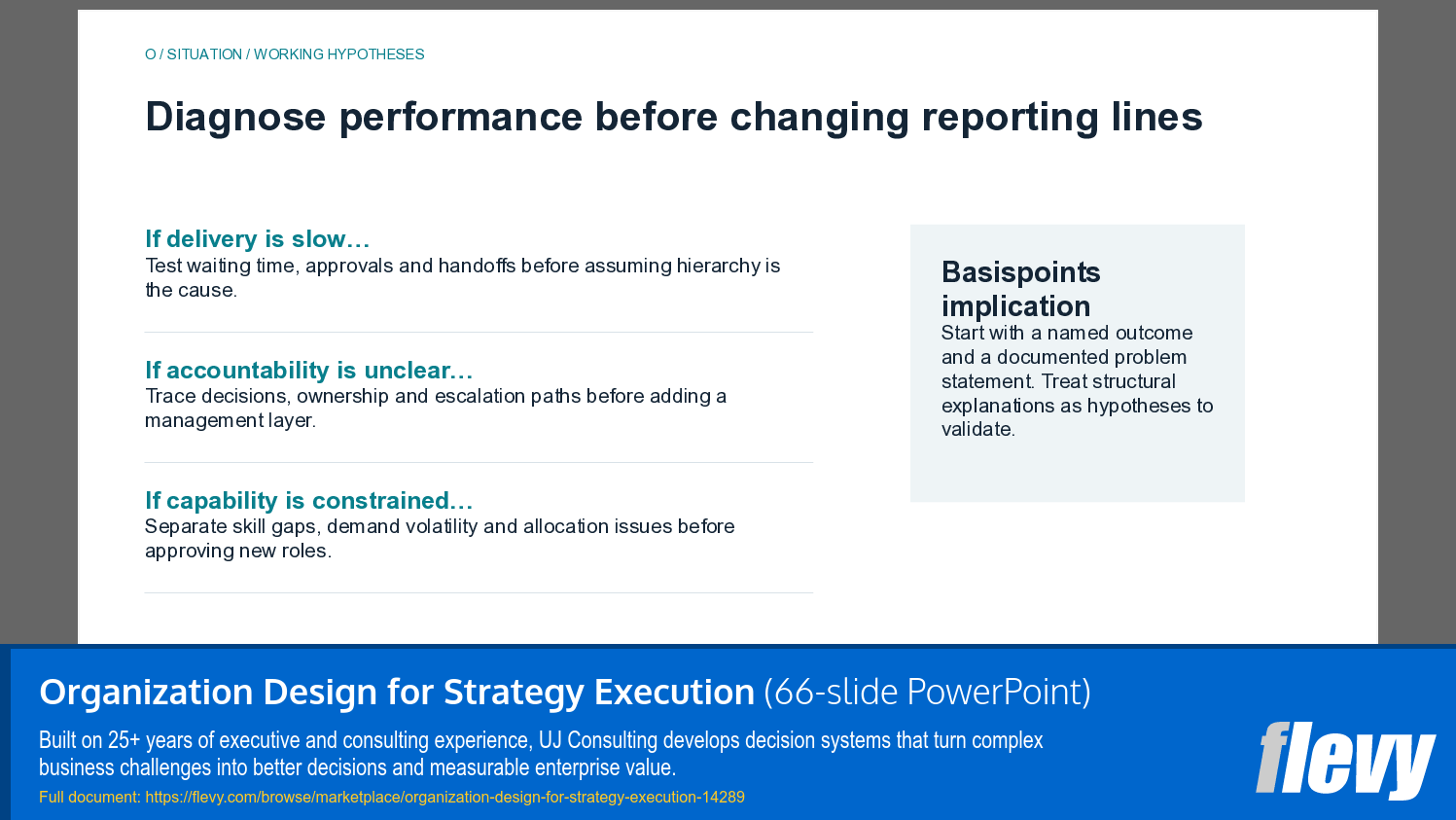
3. Take Stock of the Change Required – Examine existing organizational structures, workflows, capabilities, performance gaps, and operational constraints to establish an evidence-based foundation.
4. Identify Assessment Criteria – Develop transparent evaluation criteria that connect organizational design decisions with strategic priorities, operational effectiveness, accountability, and implementation feasibility.
5. Map the Design Options – Explore alternative organizational configurations, including functional, divisional, centralized, decentralized, and hybrid operating models.
6. Assess the Alternatives – Evaluate organizational options against agreed criteria, including decision rights, service interfaces, resource requirements, financial implications, and implementation risks.
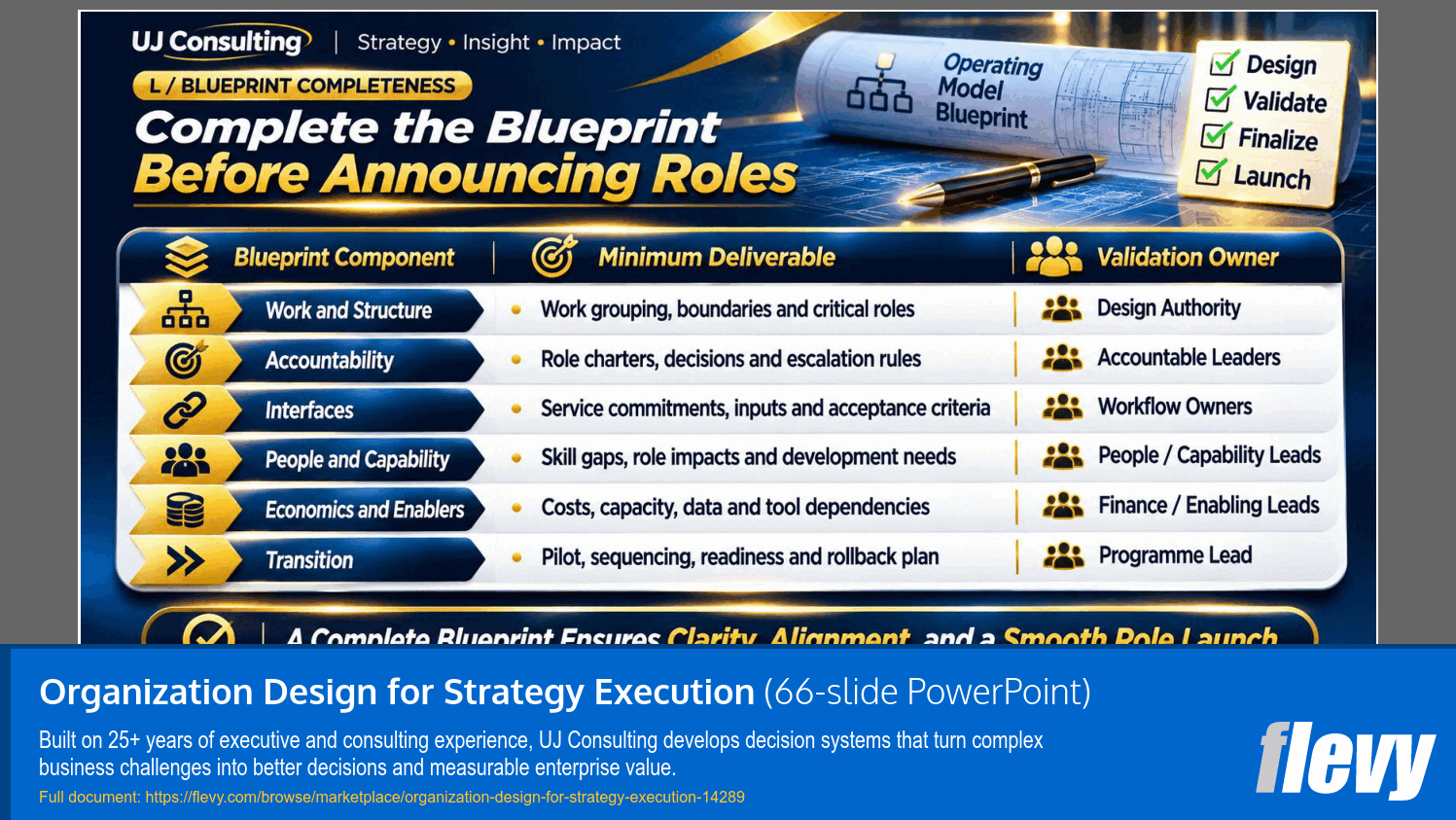
7. Lay Out the Way Forward – Develop an actionable organizational blueprint covering structure, accountability, interfaces, people capabilities, economic considerations, transition planning, and implementation readiness.
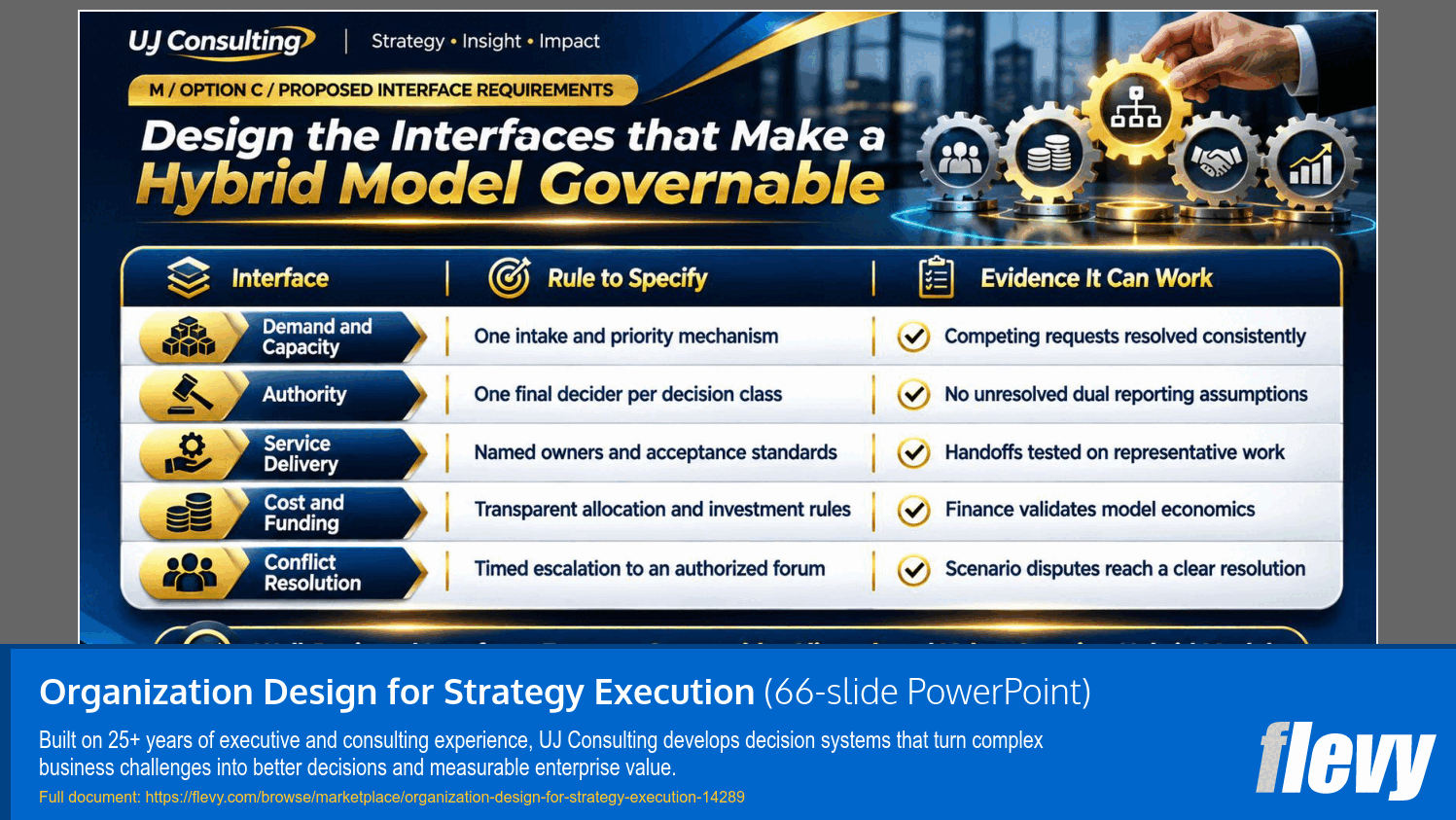
Beyond traditional organization charts, the presentation emphasizes the critical interfaces that determine whether an operating model can function effectively. These include demand and capacity management, decision-making authority, service delivery responsibilities, cost allocation, funding arrangements, and conflict resolution mechanisms.
A distinguishing feature is its focus on executive decision quality. Leaders are encouraged to assess organizational alternatives using structured evidence, explicit trade-offs, clearly defined ownership, and practical validation requirements.
The material also highlights the importance of completing the organizational blueprint before announcing new roles, ensuring that responsibilities, governance arrangements, operational dependencies, and transition requirements are sufficiently defined. Designed for executive workshops, strategic transformation initiatives, organizational restructuring programmes, leadership development, and consulting engagements, this presentation supports informed discussions and systematic management decisions.
The frameworks are applicable across manufacturing, financial services, professional services, diversified business groups, and other organizations seeking stronger alignment between strategy and execution. Developed by UJ Consulting, the presentation provides practical management frameworks, decision questions, organizational design considerations, and implementation guidance.
Ultimately, Organization Design for Strategy Execution helps executives move beyond structural rearrangement toward organizational models that strengthen accountability, improve coordination, support operational effectiveness, and enable sustainable strategy execution. Better organizational design creates stronger strategic execution.
Regards,
UJ Consulting – Strategy • Insight • Impact
SEO
SEO Title: Customer Profitability & Cost-to-Serve | Excel Decision System
Meta Description: Identify hidden customer losses, model cost-to-serve, and compare profit and cash scenarios with an executive playbook, master paper, and Excel decision engine.
Keywords: customer profitability analysis, cost-to-serve analysis, customer profitability Excel template, customer segmentation, activity-based costing, pricing profitability, service cost optimization, customer contribution margin, profitable growth, working capital analysis, customer portfolio management, executive decision system
Got a question about the product? Email us at support@flevy.com or ask the author directly by using the "Ask the Author a Question" form. If you cannot view the preview above this document description, go here to view the large preview instead.
Source: Best Practices in Organizational Design, Strategy Execution PowerPoint Slides: Organization Design for Strategy Execution PowerPoint (PPTX) Presentation Slide Deck, UJ Consulting _ Strategy-Insight-Impact
ABOUT THE AUTHOR

UJ Consulting | Strategy • Insight • Impact
UJ Consulting is an executive management consulting and business transformation practice founded by Untung Juanto, ST., MM., a senior executive, consultant, and transformation practitioner with more than 25 years of professional experience across local and multinational companies and diverse industries.
His career progressed from frontline
... [read more]
Ask the Author a Question
You must be logged in to contact the author.