 Click main image to view in full screen.
Fixed Asset Register and Depreciation Model – Excel XLSX
Excel (XLSX) + supplemental PDF


BENEFITS OF THIS DOWNLOADABLE EXCEL DOCUMENT
- Centralizes asset records, depreciation, disposals, revaluations, impairments, transfers, and capital improvements within one formula-driven workbook.
- Automates reducing-balance depreciation and reporting-year analysis from 2020 through 2030 without VBA, macros, or external workbook links.
- Improves financial control and management visibility through dashboard KPIs, asset roll-forwards, data-quality checks, and printable registers.
DEPRECIATION EXCEL DESCRIPTION
Effective fixed asset management requires more than a simple list of equipment. Finance teams must maintain reliable asset records, calculate depreciation consistently, track changes in carrying amounts, monitor disposals and transfers, and produce information suitable for management review and audit support.
The Fixed Asset Register and Depreciation Model is a formula-driven Excel workbook designed to centralize these activities within one structured financial-control solution. It provides a detailed asset register together with an automated reducing-balance depreciation engine covering the years 2020 through 2030.
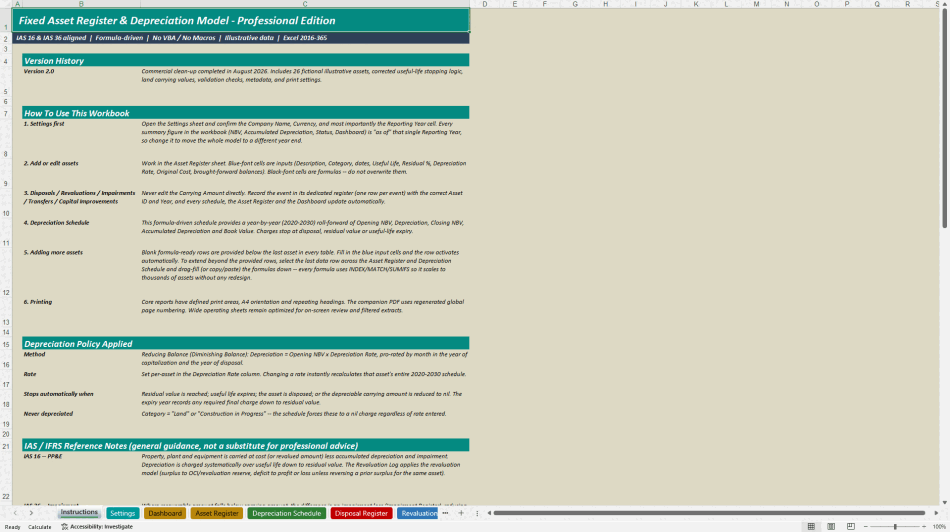
The workbook contains 11 interconnected worksheets and more than 4,700 formula cells. It uses standard Excel formulas without VBA, macros, external workbook links, PivotTables, or external data connections. It is designed for Microsoft Excel 2016, 2019, 2021, and Microsoft 365.
The Settings worksheet allows users to configure the company name, reporting currency, reporting year, depreciation defaults, report date, and approval information. Changing the reporting year automatically updates relevant carrying amounts, accumulated depreciation, current-year depreciation, asset status, summaries, and dashboard results.
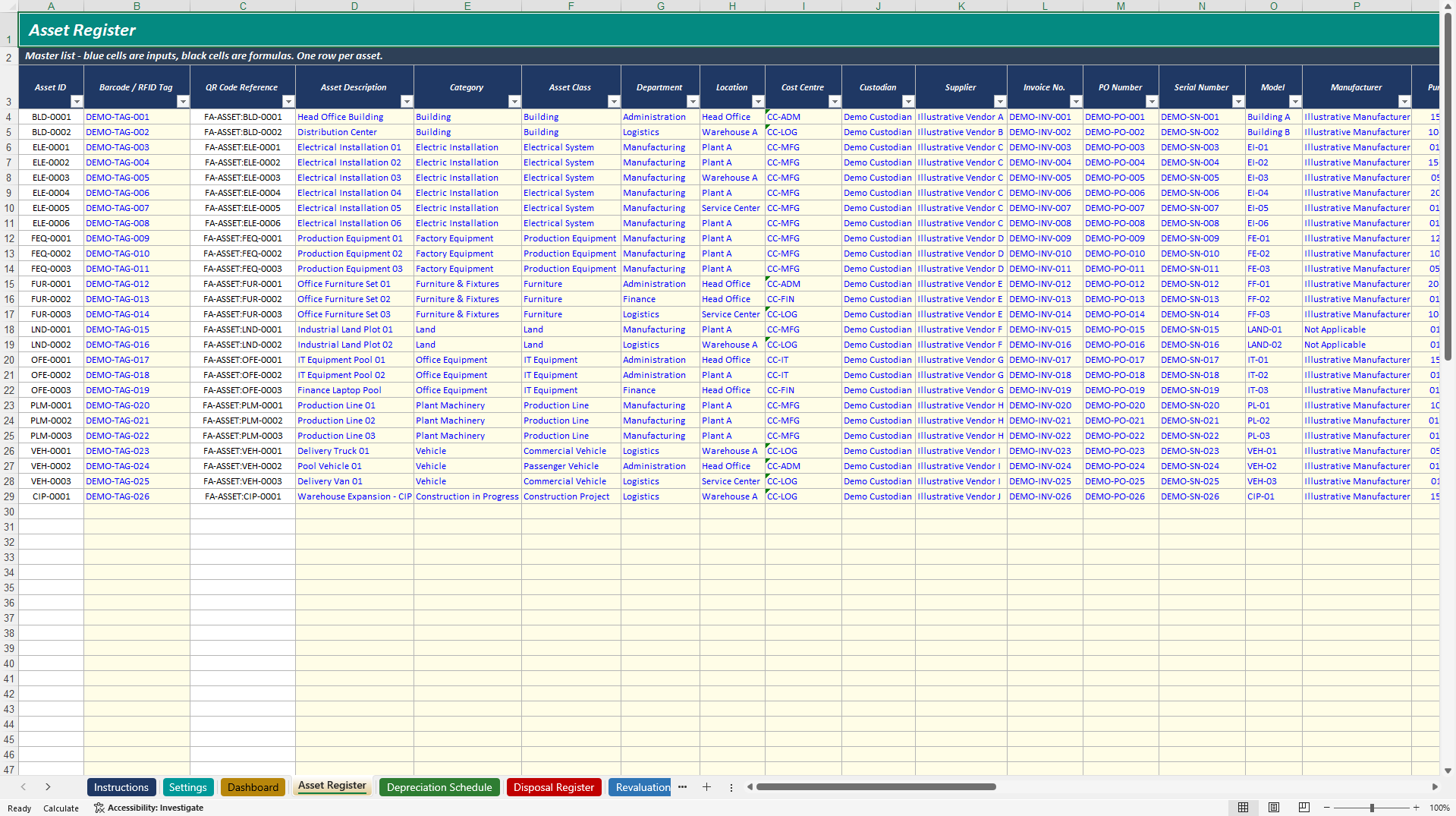
The Asset Register maintains detailed information for each asset, including asset ID, description, category, department, location, cost centre, custodian, supplier information, purchase and capitalization dates, useful life, residual value, depreciation rate, original cost, brought-forward balances, carrying amount, status, notes, and supporting-document reference.
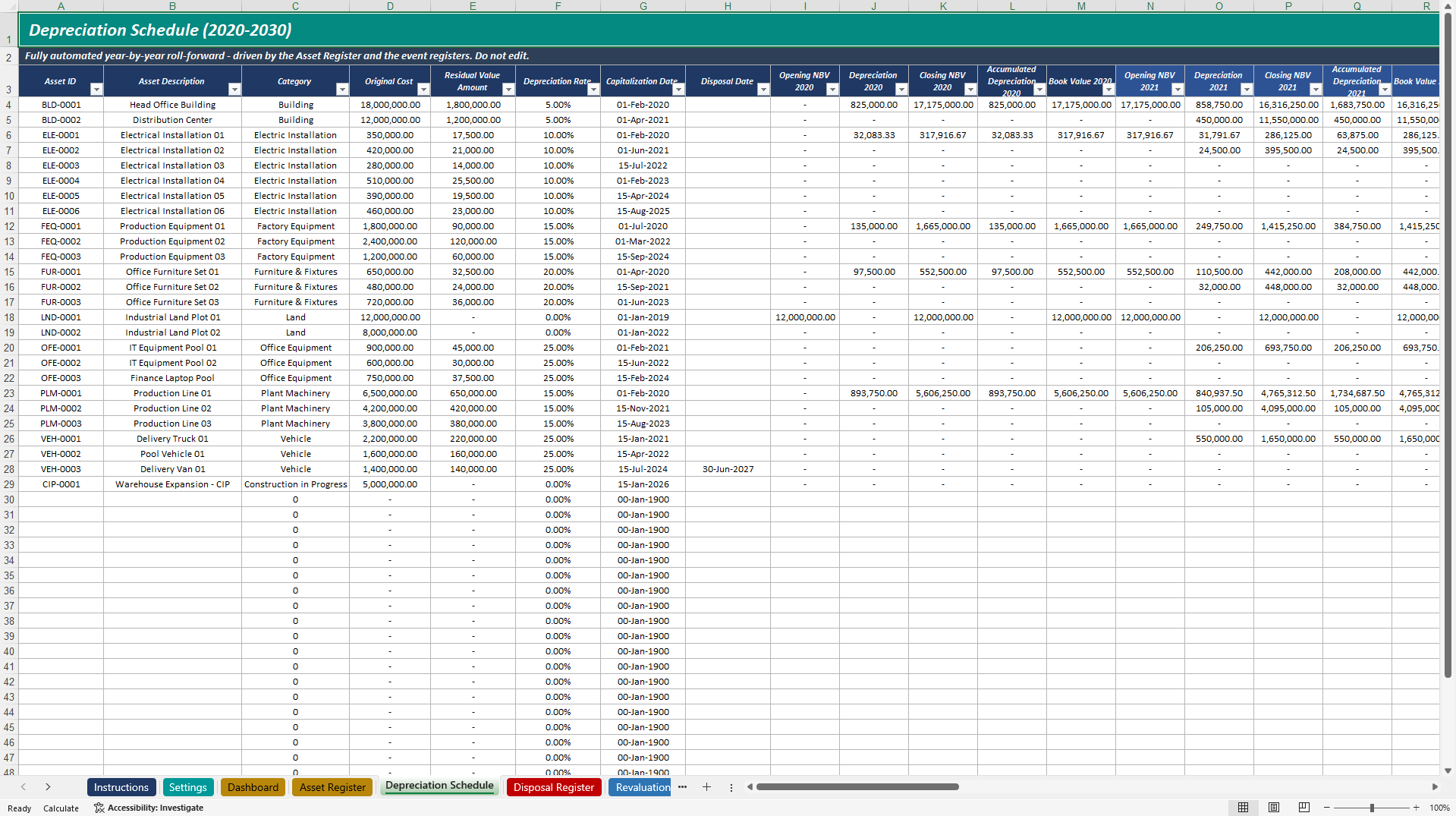
The automated Depreciation Schedule produces annual opening net book value, depreciation expense, closing net book value, and accumulated depreciation from 2020 through 2030. The calculation applies the reducing-balance method, supports monthly pro-rating, respects residual value and useful-life limits, and excludes land and construction in progress from depreciation.
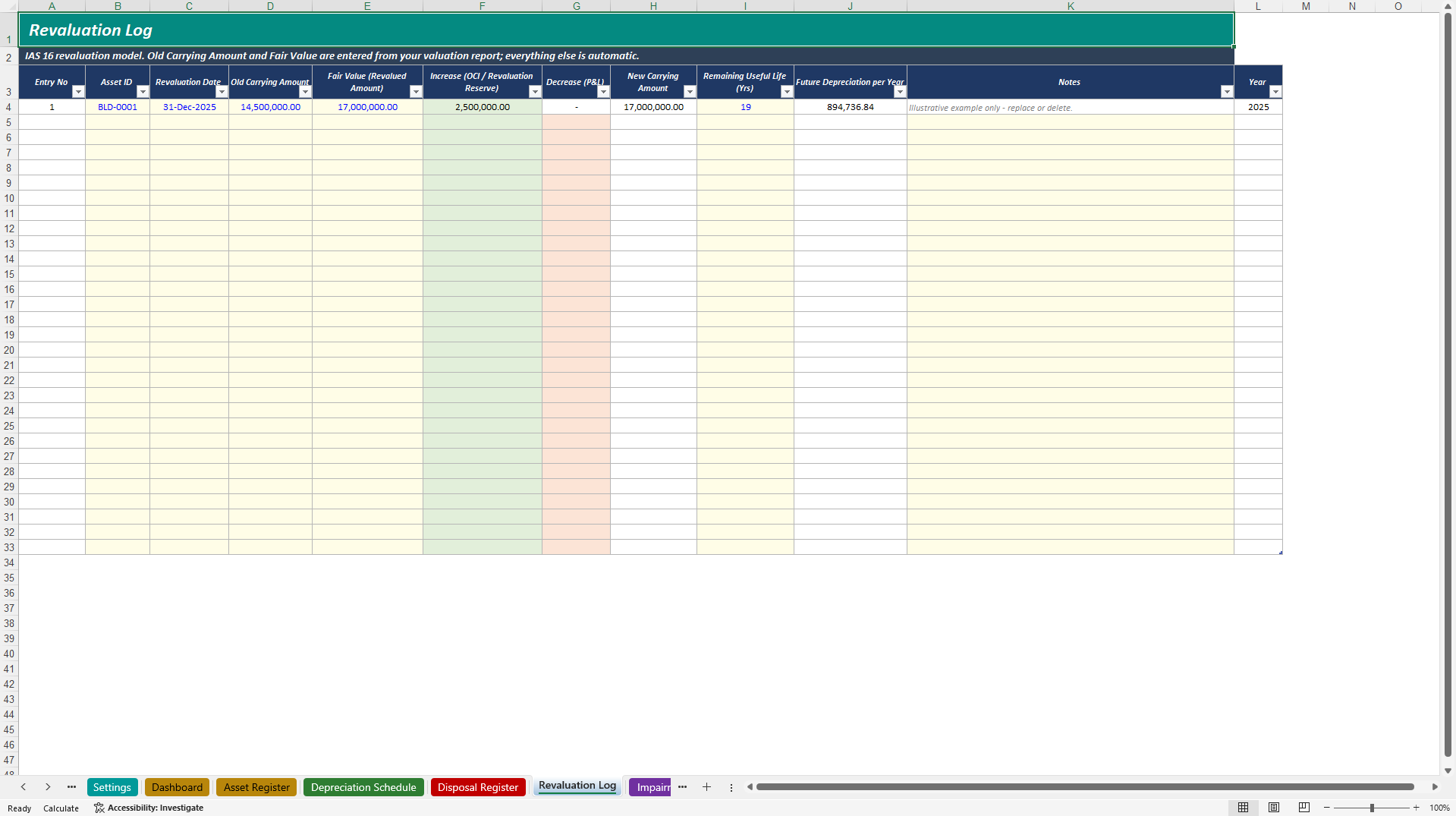
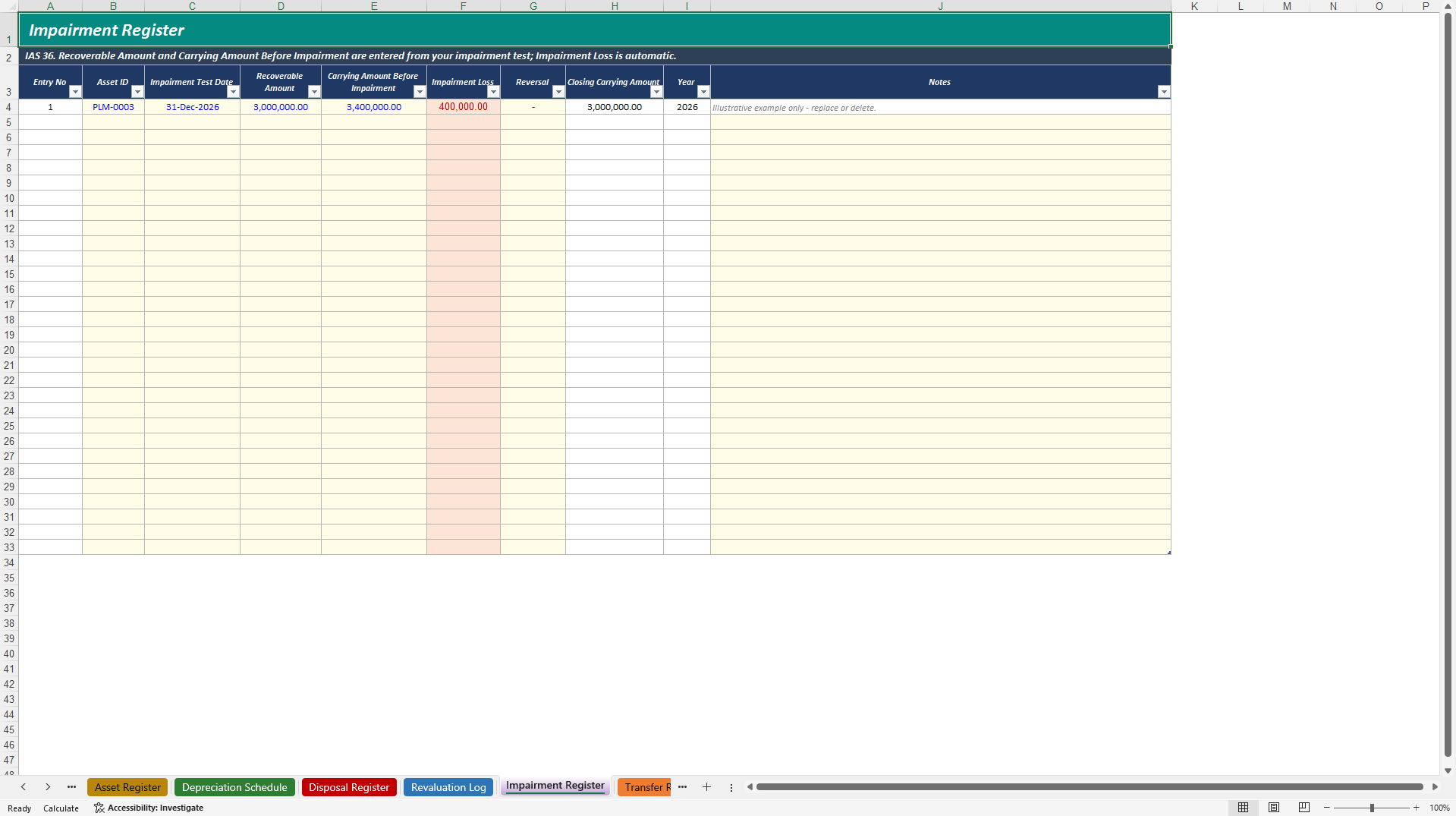
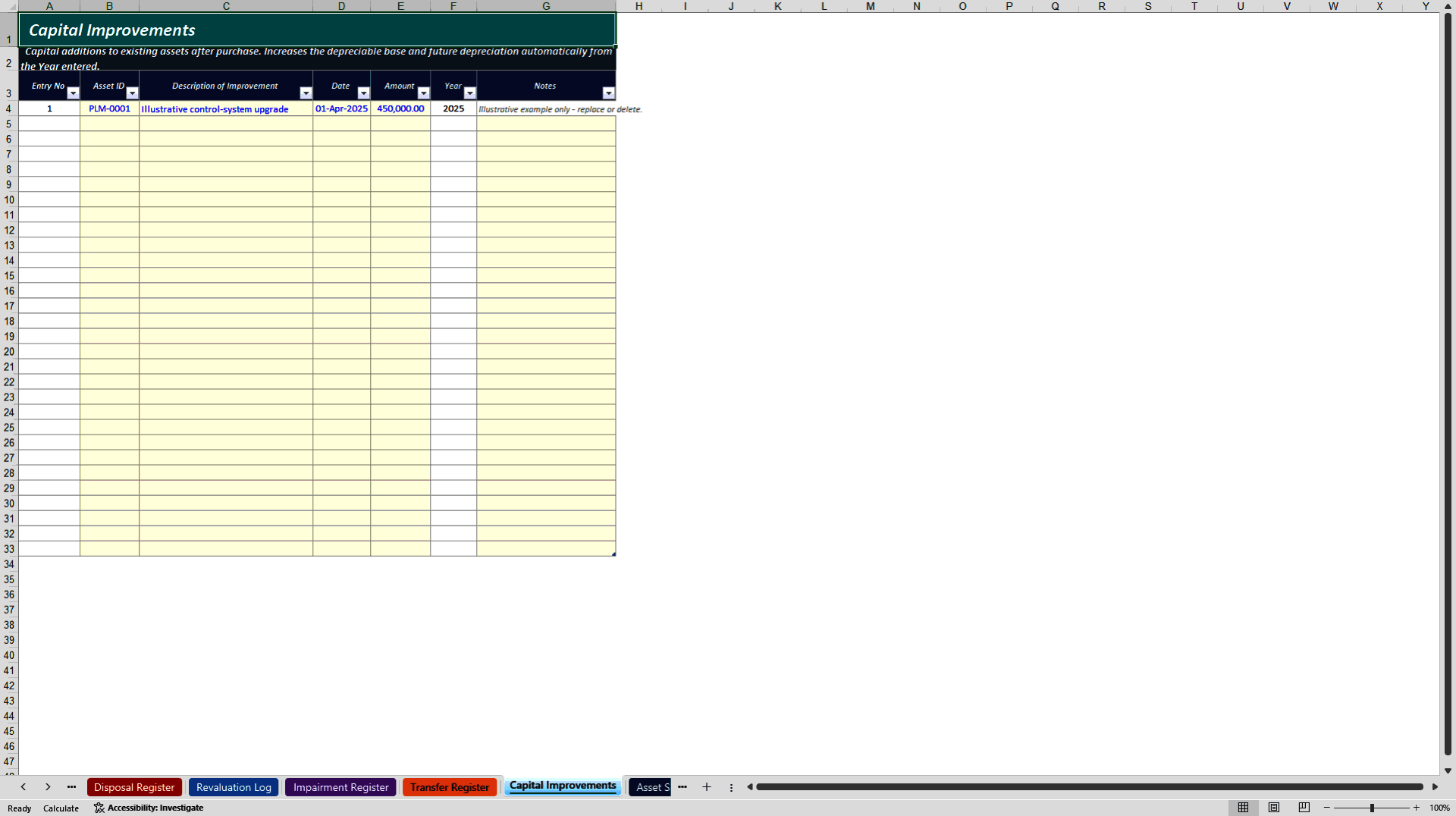
Dedicated registers are included for asset disposals, revaluations, impairment losses and reversals, departmental or location transfers, and subsequent capital improvements. These registers feed the asset records, depreciation schedules, summaries, and dashboard through linked formulas.
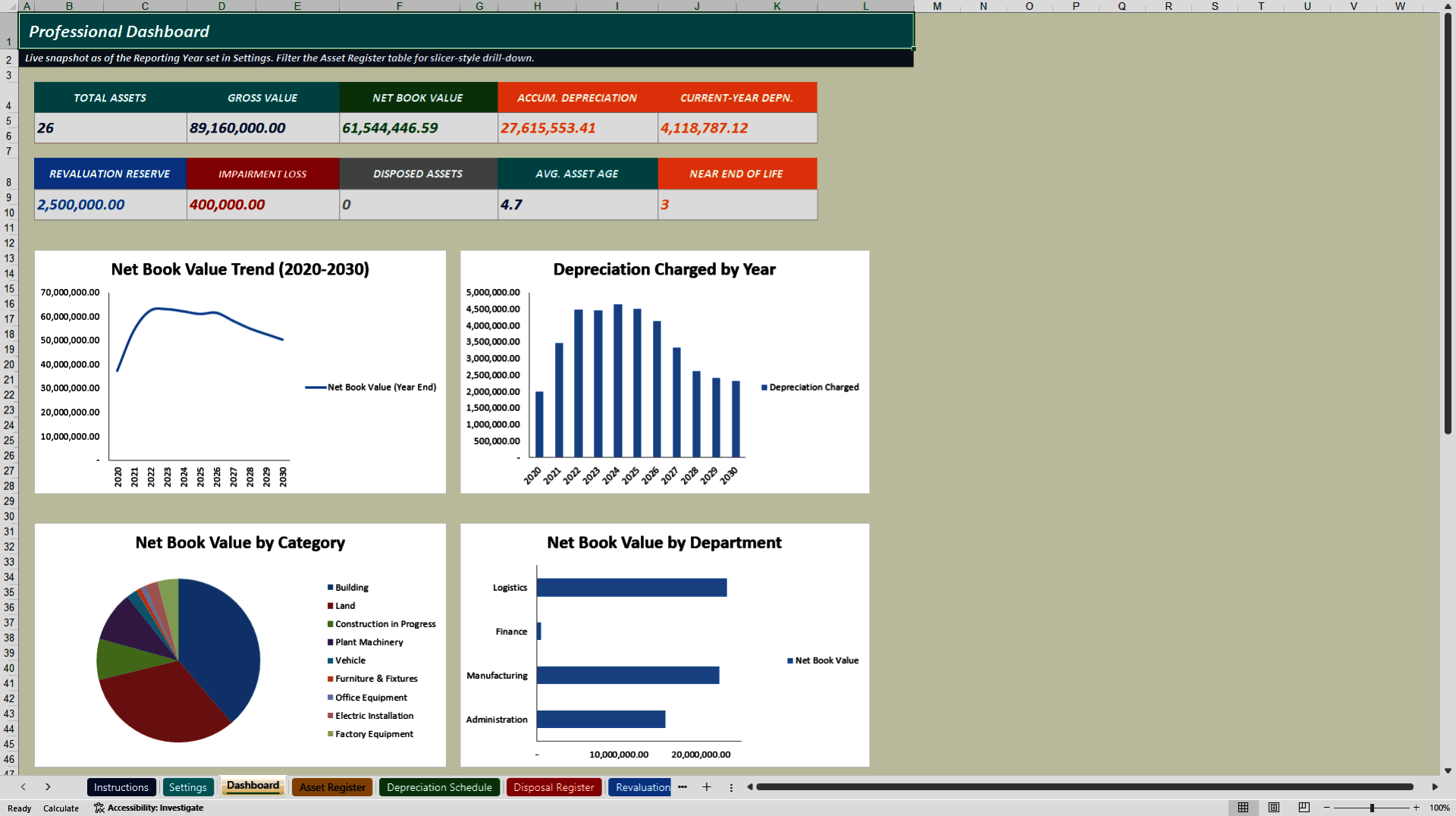
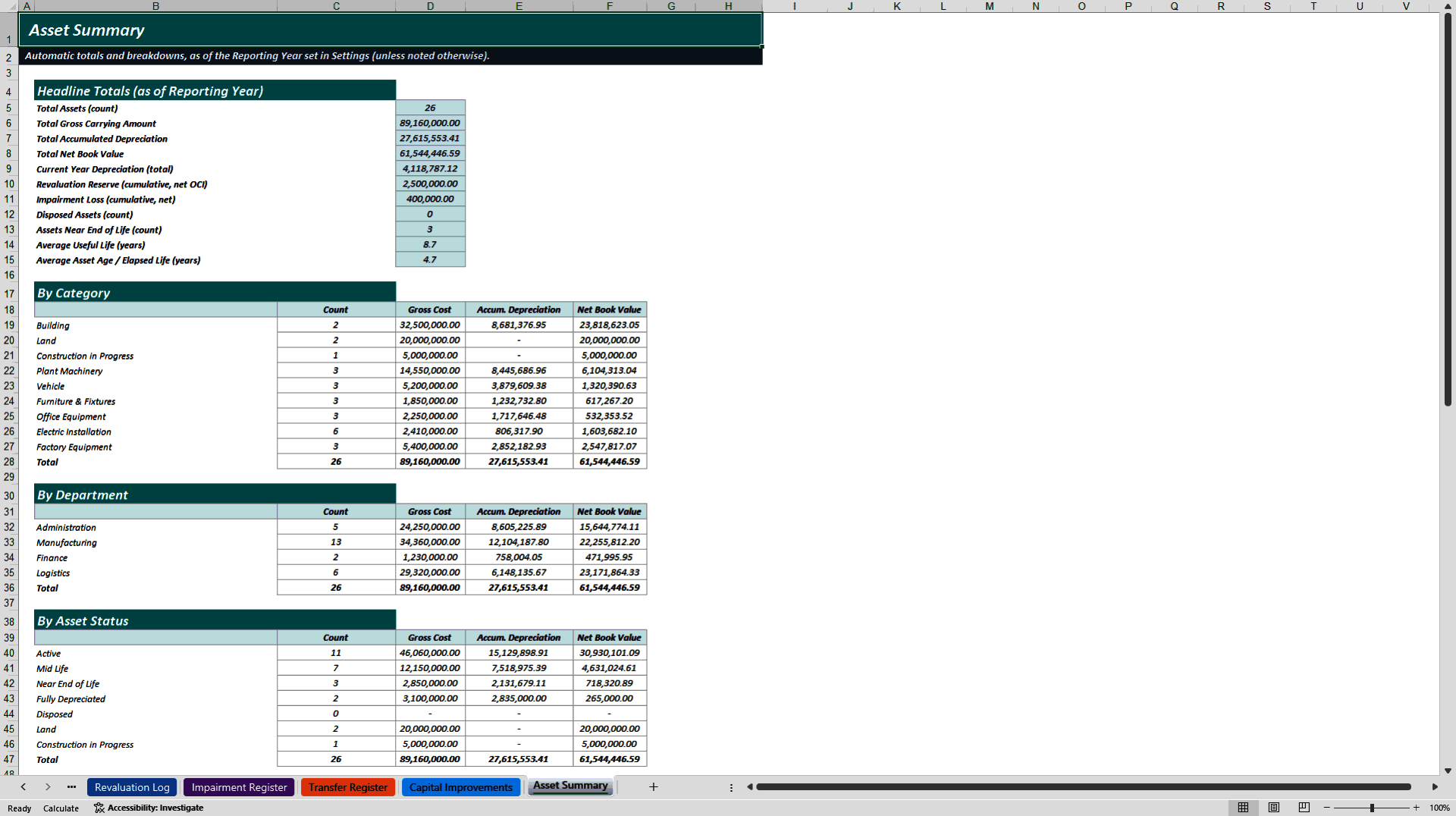
The Executive Dashboard and Asset Summary provide key indicators, category and departmental analysis, asset-status reporting, net book value trends, annual depreciation, revaluation balances, impairment information, disposals, and useful-life analysis.
Illustrative demonstration data is included to explain the complete workflow and should be replaced with the purchaser's own information. A supplemental PDF reference and printable reporting pack is also included.
The workbook is designed as a fixed asset management, depreciation calculation, and management-reporting aid. Users remain responsible for applying their organization's accounting policies, estimates, materiality thresholds, evidence requirements, local tax rules, and professional judgment. Its accounting framework is aligned with relevant principles of IAS 16 and IAS 36 but does not replace professional accounting or audit advice.
Got a question about the product? Email us at support@flevy.com or ask the author directly by using the "Ask the Author a Question" form. If you cannot view the preview above this document description, go here to view the large preview instead.
Source: Best Practices in Depreciation Excel: Fixed Asset Register and Depreciation Model Excel (XLSX) Spreadsheet, Hafiz Moiz Shahid
ABOUT THE AUTHOR

Accounting and finance professional with 8+ years of experience in financial reporting, budgeting, forecasting, accounting operations, inventory management, product costing, payroll processing, reconciliations, and ERP-based financial processes. I specialize in developing practical Excel-based financial models, business planning tools, management dashboards, budgeting and forecasting solutions, ... [read more]
Ask the Author a Question
You must be logged in to contact the author.




























