 Click main image to view in full screen.
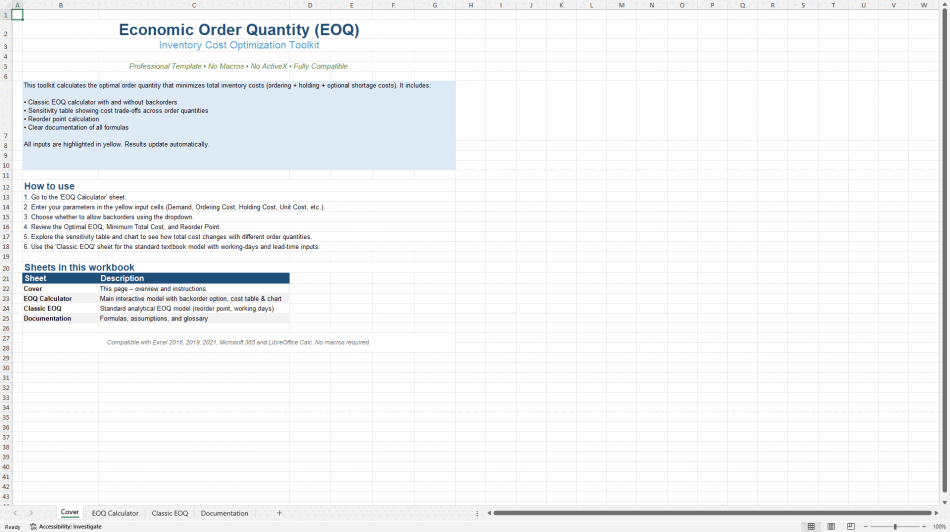
Economic Order Quantity Inventory Cost Optimization Toolkit – Excel XLSX
Excel (XLSX)


BENEFITS OF THIS DOWNLOADABLE EXCEL DOCUMENT
- Gives operations and supply chain buyers a clear optimal order quantity and reorder point from demand, ordering cost, holding cost, and lead-time inputs.
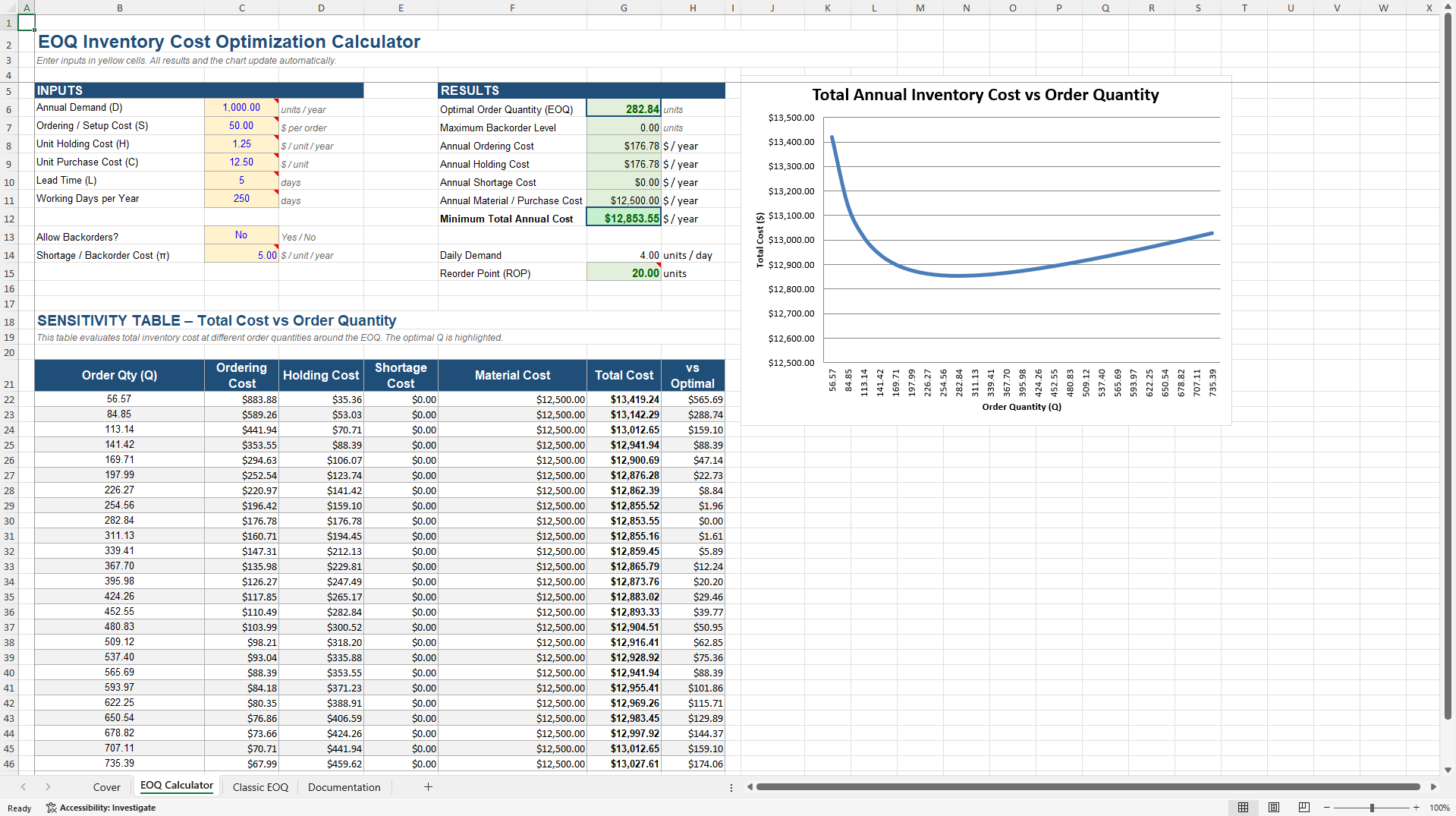
- Shows the full inventory cost trade-off across order sizes so procurement and leadership can see why a given lot size raises or lowers total cost.
- Provides an editable Excel EOQ structure teams can reuse for training, supplier discussions, and first-pass inventory policy design without building models from scratch.
COST REDUCTION ASSESSMENT EXCEL DESCRIPTION
Are excess stock and emergency orders driving up your inventory cost? Many operations, supply chain, and procurement teams still set order sizes by habit instead of by cost. The Economic Order Quantity model gives B2B buyers a practical way to balance ordering cost and holding cost—and to defend a reorder point with transparent math.
This Excel toolkit is built for professionals who need a working EOQ solution, not a slide theory deck. Use it when you manage SKUs, negotiate supplier batch sizes, train planners, or show leadership why a larger or smaller order quantity changes total cost. Typical buyers include operations managers, inventory planners, supply chain analysts, procurement leads, plant materials managers, continuous-improvement teams, and consultants supporting manufacturing, distribution, and industrial clients.
What you can do for your business
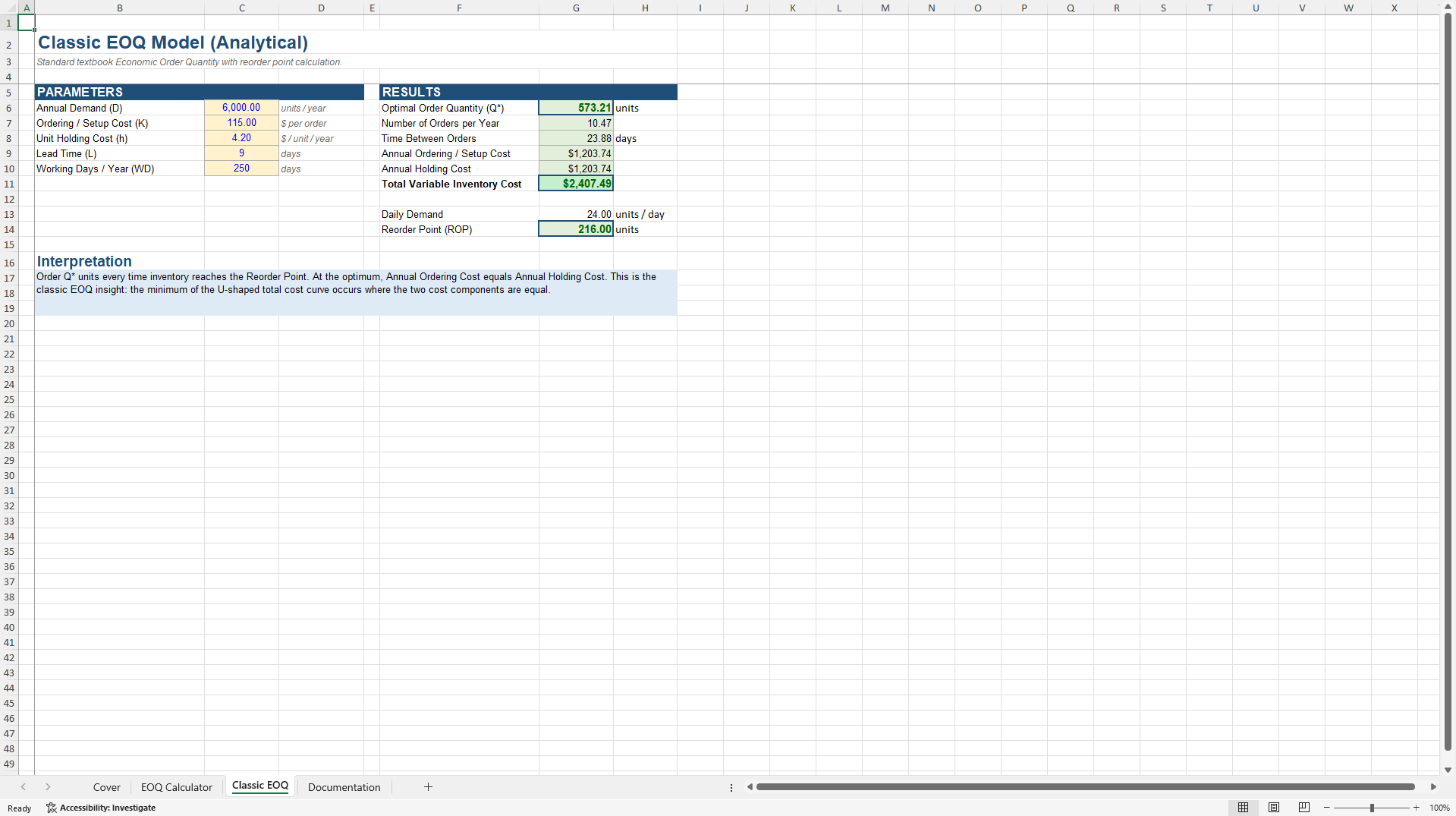
Calculate optimal order quantity from annual demand, setup or ordering cost, and unit holding cost. Derive a reorder point from lead time and working days so replenishment timing is explicit. Compare annual setup cost, annual holding cost, and total variable inventory cost at the optimum. Review a quantity-versus-cost table that shows how holding cost rises and ordering cost falls as order size increases—so stakeholders see the trade-off curve, not only a single number. Adjust parameters for what-if discussions with suppliers, finance, or plant leadership without rebuilding formulas from scratch.
How B2B teams use it
Inventory policy workshops and lean/operations training. First-pass order quantity design for stable-demand items. Supplier discussions on minimum order quantity versus true economic order size. Procurement and materials handoffs where reorder point and cost drivers must be documented. Consulting engagements that need a clean, editable EOQ reference clients can keep after the project.
What is inside
An analytical Basic EOQ sheet with demand, ordering cost, holding cost, lead time, and working-day inputs, returning optimal order quantity, reorder point, and annual cost results. An EOQ cost table across order quantities covering holding, ordering, material, shortage, and total cost for sensitivity and teaching. A components layout for simple parameter-driven ordering versus carrying cost checks. Structure is transparent so your team can audit logic and replace sample data with live item parameters.
How to get value quickly
Enter your item's annual demand, ordering cost, and holding cost in the input cells. Read optimal order quantity and reorder point from the results panel. Use the cost table to show leadership what happens to total cost if order quantity moves above or below the optimum. Align outputs with your cost-accounting definitions before locking a policy. Keep calculated cells intact; change only designated inputs.
Important boundaries for professional buyers
This is an analytical EOQ and inventory-cost toolkit under classic model assumptions (relatively steady demand, standard cost trade-offs). It is not a warehouse management system, multi-echelon planner, demand-forecasting engine, or full safety-stock optimizer for highly variable demand. Validate parameters and service-level rules against your organization's policies before operational adoption.
If your goal is lower total inventory cost, clearer reorder logic, and a shared language between operations, procurement, and finance, this toolkit gives your team a focused, editable EOQ workspace ready for real parameters.
Keywords for search: Economic Order Quantity, EOQ model, inventory management, inventory cost optimization, reorder point, ordering cost, holding cost, carrying cost, supply chain operations, procurement inventory policy, materials management, operations excellence, lot size optimization, inventory planner toolkit, B2B inventory analysis
Got a question about the product? Email us at support@flevy.com or ask the author directly by using the "Ask the Author a Question" form. If you cannot view the preview above this document description, go here to view the large preview instead.
Source: Best Practices in Cost Reduction Assessment, Inventory Management Excel: Economic Order Quantity Inventory Cost Optimization Toolkit Excel (XLSX) Spreadsheet, MW & Digitelax Consulting
ABOUT THE AUTHOR

Welcome to the official enterprise resource hub of MW & Digitelax Consulting. Directed by a seasoned banking executive, corporate risk consultant, and financial content strategist with over 28 years of institutional leadership experience, our practice delivers deployment-ready frameworks designed to drive enterprise efficiency, enforce regulatory compliance, and eliminate systemic model risk. ... [read more]
Ask the Author a Question
You must be logged in to contact the author.