 Click main image to view in full screen. Unlock all 12 preview images:
Complete Financial Analysis, Forecasting & Budgeting Toolkit – Excel XLS
Excel (XLS)


BENEFITS OF THIS DOWNLOADABLE EXCEL DOCUMENT
- Consolidates historical statement input, ratio analysis, industry benchmarking, and multi-method pro forma forecasting in one structured Excel workbook.
- Converts analysis into a final operating and financial budget, including cash flow and external financing required, for management planning cycles.
- Reduces rebuild time for FP&A and advisory work by providing linked evaluation and forecasting sheets without macros.
FINANCIAL ANALYSIS EXCEL DESCRIPTION
Companies rarely lack data. They lack a single, disciplined path from historical statements to ratios, peer context, forecasts, and a usable budget. This toolkit is built for that path.
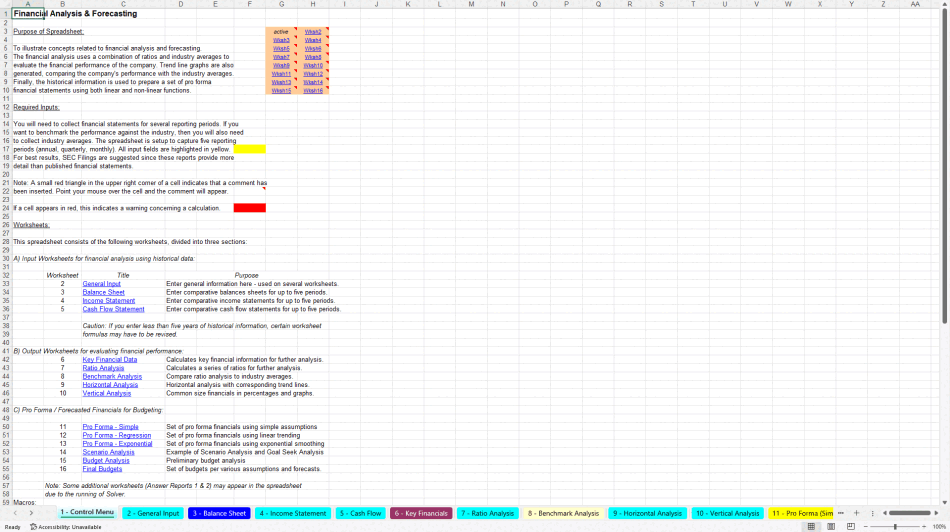
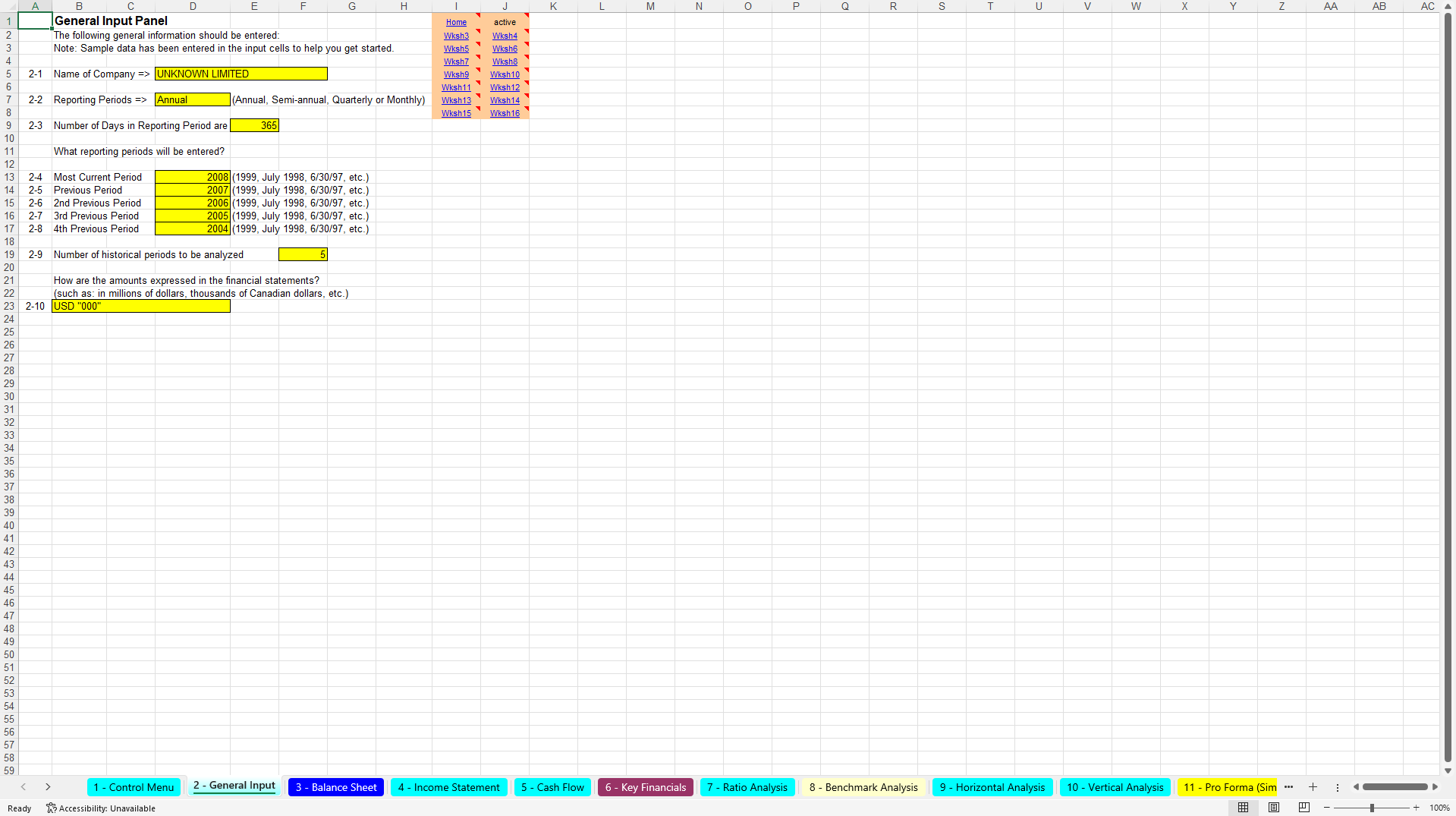
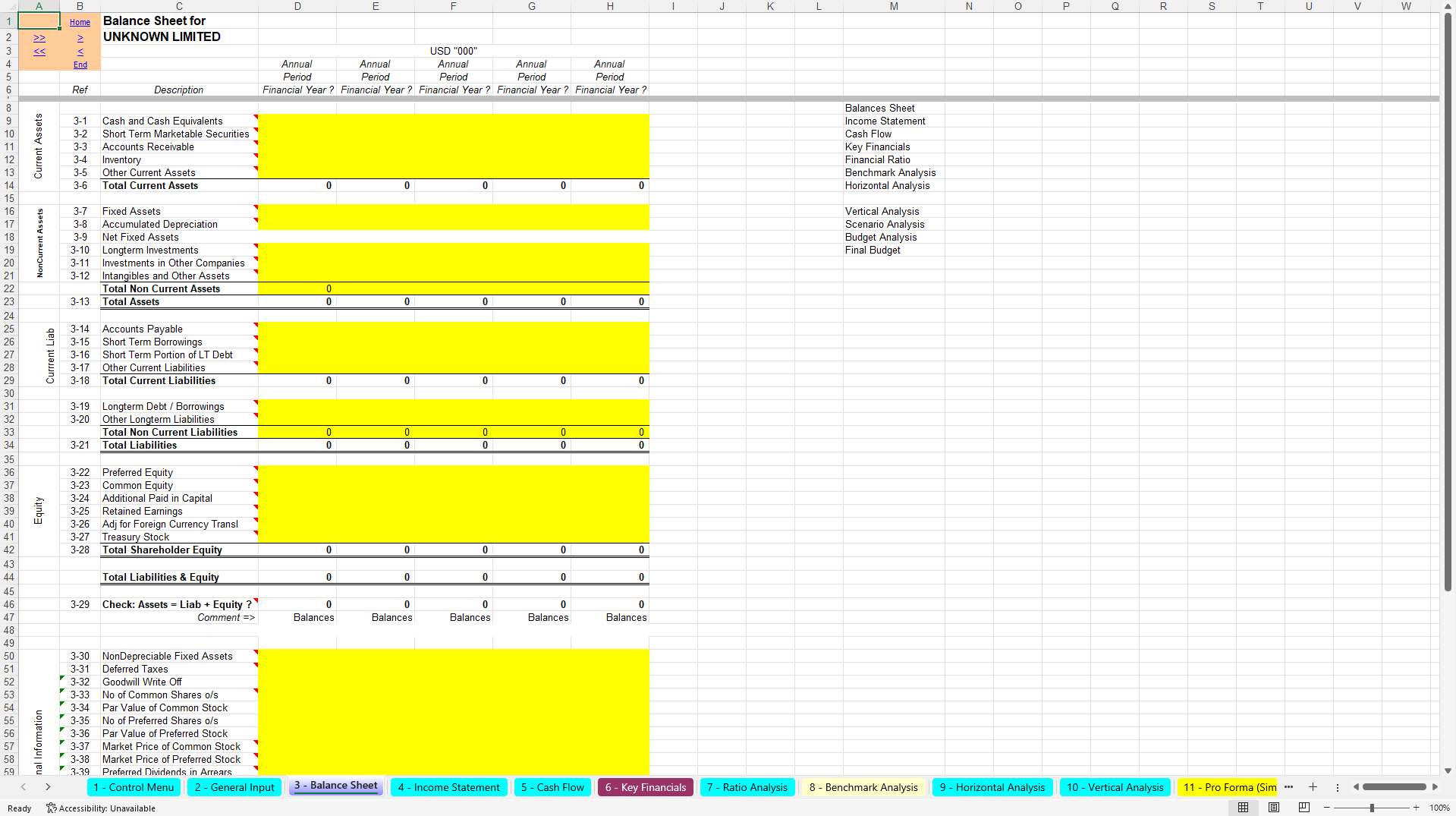
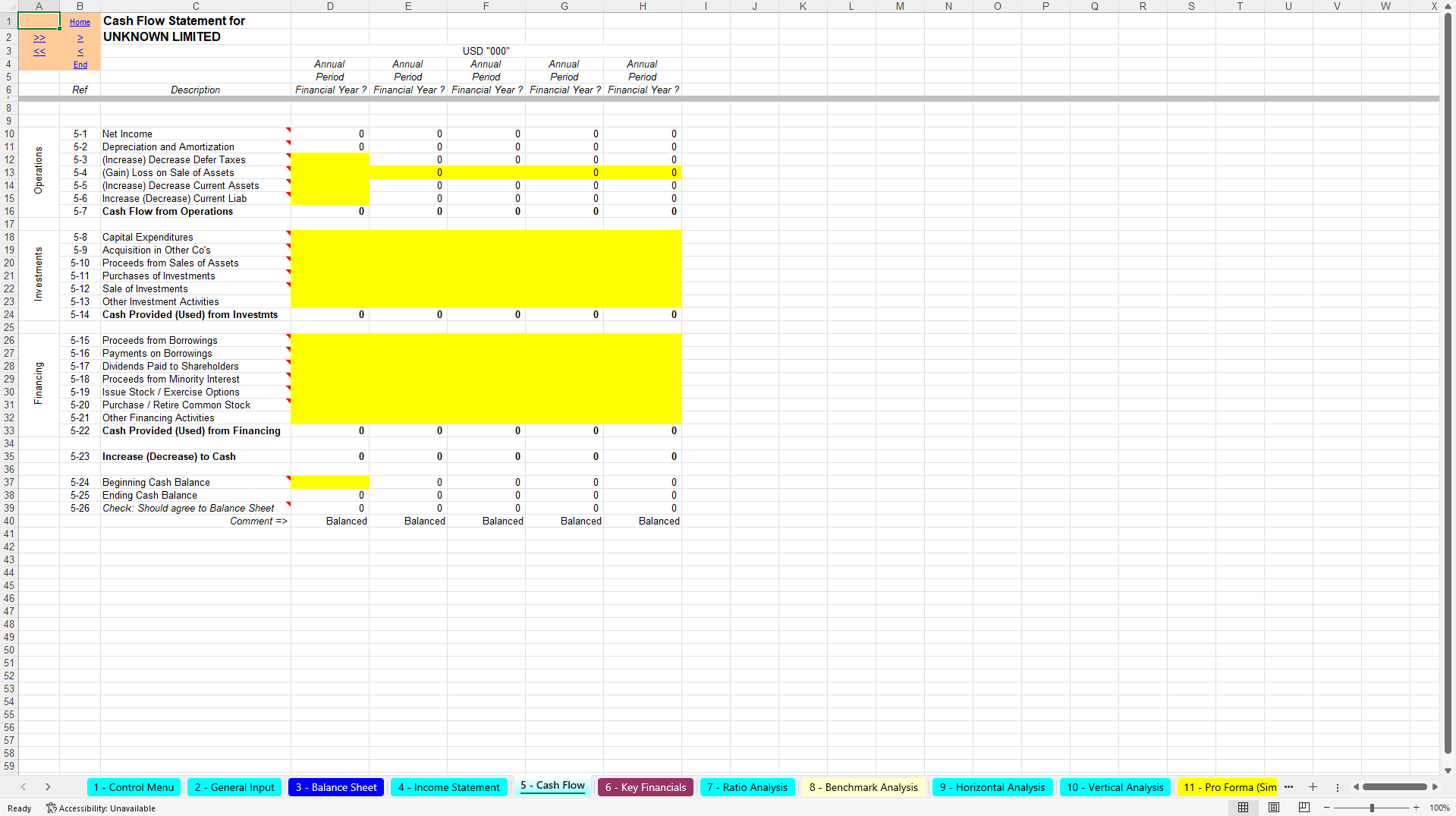
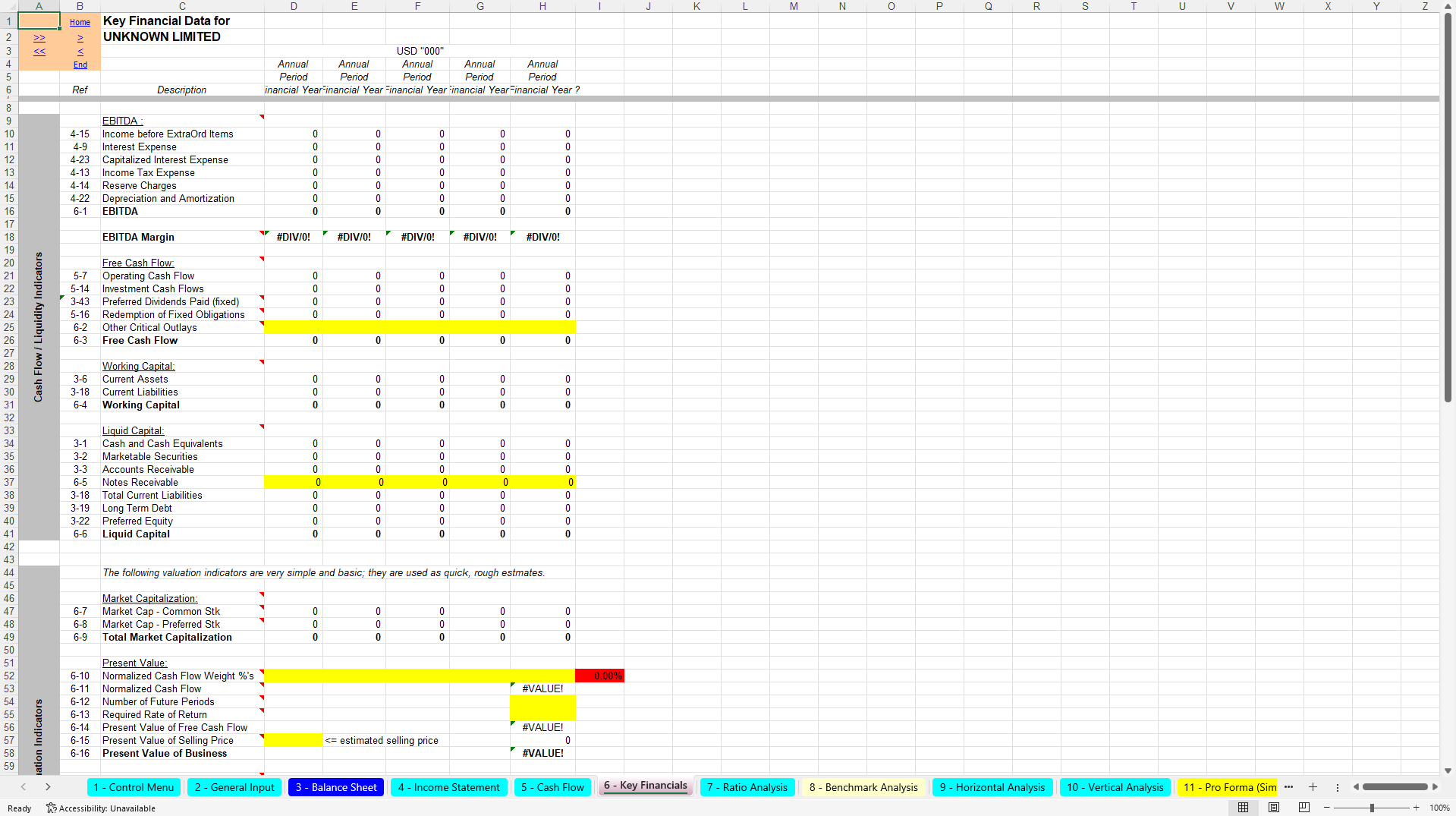
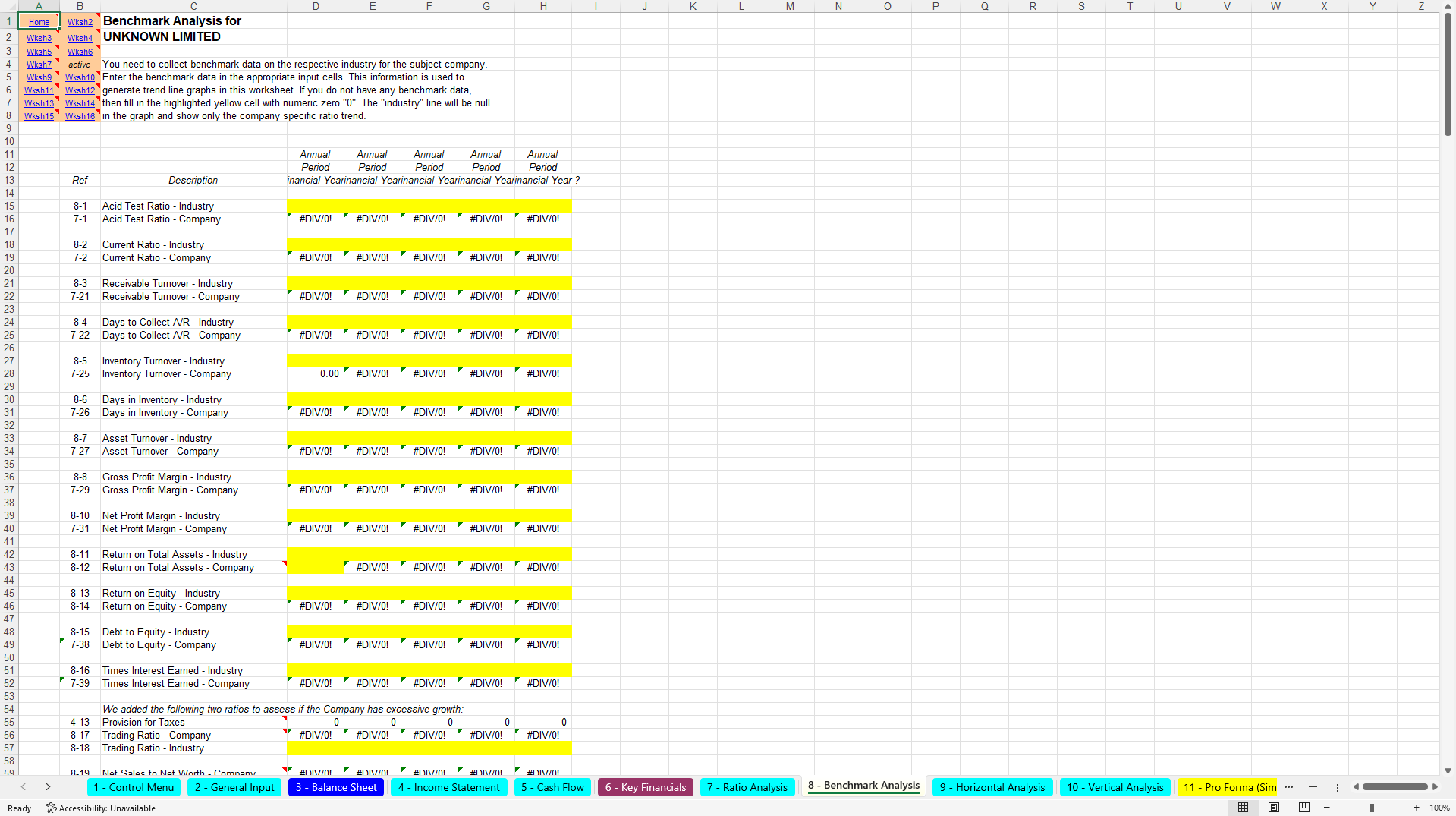
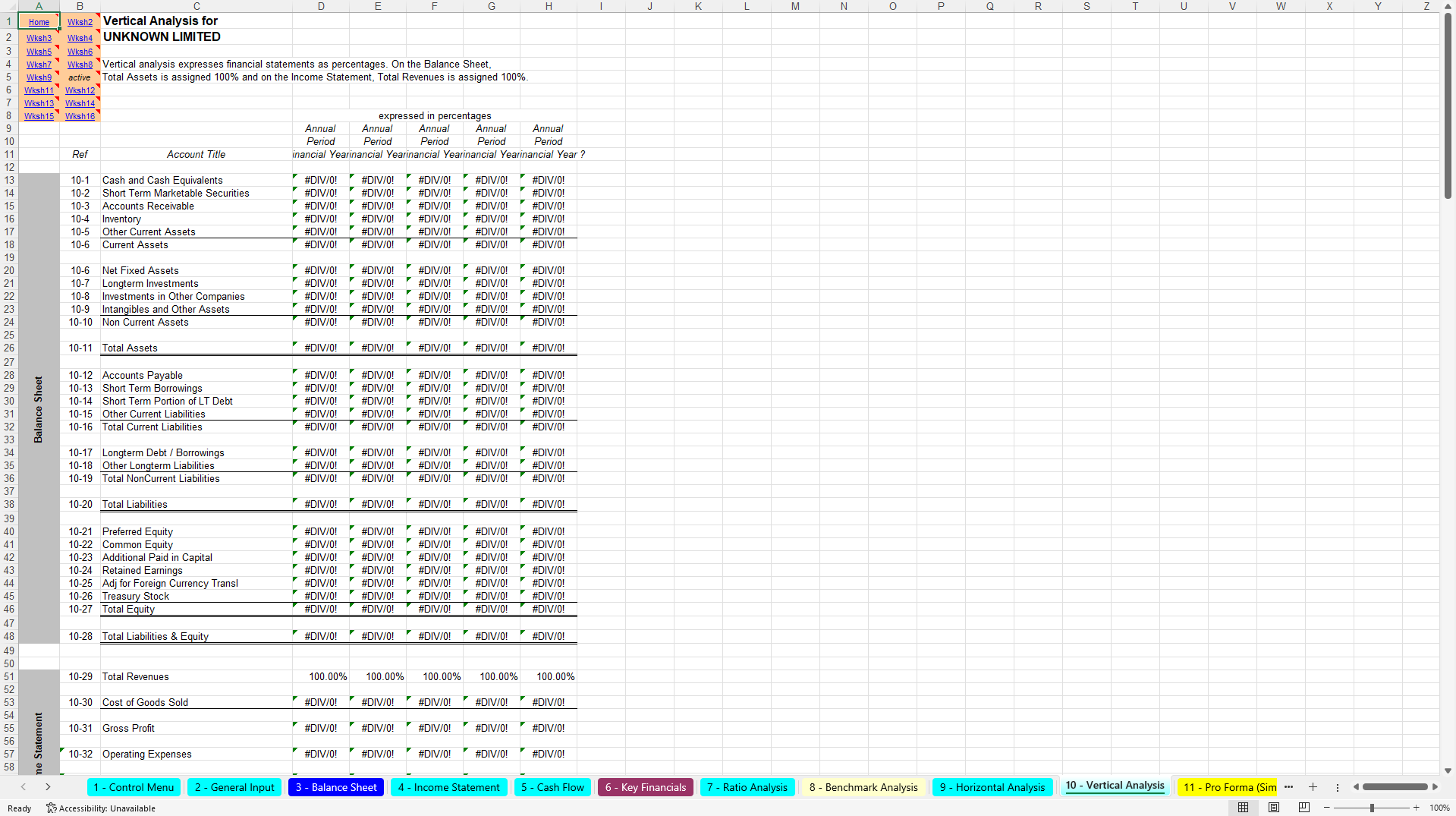
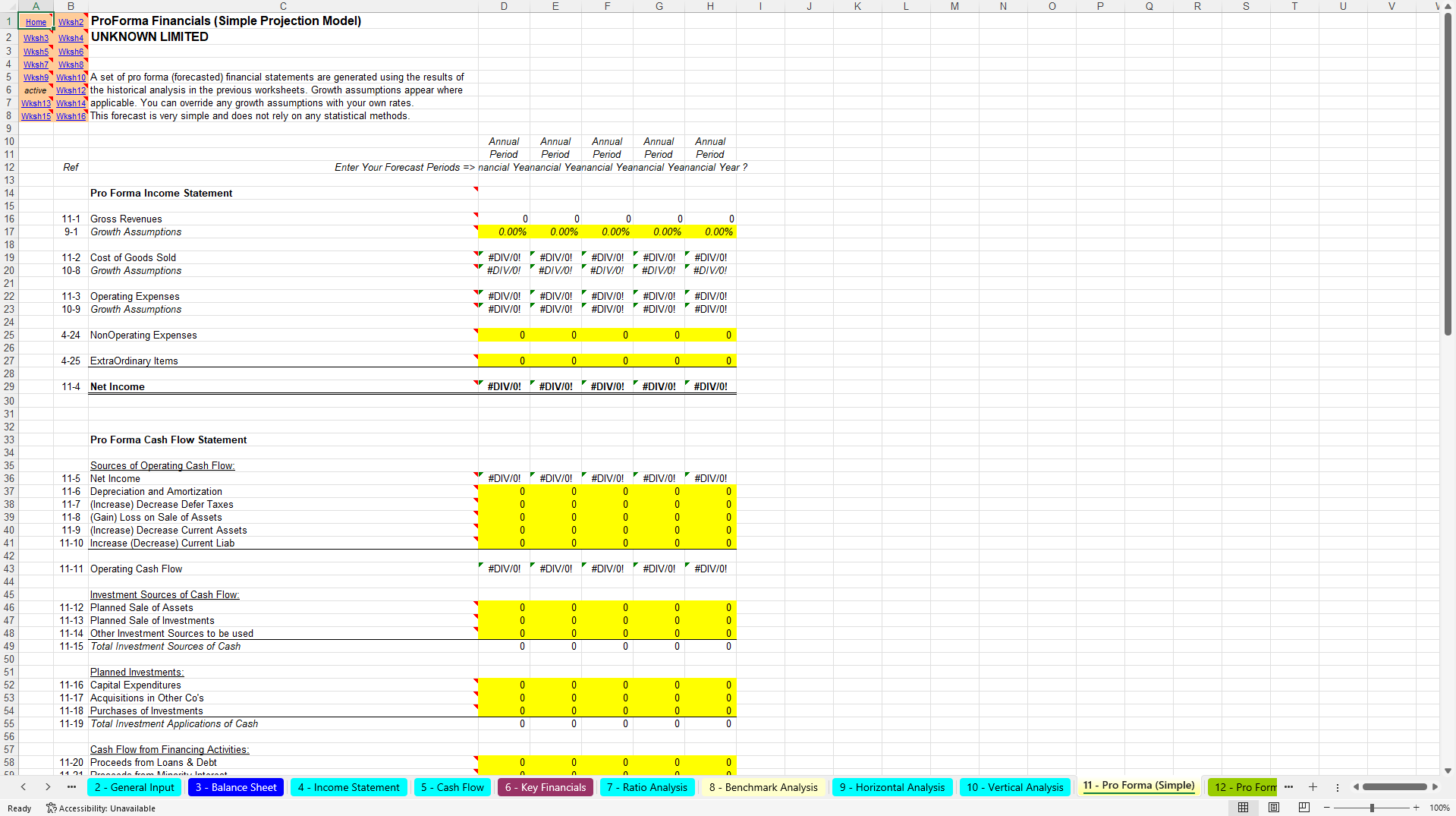
The workbook is organized in three blocks. First, you enter general company settings and up to five periods of Balance Sheet, Income Statement, and Cash Flow data in clearly marked input cells. Second, the model calculates key financial metrics, a full ratio set, and benchmark comparisons against industry averages, supported by horizontal trend analysis and vertical common-size analysis. Third, you move into planning: pro forma financials under simple assumptions, linear-style trending, and exponential approaches, plus scenario-oriented analysis that feeds a budget analysis sheet and a final budget covering the operating plan, cash flows, balance sheet, and external financing required.
For a finance leader or advisor, the practical value is speed with structure. Instead of rebuilding linked statements, ratio packs, and forecast sheets for every engagement or planning cycle, you load historical periods once and work forward through evaluation and budgeting in the same file. Ratio and benchmark views support management discussion, lender packs, and board updates. Pro forma options let you avoid relying on a single forecast method. The final budget block connects operating assumptions to cash and financing need so planning is not disconnected from liquidity.
Typical users include controllers, FP&A teams, CFOs in mid-size organizations, and consultants who prepare financial reviews for clients. The design uses no macros, which reduces friction in environments with strict IT controls. Sample data is included so the structure is visible before you replace figures with your own. For advanced forecast features, Microsoft Excel with Analysis ToolPak and, where relevant, Solver is recommended. If you use fewer than five historical periods, some formulas may need light adjustment, as noted in the control guidance.
This is an analytical and planning template. It does not replace audited financial statements, statutory reporting, tax advice, or formal valuation. Enter your data only in designated input fields and leave calculated cells unchanged. Use outputs as internal management support and as a foundation for discussion with advisors—not as a substitute for professional judgment on your specific situation.
The result is a single workbook that supports diagnosis of past performance, comparison to industry context, forward-looking scenarios, and a consolidated budget view—so planning time is spent on decisions, not on rebuilding the spreadsheet architecture.
Got a question about the product? Email us at support@flevy.com or ask the author directly by using the "Ask the Author a Question" form. If you cannot view the preview above this document description, go here to view the large preview instead.
Source: Best Practices in Financial Analysis, Budgeting & Forecasting Excel: Complete Financial Analysis, Forecasting & Budgeting Toolkit Excel (XLS) Spreadsheet, MW & Digitelax Consulting
ABOUT THE AUTHOR

Welcome to the official enterprise resource hub of MW & Digitelax Consulting. Directed by a seasoned banking executive, corporate risk consultant, and financial content strategist with over 28 years of institutional leadership experience, our practice delivers deployment-ready frameworks designed to drive enterprise efficiency, enforce regulatory compliance, and eliminate systemic model risk. ... [read more]
Ask the Author a Question
You must be logged in to contact the author.




























