 Click main image to view in full screen.
CBAM Excel Tracker | Emissions & Carbon Cost Dashboard – Excel XLSX
Excel (XLSX) + Zip archive file (ZIP)


BENEFITS OF THIS DOWNLOADABLE EXCEL DOCUMENT
- Organize importer records, editable countries and emission factors, Q1-Q4 shipment logs, quantities, CO2 estimates and internal price scenarios in one 10-sheet Excel workbook.
- Review four executive KPI cards and four native Excel charts with formula-driven quarterly totals; 100 prepared rows per register, including 15 realistic illustrative records.
- Includes a separate five-sheet emission-factor database with two native charts, editable sources and review indicators, plus an illustrated CBAM Quick Reference Card and Checklist PDF.
ESG EXCEL DESCRIPTION
🌍 CBAM EXCEL TRACKER TOOLKIT – EU IMPORT & EMISSIONS WORKFLOW
Import Data | Emission Factors | CO₂ Calculations | Internal Quarterly Logs | Carbon Price Scenarios
Create a clearer, more consistent internal process for collecting CBAM-related import data, maintaining emission factors and preparing management reports.
This professional Excel toolkit combines a structured import tracker, a separate source-oriented emission-factor workbook and two concise, illustrated PDF one-pagers.
Designed for EU importers, customs and sustainability teams, consultants, finance and procurement professionals who need editable workbooks rather than a subscription platform.
📊 MAIN CBAM TRACKER – 10 EXCEL WORKSHEETS
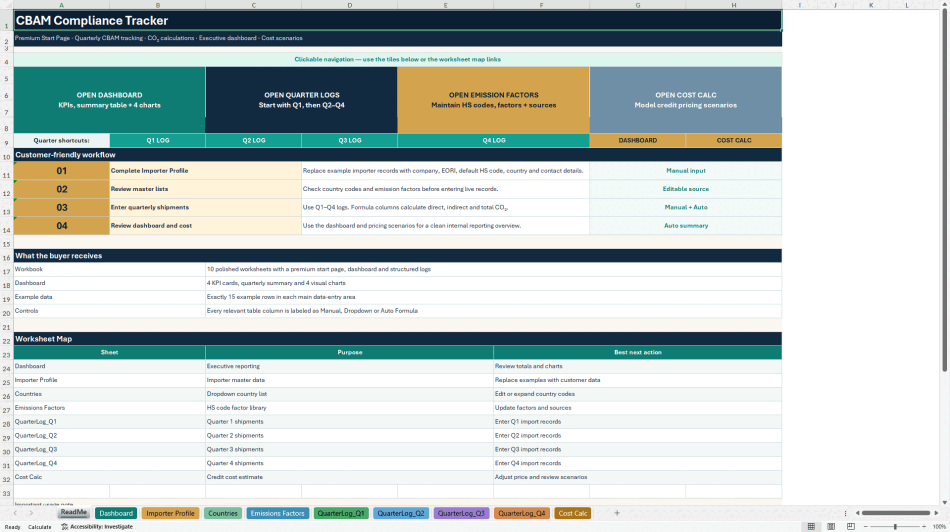
• ReadMe / Start – Navigation, workflow instructions and field legends.
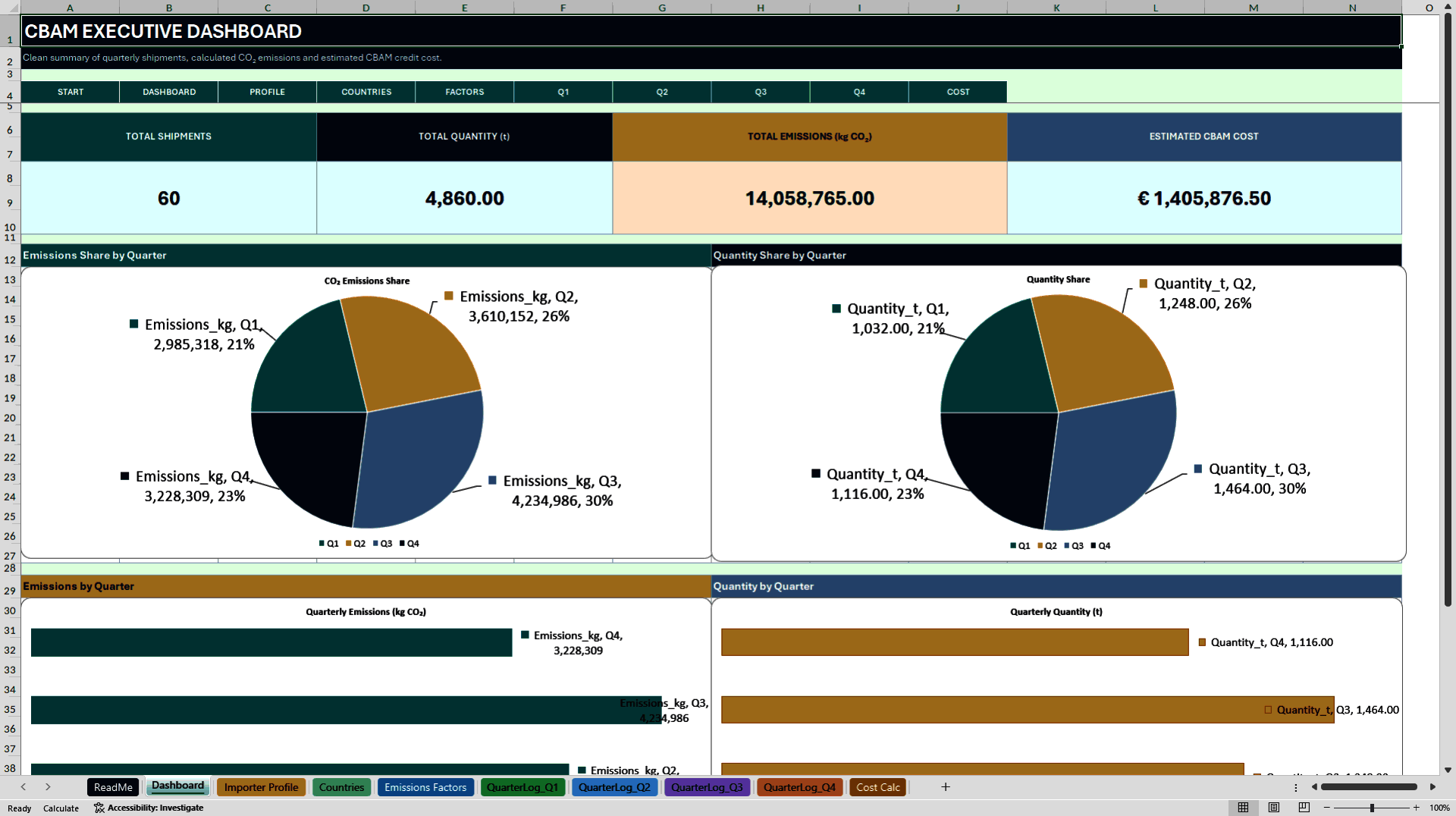
• Dashboard – Four KPI cards and four native charts for shipments, quantity, gross emissions and indicative carbon-price exposure.
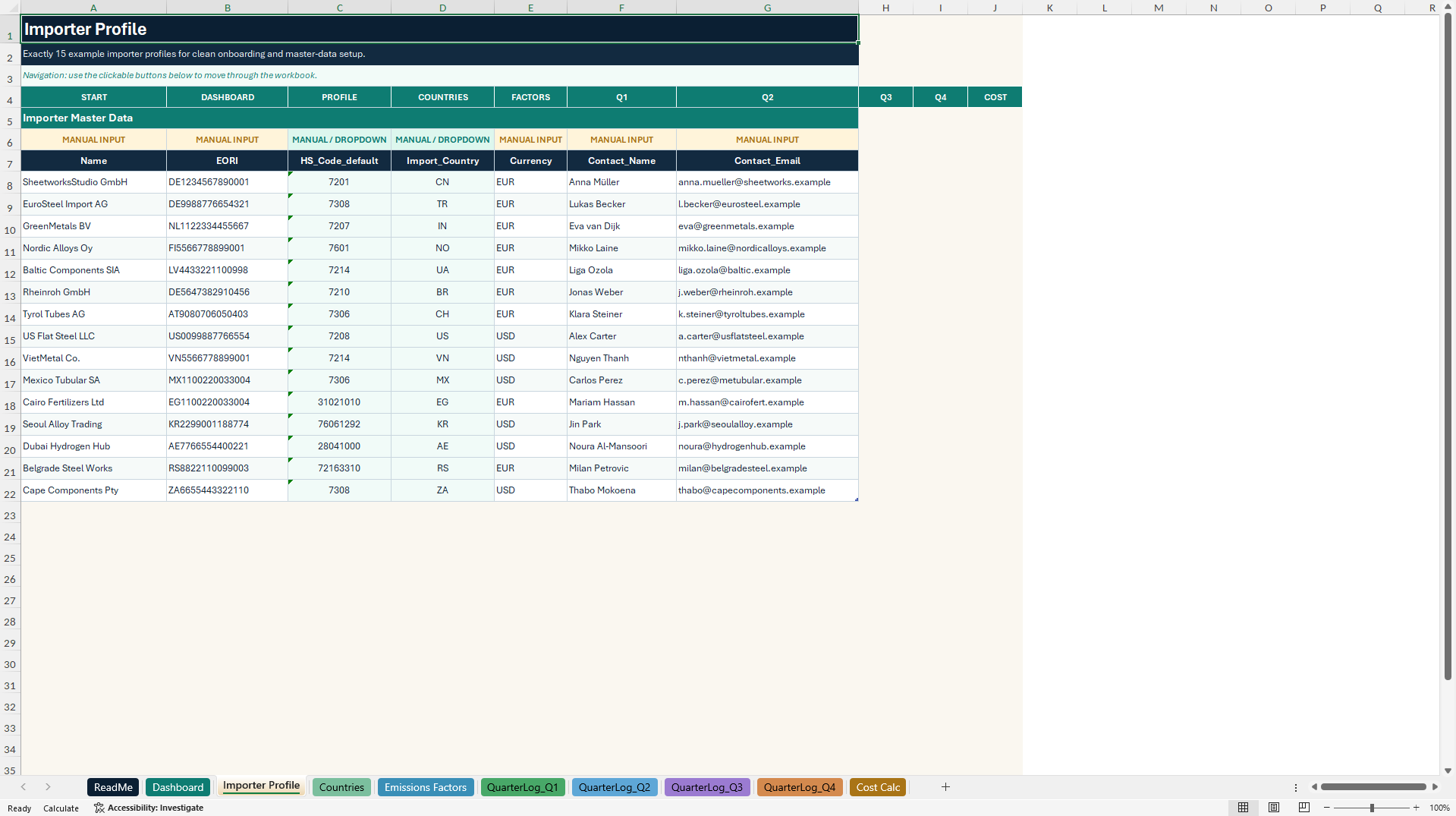
• Importer Profile – Importer identities, EORI details, product defaults, contacts and currencies.
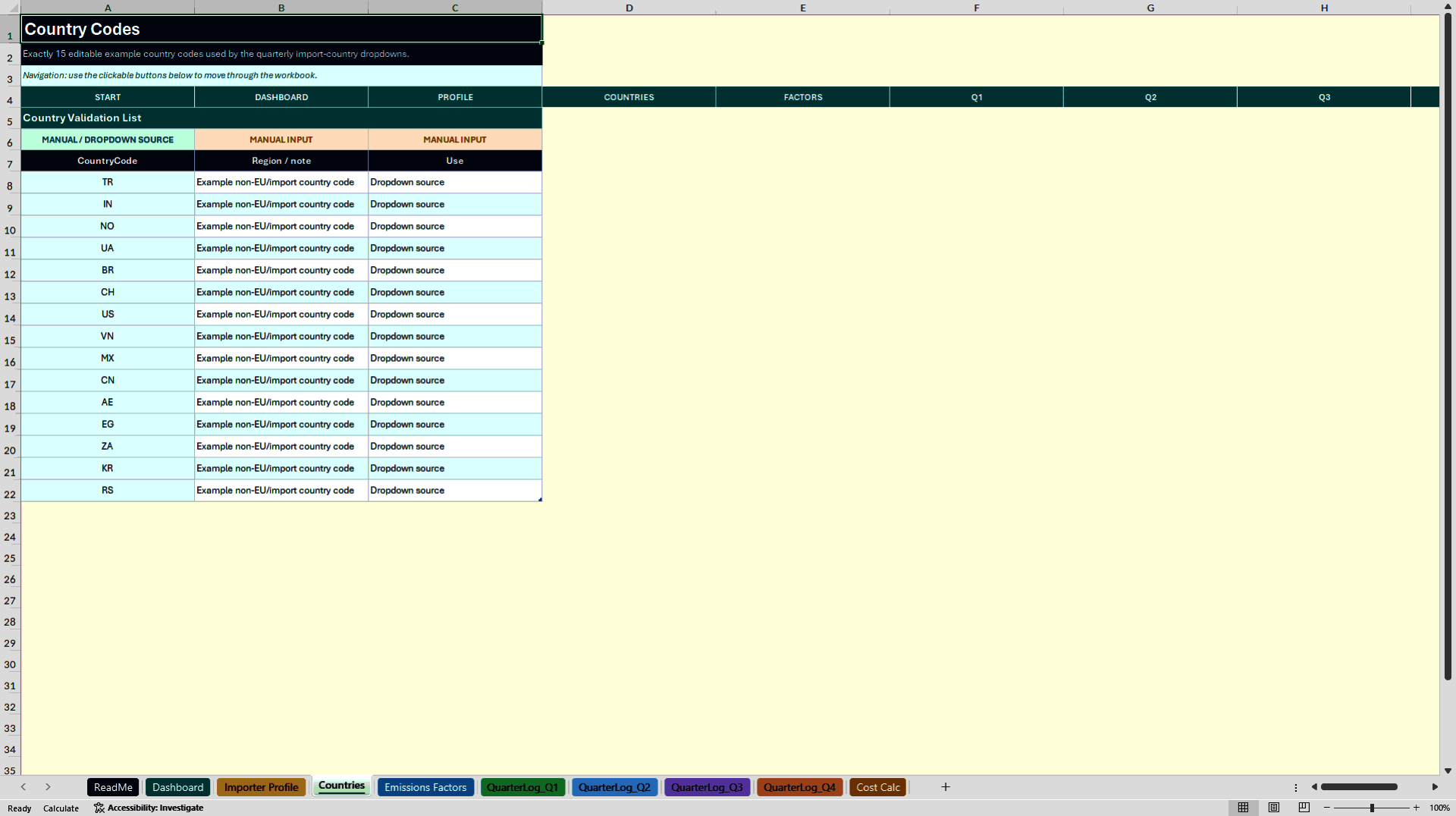
• Countries – Editable country-code reference table.
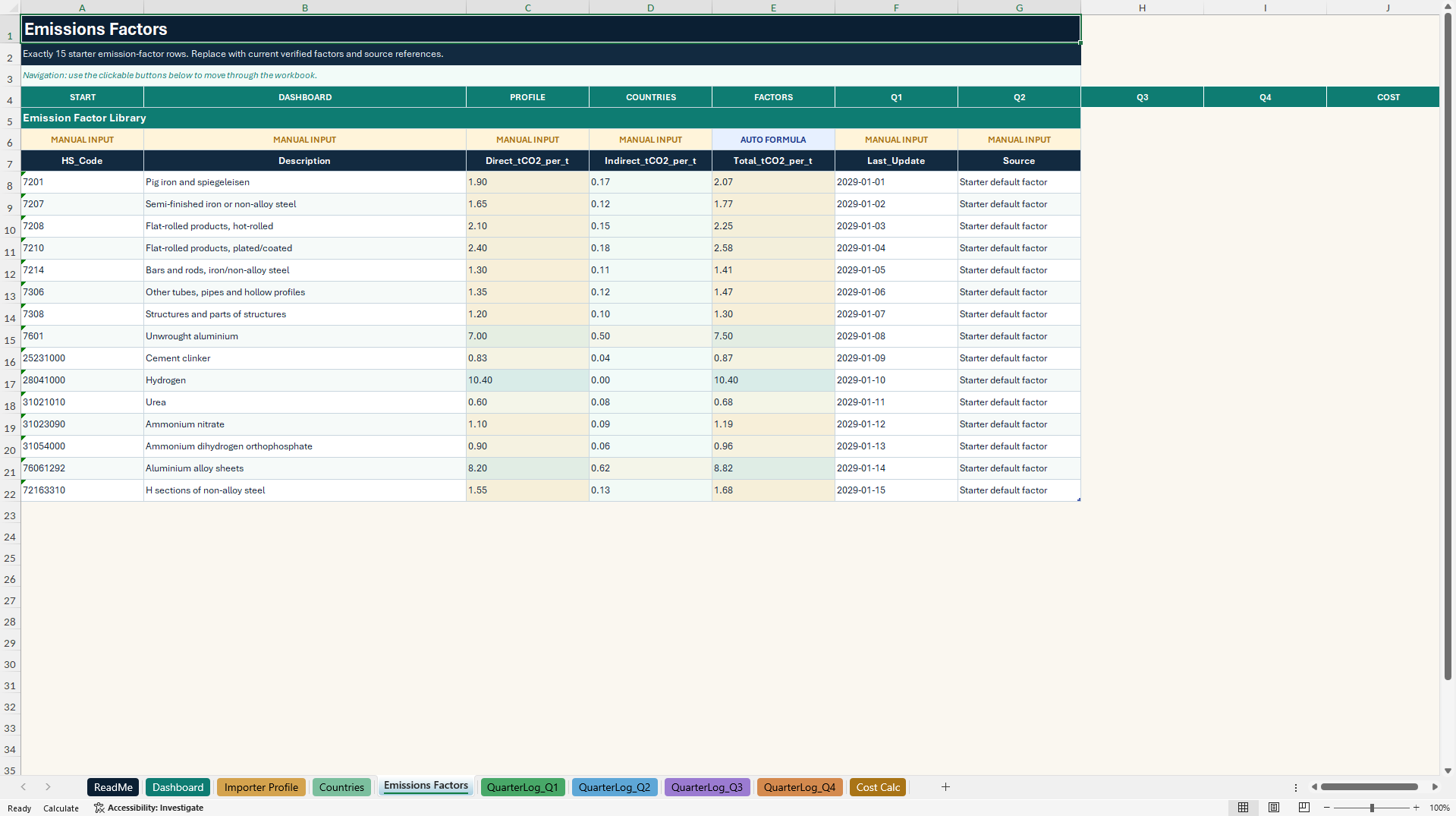
• Emissions Factors – HS/CN-oriented starter factor records, direct and indirect components, dates and source references.
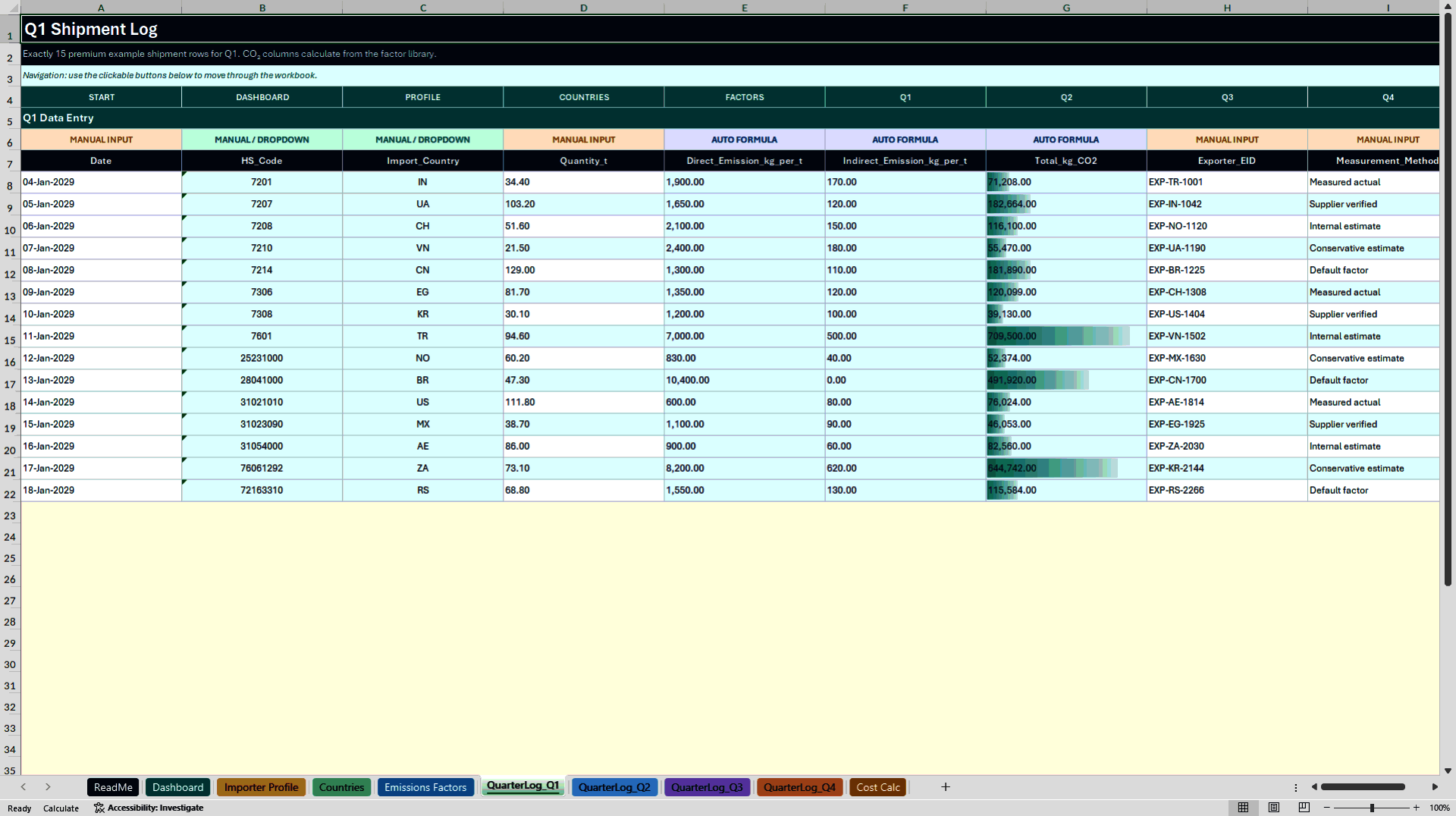
• QuarterLog_Q1 / Q2 / Q3 / Q4 – Record shipment date, product code, origin, net quantity, exporter, calculation method and computed CO₂ estimates.
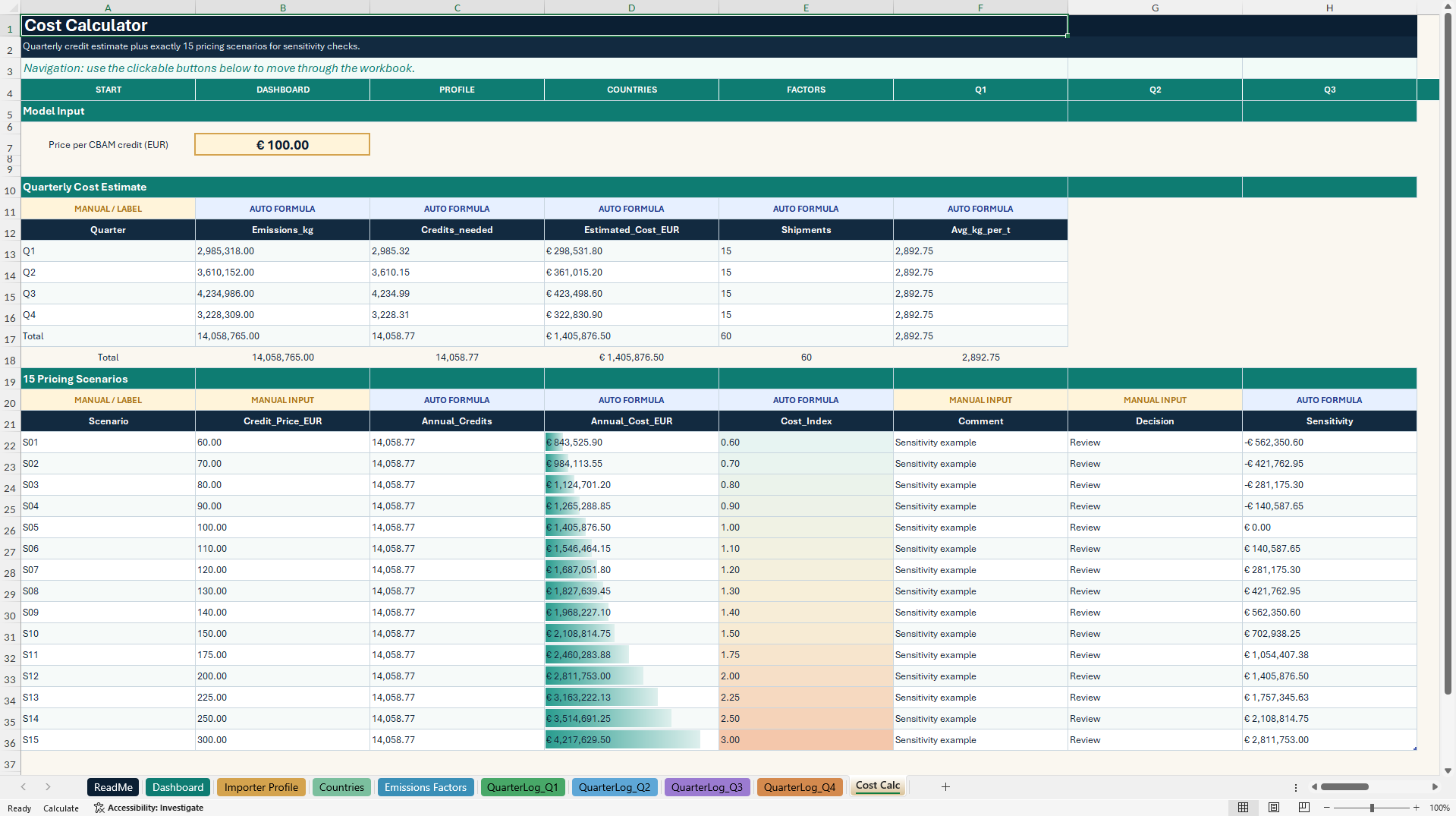
• Cost Calc – Quarterly roll-ups, an adjustable assumed carbon price and 15 illustrative pricing scenarios.
The main operational areas include 15 illustrative sample entries plus 85 prepared blank rows, with relevant formulas and selection fields extended through row 107.
The quarterly sheets are organizational tracking views, not official quarterly CBAM declarations.
📈 MANAGEMENT DASHBOARD
Four formula-linked indicators summarize:
• Shipments recorded
• Imported quantity (tonnes)
• Calculated emissions (kg CO₂)
• Illustrative gross carbon-price exposure (EUR)
Four native Excel charts visualize quarterly emissions and shipment quantities as shares and comparisons.
The cost scenarios apply an assumed euro-per-tonne carbon price to gross estimated CO₂. They do NOT calculate a legally due CBAM certificate amount, which can depend on sector-specific rules, verified/default values, free-allocation adjustments and eligible carbon-price deductions.
🧮 BONUS – EMISSION FACTOR DATABASE
A separate five-sheet Excel workbook with:
• Start and navigation
• Database dashboard with KPIs and two native charts
• Emission Factors with 15 clearly flagged starter records and 85 prepared blank rows
• Source Register for evidence and links
• Editable Lists and review-status dropdowns
The factor database is a standalone reference companion. It does not automatically synchronize with the main tracker; verified values must be reviewed and transferred manually as needed.
Starter factors and country/product examples are not official current emission values.
📄 TWO ILLUSTRATED A4 PDF GUIDES
• CBAM Quick Reference Card – Internal workflow, sector orientation, factor checks and document controls.
• CBAM Workbook Checklist – One-page quick setup, importer details, factor review, quarterly tracking, dashboard review and record archiving.
🎯 IDEAL FOR
EU importers and indirect customs representatives, customs teams, sustainability/ESG managers, procurement, compliance departments and consultants organizing CBAM-related data.
📦 COMPLETE DIGITAL DELIVERY
1. CBAM Compliance Tracker – 10-sheet Excel workbook (.xlsx)
2. Emission Factor Database – 5-sheet Excel workbook (.xlsx)
3. CBAM Quick Reference Card – one-page PDF
4. CBAM Checklist / How-to – one-page PDF
Total: Two editable Excel workbooks, six native Excel charts and two PDF one-pagers.
No physical product is shipped.
⚙️ TECHNICAL INFORMATION
Macro-free Excel files with no VBA or mandatory external connections. Microsoft Excel Desktop is recommended for navigation, dropdowns, recalculation and chart rendering.
Google Sheets import is not guaranteed to reproduce all Excel-specific features or formatting.
⚖️ IMPORTANT CBAM REGULATORY NOTICE
The definitive EU Carbon Border Adjustment Mechanism (CBAM) entered into force on 1 January 2026.
The first annual CBAM declaration for 2026 imports is generally due by 30 September 2027 for those subject to the obligation. Legal scope, the 50-tonne de minimis threshold and relevant exemptions must be checked using official guidance and the applicable current legislation.
This is an independent, unofficial internal data-collection and planning template.
It is not connected to the EU CBAM Registry and does not submit declarations, verify emissions, calculate legally binding certificate obligations, certify compliance or replace professional customs, legal, tax or sustainability advice.
Illustrative emission factors, prices, product codes and 2029 demonstration records are for workflow examples only.
Users must verify sector/CN coverage, direct versus indirect emissions applicability, supplier evidence, default versus actual values, free-allocation adjustments, carbon prices paid outside the EU and certificate/pricing rules for their circumstances.
SheetworksStudio – Independent Professional Excel Templates.
Got a question about the product? Email us at support@flevy.com or ask the author directly by using the "Ask the Author a Question" form. If you cannot view the preview above this document description, go here to view the large preview instead.
Source: Best Practices in ESG, Tariff Management Excel: CBAM Excel Tracker | Emissions & Carbon Cost Dashboard Excel (XLSX) Spreadsheet, SheetworksStudio
ABOUT THE AUTHOR

SheetworksStudio creates premium Excel-based business templates, dashboards, trackers, financial models, and management systems for professionals, consultants, entrepreneurs, and organizations.
Our portfolio covers finance, project management, operations, risk management, compliance, AI governance, HR, supply chain, performance management, and business planning. Each product is designed to
... [read more]
Ask the Author a Question
You must be logged in to contact the author.