
 Click main image to view in full screen. Unlock all 20 preview images:
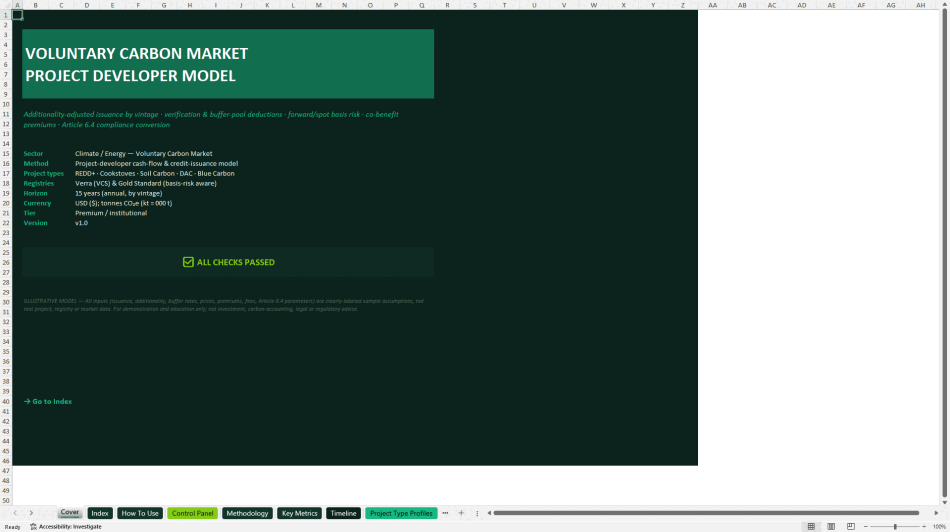
Voluntary Carbon Market Project Developer Model – Excel XLSX
Excel (XLSX) + supplemental PDF


BENEFITS OF THIS DOWNLOADABLE EXCEL DOCUMENT
- Provides a structured framework for evaluating voluntary carbon market project economics, including tonne issuance, verification costs, registry fees, buffer deductions and revenue strategy.
- Helps users analyze project value under forward sale, spot sale, price basis risk, co-benefit premium and Article 6.4 compliance conversion scenarios.
- Supports better investment, development and feasibility decisions for REDD+, cookstove, soil carbon, DAC and blue carbon project types.
ESG EXCEL DESCRIPTION
⚡ Voluntary Carbon Market Project Developer Model is a professional financial planning workbook built for carbon project developers, VCM investors, climate finance teams, sustainability consultants, ESG analysts and project sponsors evaluating voluntary carbon credit projects.
Carbon project development requires more than a basic revenue forecast.
A serious carbon credit model needs to account for:
Project type and methodology
Carbon credit issuance by vintage
Additionality adjustments
Leakage or risk deductions
Validation and verification costs
Registry and issuance fees
Buffer pool contributions
Forward sale and spot market pricing
Carbon price basis risk
Co-benefit premiums
Compliance conversion scenarios
Project cash flow and valuation
This workbook brings those components together in one structured model.
What the Model Covers
The model includes:
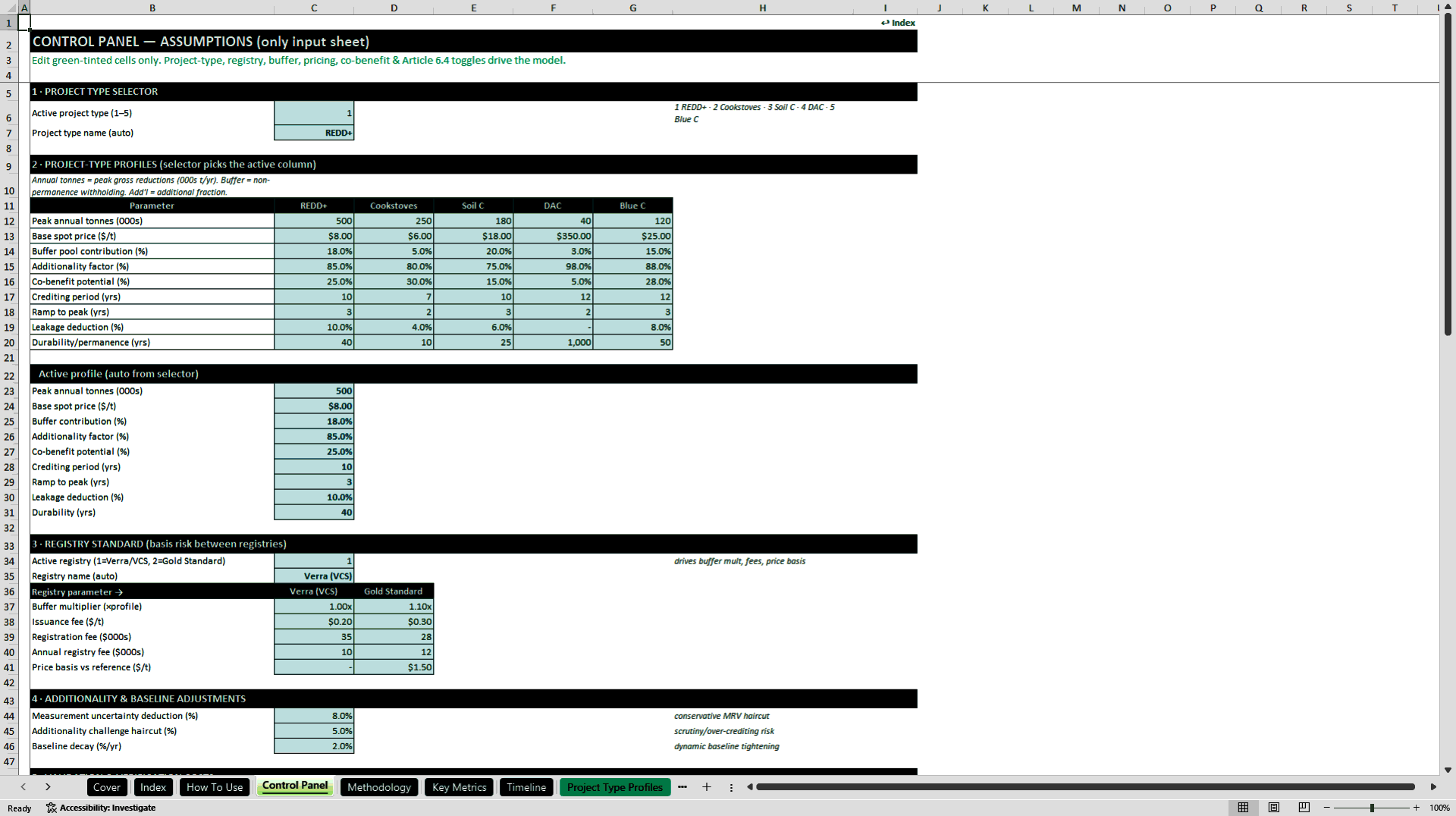
✅ Project type selector
✅ REDD+ project logic
✅ Cookstove project logic
✅ Soil carbon project logic
✅ Direct Air Capture project logic
✅ Blue carbon project logic
✅ Additionality-adjusted tonne issuance forecast
✅ Vintage-level issuance schedule
✅ Validation and verification cost schedule
✅ VVB fee assumptions
✅ Registry fee assumptions
✅ Buffer pool contribution deductions
✅ Forward sale revenue forecast
✅ Spot market revenue forecast
✅ Price basis risk analysis
✅ Co-benefit premium modeling
✅ SDG, biodiversity and community premium assumptions
✅ Article 6.4 compliance unit conversion scenario
✅ Project cost summary
✅ Cash flow forecast
✅ Project valuation
✅ Scenario analysis
✅ Sensitivity analysis
✅ Dashboard and audit checks
The model is designed to help users evaluate whether a carbon project is financially viable after issuance deductions, verification costs, registry costs, market pricing risk and sale strategy assumptions.
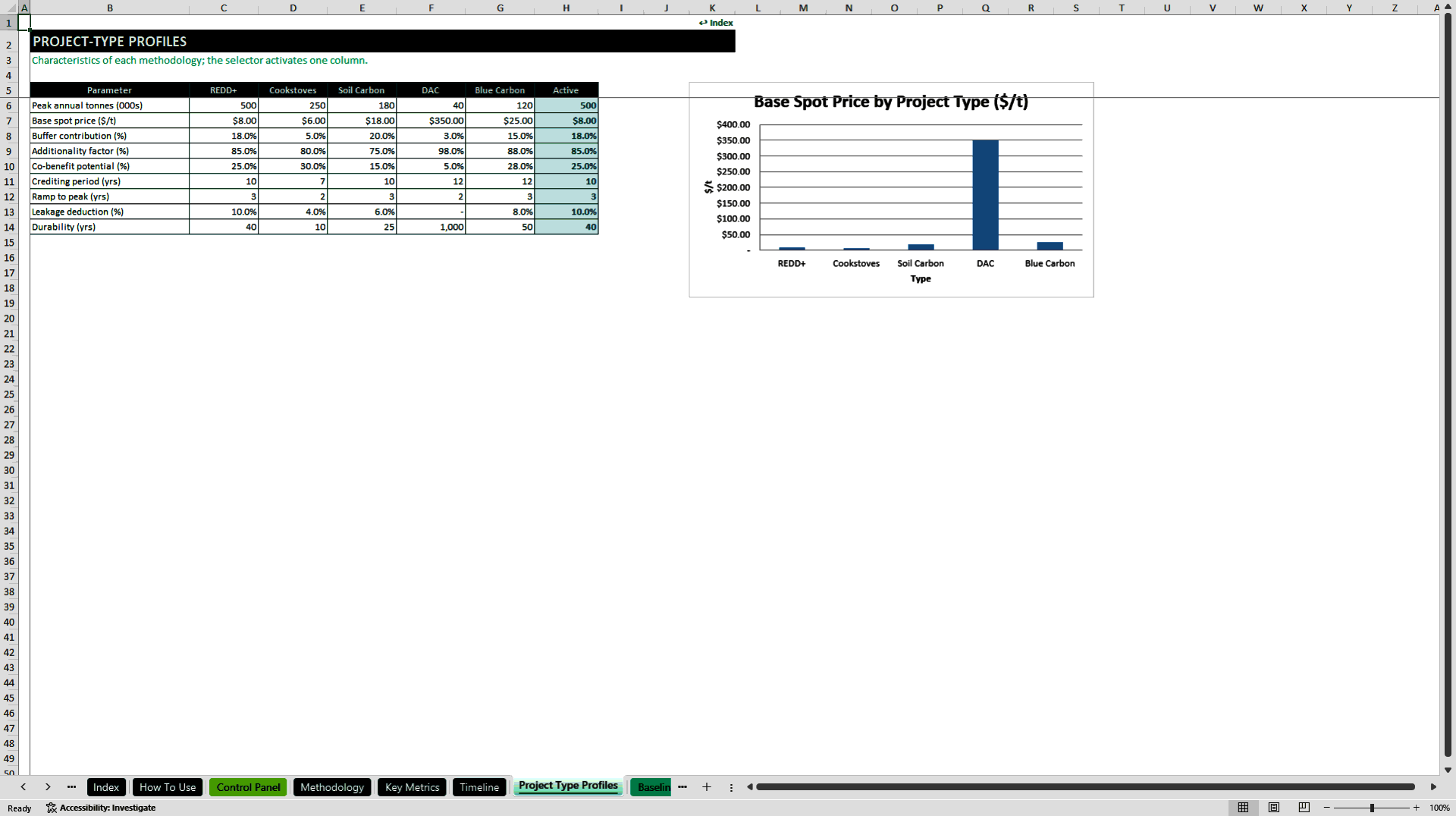
Project Type Selector
🌳 The workbook includes a project type selector for multiple carbon project categories.
Included categories:
REDD+
Cookstoves
Soil carbon
Direct Air Capture
Blue carbon
This allows users to analyze different project types using one integrated framework while still reflecting different project economics, cost profiles and issuance assumptions.
Tonne Issuance and Additionality
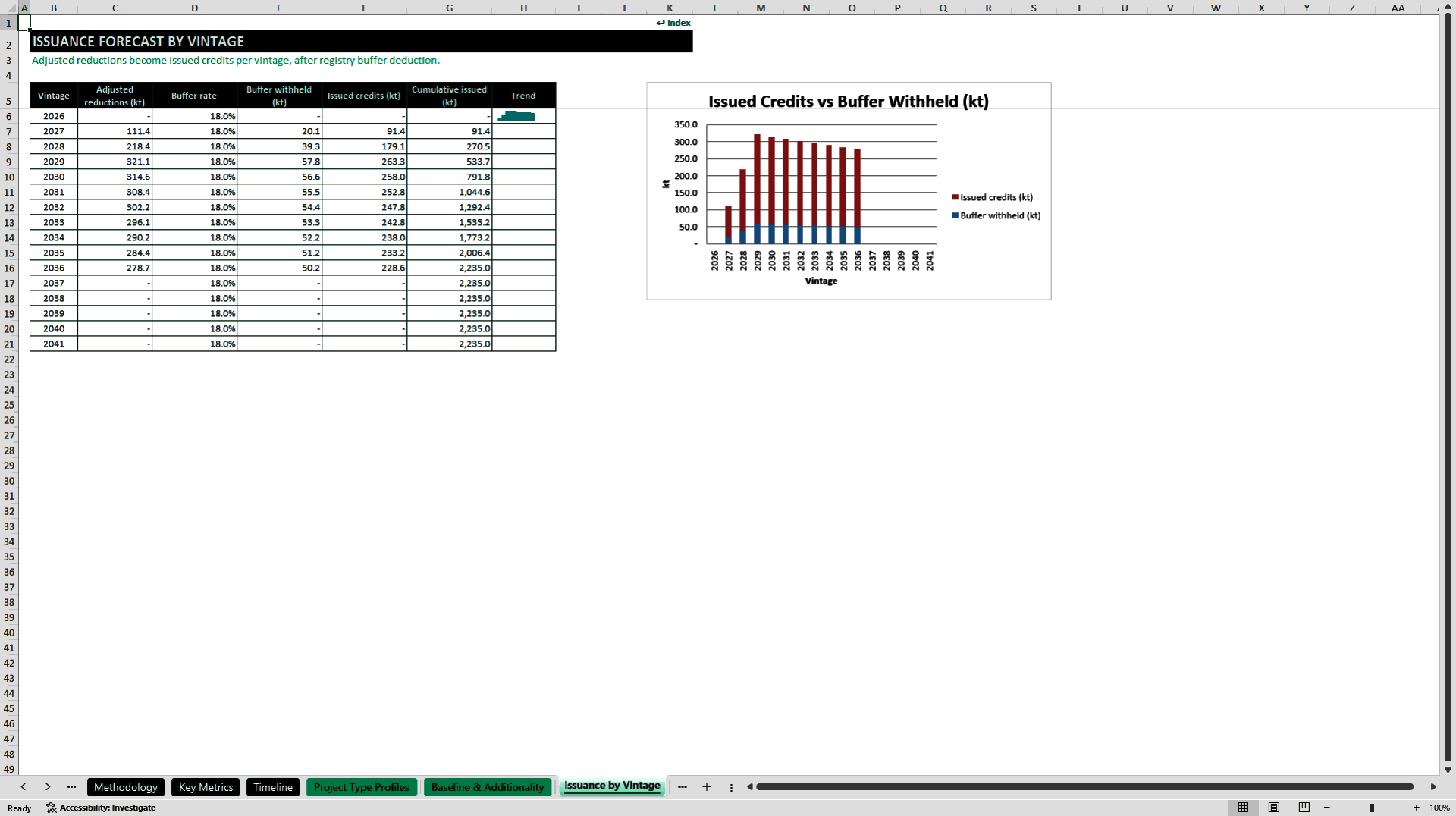
📦 The model forecasts carbon credit issuance by vintage.
It includes:
✅ Baseline tonne generation
✅ Additionality adjustment
✅ Leakage or risk deductions
✅ Verification timing
✅ Buffer contribution deductions
✅ Net saleable credits
✅ Cumulative credit issuance
This helps users understand the difference between gross project impact and actual tradable credit volume.
Verification, Registry and Buffer Pool Costs
🔍 The workbook includes validation and verification cost schedules covering VVB fees, registry fees, issuance fees and recurring verification costs.
🛡️ It also includes buffer pool contribution logic, allowing users to calculate how many credits are deducted or reserved under registry standards.
This is important because project economics can change materially after verification cost, registry cost and buffer pool deductions.
Forward Sale, Spot Sale and Basis Risk
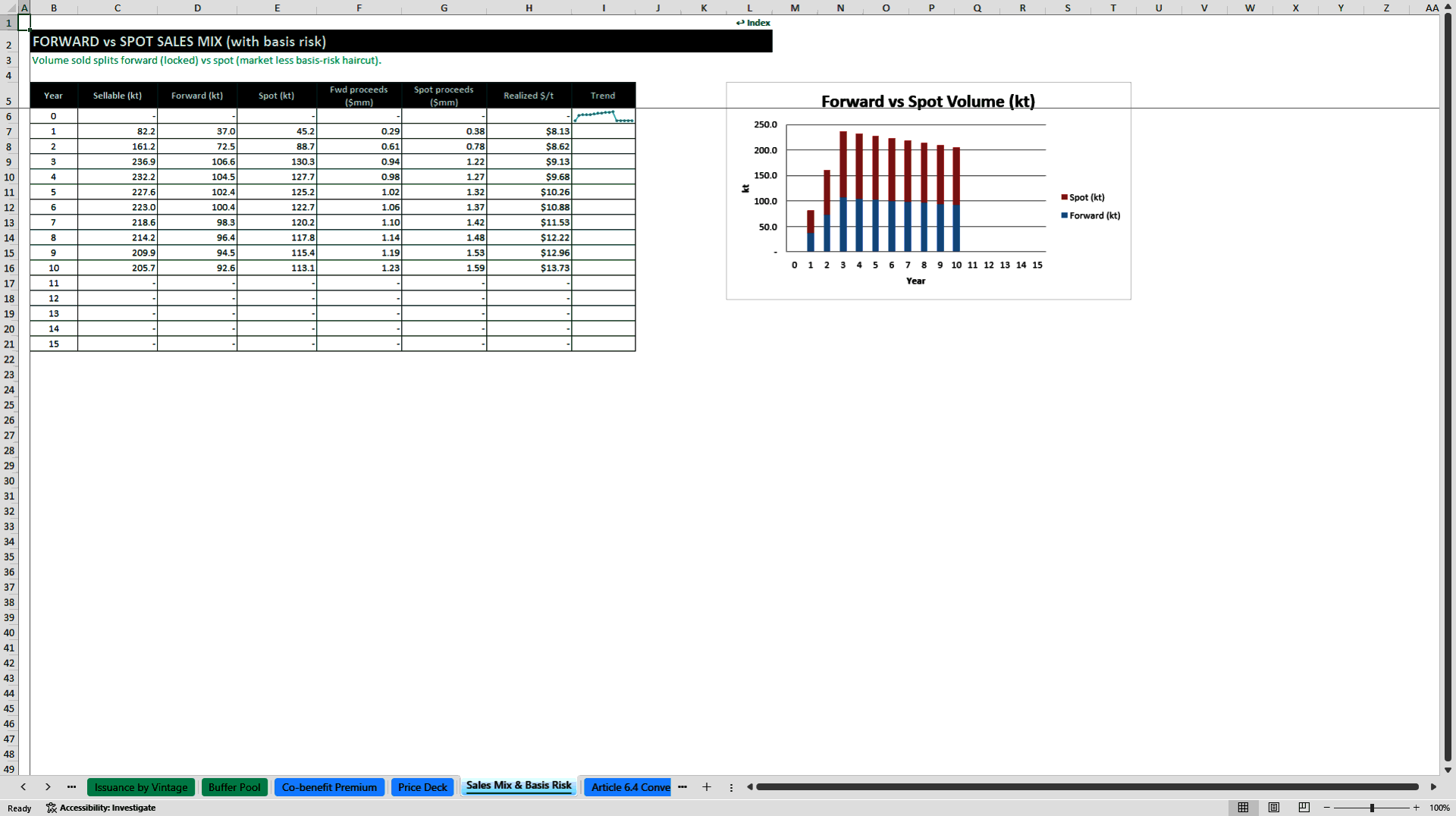
💰 Carbon credit projects may monetize credits through forward agreements, spot market transactions or a blend of both.
The model includes:
Forward sale mix
Spot sale mix
Forward price assumptions
Spot price assumptions
Basis risk between reference price and realized project price
Revenue comparison by sale strategy
Market risk sensitivity
This helps users analyze price certainty versus market upside.
Co-Benefit Premium and Article 6.4 Scenario
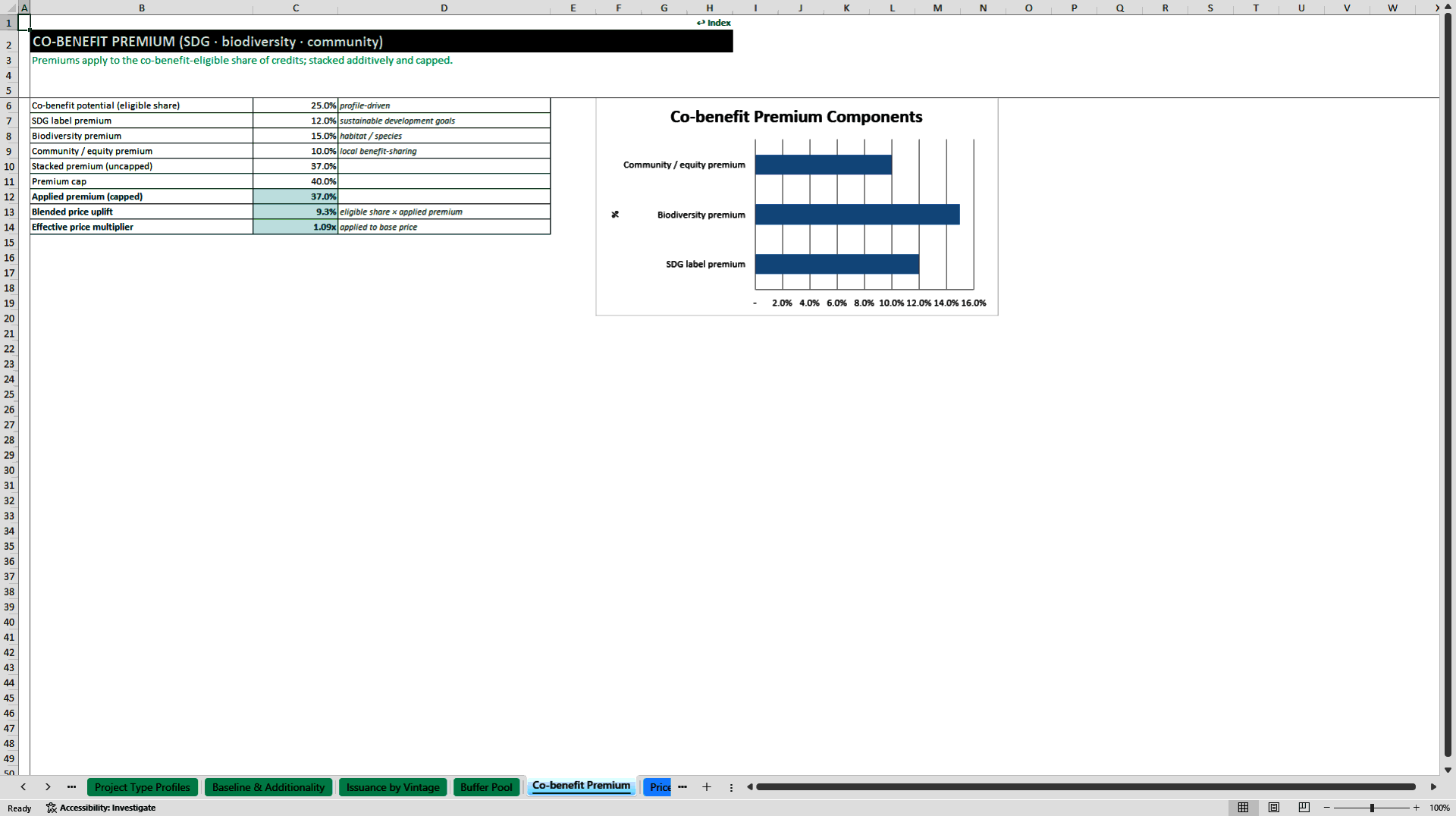
🌍 The workbook includes co-benefit premium assumptions for projects with SDG, biodiversity, community or high-integrity attributes.
📜 It also includes an Article 6.4 scenario to evaluate potential compliance-unit conversion logic, including conversion haircut, pricing impact and revenue effect.
These features are useful for evaluating how credit quality and policy-related scenarios may affect project value.
Outputs Included
📊 The workbook includes:
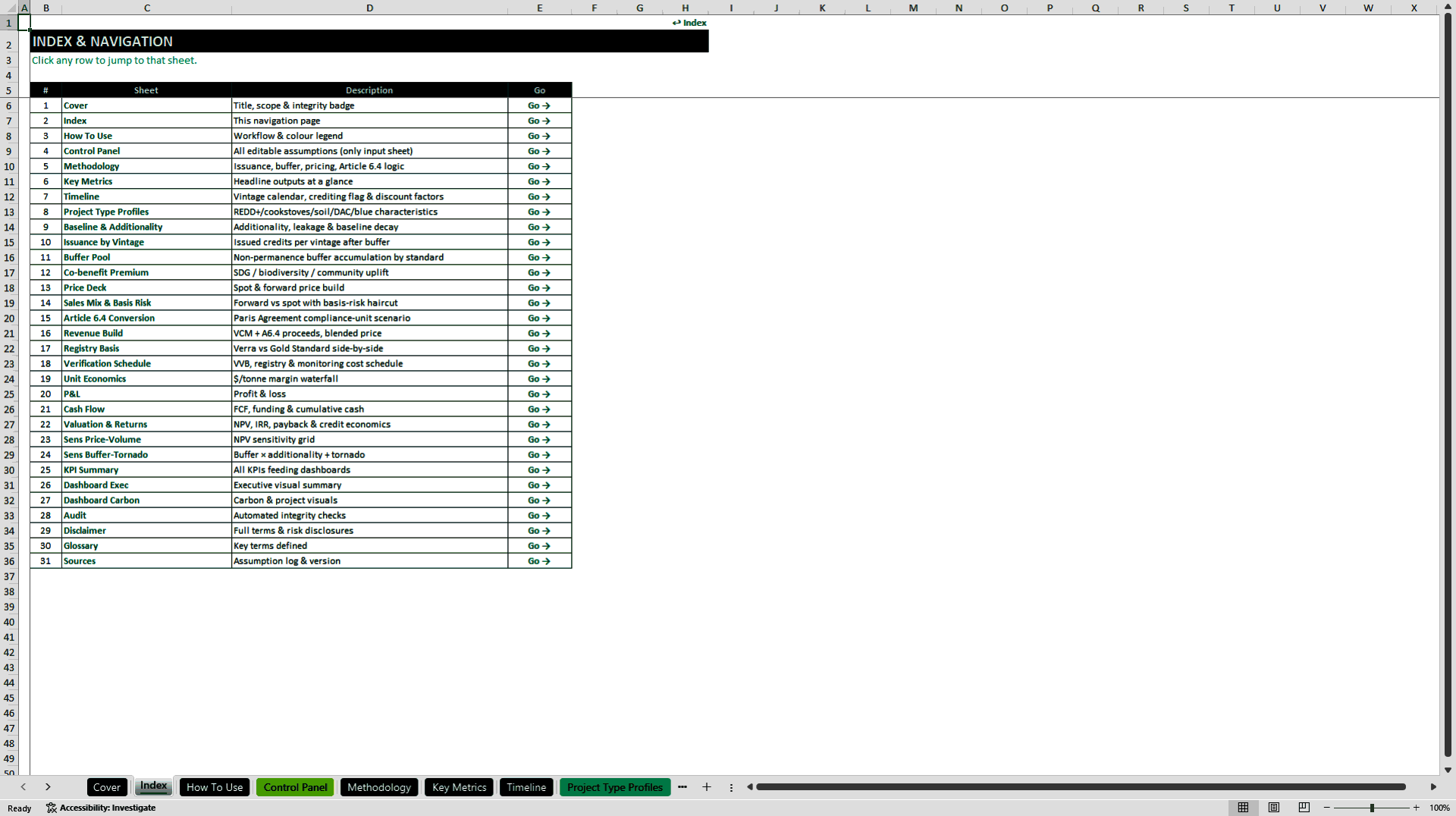
✅ Control Panel
✅ Project Type Selector
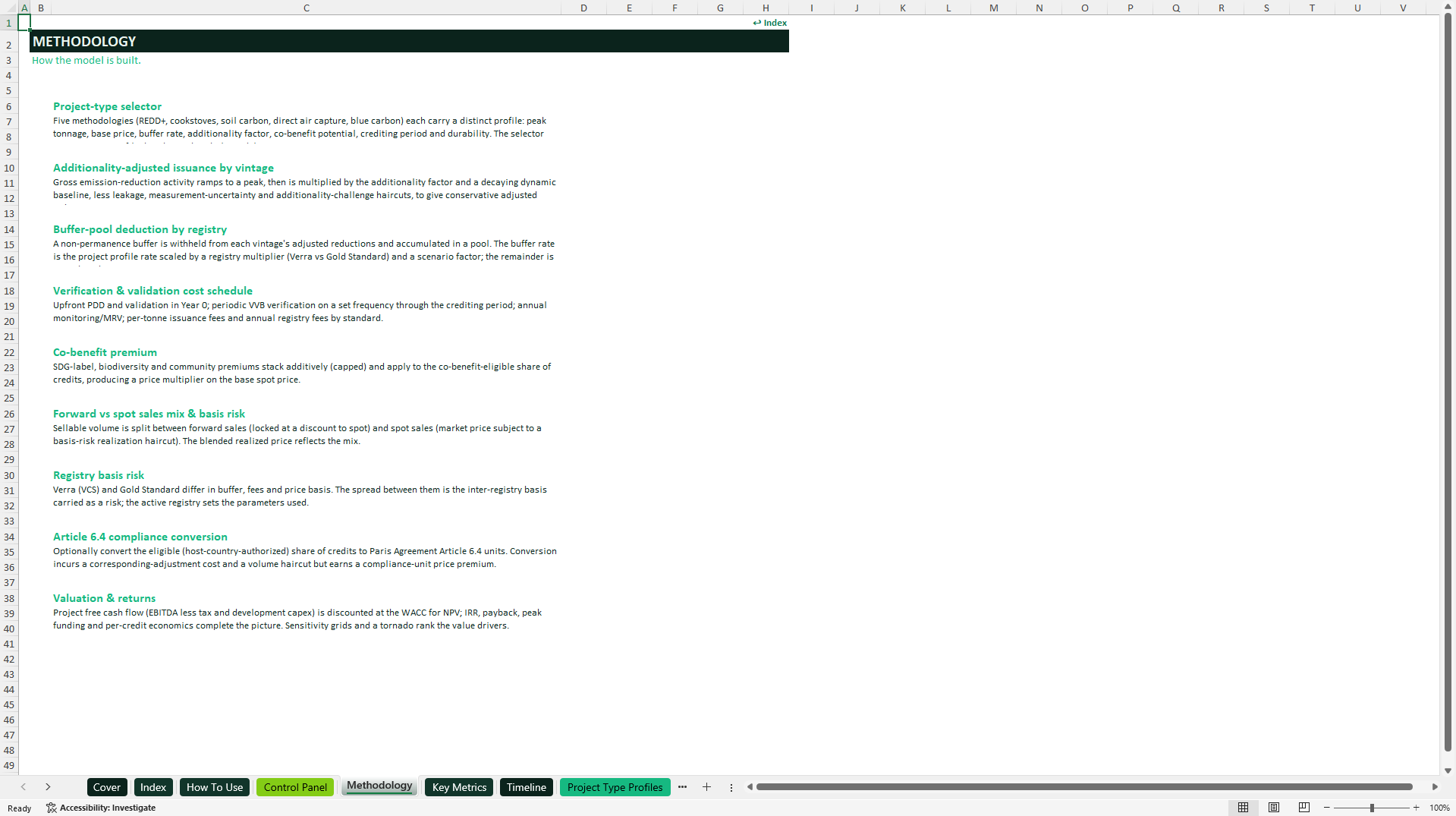
✅ Methodology
✅ Tonne Issuance Forecast
✅ Vintage Schedule
✅ Additionality Adjustment
✅ Verification Cost Schedule
✅ Registry Fee Schedule
✅ Buffer Pool Deductions
✅ Forward Sale Revenue
✅ Spot Market Revenue
✅ Price Basis Risk
✅ Co-Benefit Premium
✅ Article 6.4 Scenario
✅ Project Cost Summary
✅ Revenue Summary
✅ Cash Flow Forecast
✅ Project Valuation
✅ Scenario Summary
✅ Sensitivity Analysis
✅ KPI Summary
✅ Dashboard
✅ Audit Checks
✅ Disclaimer
✅ Glossary
Who This Document Is For
This model is suitable for:
Carbon project developers
REDD+ project sponsors
Cookstove project developers
Soil carbon project teams
Direct Air Capture project analysts
Blue carbon project developers
VCM investors
Climate finance teams
ESG and impact investors
Sustainability consultants
Carbon market advisors
Corporate sustainability teams
Project finance analysts
Climate funds and infrastructure investors
Got a question about the product? Email us at support@flevy.com or ask the author directly by using the "Ask the Author a Question" form. If you cannot view the preview above this document description, go here to view the large preview instead.
Source: Best Practices in ESG, Integrated Financial Model Excel: Voluntary Carbon Market Project Developer Model Excel (XLSX) Spreadsheet, PDMM Financial Models
ABOUT THE AUTHOR

PDMM Financial Models develops professional, decision-ready Excel models for business owners, entrepreneurs, investors, consultants, analysts, and finance teams. Our objective is to transform complex business assumptions into clear, structured analysis that supports better planning and investment decisions.
Our models cover business planning, forecasting, budgeting, feasibility analysis,
... [read more]
Ask the Author a Question
You must be logged in to contact the author.




























