Creating a compelling story with a logical structure that is easy to understand and easy to remember
Discovering and clarifying the points you want to make to better convince busy executive clients
Grasping the attention of your audience within the first few minutes
COMMUNICATIONS STRATEGY PPT DESCRIPTION
Editor Summary
Business Communications - Best Practice is a 12-slide PowerPoint deck by P-Square Partners that teaches the Pyramid Principle for structuring storylines and executive communication.
Read moreIncludes a storyline template, storyline samples, top-down and bottom-up development guides, a quality-check checklist, and customization guidance. Target users include corporate executives, consultants, project managers, and marketing teams. Used for executive presentations, board meetings, client communications, and team training. Sold as a digital download on Flevy with immediate digital download.
Use this deck when you must present complex conclusions succinctly—for example ahead of board meetings, client proposals, internal strategic reports, or communication-skills training.
Corporate executives preparing a board deck that starts with the main recommendation and lists supporting arguments.
Management consultants structuring client deliverables using top-down storylines and MECE grouping.
Project managers condensing project findings into an executive summary that highlights the governing thought.
Marketing leads developing thought-leadership pieces that map arguments to a key line.
The emphasis on starting with a governing thought and supporting it with logically ordered arguments follows the Pyramid Principle approach used in McKinsey-style problem solving.
This document will help you to:
• create a compelling story with a logical structure that is easy to understand and easy to remember
• discover and clarify the points you want to make to better convince busy executive clients
• grasp the attention of your audience within the first few minutes
Content:
• Quick guide to developing a storyline
• Storyline as pyramid thought structure and outline
• Developing a storyline top-down
• Developing a storyline bottom-up
• Choose an argument or grouping for the key line
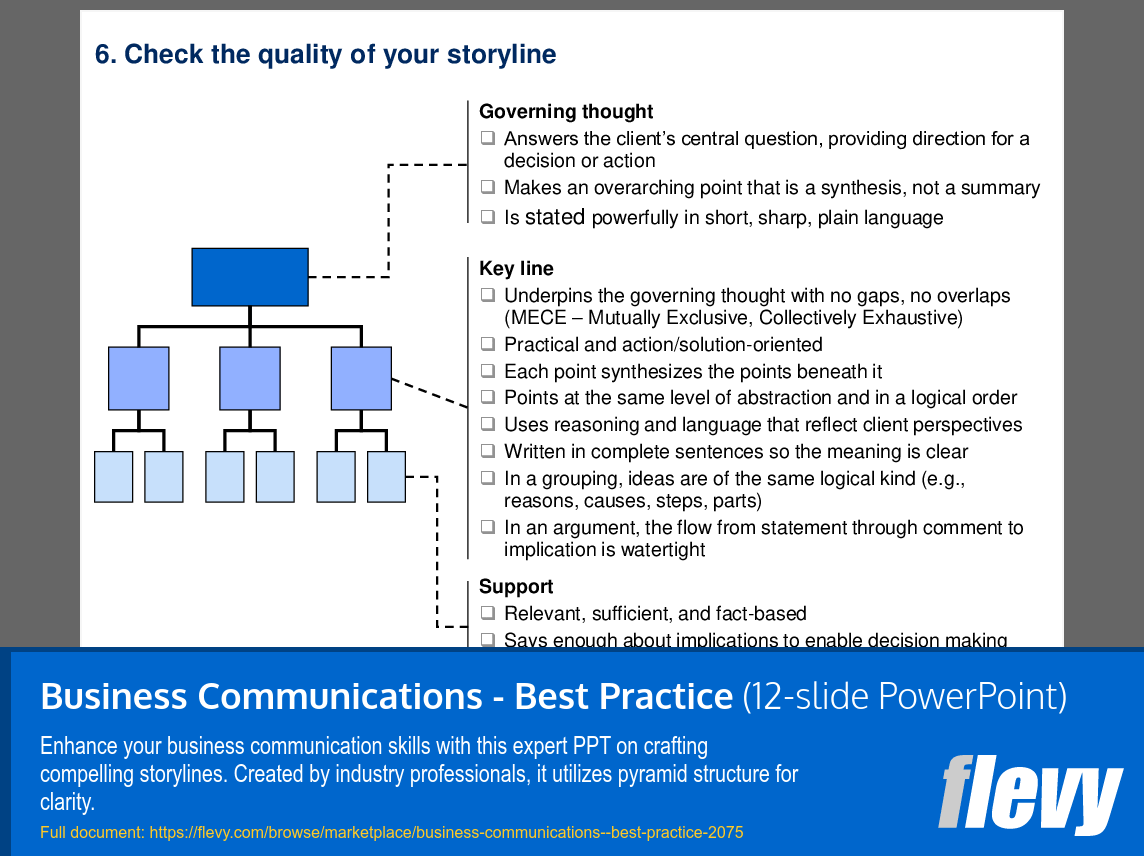
• Check the quality of your storyline
• Storyline template
• Storyline samples
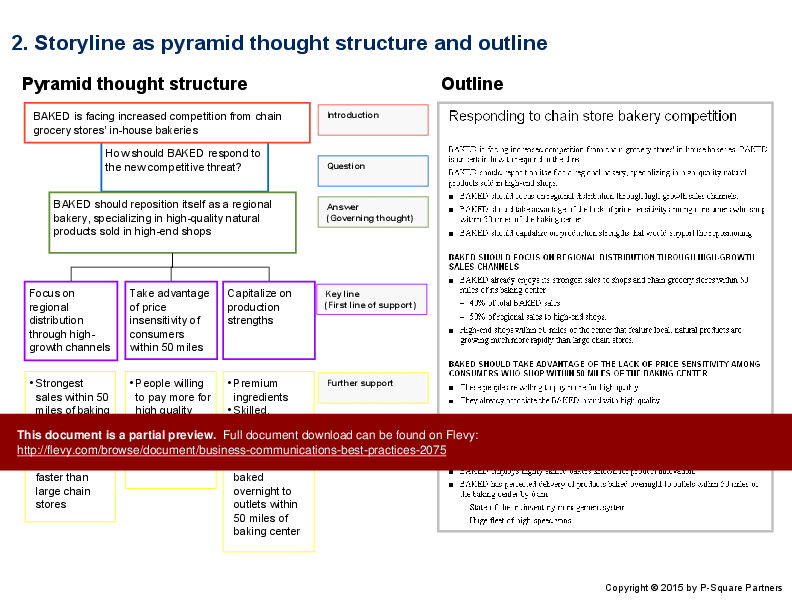
This PPT provides a comprehensive framework for constructing a storyline using the pyramid thought structure. It guides you through the process of responding to competitive threats with clear, logical arguments and supporting evidence. The pyramid structure ensures that your message is both compelling and easy to follow, making it ideal for high-stakes business communications.
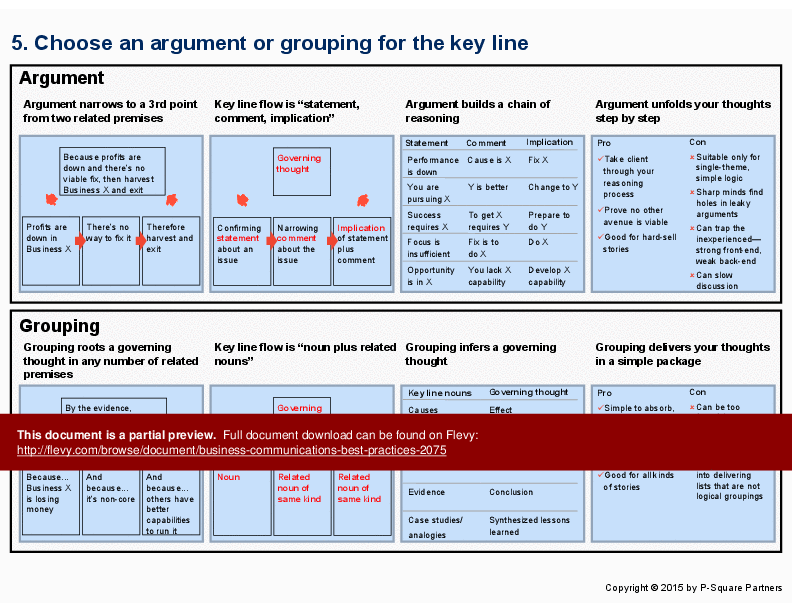
The guide also delves into the nuances of choosing the right argument or grouping for your key line. It offers practical advice on narrowing down your argument to a third point from two related premises, ensuring that your reasoning is both robust and persuasive. This section is particularly useful for executives who need to present complex ideas in a clear, concise manner.
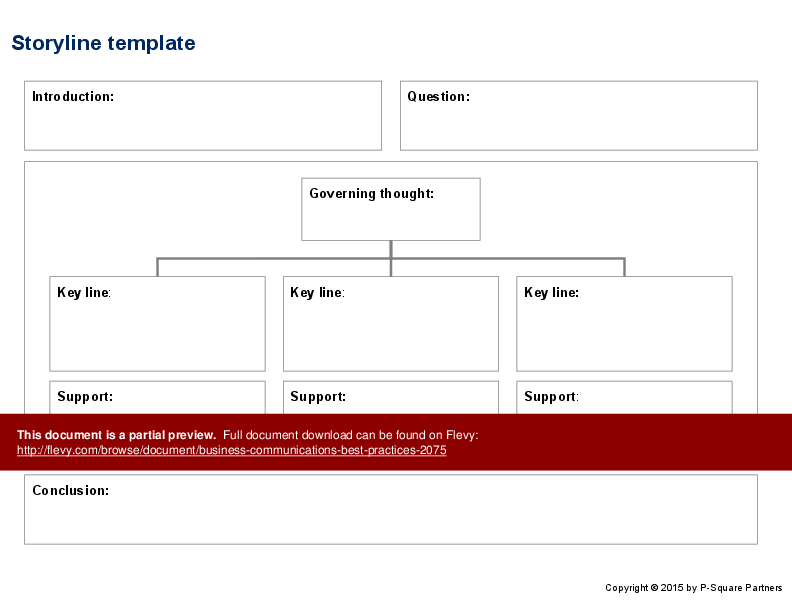
Included is a storyline template that helps you organize your thoughts from introduction to conclusion. This template is designed to streamline the development of your storyline, ensuring that each element supports your governing thought. By following this structured approach, you can create a narrative that not only captures attention, but also drives action.
Got a question about the product? Email us at support@flevy.com or ask the author directly by using the "Ask the Author a Question" form. If you cannot view the preview above this document description, go here to view the large preview instead.
MARCUS OVERVIEW
This synopsis was written by Marcus [?] based on the analysis of the full 12-slide presentation.
Executive Summary
The Business Communications Best Practice PPT is a consulting-grade presentation designed to enhance your ability to craft compelling storylines using the Pyramid Principle framework. This deck, reflecting the quality of McKinsey, Bain, or BCG, equips corporate executives and consultants with the tools to structure their communications effectively. By leveraging this presentation, users will learn to develop clear, persuasive narratives that resonate with stakeholders, ensuring that key messages are delivered with impact.
Who This Is For and When to Use
• Corporate executives seeking to improve presentation effectiveness
• Consultants aiming to enhance client communications
• Project managers needing to convey complex information succinctly
• Marketing teams focused on thought leadership and messaging clarity
Best-fit moments to use this deck:
• Preparing for executive presentations or board meetings
• Developing strategic communications for client engagements
• Crafting internal reports that require clear storytelling
• Enhancing team training on effective communication techniques
Learning Objectives
• Define the Pyramid Principle and its application in business communications
• Build a coherent storyline using a top-down approach
• Develop supporting arguments and evidence effectively
• Synthesize findings into a compelling narrative
• Evaluate the quality of a storyline for clarity and impact
• Utilize templates for streamlined communication development
Table of Contents
• Quick Guide to Developing a Storyline (page 1)
• Storyline as Pyramid Thought Structure and Outline (page 2)
• Developing a Storyline Top-Down (page 3)
• Developing a Storyline Bottom-Up (page 4)
• Choose an Argument or Grouping for the Key Line (page 5)
• Check the Quality of Your Storyline (page 6)
• Storyline Template (page 7)
• Storyline Samples (page 8)
Primary Topics Covered
• Quick Guide to Developing a Storyline - A concise overview of the key elements necessary for creating effective storylines in business communications.
• Pyramid Thought Structure - Explanation of how to organize thoughts in a pyramid format to enhance clarity and logical flow.
• Top-Down Storyline Development - Methodology for constructing a storyline starting from the main conclusion and supporting it with evidence.
• Bottom-Up Storyline Development - Approach for synthesizing findings into a coherent narrative from detailed insights to overarching conclusions.
• Choosing Arguments for Key Lines - Techniques for selecting and structuring arguments that support the main message effectively.
• Quality Check for Storylines - Criteria for assessing the clarity, relevance, and impact of a storyline.
Deliverables, Templates, and Tools
• Storyline template for structuring presentations
• Examples of effective storylines for reference
• Guidelines for developing top-down and bottom-up narratives
• Checklist for evaluating storyline quality
• Framework for organizing findings into a cohesive argument
Slide Highlights
• Overview of the question-answer flow for effective communication
• Visual representation of the pyramid thought structure
• Step-by-step guide for developing storylines top-down and bottom-up
• Examples illustrating the application of the Pyramid Principle
• Quality assessment criteria for storylines
Potential Workshop Agenda
Introduction to Effective Storytelling (30 minutes)
• Discuss the importance of clear communication in business
• Introduce the Pyramid Principle and its benefits
Storyline Development Techniques (60 minutes)
• Explore top-down and bottom-up approaches
• Practice creating storylines using provided templates
Quality Assessment and Feedback Session (30 minutes)
• Review participant-created storylines
• Provide constructive feedback based on quality criteria
Customization Guidance
• Tailor the storyline template to fit specific project contexts or audiences
• Adjust the examples provided to reflect industry-specific scenarios
• Incorporate organizational terminology and branding into the presentation
Secondary Topics Covered
• Techniques for engaging different audience types
• Strategies for visualizing data within presentations
• Importance of narrative flow in business communications
• Methods for integrating feedback into storyline revisions
Topic FAQ
What are the core steps of the Pyramid Principle for business communications?
The Pyramid Principle begins with a governing thought or main conclusion, followed by key lines that support that conclusion, and supporting evidence organized logically. It can be developed top-down (conclusion first) or bottom-up (synthesize findings into a conclusion). See the top-down and bottom-up approaches and the storyline template on page 3, page 4, and page 7 of Flevy's Business Communications - Best Practice.
How do I check the quality of a storyline before an executive presentation?
Assess clarity, relevance, logical flow, and whether the key line supports the governing thought; verify MECE grouping and dynamic assertions where applicable. Use a structured checklist to test question-answer flow and audience alignment. Flevy's Business Communications - Best Practice includes a quality-check checklist and guidance on page 6.
When is a top-down approach preferable to a bottom-up approach for storylines?
Use top-down when you need to present the main conclusion first and then justify it with evidence; use bottom-up when you must synthesize detailed findings into an overarching conclusion. The deck explains both methods and provides step-by-step guidance on pages 3 and 4 of Flevy's Business Communications - Best Practice.
What should I look for when choosing a storyline/template deck for executive communications?
Choose a deck that explains a clear structure (e.g., Pyramid Principle), provides a ready-to-use storyline template, includes sample storylines, offers a quality-assessment checklist, and allows customization for your context. These attributes help format arguments and evidence into a governing thought, checklist, and template.
How much time and team resources are typical to run a basic training on storyline development?
A compact workshop agenda in the deck suggests a 120-minute session: 30 minutes for an introduction to storytelling, 60 minutes for hands-on storyline development, and 30 minutes for quality assessment and feedback. That agenda provides a baseline for a small-group training session totaling 120 minutes.
I have a complex recommendation for a board meeting—how should I structure my slides?
Start with a clear opening statement that presents the governing thought, follow with 2–4 key lines that support that recommendation, and add concise evidence for each key line. Use the storyline template and sample storylines to map slide flow; refer to the storyline template on page 7 of Flevy's Business Communications - Best Practice.
How can I train a team to write clearer executive summaries using this approach?
Run a focused workshop using the deck's agenda: introduce the Pyramid Principle, practice creating storylines top-down and bottom-up with the provided template, then use the quality-check checklist to review outputs and give feedback. The suggested agenda is 30/60/30 minutes for intro, practice, and feedback.
Are purchased storyline templates worth the investment versus developing my own from scratch?
Templates consolidate a tested structure—governing thought, key lines, evidence flow—and include examples, customization guidance, and a quality checklist, which can reduce iteration time. The Business Communications - Best Practice deck bundles a storyline template, samples, and a checklist within a 12-slide PPT.
Document FAQ
These are questions addressed within this presentation.
What is the Pyramid Principle?
The Pyramid Principle is a framework for structuring communication in a clear and logical manner, emphasizing the importance of starting with the main conclusion followed by supporting arguments.
How can I apply this presentation to my work?
Use the techniques outlined in the presentation to develop clear and persuasive storylines for your reports, presentations, and client communications.
What are the benefits of using a top-down approach?
A top-down approach allows you to present your main conclusion first, making it easier for your audience to understand the key message before diving into supporting details.
Can I customize the storyline template?
Yes, the template is designed to be flexible and can be tailored to fit your specific project or audience needs.
How do I ensure my storyline is of high quality?
Utilize the quality check criteria provided in the presentation to assess clarity, relevance, and logical flow in your storyline.
What types of examples are included in the presentation?
The presentation includes various storyline samples that illustrate the application of the Pyramid Principle across different business contexts.
Is this presentation suitable for team training?
Absolutely, the presentation can serve as a valuable training tool for teams looking to enhance their communication skills.
How long does it take to develop a storyline using this framework?
The time required can vary based on complexity,, but the structured approach aims to streamline the process, making it more efficient.
Glossary
• Pyramid Principle - A communication framework that organizes information logically, starting with the main conclusion.
• Top-Down Approach - A method of developing a storyline that begins with the main idea and supports it with detailed arguments.
• Bottom-Up Approach - A technique for synthesizing findings into a coherent narrative, starting from detailed insights.
• Governing Thought - The central idea or conclusion that guides the storyline.
• Key Line - Supporting ideas that reinforce the governing thought.
• MECE - An acronym for "Mutually Exclusive, Collectively Exhaustive," a principle for organizing information without overlap.
• Dynamic Assertion - A complete idea expressed with a verb, used to convey findings effectively.
• Synthesis - The process of combining ideas to form a coherent narrative.
• Quality Check - A set of criteria used to evaluate the effectiveness of a storyline.
• Storyline Template - A structured format for developing presentations and reports.
• Audience Engagement - Techniques for capturing and maintaining the audience's attention during presentations.
• Visual Aids - Tools such as charts and graphs used to enhance understanding in presentations.
• Feedback Integration - The process of incorporating audience or peer feedback into storyline revisions.
• Argument Structuring - The method of organizing points to support the main conclusion logically.
• Communication Process - The steps involved in conveying information effectively.
• Supporting Evidence - Facts and data that back up the key line and governing thought.
• Conclusion - The final part of the storyline that reiterates the main message and suggests next steps.
• Opening Statement - The initial part of the storyline that sets the context and raises the central question.
• Implication - The significance or consequence of a statement within the storyline.
• Analytical Process - The method of examining information to draw conclusions.
• Recommendation - Suggested actions based on the analysis and conclusions drawn in the storyline.
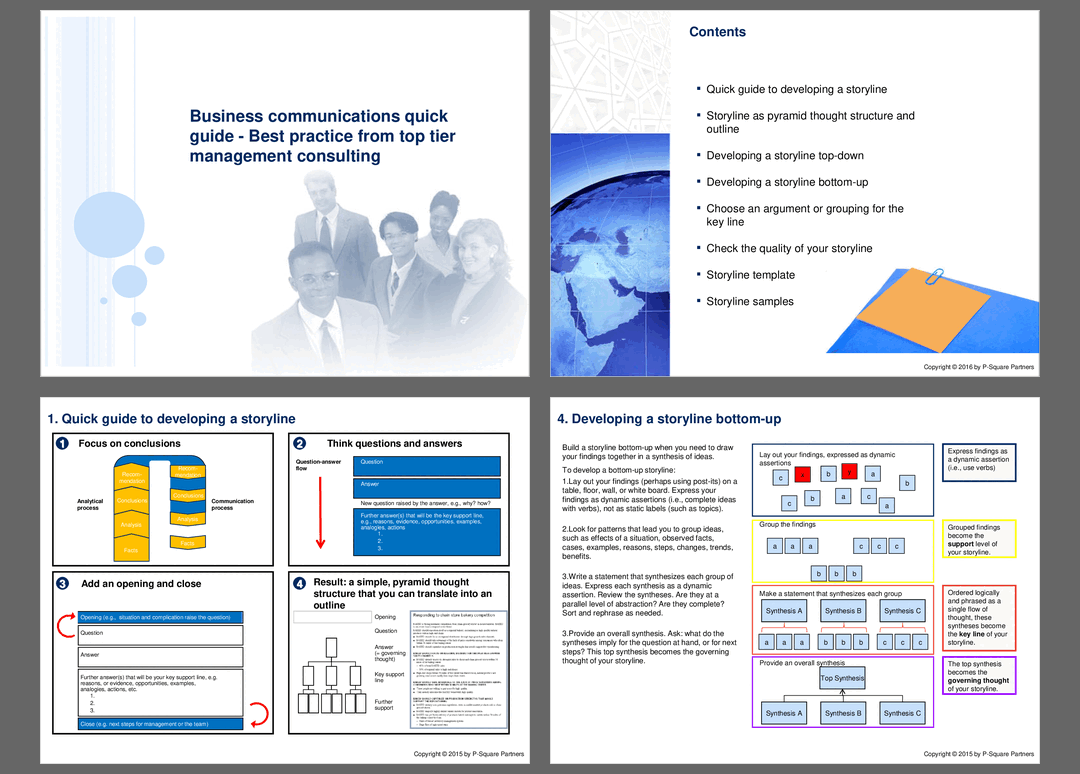
This PPT slide outlines effective storyline development in a business context, featuring a "Quick guide to developing a storyline." It introduces the "Storyline as pyramid thought structure and outline," a framework emphasizing clarity and logical flow. Two distinct approaches are presented: "Developing a storyline top-down" and "Developing a storyline bottom-up," allowing flexibility in methodology to cater to different thinking styles. The slide highlights the importance of a central thesis with "Choose an argument or grouping for the key line" to maintain focus. "Check the quality of your storyline" reinforces the need for critical evaluation, while "Storyline template" and "Storyline samples" provide practical tools for application.
This PPT slide outlines a structured approach for developing a coherent storyline from findings. It emphasizes expressing findings as dynamic assertions rather than static labels, using verbs for clarity. The process begins with visual representation of findings, utilizing tools like post-it notes to identify patterns and group similar ideas. Key elements include observed facts, trends, and benefits for meaningful clustering. Next, it instructs writing statements that synthesize each group at a comparable level of abstraction. The overall synthesis prompts consideration of implications for future actions, serving as the central thought guiding the narrative. Logical ordering and phrasing enhance clarity, ensuring the storyline remains focused and impactful, particularly for executives communicating complex ideas effectively.
This PPT slide outlines a structured approach to developing a compelling business storyline, divided into 4 key sections. The first section emphasizes focusing on conclusions, ensuring clear recommendations supported by facts for effective communication. The second section introduces a question-answer flow to engage the audience, encouraging anticipation of questions and fostering deeper interaction. The third section advises on structuring the presentation's opening and closing, starting with a compelling question or complication to capture attention. The final section illustrates a pyramid thought structure that organizes ideas logically, enhancing coherence from opening to conclusion. This guide is essential for professionals aiming to improve storytelling in business communications.
This PPT slide outlines critical components for evaluating a business narrative's effectiveness. A governing thought serves as the foundation, directly addressing the client's primary question and guiding decision-making. It must articulate a clear point that synthesizes key insights. The key line supports the governing thought, adhering to the MECE principle—Mutually Exclusive, Collectively Exhaustive—ensuring each point is practical and actionable. Language should resonate with the client’s perspective, using complete sentences for clarity. Grouped ideas must share logical connections, representing reasons, causes, or steps, with a seamless flow of argument. The support section emphasizes the need for relevant, fact-based content to facilitate informed decision-making, enhancing narrative skills for effective business communication.
Source: Best Practices in Communications Strategy PowerPoint Slides: Business Communications - Best Practice PowerPoint (PPT) Presentation Slide Deck, P-Square Partners
Since 2012, we have provided business templates to over 10,000 businesses and organizations of all sizes, from startups and small businesses to the Fortune 100, in over 130 countries.
"As an Independent Management Consultant, I find Flevy to add great value as a source of best practices, templates and information on new trends. Flevy has matured and the quality and quantity of the library is excellent. Lastly the price charged is reasonable, creating a win-win value for
the customer, Flevy and the various authors. This is truly a service that benefits the consulting industry and associated clients. Thanks for providing this service.
"
– Jim Schoen, Principal at FRC Group
"FlevyPro provides business frameworks from many of the global giants in management consulting that allow you to provide best in class solutions for your clients."
– David Harris, Managing Director at Futures Strategy
"My FlevyPro subscription provides me with the most popular frameworks and decks in demand in today’s market. They not only augment my existing consulting and coaching offerings and delivery, but also keep me abreast of the latest trends, inspire new products and service offerings for my practice, and educate me
in a fraction of the time and money of other solutions. I strongly recommend FlevyPro to any consultant serious about success.
"
– Bill Branson, Founder at Strategic Business Architects
"Flevy is now a part of my business routine. I visit Flevy at least 3 times each month.
Flevy has become my preferred learning source, because what it provides is practical, current, and useful in this era where the business world is being rewritten.
many challenges and there is the need to make the right decisions in a short time, with so much scattered information, we are fortunate to have Flevy. Flevy investigates, selects, and puts at our disposal the best of the best to help us be successful in our work.
"
– Omar Hernán Montes Parra, CEO at Quantum SFE
"I like your product. I'm frequently designing PowerPoint presentations for my company and your product has given me so many great ideas on the use of charts, layouts, tools, and frameworks. I really think the templates are a valuable asset to the job."
– Roberto Fuentes Martinez, Senior Executive Director at Technology Transformation Advisory
"I have used Flevy services for a number of years and have never, ever been disappointed. As a matter of fact, David and his team continue, time after time, to impress me with their willingness to assist and in the real sense of the word. I have concluded in fact
that it is not at all just a repository of documents/resources but, in the way that David and his team manage the firm, it is like dealing with consultants always ready to assist, advise and direct you to what you really need, and they always get it right.
I am an international hospitality accomplished senior executive who has worked and lived during the past 35 years in 23 countries in 5 continents and I can humbly say that I know what customer service is, trust me.
Aside from the great and professional service that Flevy's team provide, their wide variety of material is of utmost great quality, professionally put together and most current.
Well done Flevy, keep up the great work and I look forward to continue working with you in the future and to recommend you to a variety of colleagues around the world.
"
– Roberto Pelliccia, Senior Executive in International Hospitality
"As a young consulting firm, requests for input from clients vary and it's sometimes impossible to provide expert solutions across a broad spectrum of requirements. That was before I discovered Flevy.com.
Through subscription to this invaluable site of a plethora of topics that are key and crucial to consulting, I
have been able to exceed expectations and deliver quality advice and solutions to my clients. The quality and expertise of the authors are exemplary and gives me great confidence to use as part of my service offerings.
I highly recommend this company for any consultant wanting to apply international best practice standards in their service offerings.
"
– Nishi Singh, Strategist and MD at NSP Consultants
"As a consultant requiring up to date and professional material that will be of value and use to my clients, I find Flevy a very reliable resource.
The variety and quality of material available through Flevy offers a very useful and commanding source for information. Using Flevy saves me time, enhances my expertise and ends up being a good decision."


– Dennis Gershowitz, Principal at DG Associates
Save with Bundles
This document is available as part of the following discounted bundle(s):
Download our free compilation of 50+ slides and templates on Organizational Design, Change Management, and Corporate Culture. Methodologies include ADKAR, Burke-Litwin Change Model, McKinsey 7-S, Competing Values Framework, etc.








