
 Click main image to view in full screen. Unlock all 12 preview images:
Behavioral Health IOP/PHP Financial Model – Excel XLSX
Excel (XLSX) + supplemental PDF


BENEFITS OF THIS DOWNLOADABLE EXCEL DOCUMENT
- Links IOP/PHP census, payer economics, authorization, revenue cycle, staffing, and operating costs into one monthly financial planning framework.
- Provides Conservative, Base, and Optimistic cases plus EBITDA sensitivity analysis for census, payer mix, denials, clinical payroll, and IOP rates.
- Gives management a connected view of profitability, cash flow, A/R, staffing capacity, referral CAC, break-even census, and site-expansion triggers.
FINANCIAL MODELING EXCEL DESCRIPTION
Behavioral Health IOP/PHP Financial Model
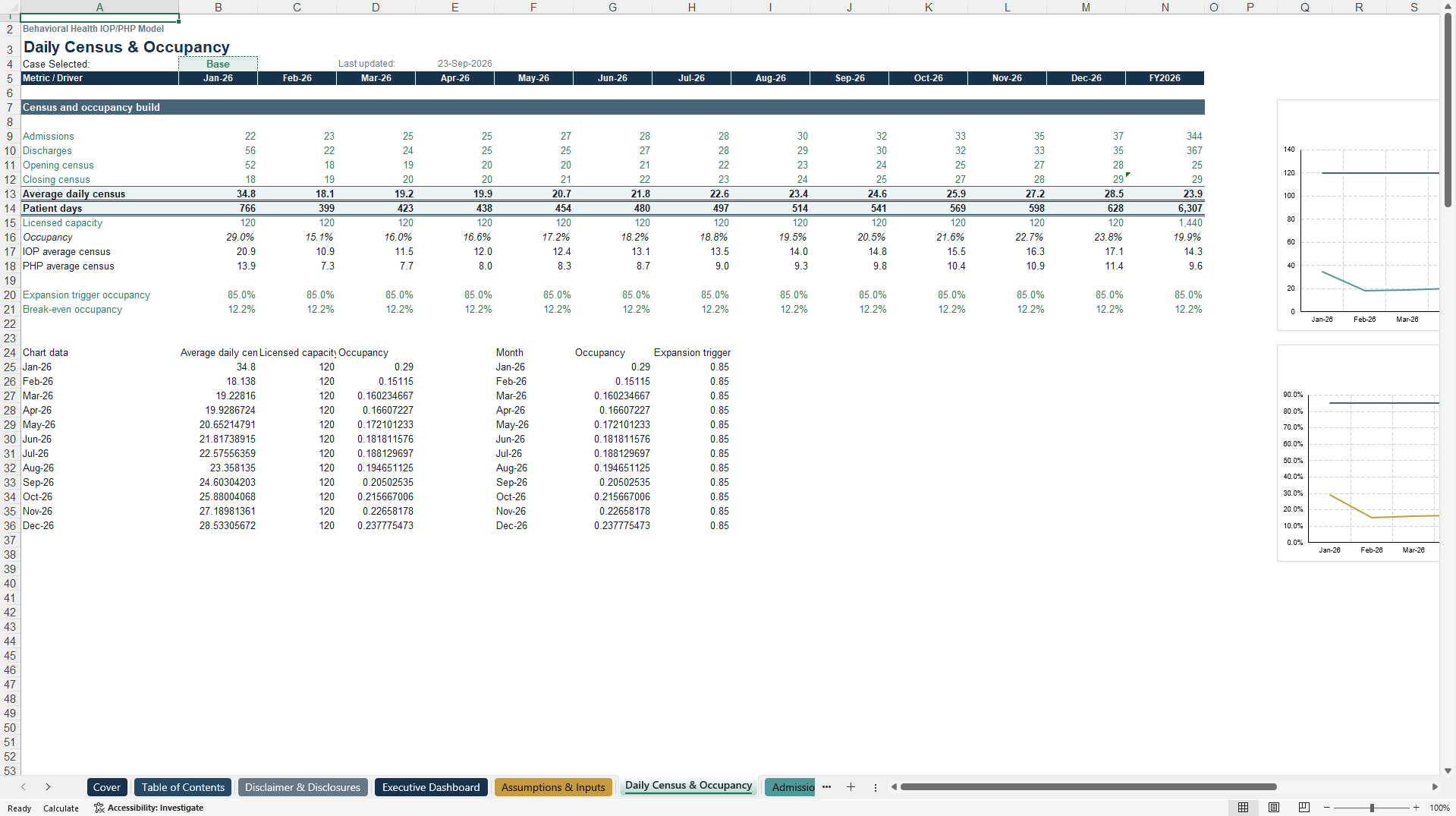
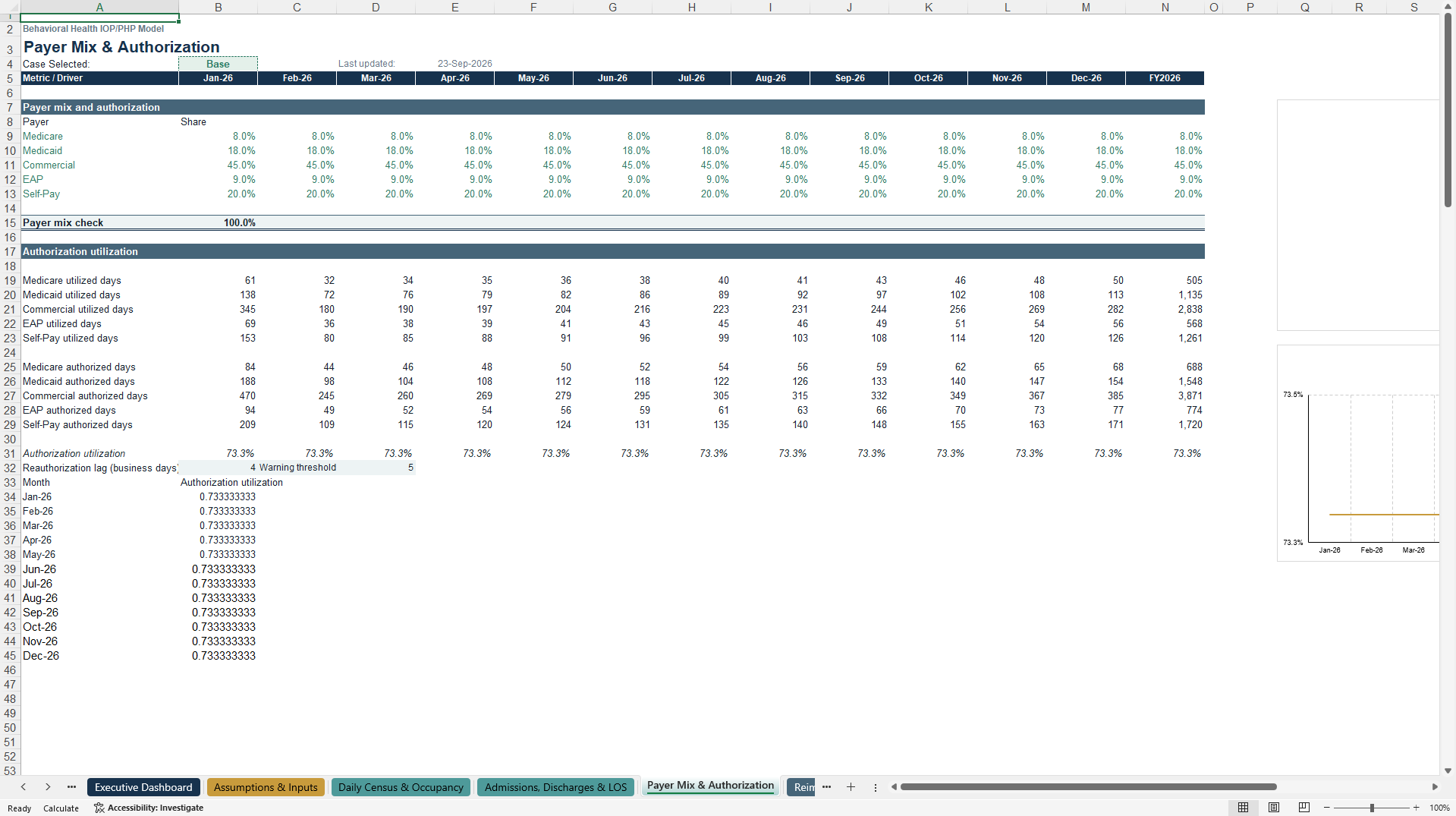
This Excel model is designed for behavioral health operators and finance teams that need to connect Intensive Outpatient Program and Partial Hospitalization Program activity with revenue, staffing, profitability, and cash flow. Rather than treating the budget as a simple top-line growth exercise, the workbook builds the forecast from core operating drivers such as admissions, discharges, average length of stay, daily census, patient days, occupancy, licensed capacity, payer mix, authorization utilization, reimbursement assumptions, denials, collections, clinician capacity, referral conversion, and operating cost.
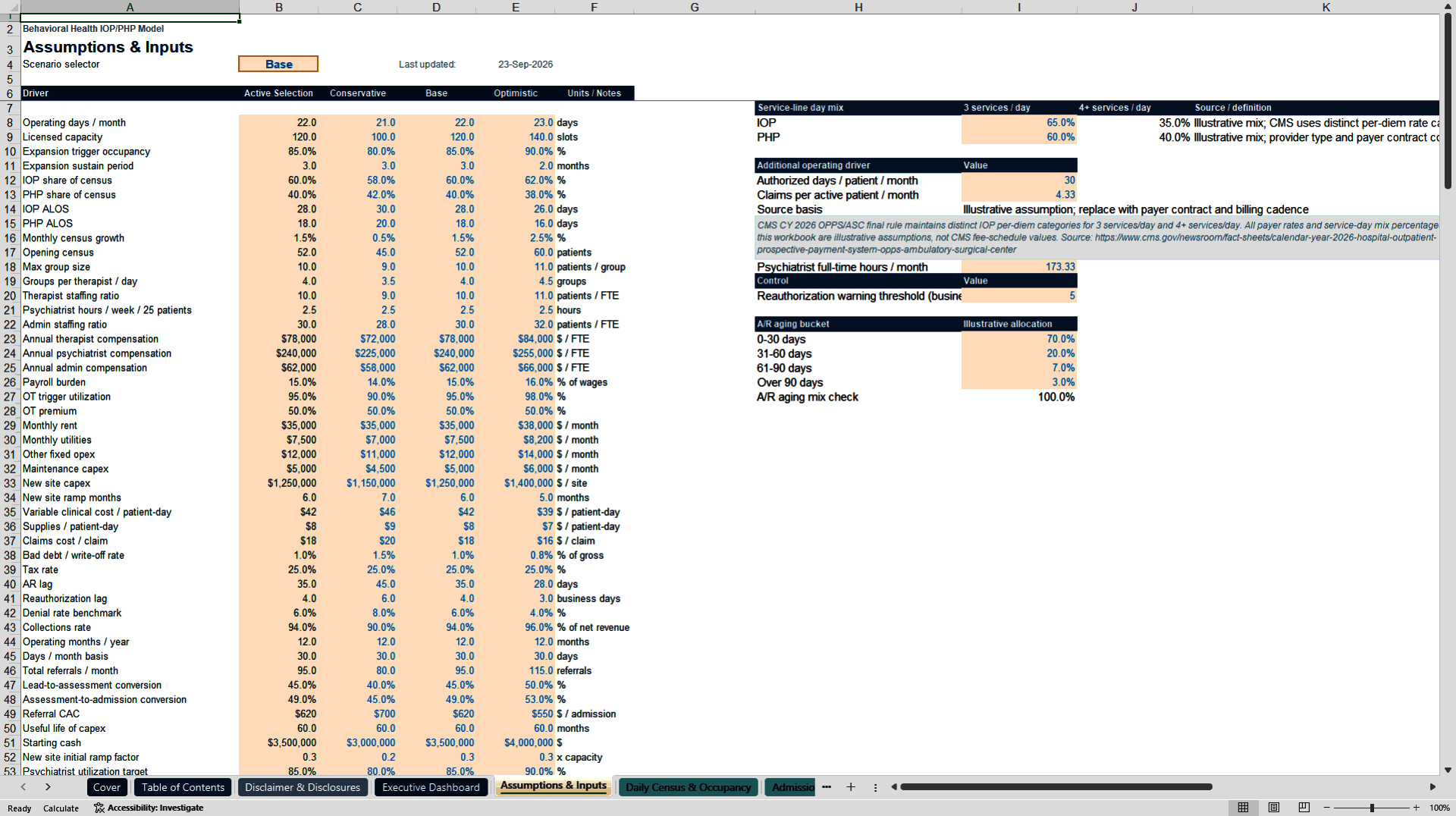
The model uses a 12-month FY2026 monthly forecast with an annual summary. A central Assumptions & Inputs worksheet provides Conservative, Base, and Optimistic cases and concentrates the major editable drivers in one place. Users can adjust census growth, IOP/PHP mix, length of stay, staffing ratios, compensation, fixed and variable costs, payer mix, reimbursement rates, contractual adjustments, denial rates, collection assumptions, referral-source mix, customer acquisition cost, starting cash, and expansion inputs.
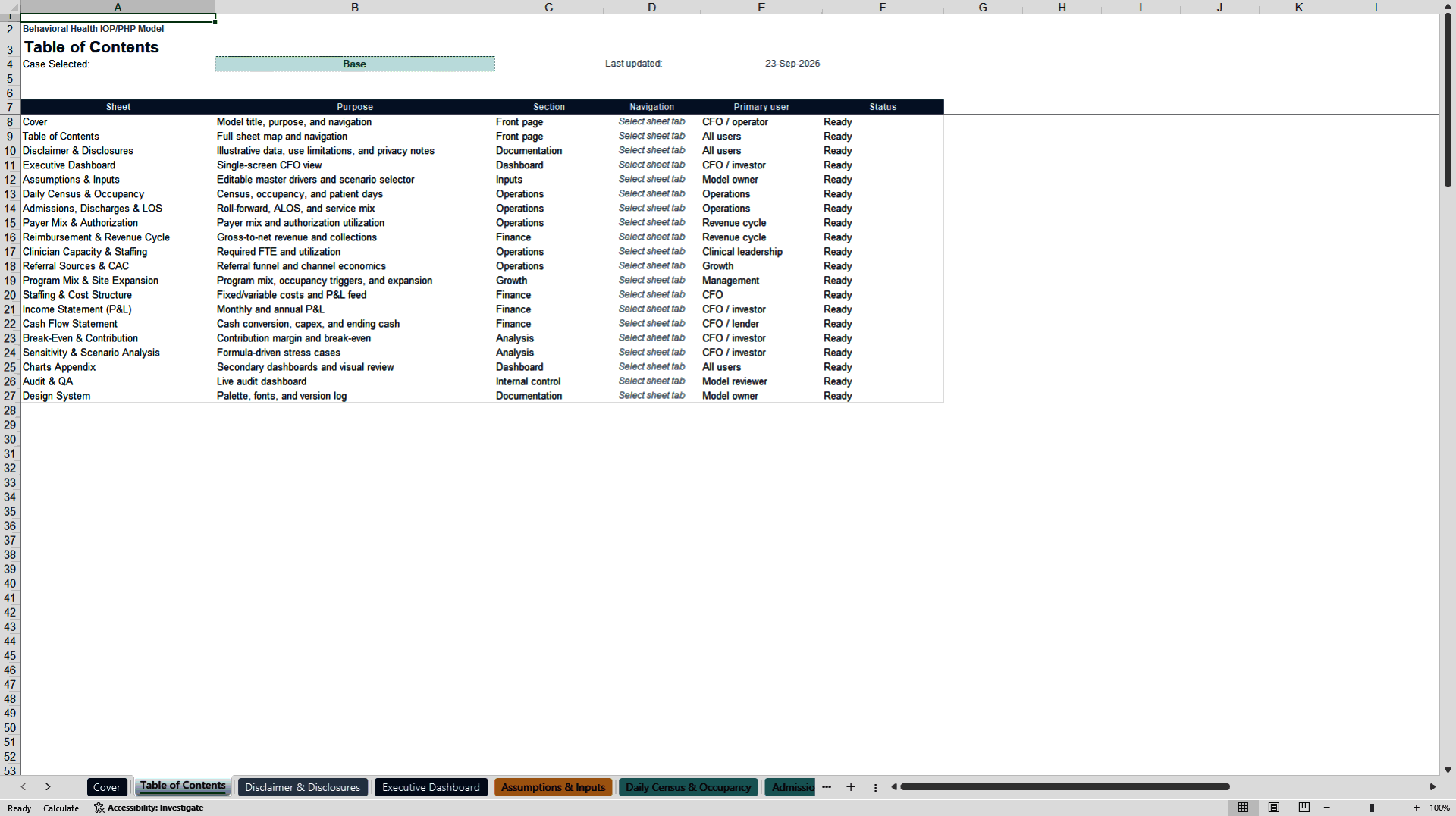
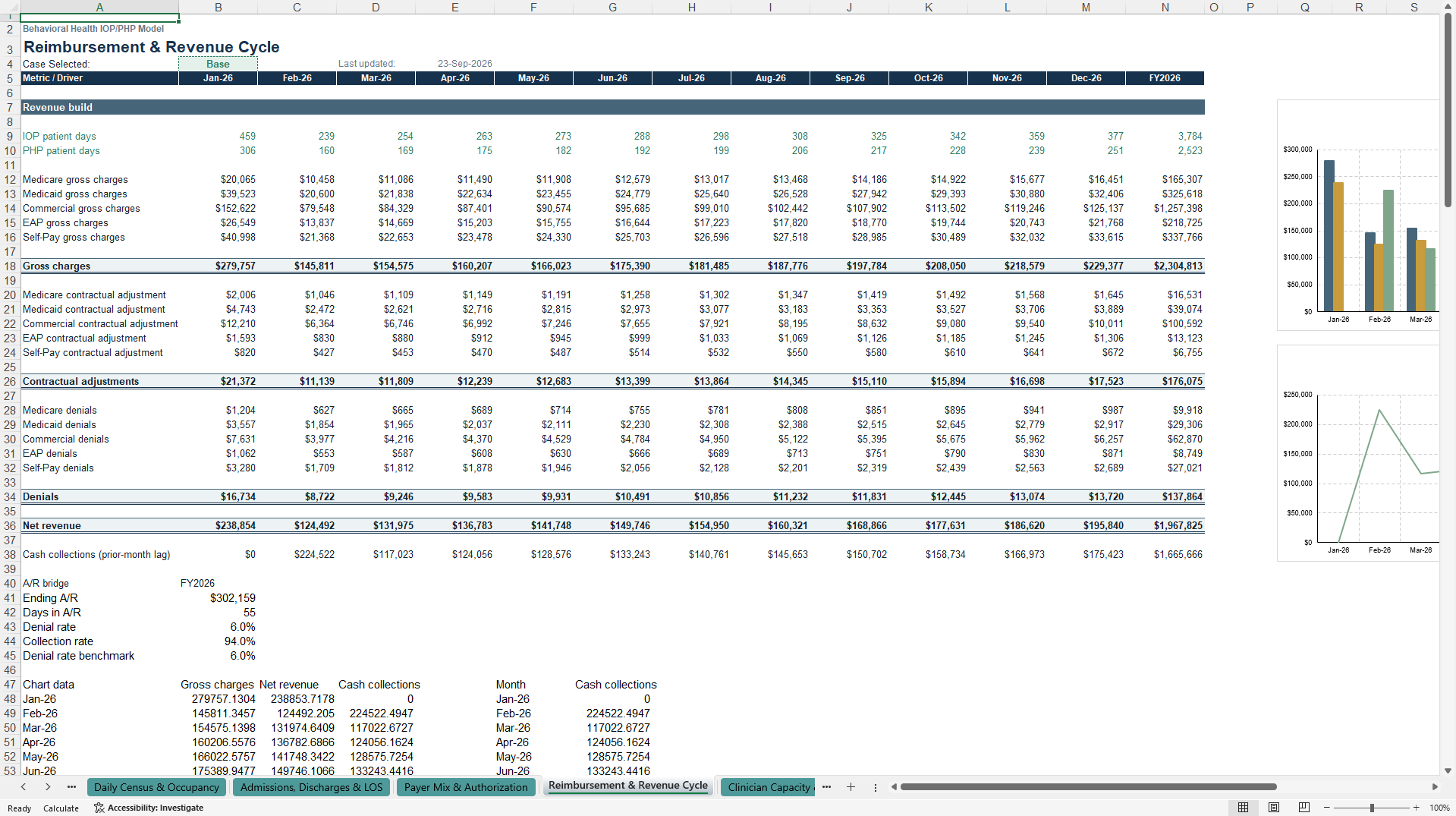
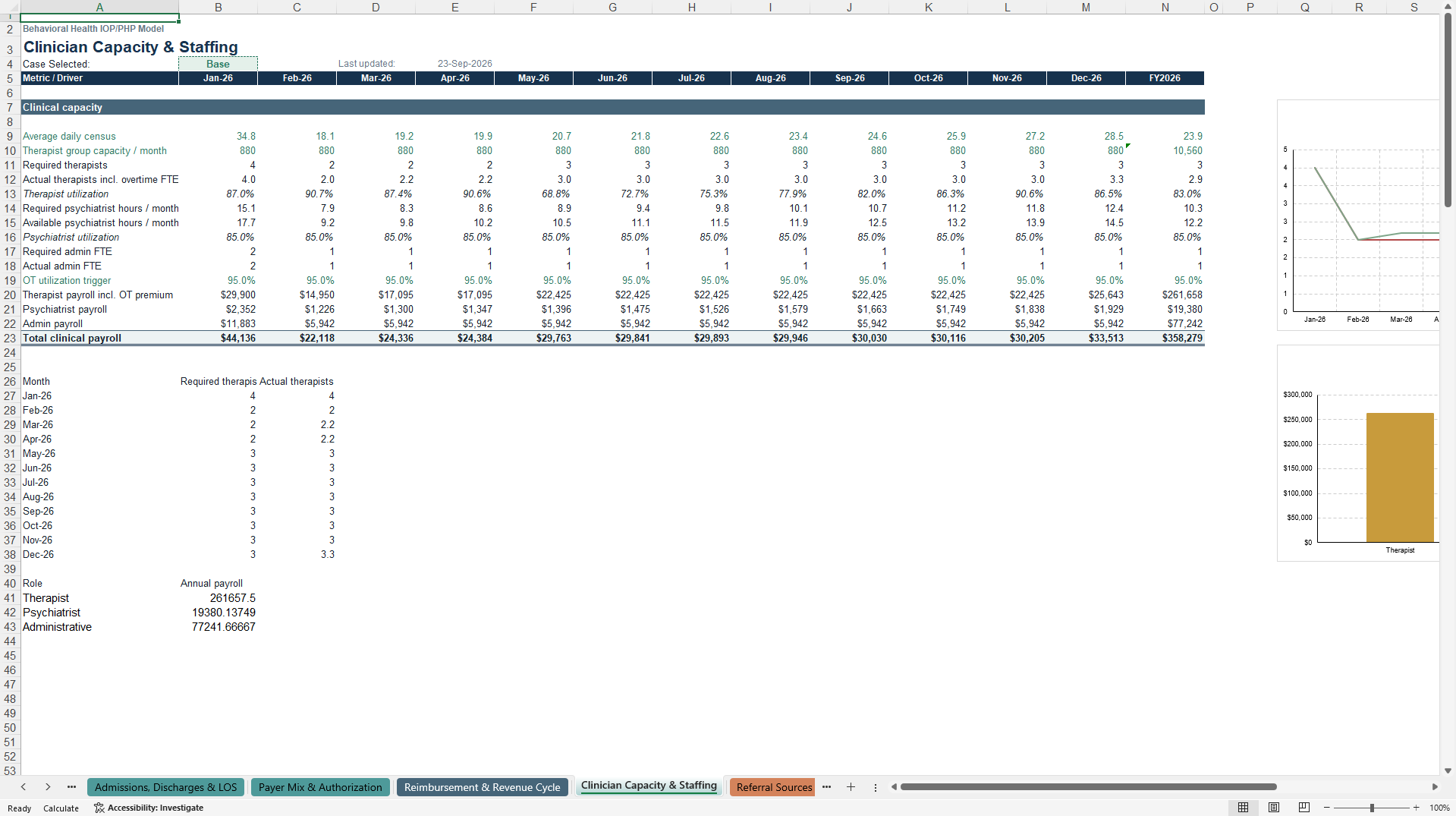
Operating modules include Daily Census & Occupancy, Admissions/Discharges/LOS, Payer Mix & Authorization, Clinician Capacity & Staffing, Referral Sources & CAC, and Program Mix & Site Expansion. The revenue-cycle module converts patient days into payer-level gross charges, contractual adjustments, denials, net revenue, lagged collections, ending accounts receivable, days in A/R, and projected A/R aging. The cost structure then feeds a monthly income statement and cash flow statement.
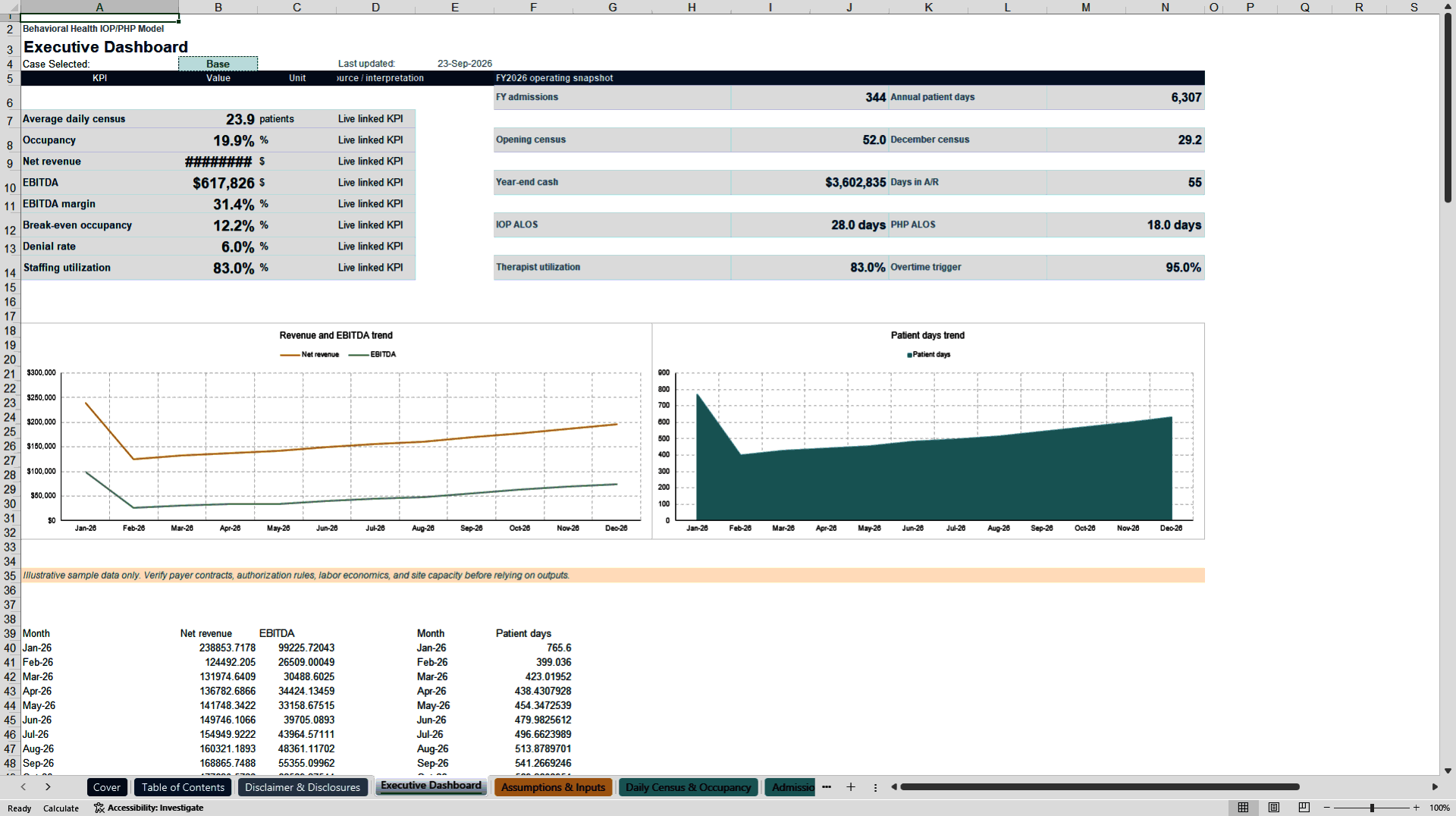
The Executive Dashboard summarizes average daily census, occupancy, net revenue, EBITDA, EBITDA margin, break-even occupancy, denial rate, staffing utilization, admissions, patient days, cash, days in A/R, and clinical utilization. Break-even analysis calculates weighted revenue per patient-day, contribution margin, break-even daily census, break-even occupancy, and margin of safety. A sensitivity section tests EBITDA response to census, commercial payer mix, denial rates, clinical payroll, and IOP rates, with low/base/high comparisons and scenario outputs.
The workbook also contains a seller-created Audit & QA worksheet with internal checks and flex-test records, plus a Design System sheet describing its visual conventions. Seller-supplied and already tested; no Studio workbook audit was performed.
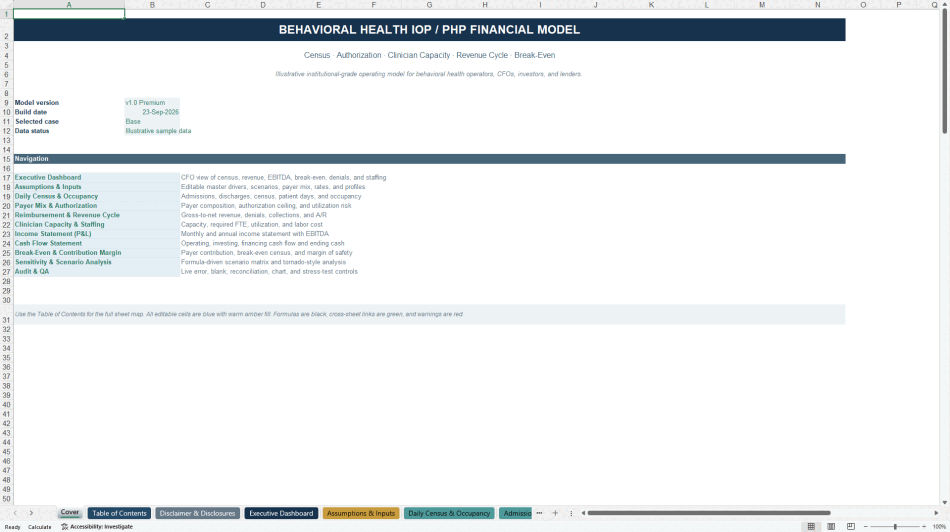
This model can be used for annual budgeting, monthly forecasting, staffing and capacity planning, reimbursement analysis, revenue-cycle planning, referral economics, profitability analysis, liquidity planning, break-even analysis, expansion screening, lender or investor review, and management scenario discussions. The package includes the original .xlsx model, a full 20-sheet PDF preview, and high-resolution worksheet screenshots.
Got a question about the product? Email us at support@flevy.com or ask the author directly by using the "Ask the Author a Question" form. If you cannot view the preview above this document description, go here to view the large preview instead.
Source: Best Practices in Financial Modeling, Healthcare Excel: Behavioral Health IOP/PHP Financial Model Excel (XLSX) Spreadsheet, PDMM Financial Models
ABOUT THE AUTHOR

PDMM Financial Models develops professional, decision-ready Excel models for business owners, entrepreneurs, investors, consultants, analysts, and finance teams. Our objective is to transform complex business assumptions into clear, structured analysis that supports better planning and investment decisions.
Our models cover business planning, forecasting, budgeting, feasibility analysis,
... [read more]
Ask the Author a Question
You must be logged in to contact the author.




























