 Click main image to view in full screen.


BENEFITS OF THIS DOWNLOADABLE EXCEL DOCUMENT
- Quantifies the full BESS revenue stack: arbitrage, FCR, aFRR, mFRR and capacity contracts
- Tests bankability with DSCR, project and equity IRR, NPV and a Base/Upside/Downside switch
- Captures degradation, reserve-funded augmentation, CAPEX grants and tax loss carry-forward
ENERGY INDUSTRY EXCEL DESCRIPTION
Battery energy storage is one of the fastest-growing segments of the European power market, and every developer, investor and lender eventually asks the same question: what does the revenue stack really look like, and does the project still work in a downside case? This annual, 25-year project finance model answers that question in a transparent and fully editable Excel workbook built specifically for stand-alone, grid-scale battery storage in Europe.
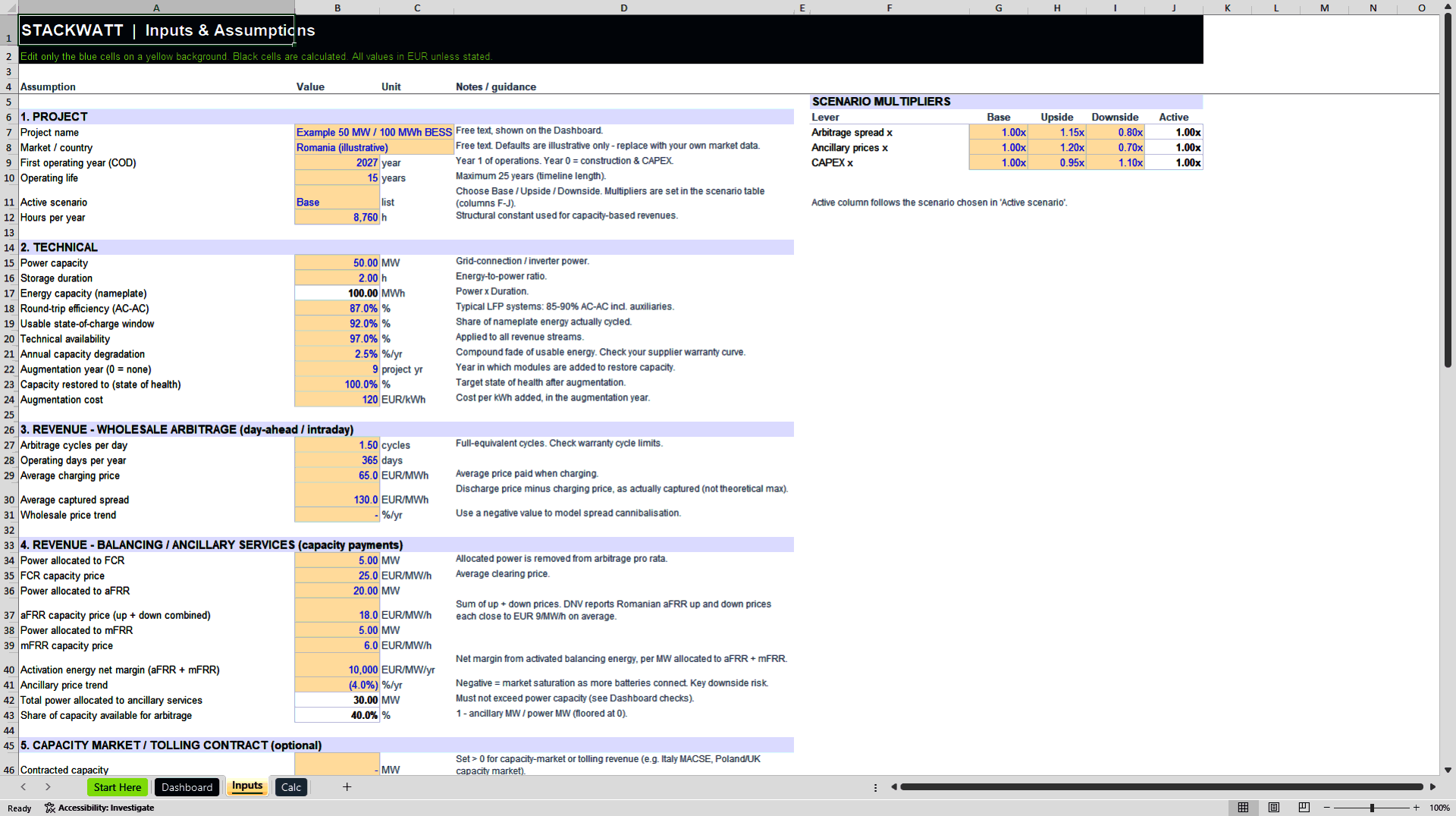
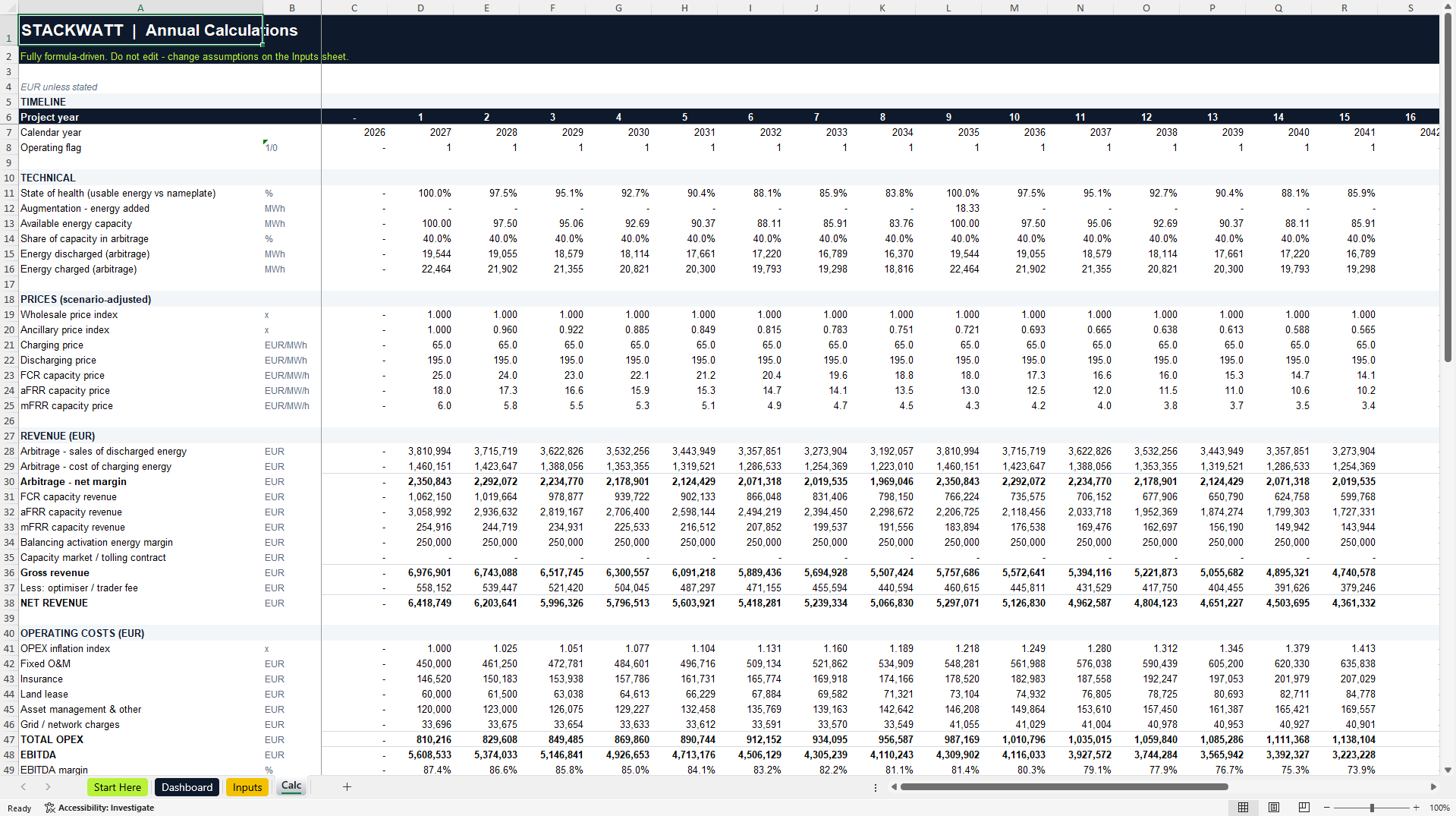
The model stacks the main revenue streams available to batteries: day-ahead and intraday energy arbitrage (modelled with an average charging price, a captured spread and round-trip losses), FCR, aFRR and mFRR capacity payments, a balancing activation margin, and an optional capacity-market or tolling contract with its own start year, duration and indexation. Power allocated to balancing services reduces arbitrage throughput pro rata, so the stack stays internally consistent.
Technical realism is built in: round-trip efficiency, usable state-of-charge window, availability, compound degradation and a capacity augmentation event that is pre-funded through a reserve, so the debt service coverage ratio is not distorted in the augmentation year.
The financing and tax layer includes gearing, an annuity loan with arrangement fee, a DSCR profile compared with a lender target, corporate tax with loss carry-forward, straight-line depreciation including augmentation, CAPEX grants and a separate unlevered tax calculation for the project IRR.
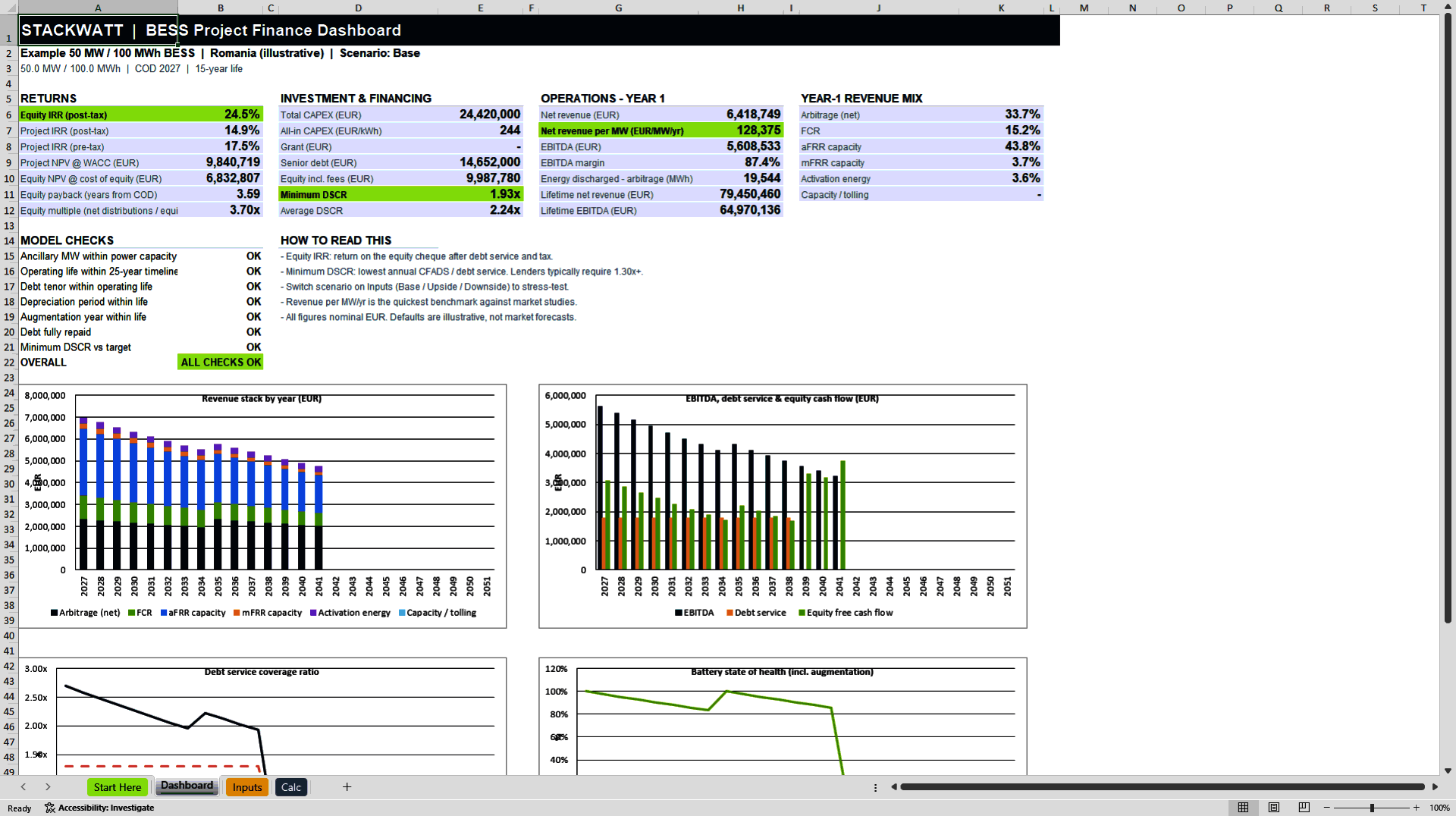
Outputs include project IRR before and after tax, equity IRR, NPV at WACC and cost of equity, equity payback, equity multiple, minimum and average DSCR, year-one revenue per MW, revenue mix and four charts. A Base, Upside and Downside scenario switch with editable multipliers lets you stress-test spreads, balancing prices and CAPEX in one click, and automatic model checks flag inconsistent inputs.
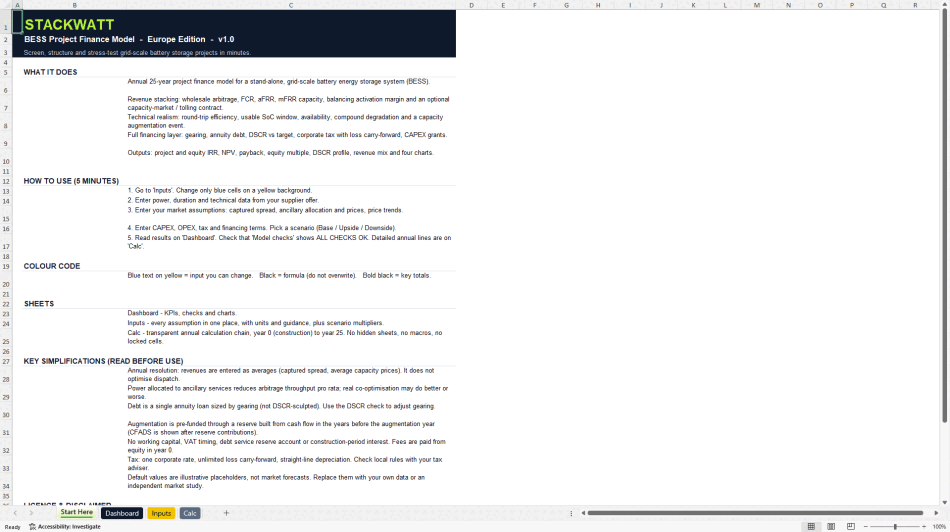
Every assumption sits on one Inputs sheet with units and guidance notes. There are no macros, no hidden sheets and no locked cells. Formulas were independently re-computed in a separate reference implementation across six test scenarios before release.
Limitations: the model uses annual resolution and average prices, it does not optimise dispatch, and the default values are illustrative placeholders that should be replaced with your own market data.
Got a question about the product? Email us at support@flevy.com or ask the author directly by using the "Ask the Author a Question" form. If you cannot view the preview above this document description, go here to view the large preview instead.
Source: Best Practices in Energy Industry, Integrated Financial Model Excel: Battery Energy Storage (BESS) Project Finance Model Excel (XLSX) Spreadsheet, Stackwatt