 Click main image to view in full screen. Unlock all 14 preview images:
Community Solar Subscription & Project Finance Model – Excel XLSX
Excel (XLSX) + supplemental PDF


BENEFITS OF THIS DOWNLOADABLE EXCEL DOCUMENT
- Plan 25 years of community solar economics with 15 solar sites, 15 subscriber groups, enrollment, churn and eligible electricity allocation.
- Distinguish utility bill credit values from project revenue and cash collections while analyzing CAPEX, debt and three linked financial statements.
- Evaluate five selectable scenarios, project and equity IRR, NPV, debt coverage and subscriber sensitivities with built-in financial checks.
SOLAR ENERGY EXCEL DESCRIPTION
☀️ COMMUNITY SOLAR FINANCIAL MODEL | 25-YEAR PREMIUM EDITION
Solar Portfolio Economics • Subscriber Enrollment • Utility Bill Credits • Cash Collections • Project Finance • IRR & NPV
ONE SOLAR PORTFOLIO. CONNECTED SUBSCRIPTIONS. TRANSPARENT LONG-TERM FINANCIAL PLANNING.
How does a community solar project convert electricity generation into subscriber-related revenue? What happens when enrollment slows, customers leave, utility credit settlements are delayed or collections fall short? And can the portfolio's cash flow support capital investment and debt obligations?
The Community Solar Subscription & Investment Financial Model by SheetworksStudio connects these questions in a structured, editable 25-year Excel financial planning system.
Designed for community solar developers, renewable energy investors, solar portfolio operators, subscription program teams and finance professionals, this model integrates site-level solar production with subscriber participation, utility credit calculations, collections, commercial revenue, operating expenses and project financing.
The workbook contains 23 interconnected worksheets, 300 monthly periods, 25 annual summaries, 15 illustrative solar sites, 15 fictional subscriber groups, five selectable scenarios and eight native Excel dashboard charts.
All supplied data and results are fictional and illustrative.
📊 01 | EXECUTIVE DASHBOARD & EIGHT NATIVE CHARTS
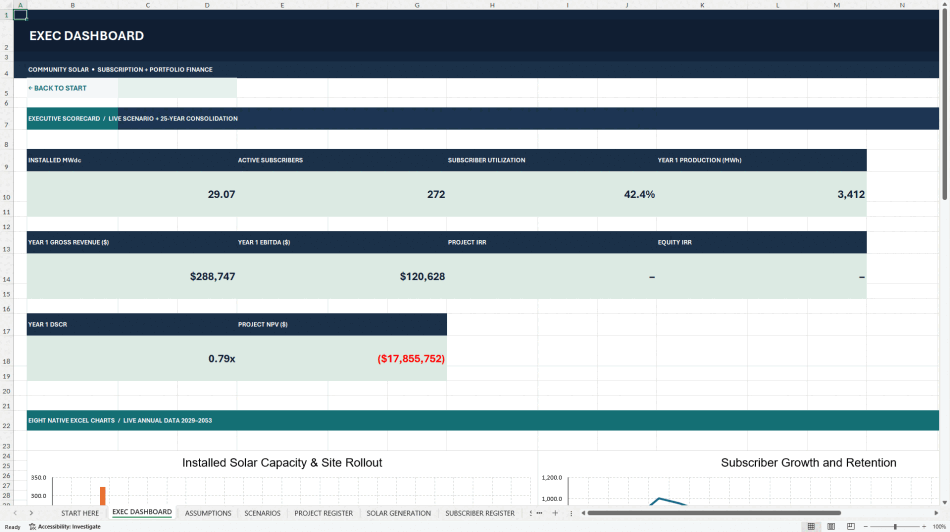
The Executive Dashboard provides an overview of community solar portfolio performance.
Review major financial and operational indicators including:
• Installed Solar Capacity
• Active Subscriber Accounts
• Subscriber Allocation Utilization
• Annual Electricity Production
• Gross Project Revenue
• EBITDA
• Project IRR
• Equity IRR
• Debt Service Coverage
• Project NPV
Eight native Excel charts visualize:
1. Capacity and Project Rollout
2. Subscriber Growth and Retention
3. Annual Solar Generation
4. Allocated versus Unallocated Credits
5. Revenue by Source
6. EBITDA versus Free Cash Flow
7. Outstanding Debt versus DSCR
8. Indicative Scenario Comparison
The charts connect to underlying workbook calculations, helping users follow the relationship between project development, subscriber participation, cash generation and financial returns.
☀️ 02 | SOLAR PROJECT REGISTER & PORTFOLIO ROLLOUT
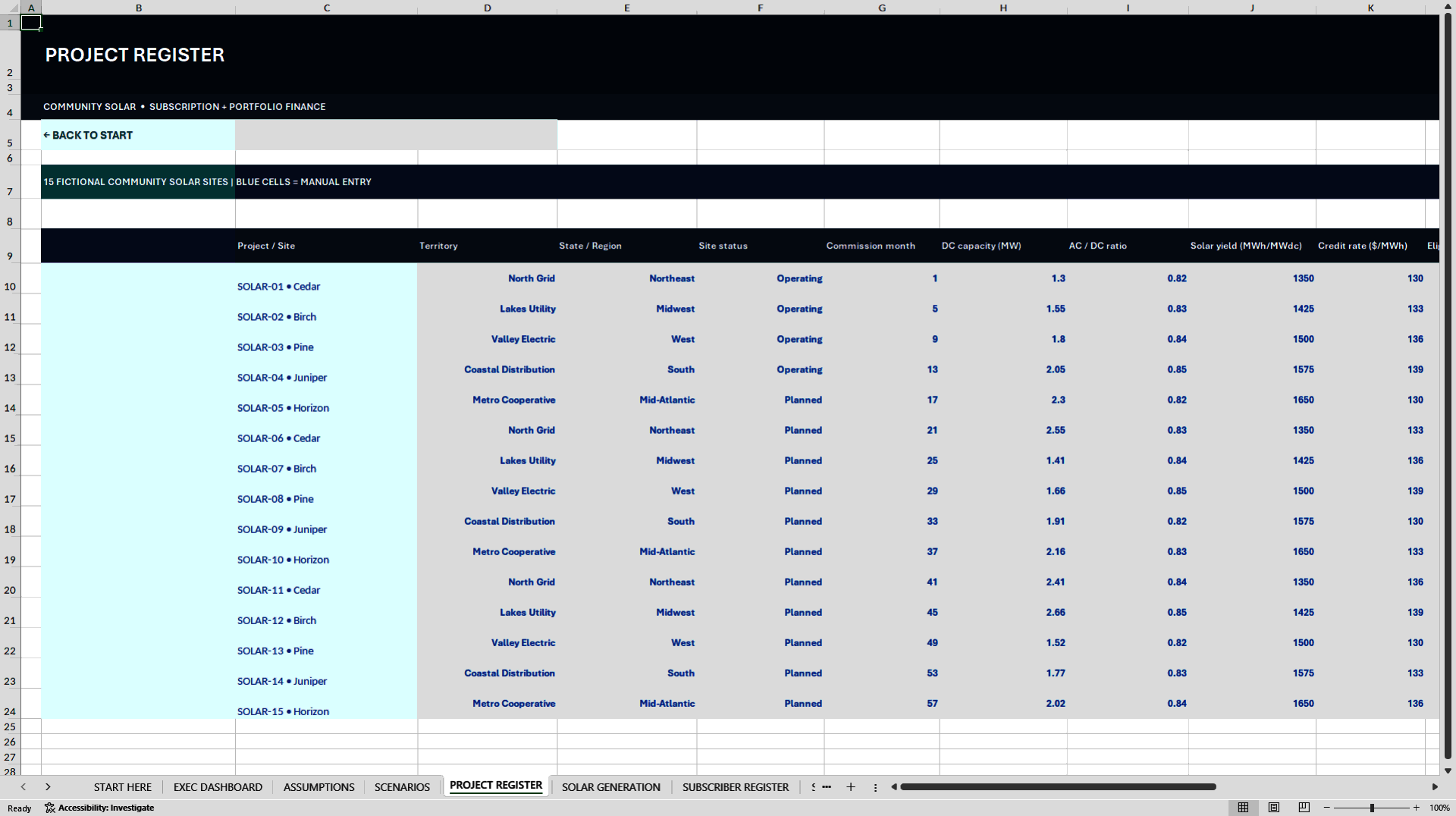
The PROJECT REGISTER contains 15 fictional solar development records.
Configure relevant assumptions for each site, including:
• Project Name and Service Territory
• Region and Operating Status
• Commissioning Month
• Installed DC Capacity
• AC Conversion Assumptions
• Annual Solar Production
• Operating Cost Parameters
• Capital Investment
• Electricity Pricing
• Credit Eligibility
The model connects individual project configurations to the overall portfolio.
Different commissioning dates allow users to evaluate a phased solar development program instead of assuming that all projects begin operating simultaneously.
Review how new sites affect total installed capacity, electricity production, project CAPEX and ongoing operating expenses.
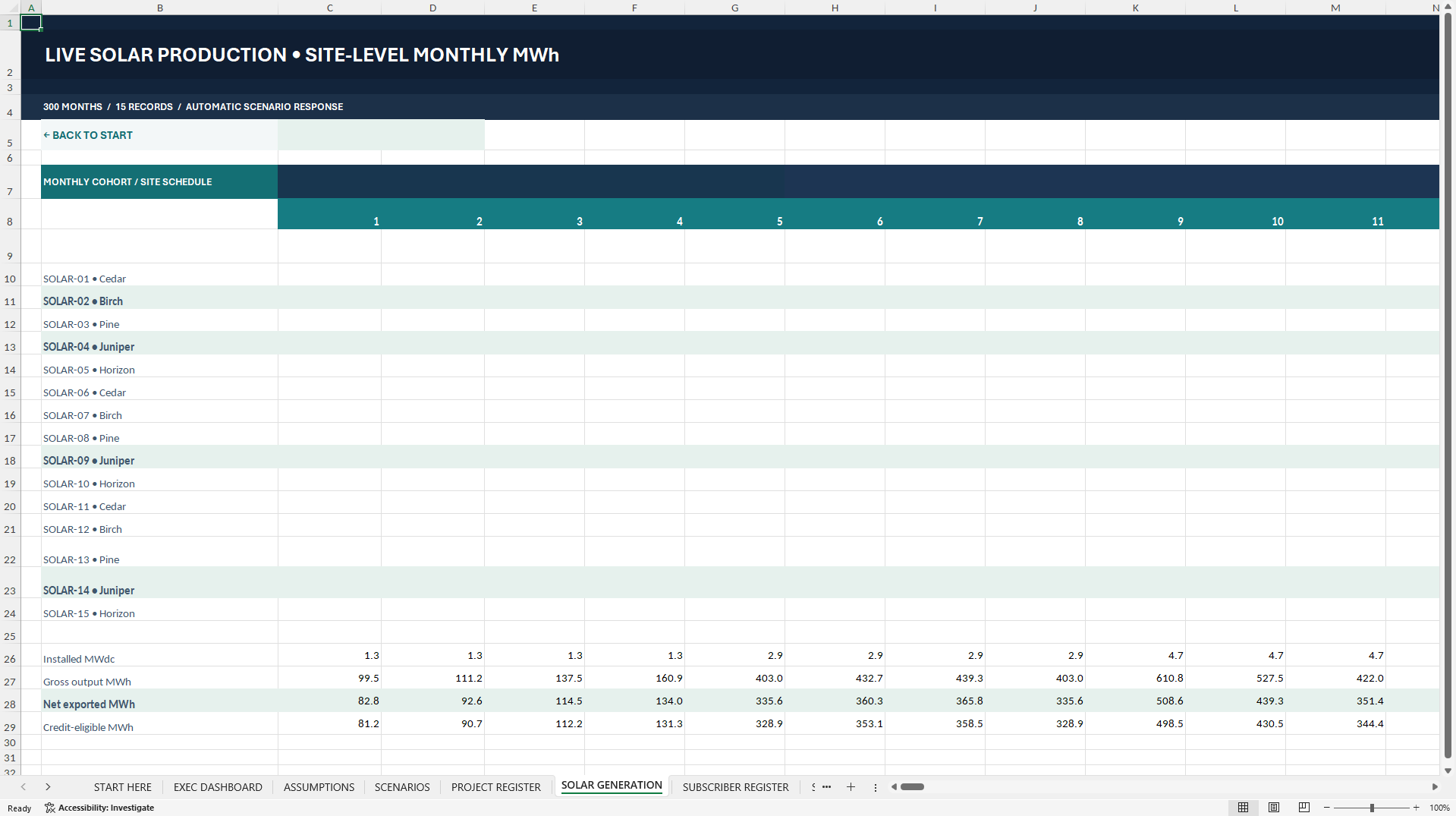
⚡ 03 | SOLAR GENERATION & ELIGIBLE ELECTRICITY
The SOLAR GENERATION worksheet estimates monthly electricity production across the planning horizon.
The model considers assumptions including:
• Installed Solar Capacity
• Solar Yield
• Monthly Seasonality
• Equipment Availability
• AC Conversion Performance
• Curtailment
• Annual Panel Degradation
• Credit-Eligible Export Share
The calculation framework distinguishes gross electricity production, net grid export and the electricity eligible for subscriber utility credits.
This distinction is important because total solar production is not necessarily equal to the volume that can be allocated to subscribers.
The workbook also identifies production that remains unsubscribed or commercially unallocated.
Actual generation requires independent engineering and solar resource validation.
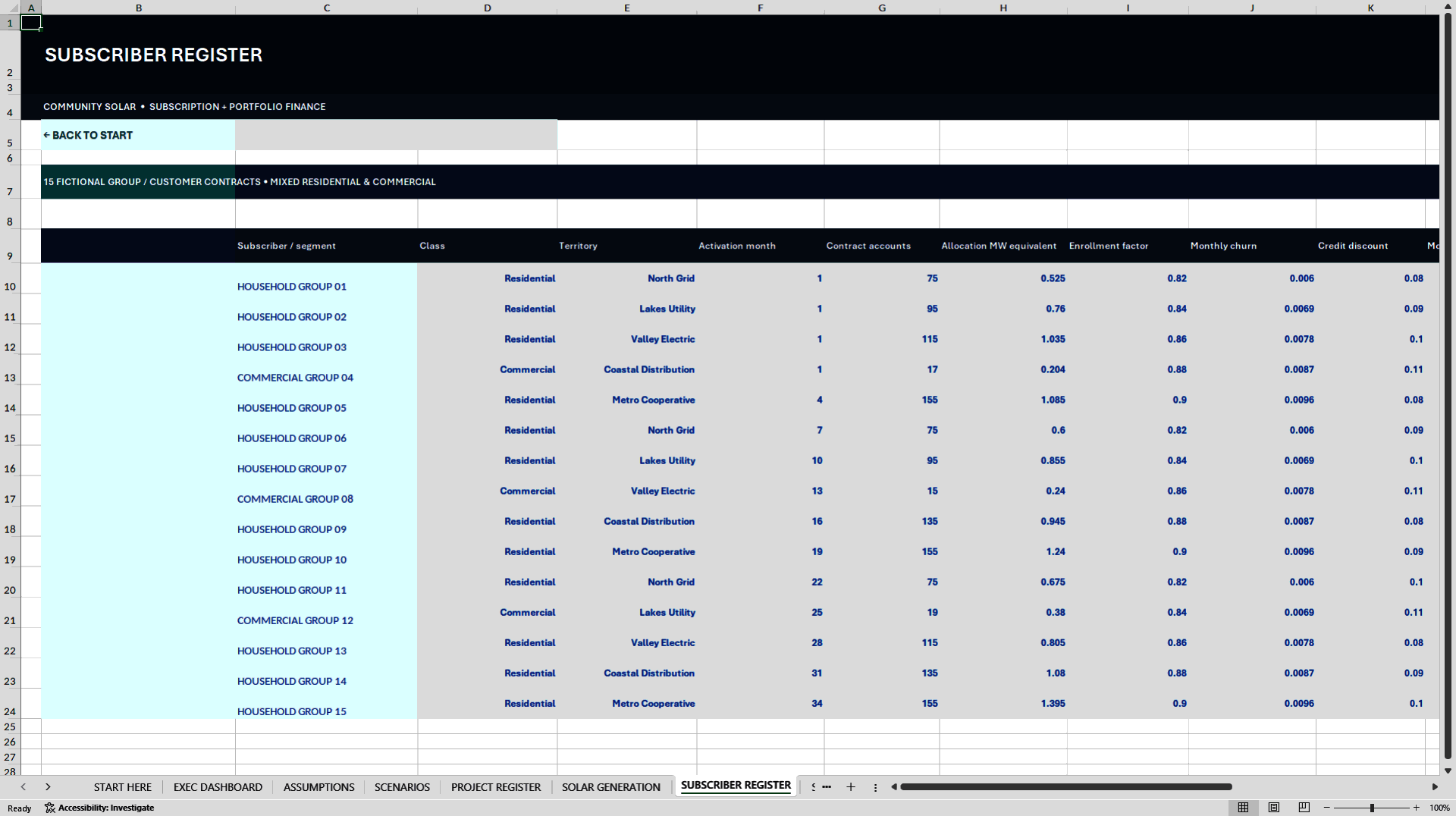
👥 04 | SUBSCRIBER REGISTER & CONTRACT ECONOMICS
The SUBSCRIBER REGISTER contains 15 fictional residential and commercial subscriber groups.
Each group can have separate participation assumptions.
Key inputs include:
• Residential or Commercial Classification
• Service Territory
• Contract Activation Month
• Number of Subscriber Accounts
• Booked Capacity
• Enrollment Rates
• Customer Churn
• Utility Credit Tariff Factors
• Subscriber Discount Assumptions
• Service Fees
• Customer Acquisition Costs
The model uses grouped subscriber records to represent different customer segments.
These are financial-planning cohorts rather than individual customer billing accounts.
The workbook is not a household-level CRM, invoicing or utility settlement platform.
📈 05 | ENROLLMENT, CUSTOMER GROWTH & CHURN
The SUBSCRIPTION ENGINE connects subscriber enrollment, activation timing, retention and contracted capacity to monthly portfolio demand.
Review how changes in customer acquisition and churn affect the number of active subscriber accounts.
The model supports analysis of:
• New Subscriber Enrollment
• Active Customer Accounts
• Customer Attrition
• Subscription Demand
• Booked Capacity
• Monthly Allocation Requirements
• Subscriber Utilization
A dedicated ACQUISITION COSTS worksheet links customer growth assumptions with marketing and acquisition expenditure.
The model also contains illustrative customer lifetime-value and acquisition-cost indicators.
These are simplified planning measures and should not be treated as independently verified customer lifetime economics.
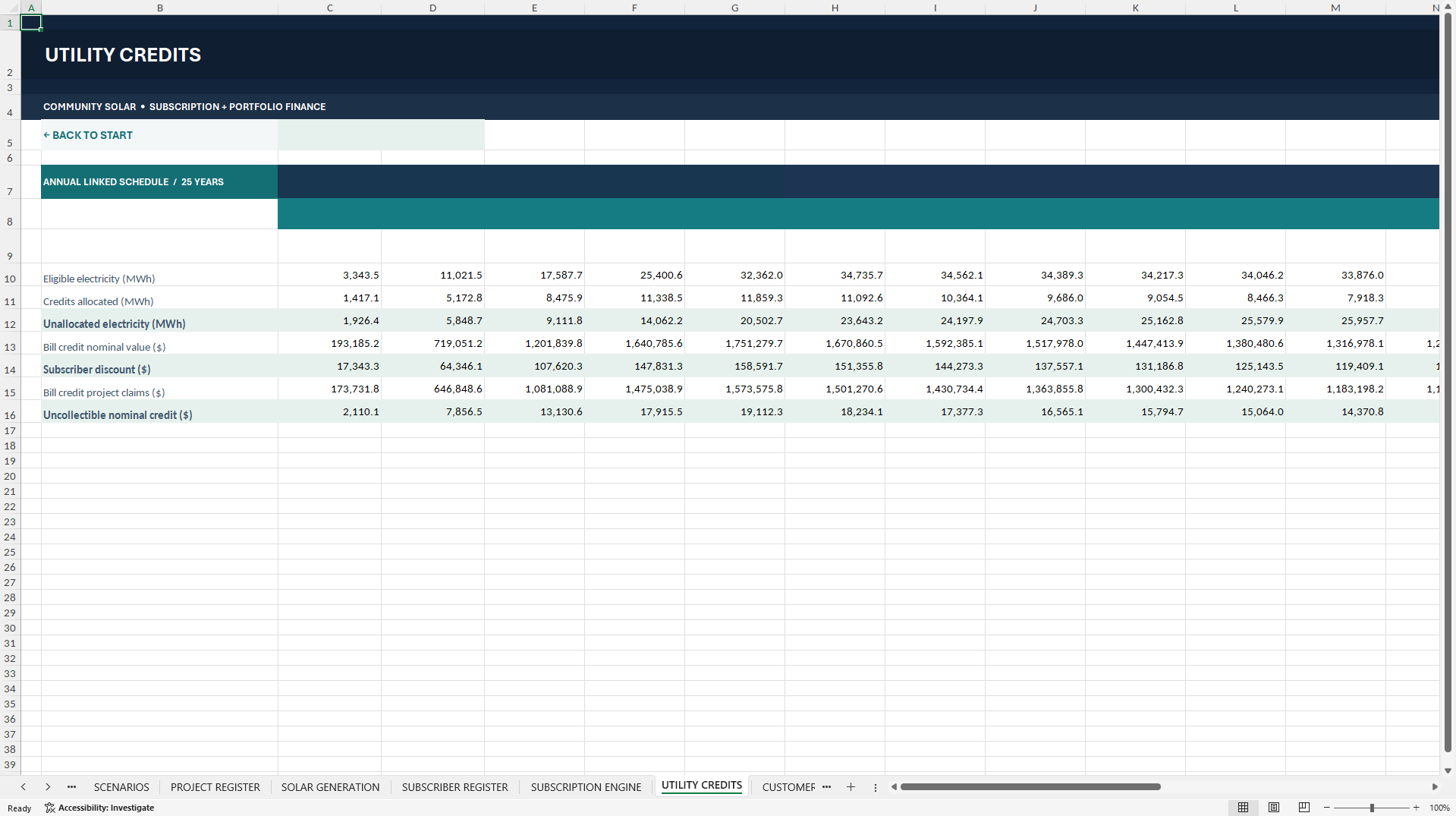
🔌 06 | UTILITY BILL CREDITS & ENERGY ALLOCATION
The UTILITY CREDITS worksheet connects eligible generation with subscriber allocation.
The financial framework distinguishes:
• Credit-Eligible Electricity
• Requested Subscription Allocation
• Actual Allocated Electricity
• Remaining Unallocated Electricity
• Utility Credit Face Value
• Subscriber Discounts
• Commercial Credit-Related Revenue
A fundamental modeling principle is that the nominal value of a utility bill credit is not necessarily the same as revenue earned by the project.
The workbook separates these concepts rather than treating the full credit face value as automatically collected income.
Subscriber allocation is constrained by eligible electricity generation.
Actual credit eligibility depends on local utility program rules, tariffs, service territories and subscriber contracts.
💳 07 | SETTLEMENT TIMING, RECEIVABLES & COLLECTIONS
The CUSTOMER PAYMENTS worksheet supports analysis of the timing between credit-related billings and actual cash receipts.
The model includes assumptions for:
• Billing and Settlement Timing
• Collection Delays
• Customer and Utility Receivables
• Collection Losses
• Cash Receipts
• Outstanding Balances
This helps distinguish the accrual recognition of revenue from the cash received by the project.
The timing difference can become important when project operating expenses and debt service must be paid before all outstanding customer or utility settlements are collected.
The model uses simplified settlement assumptions, not a detailed reconciliation against actual utility billing files.
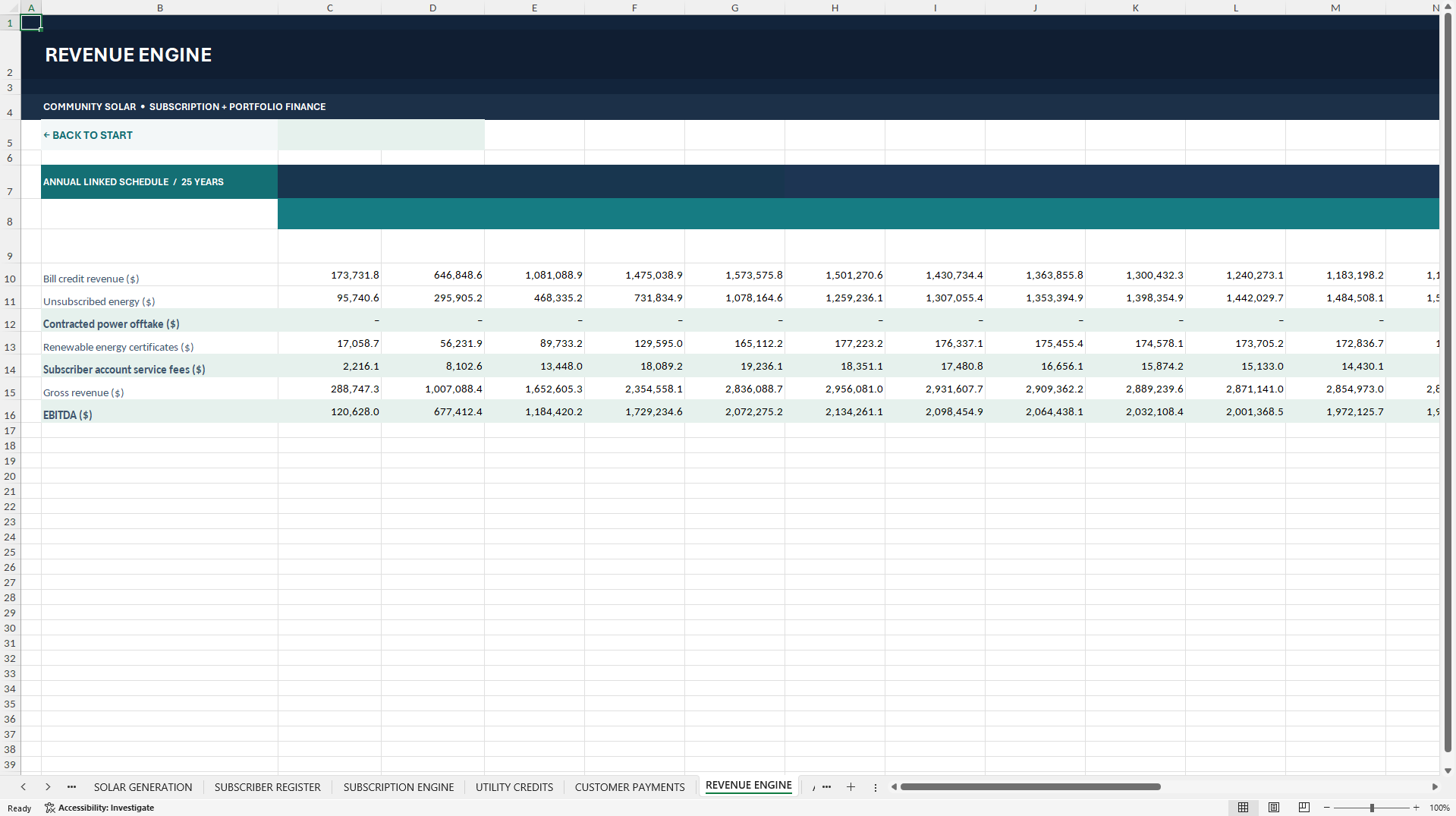
💰 08 | MULTIPLE COMMERCIAL REVENUE SOURCES
The REVENUE ENGINE consolidates modeled commercial income.
Potential income categories include:
SUBSCRIBER UTILITY-CREDIT REVENUE
Revenue associated with modeled subscriber allocations and applicable commercial discounts.
UNSUBSCRIBED ELECTRICITY COMPENSATION
Illustrative value associated with eligible electricity not allocated to subscribers.
CONTRACTED ELECTRICITY REVENUE
Modeled income from qualifying power purchase arrangements.
SUBSCRIBER SERVICE FEES
Potential commercial income associated with applicable subscription services.
RENEWABLE ENERGY CERTIFICATES
Optional modeled REC revenue where environmental attributes are eligible, owned and available for separate commercialization.
IMPORTANT COMMERCIAL LIMITATION
The same electricity output or environmental attribute should not be monetized twice in violation of applicable programs or contractual terms.
Eligibility, ownership and compatibility between revenue categories must be independently verified.
🏗️ 09 | PROJECT CAPEX, OPEX & CUSTOMER ACQUISITION
The CAPEX worksheet supports the timing and magnitude of infrastructure investment.
The model considers:
• Initial Solar Infrastructure Investment
• Development and Commissioning
• Project Expansion
• Inverter Replacement
• Long-Term Equipment Expenditure
Operating costs are maintained separately.
The OPEX worksheet includes assumptions related to:
• Solar Facility Operations
• Maintenance
• Corporate Administration
• Billing Platform Expenses
• Variable Operating Costs
• Customer Acquisition
Separate operating and investment schedules allow users to review the difference between EBITDA, operating cash flow and project free cash flow.
🏦 10 | PROJECT DEBT & EQUITY FINANCING
The FINANCING worksheet connects capital investment with modeled project borrowing and sponsor contributions.
Review:
• Project Debt Drawdowns
• Loan Interest
• Principal Repayments
• Outstanding Debt
• Sponsor Equity Contributions
• Cash Distributions
• Debt Service
• Project Liquidity
The workbook includes simplified debt coverage analysis.
Debt Service Coverage Ratio (DSCR) provides an indicative measure of the relationship between modeled operating performance and scheduled debt obligations.
The financing calculations use aggregate planning conventions rather than a complete lender-specific debt sculpting or covenant-testing framework.
Negative financial outcomes are not automatically evidence of an error.
📑 11 | THREE LINKED FINANCIAL STATEMENTS
The workbook integrates the project operating schedules with three financial statements.
INCOME STATEMENT
Review commercial revenue, operating costs, EBITDA, depreciation, financing costs, simplified taxes and net income.
BALANCE SHEET
Monitor cash, receivables, property and equipment, trade payables, outstanding debt and equity.
CASH FLOW STATEMENT
Trace settlement collections, operating expenses, interest, taxes, project investment, borrowing, equity contributions and distributions.
Monthly calculations are consolidated into 25 annual reporting periods.
The annual Cash Flow worksheet reports closing unrestricted cash as the actual year-end balance rather than the sum of monthly balances.
The financial statements provide a structured management planning view and are not independently audited corporate financial reports.
📈 12 | PROJECT & EQUITY INVESTMENT RETURNS
The PORTFOLIO RETURNS worksheet consolidates the long-term financial outlook.
Review outputs including:
• Project IRR
• Equity IRR
• Project NPV
• Annual Debt Service Coverage
• Annual EBITDA
• Project Free Cash Flow
• Sponsor Equity Funding
• Investor Distributions
• Portfolio Revenue
• Solar Capacity
• Active Subscriber Accounts
• Allocation Utilization
The return measures are based on the workbook's documented cash-flow and valuation assumptions.
Under the supplied fictional Base Case, the stored results include approximately:
Project NPV: negative USD 17.86 million
Project IRR: negative 0.33%
Equity IRR: negative 5.39%
Year-1 DSCR: 0.79x
These are illustrative financial outcomes under the provided assumptions.
They are not guaranteed returns or evidence of a commercially financeable project.
🔀 13 | FIVE SELECTABLE OPERATING SCENARIOS
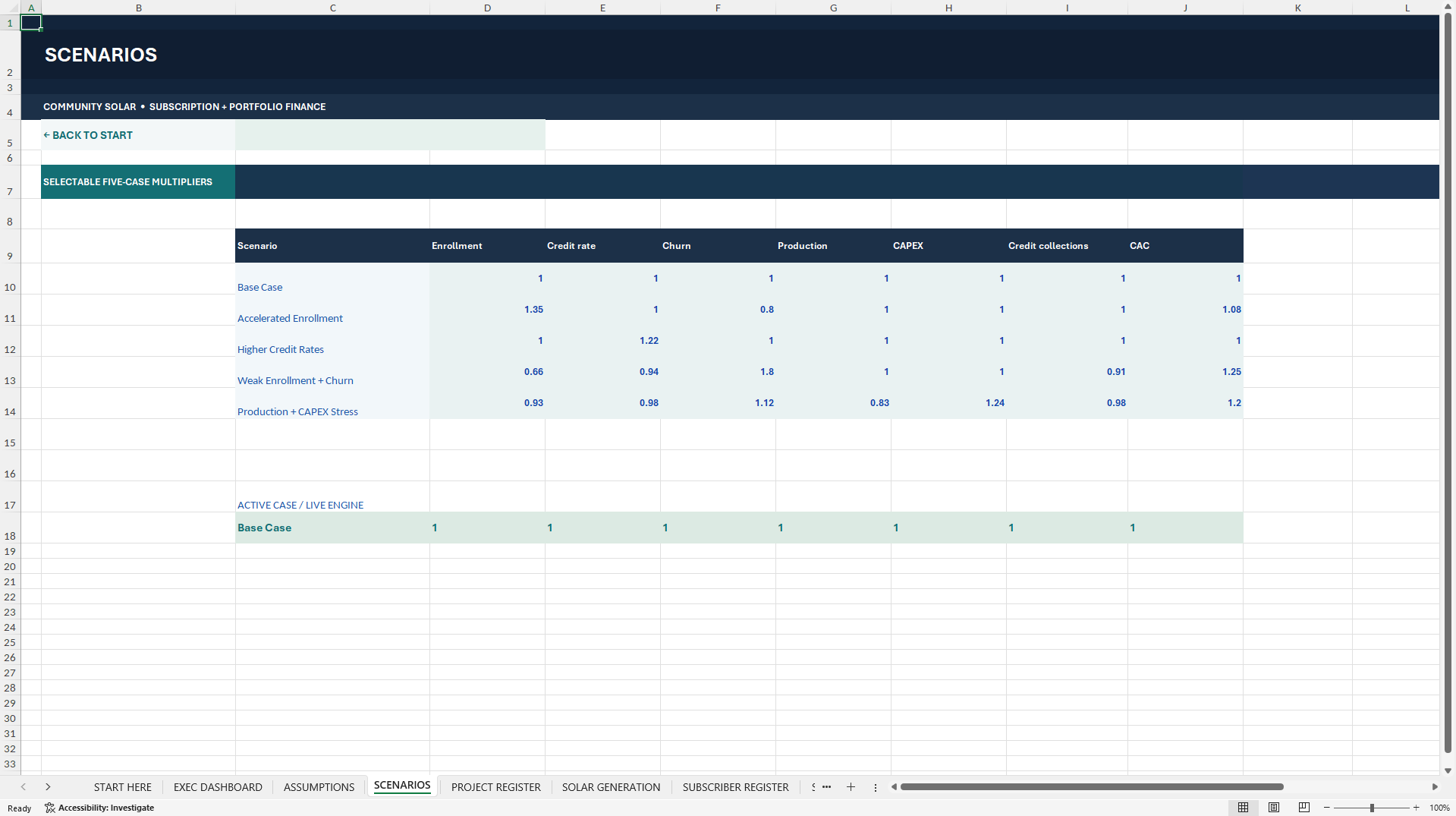
The workbook contains five scenario cases.
BASE CASE
Central illustrative assumptions for enrollment, solar generation, utility credit rates and operating costs.
ACCELERATED ENROLLMENT
Tests increased subscriber enrollment, improved retention and revised acquisition assumptions.
HIGHER CREDIT RATES
Explores more favorable utility credit economics.
WEAK ENROLLMENT + CHURN
Models reduced subscription participation and greater customer attrition.
PRODUCTION + CAPEX STRESS
Combines reduced solar production, increased infrastructure investment and weaker subscriber participation.
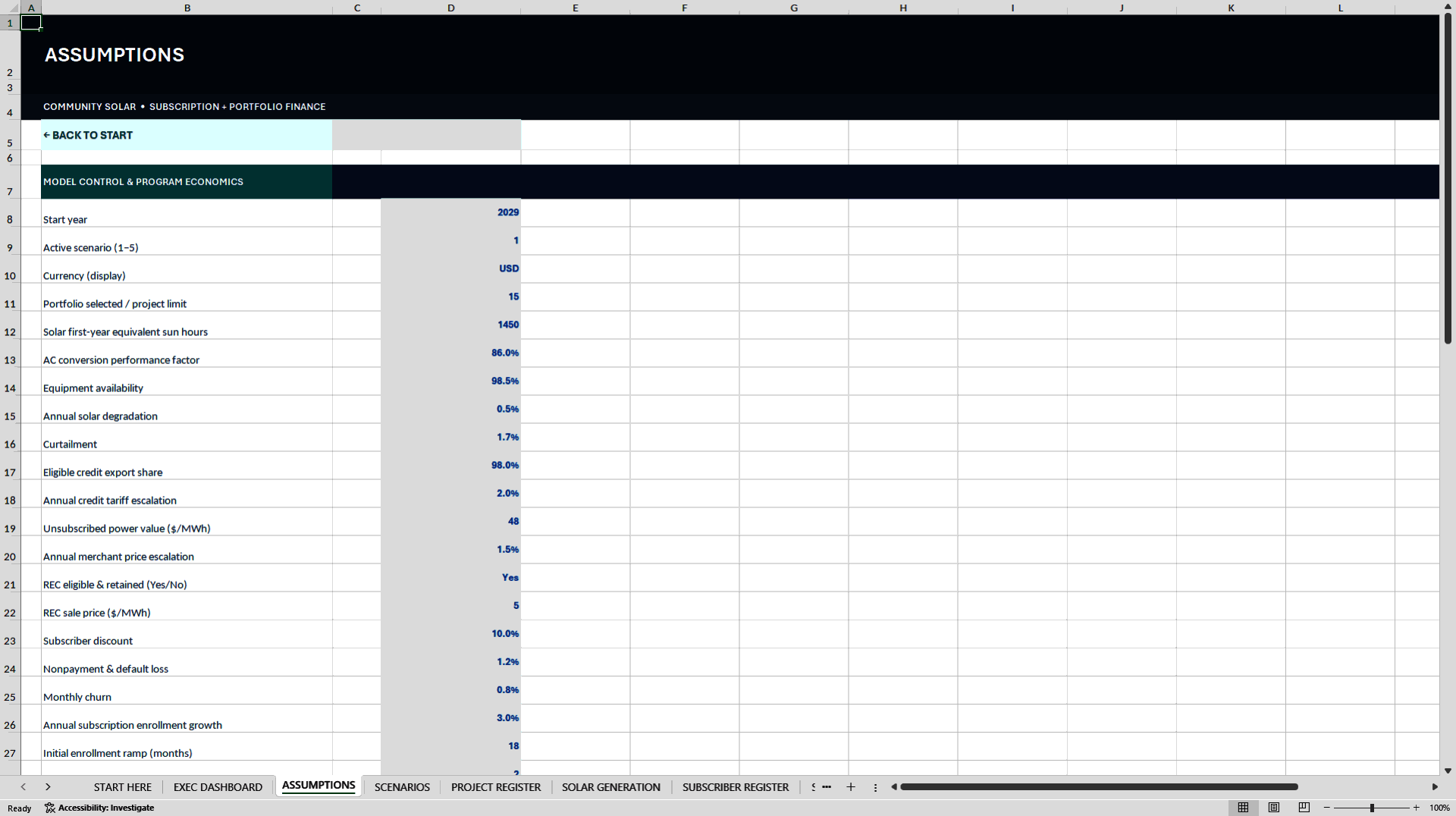
Select the active case in ASSUMPTIONS to apply the associated multipliers to the model.
The separate scenario-comparison calculations are indicative financial bridges and should not be treated as five independently calculated project valuations.
For detailed case analysis, select the scenario in the main model and review its linked operating and financial outputs.
📊 14 | TWO SENSITIVITY MATRICES
The SENSITIVITY worksheet includes two five-by-five analytical exhibits.
PARTICIPATION × UTILITY CREDIT ECONOMICS
Explore how subscriber participation and utility credit pricing affect an indicative revenue outcome.
DISCOUNT × CUSTOMER ACQUISITION COST
Evaluate the interaction between subscriber discount assumptions and customer acquisition expense.
The matrices support commercial assumption screening.
They are not 50 independent long-term project-finance simulations.
✅ 15 | MODEL CHECKS & FINANCIAL INTEGRITY
The MODEL CHECKS worksheet provides operating and accounting diagnostics.
Its controls include:
• Monthly Balance Sheet Reconciliation
• Cash Roll-Forward
• Operating Cash Flow Reconciliation
• Subscriber Allocation Limits
• Utility Credit and Discount Reconciliation
• Nonnegative Installed Solar Capacity
• Nonnegative Active Subscriber Accounts
• Debt Balance Integrity
• Nonnegative Unallocated Electricity
• Distribution and Liquidity Controls
• Approved Site Count
• Subscriber Default Assumptions
• Settlement and Financing Diagnostics
The model distinguishes mathematical reconciliation from economic viability.
A PASS indicates that the implemented test condition is satisfied. It does not establish regulatory eligibility, adequate financing, engineering feasibility or forecast reliability.
📦 WHAT YOU RECEIVE
PRIMARY DOCUMENT – EDITABLE EXCEL FINANCIAL MODEL
• 23 Connected Worksheets
• 300 Monthly Forecast Periods
• 25 Annual Reporting Periods
• 15 Fictional Solar Project Records
• 15 Fictional Subscriber Group Records
• Five Selectable Scenarios
• Eight Native Excel Charts
• Solar Generation and Eligible Electricity Calculations
• Subscriber Enrollment, Churn and Allocation
• Utility Credits and Customer Collections
• Revenue, CAPEX, OPEX and Acquisition Costs
• Debt and Equity Financing
• Three Linked Financial Statements
• Project and Equity IRR / Project NPV
• DSCR and Investment Return Analysis
• Two 5 × 5 Sensitivity Matrices
• Built-In Model Checks
• START HERE Navigation and Embedded User Guide
SUPPLEMENTARY DOCUMENT – PROFESSIONAL ENGLISH PDF GUIDE
An 18-page user manual covering workbook setup, navigation, project and subscriber inputs, solar generation, utility settlement logic, financial calculations, financing, investment returns, scenarios, validation and troubleshooting.
🧭 16 | HOW TO GET STARTED
1. Save an independent working copy of the Excel workbook.
2. Open START HERE and read the PDF guide.
3. Configure the global assumptions in ASSUMPTIONS.
4. Replace the fictional PROJECT REGISTER site examples.
5. Customize SUBSCRIBER REGISTER and enrollment inputs.
6. Review SOLAR GENERATION and SUBSCRIPTION ENGINE.
7. Examine UTILITY CREDITS and CUSTOMER PAYMENTS.
8. Review REVENUE ENGINE, CAPEX, OPEX and FINANCING.
9. Analyze the financial statements and PORTFOLIO RETURNS.
10. Select scenarios individually and investigate MODEL CHECKS.
👥 17 | WHO THIS MODEL IS FOR
• Community Solar Project Developers
• Distributed Solar Portfolio Operators
• Renewable Energy Investors
• Subscriber Program Managers
• Energy Project Finance Analysts
• Solar Commercial Strategy Teams
• Financial Consultants
• Renewable Energy Planning Educators
⚙️ 18 | TECHNICAL SPECIFICATIONS
File Format: Editable Microsoft Excel XLSX.
Forecast: 300 monthly periods and 25 annual reporting periods.
Default Illustrative Timeline: 2029–2053.
Worksheets: 23.
Dashboard Charts: Eight native Excel charts.
Scenarios: Five selectable operating cases.
Macros / VBA: None.
Required External Connections: None.
Recommended Software: Microsoft Excel Desktop.
Google Sheets import has not been independently validated.
A complete independent Excel Desktop recalculation and five-scenario stress test have not been performed.
Changing the reporting currency label does not automatically perform foreign exchange conversion.
The workbook is a financial planning template, not utility-certified billing software, project engineering certification, comprehensive tax-equity underwriting, lender-approved debt sizing or an individual subscriber CRM platform.
🛡️ 19 | INDEPENDENT TEMPLATE DISCLAIMER
This is an independent, unofficial financial planning and educational template developed by SheetworksStudio.
All demonstration solar sites, subscribers, electricity quantities, utility credit assumptions, operating expenses and financial outputs are fictional.
The product is not audited, certified, regulator-approved, utility-approved, bank-approved or endorsed by any utility, electricity market, financial institution or software provider.
Actual community solar projects require independent verification of utility program eligibility, electricity production, subscriber allocations, customer contracts, credit settlement rules, REC ownership, financing arrangements, taxes and applicable regulations.
No electricity generation, subscriber participation, utility credit collection, financing availability, profitability or investment return is guaranteed.
The template does not provide individualized financial, investment, engineering, accounting, tax or legal advice.
Digital product only. No physical solar equipment, electricity, software subscription or consulting service is included.
CONNECT SOLAR GENERATION, SUBSCRIBER ECONOMICS, UTILITY SETTLEMENTS AND TWENTY-FIVE YEARS OF PROJECT FINANCIAL PLANNING.
Got a question about the product? Email us at support@flevy.com or ask the author directly by using the "Ask the Author a Question" form. If you cannot view the preview above this document description, go here to view the large preview instead.
Source: Best Practices in Solar Energy, Integrated Financial Model Excel: Community Solar Subscription & Project Finance Model Excel (XLSX) Spreadsheet, SheetworksStudio
ABOUT THE AUTHOR

SheetworksStudio creates premium Excel-based business templates, dashboards, trackers, financial models, and management systems for professionals, consultants, entrepreneurs, and organizations.
Our portfolio covers finance, project management, operations, risk management, compliance, AI governance, HR, supply chain, performance management, and business planning. Each product is designed to
... [read more]
Ask the Author a Question
You must be logged in to contact the author.