 Click main image to view in full screen. Unlock all 17 preview images:
AI Acceptable Use Policy (AUP) Master Template – Word DOCX
Word (DOCX) 79 Pages


BENEFITS OF THIS DOWNLOADABLE WORD DOCUMENT
- Replaces weeks of policy drafting with a complete, fully written framework that needs only organization details and legal review before adoption.
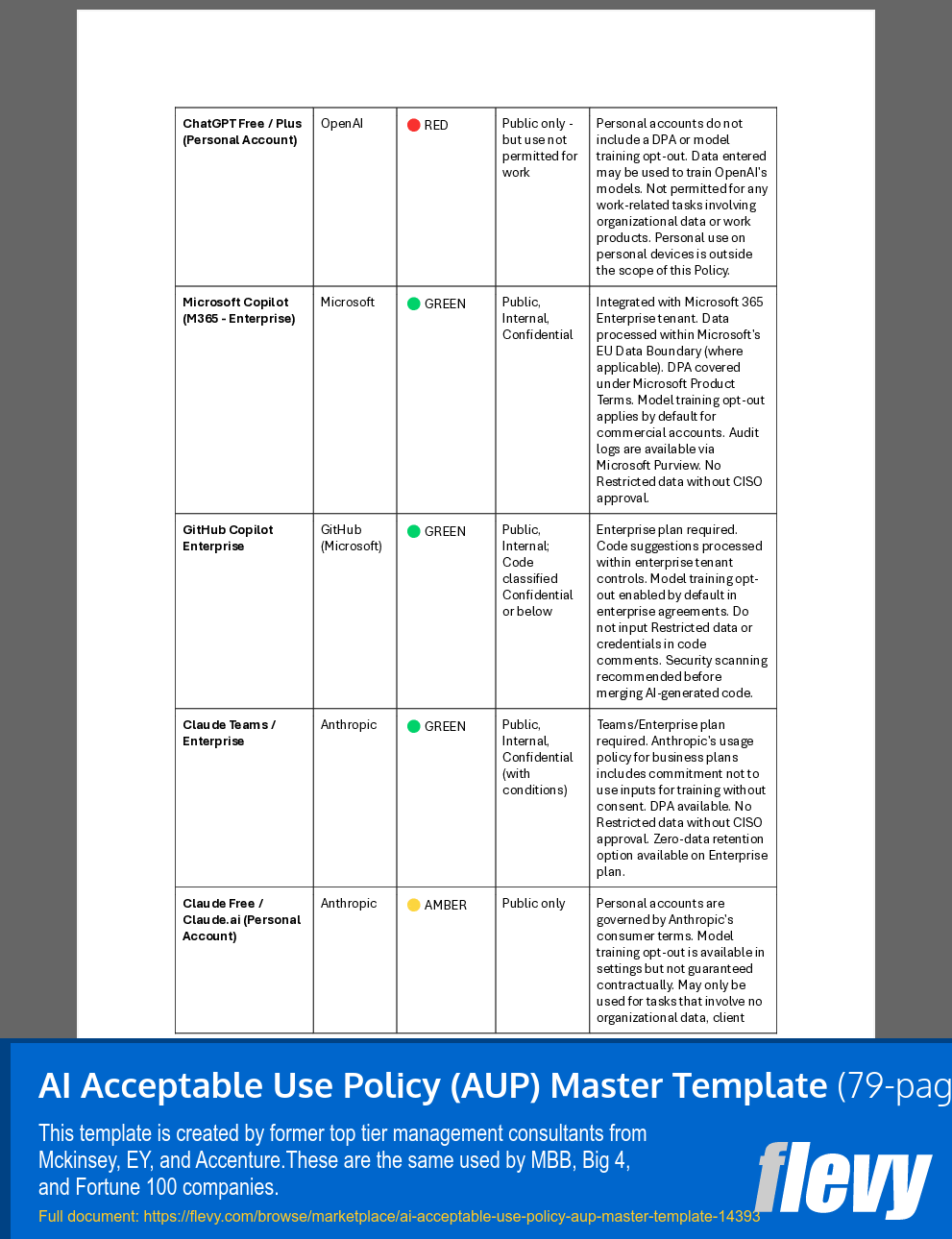
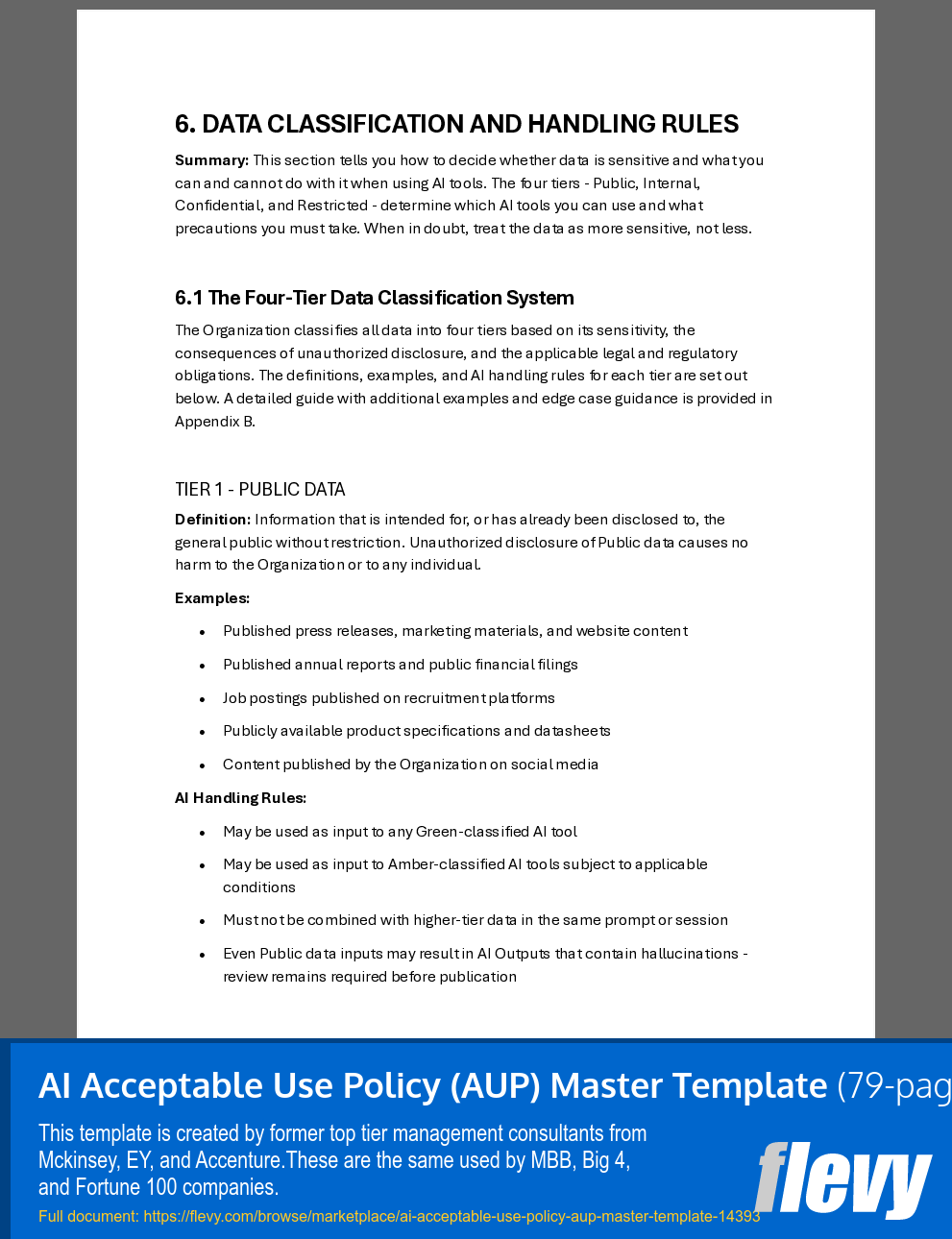
- Gives employees unambiguous rules through Green, Amber, and Red verdicts on 16 AI tool entries, a four-tier data handling matrix, and 12 plain English prohibitions.
- Strengthens regulatory defensibility with article-level mapping to nine frameworks, a four-level disciplinary model, and ready-to-use incident, audit, and attestation records.
ARTIFICIAL INTELLIGENCE WORD DESCRIPTION
Complete, editable AI governance policy with 19 sections, 8 appendices, 16 pre-classified AI tools, and article-level mapping to the EU AI Act, GDPR, India DPDP Act, NIST AI RMF, and ISO 42001.
This AI Acceptable Use Policy template gives organizations a complete, fully written framework for governing how employees, contractors, and third parties use generative AI, coding assistants, analytics tools, and autonomous AI agents. It addresses the most urgent exposure facing compliance, legal, security, and HR leaders today: staff already using AI tools that the organization has never assessed, with no clear rules on what data may be entered or how outputs must be reviewed.
What Is Included
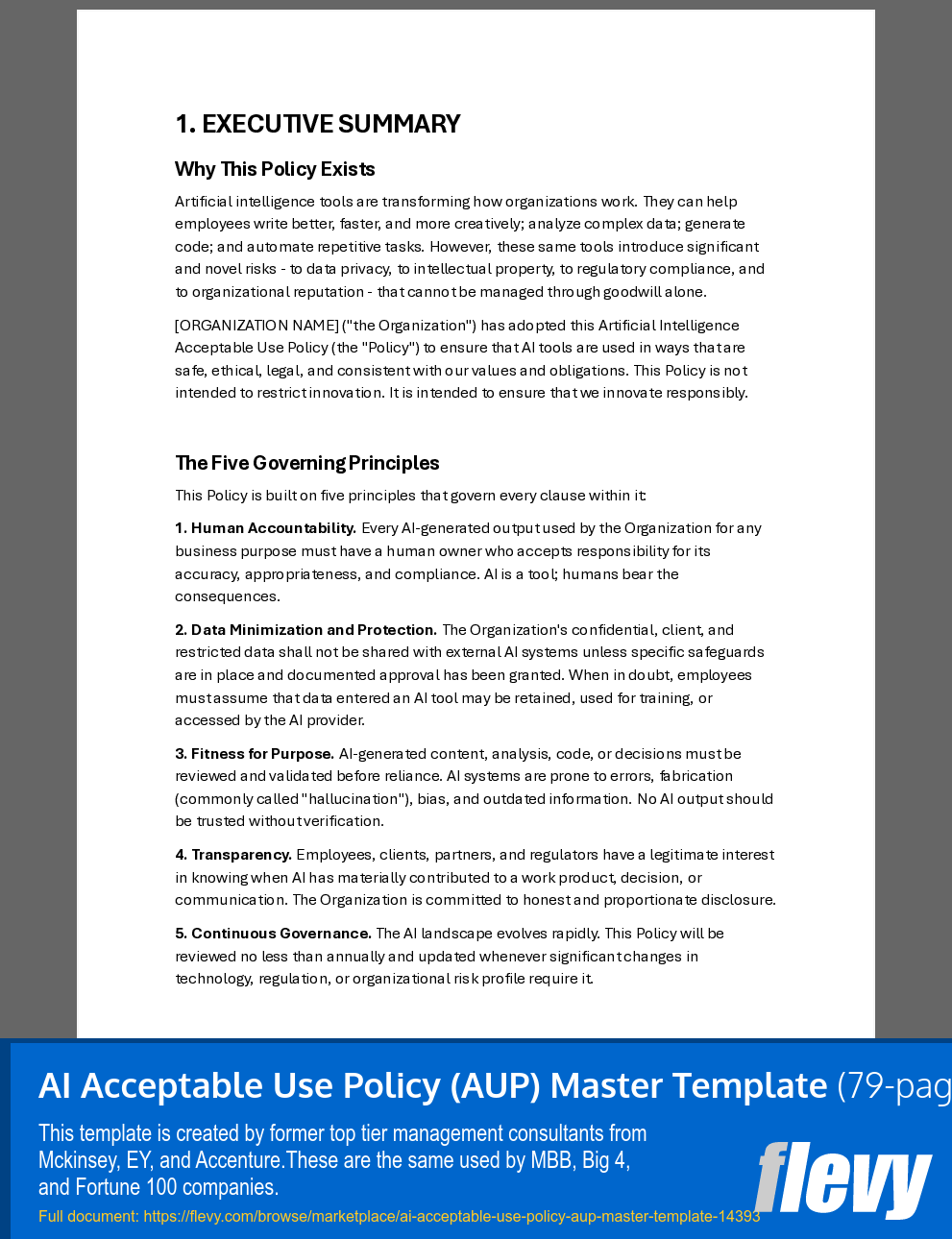
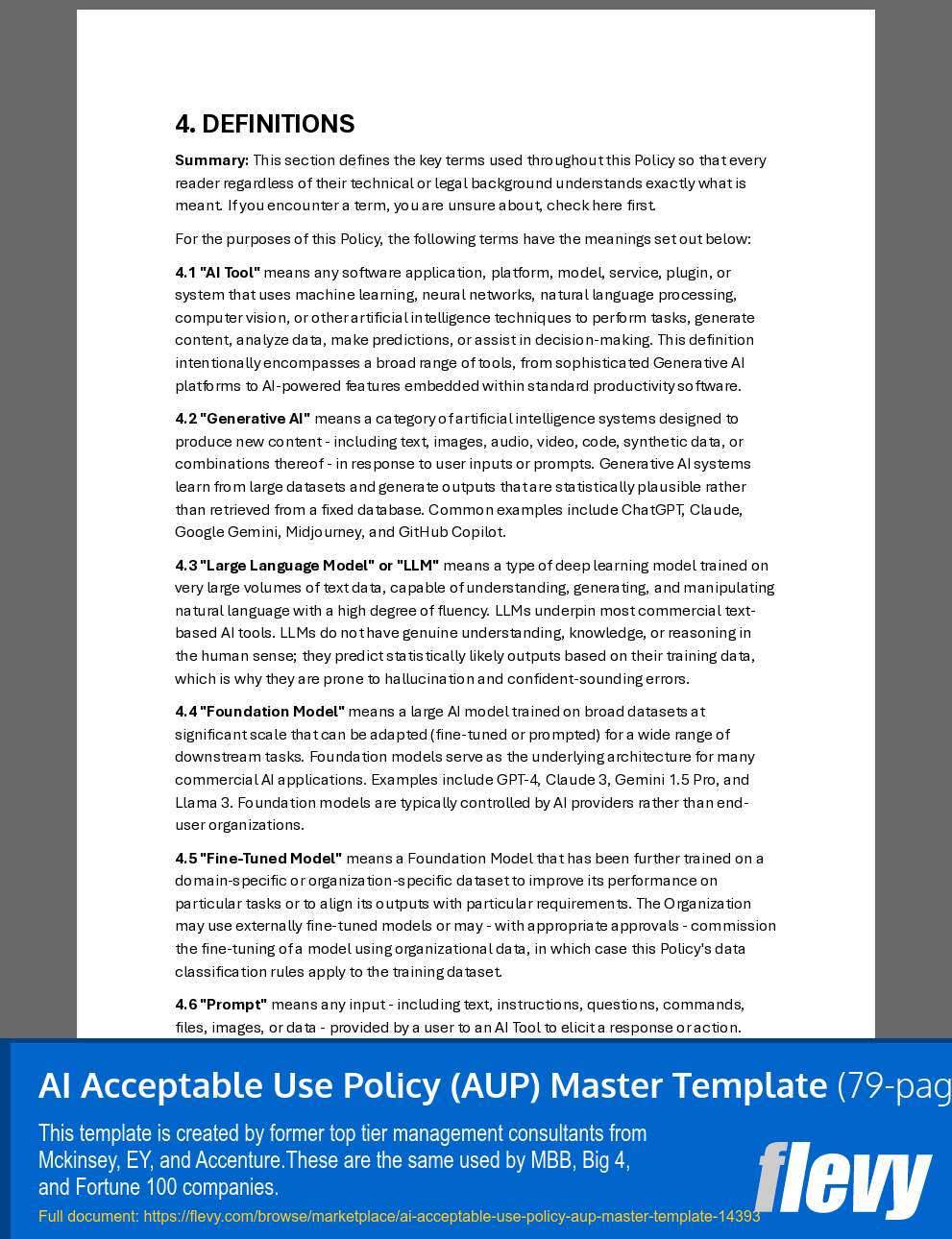
The primary document is an editable Word policy of roughly 80 pages with 19 numbered sections. Each major section opens with a short plain English summary, followed by formal policy language, so the policy is readable by any employee and defensible in front of a regulator. Sections cover the executive summary and five governing principles, purpose, scope, 19 defined terms, an AI tool classification matrix, data classification and handling rules, department use cases, 12 prohibited uses, human oversight, disclosure, intellectual property, agentic AI, vendor onboarding, incident reporting, monitoring, disciplinary consequences, review cycle, governance, and a regulatory reference index.
A supporting ZIP file contains eight standalone appendices in Word format: an AI Tool Register, a Data Classification Guide, an Employee Acknowledgment and Attestation Form, an AI Incident Report Template, a RACI Matrix, a Use Case Risk Rating Rubric, an AI Output Review Checklist, and Approved Prompting Guidelines with ten safe versus unsafe prompt examples. The ZIP also includes a PDF with step-by-step customization instructions.
Key Capabilities
The classification matrix assigns Green, Amber, or Red status to 16 named tool entries, including enterprise and personal versions of widely used AI assistants, with permitted data tiers and conditions of use. A four-tier data model (Public, Internal, Confidential, Restricted) is paired with a handling matrix and a hardcoded list of data types that may never enter an external AI tool.
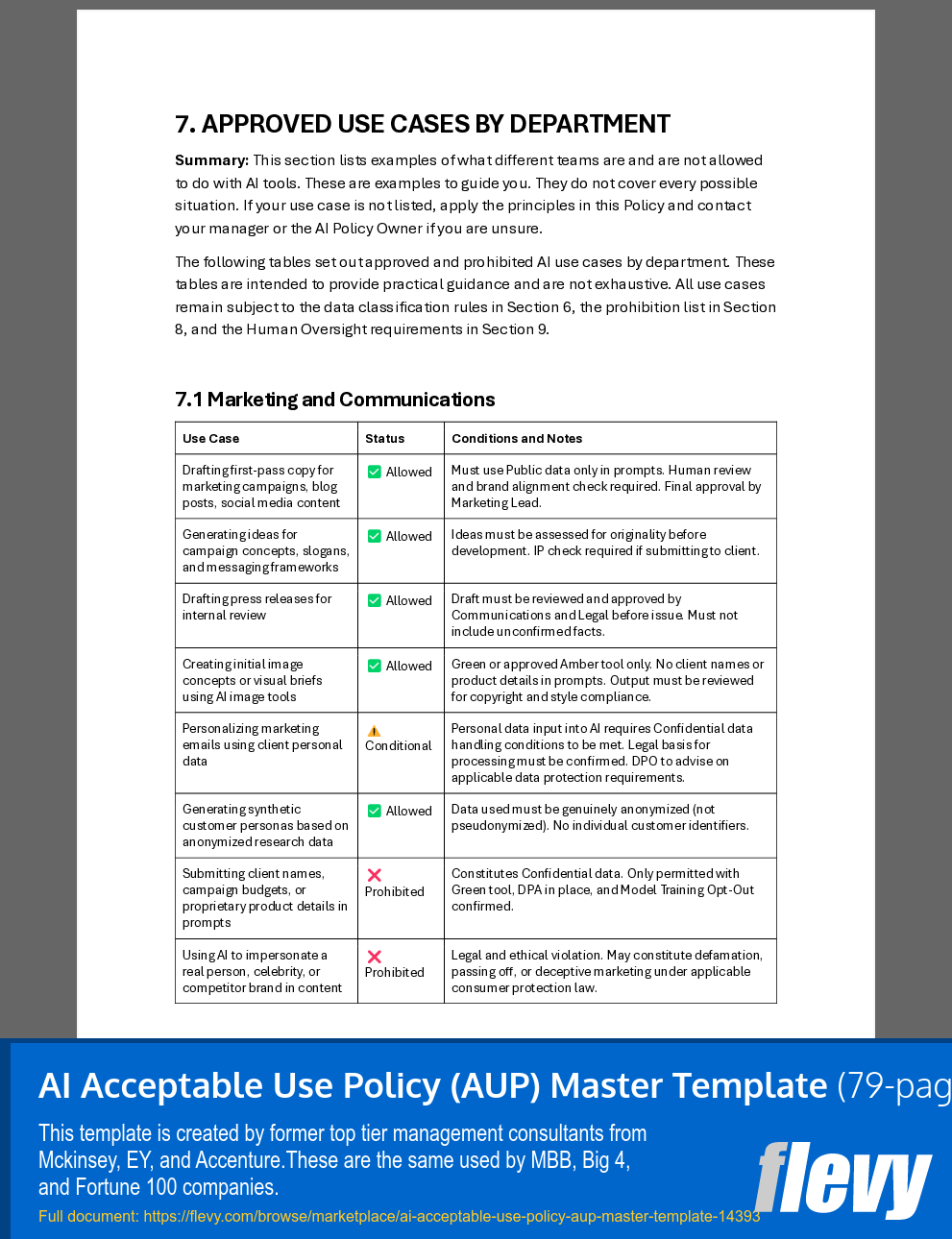
Seven departments, Marketing, Legal, HR, Finance, Engineering, Customer Service, and Executive, each receive tables of allowed, conditional, and prohibited use cases. A dedicated section on agentic AI sets mandatory controls for browsing agents, email agents, code execution agents, and external-facing agents.
The regulatory reference index maps policy sections to the EU AI Act, GDPR, UK GDPR, India DPDP Act 2023, CCPA/CPRA, NIST AI RMF, ISO/IEC 42001, OECD AI Principles, and UNESCO AI Ethics.
Business Applications
Use the template to launch a first AI policy, replace an informal guidance memo, prepare for an audit or board review, standardize vendor assessment, and run employee attestation and incident reporting from day one.
Target Audience
Chief information security officers, general counsel, data protection officers, compliance and risk leaders, HR directors, and consultants advising on AI governance.
Format and Customization
All customizable fields appear as bracketed placeholders, and the cover includes a logo placeholder. The content is generic and illustrative, not tailored to any organization. It is a template, not legal advice, and should be reviewed by qualified counsel before adoption.
Got a question about the product? Email us at support@flevy.com or ask the author directly by using the "Ask the Author a Question" form. If you cannot view the preview above this document description, go here to view the large preview instead.
Source: Best Practices in Artificial Intelligence, Corporate Policies Word: AI Acceptable Use Policy (AUP) Master Template Word (DOCX) Document, Dynack
ABOUT THE AUTHOR
Strategic intelligence for teams that move fast.
Dynack gives founders, operators, consultants, and business leaders the frameworks, templates, and playbooks that previously required a $50,000 consulting engagement to access. We strip out the gatekeeping and the fees. What remains is pure strategic utility, instantly downloadable and immediately usable.
Ask the Author a Question
You must be logged in to contact the author.