
Viable System Model (VSM)   33-slide PPT PowerPoint presentation template (PPTX)
$29.00

Viable System Model (VSM) (33-slide PPT PowerPoint presentation slide deck (PPTX)) Preview Image
Log in to unlock full preview.
Viable System Model (VSM) (33-slide PPT PowerPoint presentation slide deck (PPTX)) Preview Image
Arrow   Click main image to view in full screen.

Viable System Model (VSM) – PowerPoint PPTX Template

PowerPoint (PPTX) 33 Slides FlevyPro Document

Top 1,000 Best Practice $29.00
FlevyPro price: FREE (included in subscription)
This framework is developed by a team of former McKinsey and Big 4 consultants. The presentation follows the headline-body-bumper slide format used by global consulting firms.
Add to Cart


Immediate download
Free lifetime updates

ORGANIZATIONAL DESIGN PPT TEMPLATE DESCRIPTION

Editor Summary A 33-slide PowerPoint presentation, the Viable System Model (VSM) explains Stafford Beer’s framework for assessing organizational viability across 5 subsystems: Operational Unit, Management Level, Coordination Level, Cognitive Level, and Policy Ethos. Read more

Stafford Beer, a British operations research theorist and cybernetician, developed the Viable System Model (VSM).

VSM is a useful framework for determining the viability of an organization. The model facilitates in ascertaining whether a business organization or a system stands a chance to survive in constantly disrupting markets and settings. The VSM offers organizations a solution that helps them balance control and efficiency.

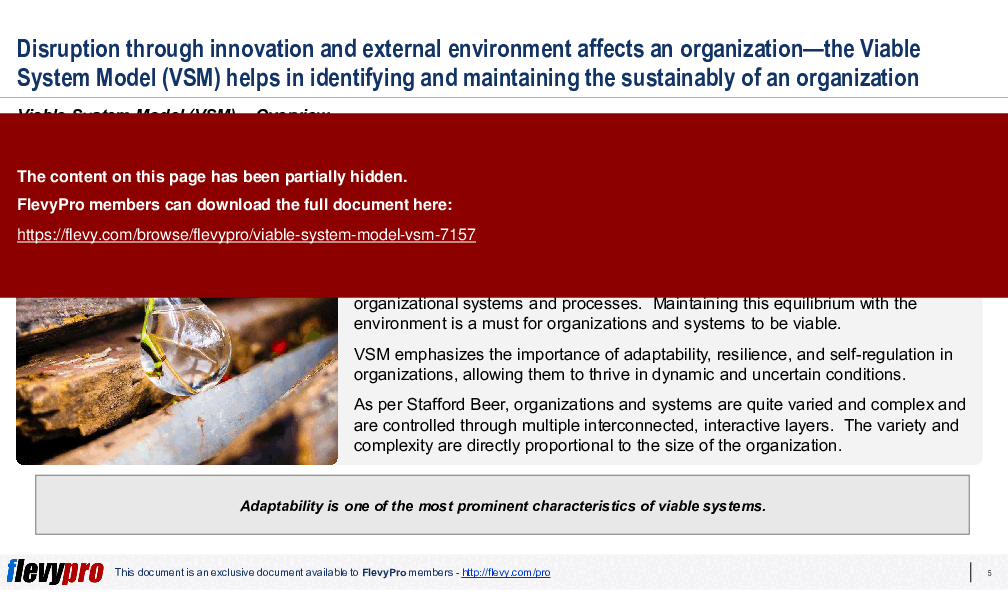
The Viable System Model enables examining the internal and external equilibrium of an organization, pinpointing shortcomings and issues, and improving organizational systems and processes. Maintaining this equilibrium with the environment is a must for organizations and systems to be viable.

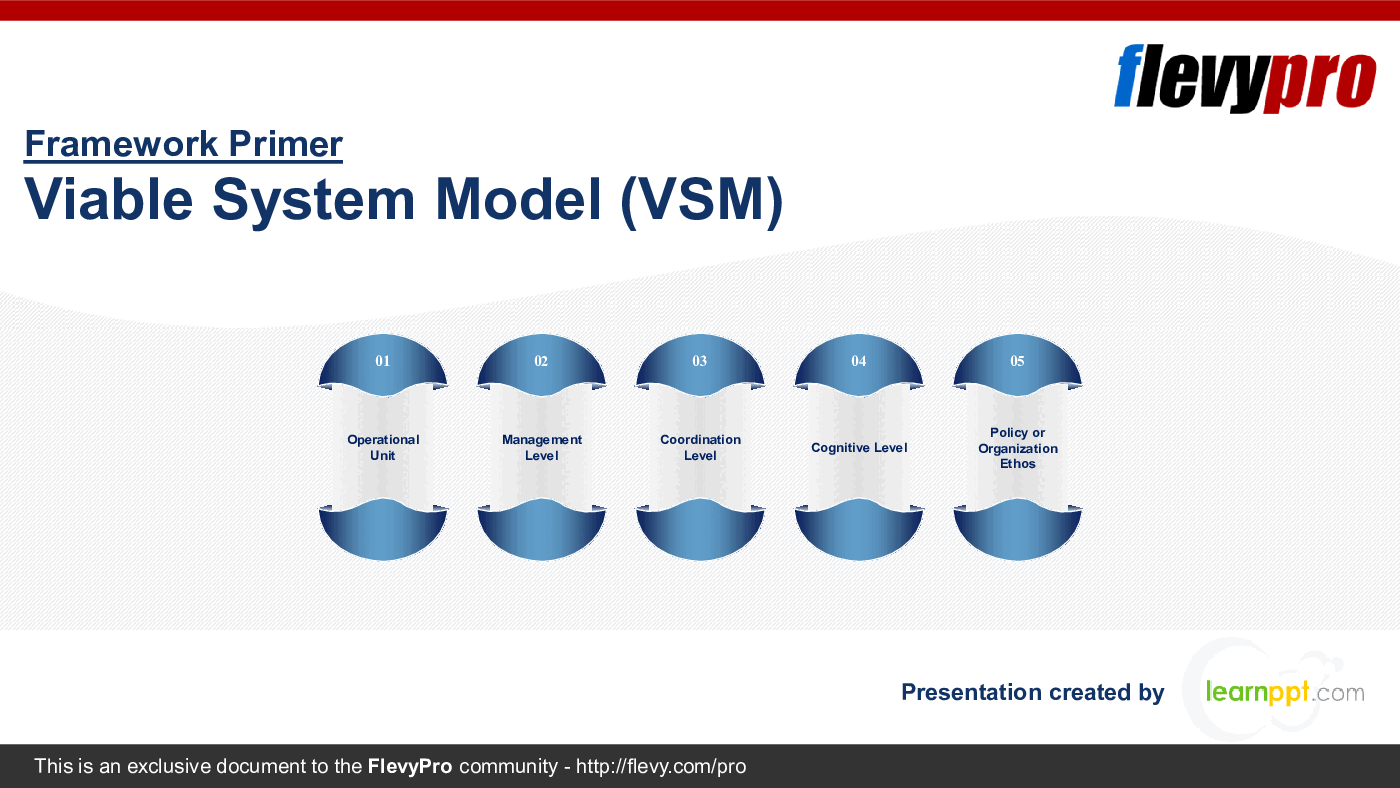
VSM encompasses 5 components or subsystems, each with distinct functions:

1. Operational Unit
2. Management Level
3. Coordination Level
4. Cognitive Level
5. Policy or Organization Ethos

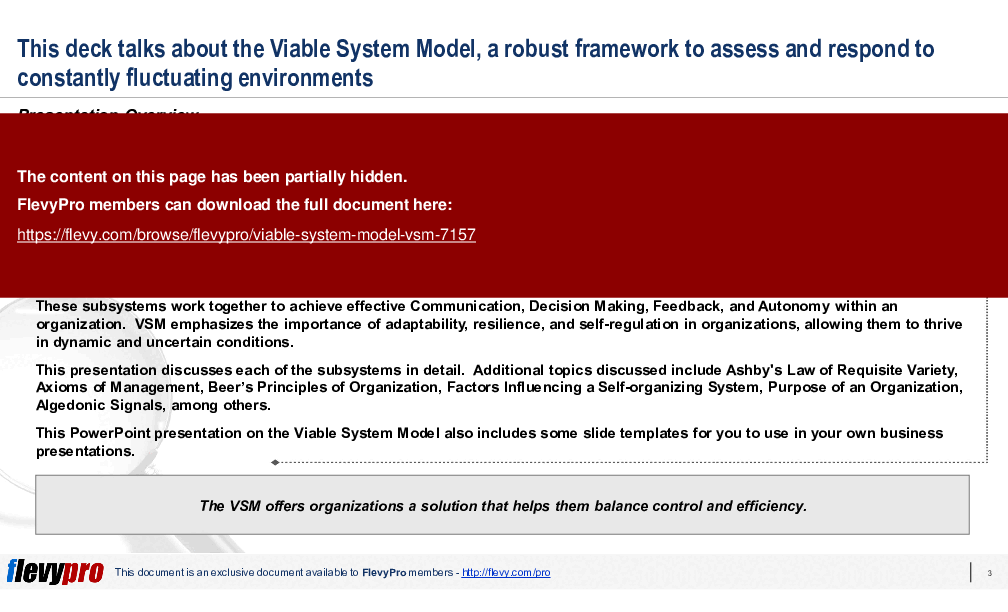
These subsystems work together to achieve effective Communication, Decision Making, Feedback, and Autonomy within an organization. VSM emphasizes the importance of adaptability, resilience, and self-regulation in organizations, allowing them to thrive in dynamic and uncertain conditions.

This PowerPoint presentation discusses each of the subsystems in detail. Additional topics discussed include Ashby's Law of Requisite Variety, Axioms of Management, Beer's Principles of Organization, Factors Influencing a Self-organizing System, Purpose of an Organization, Algedonic Signals, among others.

This PowerPoint presentation on the Viable System Model also includes some slide templates for you to use in your own business presentations.

Got a question about this document? Email us at flevypro@flevy.com.

MARCUS OVERVIEW

This synopsis was written by Marcus [?] based on the analysis of the full 33-slide presentation.


Executive Summary
The Viable System Model (VSM) presentation provides a robust framework for assessing organizational viability in dynamic environments. Developed by Stafford Beer, this model identifies 5 key subsystems that facilitate effective communication, decision-making, and adaptability within organizations. By leveraging VSM, corporate executives and consultants can enhance their organizations' resilience and self-regulation, ensuring they thrive amidst constant market disruptions. This presentation includes detailed insights into each subsystem, practical applications, and templates for immediate use in business contexts.

Who This Is For and When to Use
•  Corporate executives seeking to enhance organizational adaptability
•  Change management leaders implementing new frameworks
•  Consultants advising on organizational design and effectiveness
•  Strategy teams focused on improving decision-making processes
•  Operations managers aiming to streamline communication and feedback loops

Best-fit moments to use this deck:
•  During organizational assessments to evaluate current viability
•  In strategy sessions focused on adapting to market changes
•  When implementing new management frameworks or processes
•  For training sessions aimed at improving team collaboration and communication

Learning Objectives
•  Define the Viable System Model and its relevance to organizational viability
•  Identify the 5 subsystems of VSM and their distinct functions
•  Analyze the internal and external equilibria of an organization using VSM
•  Establish effective feedback loops to enhance adaptability and resilience
•  Apply Beer’s Principles of Organization to real-world scenarios
•  Create actionable plans to implement VSM within an organization

Table of Contents
•  Overview (page 3)
•  Viable System Model (VSM) (page 5)
•  Subsystems of VSM (page 10)
•  Additional Principles (page 18)
•  Slide Design Structure & Templates (page 22)

Primary Topics Covered
•  Viable System Model Overview - The VSM framework assesses organizational viability by analyzing its ability to adapt to changing environments.
•  Subsystems of VSM - The model comprises 5 subsystems: Operational Unit, Management Level, Coordination Level, Cognitive Level, and Policy Ethos, each serving distinct functions.
•  Adaptability and Resilience - VSM emphasizes the importance of maintaining equilibrium with the environment to ensure organizational sustainability.
•  Beer’s Principles of Organization - Four principles guide organizations in managing complexity and ensuring effective decision-making.
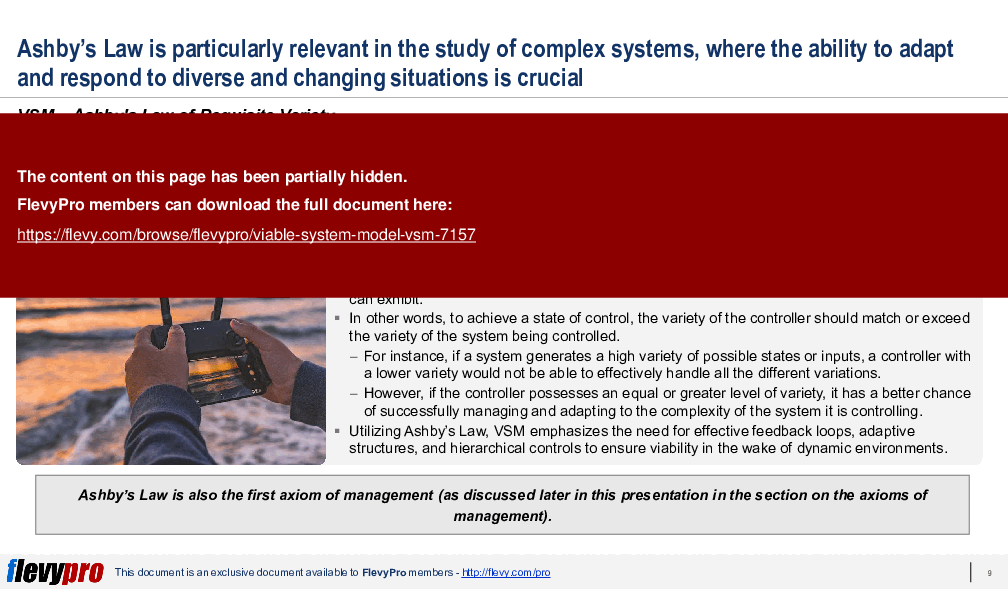
•  Ashby’s Law of Requisite Variety - This law highlights the necessity for organizations to match their internal variety with external environmental complexity.
•  Algedonic Signals - These signals help organizations balance centralization and autonomy, impacting decision-making processes.

Deliverables, Templates, and Tools
•  VSM framework overview template for presentations
•  Subsystem analysis templates for evaluating organizational functions
•  Feedback loop design templates to enhance communication
•  Action plan templates for implementing VSM principles
•  Guidelines for applying Beer’s Principles in organizational contexts
•  Algedonic signals assessment tools for measuring authority dynamics

Slide Highlights
•  Overview of the Viable System Model, detailing its 5 subsystems
•  Visual representation of the relationship between subsystems and their functions
•  Case studies illustrating the application of VSM in real-world scenarios
•  Templates for structuring presentations on organizational design
•  Key principles of Beer’s framework summarized for quick reference

Potential Workshop Agenda
Introduction to VSM (60 minutes)
•  Overview of the Viable System Model and its importance
•  Discussion on the 5 subsystems and their roles

Subsystem Deep Dive (90 minutes)
•  Detailed analysis of each subsystem
•  Group activities to identify applications within participants' organizations

Implementing VSM (60 minutes)
•  Action planning for integrating VSM principles
•  Sharing best practices and lessons learned

Customization Guidance
•  Tailor the presentation templates to reflect your organization’s specific context and terminology
•  Adjust the examples and case studies to align with industry-specific challenges
•  Incorporate organizational metrics and governance structures relevant to your team

Secondary Topics Covered
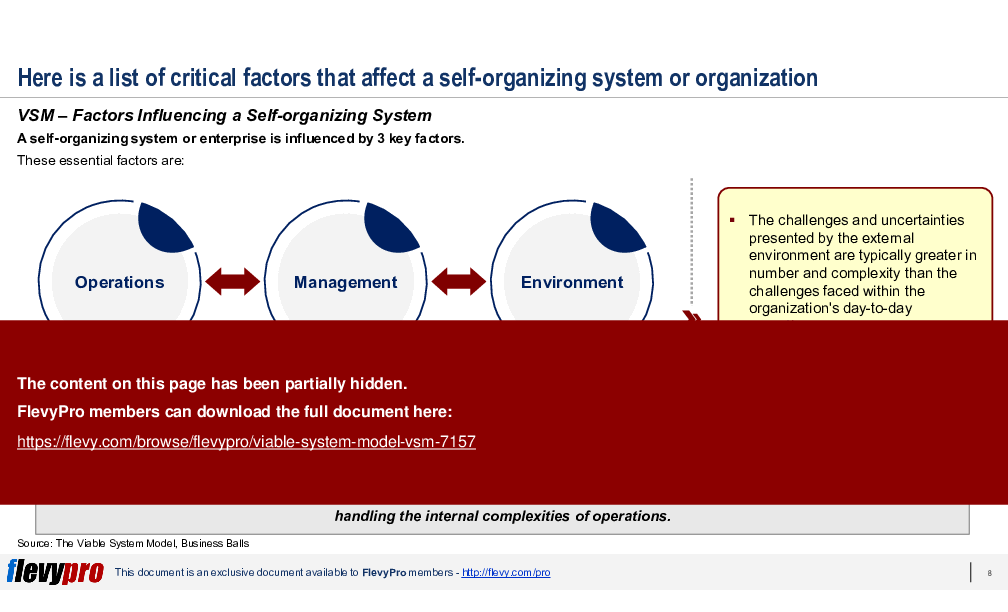
•  Factors influencing self-organizing systems
•  The role of management in maintaining organizational viability
•  Strategies for fostering a culture of adaptability and resilience
•  The impact of external environments on organizational structure

Topic FAQ

What are the core components of the Viable System Model and how do they interact?

The Viable System Model comprises 5 interacting subsystems: Operational Unit, Management Level, Coordination Level, Cognitive Level, and Policy Ethos. Together they manage operations, coordination, strategy, and governance while establishing feedback and autonomy mechanisms to maintain equilibrium with the environment—5 subsystems.

How does Ashby’s Law of Requisite Variety apply to organizational viability?

Ashby’s Law states that an organization must match its internal variety to external environmental complexity to remain viable. In practice, VSM uses this principle to size decision-making, control mechanisms, and feedback loops so internal responses can handle external perturbations—Ashby’s Law of Requisite Variety.

What are algedonic signals and why are they important for decision-making?

Algedonic signals are feedback mechanisms that alert higher levels to pain or pleasure (problems or successes), enabling balance between centralization and autonomy. They support faster escalation or devolution of decisions and are used in VSM to tune authority dynamics—algedonic signals assessment tools.

Which managerial principles underpin Beer’s recommendations in VSM?

Beer’s Principles of Organization emphasize managing complexity through requisite variety, clear communication, resilience, and recursive control across nested subsystems. These principles guide structuring feedback, decision rights, and governance to maintain viability under change—Beer’s Principles of Organization.

What should I look for when choosing a VSM presentation or toolkit for an organizational assessment?

Choose materials that explain the 5 subsystems, include diagnostic templates (subsystem analysis, feedback loops), offer case examples, and provide implementation guidance and workshop agendas. Flevy’s Viable System Model (VSM) includes subsystem analysis and feedback loop templates as concrete deliverables.

What typical deliverables help facilitate a VSM workshop for leadership teams?

Useful workshop deliverables include an overview slide of VSM, deep-dive slides for each subsystem, group exercises for subsystem mapping, action-planning templates, case study examples, and a suggested agenda. Flevy’s Viable System Model (VSM) lists a workshop agenda and slide templates as slide highlights.

How can VSM help a company improve adaptability after a disruptive market event?

VSM helps assess internal/external equilibria, identify structural or communication shortfalls, design feedback loops, and prioritize governance adjustments. That assessment informs concrete actions to restore viability, supported by templates and an implementation action plan to operationalize changes—action plan templates.

Are pre-built VSM templates useful for mid-size companies with limited consulting budgets?

Pre-built templates can accelerate diagnostics and workshop delivery, allow customization to company terminology, and reduce external advisory hours while guiding subsystem analysis, feedback-loop design, and implementation planning. Flevy’s Viable System Model (VSM) provides a VSM framework overview template to support this approach.

Document FAQ
These are questions addressed within this presentation.

What is the Viable System Model?
The Viable System Model is a framework developed by Stafford Beer to assess and enhance the viability of organizations in dynamic environments.

How can VSM improve organizational adaptability?
VSM provides a structured approach to understanding and managing the complexities of organizational systems, enabling better responsiveness to external changes.

What are the 5 subsystems of VSM?
The 5 subsystems are the Operational Unit, Management Level, Coordination Level, Cognitive Level, and Policy Ethos, each contributing to the overall viability of the organization.

How does Ashby's Law apply to VSM?
Ashby's Law states that for a system to remain viable, its internal complexity must match or exceed the complexity of its external environment, which is a core principle of VSM.

What are Algedonic Signals?
Algedonic Signals refer to the feedback mechanisms that help organizations balance authority and autonomy, impacting decision-making processes within the system.

How can I implement VSM in my organization?
Begin by assessing your current organizational structure against the VSM framework, identifying areas for improvement, and developing an action plan based on the insights gained.

What are Beer’s Principles of Organization?
Beer’s Principles provide guidelines for managing complexity within organizations, emphasizing variety, communication, resilience, and recursive control.

How can I use the templates provided in this presentation?
The templates can be customized to fit your organization’s specific needs, facilitating the application of VSM principles in your context.

Glossary
•  Viable System Model (VSM) - A framework for assessing organizational viability.
•  Subsystem - A component of the VSM, each with distinct functions.
•  Operational Unit - The subsystem responsible for day-to-day operations.
•  Management Level - The subsystem that coordinates and integrates operational activities.
•  Coordination Level - The subsystem that monitors external environments.
•  Cognitive Level - The subsystem that oversees governance and strategic decision-making.
•  Policy Ethos - The subsystem that establishes the ethical framework for decision-making.
•  Ashby's Law - A principle stating that a system must possess a variety equal to or greater than its environment.
•  Algedonic Signals - Feedback mechanisms that help balance authority and autonomy.
•  Beer’s Principles - Guidelines for managing complexity in organizations.
•  Self-organizing System - An organization that adapts and evolves based on internal and external factors.
•  Feedback Loop - A process where outputs of a system are circled back as inputs.

ORGANIZATIONAL DESIGN PPT TEMPLATES

Cognitive Level: Governance and Strategic Decision-Making

Management Level: Coordination and Control Mechanisms

Key Influencers of Self-Organizing Systems

Source: Best Practices in Organizational Design, Purpose, Business Resilience PowerPoint Slides: Viable System Model (VSM) PowerPoint (PPTX) Presentation Slide Deck, LearnPPT Consulting


$29.00
FlevyPro price: FREE (included in subscription)
This framework is developed by a team of former McKinsey and Big 4 consultants. The presentation follows the headline-body-bumper slide format used by global consulting firms.
Add to Cart
  

Did you need more documents?

Consider a FlevyPro subscription from $39/month. View plans here.

For $10.00 more, you can download this document plus 2 more FlevyPro documents. That's just $13 each.

ABOUT FLEVYPRO

This document is part of the FlevyPro Library, a curated knowledge base of documents for our FlevyPro subscribers.

FlevyPro is a subscription service for on-demand business frameworks and analysis tools. FlevyPro subscribers receive access to an exclusive library of curated business documents—business framework primers, presentation templates, Lean Six Sigma tools, and more—among other exclusive benefits.

Click here to learn more about FlevyPro and its benefits.

Did you know?
The average daily rate of a McKinsey consultant is $6,625 (not including expenses). The average price of a Flevy document is $65.


Trusted by over 10,000+ Client Organizations
Since 2012, we have provided business templates to over 10,000 businesses and organizations of all sizes, from startups and small businesses to the Fortune 100, in over 130 countries.
AT&T GE Cisco Intel IBM Coke Dell Toyota HP Nike Samsung Microsoft Astrazeneca JP Morgan KPMG Walgreens Walmart 3M Kaiser Oracle SAP Google E&Y Volvo Bosch Merck Fedex Shell Amgen Eli Lilly Roche AIG Abbott Amazon PwC T-Mobile Broadcom Bayer Pearson Titleist ConEd Pfizer NTT Data Schwab


Read Customer Testimonials

 
"I have used FlevyPro for several business applications. It is a great complement to working with expensive consultants. The quality and effectiveness of the tools are of the highest standards."

– Moritz Bernhoerster, Global Sourcing Director at Fortune 500
 
"The wide selection of frameworks is very useful to me as an independent consultant. In fact, it rivals what I had at my disposal at Big 4 Consulting firms in terms of efficacy and organization."

– Julia T., Consulting Firm Owner (Former Manager at Deloitte and Capgemini)
 
"[Flevy] produces some great work that has been/continues to be of immense help not only to myself, but as I seek to provide professional services to my clients, it gives me a large "tool box" of resources that are critical to provide them with the quality of service and outcomes they are expecting."

– Royston Knowles, Executive with 50+ Years of Board Level Experience
 
"FlevyPro has been a brilliant resource for me, as an independent growth consultant, to access a vast knowledge bank of presentations to support my work with clients. In terms of RoI, the value I received from the very first presentation I downloaded paid for my subscription many times over! The "

– Roderick Cameron, Founding Partner at SGFE Ltd
 
"Last Sunday morning, I was diligently working on an important presentation for a client and found myself in need of additional content and suitable templates for various types of graphics. Flevy.com proved to be a treasure trove for both content and design at a reasonable price, considering the time I "

– M. E., Chief Commercial Officer, International Logistics Service Provider
 
"Flevy.com has proven to be an invaluable resource library to our Independent Management Consultancy, supporting and enabling us to better serve our enterprise clients.

The value derived from our [FlevyPro] subscription in terms of the business it has helped to gain far exceeds the investment made, making a subscription a no-brainer for any growing consultancy – or in-house strategy team."

– Dean Carlton, Chief Transformation Officer, Global Village Transformations Pty Ltd.
 
"As a small business owner, the resource material available from FlevyPro has proven to be invaluable. The ability to search for material on demand based our project events and client requirements was great for me and proved very beneficial to my clients. Importantly, being able to easily edit and tailor "

– Michael Duff, Managing Director at Change Strategy (UK)
 
"One of the great discoveries that I have made for my business is the Flevy library of training materials.

As a Lean Transformation Expert, I am always making presentations to clients on a variety of topics: Training, Transformation, Total Productive Maintenance, Culture, Coaching, Tools, Leadership Behavior, etc. Flevy "

– Ed Kemmerling, Senior Lean Transformation Expert at PMG


Customers Also Like These Documents

Explore Templates on Related Management Topics


Your Recently Viewed Documents
Download our FREE Organization, Change, & Culture, Templates

Download our free compilation of 50+ slides and templates on Organizational Design, Change Management, and Corporate Culture. Methodologies include ADKAR, Burke-Litwin Change Model, McKinsey 7-S, Competing Values Framework, etc.