
Total Shareholder Return (TSR)   23-slide PPT PowerPoint presentation slide deck (PPT)
$29.00

Total Shareholder Return (TSR) (23-slide PPT PowerPoint presentation slide deck (PPT)) Preview Image
Log in to unlock full preview.
Total Shareholder Return (TSR) (23-slide PPT PowerPoint presentation slide deck (PPT)) Preview Image
Arrow   Click main image to view in full screen.

Total Shareholder Return (TSR) (PowerPoint PPT Slide Deck)

PowerPoint (PPT) 23 Slides FlevyPro Document

$29.00
FlevyPro price: FREE (included in subscription)
This framework is developed by a team of former McKinsey and Big 4 consultants. The presentation follows the headline-body-bumper slide format used by global consulting firms.
Add to Cart


Immediate download
Free lifetime updates

VALUE CREATION PPT DESCRIPTION

Editor Summary The Total Shareholder Return (TSR) is a 23-slide PowerPoint by LearnPPT Consulting that explains TSR definition, formula, and the 3 core drivers of value creation: changes in fundamental value, changes in investor expectations, and distribution of free cash flow. Read more

Maximizing shareholder value is the foremost priority for any publicly-owned company; and a top priority for most others. Value Creation is the management philosophy centered around that objective—maximizing of shareholder value. It is both an art and a science.

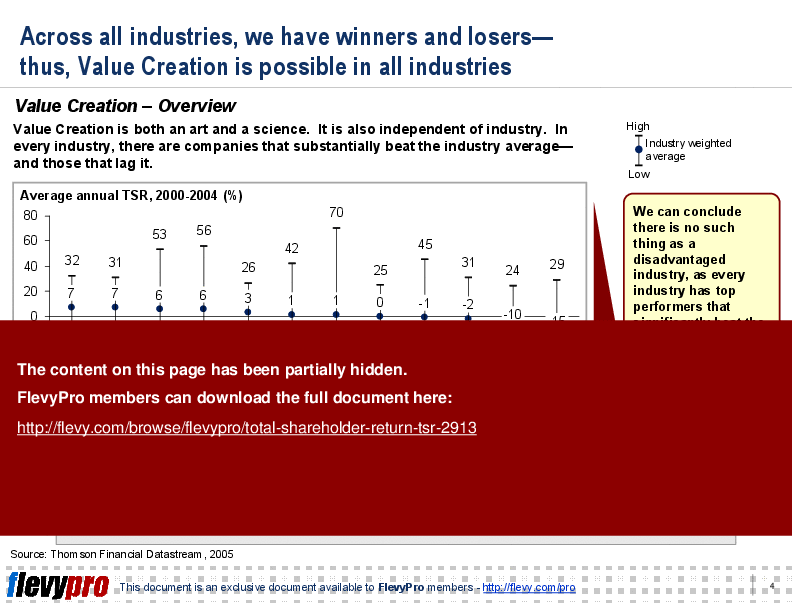
Value Creation is also independent of industry. In every industry, there are organizations that substantially beat the industry average—and those that lag it.

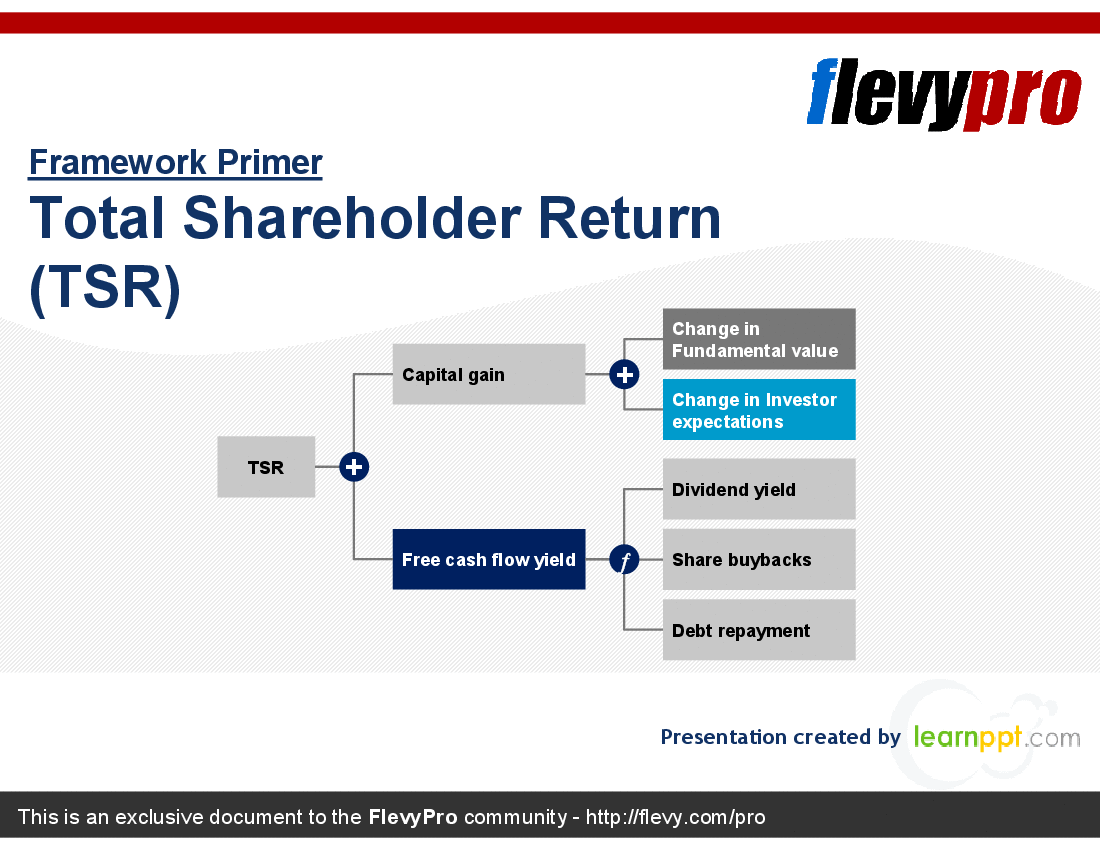
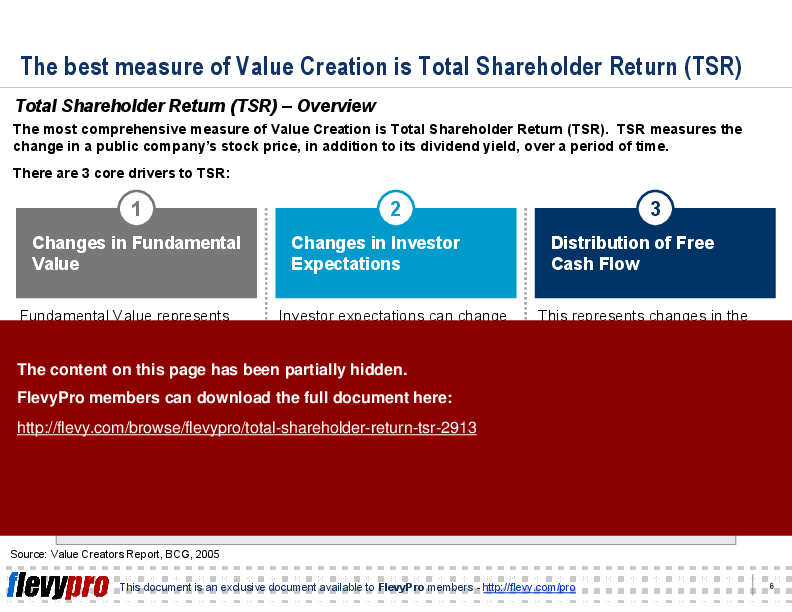
The most comprehensive and widely accepted measure of Value Creation is Total Shareholder Return (TSR). TSR measures the change in a public company's stock price, in addition to its dividend yield, over a period of time.

This TSR PowerPoint presentation discusses the 3 core drivers to TSR:

1. Changes in Fundamental Value- Fundamental Value represents the discounted value of the future cash flows of our business—based on its margins, asset productivity, cost of capital, and growth.

2. Changes in Investor Expectations – Investor expectations can change our short-term valuation. Investor expectations are measured by a company's expectation premium, which is the different between its actual stock price and the price derived from an analysis of its underlying fundamentals.

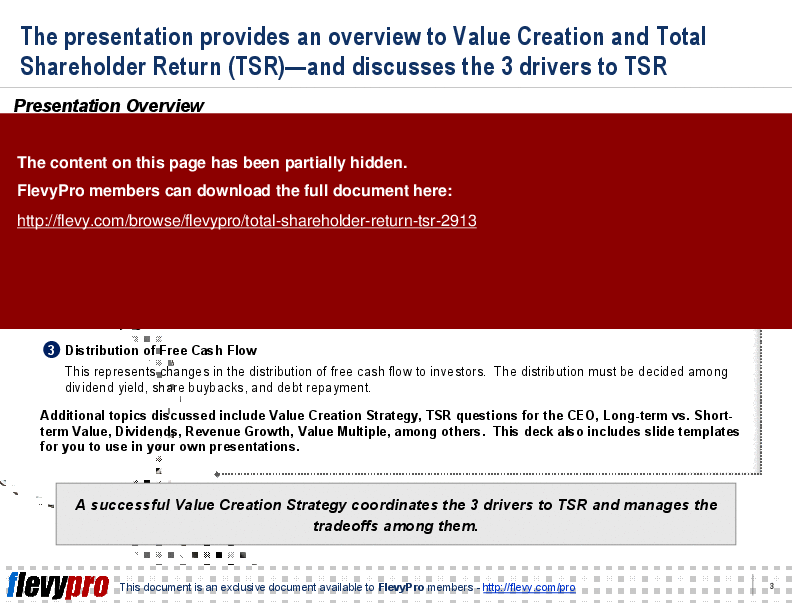
3. Distribution of Free Cash Flow – This represents changes in the distribution of free cash flow to investors. The distribution must be decided among dividend yield, share buybacks, and debt repayment.

A successful Value Creation Strategy coordinates the 3 drivers to TSR and manages the tradeoffs among them.

Additional topics discussed include Value Creation Strategy, Total Shareholder Return formula, TSR questions for the CEO, Long-term vs. Short-term Value, Dividends, Revenue Growth, Value Multiple, among others.

This Total Shareholder Return (TSR) presentation also includes slide templates illustrating (1) Total Shareholder Return (TSR) Core Drivers and (2) Value Creation Process. Furthermore, as a fully editable, customizable PPT presentation, you can re-purpose the majority of these Total Shareholder Return slides in your own business presentations.

The presentation offers a detailed breakdown of the Total Shareholder Return (TSR) formula, providing actionable insights for CEOs. It includes templates for illustrating TSR core drivers and the value creation process, making it a versatile tool for business presentations.

Got a question about this document? Email us at flevypro@flevy.com.

MARCUS OVERVIEW

This synopsis was written by Marcus [?] based on the analysis of the full 23-slide presentation.


Executive Summary
The Total Shareholder Return (TSR) presentation is a comprehensive resource designed for corporate executives and finance professionals focused on maximizing shareholder value. This presentation outlines the definition, formula, and calculation of TSR, emphasizing its role as a key measure of value creation. By leveraging this deck, users will gain insights into the 3 core drivers of TSR—changes in fundamental value, changes in investor expectations, and distribution of free cash flow. The presentation also includes templates and probing questions for CEOs, enabling organizations to develop effective value creation strategies.

Who This Is For and When to Use
•  Corporate executives responsible for shareholder value management
•  Finance teams analyzing investment performance and capital allocation
•  Strategy teams developing value creation frameworks
•  Consultants advising on financial performance and shareholder engagement

Best-fit moments to use this deck:
•  During strategic planning sessions focused on shareholder value
•  In finance team meetings analyzing TSR metrics
•  When preparing for investor presentations or earnings calls
•  For workshops aimed at aligning executive teams on value creation strategies

Learning Objectives
•  Define Total Shareholder Return (TSR) and its significance in value creation
•  Calculate TSR using its core components: capital gains, dividend yield, and free cash flow yield
•  Analyze the impact of fundamental value and investor expectations on TSR
•  Develop strategies for distributing free cash flow effectively
•  Address key questions that CEOs should consider regarding TSR
•  Utilize templates for presenting TSR data and strategies

Table of Contents
•  Overview (page 3)
•  Total Shareholder Return (TSR) (page 6)
•  Value Creation Process (page 9)
•  TSR Questions for the CEO (page 15)
•  Templates (page 18)

Primary Topics Covered
•  Total Shareholder Return (TSR) - TSR is a comprehensive measure that combines stock price changes and dividend yield to assess value creation over time.
•  Core Drivers of TSR - The 3 main drivers include changes in fundamental value, changes in investor expectations, and distribution of free cash flow.
•  Value Creation Process - A structured approach to managing the 3 dimensions that drive TSR, ensuring alignment between long-term and short-term strategies.
•  Investor Expectations - Understanding how market perceptions influence valuation and TSR, including the significance of valuation multiples.
•  Distribution of Free Cash Flow - Strategies for effectively allocating free cash flow among dividends, share buybacks, and debt repayment.
•  CEO Probing Questions - Essential questions for CEOs to evaluate their company’s TSR strategy and performance.

Deliverables, Templates, and Tools
•  TSR calculation template to assess changes in fundamental value and investor expectations
•  Framework for managing free cash flow distribution
•  Slide templates for presenting TSR data and strategic insights
•  Checklist of probing questions for CEO discussions on TSR
•  Visual aids for illustrating the value creation process and its components

Slide Highlights
•  Overview of Total Shareholder Return and its importance in value creation
•  Diagram illustrating the formula for calculating TSR and its core drivers
•  Framework for managing the value creation process across fundamental value, investor expectations, and cash flow yield
•  Key probing questions for CEOs to evaluate their value creation strategies
•  Templates for effective presentation of TSR data and insights

Potential Workshop Agenda
Understanding TSR and Its Importance (60 minutes)
•  Introduction to Total Shareholder Return
•  Discussion of its significance in value creation
•  Overview of the 3 core drivers

TSR Calculation and Analysis (90 minutes)
•  Hands-on session calculating TSR using provided templates
•  Analyzing the impact of fundamental value and investor expectations

Developing a Value Creation Strategy (60 minutes)
•  Identifying key questions for CEOs
•  Creating a framework for managing free cash flow distribution

Customization Guidance
•  Tailor the TSR calculation template to reflect your organization’s specific financial metrics
•  Adjust probing questions to align with your company’s strategic objectives
•  Incorporate industry-specific examples into the presentation slides
•  Modify the distribution strategies based on your organization’s cash flow priorities

Secondary Topics Covered
•  Long-term vs. short-term value considerations
•  The role of dividends in TSR calculations
•  Strategies for enhancing investor expectations and valuation multiples
•  Comparative analysis of TSR across different industries

Topic FAQ

What is Total Shareholder Return and how is it used to measure value creation?

Total Shareholder Return (TSR) measures company performance by combining stock price changes and dividends paid to shareholders over a period, providing a single indicator of value creation that is comparable across companies and industries; it aggregates capital gains and dividend yield into one metric.

How do you calculate TSR for a public company?

TSR is calculated by adding capital gains from stock price appreciation to dividend yield and dividing by the initial stock price; the presentation supplies a TSR calculation template to perform this decomposition and analyze contributions from price and dividends.

What are the core drivers that influence TSR?

The 3 core drivers are changes in fundamental value (future cash-flow-driven fundamentals), changes in investor expectations (valuation multiples and expectation premium), and the distribution of free cash flow among dividends, buybacks, and debt repayment.

How should a company approach distributing free cash flow to support TSR?

Companies should evaluate priorities for dividends, share buybacks, and debt repayment, weigh trade-offs against long-term fundamental investment, and select a distribution mix aligned to strategy; the deck includes a framework for managing free cash flow distribution.

When preparing an investor presentation, which TSR visuals and metrics are most useful?

Useful elements include TSR trend charts, decomposition into capital gains versus dividends, diagrams of the value creation process, and slides showing the 3 core drivers; Flevy's Total Shareholder Return (TSR) presentation provides slide templates and visual aids for these items.

What should I look for when selecting a TSR slide deck or toolkit?

Prioritize editable calculation templates, decomposition of core drivers, CEO probing questions, customization guidance, and ready-to-use presentation slides; the product available on Flevy is a 23-slide PPT that includes a TSR calculation template and related templates.

How can CEOs use probing questions to improve alignment on TSR strategy?

CEOs can use targeted questions to assess historical TSR sources, current market expectations, and trade-offs between investing in fundamentals versus returning cash to shareholders; the presentation provides a checklist of probing questions to guide executive discussions.

What practical deliverables should I expect from buying a TSR slide deck?

Expect editable PPT slides, a TSR calculation template, a framework for cash distribution, CEO probing questions, visual aids illustrating the value creation process, and a suggested workshop agenda to apply the materials in meetings.

Document FAQ
These are questions addressed within this presentation.

What is Total Shareholder Return (TSR)?
TSR is a measure of a company's performance that combines the change in stock price and dividends paid to shareholders over a specific period.

How is TSR calculated?
TSR is calculated by adding the capital gains from stock price appreciation to the dividend yield, and then dividing by the initial stock price.

What are the core drivers of TSR?
The 3 core drivers are changes in fundamental value, changes in investor expectations, and the distribution of free cash flow.

Why is understanding investor expectations important?
Investor expectations influence market valuation and can significantly impact a company's TSR, making it crucial for management to align strategies accordingly.

How can companies manage their free cash flow effectively?
Companies should evaluate their priorities for cash distribution, including dividends, share buybacks, and debt repayment, to optimize their TSR.

What probing questions should CEOs consider regarding TSR?
CEOs should assess historical TSR sources, market expectations, and trade-offs between fundamental value and cash distribution strategies.

How does the value creation process integrate with TSR?
The value creation process involves managing the 3 dimensions that drive TSR in a coordinated manner to enhance overall shareholder value.

What templates are included in the presentation?
The presentation includes templates for calculating TSR, managing free cash flow, and presenting strategic insights effectively.

Glossary
•  Total Shareholder Return (TSR) - A measure of a company's performance that combines stock price changes and dividends.
•  Fundamental Value - The discounted value of future cash flows based on a company's performance metrics.
•  Investor Expectations - Market perceptions that influence a company's valuation and TSR.
•  Free Cash Flow - Cash generated by a company after accounting for capital expenditures.
•  Valuation Multiple - A financial ratio used to assess a company's market value relative to its earnings.
•  Dividend Yield - The annual dividend payment divided by the stock price, expressed as a percentage.
•  Capital Gain - The increase in the value of an asset or investment over time.
•  Value Creation Process - A structured approach to managing the components that drive TSR.
•  Probing Questions - Essential inquiries for executives to evaluate their company's value creation strategy.
•  Templates - Pre-designed frameworks for calculating and presenting TSR and related metrics.
•  Cash Distribution - The allocation of free cash flow among dividends, share buybacks, and debt repayment.
•  Long-term Value - The sustained growth and profitability of a company over an extended period.
•  Short-term Value - The immediate financial performance and market perception of a company.

VALUE CREATION PPT SLIDES

Framework for Understanding Total Shareholder Return (TSR)

Core Drivers of Total Shareholder Return Explained

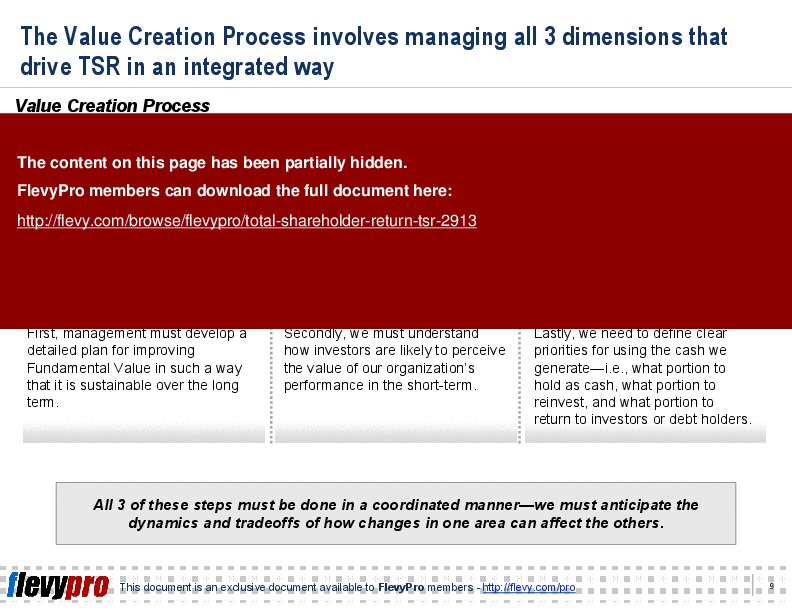
Integrated Approach to Value Creation and TSR

Critical Questions for Effective Value Creation Strategy

Source: Best Practices in Value Creation, Total Shareholder Value PowerPoint Slides: Total Shareholder Return (TSR) PowerPoint (PPT) Presentation Slide Deck, LearnPPT Consulting


$29.00
FlevyPro price: FREE (included in subscription)
This framework is developed by a team of former McKinsey and Big 4 consultants. The presentation follows the headline-body-bumper slide format used by global consulting firms.
Add to Cart
  

Did you need more documents?

Consider a FlevyPro subscription from $39/month. View plans here.

For $10.00 more, you can download this document plus 2 more FlevyPro documents. That's just $13 each.

ABOUT FLEVYPRO

This document is part of the FlevyPro Library, a curated knowledge base of documents for our FlevyPro subscribers.

FlevyPro is a subscription service for on-demand business frameworks and analysis tools. FlevyPro subscribers receive access to an exclusive library of curated business documents—business framework primers, presentation templates, Lean Six Sigma tools, and more—among other exclusive benefits.

Click here to learn more about FlevyPro and its benefits.

Did you know?
The average daily rate of a McKinsey consultant is $6,625 (not including expenses). The average price of a Flevy document is $65.


Trusted by over 10,000+ Client Organizations
Since 2012, we have provided business templates to over 10,000 businesses and organizations of all sizes, from startups and small businesses to the Fortune 100, in over 130 countries.
AT&T GE Cisco Intel IBM Coke Dell Toyota HP Nike Samsung Microsoft Astrazeneca JP Morgan KPMG Walgreens Walmart 3M Kaiser Oracle SAP Google E&Y Volvo Bosch Merck Fedex Shell Amgen Eli Lilly Roche AIG Abbott Amazon PwC T-Mobile Broadcom Bayer Pearson Titleist ConEd Pfizer NTT Data Schwab


Read Customer Testimonials

 
"I have used FlevyPro for several business applications. It is a great complement to working with expensive consultants. The quality and effectiveness of the tools are of the highest standards."

– Moritz Bernhoerster, Global Sourcing Director at Fortune 500
 
"Flevy is our 'go to' resource for management material, at an affordable cost. The Flevy library is comprehensive and the content deep, and typically provides a great foundation for us to further develop and tailor our own service offer."

– Chris McCann, Founder at Resilient.World
 
"FlevyPro provides business frameworks from many of the global giants in management consulting that allow you to provide best in class solutions for your clients."

– David Harris, Managing Director at Futures Strategy
 
"As a niche strategic consulting firm, Flevy and FlevyPro frameworks and documents are an on-going reference to help us structure our findings and recommendations to our clients as well as improve their clarity, strength, and visual power. For us, it is an invaluable resource to increase our impact and value."

– David Coloma, Consulting Area Manager at Cynertia Consulting
 
"I have found Flevy to be an amazing resource and library of useful presentations for lean sigma, change management and so many other topics. This has reduced the time I need to spend on preparing for my performance consultation. The library is easily accessible and updates are regularly provided. A wealth of great information."

– Cynthia Howard RN, PhD, Executive Coach at Ei Leadership
 
"FlevyPro has been a brilliant resource for me, as an independent growth consultant, to access a vast knowledge bank of presentations to support my work with clients. In terms of RoI, the value I received from the very first presentation I downloaded paid for my subscription many times over! The "

– Roderick Cameron, Founding Partner at SGFE Ltd
 
"Last Sunday morning, I was diligently working on an important presentation for a client and found myself in need of additional content and suitable templates for various types of graphics. Flevy.com proved to be a treasure trove for both content and design at a reasonable price, considering the time I "

– M. E., Chief Commercial Officer, International Logistics Service Provider
 
"If you are looking for great resources to save time with your business presentations, Flevy is truly a value-added resource. Flevy has done all the work for you and we will continue to utilize Flevy as a source to extract up-to-date information and data for our virtual and onsite presentations!"

– Debbi Saffo, President at The NiKhar Group


Customers Also Bought These Documents


Customers Also Like These Documents

Explore Templates on Related Management Topics


Your Recently Viewed Documents
Download our FREE Strategy & Transformation Framework Templates

Download our free compilation of 50+ Strategy & Transformation slides and templates. Frameworks include McKinsey 7-S, Balanced Scorecard, Disruptive Innovation, BCG Curve, and many more.