
Supply Chain Management (SCM): Logistics Clusters   24-slide PPT PowerPoint presentation slide deck (PPTX)
$29.00

Supply Chain Management (SCM): Logistics Clusters (24-slide PPT PowerPoint presentation slide deck (PPTX)) Preview Image
Log in to unlock full preview.
Supply Chain Management (SCM): Logistics Clusters (24-slide PPT PowerPoint presentation slide deck (PPTX)) Preview Image
Arrow   Click main image to view in full screen.

Supply Chain Management (SCM): Logistics Clusters (PowerPoint PPTX Slide Deck)

PowerPoint (PPTX) 24 Slides FlevyPro Document

$29.00
FlevyPro price: FREE (included in subscription)
This framework is developed by a team of former McKinsey and Big 4 consultants. The presentation follows the headline-body-bumper slide format used by global consulting firms.
Add to Cart


Immediate download
Free lifetime updates

SUPPLY CHAIN ANALYSIS PPT DESCRIPTION

Editor Summary 24-slide PowerPoint presentation "Supply Chain Management (SCM): Logistics Clusters" developed by former consultants from McKinsey and the Big 4, examining the strategic role of Logistics Clusters in operational efficiency, distribution, economic growth, and job creation. Read more

In the late 1990s, renown strategist Michael Porter argued that clusters make organizations more competitive by increasing the pace of Innovation and stimulating new business formation. National and regional governments quickly embraced the idea and immediately supported its development by providing the necessary funding support. As expected, good things started to happen: businesses became interested to set up in the area drawing employees and, at the same time, more employers.

In recent decades, numerous Industrial Clusters have developed around the world. But there is one sector, the Logistics sector, where Industrial Clusters have a brighter long-term future. The Logistics Cluster provides operational flexibility and distribution efficiencies that can greatly benefit many global supply chains. Logistics Clusters are local networks of businesses providing Logistics services. It is a community of companies that come together to share Logistics expertise and know-how.

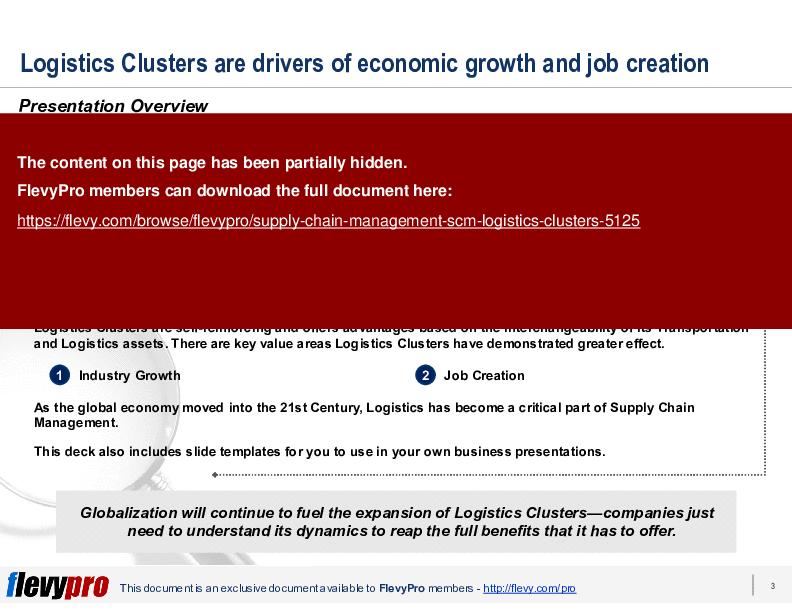
Logistics Clusters are self-reinforcing and offers advantages based on the interchangeability of its Transportation and Logistics assets. There are key value areas Logistics Clusters have demonstrated greater effect.

1. Industry Growth
2. Job Creation

As the global economy moved into the 21st Century, Logistics has become a critical part of Supply Chain Management. Globalization will continue to fuel the expansion of Logistics Clusters. Companies just need to understand its dynamics to reap the full benefits that it has to offer.

This deck also includes slide templates for you to use in your own business presentations.

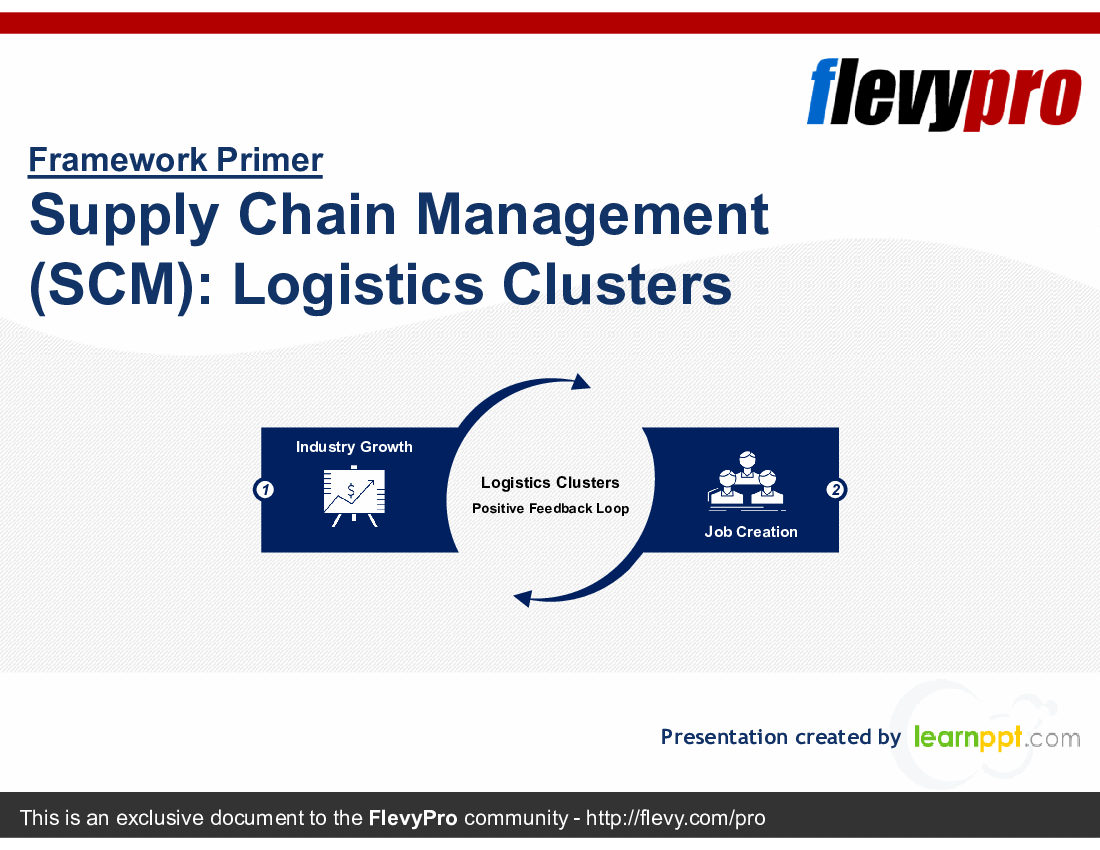
This presentation delves into the strategic importance of Logistics Clusters, emphasizing their role in driving economic growth and job creation. It provides a comprehensive overview of how these clusters enhance supply chain efficiency through the interchangeability of assets and the creation of a positive feedback loop. The PPT also includes practical slide templates designed to help you articulate these concepts in your own business presentations.

Got a question about this document? Email us at flevypro@flevy.com.

MARCUS OVERVIEW

This synopsis was written by Marcus [?] based on the analysis of the full 24-slide presentation.


Executive Summary
The "Supply Chain Management (SCM): Logistics Clusters" presentation provides a comprehensive exploration of the strategic role of Logistics Clusters in driving economic growth and job creation. Developed by former consultants from McKinsey and the Big 4, this presentation outlines how Logistics Clusters enhance operational efficiency and distribution capabilities within global supply chains. By leveraging the dynamics of these clusters, organizations can optimize their logistics strategies, leading to improved service delivery and reduced costs. This deck also includes templates for practical application in business contexts.

Who This Is For and When to Use
•  Supply Chain Executives looking to enhance logistics strategies
•  Operations Managers focused on improving distribution efficiency
•  Business Development Teams seeking to understand market dynamics
•  Economic Development Agencies interested in fostering local job creation

Best-fit moments to use this deck:
•  During strategic planning sessions to integrate logistics insights
•  When evaluating the establishment of new logistics operations
•  In workshops aimed at enhancing supply chain collaboration
•  For presentations to stakeholders on logistics investment opportunities

Learning Objectives
•  Define the concept of Logistics Clusters and their impact on supply chains
•  Analyze the role of Logistics Clusters in economic growth and job creation
•  Identify key components that constitute effective Logistics Clusters
•  Develop strategies to leverage Logistics Clusters for operational efficiency
•  Assess the interchangeability of logistics assets within clusters
•  Create actionable plans to engage with local logistics networks

Table of Contents
•  Overview (page 3)
•  Industry Clusters (page 6)
•  Logistics Clusters (page 9)
•  Industry Growth (page 12)
•  Job Creation (page 15)
•  Templates (page 20)

Primary Topics Covered
•  Logistics Clusters Overview - Logistics Clusters are defined as local networks of businesses providing logistics services, enhancing operational flexibility and distribution efficiency.
•  Economic Growth Drivers - The presentation highlights how Logistics Clusters contribute to economic growth through increased business formation and innovation.
•  Job Creation Mechanisms - It outlines how Logistics Clusters create diverse job opportunities across various sectors, emphasizing their resilience against offshoring.
•  Interchangeability of Assets - The document discusses the benefits of asset interchangeability within Logistics Clusters, which enhances service delivery and reduces costs.
•  Positive Feedback Loop - Logistics Clusters generate a self-reinforcing cycle of growth, where increased freight movement leads to better service and lower costs.
•  Templates for Application - The presentation includes templates that can be utilized for developing logistics strategies and presentations.

Deliverables, Templates, and Tools
•  Logistics Cluster analysis framework template for assessing local logistics capabilities
•  Job creation impact assessment model for evaluating logistics investments
•  Economic growth projection template based on Logistics Cluster dynamics
•  Presentation slides for stakeholder engagement on logistics strategies
•  Workshop agenda template for exploring Logistics Cluster opportunities
•  Case study examples illustrating successful Logistics Cluster implementations

Slide Highlights
•  Overview slide detailing the significance of Logistics Clusters in SCM
•  Case study slide on Alliance Texas showcasing successful logistics hub development
•  Positive feedback loop diagram illustrating the interconnectivity of logistics operations
•  Job creation statistics slide highlighting the economic impact of Logistics Clusters
•  Template slide providing a structured approach for presenting logistics strategies

Potential Workshop Agenda
Logistics Cluster Strategy Session (90 minutes)
•  Discuss the concept and benefits of Logistics Clusters
•  Analyze local logistics capabilities and opportunities
•  Identify key stakeholders and potential partnerships

Job Creation Impact Workshop (60 minutes)
•  Review case studies of successful Logistics Clusters
•  Brainstorm strategies for leveraging clusters to enhance job creation
•  Develop action items for stakeholder engagement

Customization Guidance
•  Tailor the presentation to reflect specific regional logistics capabilities and opportunities
•  Adjust case studies to align with local industry examples
•  Modify templates to fit organizational branding and messaging
•  Incorporate local economic data to enhance relevance and impact

Secondary Topics Covered
•  Competitive advantages of Logistics Clusters in global supply chains
•  Challenges faced by Logistics Clusters and strategies for overcoming them
•  The role of government in supporting Logistics Cluster development
•  Future trends in logistics and supply chain management

Topic FAQ

What are Logistics Clusters and how do they improve supply chain performance?

Logistics Clusters are local networks of businesses that provide logistics services, enabling firms to share expertise and resources. They improve performance through asset interchangeability, resource sharing, and denser service options, which together enhance operational flexibility and distribution efficiency across the local logistics network.

How do Logistics Clusters contribute to regional economic growth?

Logistics Clusters stimulate business formation and innovation by attracting logistics firms and related services, which increases freight movement and can lead to more employment. The presentation links cluster dynamics to 2 primary value areas: industry growth and job creation.

What does interchangeability of logistics assets mean in practice?

Interchangeability refers to the ability of firms within a cluster to share transportation and warehousing resources, allowing companies to substitute one provider or asset for another. This practice can reduce costs and improve service reliability through shared access to transportation carriers and warehousing companies.

What should I look for in a Logistics Cluster analysis template when evaluating a region?

A useful analysis template maps local logistics capabilities, identifies transportation carriers and warehousing capacity, assesses asset interchangeability, and quantifies economic and job impacts. Flevy's Supply Chain Management (SCM): Logistics Clusters includes a Logistics Cluster analysis framework template to support this evaluation.

How should I assess the value of pre-built Logistics Cluster templates versus building assessments in-house?

Evaluate whether ready-made templates cover local capability mapping, economic projection, job-impact assessment, and stakeholder presentation needs. The deck explicitly includes a job-creation impact model, an economic growth projection template, and workshop and presentation slides you can adapt as starting assets.

How can organizations model job creation from logistics investments?

Modeling job creation requires identifying direct logistics roles, related supply-chain employment, and resilience to offshoring. The presentation provides a job creation impact assessment model and case study examples that illustrate mechanisms linking cluster development to diverse local employment opportunities.

What slides and tools help when presenting a logistics investment case to stakeholders?

Stakeholder presentations typically combine an overview of cluster benefits, economic growth projections, job-impact analysis, case studies, and an implementation roadmap. Flevy's Supply Chain Management (SCM): Logistics Clusters supplies presentation slides, an economic growth projection template, and a case study slide such as Alliance Texas.

My company plans to site a new distribution center—how can cluster analysis inform site selection?

Cluster analysis helps assess local carrier networks, warehousing availability, potential for asset sharing, and supportive government policies. Useability is improved when the analysis quantifies economic impact and job creation; the deck includes a Logistics Cluster analysis framework template to guide such site assessments.

Document FAQ
These are questions addressed within this presentation.

What are Logistics Clusters?
Logistics Clusters are local networks of businesses that provide logistics services, enhancing operational efficiency and distribution capabilities within supply chains.

How do Logistics Clusters drive economic growth?
They stimulate innovation, attract new businesses, and create jobs by fostering collaboration among companies in the logistics sector.

What is the significance of asset interchangeability in Logistics Clusters?
Interchangeability allows companies within a cluster to share resources and services, leading to improved efficiency and reduced costs.

How do Logistics Clusters contribute to job creation?
They generate diverse job opportunities across various sectors, providing roles that are less susceptible to offshoring and tied to local economic conditions.

What templates are included in the presentation?
The presentation includes templates for logistics strategy development, job creation impact assessments, and stakeholder engagement presentations.

Can this presentation be customized for specific industries?
Yes, the content can be tailored to reflect the unique logistics needs and opportunities of specific industries or regions.

What are the key components of a successful Logistics Cluster?
Successful Logistics Clusters typically include transportation carriers, warehousing companies, and supportive government policies that foster collaboration and innovation.

How can organizations leverage Logistics Clusters for competitive advantage?
By engaging with local networks, organizations can optimize their logistics strategies, reduce costs, and improve service delivery.

Glossary
•  Logistics Clusters - Local networks of businesses providing logistics services.
•  Economic Growth - Increase in the economic output and job creation resulting from logistics activities.
•  Job Creation - The process of generating employment opportunities within a logistics framework.
•  Interchangeability of Assets - The ability to share logistics resources among companies within a cluster.
•  Positive Feedback Loop - A cycle where increased logistics activity leads to improved services and lower costs.
•  Templates - Pre-designed frameworks for developing logistics strategies and presentations.
•  Stakeholder Engagement - The process of involving relevant parties in logistics decision-making.
•  Case Study - An analysis of a successful Logistics Cluster implementation.
•  Operational Efficiency - The ability to deliver services effectively while minimizing costs.
•  Supply Chain Management (SCM) - The management of the flow of goods and services from origin to consumption.
•  Transportation Carriers - Companies that provide transportation services within a logistics framework.
•  Warehousing Companies - Businesses that offer storage solutions for goods in transit.
•  Government Support - Policies and funding provided by authorities to promote logistics development.
•  Innovation - The introduction of new ideas or methods to enhance logistics operations.
•  Resource Sharing - The practice of companies within a cluster collaborating to utilize shared logistics assets.
•  Distribution Efficiency - The effectiveness of delivering goods to consumers in a timely and cost-effective manner.
•  Local Networks - Community-based collaborations among businesses in the logistics sector.
•  Market Dynamics - The forces that influence the supply and demand of logistics services.
•  Economic Impact - The effect of logistics activities on local and regional economies.
•  Logistics Services - Services related to the planning and execution of the movement of goods.
•  Business Formation - The process of establishing new companies within a Logistics Cluster.
•  Supply Chain Integration - The alignment of logistics processes across multiple companies to enhance efficiency.

SUPPLY CHAIN ANALYSIS PPT SLIDES

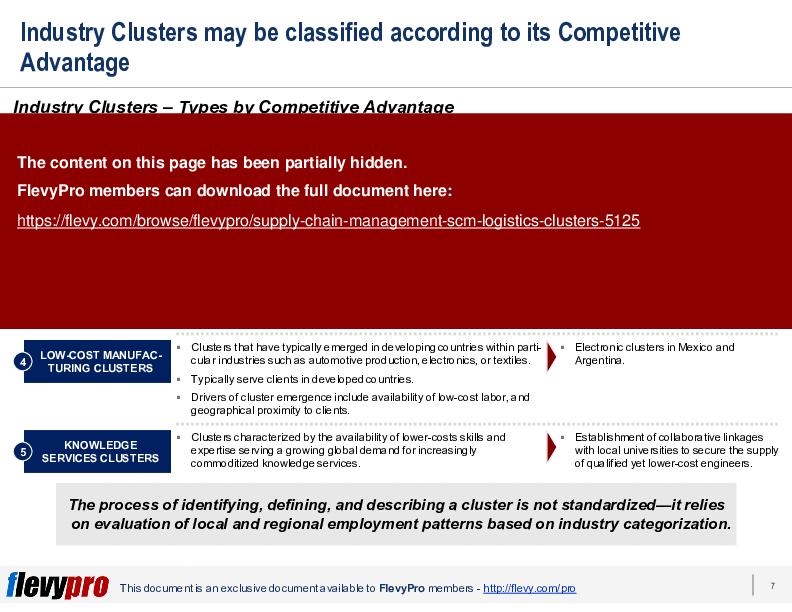
Job Creation Dynamics in Logistics Clusters

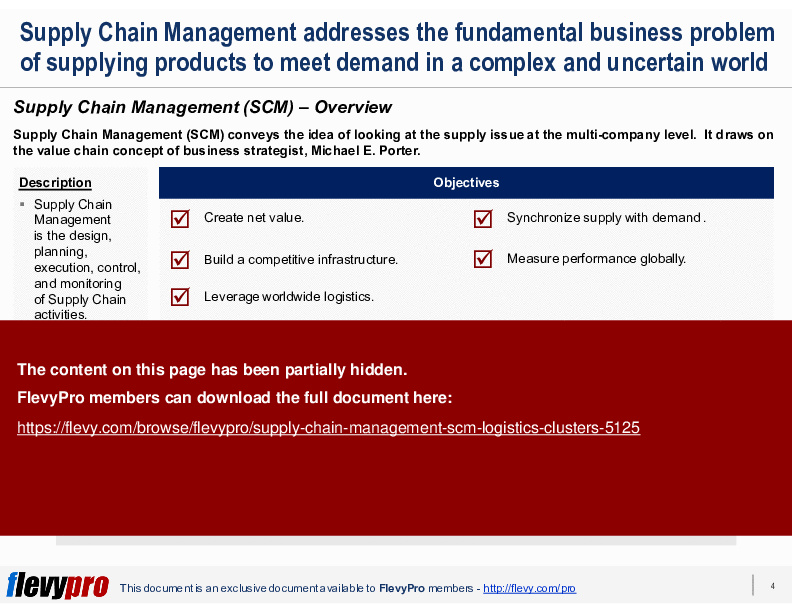
Strategic Overview of Logistics Clusters in SCM

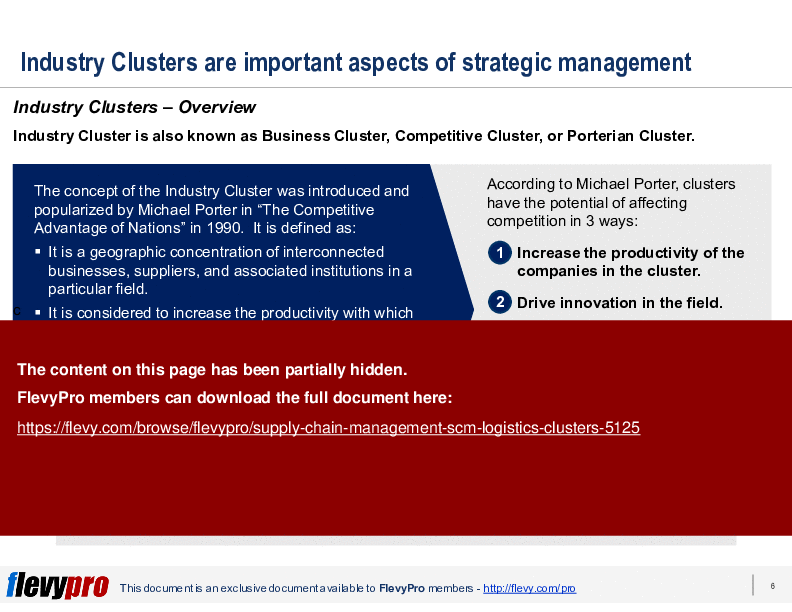
Classification of Industry Clusters by Knowledge Type

Interchangeability of Assets in Logistics Clusters

Source: Best Practices in Competitive Advantage, Supply Chain Management, Logistics PowerPoint Slides: Supply Chain Management (SCM): Logistics Clusters PowerPoint (PPTX) Presentation Slide Deck, LearnPPT Consulting


$29.00
FlevyPro price: FREE (included in subscription)
This framework is developed by a team of former McKinsey and Big 4 consultants. The presentation follows the headline-body-bumper slide format used by global consulting firms.
Add to Cart
  

Did you need more documents?

Consider a FlevyPro subscription from $39/month. View plans here.

For $10.00 more, you can download this document plus 2 more FlevyPro documents. That's just $13 each.

ABOUT FLEVYPRO

This document is part of the FlevyPro Library, a curated knowledge base of documents for our FlevyPro subscribers.

FlevyPro is a subscription service for on-demand business frameworks and analysis tools. FlevyPro subscribers receive access to an exclusive library of curated business documents—business framework primers, presentation templates, Lean Six Sigma tools, and more—among other exclusive benefits.

Click here to learn more about FlevyPro and its benefits.

Did you know?
The average daily rate of a McKinsey consultant is $6,625 (not including expenses). The average price of a Flevy document is $65.


Trusted by over 10,000+ Client Organizations
Since 2012, we have provided business templates to over 10,000 businesses and organizations of all sizes, from startups and small businesses to the Fortune 100, in over 130 countries.
AT&T GE Cisco Intel IBM Coke Dell Toyota HP Nike Samsung Microsoft Astrazeneca JP Morgan KPMG Walgreens Walmart 3M Kaiser Oracle SAP Google E&Y Volvo Bosch Merck Fedex Shell Amgen Eli Lilly Roche AIG Abbott Amazon PwC T-Mobile Broadcom Bayer Pearson Titleist ConEd Pfizer NTT Data Schwab


Read Customer Testimonials

 
"I have used FlevyPro for several business applications. It is a great complement to working with expensive consultants. The quality and effectiveness of the tools are of the highest standards."

– Moritz Bernhoerster, Global Sourcing Director at Fortune 500
 
"I am extremely grateful for the proactiveness and eagerness to help and I would gladly recommend the Flevy team if you are looking for data and toolkits to help you work through business solutions."

– Trevor Booth, Partner, Fast Forward Consulting
 
"Flevy is our 'go to' resource for management material, at an affordable cost. The Flevy library is comprehensive and the content deep, and typically provides a great foundation for us to further develop and tailor our own service offer."

– Chris McCann, Founder at Resilient.World
 
"FlevyPro provides business frameworks from many of the global giants in management consulting that allow you to provide best in class solutions for your clients."

– David Harris, Managing Director at Futures Strategy
 
"As a young consulting firm, requests for input from clients vary and it's sometimes impossible to provide expert solutions across a broad spectrum of requirements. That was before I discovered Flevy.com.

Through subscription to this invaluable site of a plethora of topics that are key and crucial to consulting, I "

– Nishi Singh, Strategist and MD at NSP Consultants
 
"As a consultant requiring up to date and professional material that will be of value and use to my clients, I find Flevy a very reliable resource.

The variety and quality of material available through Flevy offers a very useful and commanding source for information. Using Flevy saves me time, enhances my expertise and ends up being a good decision."

– Dennis Gershowitz, Principal at DG Associates
 
"The wide selection of frameworks is very useful to me as an independent consultant. In fact, it rivals what I had at my disposal at Big 4 Consulting firms in terms of efficacy and organization."

– Julia T., Consulting Firm Owner (Former Manager at Deloitte and Capgemini)
 
"I have used Flevy services for a number of years and have never, ever been disappointed. As a matter of fact, David and his team continue, time after time, to impress me with their willingness to assist and in the real sense of the word. I have concluded in fact "

– Roberto Pelliccia, Senior Executive in International Hospitality


Customers Also Bought These Documents


Customers Also Like These Documents

Explore Templates on Related Management Topics


Your Recently Viewed Documents
Receive our FREE presentation on Operational Excellence

This 50-slide presentation provides a high-level introduction to the 4 Building Blocks of Operational Excellence. Achieving OpEx requires the implementation of a Business Execution System that integrates these 4 building blocks.