
This framework is developed by a team of former McKinsey and Big 4 consultants. The presentation follows the headline-body-bumper slide format used by global consulting firms.
Editor Summary
A 22-slide PowerPoint titled Cultural Intelligence presents a framework and tools to assess and develop Cultural Intelligence (CQ), based on the CQ model of Christopher Earley and Elaine Mosakowski and developed by experts from McKinsey.
Read moreIncludes a Cultural Intelligence self-assessment template, 6 CQ profiles (Provincial, Analyst, Natural, Ambassador, Mimic, Chameleon), a six-step cultivating-CQ process, training curriculum selection guidance, and editable templates. Sold as a digital download on Flevy for use by corporate executives, integration leaders, HR professionals, and consultants.
Use this deck when leaders need to improve cross-cultural communication, align multicultural teams, or design CQ-focused training during change events such as M&A, global expansion, or diversity initiatives.
Corporate executives running leadership training who need a structured self-assessment and discussion agenda for cross-cultural skills.
Integration leaders aligning multicultural teams after a merger by profiling team members and creating targeted CQ improvement plans.
HR professionals designing D&I programs selecting training curricula based on assessed CQ weaknesses.
Consultants facilitating workshops that require profiling participants and a stepwise development process.
The six-step assessment-to-training-to-reassessment approach mirrors structured, workshop-based methodologies used at McKinsey.
Cultural Intelligence (CQ) is a model that ability to cope with national, corporate, and vocational cultures. It was developed by Christopher Earley and Elaine Mosakowski, based on a study of 2,000 managers across 60 countries. CQ is the ability to understand unfamiliar contexts, and then to adjust. It captures an outsider’s seemingly natural ability to interpret someone’s unfamiliar and ambiguous gestures the way that person's fellow compatriots would.
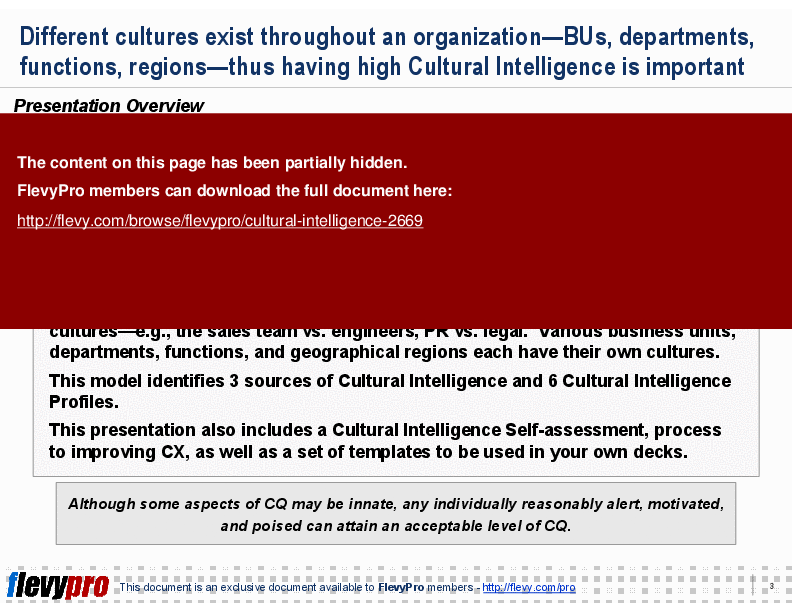
CQ is incredibly useful in business settings, particularly within larger organizations. For instance, in a large company, there are conflicting sub-cultures—e.g., the sales team vs. engineers, PR vs. legal. Various business units, departments, functions, and geographical regions each have their own cultures. Although some aspects of CQ may be innate, any individually reasonably alert, motivated, and poised can attain an acceptable level of CQ.
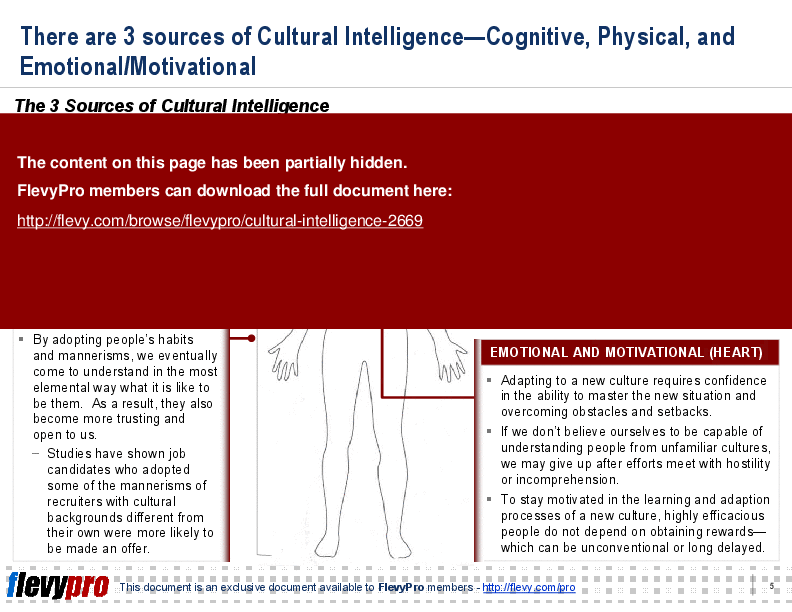
This model identifies 3 sources of Cultural Intelligence and 6 Cultural Intelligence Profiles.
This presentation also includes a Cultural Intelligence Self-assessment, process to improving CX, as well as a set of templates to be used in your own decks.
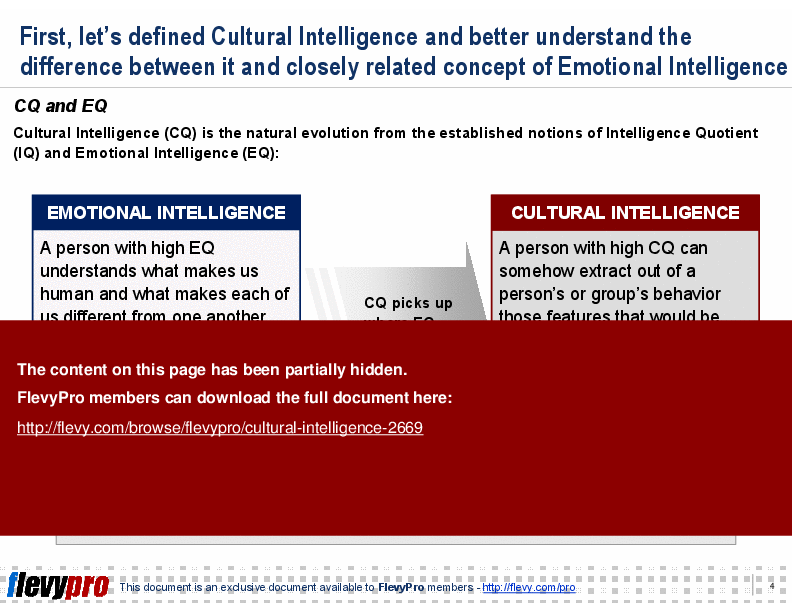
This presentation delves into the nuanced relationship between Cultural Intelligence (CQ) and Emotional Intelligence (EQ), highlighting how CQ builds upon the foundations of EQ to navigate complex cultural landscapes. It identifies three core sources of CQ: Cognitive, Physical, and Emotional/Motivational, providing a comprehensive framework for understanding and developing these competencies. The PPT also outlines the critical cross-cultural skills necessary for high CQ, such as perceptual acuity, relational skills, and tolerance of uncertainty.
Included is a detailed self-assessment tool designed to evaluate your current level of CQ and identify areas for improvement. The six-step process for cultivating CQ is clearly laid out, offering practical guidance for both individual and organizational development. This resource is essential for leaders aiming to enhance their cultural adaptability and effectiveness in diverse business environments.
This synopsis was written by Marcus [?] based on the analysis of the full 22-slide presentation.
Executive Summary
The Cultural Intelligence (CQ) presentation is designed to enhance understanding and application of Cultural Intelligence in diverse business environments. Developed by experts from McKinsey, this deck provides a structured approach to improving CQ through self-assessments, frameworks, and actionable strategies. It empowers corporate executives and consultants to navigate complex cultural landscapes, fostering effective communication and collaboration across various organizational functions and geographical regions.
Who This Is For and When to Use
• Corporate executives seeking to improve cross-cultural communication within their teams
• Integration leaders managing multicultural teams or projects
• HR professionals focused on diversity and inclusion initiatives
• Consultants advising organizations on cultural adaptation strategies
Best-fit moments to use this deck:
• During leadership training sessions focused on cultural awareness
• In workshops aimed at enhancing team collaboration in multicultural settings
• When developing diversity and inclusion programs within organizations
Learning Objectives
• Define Cultural Intelligence and its importance in business settings
• Identify the 3 sources of Cultural Intelligence: cognitive, physical, and emotional/motivational
• Assess individual CQ using the provided self-assessment tool
• Develop targeted training plans to enhance CQ based on assessment results
• Implement strategies for cultivating Cultural Intelligence in teams
• Evaluate progress in CQ development through reassessment
Table of Contents
• Overview (page 3)
• Cultural Intelligence Profiles (page 9)
• Cultivating Cultural Intelligence Process (page 12)
• Templates (page 16)
Primary Topics Covered
• Cultural Intelligence Overview - An introduction to the concept of Cultural Intelligence, its significance in navigating diverse cultural contexts, and its application in business.
• Cultural Intelligence Profiles - A classification of individuals into 6 distinct CQ profiles based on their self-assessment results, aiding in understanding personal strengths and weaknesses.
• Cultivating Cultural Intelligence Process - A six-step framework for developing CQ, including initial assessment, training selection, and ongoing evaluation.
• Self-Assessment Tool - A structured method for individuals to evaluate their CQ across cognitive, physical, and emotional dimensions.
• Training and Application Strategies - Practical approaches for applying CQ principles in real-world situations to enhance intercultural effectiveness.
• Reassessment and Continuous Improvement - Guidance on how to measure progress in CQ development and identify areas for further training.
Deliverables, Templates, and Tools
• Cultural Intelligence Self-assessment template for personal evaluation
• Training curriculum selection guide tailored to individual CQ weaknesses
• Step-by-step process for cultivating CQ in organizational settings
• Framework for ongoing CQ development and reassessment
• Templates for documenting CQ training and application strategies
• Visual aids for understanding and communicating CQ concepts
Slide Highlights
• Overview of Cultural Intelligence and its relevance in business contexts
• Detailed profiles of the 6 Cultural Intelligence types
• Step-by-step process for cultivating CQ, including actionable training steps
• Self-assessment scoring template for evaluating individual CQ
• Visual representations of cross-cultural skills and their importance
Potential Workshop Agenda
Cultural Intelligence Introduction (60 minutes)
• Overview of Cultural Intelligence and its significance
• Discussion on the 3 sources of CQ
CQ Self-Assessment Workshop (90 minutes)
• Participants complete the self-assessment
• Group discussion on individual results and implications
Cultivating CQ Strategies (120 minutes)
• Identify training needs based on self-assessment results
• Develop personalized CQ improvement plans
Customization Guidance
• Tailor the self-assessment tool to reflect specific organizational cultures and contexts
• Adjust training curriculum based on identified CQ weaknesses within teams
• Incorporate company-specific examples and case studies into training materials
Secondary Topics Covered
• The relationship between Cultural Intelligence and Emotional Intelligence
• Strategies for building trust and rapport in multicultural teams
• The impact of Cultural Intelligence on organizational performance
• Techniques for effective cross-cultural communication
Topic FAQ
What are the core components of Cultural Intelligence and how are they defined?
Cultural Intelligence comprises 3 core sources: cognitive CQ (knowledge of cultural norms), physical CQ (behavioral adaptability and body language), and emotional/motivational CQ (confidence and motivation to engage across cultures). The model emphasizes assessing and developing each of these 3 sources.
How does Cultural Intelligence relate to Emotional Intelligence in practice?
Cultural Intelligence builds on Emotional Intelligence by applying interpersonal and self-regulation skills across unfamiliar cultural contexts; EQ supports empathy and relational skills while CQ adds cultural knowledge and behavioral adaptation. The presentation explicitly links CQ and EQ and outlines the 3 sources of CQ.
What are common CQ profiles teams may display and how are they used?
Typical CQ profiles categorize individuals into 6 types—Provincial, Analyst, Natural, Ambassador, Mimic, and Chameleon—to highlight strengths and development gaps. Teams can use profile segmentation to tailor training and role assignments; the slide deck includes descriptions of all 6 profiles.
What steps are involved in a practical process to cultivate Cultural Intelligence?
A practical CQ development process begins with an initial self-assessment, profile interpretation, selection of targeted training, applied practice in real situations, ongoing coaching, and periodic reassessment. The presentation summarizes these activities as a structured six-step framework.
What should I look for when choosing a Cultural Intelligence toolkit for my organization?
Choose a toolkit that provides a validated self-assessment, clear profile typology, training-curriculum selection guidance, templates for documenting plans, and reassessment methods so you can move from diagnosis to training and measurement; look specifically for a self-assessment template and training selection guide.
How valuable are pre-built CQ templates versus customizing tools internally?
Pre-built templates accelerate workshop prep and provide consistent scoring and reporting (self-assessments, profile summaries, training plans),, but the deck advises tailoring items to reflect company culture and examples; the product includes templates plus guidance for customization, including the Cultural Intelligence Self-assessment.
I’m integrating multicultural teams after an acquisition—what CQ activities should I run first?
Begin with an individual CQ self-assessment, map team profiles to identify capability clusters, run facilitated workshops to discuss results, create personalized CQ improvement plans, and schedule reassessment after applied training. The presentation provides a sample workshop agenda, self-assessment, and the six-step cultivation process.
How often should individuals and teams reassess their Cultural Intelligence?
Reassessment should occur periodically, particularly after significant training or substantial cultural exposure, to measure progress and identify new gaps; the deck recommends reassessment following major training or cultural experiences.
Document FAQ
These are questions addressed within this presentation.
What is Cultural Intelligence?
Cultural Intelligence (CQ) is the capability to relate and work effectively across cultures, encompassing cognitive, physical, and emotional aspects.
How can I assess my Cultural Intelligence?
You can assess your CQ using the provided self-assessment tool, which evaluates your cognitive, physical, and emotional dimensions.
What are the benefits of improving Cultural Intelligence?
Enhancing CQ leads to better communication, improved teamwork, and increased effectiveness in multicultural environments.
How can organizations cultivate Cultural Intelligence?
Organizations can cultivate CQ through targeted training programs, ongoing assessments, and by fostering an inclusive culture.
What are the 6 Cultural Intelligence profiles?
The 6 profiles include the Provincial, Analyst, Natural, Ambassador, Mimic, and Chameleon, each representing different strengths and challenges in cultural interactions.
How often should CQ be reassessed?
CQ should be reassessed periodically to track progress and identify areas for further development, ideally after significant training or cultural exposure.
Can Cultural Intelligence be developed?
Yes, CQ can be developed through structured training, real-world application, and continuous learning.
What role does Emotional Intelligence play in Cultural Intelligence?
Emotional Intelligence (EQ) complements CQ by enhancing interpersonal skills and the ability to navigate emotional dynamics in cross-cultural interactions.
Glossary
• Cultural Intelligence (CQ) - The capability to function effectively across various cultural contexts.
• Cognitive CQ - The knowledge and understanding of cultural norms and practices.
• Physical CQ - The ability to adapt one’s behavior and body language in different cultural settings.
• Emotional/Motivational CQ - The confidence and motivation to engage with individuals from diverse cultures.
• Cultural Intelligence Profiles - Categories that describe different levels of CQ based on self-assessment results.
• Self-assessment Tool - A structured method for evaluating one’s CQ.
• Training Curriculum - A planned set of training activities aimed at improving CQ.
• Reassessment - The process of evaluating progress in CQ development after training.
• Cross-cultural Skills - Abilities that facilitate effective interaction in multicultural environments.
• Relational Skills - The capability to engage and communicate effectively with individuals from different cultures.
• Tolerance of Uncertainty - The ability to remain comfortable in ambiguous or unfamiliar situations.
• Adaptability - The capacity to adjust behaviors according to cultural demands.
• Empathy - The ability to understand and share the feelings of individuals from different cultural backgrounds.
• Perceptual Acuity - The skill to notice and interpret subtle cultural cues during interactions.
This PPT slide outlines 6 Cultural Intelligence Profiles based on responses to a CQ Self-assessment, each influencing managerial effectiveness in diverse cultural settings. "The Provincial" excels in familiar environments, but struggles with cultural diversity, highlighting the need for adaptability. "The Analyst" employs a methodical approach to navigate unfamiliar cultures, though they may initially feel disoriented. "The Natural" relies on instinct for cultural dynamics, enabling intuitive connections without extensive preparation. "The Ambassador" is a confident communicator who conveys belonging despite limited cultural knowledge, balancing confidence with humility. Identifying these profiles allows organizations to tailor training initiatives, enhancing cross-cultural interactions and improving collaboration in global markets.
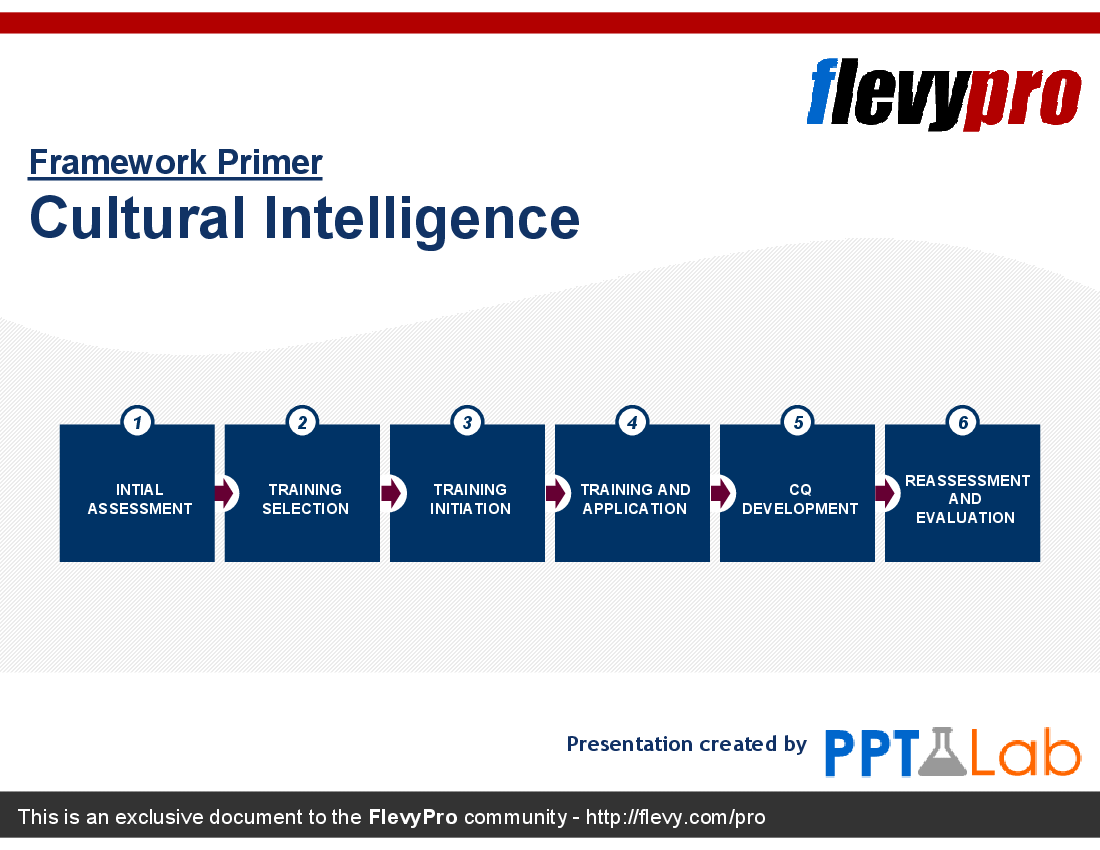
This PPT slide outlines a structured approach to enhancing Cultural Intelligence (CQ) through 3 steps: Initial Assessment, Training Selection, and Training Initiation. In the Initial Assessment, individuals evaluate their CQ strengths and weaknesses using tools like a Cultural Intelligence Self-assessment, simulated business encounters, and 360-degree feedback. The Training Selection step involves choosing targeted training to address specific weaknesses, such as acting classes for physical CQ or business case studies for cognitive CQ. Finally, Training Initiation applies the selected curriculum, with practical exercises like greeting someone new to build confidence in low motivational CQ. This systematic method fosters improvements in cross-cultural interactions and enhances organizational cultural competencies.
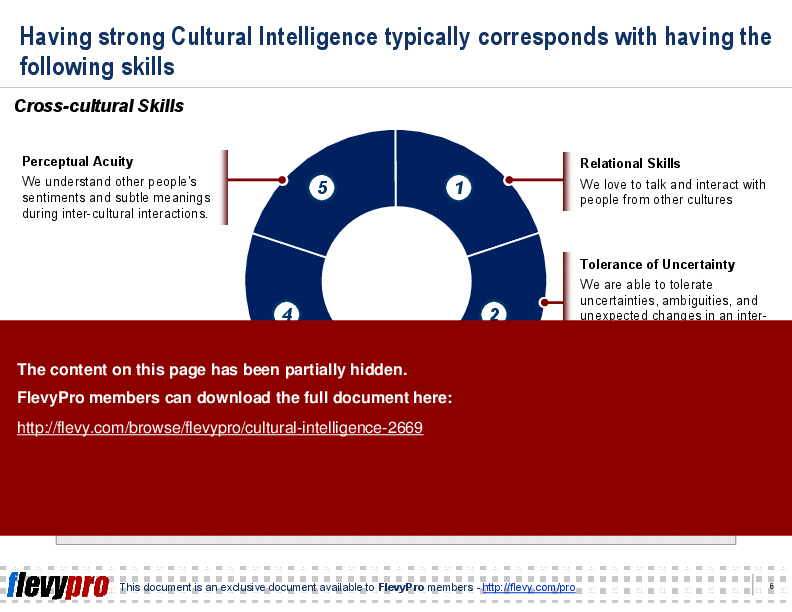
This PPT slide outlines key skills associated with Cultural Intelligence (CQ) essential for effective intercultural interactions in a globalized environment. The 5 skills include:
1. Perceptual Acuity: The ability to understand subtle sentiments and non-verbal cues in cross-cultural interactions.
2. Empathy: The capacity to adopt the perspective of individuals from different cultural backgrounds, fostering deeper connections.
3. Relational Skills: Enjoyment and enthusiasm for engaging with diverse cultures, leading to richer exchanges and trust-building.
4. Tolerance of Uncertainty: Comfort in ambiguous situations common in intercultural contexts, essential for navigating complex interactions.
5. Adaptability: Modifying behavior to align with varying cultural expectations, crucial for successful engagement in diverse environments.
These "soft" skills are critical for enhancing cultural competencies within organizations.
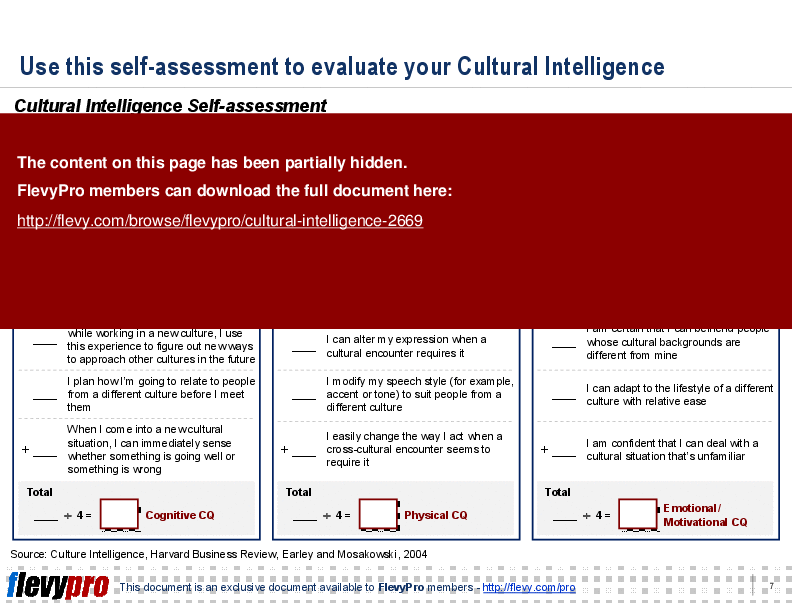
This PPT slide features a self-assessment tool for evaluating Cultural Intelligence (CQ) across 3 dimensions: Cognitive, Physical, and Emotional/Motivational. The Cognitive CQ section assesses knowledge of different cultures and self-awareness in cross-cultural interactions. The Physical CQ segment evaluates non-verbal communication skills, including body language and speech style adjustments, highlighting the importance of non-verbal cues. The Emotional/Motivational CQ section measures confidence and adaptability in engaging with diverse cultures. By calculating average scores for each dimension, users can identify strengths and areas for improvement in cultural competencies, guiding personal development in a globalized business environment.
Source: Best Practices in Corporate Culture, Cultural Intelligence, Elaine Mosakowski, Emotional Intelligence, Christopher Earley PowerPoint Slides: Cultural Intelligence PowerPoint (PPT) Presentation Slide Deck, PPT Lab
This framework is developed by a team of former McKinsey and Big 4 consultants. The presentation follows the headline-body-bumper slide format used by global consulting firms.
For $10.00 more, you can download this document plus 2 more FlevyPro documents. That's just $13 each.
ABOUT FLEVYPRO
This document is part of the FlevyPro Library, a curated knowledge base of documents for our FlevyPro subscribers.
FlevyPro is a subscription service for on-demand business frameworks and analysis tools. FlevyPro subscribers receive access to an exclusive library of curated business documents—business framework primers, presentation templates, Lean Six Sigma tools, and more—among other exclusive benefits.
The average daily rate of a McKinsey consultant is $6,625 (not including expenses). The average price of a Flevy document is $65.
Trusted by over 10,000+ Client Organizations
Since 2012, we have provided business templates to over 10,000 businesses and organizations of all sizes, from startups and small businesses to the Fortune 100, in over 130 countries.
"I have found Flevy to be an amazing resource and library of useful presentations for lean sigma, change management and so many other topics. This has reduced the time I need to spend on preparing for my performance consultation. The library is easily accessible and updates are regularly provided. A wealth of great information."
– Cynthia Howard RN, PhD, Executive Coach at Ei Leadership
"Flevy is our 'go to' resource for management material, at an affordable cost. The Flevy library is comprehensive and the content deep, and typically provides a great foundation for us to further develop and tailor our own service offer."
– Chris McCann, Founder at Resilient.World
"Flevy is now a part of my business routine. I visit Flevy at least 3 times each month.
Flevy has become my preferred learning source, because what it provides is practical, current, and useful in this era where the business world is being rewritten.

many challenges and there is the need to make the right decisions in a short time, with so much scattered information, we are fortunate to have Flevy. Flevy investigates, selects, and puts at our disposal the best of the best to help us be successful in our work.
"
– Omar Hernán Montes Parra, CEO at Quantum SFE
"The wide selection of frameworks is very useful to me as an independent consultant. In fact, it rivals what I had at my disposal at Big 4 Consulting firms in terms of efficacy and organization."
– Julia T., Consulting Firm Owner (Former Manager at Deloitte and Capgemini)
"I have used FlevyPro for several business applications. It is a great complement to working with expensive consultants. The quality and effectiveness of the tools are of the highest standards."
– Moritz Bernhoerster, Global Sourcing Director at Fortune 500
"[Flevy] produces some great work that has been/continues to be of immense help not only to myself, but as I seek to provide professional services to my clients, it gives me a large "tool box" of resources that are critical to provide them with the quality of service and outcomes they are expecting."
– Royston Knowles, Executive with 50+ Years of Board Level Experience
"One of the great discoveries that I have made for my business is the Flevy library of training materials.
As a Lean Transformation Expert, I am always making presentations to clients on a variety of topics: Training, Transformation, Total Productive Maintenance, Culture, Coaching, Tools, Leadership Behavior, etc. Flevy
It is well worth the money to purchase these presentations. Sure, I have the knowledge and information to make my point. It is another thing to create a presentation that captures what I want to say. Flevy has saved me countless hours of preparation time that is much better spent with implementation that will actually save money for my clients.
"
– Ed Kemmerling, Senior Lean Transformation Expert at PMG
"FlevyPro provides business frameworks from many of the global giants in management consulting that allow you to provide best in class solutions for your clients."
– David Harris, Managing Director at Futures Strategy
Download our free compilation of 50+ slides and templates on Organizational Design, Change Management, and Corporate Culture. Methodologies include ADKAR, Burke-Litwin Change Model, McKinsey 7-S, Competing Values Framework, etc.