 Click main image to view in full screen.
Construction Company Business Capability Model – PDF
PDF document 1 Pages


BENEFITS OF THIS DOWNLOADABLE PDF DOCUMENT
- Enterprise Architecture fundamental model
- Business Architecture Core Model
- Transformation strategy core document
BUSINESS CAPABILITY MODEL PDF DESCRIPTION
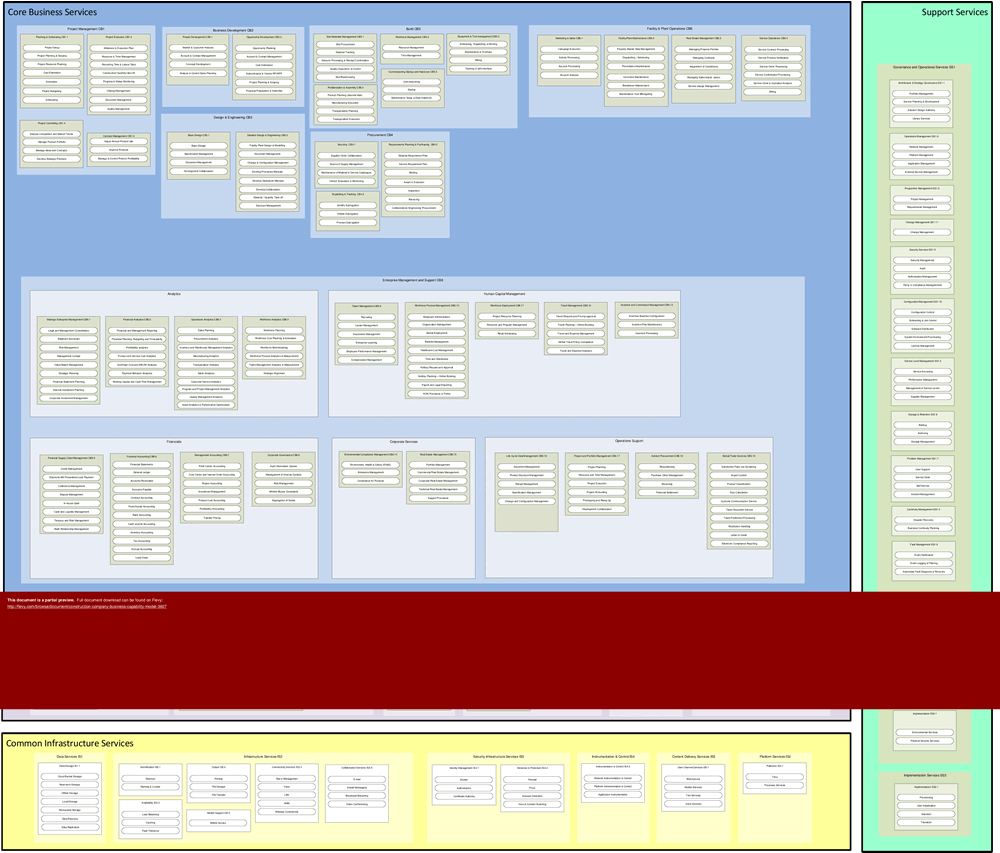
A business capability model of a construction company providing a basis for Enterprise Architecture, Business Architecture, Strategic Planning. Comprehensive balance of business capabilities and technical support capabilities.
This PDF offers a detailed framework for understanding the core functions and technical support mechanisms essential to a construction company's success. The model is meticulously designed to align with the principles of Enterprise Architecture and Business Architecture, ensuring that strategic planning is both robust and adaptable. It serves as a critical tool for executives aiming to streamline operations and enhance organizational efficiency.
The preview images reveal a structured approach to categorizing business capabilities, emphasizing areas such as project management, resource allocation, and compliance. The model also highlights the importance of integrating technological advancements to support these capabilities, making it a valuable resource for companies looking to stay competitive in a rapidly evolving industry. This document is particularly useful for identifying gaps in current processes and developing targeted strategies for improvement.
Executives will appreciate the clear delineation of roles and responsibilities within the organization, as well as the focus on optimizing both human and technological resources. The capability model provides actionable insights that can drive decision-making and foster a culture of continuous improvement. This is an indispensable guide for any construction company committed to achieving operational excellence and long-term growth.
Got a question about the product? Email us at support@flevy.com or ask the author directly by using the "Ask the Author a Question" form. If you cannot view the preview above this document description, go here to view the large preview instead.
TOPIC FAQ
What is a business capability model and how is it used in construction companies?
A business capability model catalogs an organization’s functions as stable capabilities rather than org-chart roles or processes. In construction, it frames core delivery areas and enabling services so leaders can align technology, roles, and strategy; it supports gap identification across areas like project management, resource allocation, and compliance.Which capability areas should a construction company include in a capability model?
A construction capability model should combine delivery capabilities (project management, site operations), support functions (resource allocation, procurement), governance (compliance, safety), and technical support capabilities that enable them, ending with explicit delineation of roles and responsibilities such as project management, resource allocation, compliance.How can capability modeling support strategic planning in construction firms?
Capability models provide a stable map of what the business must do, making it easier to assess where capabilities are weak, where investments are needed, and how technology supports outcomes. This enables prioritization and roadmapping tied to Strategic Planning and Enterprise Architecture for clearer investment decisions.What should I look for when choosing a construction capability model template?
Choose a template that explicitly links business capabilities to technical support, clarifies roles and responsibilities, uses industry-relevant categories (project delivery, resource allocation, compliance), and is usable in EA and strategic planning discussions, with coverage of technical support capabilities.Are one-page capability models useful for executive presentations, or do I need a multi-slide toolkit?
One-page models are useful for high-level alignment with executives because they summarize capability scope, roles, and technology relationships succinctly. For detailed design or implementation you may need supplementary artifacts,, but a one-page PDF is effective for executive-level gap identification and alignment.I need to align IT investments with operational needs at my construction firm — where does capability modeling fit?
Capability modeling surfaces where technology enables or constrains business capabilities, helping prioritize IT investments against operational impact. A capability map that highlights technical support capabilities and their links to delivery areas guides investment sequencing and requirements definition for IT spend.I need to streamline operations across project sites — can capability modeling help with that?
Yes. Mapping capabilities clarifies who owns which capabilities, standardizes processes across sites, and highlights where technology or resource allocation changes can improve consistency and efficiency, supporting initiatives to optimize both human and technological resources.How much should I expect to pay for a ready-made capability model for construction, and is buying one cost-effective?
Prices vary by provider and detail level; a ready-made model can save time in creating a consistent capability inventory and accelerate EA or strategy work. For a compact option, Flevy's Construction Company Business Capability Model is offered as a 1-page PDF sold on Flevy.Source: Best Practices in Business Capability Model, Construction PDF: Construction Company Business Capability Model PDF (PDF) Document, R Bradley Consulting




























