 Click main image to view in full screen.
Supplier Exit and Transition Planning Toolkit – PowerPoint PPTX Template
PowerPoint (PPTX) + Zip archive file (ZIP) 11 Slides


BENEFITS OF THIS DOWNLOADABLE POWERPOINT DOCUMENT
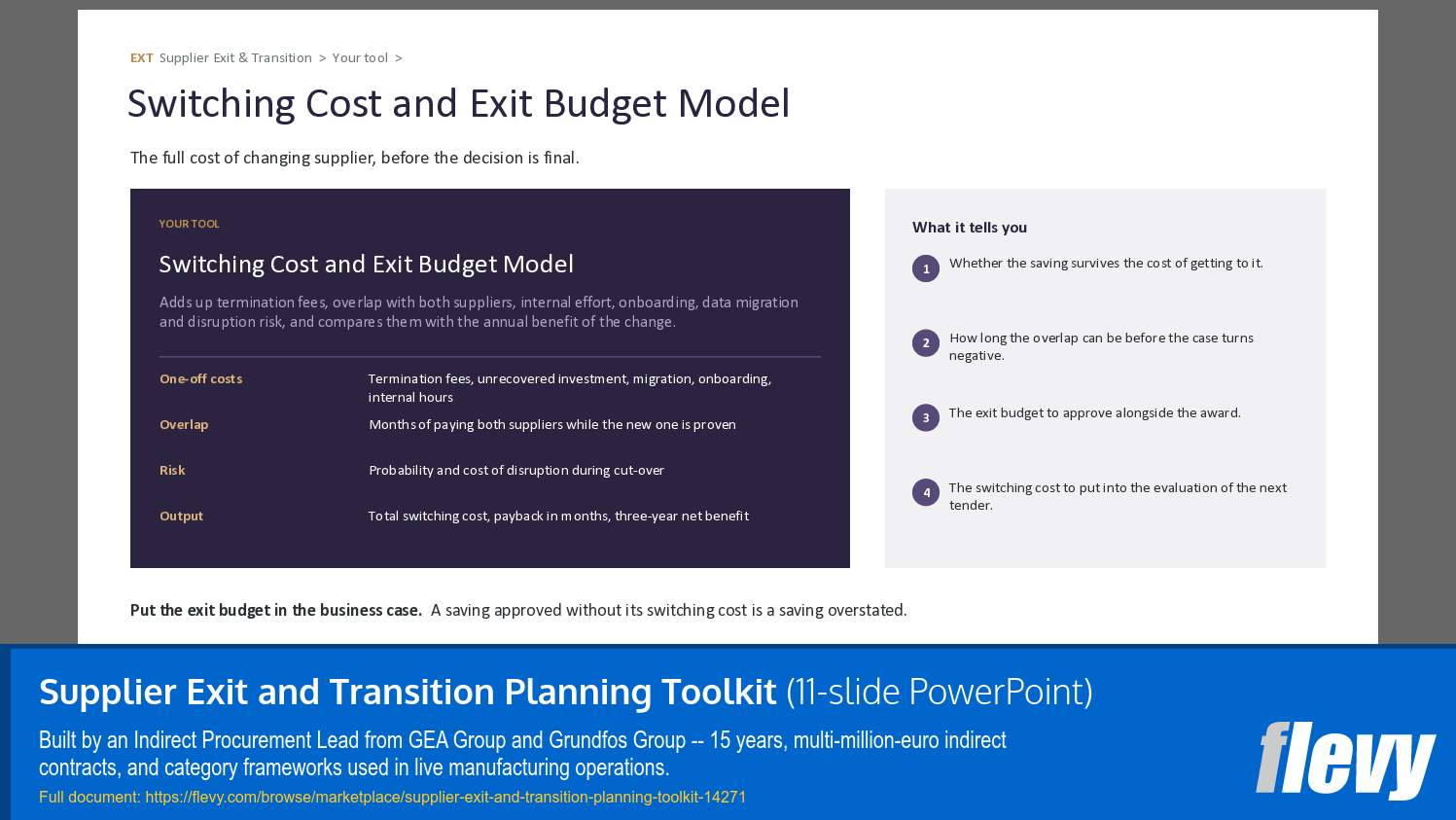
- Calculate the full cost of changing supplier - termination fees, migration, internal effort, overlap and disruption risk - and see payback and three-year net benefit before you decide
- Run a dated exit plan of 28 tasks across four workstreams that moves automatically when the exit date changes, with late tasks flagged
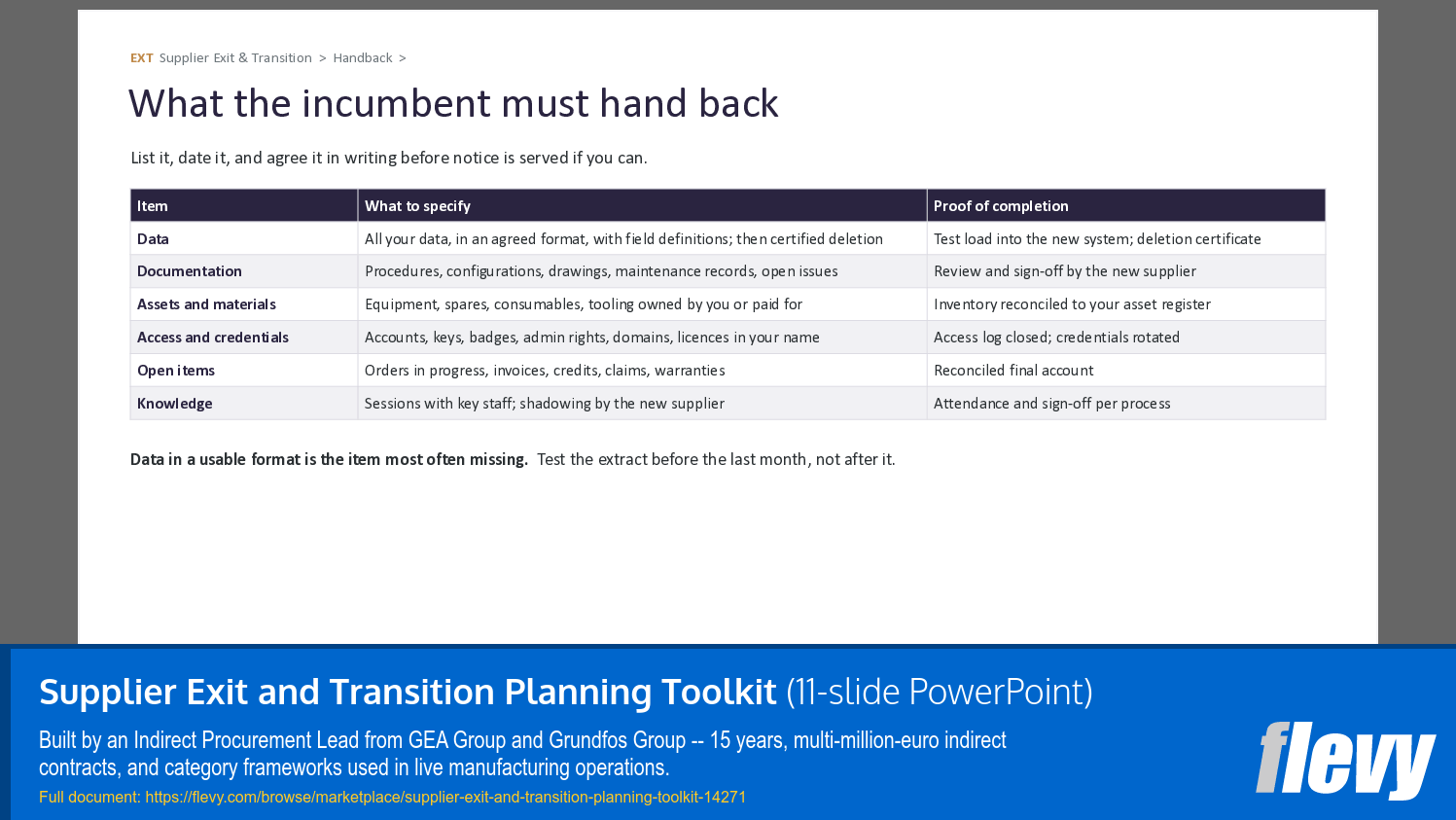
- Specify exactly what the incumbent must hand back, how completion is proven, and serve notice with the right letter for the route
PROCUREMENT STRATEGY PPT TEMPLATE DESCRIPTION
Most supplier exits fail on the way out, not because the new supplier was the wrong choice. Exits are planned less carefully than tenders, yet they carry more risk: the tender picks the next supplier, the exit decides whether the service survives the change.
Data that cannot be extracted, equipment nobody inventoried, knowledge held by two people at the incumbent, a notice served a month late – each one turns a sound sourcing decision into a disruption the business remembers longer than the saving.
THE METHOD
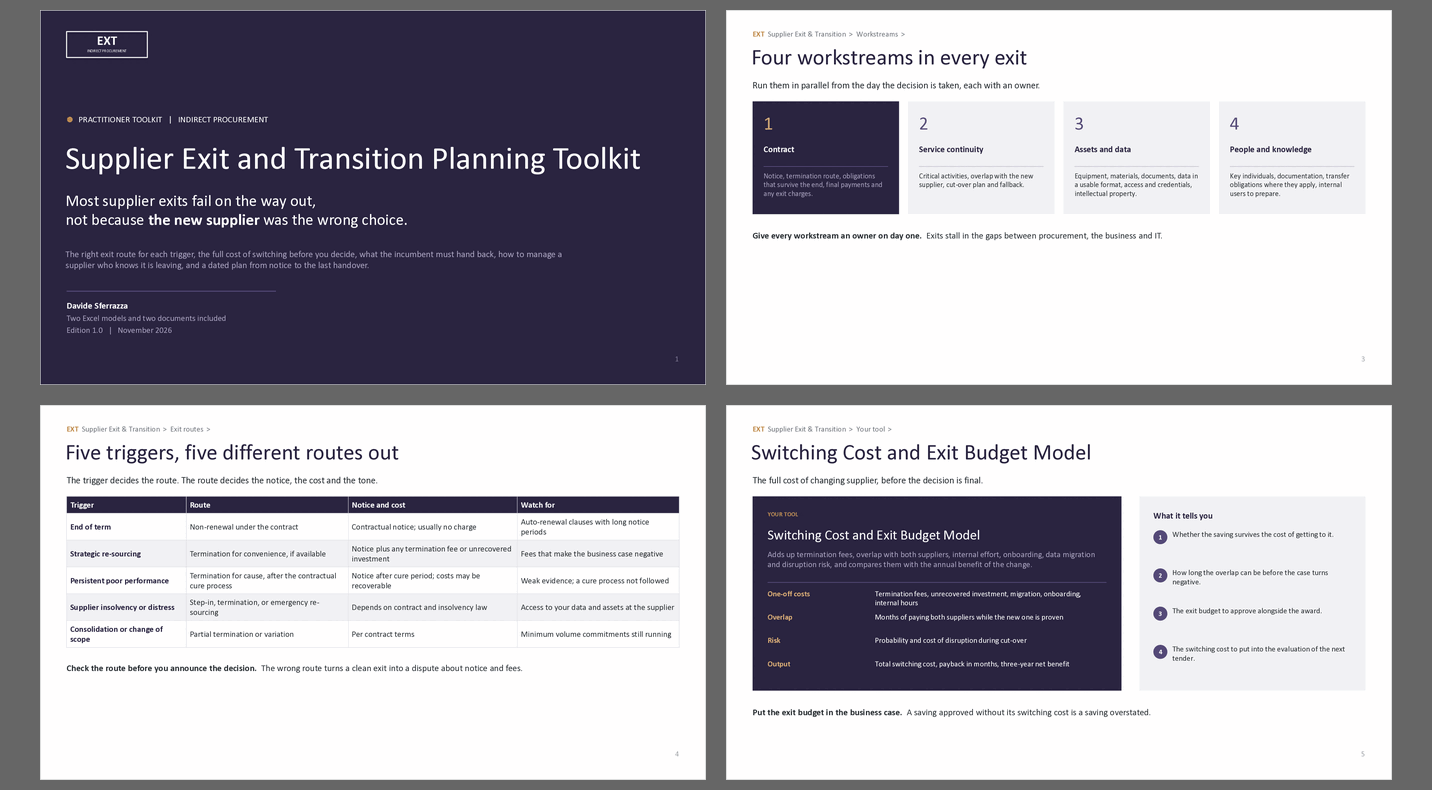
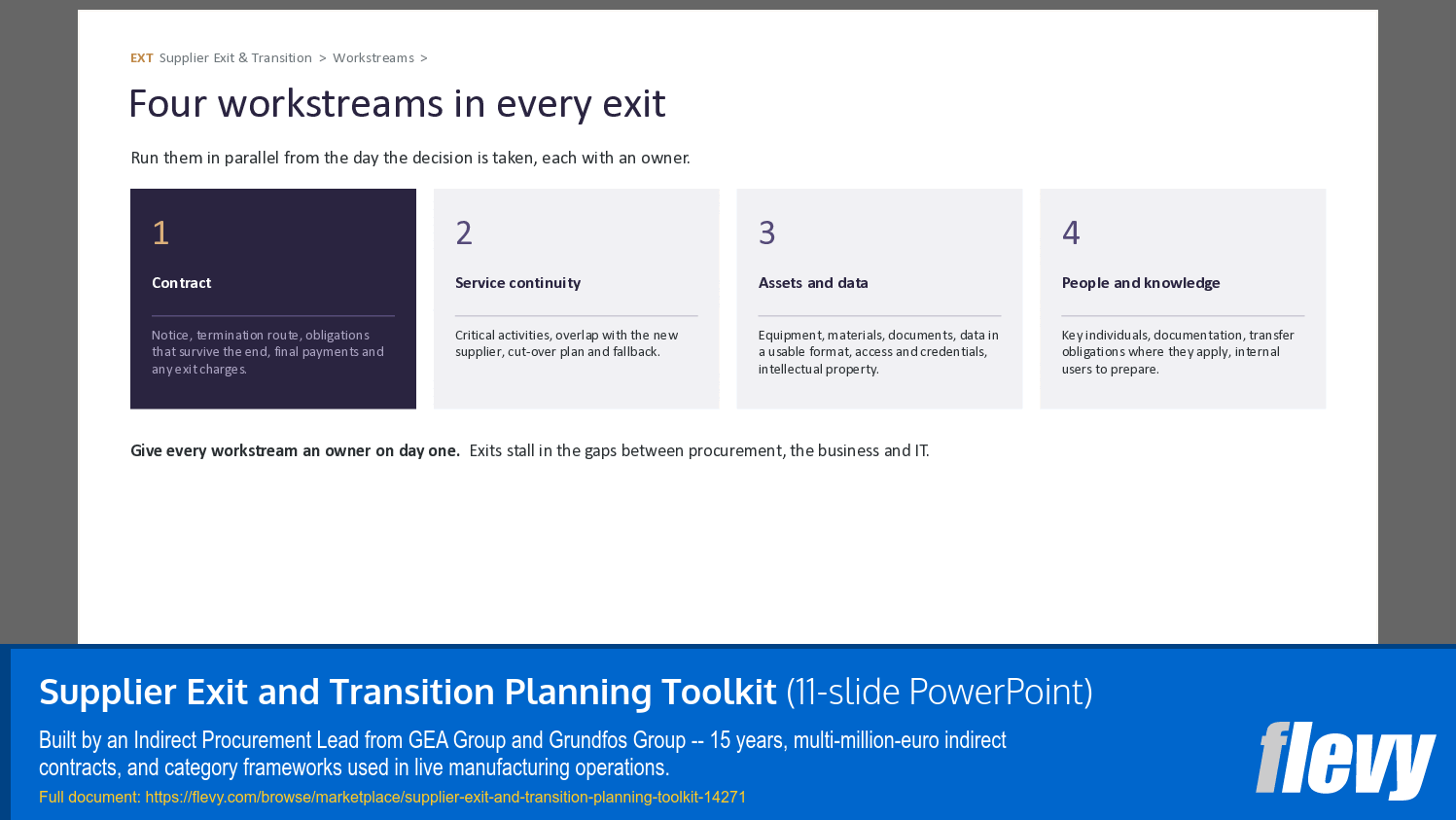
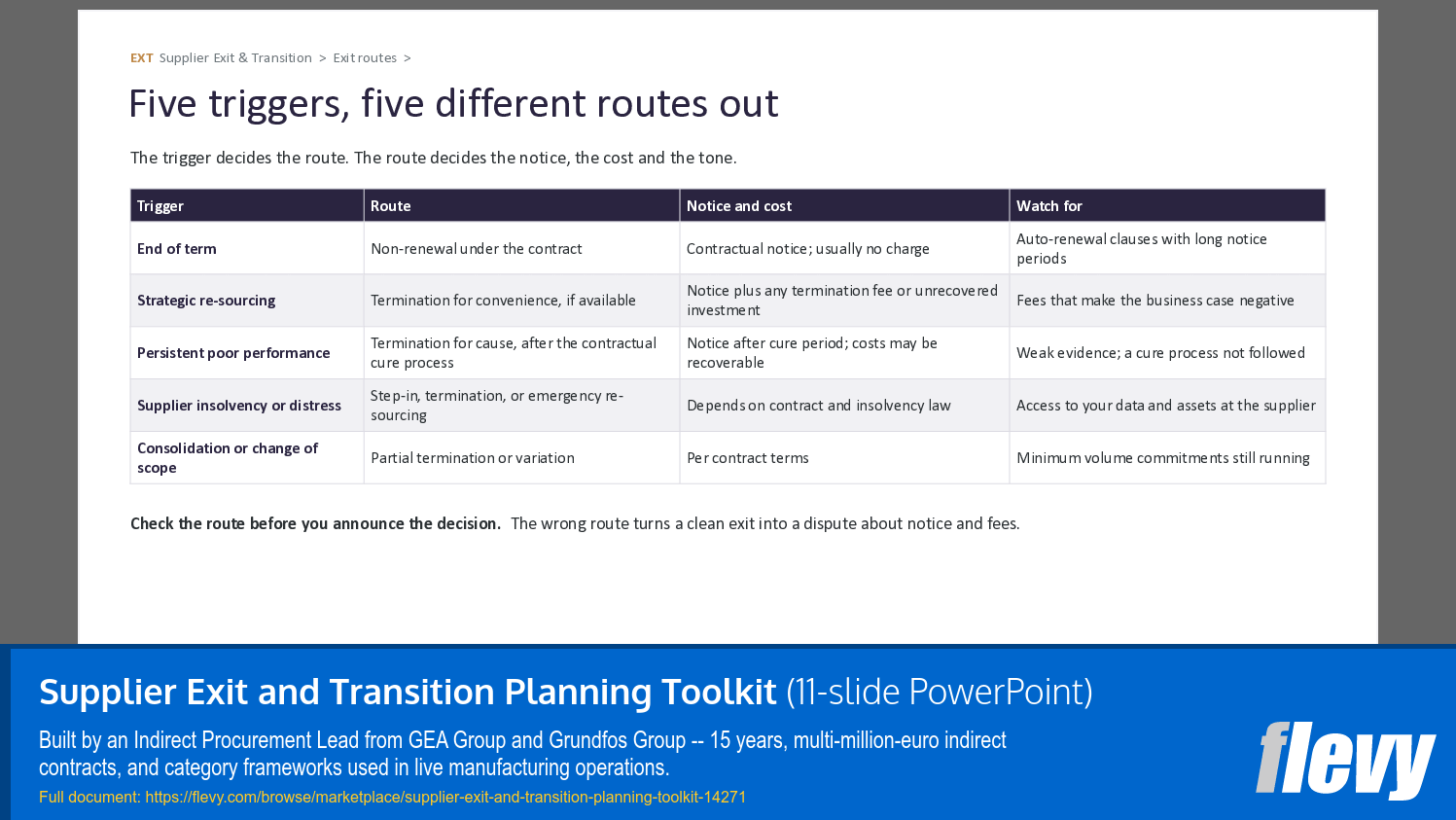
Four workstreams run in parallel from the day the decision is taken, each with an owner: contract, service continuity, assets and data, people and knowledge. The trigger decides the route – non-renewal, termination for convenience, termination for cause, insolvency, partial termination – and the route decides the notice, the cost and the tone. The switching cost goes into the business case before the decision is final.
WHAT IS INCLUDED
Primary document – a 10-slide guide covering the four workstreams, five exit triggers and their routes, what the incumbent must hand back and how to prove it, managing a supplier who knows it is leaving, the last ninety days, and a plan from decision to final handover.
Switching Cost and Exit Budget Model (Excel) – termination fees, migration, onboarding, internal effort, asset transfer, training, legal costs, overlap with both suppliers and expected disruption cost, against the annual benefit: total exit budget, payback in months, three-year net benefit and the maximum overlap before the case turns negative.
Exit and Transition Plan Tracker (Excel) – 28 standard tasks across the four workstreams, each dated from the exit date by an offset, with owners, status, late-task flags and a progress summary by workstream.
Supplier Exit Plan Template (Word) – a structured plan covering route, budget, continuity, handback register, people, governance, close-out and sign-off.
Termination and Handover Letter Templates (Word) – notice of non-renewal, termination for convenience, exit plan and handover requirements, and close-out.
WHO IT IS FOR
Category managers and buyers changing a supplier after a tender. Contract managers handling a termination. Operations and facilities managers responsible for service continuity during a change. Consultants supporting a re-sourcing programme.
WHAT THIS IS NOT
It is not legal advice: termination rights, notice requirements and staff transfer rules depend on the contract and the jurisdiction, and should be checked by your adviser. It is a practical way to make sure the exit is as well planned as the tender that caused it.
Got a question about the product? Email us at support@flevy.com or ask the author directly by using the "Ask the Author a Question" form. If you cannot view the preview above this document description, go here to view the large preview instead.
Source: Best Practices in Procurement Strategy, Supplier Management PowerPoint Slides: Supplier Exit and Transition Planning Toolkit PowerPoint (PPTX) Presentation Slide Deck, Davide Sferrazza
ABOUT THE AUTHOR

Indirect Procurement Lead, with 15 years spent in the categories most organisations manage least well: MRO, facilities, utilities and energy, marketing services, IT and software, professional services, logistics and CapEx.
That career has been inside manufacturing groups -- Pavan (GEA Group) and DAB Pumps (Grundfos Group) -- leading procurement transformation projects, negotiating
... [read more]
Ask the Author a Question
You must be logged in to contact the author.