 Click main image to view in full screen.
Single Source Justification and Supplier Dependency Pack – PowerPoint PPTX Template
PowerPoint (PPTX) + Zip archive file (ZIP) 9 Slides


BENEFITS OF THIS DOWNLOADABLE POWERPOINT DOCUMENT
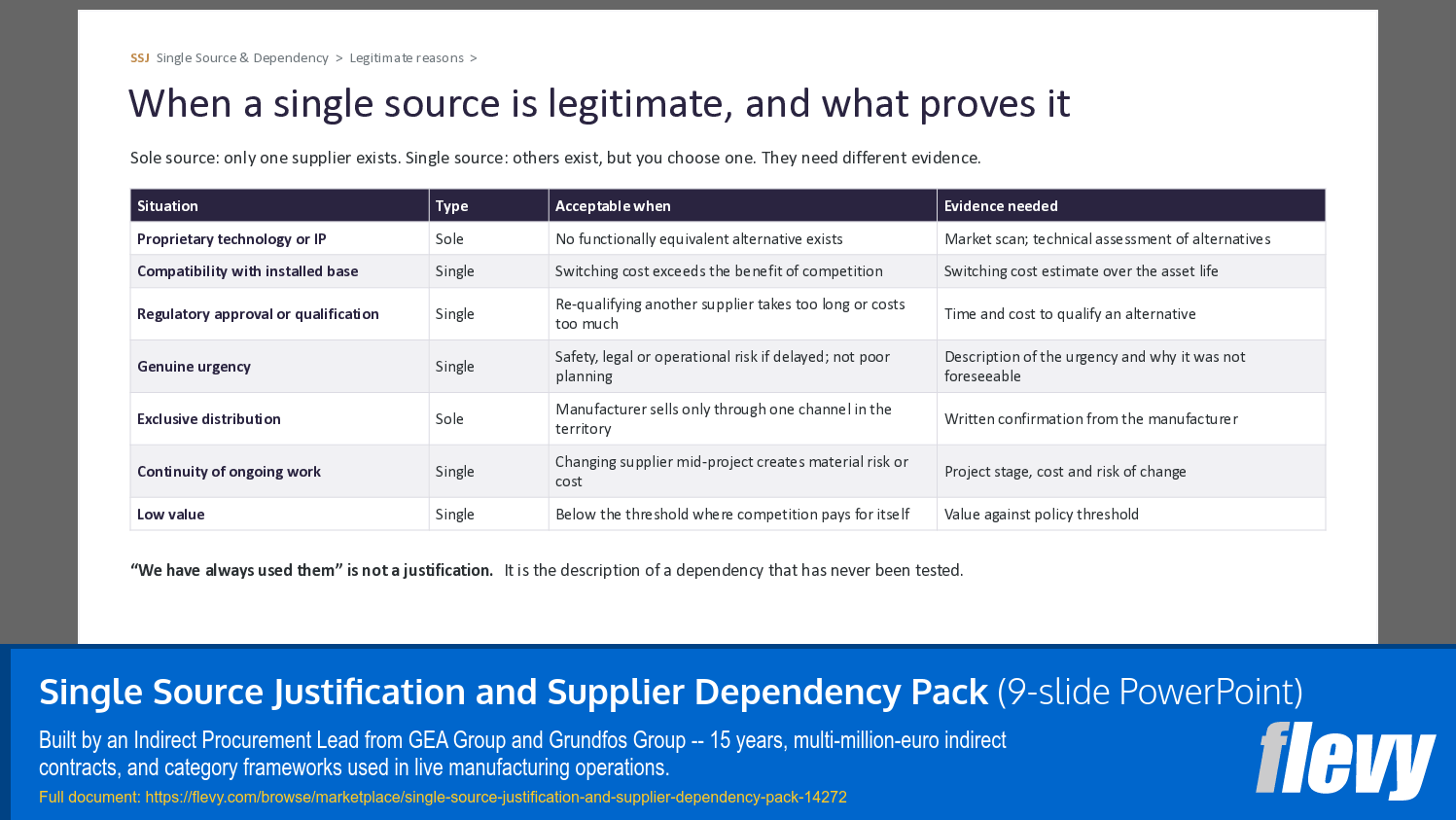
- Distinguish sole from single source, and know the evidence each legitimate reason requires before a request is approved
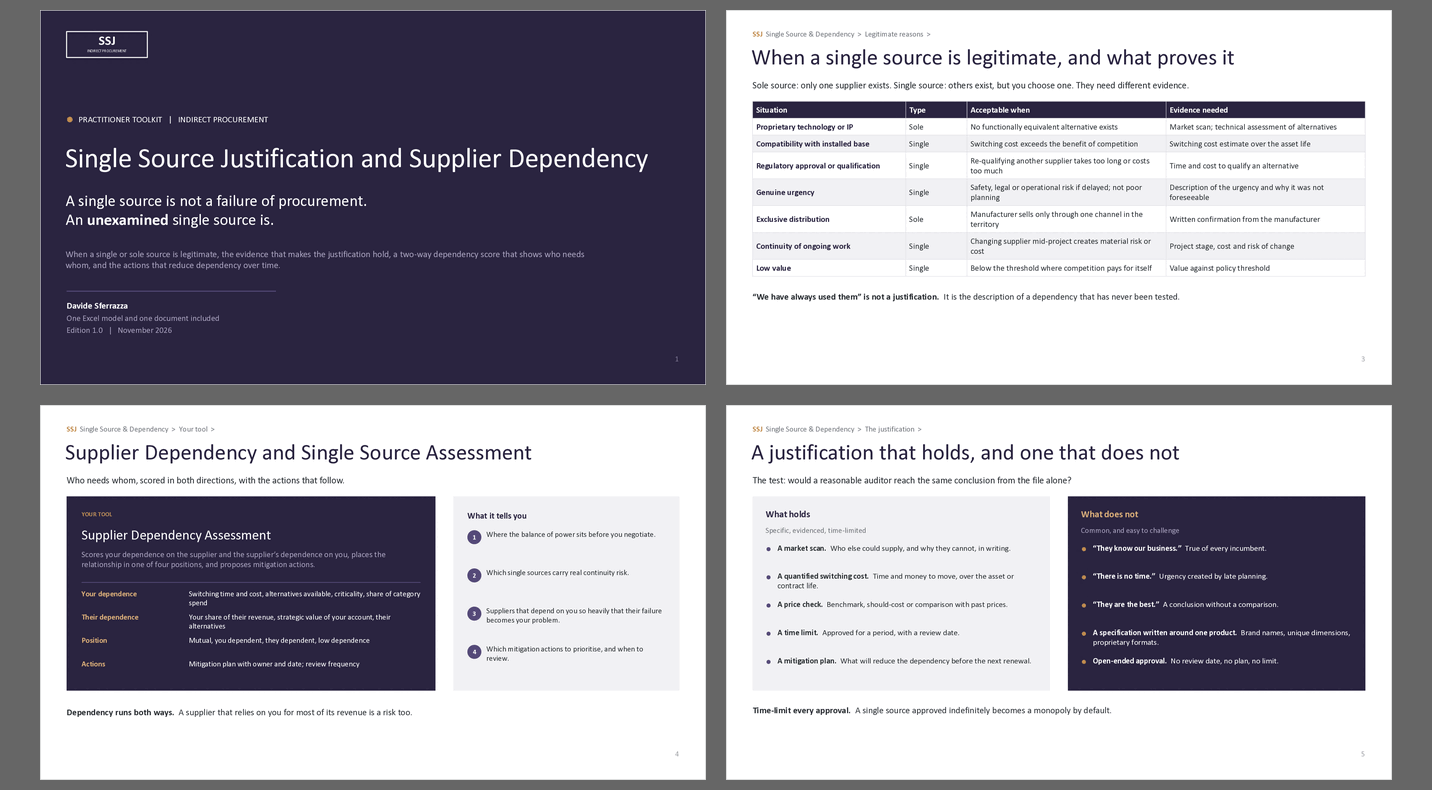
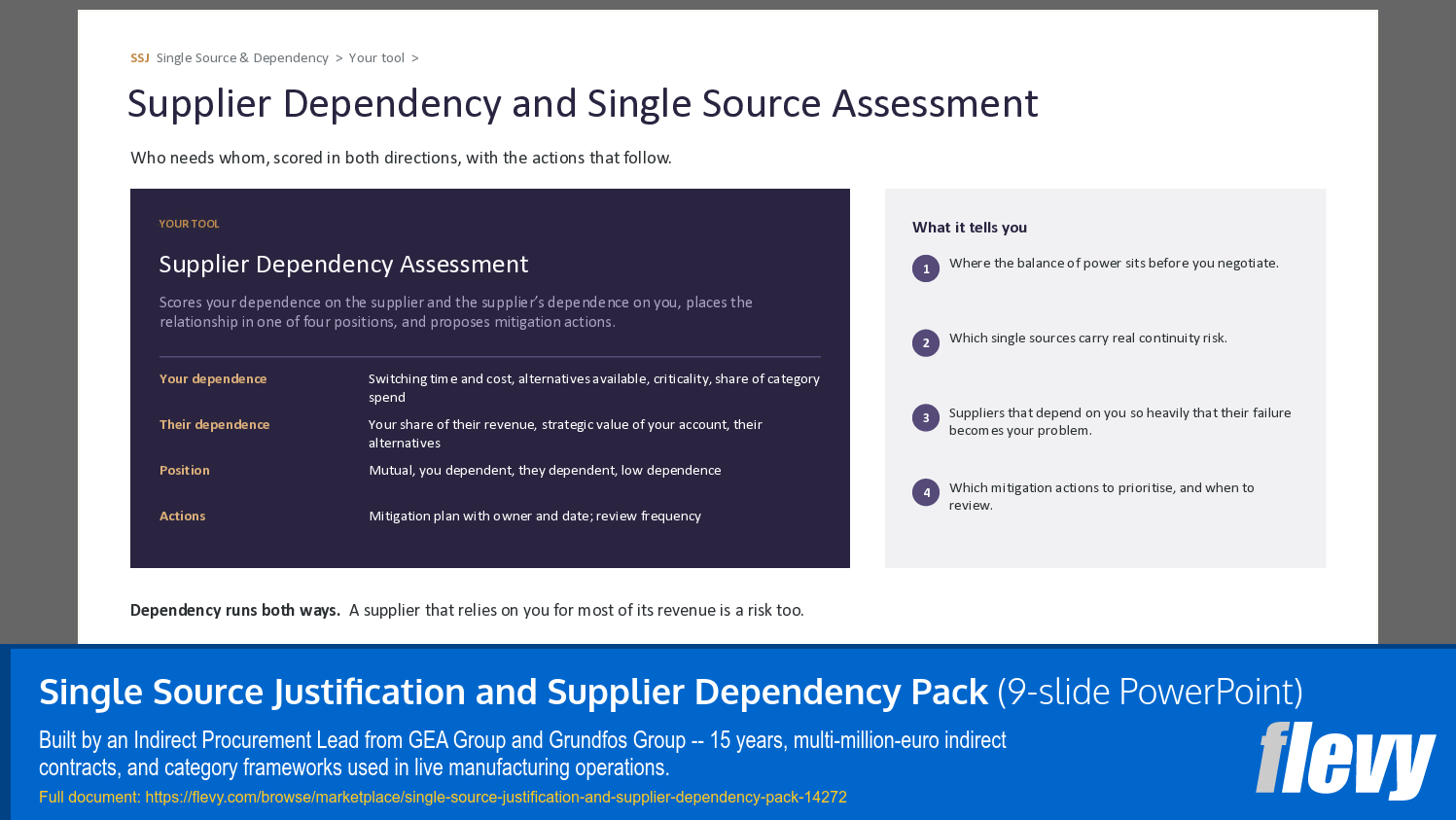
- Score supplier dependency in both directions - your dependence on them and theirs on you - and get a position, a priority action and a review interval
- Record every single-source decision on a form that captures the reasoning, the price check, the time limit and the plan to reduce dependency
PROCUREMENT STRATEGY PPT TEMPLATE DESCRIPTION
A single source is not a failure of procurement. An unexamined single source is.
Single-source requests are often approved on the strength of one sentence: only this supplier can do it. Most are never tested, and most dependencies are discovered only when the supplier raises its price or fails. Yet many single sources are entirely legitimate – proprietary technology, an installed base, a regulatory qualification. The issue is not that they exist, but that nobody records why, measures the dependency, or plans how to reduce it.
THE METHOD
Separate sole source (only one supplier exists) from single source (others exist, but you choose one), because they need different evidence. Test every request against a short list of legitimate reasons. Measure dependency in both directions, because a supplier that relies on you for most of its revenue is a risk too. Time-limit every approval, and plan the actions that make the next renewal less dependent than this one.
WHAT IS INCLUDED
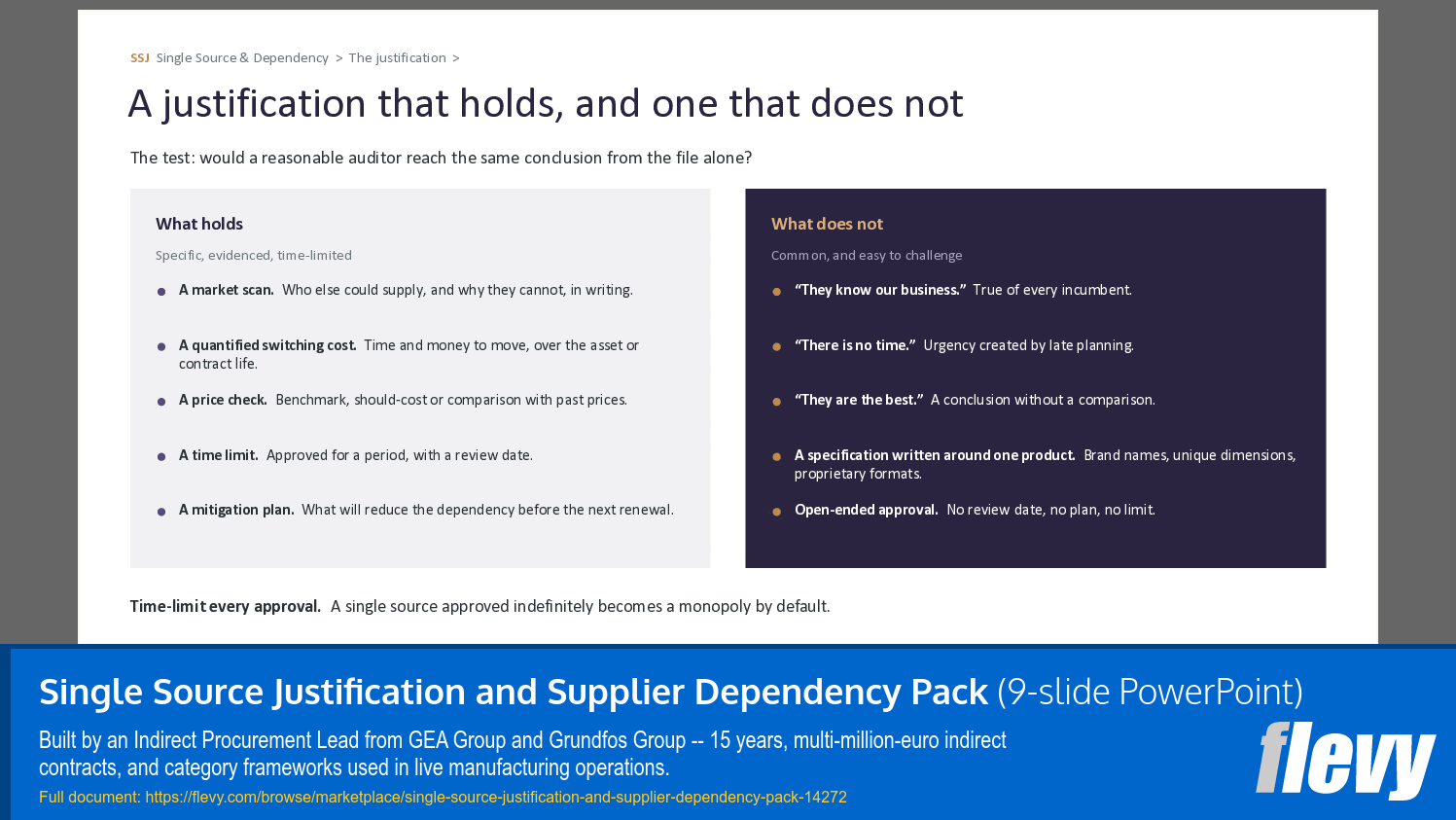
Primary document – an 8-slide guide covering seven legitimate reasons for a single or sole source and the evidence each needs, what makes a justification hold and what does not, two-way dependency, five ways to reduce dependency over time, share of wallet, and a three-stage approval process.
Supplier Dependency and Single Source Assessment (Excel) – nine weighted criteria scored 1 to 5 for up to five suppliers: six for your dependence on the supplier and three for the supplier's dependence on you. The model places each relationship in one of four positions – mutual dependence, you dependent, they dependent, low dependence – with a priority action and a review interval, plus a scoring guide and a mitigation plan.
Single Source Justification Form and Guidance (Word) – request details, evidence required, reason codes with minimum evidence, mitigation and time limits, approval signatures, and guidance for reviewers.
WHO IT IS FOR
Buyers and procurement managers who approve or challenge single-source requests. Budget holders who need to justify one. Internal auditors and controllers reviewing non-competitive purchases. Organisations writing or tightening their procurement policy.
WHAT THIS IS NOT
It is not a public procurement compliance guide: rules on non-competitive procedures in the public sector are specific to each jurisdiction. It is a practical method for private-sector and general use, designed to make single-source decisions deliberate, evidenced and time-limited.
Got a question about the product? Email us at support@flevy.com or ask the author directly by using the "Ask the Author a Question" form. If you cannot view the preview above this document description, go here to view the large preview instead.
Source: Best Practices in Procurement Strategy, Supplier Management PowerPoint Slides: Single Source Justification and Supplier Dependency Pack PowerPoint (PPTX) Presentation Slide Deck, Davide Sferrazza
ABOUT THE AUTHOR

Indirect Procurement Lead, with 15 years spent in the categories most organisations manage least well: MRO, facilities, utilities and energy, marketing services, IT and software, professional services, logistics and CapEx.
That career has been inside manufacturing groups -- Pavan (GEA Group) and DAB Pumps (Grundfos Group) -- leading procurement transformation projects, negotiating
... [read more]
Ask the Author a Question
You must be logged in to contact the author.