
 Click main image to view in full screen. Unlock all 17 preview images:
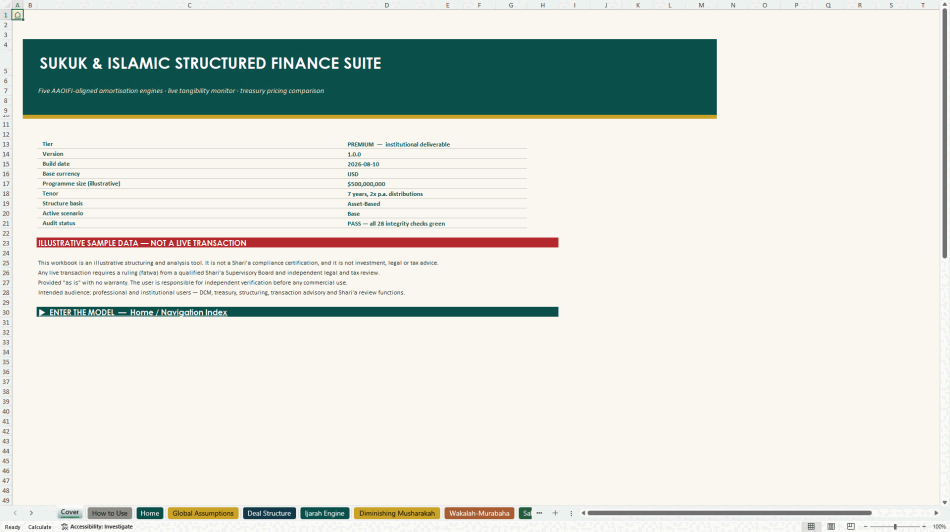
Sukuk & Islamic Structured Finance Suite – Excel XLSX
Excel (XLSX) + supplemental PDF


BENEFITS OF THIS DOWNLOADABLE EXCEL DOCUMENT
- Provides five linked Sukuk-structure engines, allowing users to compare cash-flow shape, economics and capital-return profile without building each structure from scratch.
- Makes key structural and monitoring issues visible through a live tangibility test, SPV waterfall, purchase-undertaking integrity check, DSCR reporting and automated audit controls.
- Converts complex schedules into pricing, sensitivity, risk, executive and investor outputs that are suitable for internal analysis and professional discussion.
WEALTH MANAGEMENT EXCEL DESCRIPTION
🕌 Build, compare and explain sophisticated Sukuk structures in one professional, fully linked Excel suite.
The Sukuk & Islamic Structured Finance Suite is a premium, native Excel financial model designed for professionals who need more than a simple debt amortisation schedule. It gives you a structured way to build and analyse a multi-engine Sukuk programme, trace cash from the underlying contracts through an SPV waterfall, test selected monitoring metrics, compare the economics with conventional debt and present the outcome in clear executive and investor views.
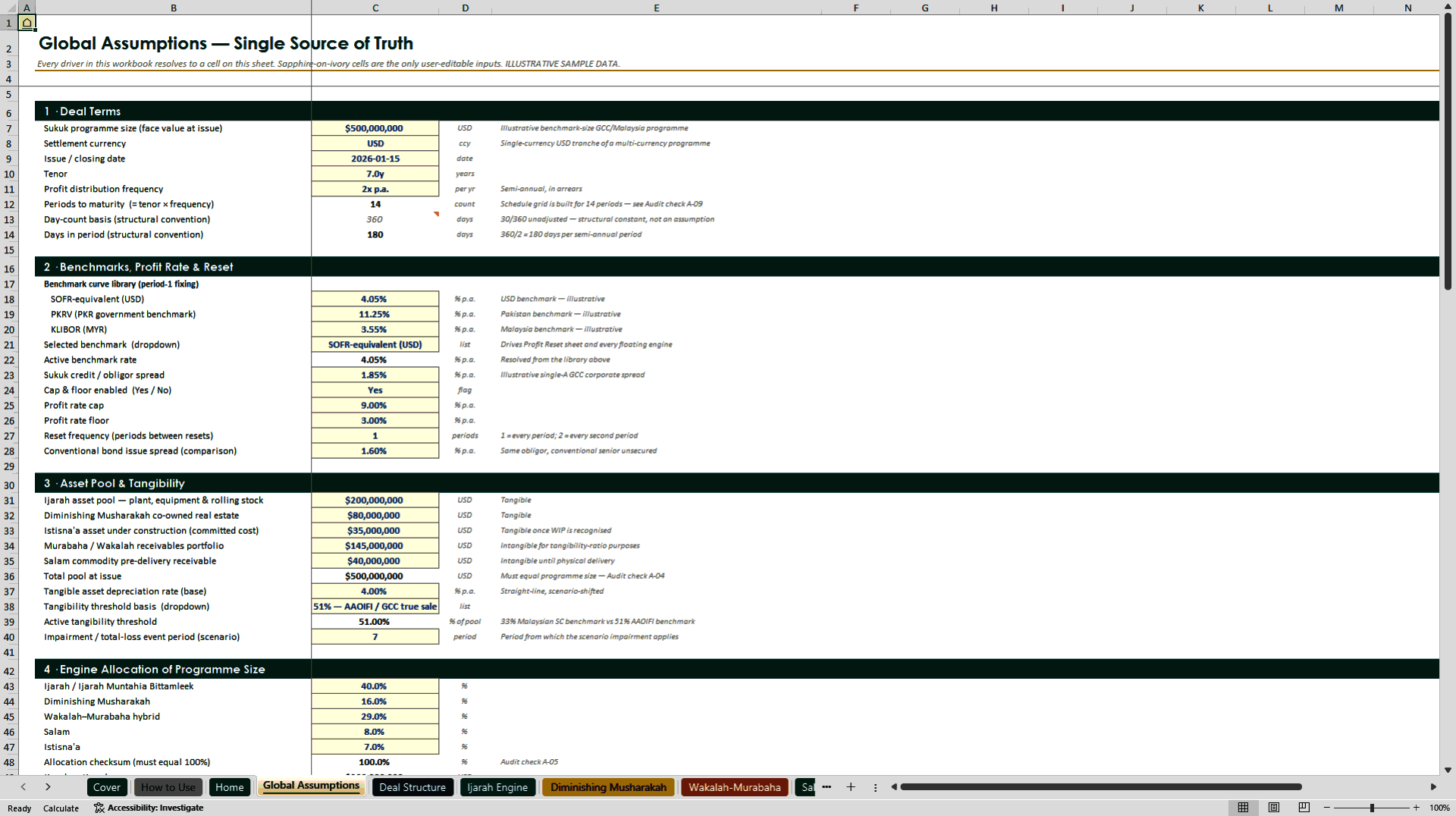
This is a fully editable, formula-driven workbook with no macros or VBA. Rather than entering assumptions across many tabs, all key inputs sit in one clearly marked Global Assumptions sheet. Change the deal size, tenor, payment frequency, curve, spread, scenario, asset allocation or structural setting once, and the connected schedules, pricing analytics, risk indicators and dashboards update together.
🌟 Five detailed Sukuk engines in one workbook
The suite brings together five major Islamic structured-finance mechanics so you can evaluate different cash-flow shapes and allocation mixes inside one programme:
Ijarah / Ijarah Muntahia Bittamleek (IMB): models a level-rental annuity, rental profit and capital split, servicing fee, lessor-borne takaful and major maintenance, residual value and the maturity exercise amount.
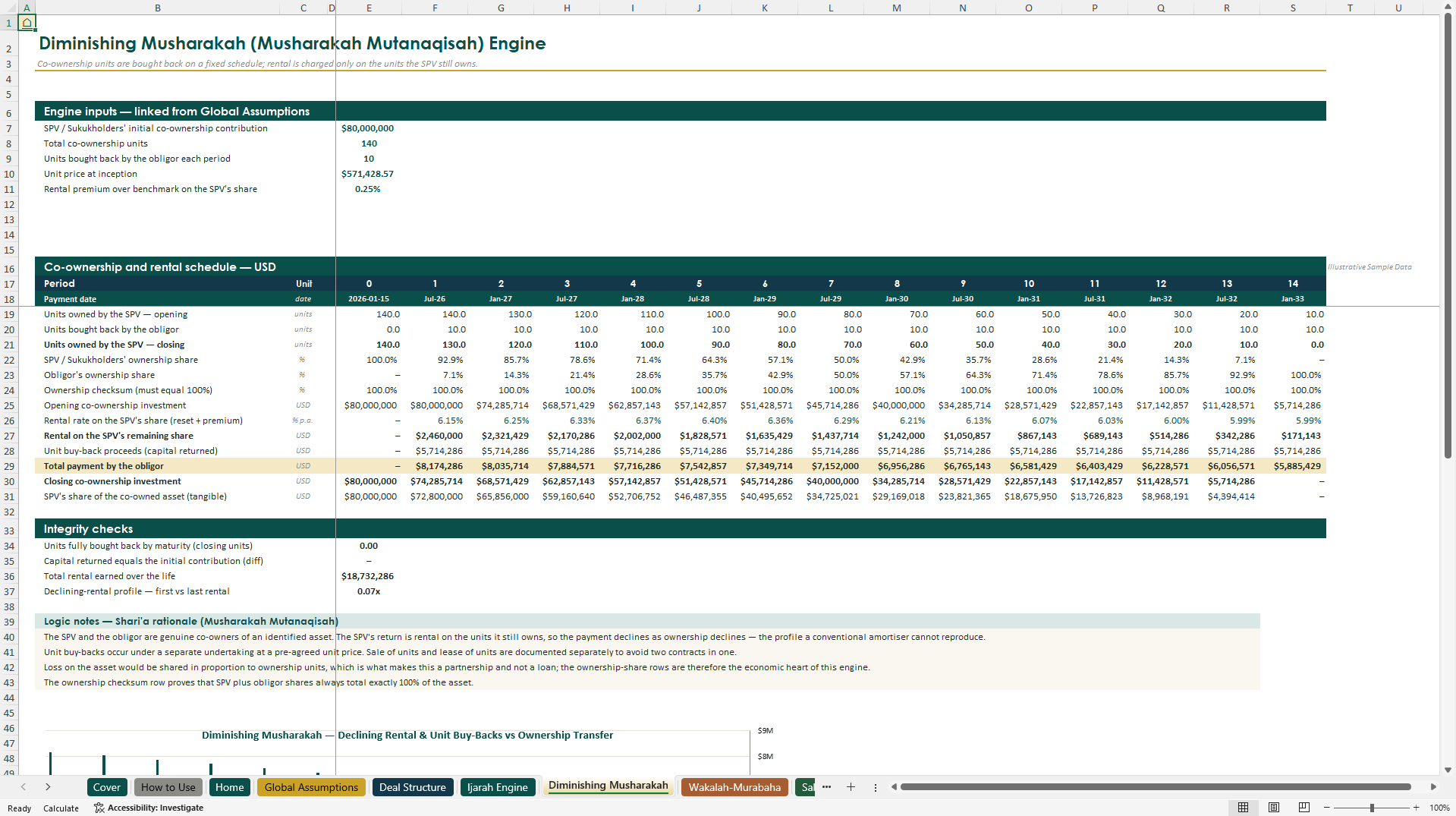
Diminishing Musharakah: models genuine co-ownership, opening and closing unit balances, periodic unit buy-backs, ownership percentages, rental charged only on the SPV's remaining ownership share, and the naturally declining rental profile.
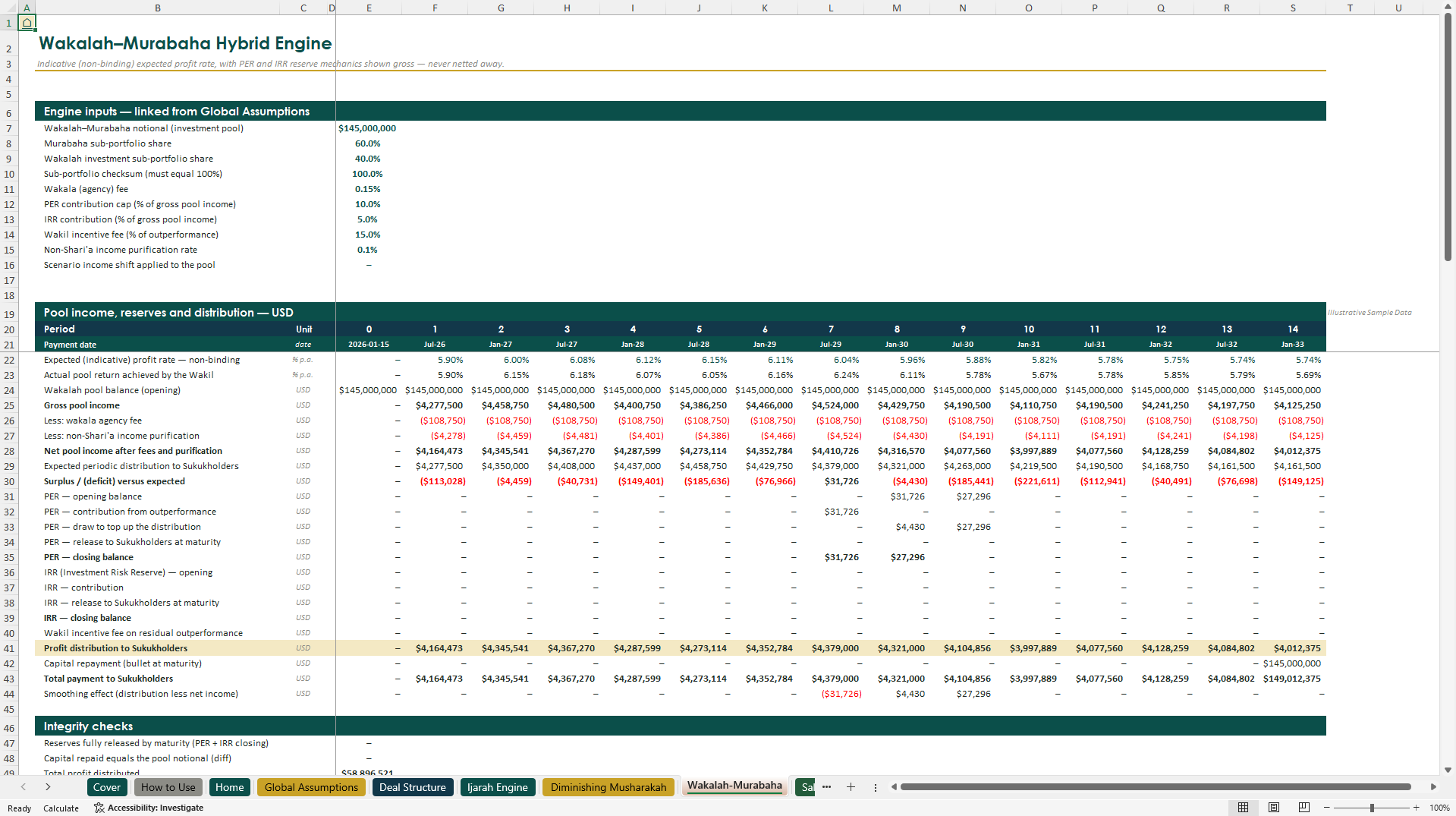
Wakalah–Murabaha hybrid: models the Murabaha and Wakalah sub-portfolio mix, indicative expected profit, actual pool return, agency fee, non-Shari'a income purification, wakil incentive fee, Profit Equalisation Reserve (PER) and Investment Risk Reserve (IRR) flows—including their release at maturity.
Salam with Parallel Salam offset: captures the full upfront Salam payment, quantity and delivery tranches, delayed delivery proceeds, delivery shortfall cash settlement, parallel-sale pricing and the resulting trading-profit / capital-recovery profile.
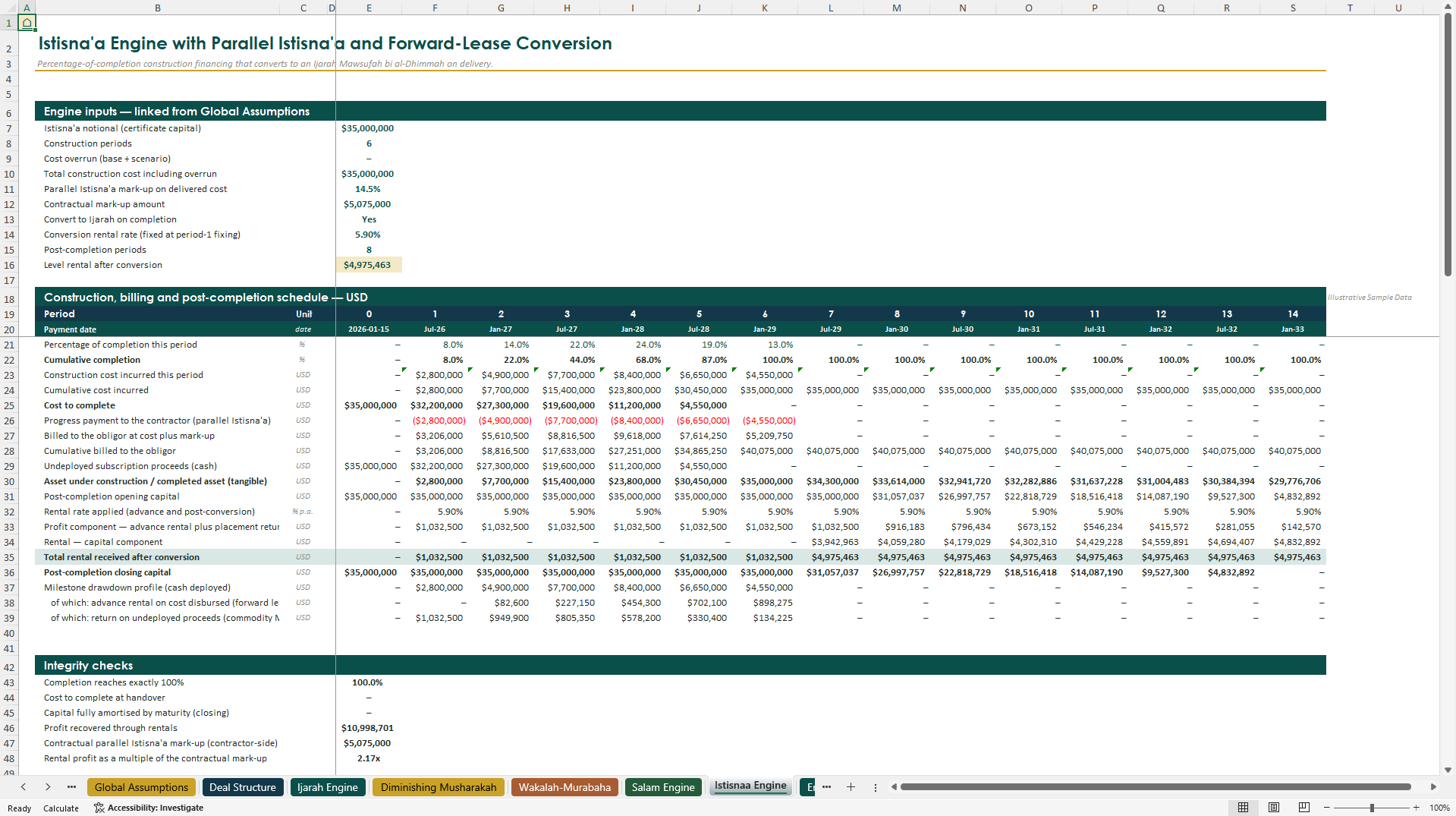
Istisna'a with Parallel Istisna'a and forward-lease conversion: models percentage-of-completion construction costs, cost-overrun assumptions, milestone drawdowns, billing at cost plus mark-up, undeployed proceeds, completion, and post-completion Ijarah Mawsufah bi al-Dhimmah rental cash flows.
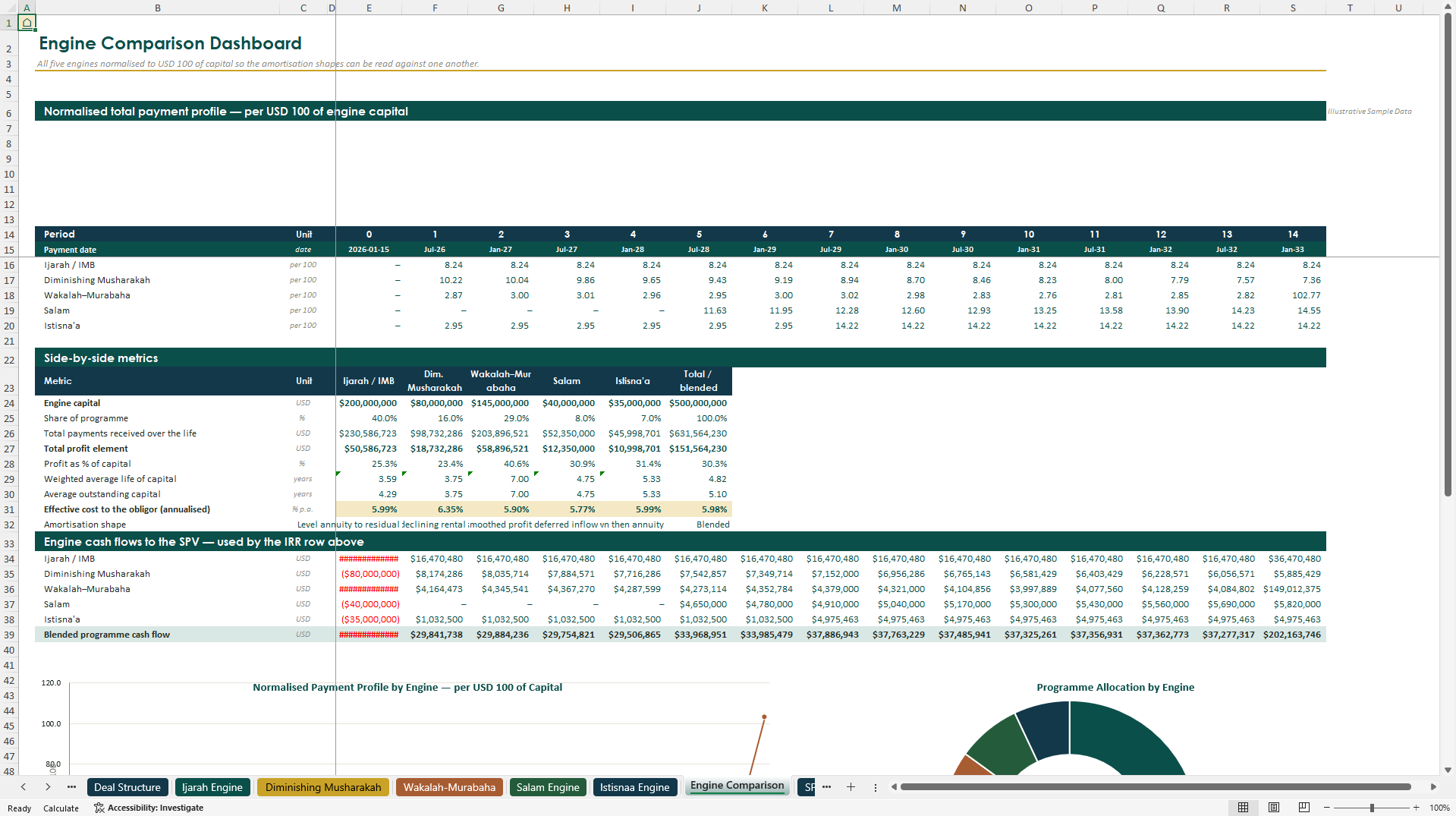
Every engine has a period-by-period schedule and plain-English explanatory notes. The Engine Comparison dashboard normalises all five structures to a per-USD-100 basis so you can easily compare amortisation, payments, profit component, weighted-average life and effective cost across structures.
🏗️ Structure, cash waterfall and monitoring built in
The model is not limited to individual asset schedules. It combines the engines into a programme-level SPV analysis:
Allocate the full Sukuk programme among the five engines and confirm that allocations reconcile to 100%.
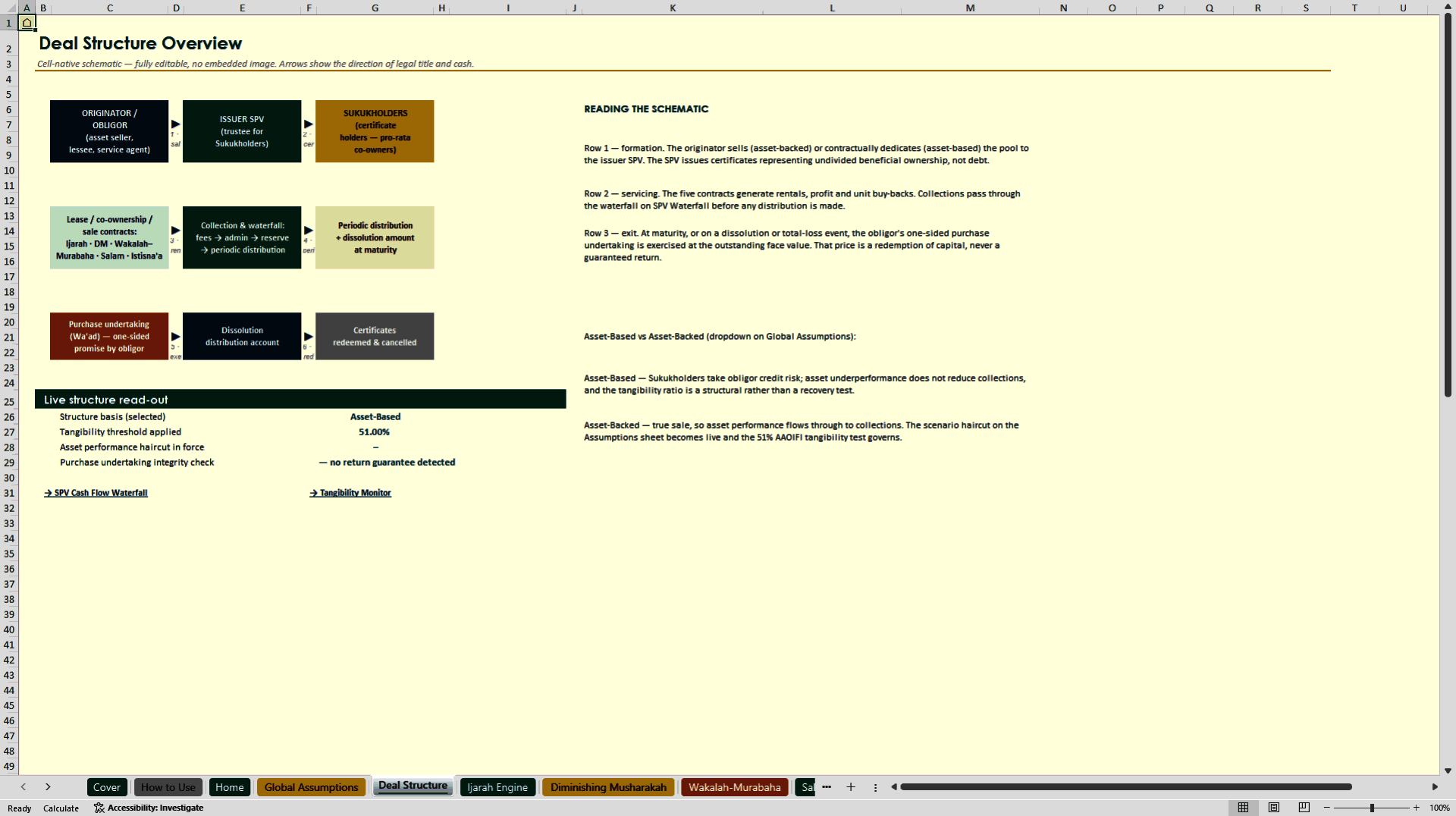
Choose an asset-based or asset-backed basis and see the selected treatment flow through the waterfall.
Model collections, performance haircut where relevant, servicing / collection fee, administration cost, reserve-account funding or release, profit distribution and capital redemption.
Review cash available for distribution, contractual payment obligations, coverage surplus / deficit and DSCR for every period.
Track outstanding certificate face value from issue to redemption.
Assess a purchase undertaking and its exercise profile at maturity, dissolution or selected triggering events, with a formula check that it does not diverge from outstanding face value.
The dedicated Tangibility Monitor calculates tangible assets, intangible assets and total pool value period by period. It lets you select either the 51% AAOIFI / GCC threshold or the 33% Malaysia SC threshold, then reports the ratio at issue, the minimum ratio over the programme life, headroom, breach count and first period of breach. This makes a complex structural consideration visible before you rely on pricing outputs.
📈 Professional pricing, treasury and investor analytics
The suite makes the model useful for finance and treasury decision-making—not merely for creating payment tables:
Select SOFR-equivalent, PKRV or KLIBOR as the benchmark curve input.
Apply credit spread, scenario shift, reset frequency and agreed cap / floor settings through the Profit Reset schedule.
Calculate investor periodic IRR, annualised blended effective profit rate, weighted-average life, Macaulay duration, modified duration, convexity and PV01.
Review a full price / yield grid derived from the investor contractual cash flows.
Compare Sukuk cash cost and cash-flow profile with a conventional bullet and a conventional amortising facility using the same principal, tenor and frequency.
Identify the spread and cash-cost difference between the Sukuk programme and its conventional equivalent.
🔍 Scenario analysis, risk view and audit trail
Use the model to examine the deal under Base, Stress and Upside conditions. The sensitivity sheet shows the scenarios side by side and includes a tornado chart that ranks the impact of benchmark movement, credit spread, Musharakah rental premium, Salam margin / shortfall and cap settings on total profit cost.
The workbook also contains:
An Executive Dashboard for programme size, effective profit rate, weighted-average life, conventional spread, tangibility, compliance-status output, profit cost and risk score.
An Investor Dashboard for distributions, yield, duration, total-return multiple, outstanding face and engine mix.
A Risk Dashboard that translates nine formula-driven sub-metrics into Shari'a-compliance, market / benchmark and credit / counterparty risk categories.
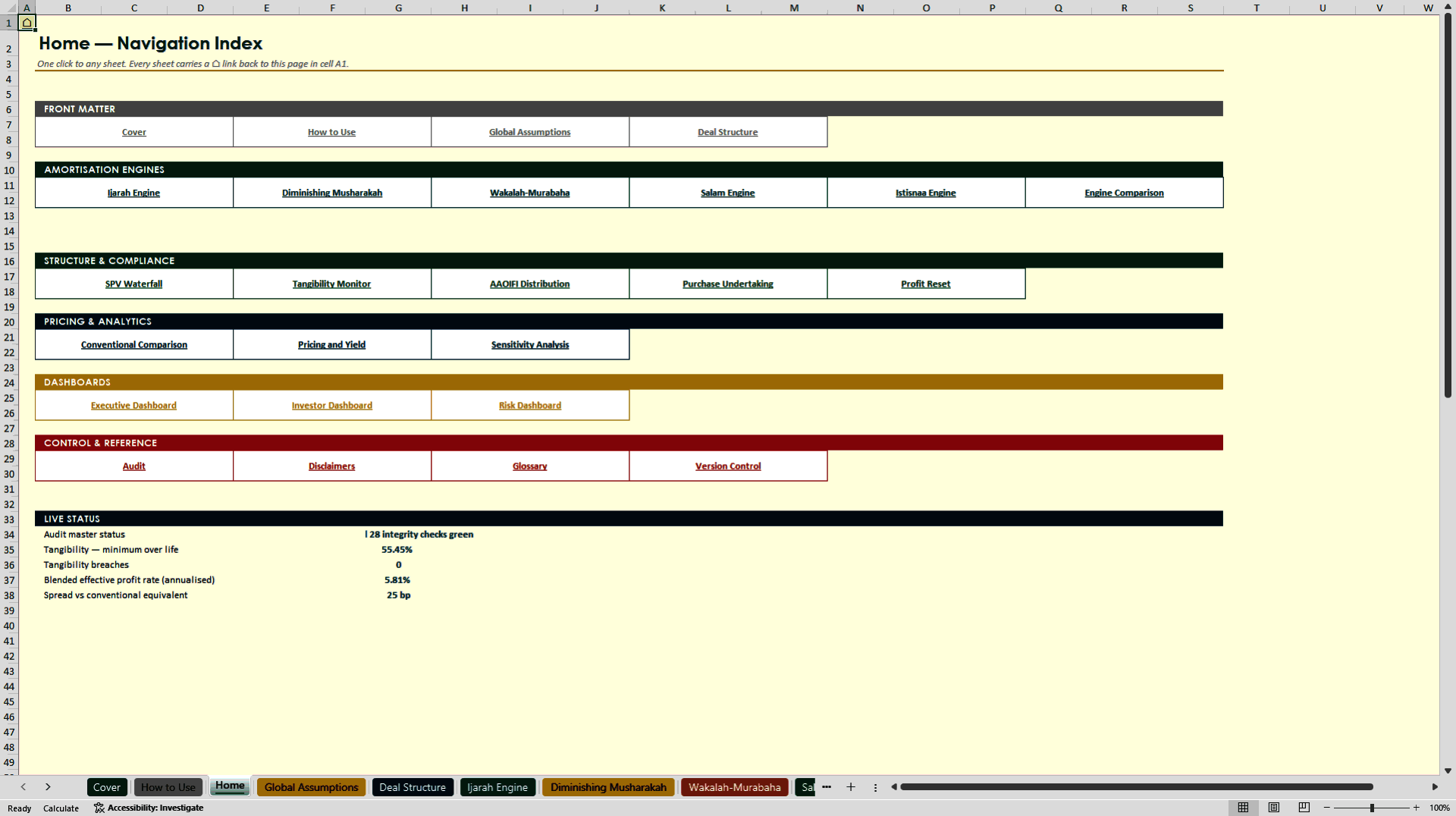
A live Audit sheet with 28 formula-based checks covering errors, circularity, asset-pool reconciliation, allocations, schedule integrity, engine roll-forwards, reserve release, redemption, purchase-undertaking integrity and cross-sheet links.
A home navigation index, a concise how-to-use guide, disclosed modelling conventions, a glossary of Islamic-finance terminology, disclaimers and version control.
✅ How to work with the model
Open How to Use for the colour legend and workflow, then enter or replace the sample data only in the highlighted editable fields on Global Assumptions.
Set the four key switches: benchmark curve, tangibility threshold, asset-based / asset-backed treatment and active scenario.
Review the five engine schedules and Engine Comparison to choose or assess the right structure mix and cash-flow profile.
Review Tangibility Monitor, Purchase Undertaking, SPV Waterfall and Audit before interpreting pricing and dashboard output.
Use the pricing, conventional comparison, sensitivity, risk and dashboard tabs to support treasury, advisory, investment-committee, structuring or educational discussion.
Got a question about the product? Email us at support@flevy.com or ask the author directly by using the "Ask the Author a Question" form. If you cannot view the preview above this document description, go here to view the large preview instead.
Source: Best Practices in Wealth Management, Integrated Financial Model Excel: Sukuk & Islamic Structured Finance Suite Excel (XLSX) Spreadsheet, PDMM Financial Models
ABOUT THE AUTHOR

PDMM Financial Models develops professional, decision-ready Excel models for business owners, entrepreneurs, investors, consultants, analysts, and finance teams. Our objective is to transform complex business assumptions into clear, structured analysis that supports better planning and investment decisions.
Our models cover business planning, forecasting, budgeting, feasibility analysis,
... [read more]
Ask the Author a Question
You must be logged in to contact the author.




























