
 Click main image to view in full screen. Unlock all 9 preview images:
Solar PV & Battery (BESS) Project Finance Model with DSCR – Excel XLSX
Excel (XLSX) + supplemental PDF


BENEFITS OF THIS DOWNLOADABLE EXCEL DOCUMENT
- Solves the two circular references a project finance model normally carries, construction interest and DSCR-sculpted debt sizing, in visible columns with iterative calculation switched off.
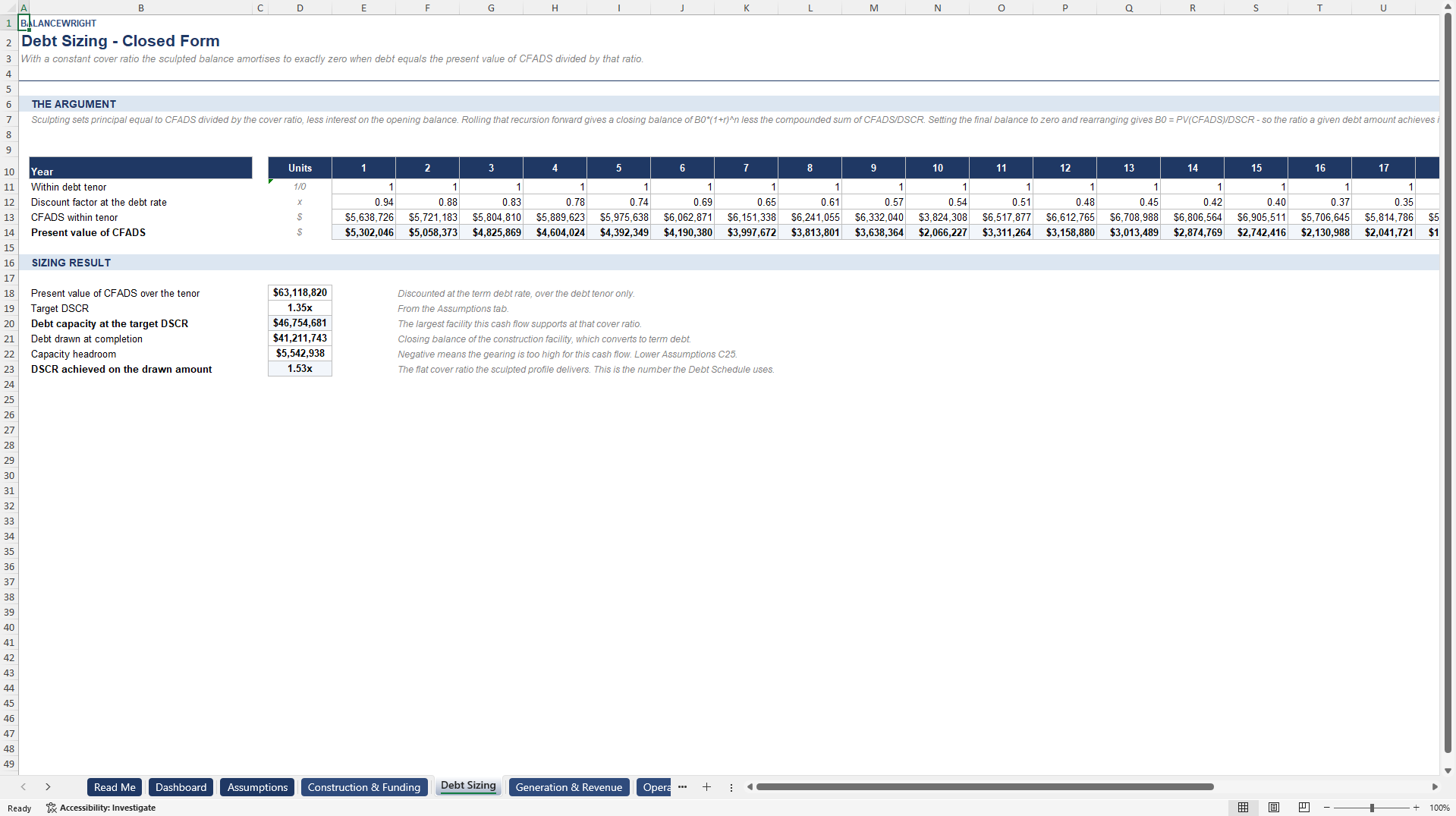
- Sizes the facility from your target cover ratio in closed form, then reports the ratio the drawn amount actually achieves, flat across the entire tenor.
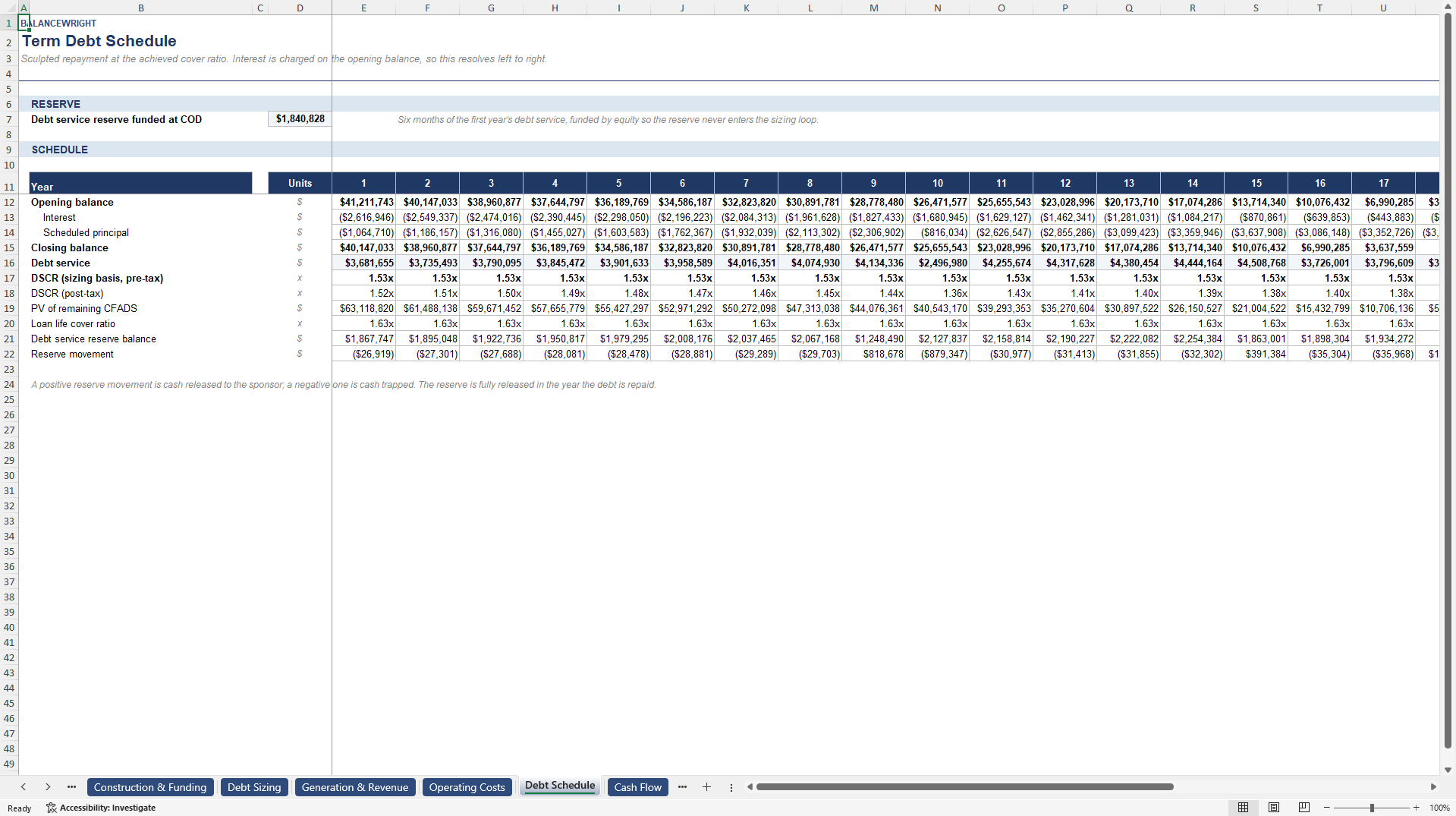
- Ships with twelve integrity checks, two of which prove the sculpted balance amortises to exactly zero and the cover ratio never drifts.
FINANCIAL MODELING EXCEL DESCRIPTION
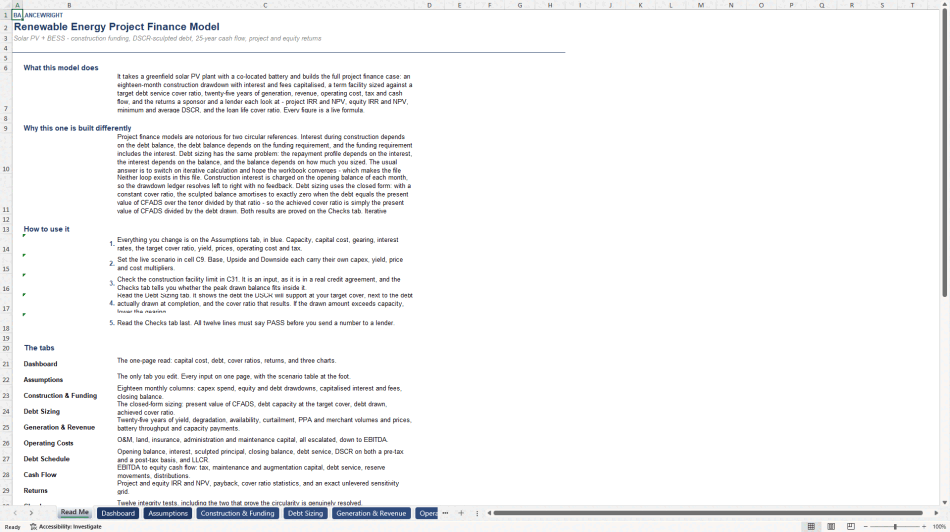
A complete project finance model for a greenfield solar plant with a co-located battery, built so that the two circular references this kind of model normally carries simply do not exist.
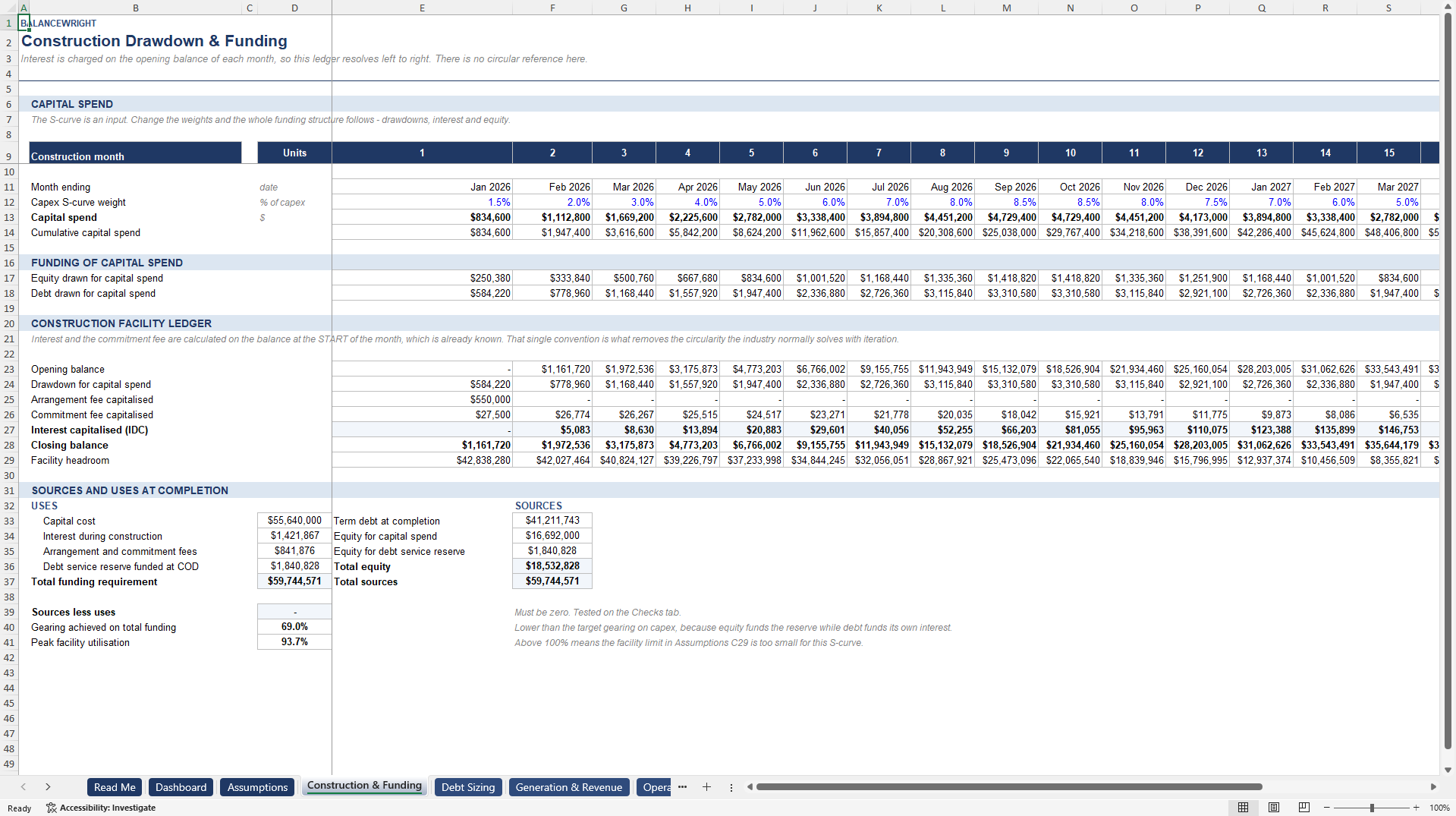
Eighteen monthly construction columns take the capital spend through an S-curve you control, fund it at your target gearing, and capitalise the arrangement fee, the commitment fee and the interest during construction month by month. Because interest is charged on the balance at the start of each month, the ledger resolves strictly left to right. No cell depends on itself, and iterative calculation stays switched off.
The term facility is sized the same way. Sculpting sets principal equal to cash flow available for debt service divided by the cover ratio, less interest on the opening balance. Rolling that recursion forward and setting the final balance to zero gives the closed form: debt equals the present value of CFADS over the tenor divided by the cover ratio. Turn it around and the ratio a given facility achieves is that present value divided by the debt drawn. One division. No goal seek, no solver, no macro, and nothing for a reviewer to distrust.
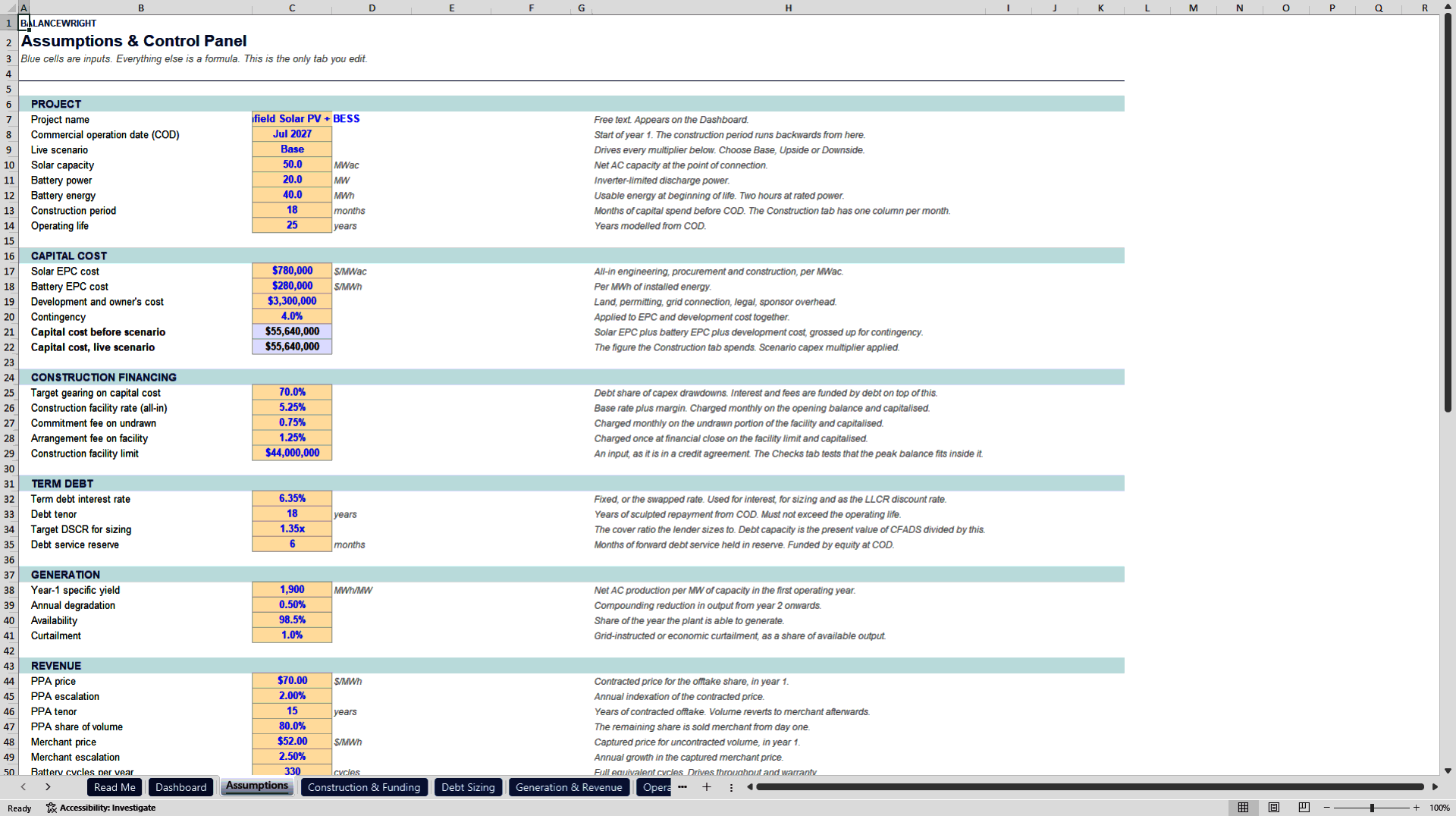
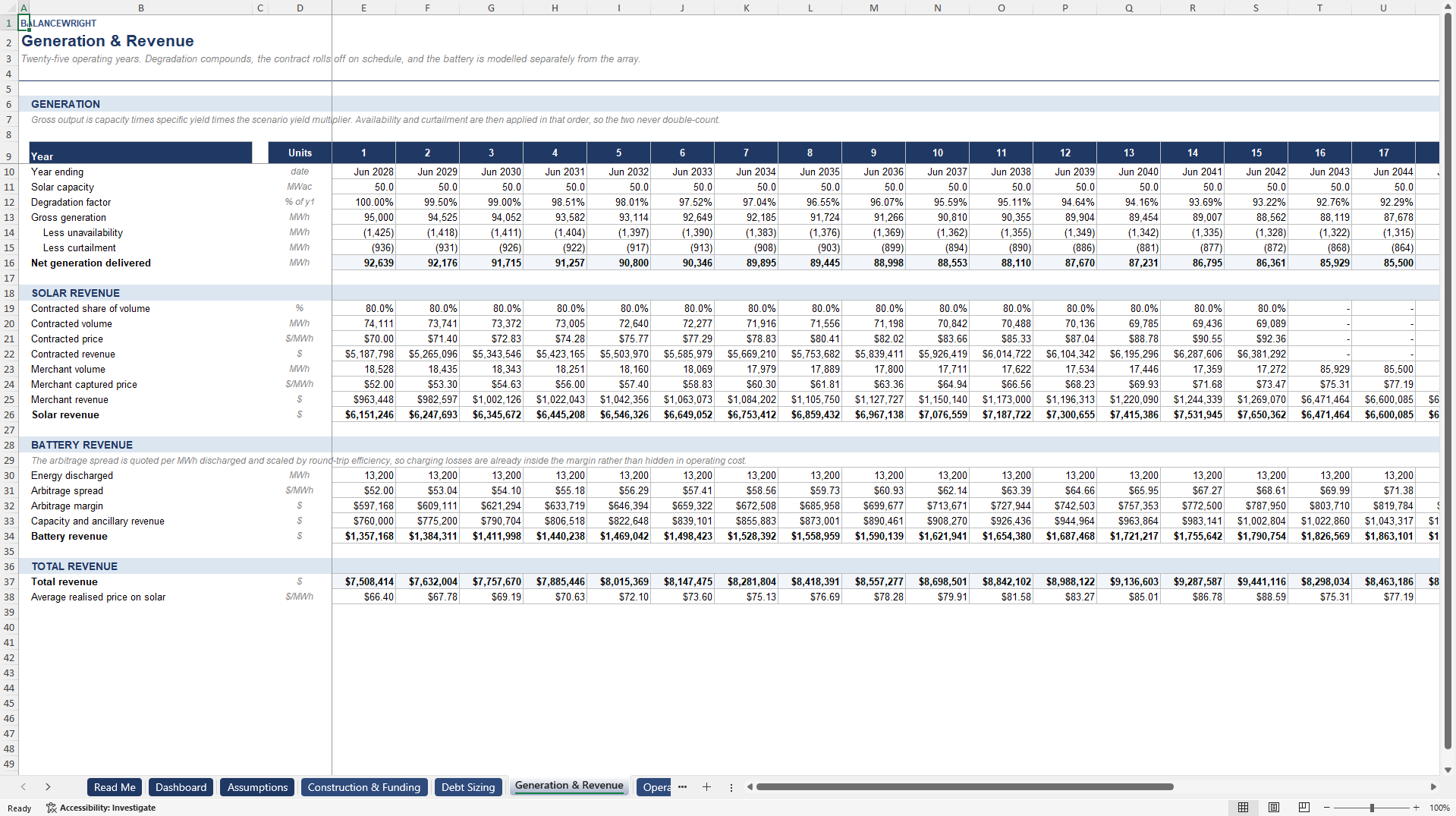
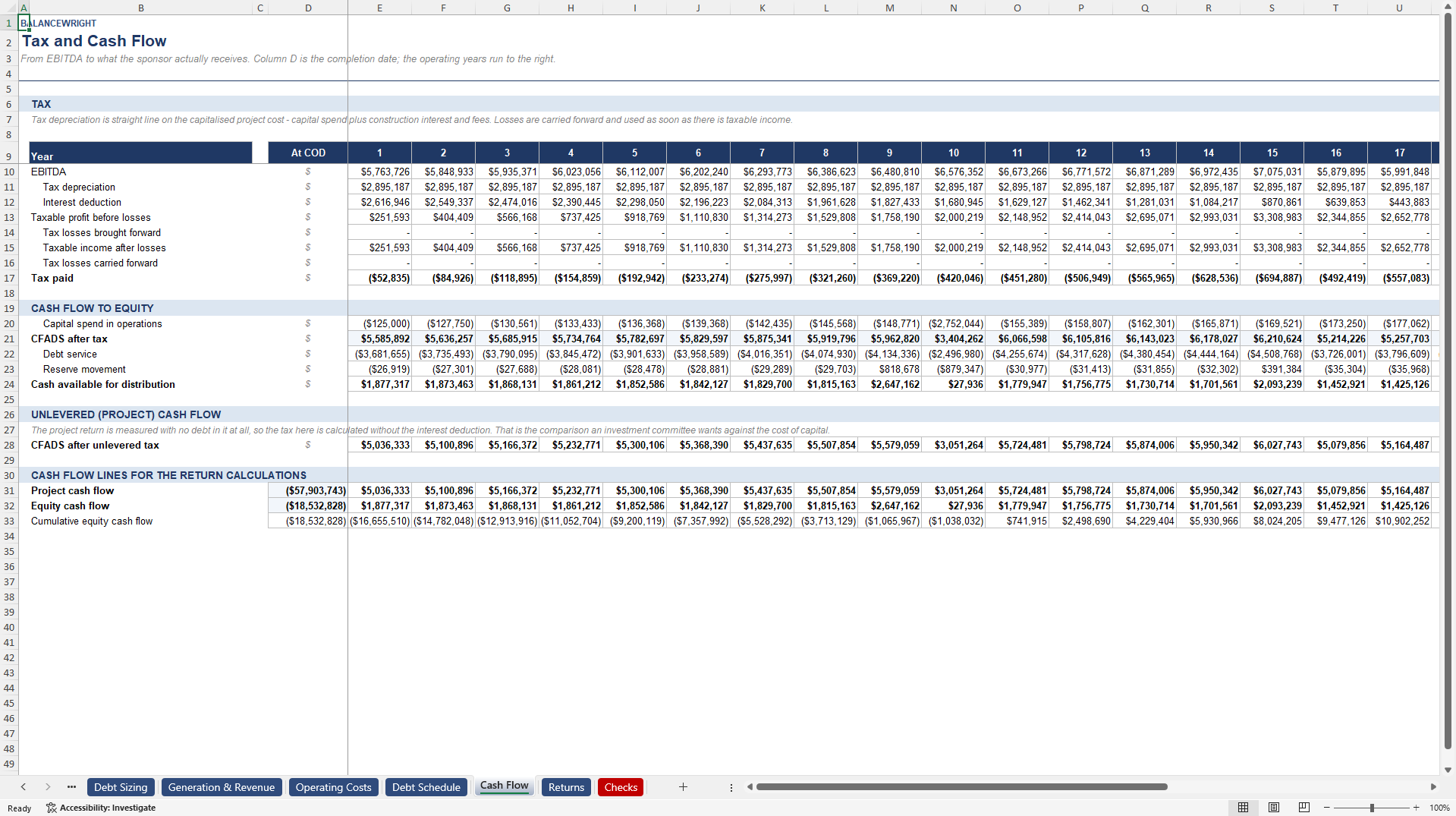
Twenty-five operating years carry degradation, availability and curtailment, a contracted offtake that rolls off on schedule into merchant pricing, and the battery modelled separately: cycles, round-trip efficiency, arbitrage spread and capacity revenue. Operating cost, maintenance capital and a battery augmentation year escalate to EBITDA and then to CFADS. Tax runs on straight-line depreciation with loss carry-forward and the interest deduction, so the post-tax cover ratio sits next to the sizing ratio rather than replacing it.
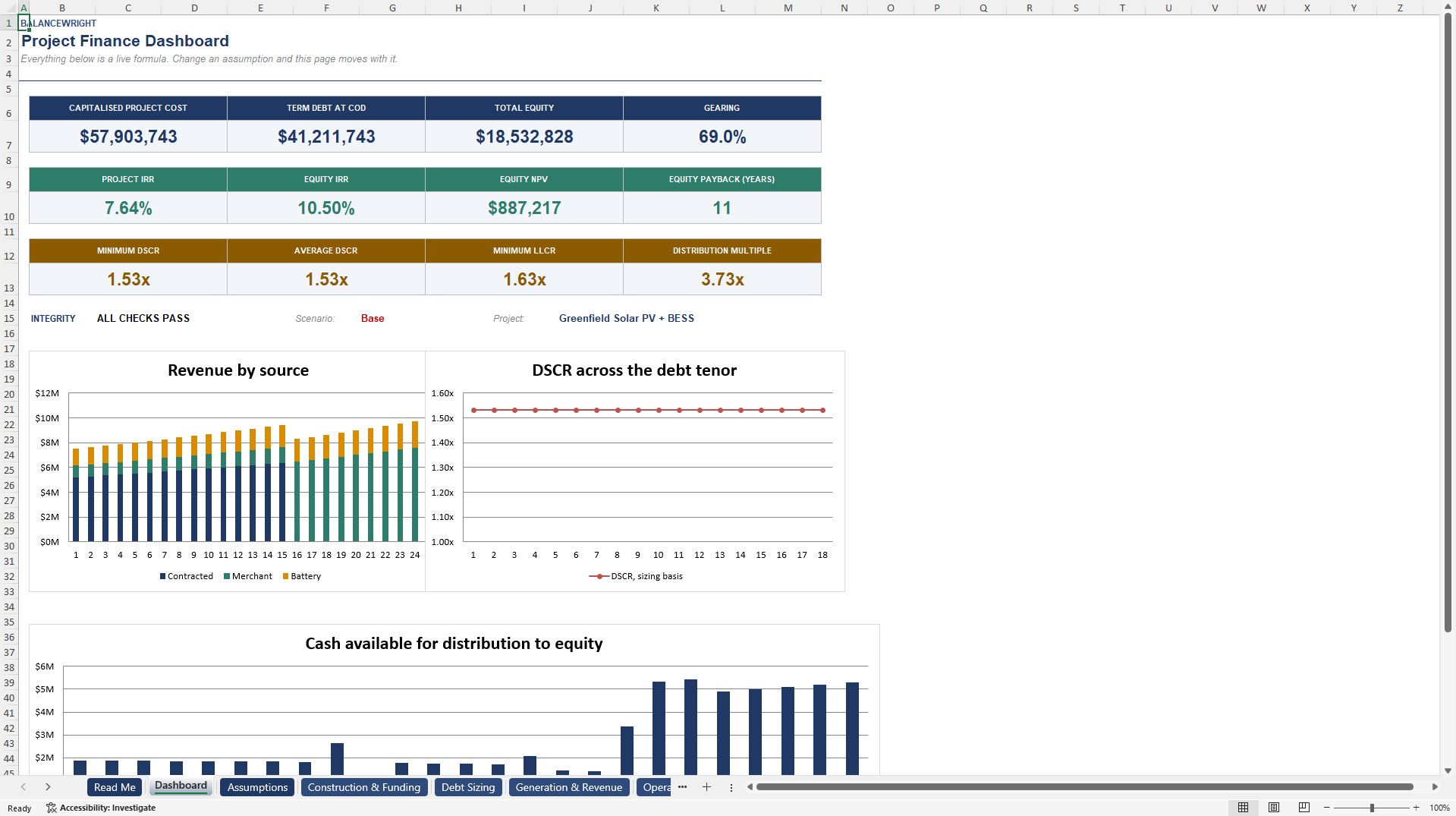
What comes out is what a sponsor and a lender each ask for. Project internal rate of return and net present value on the unlevered cash flow. Equity internal rate of return and net present value, payback and the distribution multiple. Minimum and average debt service cover ratio, and the loan life cover ratio year by year. Two one-way sensitivity tables on the Returns tab are exact rather than interpolated: every case is a full twenty-five year recalculation with tax recomputed and the rate of return re-solved, and the workings sit on the same tab so you can audit them.
Twelve integrity checks have to read PASS before any of it is worth quoting. Sources equal uses. The construction ledger rolls forward without a gap. The peak drawdown fits inside the facility limit. The debt drawn does not exceed the cover ratio capacity. The sculpted balance lands on exactly zero at the end of the tenor. The cover ratio is identical in every year of it. Total principal repaid equals the debt drawn. Two of those exist only because of how this file is built, and a workbook that reached the same place by iteration could not show you either line.
Eleven tabs. Live formulas throughout. No macros, no add-ins, no external links, no locked cells and no passwords. A fifty megawatt plant with a twenty megawatt, forty megawatt-hour battery is pre-loaded as a worked example, so every tab works the moment you open it. A supporting PDF guide is included alongside the workbook; it covers the method, the conventions and the honest limitations, and it is there so a reviewer can follow the argument without opening Excel.
Most templates ask you to trust them. This one shows its working.
This workbook models the arithmetic of your own project. It is not investment advice, and the worked example is invented.
Building this from scratch takes a competent financial modeller two to four days.
Got a question about the product? Email us at support@flevy.com or ask the author directly by using the "Ask the Author a Question" form. If you cannot view the preview above this document description, go here to view the large preview instead.
Source: Best Practices in Financial Modeling, Solar Energy Excel: Solar PV & Battery (BESS) Project Finance Model with DSCR Excel (XLSX) Spreadsheet, Paweł Dudek, Balancewright
ABOUT THE AUTHOR

Balancewright is Paweł Dudek. The catalogue covers project finance, fund and waterfall structures, corporate three-statement forecasting, working capital, valuation and FP&A -- built as working models rather than formatted templates.
Every model is formula-driven end to end. No locked cells, no passwords, no macros and no external links, so any calculation can be inspected, adapted and
... [read more]
Ask the Author a Question
You must be logged in to contact the author.




























