Project Finance Suite: PPP, Mining, Data Center & Solar – Document Bundle


DESCRIPTION
Project finance is one method applied to four very different assets. The method is always the same: work out what the asset can pay, size the debt so that it is covered in the worst period rather than on average, and then prove that the schedule you have built actually behaves the way you said it does. What changes between industries is the risk that sits in front of the cash flow, and that is exactly the part a generic template leaves out.
These four models share the method and each carries its own risk properly.
PPP AVAILABILITY PAYMENT MODEL
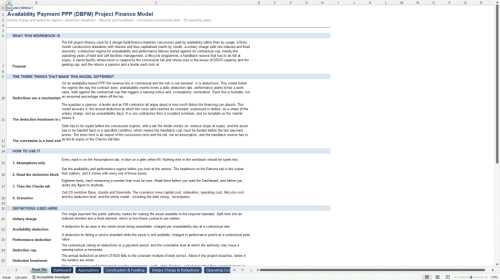
A concession paid for being available rather than for being used. The revenue is contractual, so the risk is not demand, it is deductions: the performance regime that takes money off the payment when the asset is not available or not performing. The model carries a deduction mechanism with a headroom line showing how far the project is from the threshold that triggers a step-in, and the debt is sized against the payment net of a deduction assumption rather than against the headline.
MINING PROJECT FINANCE MODEL
Reserve tail, all-in sustaining cost and a debt schedule that has to be repaid before the deposit runs out. The tail is the constraint nobody models: a lender will not accept a repayment profile that runs to the last tonne, so the model sizes the debt against the reserve remaining at maturity and reports the cover explicitly.
DATA CENTER PROJECT FINANCE MODEL
Contracted power, PUE and the difference between capacity sold and capacity drawn. Revenue follows the contracted kilowatt rather than the utilised one, cost follows the utilised one, and PUE is what sits between them. A model that treats them as the same number is a model that has assumed the margin.
SOLAR PV AND BATTERY STORAGE MODEL
Two revenue streams with different risk, separated rather than netted: energy from the array and arbitrage or capacity from the battery, with cycling and degradation on the battery handled on its own line. The DSCR is reported for each so a lender can see which half of the project is actually servicing the debt.
WHAT THE FOUR HAVE IN COMMON
Every one of them sizes debt to a target cover ratio rather than to a loan-to-value percentage, because a percentage of a capital cost tells a lender nothing about whether the asset can pay. Every one of them charges interest on the opening balance, so there are no circular references and iterative calculation stays off in all four files. Every one of them computes the cover ratio in every period and reports the minimum with the period it occurs in, because the average cover ratio of a project that breaches in year seven is a number that hides the only fact that matters.
And every one of them ships with a panel of built-in tests that measure numbers which must be nil: the debt schedule tying to itself, the cash flow closing to the balance, every cost line an outflow, the cover ratio recomputed from its components. Each panel was independently re-derived against a second, from-scratch implementation before the file was published.
WHO THIS IS FOR
Anyone who works across more than one infrastructure asset class and is tired of relearning somebody else's layout each time. A lender or an adviser reading four of these reads them the same way, because the debt block, the cover ratio block and the check panel are in the same place with the same labels in all four.
FORMAT
Four Microsoft Excel workbooks (.xlsx). They open in Excel 2016 and later, Microsoft 365, LibreOffice Calc, Apple Numbers and Google Sheets. No macros, no add-ins, no external links, no password protection, no locked cells, iterative calculation off. Blue on pale yellow is an input; nothing else in any of the files should be typed into. A guide and preview PDF comes with each model.
There is no duplicate content between the four. They share conventions and a check philosophy, not sheets.
Got a question about the product? Email us at support@flevy.com or ask the author directly by using the "Ask the Author a Question" form.
Source: Project Finance Suite: PPP, Mining, Data Center & Solar () Document, Paweł Dudek, Balancewright
THERE ARE 4 PRODUCTS IN THIS BUNDLE:
|
|
Every toll road and PPP model on the market answers the demand question: how much traffic, at what toll, growing at what rate. On an availability-based concession that question... [read more]
Individual Price: $79.00
|
|
|
Almost every mining model on the market is a discounted cash flow or a three-statement projection with a production schedule typed into a row. Both answer the investor's... [read more]
Individual Price: $79.00
|
|
|
Almost every data centre model in circulation is a real estate model with the words "data centre" on the cover. It takes square feet, applies a rent, escalates it,... [read more]
Individual Price: $79.00
|
|
|
A complete project finance model for a greenfield solar plant with a co-located battery, built so that the two circular references this kind of model normally carries simply do... [read more]
Individual Price: $69.00
|
ABOUT THE AUTHOR

Balancewright is Paweł Dudek. The catalogue covers project finance, fund and waterfall structures, corporate three-statement forecasting, working capital, valuation and FP&A -- built as working models rather than formatted templates.
Every model is formula-driven end to end. No locked cells, no passwords, no macros and no external links, so any calculation can be inspected, adapted and
... [read more]
Ask the Author a Question
You must be logged in to contact the author.




























