 Click main image to view in full screen.
Small Business Acquisition & Lender Underwriting Model – Excel XLSX
Excel (XLSX)


BENEFITS OF THIS DOWNLOADABLE EXCEL DOCUMENT
- Puts the asking price, the price the cash flow carries and the price your equity carries side by side, so the negotiation starts from a number instead of a feeling.
- Tests coverage in every year, not just year one, and names the binding year - usually the year the seller note stops being interest only and the deal quietly breaks.
- Turns a coverage shortfall into days of working capital, so a failed DSCR becomes something you can actually go and fix on Monday.
M&A (MERGERS & ACQUISITIONS) EXCEL DESCRIPTION
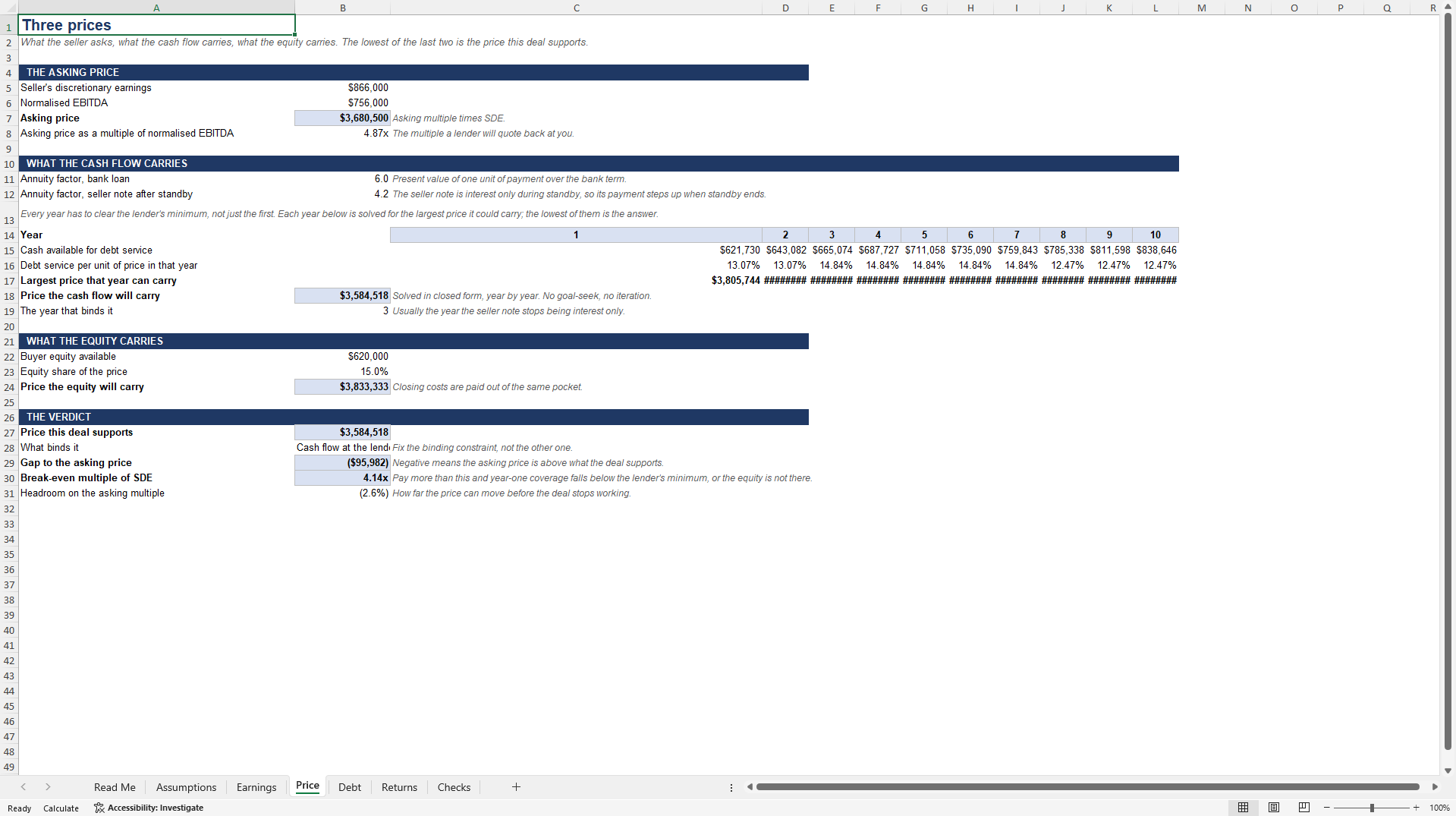
A business that asks $3.68m can be worth exactly that and still be unfundable. This model puts three prices on one screen: the asking price, the price the cash flow will carry at the lender's minimum coverage, and the price the buyer's equity will carry. The lowest of the last two is the price the deal supports, and the gap to the asking price is the negotiation.
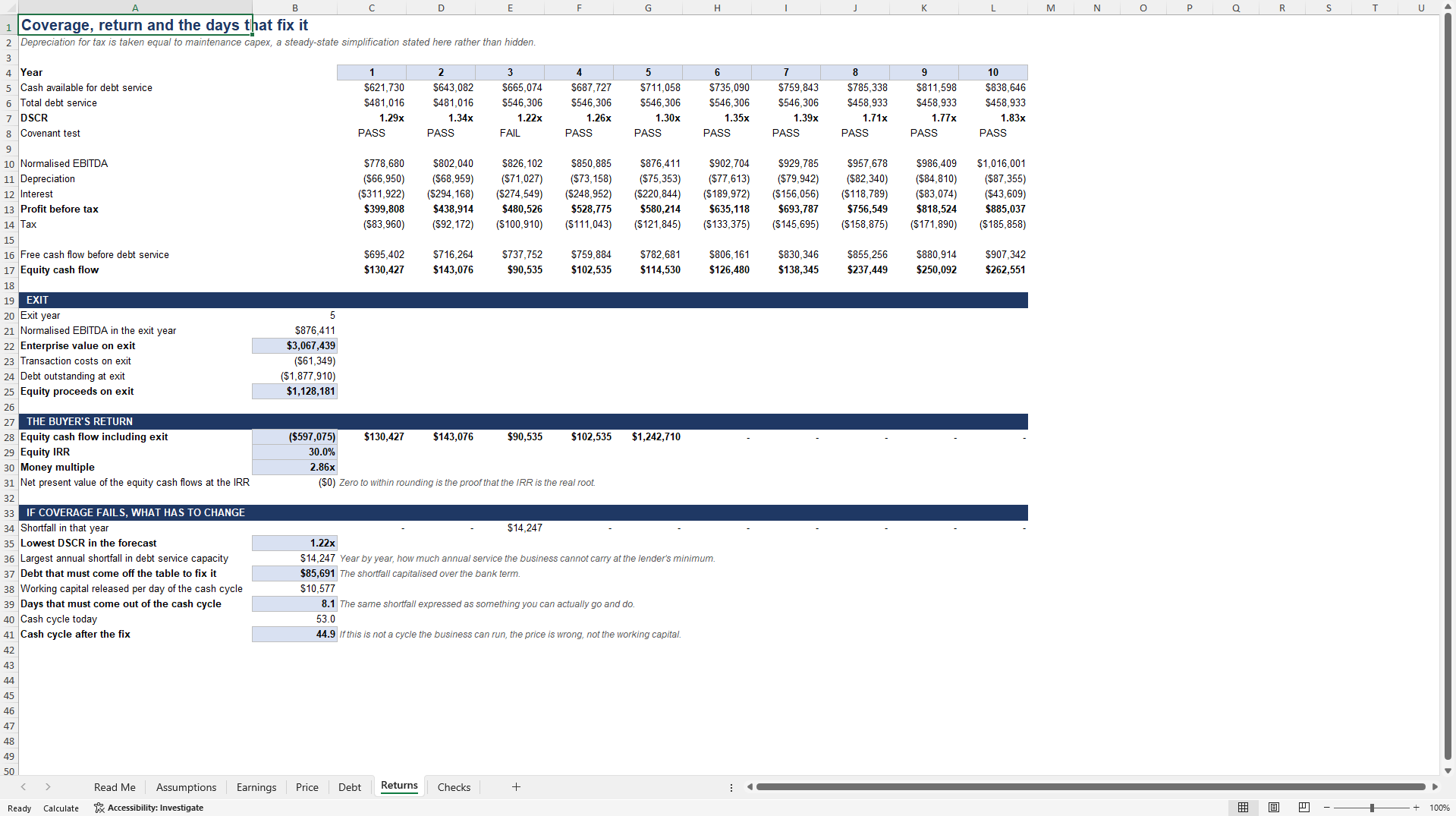
In the example shipped in the file, a $4.2m revenue business with $866,000 of seller's discretionary earnings is asking 4.25x SDE, or $3,680,500. The cash flow carries $3,584,518. The deal is 2.6% too expensive, the lowest coverage in the forecast is 1.217x against a required 1.25x, and the fix is either $96,000 off the price or 8.1 days out of the cash conversion cycle.
WHAT YOU GET
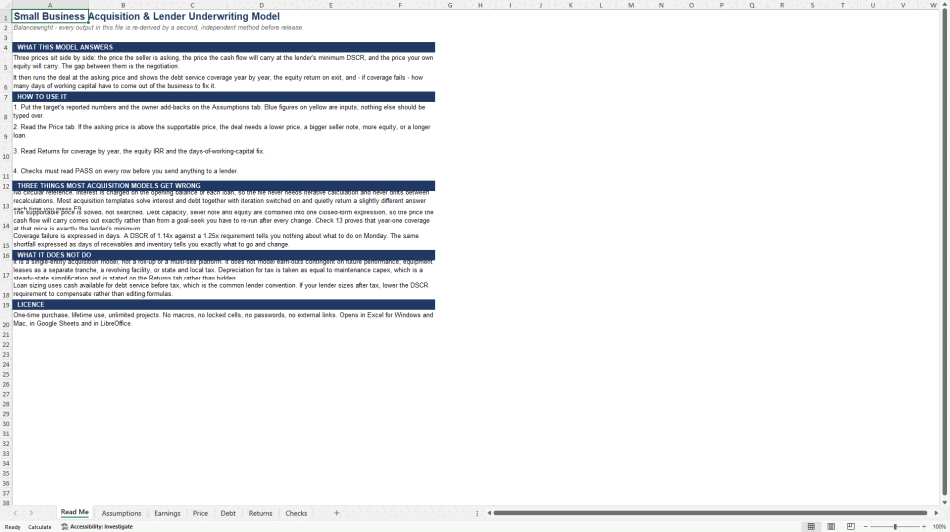
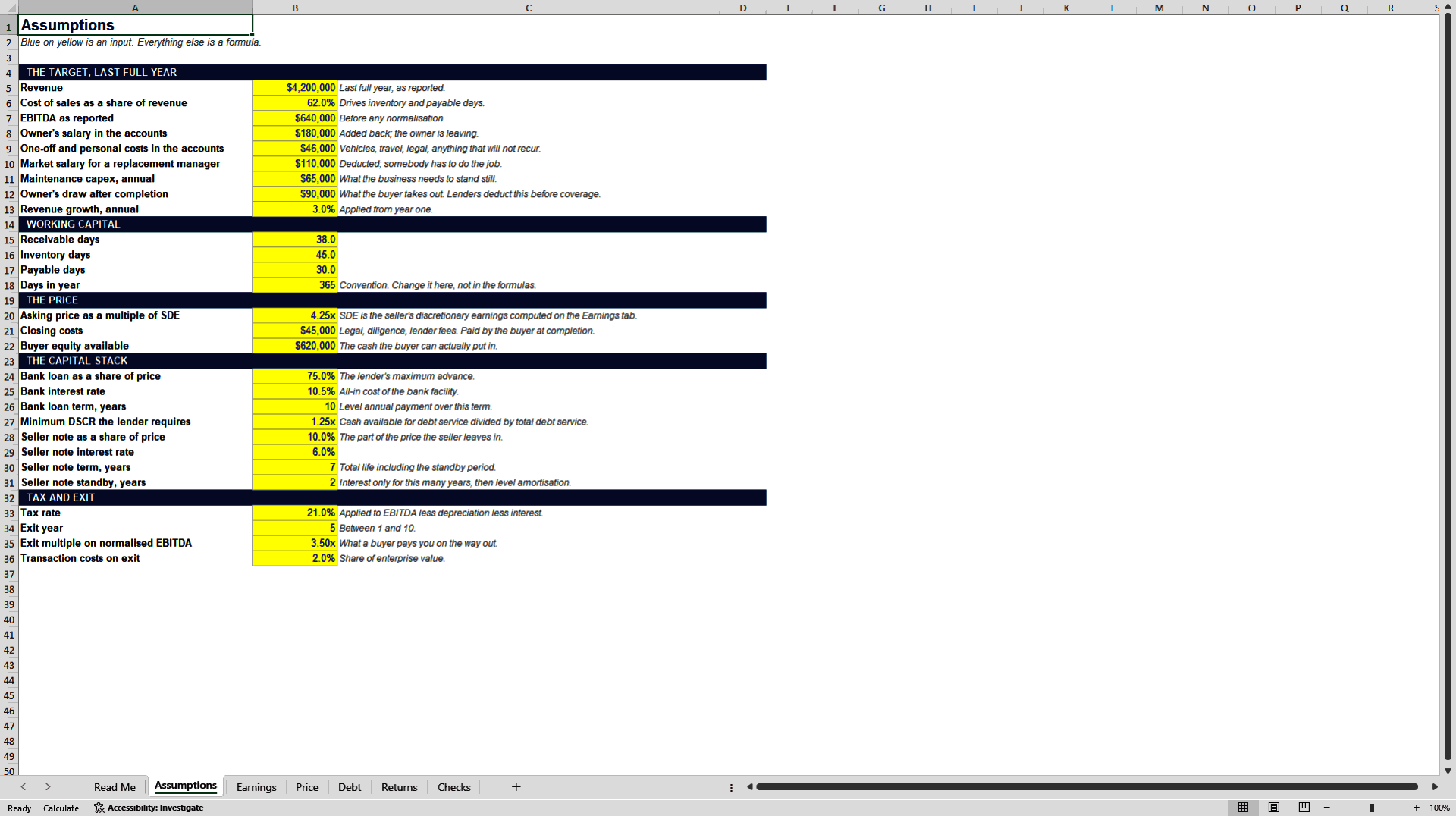
Seven worksheets: Read Me, Assumptions, Earnings, Price, Debt, Returns and Checks. 502 live formulas across a ten-year horizon. Every input sits on one Assumptions tab in blue; nothing is hard-coded inside a calculation. 25 integrity checks run in the workbook and all 25 pass on delivery. Beyond those, every output was re-derived by a separate independent script using a different method: 182 of 182 figures matched.
THREE THINGS THIS MODEL DOES THAT OTHER ACQUISITION TEMPLATES DO NOT
1. The supportable price is solved year by year, not just for year one. Debt service per dollar of price changes over time, because a seller note on standby pays interest only at first and then steps up to full amortisation. A model that tests coverage in year one alone will wave through deals that break in year three. This one computes, for every year of the forecast, the largest price that year could carry at the required DSCR, and takes the lowest. In the worked example the binding year is year three, the year the seller note starts amortising, and the model names it.
2. No circular reference anywhere. Interest is charged on the opening balance of each loan and debt capacity is solved in closed form, so the file never needs iterative calculation and never drifts between recalculations. Most acquisition templates solve interest and debt together with iteration switched on and quietly return a slightly different answer each time you press F9. The supportable price here was independently checked by bisection, a completely different method from the algebra in the file, and the two agree to within two dollars.
3. A coverage shortfall is expressed in days. A DSCR of 1.217x against a 1.25x requirement tells you nothing you can act on. The same shortfall converted into days of receivables and inventory tells you exactly what has to change: in the example, 8.1 days out of a 53-day cash cycle, leaving 44.9. If that is not a cycle the business can run, the price is wrong rather than the working capital, and the model says so.
WHAT IS INSIDE
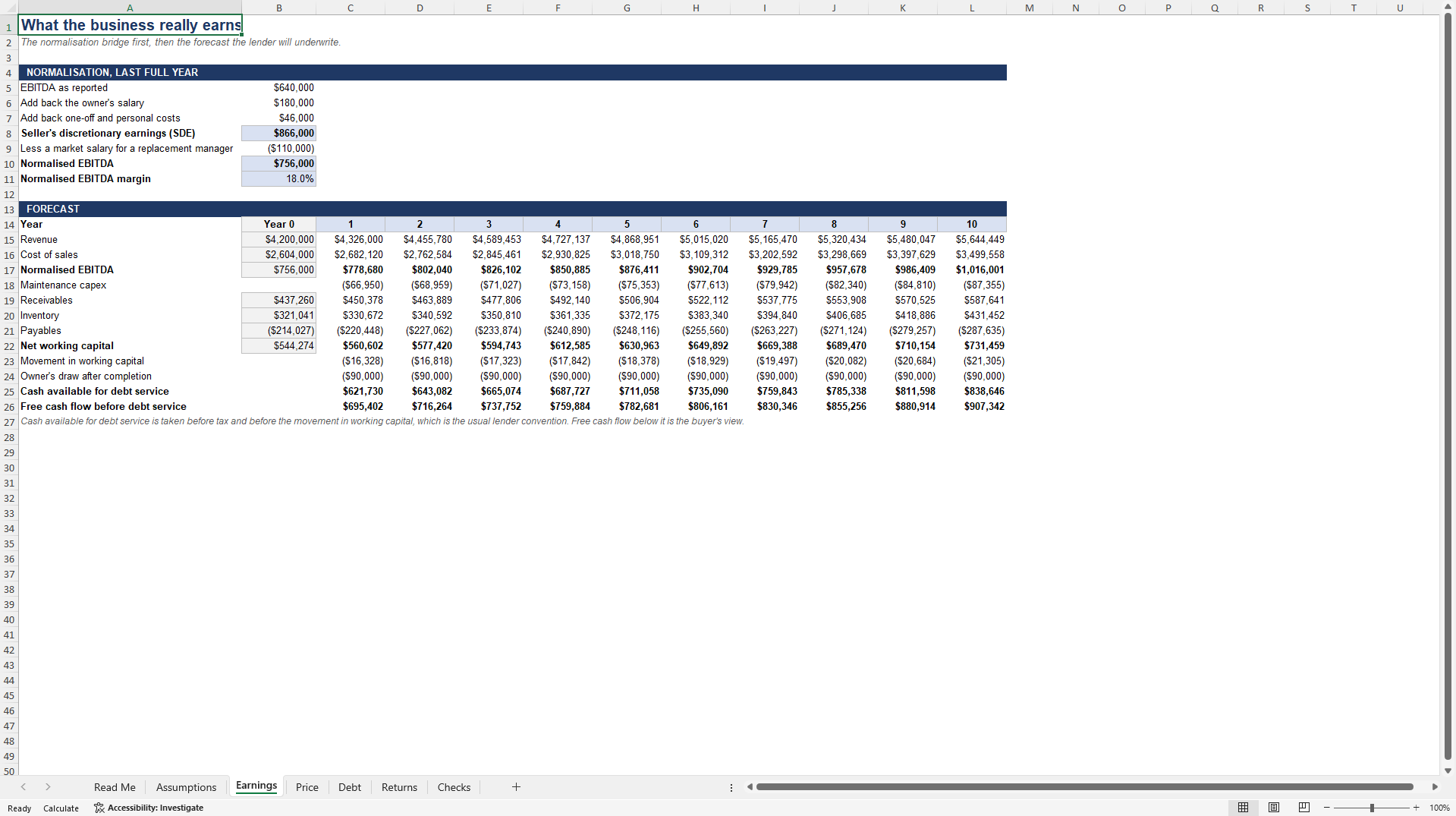
Earnings: the normalisation bridge from reported EBITDA through owner add-backs and one-off costs to seller's discretionary earnings, then down to normalised EBITDA after a market salary for a replacement manager. A ten-year forecast with revenue growth, maintenance capex, a full working capital build on receivable, inventory and payable days, cash available for debt service and free cash flow.
Price: the asking price and the multiple it implies on normalised EBITDA. The year-by-year capacity calculation, the price the cash flow carries, the binding year, the price the equity carries, the verdict on which constraint binds, the gap to the asking price, the break-even multiple of SDE and the headroom on the asking multiple.
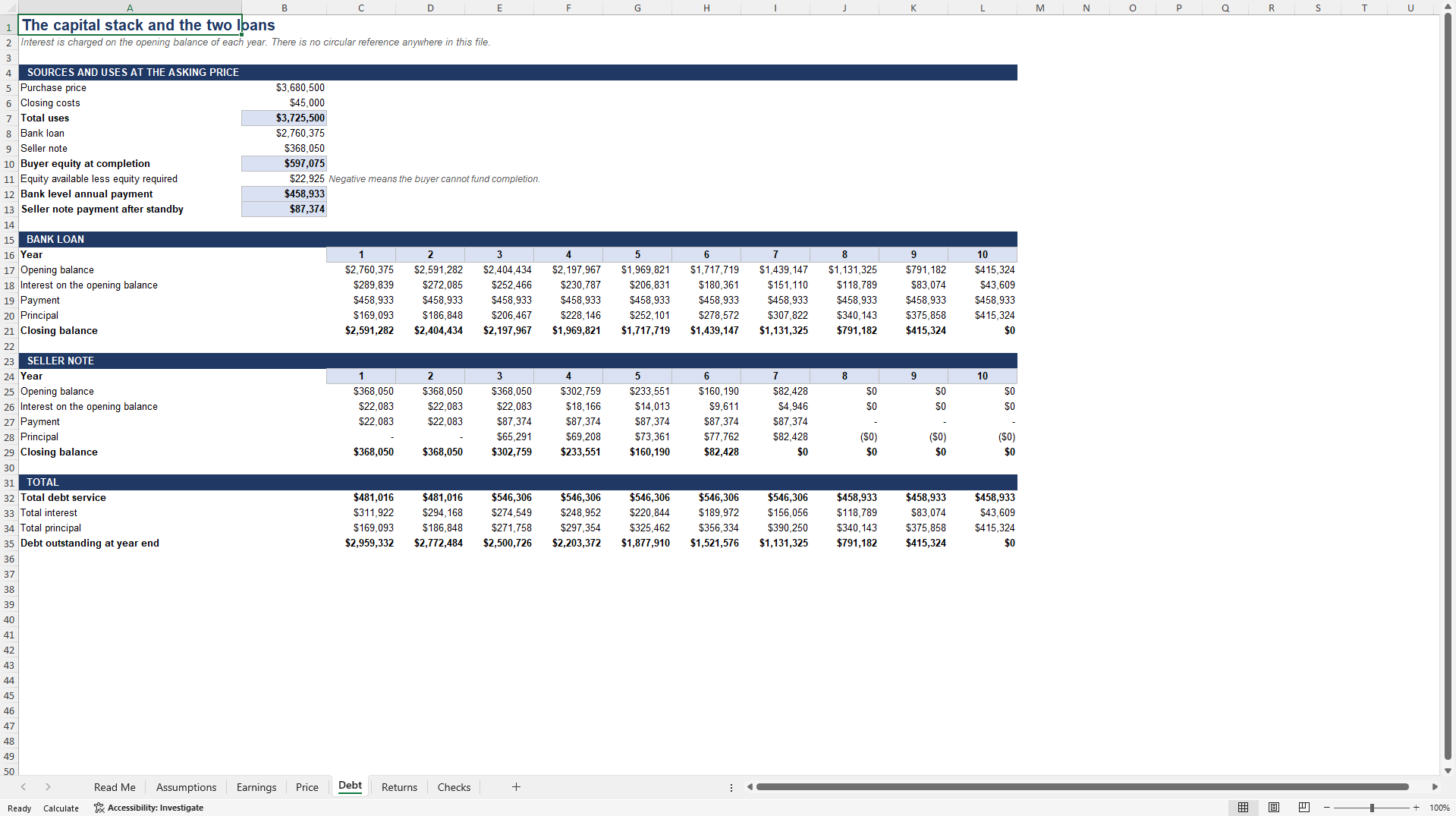
Debt: sources and uses at completion, bank loan and seller note sized from the price, full amortisation schedules with interest on opening balances, the seller note's standby period, and total debt service, interest, principal and debt outstanding by year.
Returns: DSCR and a pass or fail verdict for every year, the tax computation, the buyer's equity cash flow, the exit at a chosen year and multiple, equity IRR and money multiple, and the days-of-working-capital fix when coverage fails. In the example the buyer makes a 30.0% IRR and 2.86x on exit in year five.
WHO USES IT
Search fund and self-funded buyers underwriting a target before they commit diligence money. Brokers and M&A advisers showing a seller what a lender will actually fund. Lenders and credit analysts sanity-checking a borrower's own model. CFOs and corporate development teams buying a bolt-on. Anyone who has to explain to a credit committee why the price works, or why it does not.
WHAT IT DOES NOT DO
It is a single-entity acquisition model, not a roll-up or a multi-site platform. It does not model earn-outs contingent on future performance, equipment leases as a separate tranche, a revolving facility, or state and local tax. Depreciation for tax is taken as equal to maintenance capex, a steady-state simplification that is stated on the Returns tab rather than hidden. Loan sizing uses cash available for debt service before tax, which is the common lender convention; if your lender sizes after tax, lower the DSCR requirement rather than editing formulas. Saying this up front is more useful than a feature list that quietly overstates what is inside.
FREQUENTLY ASKED QUESTIONS
Does it contain macros? No. The file is formula-only, with no VBA, no add-ins and no external links. It opens and calculates in Excel for Windows and Mac, in Google Sheets and in LibreOffice.
Do I need iterative calculation switched on? No. The model has no circular references anywhere, by design. That is the most common defect in acquisition templates and the reason interest here is charged on opening balances.
Can I change the capital stack? Yes. The bank advance rate, interest rate and term, the seller note percentage, rate, term and standby period, and the buyer's equity are all inputs. Set the seller note to zero for an all-bank deal; the sizing, the schedules and the checks all follow.
Is the horizon fixed at ten years? The delivered forecast is ten years, which covers a standard ten-year amortisation. The structure extends by copying columns; the checks and the sizing logic follow.
How do I know the numbers are right? Two ways, both visible to you. A Checks tab with 25 named tests that must all read PASS, covering the normalisation bridge, sources equal uses, interest charged on opening balances, every balance rolling forward, both loans fully repaid by the end of their terms, the standby period paying interest only, the supportable price reproducing the required coverage exactly, working capital tying to its own components, DSCR tying to its inputs, the exit bridge and the discounted equity cash flows returning to zero at the stated IRR. And the independent re-derivation described above, 182 of 182 figures matched by a second method.
Is it unlocked? Yes. No password, no hidden sheets, no protected cells. Every formula is readable and editable so you can audit it and adapt it to your own deal.
Can I use it outside the United States? Yes. There is nothing jurisdiction-specific in the mechanics. The capital stack is a bank loan, a seller note and equity, which is how small business acquisitions are financed almost everywhere; only the names change.
Delivered as a single .xlsx file. One-time purchase, lifetime use, unlimited projects.
Got a question about the product? Email us at support@flevy.com or ask the author directly by using the "Ask the Author a Question" form. If you cannot view the preview above this document description, go here to view the large preview instead.
Source: Best Practices in M&A (Mergers & Acquisitions), Integrated Financial Model Excel: Small Business Acquisition & Lender Underwriting Model Excel (XLSX) Spreadsheet, Paweł Dudek, Balancewright
ABOUT THE AUTHOR

Balancewright is Paweł Dudek. The catalogue covers project finance, fund and waterfall structures, corporate three-statement forecasting, working capital, valuation and FP&A -- built as working models rather than formatted templates.
Every model is formula-driven end to end. No locked cells, no passwords, no macros and no external links, so any calculation can be inspected, adapted and
... [read more]
Ask the Author a Question
You must be logged in to contact the author.