 Click main image to view in full screen.
RV Park & Campground Acquisition Underwriting Model – Excel XLSX
Excel (XLSX) + supplemental PDF


BENEFITS OF THIS DOWNLOADABLE EXCEL DOCUMENT
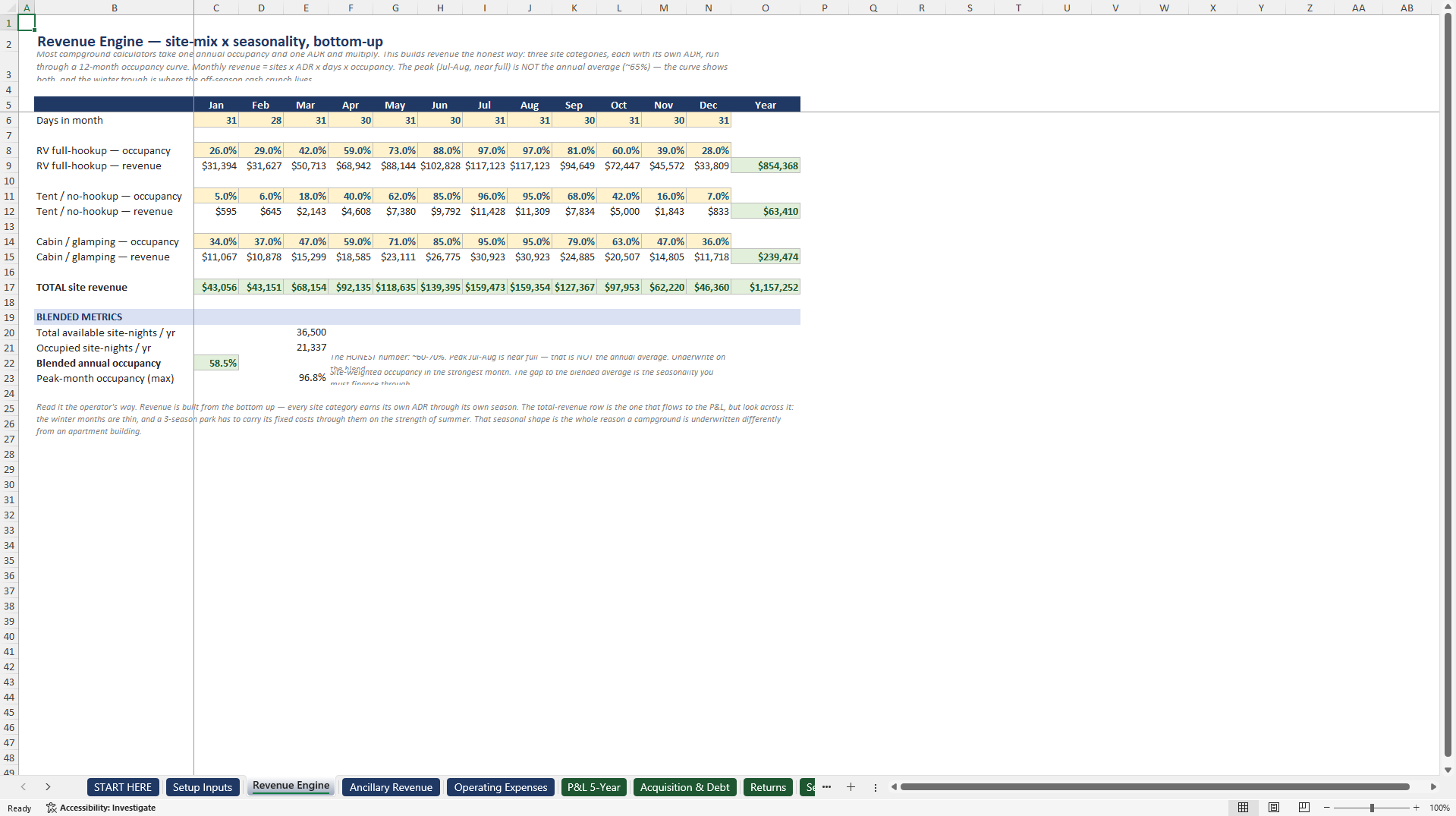
- Price three site types separately, each with its own ADR and its own 12-month occupancy curve, so a 58.5% blended annual occupancy and a 96.8% peak month are both visible instead of averaged away.
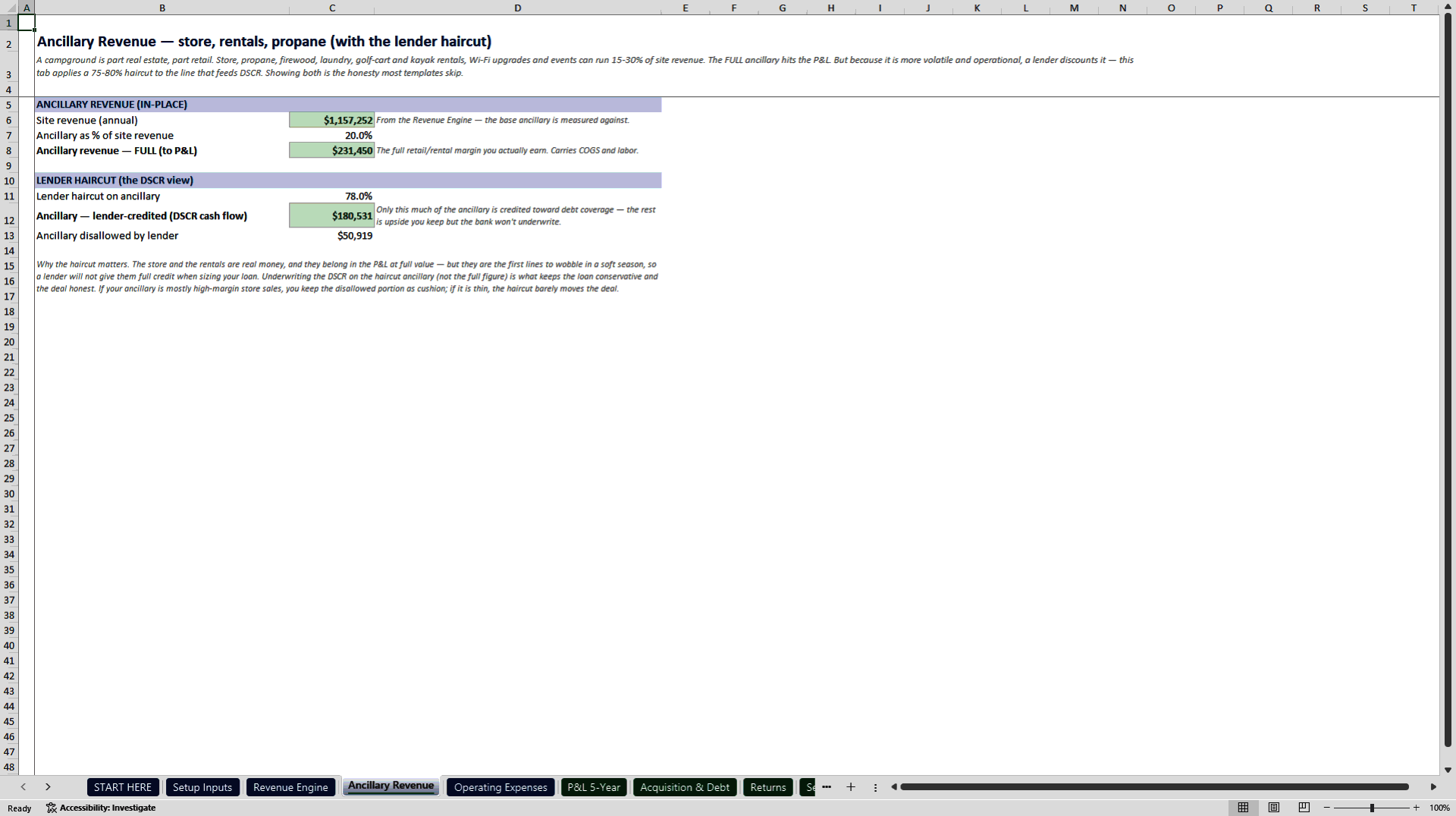
- Underwrite the DSCR on ancillary revenue at a 78% lender haircut, $180,531 credited against $231,450 booked, which is how a bank treats store, propane and rental income.
- Size the working-capital reserve from a stated off-season number: at the default the weakest winter month runs a $23,267 deficit rather than disappearing into an annual total.
REAL ESTATE EXCEL DESCRIPTION
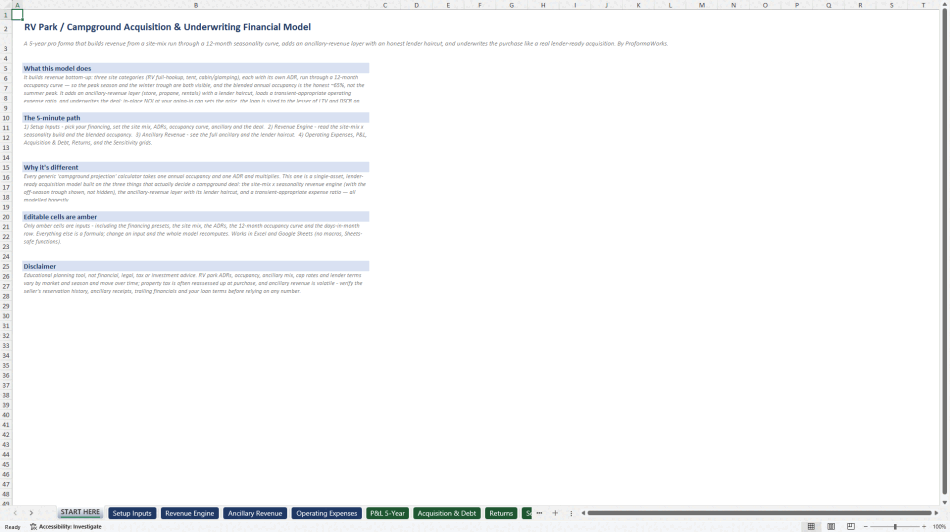
This model is for a buyer underwriting a single RV park or campground and for the lender deciding whether the deal covers its debt through the winter. It is an acquisition underwrite at single-asset level, not a portfolio roll-up.
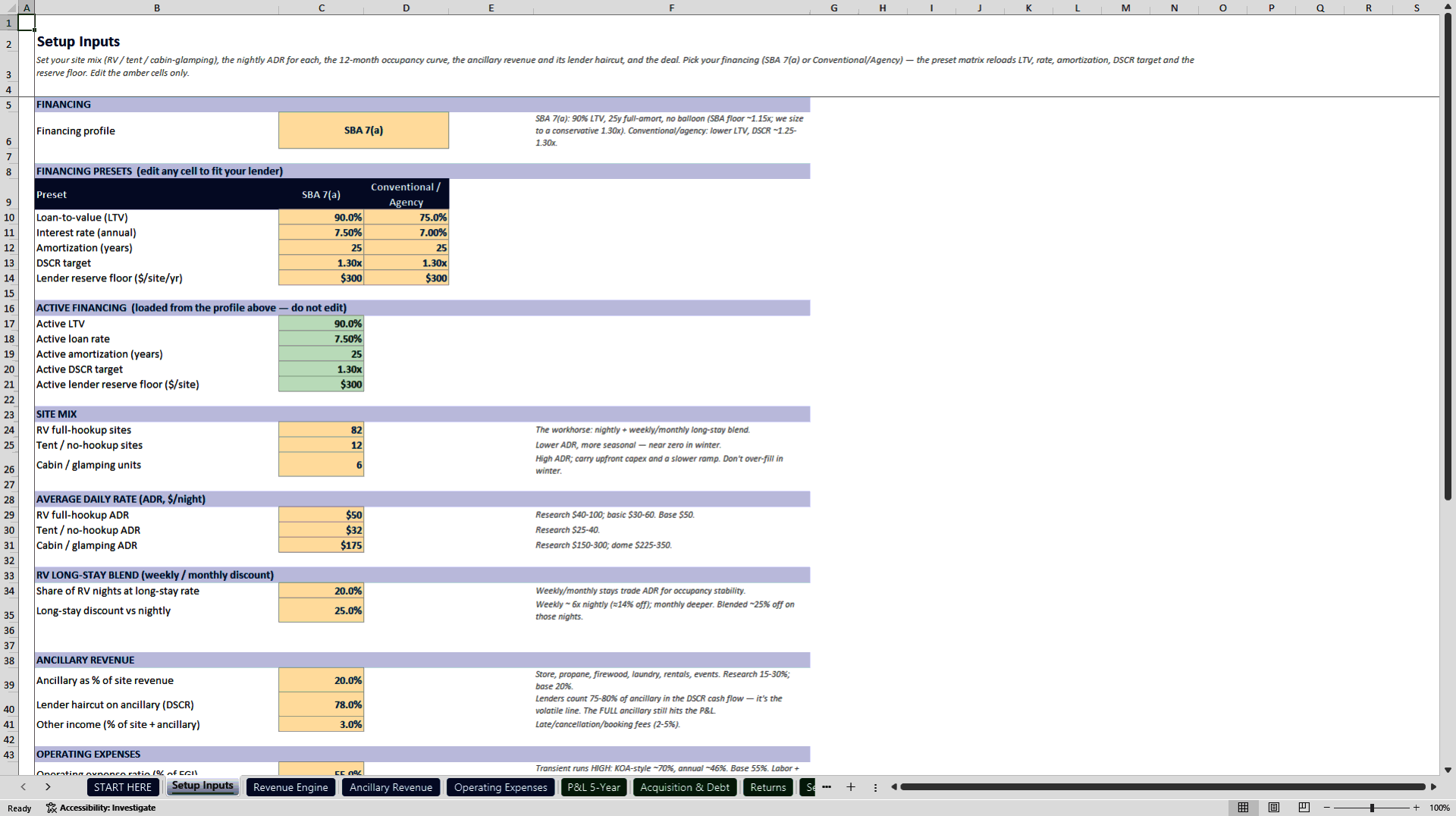
The valuation error it intercepts is the flat annual average. Most campground templates take one annual occupancy and one nightly rate and multiply, which hides the fact that decides a seasonal deal: summer runs near full and winter runs near empty. Here effective gross income is built bottom-up from three site categories, RV full-hookup, tent and cabin or glamping, each with its own ADR run through its own 12-month occupancy curve. At the default of 100 sites, 82 RV plus 12 tent plus 6 cabin, site revenue is $1,157,252 (RV $854,368, tent $63,410, cabin $239,474) at a blended annual occupancy of 58.5% while the peak month runs 96.8%. A share of RV nights books at weekly or monthly rates, so the nightly ADR is blended down from $50 to $47.50 rather than left at an all-nightly figure.
The second mechanism is the ancillary line. Store, propane, firewood, laundry and rentals run about 20% of site revenue, $231,450 at full value to the P&L, but a lender credits only part of volatile retail income. The model applies a 78% haircut, crediting $180,531 and disallowing $50,919, and underwrites the DSCR on the haircut figure rather than the full one.
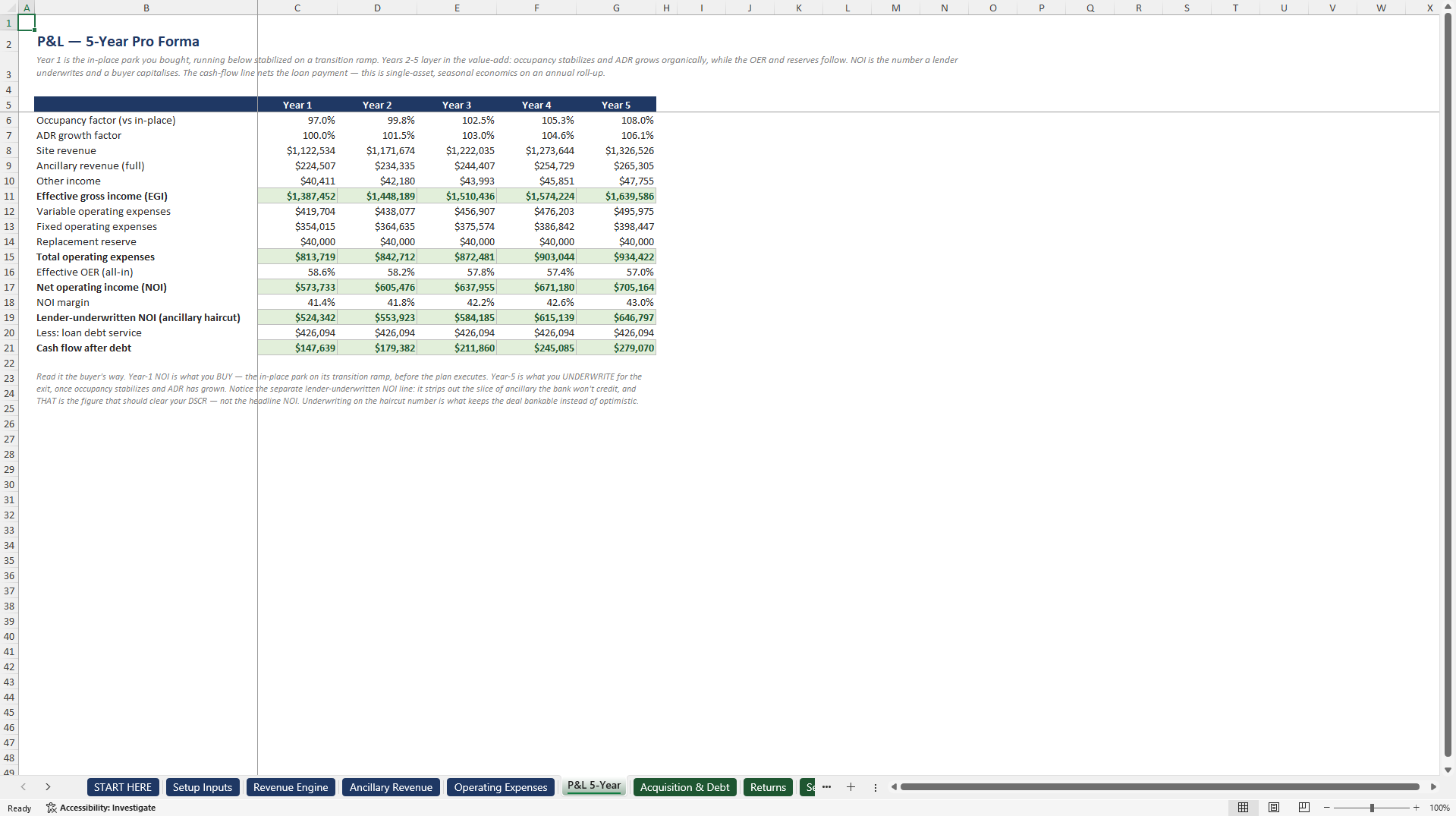
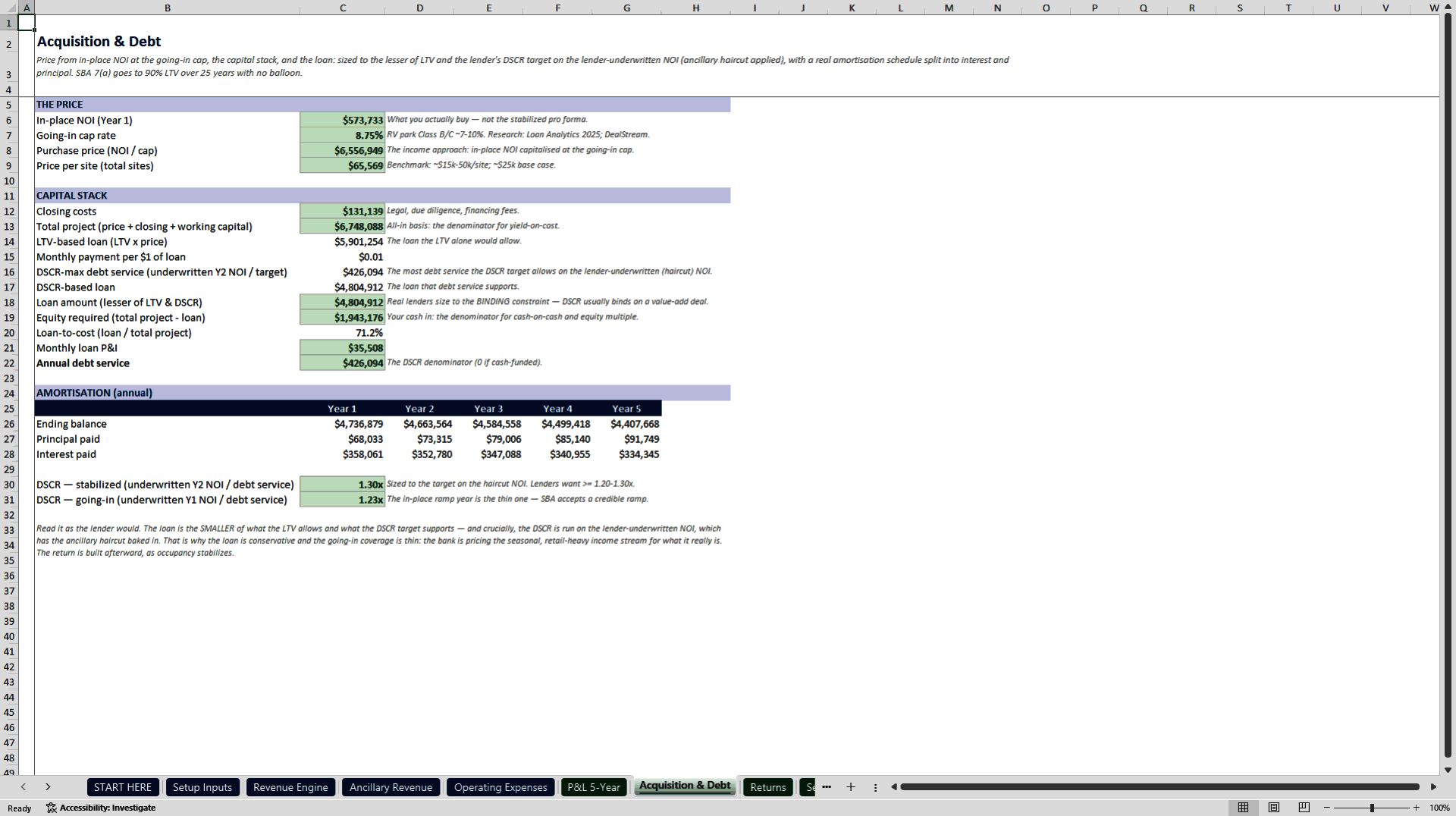
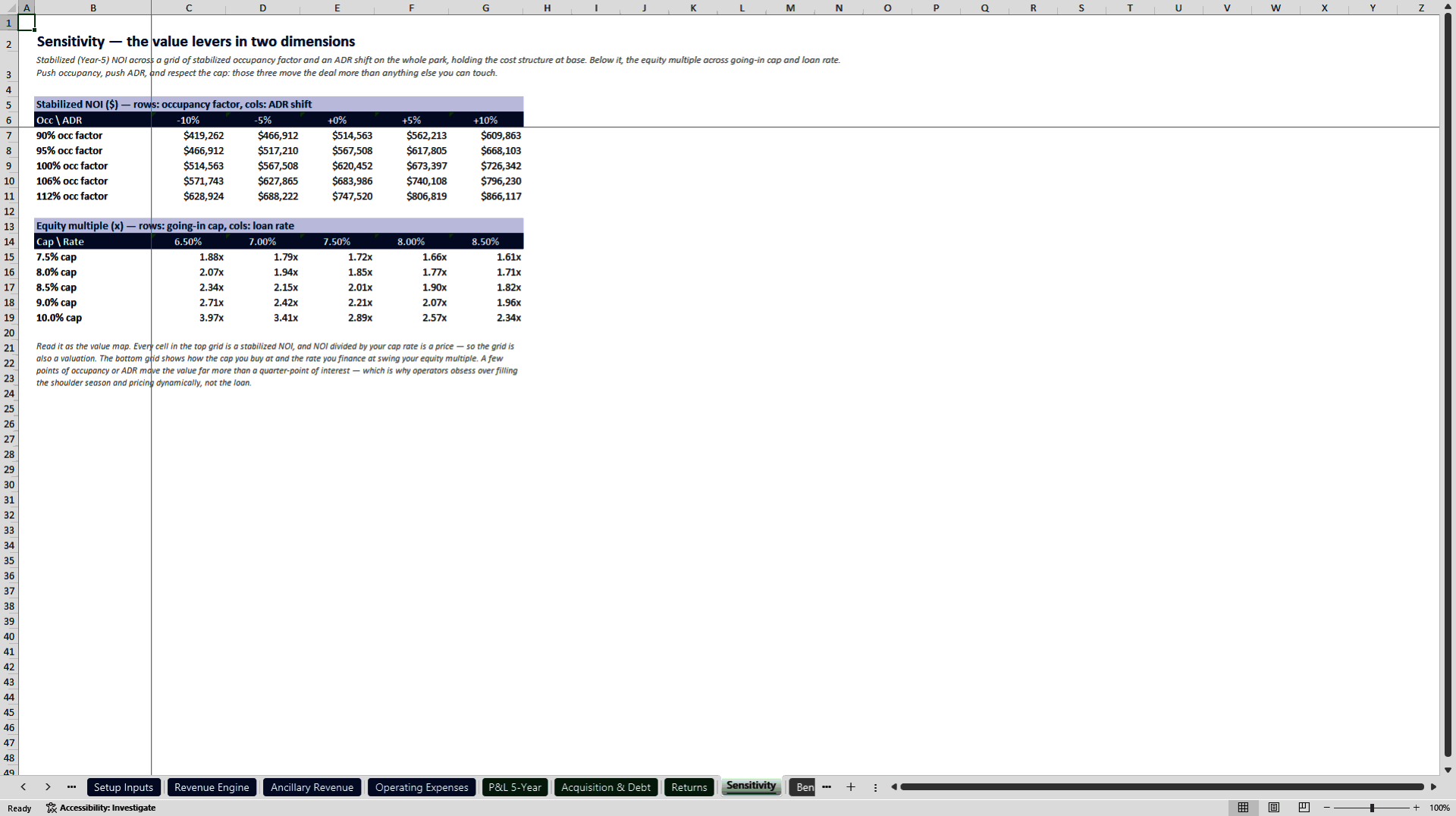
Then it underwrites the purchase. NOI is struck after a transient operating stack of roughly 55-59% all-in, not an annual-lease 40%: in-place NOI is $573,733 rising to $705,164 by year five, a deliberate 23% over the hold rather than a hockey stick. Price comes from in-place NOI divided by the going-in cap, $6,556,949 at the default 8.75% cap, or $65,569 per site. The capital stack is sized on the lesser of the LTV cap and the DSCR constraint, on the haircut NOI, with an SBA 7(a) versus conventional toggle that swaps LTV, rate, amortisation and DSCR target. The outputs are a 1.30x stabilised DSCR (1.23x going-in), an 11.9% debt yield, an 8.50% going-in yield-on-cost stabilising at 10.45%, a conservative five-year exit and a 2.10x equity multiple. A three-season park runs a real monthly deficit in its weakest winter month, minus $23,267 at the default, and the model surfaces it so you size the working-capital reserve to carry it.
You get a 10-sheet Excel workbook with no macros, add-ins or external links, so it runs in Google Sheets, plus a 19-page PDF guide covering the engine, the haircut, how a lender reads your DSCR and yield-on-cost, and where to find the seller's real numbers.
What it does not claim. With a 90% SBA loan the levered return is leverage-amplified, so the model headlines stabilised yield-on-cost, DSCR and the going-in cap rather than a flattered cash-on-cash. It is an educational planning tool, not financial, legal, tax or investment advice; property tax is commonly reassessed on a change of ownership and ancillary revenue is volatile.
Got a question about the product? Email us at support@flevy.com or ask the author directly by using the "Ask the Author a Question" form. If you cannot view the preview above this document description, go here to view the large preview instead.
Source: Best Practices in Real Estate, RV Dealerships, Integrated Financial Model Excel: RV Park & Campground Acquisition Underwriting Model Excel (XLSX) Spreadsheet, ProformaWorks
ABOUT THE AUTHOR

ProformaWorks builds acquisition-grade financial models for Main Street and lower-middle-market businesses - the kind of deal financed with an SBA 7(a) loan or a small commercial facility.
Every model answers one question: does this deal pencil at the bank? That means SDE or NOI rebuilt from the seller's own numbers, the add-backs a lender will and will not accept, a debt-service
... [read more]
Ask the Author a Question
You must be logged in to contact the author.




























